WP_Post Object
(
    [ID] => 5055
    [post_author] => 15
    [post_date] => 2022-09-15 18:03:50
    [post_date_gmt] => 2022-09-15 18:03:50
    [post_content] =>
Want to be a better tourist? Start by embracing local lore.


When I visited Iceland, there were a few things on my list: an active volcano, a museum of witchcraft in the Westfjords, a puffin tour, and running into Björk and becoming best friends. I kind of knew I wanted to visit Hafnarfjörður, a port town close to Reykjavík, home to an idyllic volcanic park known for elf sightings. But it was an afterthought, a kitschy stop that I expected to experience as a skeptical tourist rather than a believer.


Icelandic people’s belief in and deference to the Huldufólk (Hidden People) is well-documented. Tourists know it, and mock it, all while indulging in activities like the Elf School, which is exactly what it sounds like. On an episode of Travel Man, host Richard Ayoade and his companion attended the school and spent the segment mocking the very elves they were supposed to be learning about, leaving no more enlightened than when they went in. Global headlines read things like, “More Than Half of [This Country] Believes in Elves,” but obscure what that belief really means. It’s a punchline, something to make the people of Iceland seem naive, primitive. As if to say: There was a time when it was appropriate, but now there are cars on the road. Grow out of it, already.


The belief varies person to person, but the general consensus is that elves exist in nature, in rocks and volcanoes and forests and water. There are over 50 kinds, all with different physiques and temperaments, depending on where they live. And regardless of proof or lack thereof, one thing is for sure: When an elf’s home is moved, to make way for construction or similar human disturbances, bad things tend to happen. This alone is enough to deter most people from fucking with them. When starting construction, many people will consult with elf experts like Ragnhildur Jónsdóttir, who can liaise with the elves and find out who lives where and whether they’d consider moving on. If they won’t, construction stops. The result is a country that lives in harmony with its expansive, alien landscape. A country and a people that moves and develops slowly enough to let nature—and the Huldufólk who protect it—flourish around them.


It’s that volcanic landscape that drew me, and draws most tourists, to Iceland. Fagradalsfjall was still active, as it is again now, and the country-wide presence of volcanic rock is enough to distinguish it from anywhere else I’ve ever been. Whole fields of lava feel like a walk on the moon, sparse and removed from humanity, and yet teeming with life. Where another country might have cleared them away, Iceland builds tourism around its volcanoes, turning large expanses of hardened lava into family friendly parks and attractions. I ultimately decided to go to Hafnarfjörður, not for the elves, but for this scenery and the quiet that comes with it.


The park in Hafnarfjörður, like much of Iceland’s scenery, grows around lava and the ever-present threat of volcanic eruption. Despite the human feet stomping around, however, locals say that all that untouched nature creates the perfect environment for elves. Hafnarfjörður plays up the legend somewhat, with little human-built elf houses and a gift shop that sells elf dust. It’s kind of a tourist trap—but a very quiet one, with local families just hanging out. While I thought I just wanted to relax in the park, I was also primed to retreat into the rocks with the Huldufólk: That morning, my phone was filling up with people congratulating me on something that should have been exciting but instead felt overwhelming. I set it to airplane mode and set off into the park, trying to let myself be in tune with another world, which felt easy with an unusually warm Icelandic sun on my back.


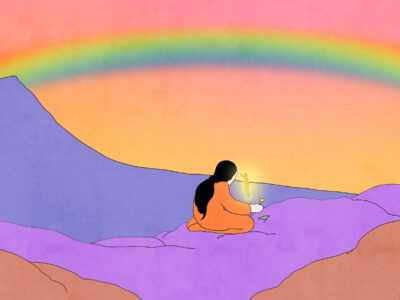
It was there that I found the Huldufólk, or they found me. I came across a crack in the lava and crouched down, laying my hands on rock that still felt warm, alive. I peered inside and saw nothing in it, no elves teasing me, so I lay a flower at the entrance, where thick, hard, clear slime interlaced with rainbows decorated the grass. I sat, still, the peace that had been evading me finally gathering. I thanked the elves for the quiet and moved on after a while, enjoying the rest of the park.


In all of the photos surreptitiously taken of me hanging out by that crack in the rock, there is a rainbow enveloping me. It hadn’t been raining and I hadn’t seen the rainbow, except in the slime, but there it was. When my fiancée and I later told a friend of his, an Icelandic professor, about our experience, she said, “Oh yes, elf slime,” like it was the most normal thing in the world. She also gave a stern warning: Do not follow the elves, no matter what they offer.


When we later shared our experiences with other Icelandic people, it caught me off guard how difficult it was to be embarrassed. They listened, told us that we were lucky, that the elves didn’t appear to just anyone, and so rarely to tourists. It didn’t matter that I hadn’t “seen” an elf—the extent of my small interaction was enough. I felt grateful to be believed, but I also felt some gratitude in return that I hadn’t questioned their beliefs or culture. I went in, two-footed, willing to see the elves if they would show themselves to me. What I got was something special, an experience to talk about, but also a moment of peace that I desperately needed, elves or not.


For much of my early life I believed in magic, something that faded as I got older. As a child, I believed wholeheartedly in the tooth fairy, insofar as I believed she would be my friend and bring me gifts. So maybe it shouldn’t come as that much of a surprise that I found myself among elves, wanting to fall into gaps in the volcanic rock. But why shouldn’t we look for magic as adults, especially in places like Iceland that offer it up so freely? Who does it harm to respect someone else’s version of the tooth fairy I’d loved, and maybe even try to meet them, too?


When—if—we share our supernatural experiences with people who don’t come from cultures that share them readily, there’s always a moment of shared trepidation. You can sense them tip-toeing around their own experiences, hedging with “I don’t usually believe in this stuff” or “it could have been anything.” After a while, when each person realizes they are safe, they share. We might not always have proof, but what we experience and how we perceive it is real. When we experience it with others, our beliefs—and our confidence in our own experiences—gain power.


More than that, when we as tourists are lucky enough to spend time in other people’s countries and cultures, we need to honor them. That means trying their food, understanding their customs, learning to fit in. That means not immediately complaining if you don’t get enough ice or the service isn’t fast enough. It means exploring temples and monuments and other important sites with respect. It means trying your best to speak the language and not just shouting “chips, PLEASE” in a waiter’s face.


It also means taking on those customs and beliefs that are maybe even more foreign to you, like believing in elves. It means not laughing at something that means a lot to a lot of people in a country that for the most part gets by just fine without you. In Iceland, the Huldufólk maintain the rule of the land, a respect for the sparse, otherworldly landscape that blooms freely. Believing in elves or magic or ghosts or God or tree spirits isn’t inherently childish or naive, it’s a part of being a human being with a belief system and a desire for rituals and order.


More than that, by having patience and respect for the places you visit, even when it requires a suspension of disbelief, you might open yourself up to a little magic. You might make friends and take home experiences that you could never have had if you scoffed at something meaningful to someone else. You might even meet an elf. Plus, you’ll just seem like less of an asshole, one less reason for people to hate tourists. And wouldn’t that be nice?

    [post_title] => I Didn't Believe in Elves Until I Did
    [post_excerpt] => Want to be a better tourist? Start by embracing local lore.
    [post_status] => publish
    [comment_status] => closed
    [ping_status] => closed
    [post_password] =>
    [post_name] => believe-elves-huldufolk-iceland-tourism
    [to_ping] =>
    [pinged] =>
    [post_modified] => 2026-08-04 20:26:38
    [post_modified_gmt] => 2026-08-04 20:26:38
    [post_content_filtered] =>
    [post_parent] => 0
    [guid] => https://conversationalist.org/?p=5055
    [menu_order] => 110
    [post_type] => post
    [post_mime_type] =>
    [comment_count] => 0
    [filter] => raw
)