WP_Post Object
(
    [ID] => 8525
    [post_author] => 15
    [post_date] => 2025-06-05 18:35:51
    [post_date_gmt] => 2025-06-05 18:35:51
    [post_content] => 

We don't just need more women in office. We need a culture shift.

I once believed that the presence of a female leader signaled real progress—a sign that gender equality had taken root. As a girl growing up in China, I watched with admiration as women like President Tsai Ing-wen in Taiwan and President Park Geun-hye in South Korea rose to the highest offices in their respective countries. Their success seemed to promise a future in which women’s voices would be equally heard, equally respected—that perhaps women might finally be seen as equals.

But as I began to study gender and politics more deeply, particularly across East and Southeast Asia, that initial optimism gave way to unease. Representation alone, I realized, does not guarantee change. Even more alarmingly, the symbolic presence of women in power can obscure the systemic barriers that continue to shape—and often silence—most women’s participation in political life.

Globally, this problem has proven surmountable. In Scandinavia, gender quotas and institutional reforms have helped elevate women to between 40% and 50% of parliamentary seats, reflecting not only a shift in numbers but a broader cultural embrace of women as political leaders. Similar gender quotas in Mexico—which elected its first woman president, Claudia Sheinbaum Pardo, last year—have led to women making up 50% of seats in congress, after gender parity was enshrined in the country’s constitution in 2014. 

In contrast, however, East and Southeast Asian democracies continue to lag behind—not only in representation, but in the structural support needed to close the gender gap. Japan, for example, despite being one of the world’s largest economies, has seen little progress in this area. Women occupy roughly 16% of seats in the national legislature—a statistic that reveals not just electoral imbalance, but deeper societal expectations about leadership, gender roles, and public legitimacy. As of April of this year, the percentage of women who hold parliamentary seats in India (13.8%), Cambodia (13.6%), Malaysia (13.5%), Sri Lanka (9.8%), and Bhutan (4.3%) remains even lower. And in China, there have been no women in the politburo since 2022, something the United Nations has flagged as a matter of great concern.

So, are women truly gaining power in Asia, or are they simply there to make politics look more gender equal?

Analyzing data from the Asian Barometer Survey suggests the reason women’s political participation remains low in Asia is as much a numbers problem as it is a cultural one. Founded in 1971, the ABS is a cross-national survey that aims to gather “public opinion data on issues such as political values, democracy, governance, human security, and economic reforms.” In a 2020 academic paper from the University of Edinburgh’s Dr. Sarah Liu, one surprising finding from the 2010–2012 survey was how the gender of the interviewer affected women’s answers. Faced with female researchers, women opened up about their political beliefs. With male interviewers, many of them hesitated. This suggests a much deeper problem with Asia’s gender divide, rooted in women feeling both uncomfortable with and unwelcome in politics. 

Across many societies, not just in Asia, politics is still seen as a man’s domain, where women are expected to support, not lead. But in East and Southeast Asia, where traditional gender roles continue to shape public and private life, this attitude is amplified. Even in modern cities, women are constantly told that politics is not their space. For me, it wasn’t that anyone said I couldn’t be a leader when I was growing up—it was that no one ever expected me to be one. And when women are constantly told that something isn’t an option for them, it makes sense that, eventually, they might actually start to believe it.

When women do step forward to lead, they also face a very different kind of scrutiny to their male peers. Their private lives are often judged more harshly than their professional ones, and given as much attention, if not more. When Tsai Ing-wen became Taiwan’s first female president, critics focused on the fact that she was unmarried—as if being single made her unfit to lead. But when it comes to unmarried male leaders, no one ever even thinks to question it.

The media frequently contributes to this double standard. I remember watching coverage of Shoko Kawata, a 33-year-old woman who became the youngest female city mayor in Japanese history after winning her election in Yawata, Kyoto Prefecture in 2023. I was furious that the story’s focus was not on what she’d said in her speech, but on what she was wearing. Other reports also emphasized her love of tea ceremony and traditional kimono attire—while barely mentioning her actual policy goals. Her agenda had been reduced to its aesthetics: her clothes were that day’s headline news, while her policies went overlooked.

Even within political institutions, this bias persists. In Japan, a young Tokyo assemblywoman was once heckled by her male colleagues while speaking about the need for better childcare policies. This incident occurred in 2014, when Ayaka Shiomura, a member of the Tokyo Metropolitan Assembly, was addressing how the government might better support mothers in light of Japan’s drastically decreasing birth rate. During her speech, several male lawmakers interrupted her with sexist remarks such as “Go and get married!” and “Can you even have children?” One of them, Akihiro Suzuki, later admitted to the heckling and publicly apologized. But the incident sparked widespread outrage, and served as another stark reminder of the entrenched gender bias in even the most formal of political spaces. 

Fueling all this is the deeper issue that women are still expected to prioritize the family above all. This problem isn’t singular to Asia, but nonetheless, it feels especially pervasive here: Even in the public sphere, women are still trapped in private expectations. When a woman chooses public service, some see it as a betrayal of her “real” duty. The media asks, “Can she have it all?”—a question they’d never ask of a man, and one that has never been asked of a father.

These attitudes don’t just make the job harder. They make women question whether the space was ever meant for them. And in many ways, it still isn’t—something that keeps women out of politics, and keeps everyone, regardless of gender, chained to the status quo.

Yet, despite persistent challenges, women politicians in Asia have continued to make remarkable strides. President Tsai and President Park both shattered historical barriers to ascend to the highest levels of national leadership in their respective countries, proving that women are more than capable of leading. They also both drove meaningful social and economic change during their terms—even in systems not designed for them. 

As the first woman president of Taiwan, Tsai Ing-wen and her administration actively pushed for gender-equal policies, earning Taiwan the top spot in Asia—and one of the highest rankings globally—for gender equality. One particularly meaningful initiative was an amendment requiring companies with more than 100 employees to provide childcare facilities—helping to ease the burden on working mothers. Tsai also supported policies that loosened loan restrictions for women entrepreneurs and promoted female participation in the economy as a path to structural change. 

Beyond legislation, she repeatedly called for dismantling gender stereotypes and encouraged women to participate in public life—raising both the visibility and legitimacy of women in leadership. Under her eight-year tenure, Taiwan’s economy grew steadily, with an average annual GDP growth rate of 3.15%, and even reached 6.6% in 2021—a rare achievement during global economic uncertainty.

Park Geun-hye’s presidency, meanwhile, offered a different but equally important approach to leadership. While her administration made more modest progress on gender-specific reforms, it recognized the challenges faced by working mothers and proposed expanding childcare services to support female employment. More broadly, Park’s role as a woman navigating a traditionally male-dominated political landscape was also deeply symbolic. 

Under her leadership, South Korea expanded its global economic footprint by signing free trade agreements with 52 countries, including China and Vietnam—bolstering South Korea’s export markets and international competitiveness. These policy efforts, though not always framed through a gender lens, reflected a broader vision of national growth, with women as increasingly visible participants.

Tsai and Park’s contributions—each shaped by their own context—highlight the transformative power and potential of women’s leadership. For millions of women across Asia, seeing them in positions of power—on television, in parliament, in international headlines—continues to deliver an enduring message: women belong here. And their presence alone continues to inspire others to imagine what is possible when women are no longer the exception.

Change won’t come overnight. Cultural shifts take time. But every honest conversation, every woman who speaks up, every moment of resistance matters—so hopefully, one day, girls growing up in East or Southeast Asia will see women in power and think: “That could be me.” Not because it’s rare, but because it’s normal.

To achieve this, we don’t just need more women in office. We need political systems that respect their leadership, media that reports on their work—not their wardrobe—and societies that stop measuring women by outdated standards. We need women in Asia to not just be seen in politics, but truly heard.

[post_title] => When Will Women in Asia Be Seen as Leaders—Not Exceptions? [post_excerpt] => We don't just need more women in office. We need a culture shift. [post_status] => publish [comment_status] => closed [ping_status] => closed [post_password] => [post_name] => women-leaders-asia-politics-tsai-ing-wen-taiwan-park-geun-hye-south-korea-government-gender-parity-equality [to_ping] => [pinged] => [post_modified] => 2026-08-03 22:48:14 [post_modified_gmt] => 2026-08-03 22:48:14 [post_content_filtered] => [post_parent] => 0 [guid] => https://conversationalist.org/?p=8525 [menu_order] => 14 [post_type] => post [post_mime_type] => [comment_count] => 0 [filter] => raw )
A soft, blue-toned illustration of a wind chime. In the center, replacing one of the bells, is a piece of paper depicting a woman facing away.

When Will Women in Asia Be Seen as Leaders—Not Exceptions?

WP_Post Object
(
    [ID] => 6925
    [post_author] => 15
    [post_date] => 2024-06-12 20:13:35
    [post_date_gmt] => 2024-06-12 20:13:35
    [post_content] => 

My Nai Nai dressed my Ye Ye every morning for over sixty years. The last time she dressed him was for his funeral.

Listen to this article on The Conversationalist Podcast. | 16:11 min

The coroner comes and goes. The Taoist shaman comes and goes. But the family stays. There are many things left to be done. 

Nai Nai is gathering Ye Ye’s belongings, the clothes that he is to be burned with, his favorite shoes, the paper fan he’d use to cool himself with during sweltering Taiwanese summers. The coroner has told Nai Nai it is best to dress Ye Ye in his funeral clothes now. Before the body gets cold and hard. Their daughter, the shamanic authority of the family, doesn’t like this idea. 

“If you touch him immediately after death, he’ll feel intense pain,” she insists. “We must dress Ba Ba without touching him at all.” 

Nai Nai looks at Ye Ye, what would have been an exchange of knowing looks. Her husband says nothing.

The women compromise, agreeing to dress him quickly, skin touching skin as little as possible. But while the daughter rushes, Nai Nai takes her time. She straightens the collar of her husband’s shirt and checks that the waistband of his pants hugs his belly comfortably. She runs her fingers through his now sparse, white hair, brushing it tenderly. As if by instinct, she licks her finger and smooths the unruliest strands.

The daughter grows impatient. “Mom, you’re too slow. You’re hurting him. Just let me…”

Nai Nai does not budge. She rubs Ye Ye’s hands between her own, searching for something; feeling the familiar grooves of his palms and the veins of his wrist. She continues with their routine, carefully checking the seams of her husband’s trousers, the pair she steam pressed just last week. She moves on to his socks, stretching them with her fingers so they don’t restrict his circulation during the long journey ahead. 

Suddenly, Nai Nai leaves the room, and returns with her husband’s favorite gold-rim glasses, the ones that always made him look so smart and charming, like a senator. 

He’ll need these to see, she thinks to herself. She reaches over her daughter’s busy arms to place the glasses gently across Ye Ye’s face. 

Later, Nai Nai will tell me over the phone how she leaned back, admiring her work. I savor every detail, wishing I could have been there, too. Instead, I will send him off over video chat. During the funeral, I wonder if my grandfather can hear me calling to him from across the ocean, whether my laptop can transfer my grief; if he knows his granddaughter’s heart is breaking. 

~

Long before Nai Nai, Ye Ye was dressed by his mother. The only son of wealthy landowners in a small village in Jiang Su, he rarely had to lift a finger. When Ye Ye entered school, each morning, his mother would place his clean uniform at the foot of the bed, freshly washed of the stains he’d acquired the day before. As he got older, Ye Ye eventually dressed himself—although it wasn’t always a choice. While hiding from Japanese soldiers during the war, he was forced to go for days at a time without washing or changing. In the deafening silence each night, he dreamed he’d wake up the next morning to his mother’s gentle voice, back in his childhood bedroom, his clean clothes folded at his feet.

Ye Ye eventually found his way to Taiwan, where he met his would-be wife, a woman so beautiful a large portrait of her hung in the window of a photography studio in the neighborhood where he walked his beat as a young cop. At 30 and 22, respectively, Ye Ye and Nai Nai married; and of her many household duties and chores, Nai Nai made it a point to help her husband get dressed every morning—not because he asked her to, but because it brought her pride. Both she and her husband agreed: how a man dressed was critical to his career and reputation. So it was important he dressed well.

When they first married, it was the police uniform. Though Ye Ye was only a beat cop, Nai Nai thought it was crucial he looked presentable to his superiors, carefully steaming his uniform every night, gently folding it over the nice wooden hangers she’d purchased on sale. She was young; the only thing she’d ever steamed before had been the gown she’d worn when she snuck out of her mother’s house to compete in a local pageant at 18. Still, she did her best, and so did he. As Ye Ye slowly rose through the ranks, his uniform became adorned with new medals, and Nai Nai’s responsibilities grew. Soon, they had children, and she dressed them, too. But their morning routine stayed the same: The least I could do is make sure my husband looks good.

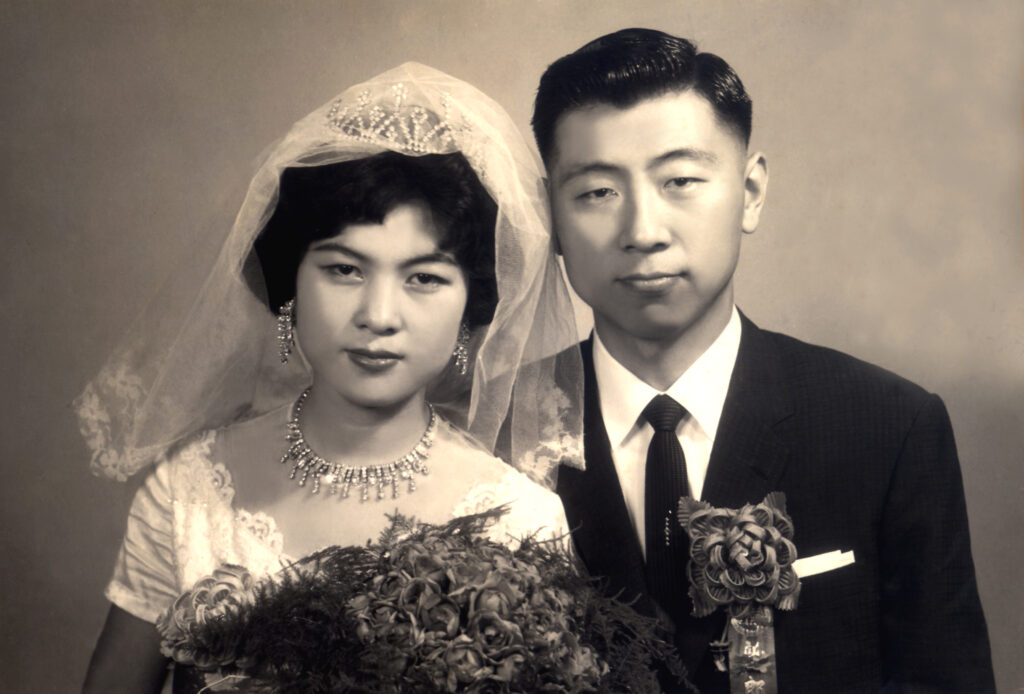
A sepia tone photo of the author's grandparents on their wedding day.
Nai Nai and Ye Ye. (Image courtesy of the author.)

Three kids later, Ye Ye left the precinct to start his own leather goods business. Nai Nai was supportive; their kids were getting older and household expenses were only growing. Together, they purchased him a good suit, one that cost a little more than they could afford, but that made him look smart and trustworthy. Nai Nai helped her husband into the suit every morning, and Ye Ye would smile and kiss her goodbye before heading off to work. When there were small rips and tears in the seams, Nai Nai would sew them back together after putting the kids to bed at night. She didn’t mind the added work. The silence of the night, interrupted only by the rhythmic hum of her sewing machine, became a familiar lullaby that belonged to her alone. 

When the business took off, Ye Ye and Nai Nai bought a new home, and Ye Ye’s first good suit proudly gathered dust in the back of its largest closet. They hired a housekeeper. Because of this, Nai Nai no longer had to wash and tailor her husband’s clothes, but each morning, she would pick out a perfect suit for his scheduled meetings from a wardrobe filled with color. 

The life they’d built made her proud, and she held her head high, always moving through the world with grace. Even when the business failed and the debt collectors came knocking, Nai Nai would take a deep breath, puff up her chest, and open the front door with a smile. She would walk to the busiest street corner at 6 AM every morning and sell homemade bento boxes to pay for the children’s school tuition, even more expensive now with her fourth child entering school. When Ye Ye had to go door to door begging relatives and neighbors for help, Nai Nai made sure he looked dignified while doing it. 

The tough times passed, and the kids grew older, soon with children of their own. Nai Nai dressed them—dressed me—too, in one-of-a-kind sweaters she knit by hand so we never clashed outfits with anyone on the playground. Ye Ye’s daily uniform became a simple polo shirt and loose khakis, comfortable enough to play on the floor with his grandkids, but presentable enough in case Nai Nai wanted to snap a picture. As a child, and their eldest granddaughter, I loved to play lion, and Ye Ye would join me proudly, the two of us crawling around and roaring at each other like it was our own secret language. Nai Nai, meanwhile, would smile to herself from the living room couch, thankful she had time to mop the floors in the morning. 

She would continue to dress him for the rest of his life, and after it. Even after her children had no longer needed her, and the grandchildren had gone to college, Nai Nai had never felt like an empty-nester, precisely because of this: Her husband had continued to need her, and to love her. And she’d been happy to be needed, and to be loved. 

~

A week before Ye Ye passed, Nai Nai woke up in the middle of the night to her husband staring gently at her, the corners of his lips curled into a smile. With his dementia, Ye Ye often drifted in and out of consciousness, sometimes alert and sharp, other times blissfully unaware. 

“Still so pretty after all these years,” he said softly. “I feel content and at peace, I’ve lived a fulfilling life.”

“Aiya, it’s so late. Go back to sleep.” Nai Nai dismissed him with a wave of her hand as she repositioned her back, sinking deeper into their bed. But she felt a tightness in her chest as his words, too, sank in—something about them felt so final. 

After a few moments of silence, Ye Ye tried again, this time with a hint of urgency: “There’s something I need to tell you.” 

Afraid of hearing what might be her husband’s last words, Nai Nai shut her eyes even tighter, and let out a light, fake snore. 

Ye Ye lingered for a moment before rolling away to face the opposite wall, where an old photo of his wife at 18, in her pageant gown, smiled back at him. He sighed. Unable to control herself, Nai Nai awoke from her fake slumber to smooth out the wrinkles of his pajama shirt with her wrinkled fingertips, memorizing the warmth of his body. 

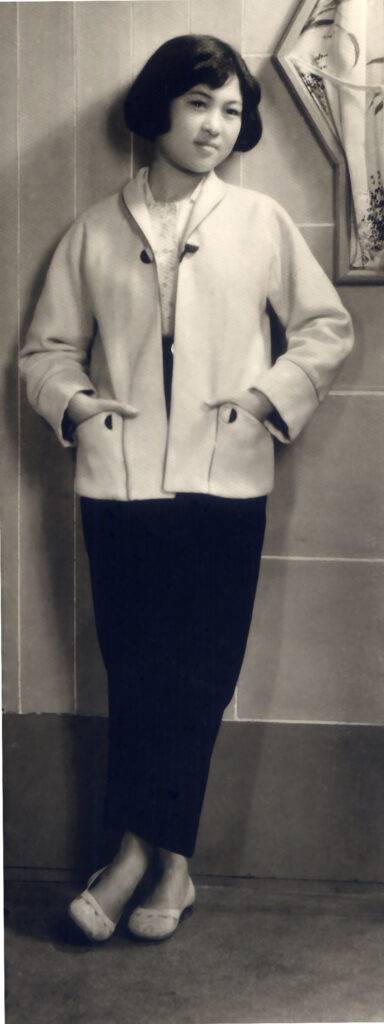
A photo of the author's grandmother, leaning against a wall. She's wearing a jacket with patch pockets, with both hands in her pockets. One leg is crossed over the other.
Nai Nai. (Image courtesy of the author.)

The next morning, Nai Nai would wake up before her husband, wash up quickly, and prepare his clothes, just like she had every morning for the last 60 or so years. And of course, she would dress herself, too, from a wardrobe that had changed just as much as her husband's over the years. When she’d first met him, she'd dress in her flirty floral dresses and her baby blue skirts with the ruffles; and as she got a little older, in her matching tweed skirt suits—always color coordinated with her husband’s outfit for the day, and embellished with a tasteful brooch or earrings from her collection. Today, she would wear her purple t-shirt and stretchy gray pants—a suitable uniform for a woman in her 80s with a day of cleaning and cooking ahead. She had no time or energy for jewelry now, but still put on the same rose-pink lipstick she’d worn every morning since she was 18, just to feel like herself. Satisfied, she’d turn again to their shared closet and begin her day’s work. 

Dressing him for his funeral, Nai Nai knows it is the last time; the last time she will look at her husband’s face so closely, the last time she will smooth out the wrinkles of his shirt with her warm palms in a downward sweeping motion, the last time she will check that all his buttons are buttoned correctly. She wants to make sure she remembers it.

Nai Nai is calm and deliberate. Everything about this routine is familiar to her. Everything about his body is familiar to her. Every scar, every vein; and every thread that adorns it.

[post_title] => If Clothes Make the Man [post_excerpt] => What does that make the woman who dressed him? [post_status] => publish [comment_status] => closed [ping_status] => closed [post_password] => [post_name] => clothing-nainai-yeye-grandparents-spouse-gender-roles-husband-wife-marriage-death-grief-funeral [to_ping] => [pinged] => [post_modified] => 2026-08-04 17:07:40 [post_modified_gmt] => 2026-08-04 17:07:40 [post_content_filtered] => [post_parent] => 0 [guid] => https://conversationalist.org/?p=6925 [menu_order] => 55 [post_type] => post [post_mime_type] => [comment_count] => 0 [filter] => raw )
A pastel drawing of a woman with black hair and a green, long sleeved tunic standing in a closet. We see the back of her head as she looks over her shoulder at a hanging, long-sleeved white shirt, while reaching her hand out to hold the sleeve.

If Clothes Make the Man