
WP_Post Object
(
    [ID] => 10649
    [post_author] => 15
    [post_date] => 2026-06-11 16:53:52
    [post_date_gmt] => 2026-06-11 16:53:52
    [post_content] => 

Looking back at the courage of activists in decades past can help keep you from falling into hopelessness today.

One of my New Year’s resolutions was to quit “doomscrolling” at night. 

It was going okay, until the Minnesota ICE raids accelerated in late January, and staying glued to my phone felt like all I could do to help from an ocean away.  A few days later, there was news of yet another anti-trans bathroom bill passing, this time in Kansas, after over 600 anti-LGBTQIA+ bills were introduced across the United States last year. That same week, the Epstein files were released. 

Previously ongoing for several years, my doomscrolling had instilled in me a sense of hopelessness that didn’t allow for any light to shine in. After I relapsed, I began to make nihilistic jokes about how dire everything felt, heavy bags under my eyes amidst my renewed nighttime habit. Instead of transphobic laws, anti-immigration sentiment, and sky-high rent existing as separate issues to be tackled with careful activism, all of the “bad” in the world morphed into one large, unintelligible blob, entitled “the horrors.” 

Concerned about the possible damage I was doing to my brain, I sought advice from Melody Li, therapist and founder of Inclusive Therapists and Mental Health Liberation. They confirmed my fears were legitimate: According to Li, a “sense of despair” is one of the primary mental health impacts of doomscrolling. 

“Social media feeds and the algorithm are designed to be addictive and to keep us scrolling to generate profit,” Li says. “[This] may manifest as feelings of depression, anxiety and hopelessness. When combined with loneliness—as these apps are designed to keep us isolated from community and real-world interactions—the despair may even heighten.”

I knew my anxiety and sense of hopelessness were increasing due to what was going on in the world around me. Unsure of how to stop it, however, I decided to turn to my work and community for guidance.

I am a queer journalist working on a long-term assignment about historic LGBTQIA+ activism, which includes researching movements led by queer British women. On one of my most fun work days, I read about a group of British women known as the Lesbian Avengers, who staged demonstrations against an infamous Thatcher-era law which banned discussion of LGBTQIA+ topics in schools. In 1988, as the law was debated in Parliament, the Avengers threw lengths of washing line over the House of Lords balcony, and abseiled into the chamber. They were immediately thrown out of the building, though some of the group were arrested and put in a “cell by Big Ben,” released several hours later. Despite their efforts, the law passed anyway, and was in place for 15 years until its repeal in 2003, but learning of the Avengers’ bravery and creativity in standing against it was galvanizing. 

It also sparked a realization that I wasn’t achieving much by doomscrolling except augmenting my anxiety: If just one story could stir a hope I hadn’t experienced in years, what might learning about others do? 

I began with two of the best-known examples of LGBTQIA+ resistance: the 1960s Stonewall Riots and Compton’s Cafeteria Riot in New York and California, respectively. Both were led by trans women and drag queens resisting police harassment and violence, inspiring Pride protests as we know them today. Wanting to better understand the wider movement, I decided to dig further into past and ongoing LGBTQIA+ demonstrations across the globe, and was astonished by the rich history that rarely ever makes it to the mainstream.

I learned, for example, about the prolonged fight for India’s Hijra (transgender and intersex, otherwise known as “third gender”) community to achieve voting rights in 1994. The campaign group, All India Hijra Kalyan Sabha, had already secured their right to vote after a decade of organizing, but in the 90s, “third gender” was still not an option on electoral rolls, forcing voters to choose between “male” and “female”. After years of further activism, the Supreme Court of India finally recognized “third gender” on official documents in 2014. 

Today, Hijra people are still deeply marginalized, often facing “invasive” medical exams, difficulty accessing gender-affirming care, and roll-backs to existing rights, but the community continues to fight via widespread protests, community organizing, and online campaigns. Representation in politics, activism, and culture is also improving; in 2015, Madhu Bai made history as the first trans mayor in India, hijra people were represented as “kick ass” warriors in the Dev Patel film Monkey Man, while the community magazine Trans News launched in 2020, increasing global awareness of Hijra people and their struggles. Hijra activists are also reaching a wider global audience in news media across the world, highlighting the need to safeguard and expand their human and civil rights. 

In Argentina, legal safeguards for LGBTQIA+ people were propelled by a group of twenty activists who stormed the Buenos Aires Constituent Assembly on August 27, 1996. The group carried large photos of Carlos Jáuregui, a gay activist who died of AIDS-related causes the week prior. Jáuregui was widely known for his HIV/AIDS awareness campaigns, for creating the LGBTQIA+ group Gays por los Derechos Civiles in 1991, and for attempting to sue the Archbishop of Buenos Aires for discrimination. He also organized the first ever Pride March in the city in 1992, which was made up of around 300 people, many of whom wore masks to avoid being recognized. (Buenos Aires Pride now attracts around a million people.) 

During the August 27 demonstration, activists tracked down members of the commission, refusing to leave until they signed a statement of support for outlawing discrimination on the basis of sexual orientation. Days later, on August 30, the anti-discrimination clause was approved into the Constitution of the city of Buenos Aires, which became the first city in Spanish-speaking Latin America to legally protect LGBTQIA+ people from discrimination. Today, Argentina’s LGBTQIA+ rights are rated higher than the UK and the US due to their strong protections against hate crimes.

In Uganda, the LGBTQIA+ community continues to stand up against mounting discrimination with joy and courage, throwing “guerrilla-style” Pride celebrations despite some of the strictest anti-LGBTQIA+ laws in the world. At great personal risk, activists and allies alike have fought through several channels, including legally challenging the country’s anti-LGBTQIA+ laws. A group of Ugandan mothers of LGBTQIA+ people even took on the President in an open letter criticizing homophobic legislation, writing that it has been “horrific” to see their children “verbally threatened, physically targeted and abused for who they are and for whom they love.” 

Especially touching to me while investigating these brave, public feats of political activism was the knowledge that they were so often preceded by decades of quieter community-based activism—like the lesbians in San Diego who stepped up to donate blood during the HIV/AIDS epidemic, the “buddy systems” which paired people living with HIV with an ally who “provided care, support and friendship when many people turned their backs,” the communities who fundraised for their vulnerable neighbors, and the friends who acted as each other’s chosen families. Many of these past activists’ strategies mirrored anti-ICE action in Minnesota, like noise protests, sit-ins, and mutual aid, demonstrating that in-person organization and community continue to be effective and powerful. 

Still, old habits die hard, and despite my renewed hopefulness and resolve, the magnet of my phone nonetheless persisted in drawing my attention during those early-morning hours, the feeling that I had to know all the horrors difficult to expunge. I’m hardly alone: Over half of Gen Z (53%) have reported engaging in doomscrolling, compared to a third of US adults (31%) as a whole. It’s also not the same as ordinary online activity, as studies found LGBTQIA+ youth actually benefit from healthy social media use—while doomscrolling does the opposite, increasing users’ anxiety and emotional exhaustion

To curb some of these negative consequences, Li suggests allocating time limits on certain apps, turning off notifications, and setting boundaries with friends who might send you “doom” content. They also emphasize engaging with our communities—offline.

“Being in community helps us build collective power and systems of care that center our voices and needs,” they explain. “Doomscrolling will spiral us into isolation and a sense of helplessness… We must resist these tactics by taking part in community, where we can share resources, organize, strategize, and make change together.”

Li’s advice on harnessing our collective power has been especially meaningful to me, though I do still find myself doomscrolling on nights I can’t sleep. But more than before, I’m able to ease the urge to give into hopelessness by gaining strength from the past. I remember the women who abseiled into Parliament, the people who risked their lives dancing in the streets for Pride, the community protesting for trans rights today, and those who have bravely faced, and continue to face, the “doom” head-on. They remind me that the opposite of doomscrolling is action, and I have begun to act—to volunteer with my local LGBTQIA+ community, to amplify marginalized voices, to join local protest groups. Because of their example, I am able to turn away from the cold blue light of the screen, and instead find the light in the community around me.

[post_title] => How To Quit Doomscrolling When the World Is on Fire [post_excerpt] => Looking back at the courage of activists in decades past can help keep you from falling into hopelessness today. [post_status] => publish [comment_status] => closed [ping_status] => closed [post_password] => [post_name] => quit-doomscrolling-lgbtqia-activism-activists-history-marsha-p-johnson-stonewall-compton-cafeterio-riots-pride-hijra-carlos-jauregui-community-politics [to_ping] => [pinged] => [post_modified] => 2026-06-11 16:59:47 [post_modified_gmt] => 2026-06-11 16:59:47 [post_content_filtered] => [post_parent] => 0 [guid] => https://conversationalist.org/?p=10649 [menu_order] => 0 [post_type] => post [post_mime_type] => [comment_count] => 0 [filter] => raw )
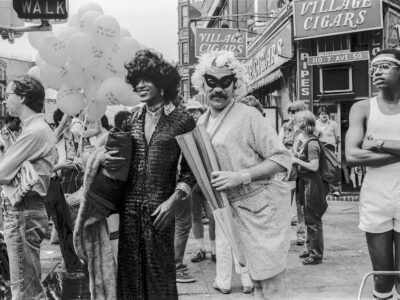
American gay liberation activist Marsha P Johnson (1945 - 1992) (center left, in dark outfit and black hair), along with unidentified others, on the corner of Christopher Street and 7th Avenue during the Pride March (later the LGBT Pride March), New York, New York, June 27, 1982. (Barbara Alper/Getty Images)

How To Quit Doomscrolling When the World Is on Fire

WP_Post Object
(
    [ID] => 10374
    [post_author] => 15
    [post_date] => 2026-03-27 21:37:14
    [post_date_gmt] => 2026-03-27 21:37:14
    [post_content] => 

How the ephemerality of the internet and the many ways we present ourselves online has warped our ability to know who we really are.

Will the Future Like You? Reflections on the Age of Hyper-Reinvention begins with a declaration: Our personal identities have not kept pace with the tempo of technology. And, according to author Patricia Martin, this imbalance has made us wholly unprepared to explore—let alone answer—the age-old question of who we really are.

In her book, Martin, a cognitive psychology-informed cultural analyst and host of the podcast Jung in the World, frames many of her arguments using Carl Jung’s theory of archetypes, applying them to identity formation in the digital age. If Jung’s original thesis proposes that humans rely on universal themes and inherited behaviors in the psyche to present who we are across self, shadow, persona, and anima, Martin contends the ephemerality of the internet has warped our inheritance. Her primary concern are the selves we present to the world via our various performances online, often manufactured as authentic while being anything but. Carrying out numerous ethnographic approaches including content analysis, narrative interviews, and sorting and coding “15,000 online users across 500 million posts,” she concludes these performances are also occurring at an exorbitant rate never experienced before in human history, sowing mass identity confusion in the process. 

Having become increasingly skeptical (and weary) of internet self-presentation via social media, I devoured Martin’s latest work, which utilized psychoanalytical language and frameworks to explore observations I’ve mainly considered through a cultural and anthropological lens. But even those who don’t agree with Martin (or me) about the current state of affairs will likely find instructive value in the book’s summations about our ever brave new technological era and its effects on identity. 

According to Martin, there are three main elements contributing to our modern distortions of self-construction and development: “personal fog,” “chronic self-doubt,” and “cascading crossroads.” Borrowing from Jung’s definition of the persona as a complex system that helps the individual relate with the world socially by wearing a kind of mask, Martin argues that personal fog comes from the continuous amplification and proliferation of various personas online, which obliterate our sense of who we are. Chronic self-doubt, meanwhile, delineates the distances between our digital presentations, which rely on external validation, and the selves we present offline, a gap that can cause tremendous self-uncertainty. Finally, cascading crossroads is characterized by how previously reliable identity anchors—such as family and work, or even other modes, such as class, gender, and where we consider home—now fluctuate more frequently, making our shape-shifting far more incessant. 

Among the many examples Martin offers of this increasing ephemerality, she cites the story of the trailblazing confessional blogger, Heather Armstrong. In the early aughts, Armstrong’s blog, Dooce, was a “mommy tell-all” magnet to millions, especially young mothers, who regularly consumed her relatable personal accounts of raising two children in Salt Lake City, Utah. But even before Dooce’s eventual decline due to the rise of social media, Martin points out that as Armstrong “matured, she found her light waning,” and the blogger increasingly divulged more serious confessions, including daily alcohol consumption and marital issues, not to mention the details of her history with depression. Martin isn’t explicit about whether Armstrong’s solemn shift was a cry for help or an effort to reinvigorate the blog. She does, however, add that “Dooce attempted several comebacks. But traffic never bounced back.” In 2023, Armstrong died by suicide. Examining how she was remembered, Martin notes “how little was said about her massive output of content, the effort it took, and the emotional toll of constant reinvention…”

While Armstrong’s story is a particularly dire case, there are others—admittedly less tragic—throughout the book that still speak to the toll our relationship to having an audience is taking on our relationship to ourselves. Martin also makes clear this goes beyond those who are, in some shape or form, attempting to be influencers: All of us online are liable to the emotional struggles of trying to juggle various presentations at cost to our psyche and identity development. 

However, the book doesn’t propose that we all abandon the internet (to the extent that we can) to counter these identity disruptions. Nor does Martin suggest that we wholly desert digital performance and presentation altogether. Rather, she asks the reader to more carefully consider the repercussions to our relationships—both to ourselves and others—online, where our identities are overwhelmed by seemingly endless transmutations, and ultimately underpinned by digital spaces extorting our identity confusion for profit. 

This inevitably has affinities with Karl Marx’s concept of the alienation of the factory worker from anything that could give their work meaning. But for me, it brought to mind Aimé Cesaire’s Discourse on Colonialism, and its thesis that the thingification of the colonized subject turns them into a commodity, isolating a person from themselves and the other. Transposing Cesaire’s contentions onto Martin’s begs questions worth probing further: Are we being colonized by the internet? Or by the tech bros that run it? 

Luckily, Martin doesn’t leave us without specific resolutions for alleviating our identity disruptions, the greatest of which is—perhaps surprisingly—a spiritual recommendation: that we reconsider the soul. Some anecdotes in the book are even dedicated to people who've been able to subvert identity confusion by relying on time-honored means of transformation and soul-enrichment: insulating themselves offline, and leaning on close bonds in the flesh. 

Martin also challenges us not to render onto technology what cannot be done by technology. Instead, she encourages us to create and honor our most true selves beyond the curations the internet can only offer. “We set boundaries, we verify claims, and we don’t give ourselves away too easily for the sake of a little fawning attention,” Martin writes in the concluding chapters of the book; to me, sound advice regardless of which continuum of internet identity discourse you choose to be on. She also offers perhaps one resolve for the question the book’s title proposes, Will the Future Like You?: Ultimately, the quest to answer this in the digital space is a hollow endeavor, because it requires an endless reconfiguration of selves, often to our own detriment. So, whatever selves we do offer up as performance in digital spaces, at the very least, we should refuse to give in fully—saving us perhaps not only from ourselves, but for ourselves.

[post_title] => Book of the Month: "Will The Future Like You?" by Patricia Martin [post_excerpt] => How the ephemerality of the internet has warped our ability to know who we are. [post_status] => publish [comment_status] => closed [ping_status] => closed [post_password] => [post_name] => march-book-of-the-month-botm-will-the-future-like-you-patricia-martin-identity-online-social-media-nonfiction-psychology [to_ping] => [pinged] => [post_modified] => 2026-04-29 18:07:12 [post_modified_gmt] => 2026-04-29 18:07:12 [post_content_filtered] => [post_parent] => 0 [guid] => https://conversationalist.org/?p=10374 [menu_order] => 0 [post_type] => post [post_mime_type] => [comment_count] => 0 [filter] => raw )
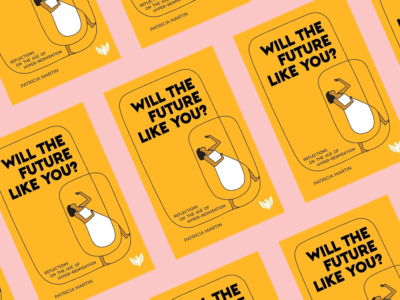
Book cover for "Will The Future Like You?" by Patricia Martin.

Book of the Month: “Will The Future Like You?” by Patricia Martin

WP_Post Object
(
    [ID] => 9787
    [post_author] => 15
    [post_date] => 2026-02-03 20:58:23
    [post_date_gmt] => 2026-02-03 20:58:23
    [post_content] => 

While at surface level, #WeirdTok is all fun and games, it also cuts to something deeper about being human.

Soapbox is a series where people make the case for the sometimes surprising things they feel strongly about.

The user who makes delightful felt animations. Wild, dramatically narrated video montages about horses at Costco and skeletons at Subway. A creator building a sprawling fortified terracotta city in a forest, an armored hand periodically creeping into frame to demonstrate the latest structure. Programming cards to play Coldplay’s “Clocks” on an antique mechanical organ. Witches in unsettling paper maché masks. A man who goes in deep on the technicalities of the musculoskeletal anatomy of mythical creatures. A tractor set to EDM.

“This is a hilarious and brilliant way to use your weed zapper technology LMAO how do you always find the best TikToks??? My FYP is never this obscure,” my friend and colleague Erin Biba replied when I shared the tractor video to Bluesky. I took her question as a challenge: How weird could my For You Page get? With a bit of effort, as it turns out: very, very weird.

#WeirdTok is a magical, fascinating, bizarre, wonderful, confusing, sometimes horrifying place filled with myriad wonders, delights, and, unfortunately, the inevitable incursion of AI slop. It is also art I genuinely, unironically love. It’s fucking great. And thanks to TikTok’s highly powerful algorithm, the app has learned what I like—and what I do not—with uncanny alacrity. If the FYP throws most people a hodge-podge of content it thinks is popular—horses for the horse girls, tradwives in beige kitchens cooking cereal from scratch, political commentators weighing in on the minutia of the Trump administration—for me, it has been forced to come up with the unpopular. The artisanal videos made by fellow strangeness enthusiasts, with 200 views and three baffled comments from normies wondering how they got there.

Delightfully, the more #WeirdTok I interact with, and the more extensive those interactions—watching all the way through, saving, liking, commenting—the more the weird juice flows. And flow it does. Surrealist skits in a Japanese restaurant. An artist projecting an animation of a horse onto a cityscape from the back of a bicycle. Musical stylings. A heavy equipment operator riding in the bucket of an excavator to the tune of “Cotton-Eyed Joe.” Elaborate frame-by-frame stereoscopic graffiti. Cats playing theremins. Dizzying animations of skeletal anatomy. More musical stylings: Suited brass bands chasing runners in a park while playing the “Mission Impossible” theme. Dazzling woodcock fancams. People wearing cardboard bug costumes with cutouts for their faces and writhing around in a parking lot.

Refusing to keep these gems to myself, several nights a week, I select a carefully curated #WeirdTok to share on Bluesky. I always tag Erin, who replies with a different weird video SHE has found. Over the months, our interactions have attracted a small band of loyal followers akin to those who wait to see how many eels show up under a bridge every morning; a small, fun, silly bright spot in dark times.

This shouldn’t be mistaken for escapism—delightful as it may be to watch remote control cars carrying a payload of pastel plushies while crushing autumn leaves, or a man’s surreal video series about his sleep paralysis demon, or a woeful potato taking a shower. Rather, the utter randomness of #WeirdTok—and the community that has formed around it—feels inherently strange and ungovernable, a necessary connection to humanity during a fucking scary time to be alive. We cannot survive if we cannot find joy: Surrounded by the fall of empire and the rise of fascism, I DO want to watch a whimsical video of wizard puppets jerkily animated in outdoor locations, thank you—and as it turns out, other people do, too.

While at surface level, #WeirdTok is all fun and games, it also cuts to something deeper about being human and the way art can transcend linguistic and social boundaries. I’m a long-time fan of so-called “outsider art.” Strange performance pieces. Unsettling musical compositions. Surreal found object exhibitions. Art cars and bohemian silliness. Whole communities centered around radical living, such as Bombay Beach along the Salton Sea.

These spaces feed my deep and abiding affection for weirdness, but also for making a place for art that is unconventional, highly specific, challenging. #WeirdTok, too, is often produced by self-taught, working-class artists exploring the world without feeling bound to whatever the rules of art are supposed to be. Art that is increasingly difficult to make in the modern era because of how expensive it has become to simply live. Gone are the days of the WPA and its serious investment in arts and creativity in the United States, or the arts grants that contributed to a flowering of culture in the U.K. in the 1960s and ‘70s. Instead, our cities are filled with creeping homogeneity, Airbnbs, and flipper homes trying to cash in on reputations of countercultures that now can’t actually afford to exist in those same places, while the true radicals are forced to the margins, such as the Ghost Ship collective in Oakland, destroyed by a fire in 2016 that killed 36 people. In the face of this, supporting weird art is essential.

It's also a surprisingly human thing to do. The cream of the #WeirdTok crop doesn’t use artificial intelligence, and in fact, actively defies even the most feverish robot hallucinations. Human weirdness is original. It comes from somewhere deep in the heart, not a blender filled with other people’s creativity and run on high for 30 seconds before being blorped out and shoved in your face. It is produced for the love of the game.

To discover a truly unhinged video feels hard-earned, a sort of reverse algorithmic manipulation. It is also, fundamentally, a rejection of technofascism and the bland hegemony tech companies want to force upon all of us, to turn us into passive consumers gobbling up slop and rolling in garbage while the world burns.  As a very specific niche, #WeirdTok often only makes it way to the right viewers, often without captions, hashtags, or explanations. It simply is, waiting to be discovered as you scroll. Some nights I am hit with banger after banger, saving every other video for future enjoyment and sharing, the FYP and I in a groove, unstoppable. It is like wandering the streets of a new city with no destination in mind, my favorite way to travel, finding new, intriguing things around every corner. It’s an experience that reminds me of the “old internet,” a long-gone place that we all once inhabited and loved, where it was possible to randomly stumble upon a painstakingly hand-coded website, human-made, then never see it again.

The ephemerality of TikTok is also an important element of #WeirdTok, and not just because the videos can vanish at the click of a button. At times, it feels like a fever dream, one that is frustratingly elusive to explain to people outside this liminal space. From an entirely practical perspective, there is also a “you had to be there” sense that is escalating as the app’s future in the U.S. grows increasingly uncertain. After a forced deal with Oracle, it appears ByteDance will be licensing its algorithm, but TikTok’s future overall is a big unknown as its new parent company brings its own biases and priorities to the table, all under the looming hand of the Trump administration. Will this change squeeze the joy from the FYP, as weird art serves no purpose under capitalism? If so, where will the weird art go next?

There is a sense of being on the rooftop at a wild party, watching the grey fingers of dawn slowly creep over the horizon, knowing that in daylight, everything will look very different. Yet, #WeirdTok is a reminder that even if this party ends and people trickle home, shedding feathers and sequins on transit, weird art, human ingenuity, joyous creativity, will endure. There will always be another party, and no matter where it shows up and who will be there, it will exist.

[post_title] => How Weird Can Your For You Page Get? [post_excerpt] => While at surface level, #WeirdTok is all fun and games, it also cuts to something deeper about being human. [post_status] => publish [comment_status] => closed [ping_status] => closed [post_password] => [post_name] => soapbox-weirdtok-tiktok-videos-social-media-outsider-weird-art-strange-unusual-fun-content [to_ping] => [pinged] => [post_modified] => 2026-02-03 21:00:39 [post_modified_gmt] => 2026-02-03 21:00:39 [post_content_filtered] => [post_parent] => 0 [guid] => https://conversationalist.org/?p=9787 [menu_order] => 0 [post_type] => post [post_mime_type] => [comment_count] => 0 [filter] => raw )
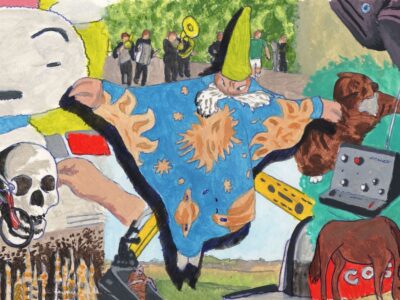
An illustration depicting various #WeirdTok videos.

How Weird Can Your For You Page Get?

WP_Post Object
(
    [ID] => 5838
    [post_author] => 15
    [post_date] => 2023-05-03 17:29:33
    [post_date_gmt] => 2023-05-03 17:29:33
    [post_content] => 

How social media influencers are challenging stereotypes both within and outside of Muslim communities—just by being themselves.

In this very digital age, I wouldn’t describe myself as much of a social media person. Despite my active Twitter presence, which I attribute to work, and the occasional procrastination scroll on Instagram, which always ends up longer than expected, I’ve just never really found much joy in it. Even back when most people dreamed of becoming bloggers, I never saw the appeal: I couldn’t relate to their desire to share their lives so publicly, and felt a disconnect with their content as a result. 

Then, around January last year, I discovered With Love, Leena. The account follows the day to day life of Texas-based content creator Leena Snoubar, covering everything from fashion to parenting to all things lifestyle. In one video, she gives a tutorial on how she removes makeup stains from her hijabs. In another, she shares an intimate day out with her mother and sisters, where they grab brunch and go wedding dress shopping for her youngest sister. Scrolling through her account, I found myself feeling—for the first time—like I was actually getting something out of my Instagram experience: I’d never come across a Muslim influencer who was so visibly Muslim and yet didn’t feel the need to justify or be bound by their religion. 

It was only when I came across Leena that I realized my feelings of disconnect on social media had less to do with the platforms themselves, and more to do with the kind of content I was seeing. Maybe it was the algorithm or just my lack of social media engagement, but I was almost exclusively served either general fashion and beauty content—which I assumed was because of my gender—or Islamic videos, with little in between. It made me feel alienated in terms of my other interests, and like I had to separate my religious identity from the rest of me, or else somehow justify their intermingling. 

For a lot of young Muslims, being online as a visibly Muslim person creates a pressure to either always be preaching Islamic content or advocating for our religious identity. When I first started out as a journalist, I often felt a heavy responsibility to justify my identity, and to prove, somehow, that Muslim women were not limited to the stereotypes projected onto us. But constantly having to justify my identity also meant constant emotional labor, and as I quickly learned, this only ever led to burnout. It’s a pressure that content creator Maliha—who says she’s been an “internet girlie” since before influencers became popular—is very familiar with. “I started out with my YouTube channel, and then Instagram, and because a lot of my content was cosplay I became the ‘hijabi cosplayer,’” she says. “But I’m not very good with having a niche, and when I moved to TikTok, I started making content that I connected to more, mostly rants and healing—social justice-y stuff.” Despite pivoting directions with her content, though, she soon found that her audience hadn’t changed or expanded at all: Maliha says that even though her content wasn't Islamic, TikTok’s algorithm was almost exclusively showing her videos to other Muslim users. 

This sort of systemic stereotyping, that comes from both outside and within Muslim communities, is exactly what some influencers like Leena and Maliha are challenging with their diverse content. Despite living continents apart, I immediately felt a connection to Maliha—one that came from so many shared experiences, not just as Muslims, but also as young women. She’s just an average twenty-something, sharing her everyday thoughts, laced with a little humor and, often, a lot of sarcasm. I’m not the only one who has felt a connection to her work, either: Maliha says that her role as a content creator has helped her make friends across the globe. 

For 20-year-old Younis AlZubeiri, this sense of community has played a big role in his own content creating journey. “My overarching goal with my content was to also be that outlet for other Muslims on the internet that didn’t really have someone to look to online,” he says. “In the world of Andrew Tates and [other] horrible role models to young kids, especially Muslims, I tried to just be a source of good to them.” He first started creating content at 14, making videos about comics just for himself. But slowly, his focus started shifting. “When I had followers who looked like me tell me about my impact on them, there was a light that switched,” he shares. Now, he has over 100,000 followers on TikTok, where he shares videos exploring culture and entertainment and diversity within both. 

Along with creating spaces of acceptance for Muslims from all walks of life, many of these influencers are also challenging what it means to be visibly Muslim in 2023. This means fighting stereotypes offline, too: Amira Rahmat, a food and travel blogger, often embarks on solo trips and says she’s always met with surprise when people see a young Muslim woman traveling alone. “When I post content on my page, a lot of the comments I see are, ‘Oh, you’re so brave to travel alone,’” Amira shares. But likewise, she says many of her commenters are inspired by her videos: For many Muslim women, who have to fight back stereotypes that Muslim women’s pardah or religious restrictions keep them confined to their homes, seeing women like Amira and being able to share in her experiences has become a crucial part of shaping their confidence and self reflection. 

It may seem like these are just a bunch of random creators covering various topics, but that’s the point. In this age of growing Islamophobia, they’ve begun to play a very important role in humanizing all of us beyond our hijabs and beards and masjids. They’re creating their own spaces, where being Muslim doesn’t impact or influence all the other parts of themselves. This is just as pivotal within our community as it is outside of it: Muslims who find themself stuck between proving themselves to other Muslims and justifying themselves to non-Muslims seeing creators just being honest and unapologetic about whatever topic they’d like can give us a lot of strength on the days we most need it. “It’s such a fine line to be a Muslim artist in any capacity,” says Dubai based content creator Emad. Whether or not you talk about religion, he continues, you’ll be judged by Muslim and non-Muslim creators alike, and pigeonholed by both. “For someone like me, I wanted to get into Muslim content because it’s fun. [But] so many times it happens that you become a ‘Muslim creator’ and then you do a fun TikTok dance and suddenly you’re not a Muslim creator because you’ve apparently done something wrong.”  

This isn’t always easy. But when the polarized opinions and criticism become too much, Younis says that humor helps—especially when met with harmful alt-right and other extremist narratives. “I can’t just post about being a leftist and expect them to change,” he says. “You have to go about it in another light and try to convey the point you’re trying to make through humor.” These are baby steps, he adds, but making viewers laugh can challenge pre-existing notions that all Muslims are the same and that they don’t exist outside of a one-dimensional identity.

These small steps go a long way, and are already making a difference for creators (and viewers) around the world. Pakistan-based food blogger Emon Malik says the content creator economy has been growing in her country, and credits that to the growing diversity of creators. And the number of Muslim content creators is only growing.

“With more [diverse] content creation, people are more informed,” Amira says. “It comes from personal experiences, not Google, and it’s more raw and authentic.” It’s also more relatable—and for me, inspiring. When I see content creators like Leena or Maliha or Amira, it gives me the push I need to be more unapologetically myself. As these content creators have shown me, I’m more than my religious identity, but I don’t have to hide it away, either.

[post_title] => The New Faces of Being Visibly Muslim Online [post_excerpt] => How influencers are challenging stereotypes both within and outside of Muslim communities—just by being themselves. [post_status] => publish [comment_status] => closed [ping_status] => closed [post_password] => [post_name] => muslim-tiktok-social-media-islam-representation-content-creators-influencers-advocacy [to_ping] => [pinged] => [post_modified] => 2026-08-04 19:19:00 [post_modified_gmt] => 2026-08-04 19:19:00 [post_content_filtered] => [post_parent] => 0 [guid] => https://conversationalist.org/?p=5838 [menu_order] => 84 [post_type] => post [post_mime_type] => [comment_count] => 0 [filter] => raw )
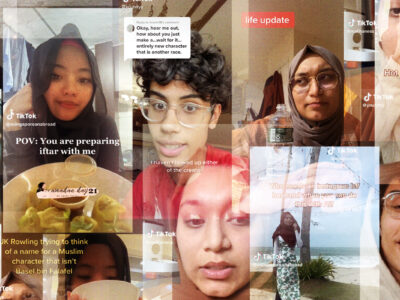
A collage of screenshots, from various Muslim TikTok content creators, engaging in all sorts of different styles of content creation. In one video, the creator is dressed in a banana suit; in another, the creator is answering a question about cosplay; in another, it appears to be a cooking tutorial. The screenshots are overlapping, with various degrees of opacity, giving the feeling of rich, diverse array of content.

The New Faces of Being Visibly Muslim Online

WP_Post Object
(
    [ID] => 3234
    [post_author] => 2
    [post_date] => 2021-10-05 02:14:04
    [post_date_gmt] => 2021-10-05 02:14:04
    [post_content] => We know Facebook is hurting individuals and whole societies; but now we know that Facebook knows it, too.  

On Sunday, October 3, the Facebook whistle-blower, whose trove of internal research documents has made global headlines for weeks, revealed her identity on 60 Minutes, the prestigious American television news show. Frances Haugen, who quit her job at Facebook in May 2021, said “the version of Facebook that exists today is tearing our societies apart,” and that Facebook’s senior executives know this but refused to act. Haugen said she took a trove of internal documents to prove beyond doubt that Facebook’s research team and senior executives know exactly the damage the company inflicts but choose to prioritize advertising revenue. She said; “Facebook has realised if they make it safer, people spend less time on the site, click on less ads, they make less money.” She brought proof of what many outsiders have said for years: Facebook prioritizes revenue over public safety, and Instagram makes children—especially teenage girls - mentally ill.

Who is Frances Haugen? She is a 37 year-old American data scientist, a Harvard Business School graduate, who has worked for Big Tech for 15 years, including for Google, Yelp, and Pinterest. At Facebook, where she had worked for two years, Haugen led a small team working on counterespionage for civilians targeted by hostile states—for example, Taiwanese or Uyghur people being spied on by the Chinese government. Her team of just seven people was expected to provide enough protection for people around the world, and requests for more resources were refused. But Haugen says her personal trigger to blow the whistle was when she lost a friend radicalized by social media into far-right racism.

From early 2021, Haugen assiduously copied tens of thousands of pages of Facebook’s own research about the harms it creates. She has worked with the Wall Street Journal — who reported on Instagram’s harms to teenage girls in September —and will testify to the US Senate Commerce Subcommittee later this week. Just as importantly, Haugen has filed several complaints with the US Securities and Exchange Commission, a regulator for companies. She alleges that Facebook is lying to the public and to shareholders when it says it’s making progress on how it deals with disinformation and hate. One internal Facebook study said “we estimate that we may action as little as three-to- five percent of hate… and 0.6 percent of violence and incitement on Facebook.” Facebook replied a full two weeks after Wall Street Journal reports based on Haugen’s leaked documents, to claim its own research was unreliable. (To be fair, one of the Instagram studies had a tiny sample size of just 40 teenagers.) But it did not address many of the factual claims made about the real, ongoing and fully known harms Facebook is perpetrating against children—and against democracy itself.

Of course, none of the claims made by Haugen’s leaks are new. Independent researchers have pointed out for years that Facebook profits from extremism and hate. Facebook’s 2018 change to the algorithm that decides which content users see was designed to aggressively monetize even more the fact that anger drives clicks. Another whistle-blower, Sophie Zhang, said in April 2021 that Facebook systematically under-resources the teams working to counter state manipulation of the platform by autocrats around the world. If it’s the US presidential election, election integrity is a priority and, as Haugen says, rules and system changes were introduced and heavily resourced, at least temporarily. But for countries like Honduras, Albania and Azerbajan? According to Zhang, not so much. Protecting election integrity from disinformation and organized hate in lower priority countries “felt like trying to empty the ocean with an eyedropper.” And academic researchers have for years provided evidence that Instagram drives eating disorders, suicidal ideation and self-harm. We know Facebook is hurting individuals and whole societies; but now we know that Facebook knows it, too.

Whistle-blowing is vital because it provides documentary evidence not just of harms, but of the culpability of those doing the harm. That’s why Haugen’s tens of thousands of pages are important. No doubt, Senators’ research staff and SEC investigators will be pouring over them, searching for the smoking gun, for whose finger was on the trigger and when. But it is vital that, despite the attraction of focusing on the whistle-blower themselves, we concentrate on what the documents say, and about whom. Attention must go to the independent researchers who have, all along, generated credible evidence of Facebook’s harms. That includes people who have had their access revoked to data Facebook had promised to share, including researchers at NYU just weeks ago, and social scientists around the world whose access to data via APIs was blocked in 2018. Focusing attention on independent researchers is crucial, as they provide context and depth for the claims of harm. Also, every time Facebook has a scandal, it promises to "do better" and be more transparent, but once the media attention relents, it pulls the plug.

Haugen has taken a great risk with her future career, and has provided the documentation that regulators and policymakers need. For this we should be grateful. But she is not the arbiter of what should be done. So far, when asked about solutions, she’s made vague gestures toward “regulation,” but in the context of her belief that “the version of Facebook that exists today is tearing our societies apart.” To this way of thinking, there is a reachable version of Facebook that would do less harm and be OK. This incremental approach is no surprise. Haugen has already worked for 15 years for companies with names that are synonymous with surveillance capitalism. She doesn’t have a problem with the basic business model of extracting people’s data to sell ads. She just has a problem with Facebook being the most egregious of a very bad bunch.

I’ve written before about the Prodigal Tech Bro, the generic guy who got rich working for Big Tech, but then saw the light and left, to decry its failings. The Prodigal Tech Bro converts his social and actual capital into big platforms to question how technology is used. It’s not just galling; it’s dangerous. Centring people who made the problems pushes aside the people— so often women of colour— who’ve been making independent, good faith critiques for years, with little status or money. And it spotlights incremental, milquetoast “solutions” that don’t fundamentally alter the structures and incentives of Big Tech; “The prodigal tech bro doesn’t want structural change. He is reassurance, not revolution. He’s invested in the status quo, if we can only restore the founders’ purity of intent.” Haugen is far, far more courageous than the prodigal tech bro. For choosing to be a whistle-blower she will lose the rest of the career she prepared for and must have planned. She has literally put her money where her mouth is, and I applaud her. But what we need from her now is context, insider knowledge, facts and examples of how Facebook does what it does. We don’t need her to set the frame for what the solutions should be.

I have a lot of empathy for Mark, and Mark has never set out to make a hateful platform. But he has allowed choices to be made where the side-effects of those choices are that hateful polarizing content gets more distribution and more reach. --Frances Haugen

Insider critiques are uniformly based on the feeling that “Mark” or “Sheryl” either don’t really understand the harms they do, aren’t sufficiently informed about them, or just want to do the right thing but are trapped in a system of wrong incentives. “It’s one of these unfortunate consequences,” Haugen says, “No one at Facebook is malevolent, right? But the incentives are misaligned.” But Facebook created its own incentives from nothing, hiring Sheryl Sandberg to build its data-extractive, advertising-based business model. Its focus on growth above all else is what made its platform an extreme amplifier of disinformation and hate, simply because that’s what drives clicks. And the amount of money the trillion dollar company spends on moderating content and following up on the direct incitements to violence it generates is miniscule. Facebook does what it does because that is who it is. It doesn’t change because, as Haugen encapsulates; “Facebook has realized if they make it safer, people spend less time on the site, click on less ads, they make less money.” Haugen’s simple, pithy summary of why we are where we are is the starting point for real change. The documents she has leaked and her upcoming Senate testimony will focus attention on the fundamental problems the company created. Now we need to listen to a wide range of people and gird ourselves for a course of radical, outsider-driven change. [post_title] => Blowing the whistle on Facebook is just the first step [post_excerpt] => Whistle-blowing is vital because it provides documentary evidence not just of harms, but of the culpability of those doing the harm. [post_status] => publish [comment_status] => closed [ping_status] => open [post_password] => [post_name] => blowing-the-whistle-on-facebook-is-just-the-first-step [to_ping] => [pinged] => [post_modified] => 2026-08-06 17:24:52 [post_modified_gmt] => 2026-08-06 17:24:52 [post_content_filtered] => [post_parent] => 0 [guid] => https://conversationalist.org/?p=3234 [menu_order] => 173 [post_type] => post [post_mime_type] => [comment_count] => 0 [filter] => raw )
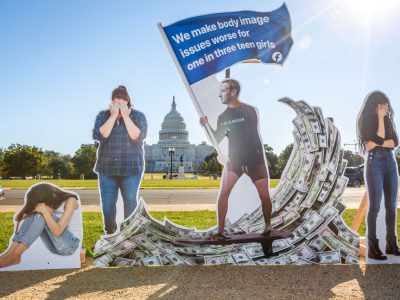
Blowing the whistle on Facebook is just the first step

WP_Post Object
(
    [ID] => 1454
    [post_author] => 2
    [post_date] => 2019-11-08 22:30:16
    [post_date_gmt] => 2019-11-08 22:30:16
    [post_content] => 

(CC BY 2.0)

The claim that social media is a neutral platform for the amplification of free speech does not hold up to scrutiny.  Does it matter that Mark Zuckerberg dines with far-right politicians and activists, or that he genuinely seems to believe their websites are trustworthy fact-checkers? Does it matter that Jack Dorsey personally overrules Twitter bans on white supremacists but allows Donald Trump to ignore the acceptable use rules that the rest of us must obey? Yes and no. Yes, it matters because the political preferences and blind spots of social media C.E.O.s influence their businesses. And no, because leaders’ opinions matter less than how right-favoring ideas, incentives and ways of organizing are baked into social media’s business models in ways those executives don’t even seem fully aware of. We know that Facebook’s Washington D.C. lobby-shop and electoral integrity work is dominated by Republican party operatives and members, and we know Twitter prefers to give Nazi sympathizers a blue check mark rather than the boot. Google funds climate change deniers and YouTube is a right-wing radicalization engine. There is no shortage of evidence that America’s West Coast tech unicorns qualify as liberal only on a narrow range of identity issues. They’ll stand up for LGBTQ rights, but they’ll come down hard on any union activism among their own employees. Less obvious is the fact that social media itself is structurally right-wing. Not because its CEOs are tech-bro libertarians or even because of their suspiciously agile pivot to Trump, but because social media affords advantages to the ideas, feelings and organizing principles of the hard-right. Oh, and also because of the money.

Structure

First, some heavy lifting. Social media as we currently organize it is trivially easy to weaponize in ways that favour autocracy and damage democracy. Political scientist Henry Farrell* and information security expert Bruce Schneier recently explained why democracies are so easily harmed by disinformation attacks while autocracies are actually strengthened by them. It’s because democracies and autocracies rely on people having two different kinds of shared knowledge; and social media disinformation disrupts one and favours the other. In an autocracy, you know who’s in charge and what they want, but you’re not sure who the different political movers in society are, how much power they have and who you could form a coalition with. Certainly, political conflict occurs in societies that are dominated by the power vertical, but mostly off-stage or in ways only insiders can interpret. That’s why we still use the term ‘Kremlinology’ to describe the study of subtle public signs of largely secret power struggles. In an autocracy, shared knowledge about other people’s political views is low. This makes it risky and difficult to organize an opposition. In 2010, democracy activists in Tunisia had very little idea how many other people felt the same and were prepared to rise up against the regime until Mohamed Bouazizi, that fateful vegetable seller, set himself on fire and triggered the entire Arab Spring. Social media did help those protests to go viral — though its role has been exaggerated — but autocratic rulers learned quickly how to turn social media against citizens. The main tactic autocrats use is "flooding," sending huge numbers of often contradictory political messages via automated social media accounts to drown out discourse and make it impossible to figure out who’s friend, who’s foe, or who’s even a human. The Chinese government strategically uses social media flooding both as a censorship tool — "who knows what’s really true?" —  and to distract and divide people, weakening them as a political force. Autocracies are strengthened by divisions that prevent people coming together as a political force. The tactics autocrats use at home can quickly become part of their strategy abroad. Russia is known to have used flooding to undermine shared belief in the validity of electoral politics in Ukraine and also in the U.S., U.K., France, and Germany. Social media makes flooding cheap and successful because increasing the quantity of noise degrades the quality of discourse. It might even make it impossible to sustain. When a tactic becomes a strategy, things can change, sometimes very quickly. An aside: I recently heard a well-connected U.K. conservative saying something I’ve heard from at least a dozen people in powerful positions: "Social media doesn’t do anything new. It just lets people express themselves, for good and for ill." Wrong. Different technologies — embedded in different business models — have different affordances. They encourage certain kinds of behavior, ways to make money and means to concentrate power. Those who benefit from these affordances seem to be almost unaware of the advantages thus bestowed, as though they’re used to playing the game of life on "easy." The same person later regretfully confided that yes, it was dreadful their own party was going to fight an election campaign that would pit parliament against "the people," but no, there was nothing to be done about it. Nothing at all. Farrell and Schneier’s article explains that democracy is so vulnerable because flooding destroys precisely the kind of information democracy depends on. In a stable democracy we disagree about who should be in charge, but we share — and depend on — common knowledge about who the political actors are, how much support they have and how we can form coalitions. That shared knowledge allows us to have a functioning political opposition. We also share the knowledge that our electoral systems are basically fair, that outcomes approximate what enough people really feel, and that if we lose this year’s election we still have a good chance of winning the next one. If that knowledge goes away, then the institutions that depend on it can, too. All very interesting, you might say, but this shows that social media helps autocrats, and autocracy can be of the left, too, at least in its self-justifying propaganda. What is peculiar to how social media helps right-wing autocracy? Social media is structurally disposed to weaken our real-life horizontal ties with one other, to poison our ability even to imagine a social contract, to disrupt our drive to discover shared interests and shape them into collective political action. Social media is great for democracy only if you think democracy is a an exercise in ticking all the boxes for crowning a strongman. I say social media is inherently right-wing because it is structurally predisposed to making social democracy impossible. Social democracy depends on the ability to form rolling coalitions of different groups around broadly shared goals. If I’m the middle-class parent of a disabled child, I can make common cause with an unemployed miner hundreds of miles away. We both want the state to be a social safety net for when life throws us a curveball. We don’t want all the same things, but we agree on enough to vote for or even belong to the same political party. And it’s not purely transactional. In our kinder moments, we feel solidarity, even though we are in different places and belong to different social classes. But what happens if I start seeing that ex-miner as an enemy, and vice versa? If our tribal identities have become so narrow and hardened that we no longer feel we’re on the same side? Hell, that we no longer even live the same world? If the broad-based coalitions that built social democracy can no longer recognize each other as allies, then it’s devil take the hindmost in a world of an unchecked and punitive state. Goodbye fraternity, hello Koch brothers. Social media is the ideal medium and amplifier for the actively divisive and zero-sum politics of the hard, populist right. It disadvantages any politics based on compromise, on solidarity, on a forgivingly broad concept of who ‘the people’ are. Social media’s methods structurally favour Duterte, Trump, Orban et al the way tennis disinterestedly favours athletes with long arms.

Methods

Facebook and Google act as advertising consolidators, collecting vast amounts of personal data on users and renting that data and access to their users to advertisers. So the more you use their services, the more data they can gather and ads they can sell. This is called adtech, and it is social media’s chosen business model.  The official version regarding the unique selling point (USP) of adtech is that social media firms can target ads to us more closely because they know so much about us. The private, and more accurate, USP to advertisers is that they have finely segmented the markets we inhabit in order to identify the tiniest possible groups for advertisers to target. The key to adtech is market segmentation— i.e., breaking people down into ever smaller groups to sell things to. We sell things to people by convincing them of the importance and uniqueness of their group. What sells is making people feel they are different, special and even superior. They deserve things most others don’t. In society at large we call this "fomenting division." Social media, the pill we swallow to ingest adtech, is based on creating and exploiting social division. So too, it turns out, is the right-wing project whose goal and working methods are to create in-groups and out-groups for an ever-smaller number of people who count as ‘people’. Social media’s business model is to make us feel more divided than ever, and monetize the finest of distinctions we can be made to feel.

Feelings

And what keeps us clicking? Strong emotions like fear, anger and even hate. By now, most of us know that YouTube and others drive "engagement" by presenting the most emotive content, with most of us barely three clicks away from politically extremist content. Social media divides us ever more finely, all the better to market our profiles to its real customers, the advertisers, and then it makes us internalize distinction and divisions by force-feeding us hateful clickbait. Xenophobia and conspiratorial distrust create clicks. These are the signature emotions of the far right. It's anger with no purpose except to be monetized. Clickability almost always leads to the dark side. The political radicalization that helps make social media so wildly profitable is almost exclusively to the right. As well as fomenting division and making political solidarity harder to evoke, the dark emotional palette social media spatters everywhere has a deeper effect on what we think politics is actually for. Firehosing is a technique used by disinformation merchants to pump out a stream of often contradictory lies. No one has the time, energy or resources to dispute each lie, and airing out lies to debunk them can make even more people believe them. This method is used by anti-vaxxers, far-right media sites and state-sponsored disinformation campaigns. Firehosing floods what used to be a conversation with wacky grimdark lies that cumulatively insist that nothing really works, everyone is on the make and no organization or authority can be trusted. It implies that nothing we do to collectively improve the state of the world can work, because someone, somewhere is gaming the system and that someone is probably brown or female or educated. Firehosing helps explain why people who think the government should slash taxes and drop environmental regulations also think it should kidnap immigrants’ children and micro-manage women’s uteruses. The world of the firehose is one in which reality is not true and almost everyone is bad. In this world, the only useful way to use state power is to punish, to coerce, and to hurt. It reinforces a world where states can do no positive good because it will be taken advantage of — someone, somewhere is getting stuff for free that you have to pay for. If the only effective state power is violence, the only role of politics is to decide who to target. This isn’t an intentional effect of the medium, but it is a real world consequence of the quality and sheer volume of the messages it transmits. Social media is rightwing because its amplified nihilism makes far-right misanthropy sound like a fundamental truth and ushers its dream into being; a world where the state exists only to punish outsiders and throttle the poor, not to rebalance wild excesses of inequality.

Organizing

But if social media companies are making money from advertisers, and advertisers – most of them aggregators – are making money from the companies whose ads they place, who is making money from the emotive content that keeps people clicking? Who is paying to feed the beast? All those videos, images and stories that trigger and sustain the outrage cycle aren’t going to just make themselves. New York Times columnist Charlie Warzel asked whether the Democrats can compete with Trump’s Twitter feed and concluded that “one of the few ways to power right now is to never, ever stop making content."
A Photoshopped image of a dog getting the Medal of Honor. Sharpiegate. A Fourth of July military parade. They’re all attention spectacles.
To "win" social media you must spew out content optimized for virality. Individuals can only do so much. Volunteer organizations don’t have the time and are too busy firefighting (and, let’s be honest, infighting). The organizations manning the firehose are top-heavy political outfits with strong message control – typically the preserve of the hierarchical right — and astro-turf fronts pretending to be grassroots organizations. Yes, there is an ecosystem of ad aggregators and content amplifiers. But the optimal organizational form to create firehose content at scale isn’t the pyramid of large and unwieldy membership organizations so beloved of the left, but a thorn — rigid, narrow and sharpened to a point — all the better to sink deep into the flesh of the body politic. Social media lets small, well-funded organizations convert grey and dark money into attention. It makes big money’s ideas look like they’re backed by the masses. People on the left almost never have hundreds of millions of dollars sitting around waiting for a vast, anonymizing influence engine to convert money into power. People on the right do. Fake organizations are more effective than real ones. Sock puppets, amplification accounts and automatic reply-guys work 24/7, never disagree with the leader, get disillusioned or split into factions. Social media makes fake organizations look real, and real ones look like dinosaurs. Only on the right is there a sufficient concentration of capital with the means and motivation to exploit this.

Ideas

None of this can be unknown to those running the big social media companies. Their job is to understand what works on their websites in ways we outsiders can only guess at. Science writer James Gleick recently observed that “people on the left and people on the right BOTH understand that Facebook’s policy of allowing lies benefits the right.” Monetizing lies drives profit. How can anyone possibly defend that? In the US, free speech absolutism is a feature of the right. Liberals argue for laws banning hate speech and incitement, while conservatives and the far right insist freedom of expression is enshrined without condition in the U.S. constitution, even if that means people are hurt or sometimes die. This year, as the clamour has grown against Facebook’s damage to democracies around the world, the company has doubled down on its insistence that advertising is protected speech. Sheryl Sandberg, Facebook’s COO, has said: “We believe that ads are a big part of [freedom of expression]." Social media executives’ insistence that their companies are just neutral bystanders but that the most important value of all is free speech shows how closely aligned their interests now are to the right. Mark Zuckerberg doesn’t invite Tucker Carlson home to try and understand the alien mindset of America’s hard right, but because they share a common financial interest in protecting the peculiar political ecosystem of which Facebook is the apex predator. Social media companies share ideas with the right not because they are awkward fellow travellers but because they share fundamental interests. But just as my conservative acquaintance couldn’t admit, even to themselves, that social media’s affordances privilege the ideas and organizations from which they personally and politically benefit, so social media executives seem to believe their pursuit of self-interest is simply the acting out of self-evident philosophical imperatives like the absolute value of freedom of speech. But guess what? It doesn’t matter. It doesn’t matter whether Mark Zuckerberg holds his nose when he dines with the far right, if Jack Dorsey torments himself about open Nazis he keeps inviting back in, or if Susan Woijicki truly believes YouTube is a force for good. It is wholly irrelevant whether these individuals believe they are speaking in good faith or how deep any self-deception may go. Their interests are fully those of their companies, and their companies exist to make money. Their companies are once-in-a-century concentrations of capital whose only imperative is survival and growth. Capital doesn’t care if the boss still thinks he’s one of the good guys, if, in his heart of hearts, he’s truly not a racist but just happens to run a company that monetizes racism. Capital doesn’t care if he can’t sleep at night. Capital calls to capital everywhere. Social media empires are big business and history shows us that big business doesn’t have a problem with the far right. They want many of the same things; to act unfettered, to weaken horizontal social ties, to re-shape the world in their own twisted image. Social media driven by adtech will only, always serve capital, however many beanbags they have in the office. * Henry Farrell is the writer's brother. [post_title] => Social media's right wing bias is baked in to its business model [post_excerpt] => Social media lets small, well-funded organizations convert grey and dark money into attention. It makes big money’s ideas look like they’re backed by the masses.   [post_status] => publish [comment_status] => closed [ping_status] => open [post_password] => [post_name] => social-medias-right-wing-bias-is-baked-in-to-its-business-model [to_ping] => [pinged] => [post_modified] => 2026-08-06 23:21:02 [post_modified_gmt] => 2026-08-06 23:21:02 [post_content_filtered] => [post_parent] => 0 [guid] => https://conversationalist.org/?p=1454 [menu_order] => 294 [post_type] => post [post_mime_type] => [comment_count] => 0 [filter] => raw )
Social media’s right wing bias is baked in to its business model

WP_Post Object
(
    [ID] => 1108
    [post_author] => 2
    [post_date] => 2019-06-13 15:06:55
    [post_date_gmt] => 2019-06-13 15:06:55
    [post_content] => Social media platforms and authoritarian populists have a troubled, tangled, symbiotic relationship

Evgeny Morozov, a prominent culture critic and social media expert, argues in a recent opinion piece for The Guardian that the global right-wing populist movement is divided over Big Tech companies. Globally, populists see the platforms as a way to subvert mainstream media, but in the United States the right wing sees it as a target to attack.  Morozov's analysis overlooks, however, the fact that American extremists have been having it both ways: they capitalize off the opportunity to radicalize individuals on social media, while cynically complaining about “far-left” ideologues, as demonstrated by recent events.

Last week, YouTube initially declined to sanction the right-wing comedian Stephen Crowder for posting videos filled with racist and homophobic attacks against a Vox journalist. As HuffPo reporter Andy Campbell observes, this is a really bad sign for the company’s new anti-hate policy.

Then the company proceeded to prove, as Will Oremus describes it, “The One Rule of Content Moderation”: Namely, if a decision is too controversial, reverse it. YouTube’s decision to take away Crowder’s ability to make money off his videos is neither a “hard-won victory” nor “mob rule,” but merely more evidence that the tech companies have no idea what they’re doing.

As this story by New York Times reporter Kevin Roose demonstrates, the recommendation engines that power platforms like YouTube are as influential as content moderation — if less visible. Roose reports that a series of tweaks to the recommendation system on YouTube made it even easier for white supremacists and other right-wing populists to radicalize their audiences.

However, Roose also reports that some left-wing YouTubers are hacking the system by mimicking the video style, lingo, and subject matter of right-wing populists, and then debunking their messages. These activists are modeling their tactics on successful de-radicalization by co-opting the medium, meme by meme. While this community-driven strategy is promising, its creators are ultimately at the mercy of the same algorithms as their far-right colleagues: if YouTube switches things up again, who knows whether they can still get their videos in front of the people who need them.

In other news:

States race to ban styrofoam in the latest skirmish of the much-needed war on plastic. Read more. How an “innovation team” is ending blight in Mobile, Alabama. Learn more. The small Hawaiian island of Moloka‘i is modeling a post-carbon future for us all. Here’s how. [post_title] => How the far right games social media platforms [post_excerpt] => [post_status] => publish [comment_status] => open [ping_status] => open [post_password] => [post_name] => how-the-far-right-games-social-media-platforms [to_ping] => [pinged] => [post_modified] => 2026-08-07 16:06:00 [post_modified_gmt] => 2026-08-07 16:06:00 [post_content_filtered] => [post_parent] => 0 [guid] => https://conversationalist.org/?p=1108 [menu_order] => 323 [post_type] => post [post_mime_type] => [comment_count] => 0 [filter] => raw )
How the far right games social media platforms