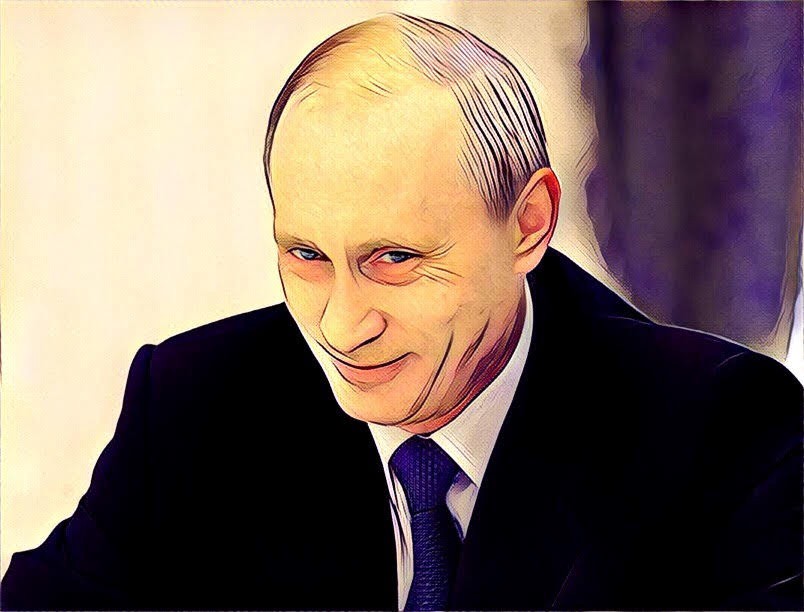
Why don’t Trump supporters care that their leader seems more sympathetic to the Kremlin than he does to, say, his own intelligence community? Take a look at the numbers.
There are many reasons why Putin is attractive to conservative voters — both obvious and not-so-obvious.
As Terrell J. Starr has repeatedly pointed out on Twitter (if you’re on Twitter, you should really follow his account, btw), Putin is particularly beloved by Americans who have a lot of anxiety around race issues/nonwhite leaders (*cough* Obama *cough*)/the idea of whites becoming a minority, etc.
While some of them know that Russia is a diverse country, they also see it as a country where “minorities know their place” (they may have heard as much from notorious racist David Duke to various right wing websites).
That’s just one piece of the puzzle— but it’s important, and rarely discussed by cable news. There is a lot of discomfort around this issue.
As for Trump himself, even if you discard the wilder allegations against him, including the idea that the Kremlin is literally blackmailing him, his line of work and his personality can clue you in as to why he wants to cozy up to the Kremlin.
Trump is a good salesman. He tells people what they want to hear.
Instinctively, Trump understood that what millions of people wanted to hear is that there is a country — a big country with imperial ambitions and nuclear might— where white people are in charge and make no apologies for it.
There is no pesky “political correctness” in this alleged white paradise. This image of Russia and its leader was a product that Trump could sell to voters. It worked. It’s still working.
(The reality of life in Russia is different from the fantasy, but we at the Anti-Nihilist Institute will get to that in our subsequent articles on the topic)
Trump is also just a narcissist. There is no getting around it — this man feeds off of the spotlight, he needs to be adored, and he believes that now that he is president, it is everyone’s job to adore him. He’s going to respond favorably to a Kremlin that’s making overtures to his ego, national security be damned.
On cable news, we keep hearing the excuse that Trump merely wants to normalize relations with Russia. If you know anything about foreign policy, this should strike you as odd. Normalizing relations ≠ siding with foreign officials over your own officials (the Russians know it too, which is why I recently told Marco Werman that I bet Putin is laughing at us right now).
What can be done about this hot mess? It pays to be realistic and play the long game.
Don’t think that facts will convince Trump or his most fervent supporters. If facts mattered to him or his base, he would have never become president. Facts don’t matter to the Kremlin at all, and it’s doing just great (for now).
Remember that people who bought into Trump mania are just as feverishly excited (if not more so) as a different section of the electorate was excited for Obama. The pendulum swings both ways — first there is the euphoria, and then the inevitable letdown.
When the letdown begins it’s important to remember that these excited people were, in many instances, motivated by rage. Many of them may be looking to turn to even more aggressive right-wingers as the result. A lot of right-wing leaders (particularly those who promote Russia as a white man’s paradise) who have flocked to Trump understand this.
This is why it’s important to begin the process of reconciliation sooner rather than later. If you know anti-Trump conservatives or even Trump voters who are beginning to have doubts, check out the Anti-Nihilist guide to reaching out to them. Only do it if you are able & think it is safe. Fellow white people, it’s time to step up to the plate and reject white supremacy. Use your privilege for good.
Remember that the majority of the American public did not vote for this man. How did the Bolsheviks win in Russia? They convinced everyone that they were the majority. “Bolshevik” comes from the Russian word “bolshinstvo,” or “majority”. (They did so, in part, by stealing isolationist, populist platforms to rouse the peasants and soldiers returning from WWI into a bloody civil war at home.) They were NOT even the majority of their own party, and if people never fell for their BS, Russia may have been a different country. The Trump White House is already using Kremlin-like tactics of distorting numbers in order to make support for Trump seem bigger than it is. Simple ideologies spread easily. Don’t fall for it.
As scholar Mark Galeotti explains, a Trump-Putin summit may torpedo the friendship between Trump and Putin faster than any intelligence dossier featuring kinky sex stuff.
It won’t be an issue of their differences, it will be an issue of their similarities. Putin depends on his image as a strongman. Trump depends on his image as an all-powerful corporate boss. They may never admit it in public, but in private the two are bound to clash.
Meanwhile, here is the main reason why Trump admires Putin — Putin does what he wants and is held accountable by no one inside his own country.
That kind of power comes at the cost of freedom for millions of people.
Watch out for anti-protest measures, for crackdowns on civic activity, for even more spying on Americans, for, well, classic authoritarian tactics.
Don’t expect the majority of Republicans in Congress to automatically revolt against this — they have proven themselves to be craven and self-serving.
Repealing the Affordable Care Act with no viable replacement is another measure that serves authoritarian interests. As any good authoritarian will tell you, when you have citizens who are literally struggling to survive, it’s much easier to do whatever the hell you want.
This is why it’s important to:
a) Keep up the pressure on your officials. Remember, they don’t like pressure — especially not when they have to face it publicly. Phone calls and e-mails will not be enough.
b) Hold the media to high standards. Access journalism is overrated when the people journalists are trying to access will only lie to their faces. Media sycophants will be used to advance Trump’s agenda.
c) Forge new alliances. Trump is impulsive and alienates people. He alienated his own intelligence community before he was sworn in (now he’s saying that he “loves” them — that just looks like more inconsistency to them). Meanwhile, your conservative neighbors down the street may not be as comfortable with the Trump-Putin bromance (not to mention Trump saying “grab them by the pussy”) as they pretend to be. You can use Trump’s impulsiveness against him.
This is not going to be an easy battle. But it will be slightly easier if we come prepared, with realistic goals on the agenda. Remember, a lot of the Democrats in Washington are not ready to hear any of this right now — and keeping pressure on them as a way of making them understand what’s happening is also important.
[post_title] => Russia as a “White Man’s Paradise” & Other Scary Reasons Why Trump Adores Putin (and what to do about it)
[post_excerpt] =>
[post_status] => publish
[comment_status] => open
[ping_status] => open
[post_password] =>
[post_name] => russia-as-a-white-mans-paradise-other-scary-reasons-why-trump-adores-putin-and-what-to-do-about-it
[to_ping] =>
[pinged] =>
[post_modified] => 2026-08-07 16:53:34
[post_modified_gmt] => 2026-08-07 16:53:34
[post_content_filtered] =>
[post_parent] => 0
[guid] => https://conversationalist.org/?p=405
[menu_order] => 365
[post_type] => post
[post_mime_type] =>
[comment_count] => 0
[filter] => raw
)
By American exceptionalist logic, the United States is rich because Americans are good people who make good choices. Russians suffer because they’re dirty liars who don’t want to be happy.
As the Trump-Russia scandal continues to unravel, no one blinked when former Director of National Intelligence James Clapper said, “It is in [the Russian people’s] genes to be opposed, diametrically opposed to US and western democracies.” Excuse me? I had no idea that my DNA depended on an outdated, racist clash of civilizations. Tell me, sir: as a Russian-American Jew, will medical tests show trace amounts of Fifth Column in my blood?
Many will argue that statements like Clapper’s should be taken seriously but not literally. Even metaphorically, however, the statement is crap. The Russian people cannot be reduced to Putin’s regime, nor do they have an inherited cultural defect which can cured by exporting American capitalism or rule of law. Above all, their pride won’t allow them to submit to a culture that openly disdains them. What meeting of minds can there be when the likes of Vanity Fair and Louise Mensch treat the name “Vladimir” as an expletive?
According to a family anecdote, my father worked as a television engineer for the Soviet team taping the 1959 “Kitchen Debate” in Moscow between then Vice-President Richard Nixon and Soviet General Secretary Nikita Khrushchev. The exhibition of kitchen appliances as the fruits of American capitalism was meant to foment envy in Soviet households over Americans’ superior lifestyle. The whole episode was recorded in color using American technology.
When Nixon boasted about America’s technological prowess, Khrushchev angrily responded that the Soviets would soon catch up. And so they did. In my father’s retelling, his team got the American camera crew so drunk that the chumps didn’t notice when their equipment was stolen. The Soviet team copied down blueprints of the technology before returning the equipment.
I told this story in a class discussion years ago and the professor, a humorless Cold Warrior, looked at me and retorted, “Ah, now you make sense!” It wasn’t a compliment.
We agreed that the Soviets broke the rules, didn’t respect American property rights, and didn’t innovate as quickly. With his backhanded shade, however, he turned a tricky historical situation into a moral failing, a defect passed down to me by my family.
His judgment came with all the moral weight of a sheltered American who’d never been forced to choose between bad and worse. Black and white thinking is for people who’ve never lived in grey.
Many Americans hear that story and see American capitalism rising above the Soviet saboteurs who would undermine democratic norms just for kicks. My takeaway was that the Americans were arrogant idiots for thinking they could out-drink the Russians that day. To each their own.
Americans of every political stripe enjoy shitting on the Russians to make themselves feel superior. They’re rough around the edges, hahaha! They’ve lived through horror and had to make ugly choices to survive. The women are whores and the men will bury you. As Dan Soder’s comedy bit goes, “Russians are the scariest white people.” And some people seriously believe that — and wouldn’t want them dirtying our democracy.
By American exceptionalist logic, the United States is rich because Americans are good people who make good choices. Russians suffer because they’re dirty liars who don’t want to be happy.
The political sentiment on Trump-Russia in 2017 can be summed up as: “Americans got Trump because shady Russians got him elected — not because of racist nativists and political corruption. Russians got Putin because they’re ignorant animals who don’t believe in human rights.”
Democrats and Republicans are playing up ignorant stereotypes to deflect from America’s institutional collapse. Democrats don’t want to admit to themselves that there is a vicious contingent of Americans who want white supremacist dictatorship.
That must be the Russian influence, they say. Pshh. The Republicans, meanwhile, are glorifying Russia as a haven for corporate malfeasance and white supremacist patriarchy. Someone should tell Ann Coulter that Muslims make up the second largest religious population in Russia before she tries to move there.
Russophobia, like any irrational hatred, plays directly into unscrupulous hands. Vladimir Putin exploits American condescension in order to bolster power at home. Propaganda works best when it contains a kernel of truth. Russians haven’t forgotten the American journalists in Sochi who laughed at the poverty and corruption ruining their lives. Imagine the schadenfreude Russians felt when Lavrov rubbed Comey’s firing in our faces before playing our president for a fool in the Oval Office itself.
Even in our current situation, Americans still live in a richer country with a vastly better quality of life, but instead of acting maturely, we’re sitting poolside like ladies who lunch, teasing Russia mercilessly for daring to apply to the same country club. The European Union did the same to Turkey with equally disastrous results.
Mar a Lago-style diplomacy will steer us all off a cliff
When we don’t take the time to relate to our geopolitical adversaries, or we call their inferiority complexes stupid, we‘re rubbing salt in old wounds. No one responds well to that kind of behavior.
The other day a young conservative mentioned to me how much he loved that Russia “doesn’t care about human rights” — a dangerous sentiment we’re hearing echoes of from Trump and Theresa May. When I told him that Russians do care about rights — socioeconomic rights, for example— he was shocked that Russians aren’t a mythical people built to suffer in order to make us feel superior. He preferred to rationalize his prejudice rather than debate me, but he’d be better served letting go and sitting for an episode of The Americans. That show knows that Soviets were people too.
[post_title] => American Russophobia is real — and it’s helping Putin
[post_excerpt] => Russophobia, like any irrational hatred, plays directly into unscrupulous hands. Vladimir Putin exploits American condescension in order to bolster power at home.
[post_status] => publish
[comment_status] => open
[ping_status] => open
[post_password] =>
[post_name] => american-russophobia-is-real-and-its-helping-putin-2
[to_ping] =>
[pinged] =>
[post_modified] => 2026-08-07 16:54:06
[post_modified_gmt] => 2026-08-07 16:54:06
[post_content_filtered] =>
[post_parent] => 0
[guid] => https://conversationalist.org/?p=401
[menu_order] => 366
[post_type] => post
[post_mime_type] =>
[comment_count] => 0
[filter] => raw
)
This remarkably prescient and insightful analysis was originally published on January 10, 2017.
Early on in Ridley Scott’s movie Gladiator (2000), an overwhelming Roman force is poised to slaughter assorted Teutonic tribes, with the aging emperor, Marcus Aurelius wearily looking on from a gloomy, snow-covered hilltop. As the tribesmen raise their defiant clamor in anticipation of battle, a young Roman commander wryly opines: “A people should know when they’re conquered.” Within minutes, that point is brought home with bone-crushing vividness as the tribesmen are utterly decimated and consigned to a blood-soaked earth and to historical oblivion. Only then, however is the movie’s underlying conceit revealed.
For no sooner have the “civilized” Romans vanquished their barbarian foes than the Romans’ own, inner barbarian is released. Thus the old, philosophically inclined Marcus Aurelius is dispatched, no less violently, by his upstart son Commodus, a type who at this precise moment in our nation’s time will seem distressingly familiar: suffused with petty resentments, vacillating between bouts of insecurity and sudden imperiousness, and a narcissist who consistently blurs the lines separating crude gladiatorial spectacle from the craft of politics.
The scene comes to mind as our country awaits the transfer of political power, from a cool, articulate, and circumspect rationalist to a man of Commodus-like temper who by force of his personality and a lifetime record of fraudulent dealings has at last seized the presidency.
In this, the president-elect ended up being supported by party leaders who, temporarily caught up in a struggle between fading “principles,” stung pride, and native opportunism, predictably resolved that conflict in favor of the latter.
Having concluded its long journey from initial disbelief at an improbable candidate to groveling support of the president elect, the GOP is now poised to seize control of all three branches of government and to enjoy the spoils of a post-democratic order whose contours Trump so vividly drew throughout his seemingly endless and intensely divisive campaign.
Ideological purity and personal integrity have been sacrificed to the prospect of unchecked political power and economic interest. Meanwhile, the president-elect traverses his realm on a “thank you tour,” declares himself immune to conflicts of interest, declines intelligence briefings, stokes the passions of his fanatical supporters with irrelevant tweets at 3 a.m., and generally refuses to distinguish between fact and fantasy, promise and fulfillment.
Predictably, there has been vehement opposition, not just to Trump’s often lurid pronouncements during the campaign (a “beautiful wall” to be built; an opponent to be jailed) but also to his policy proposals: to undo his predecessor’s executive orders aimed at protecting the environment; to strip employee rights and protections; to dismantle the Affordable Care Act; to unweave the delicate fabric of legal restrictions governing business and finance and aiming to establish some semblance of parity between the haves and the have-nots of our society.
Both prior to and since November 8th, 2016, opposition to the looming deregulation of this country’s established social contract has mainly originated from what has been so dismissively and (as we now see) effectively been labeled the “liberal media.”
Facebook and Twitter accounts remain awash with conversation groups and anxious posts recalling or uncovering pertinent statistics and “facts” (a quaint word, it now seems); and social media are deluged with well-meaning advice about how to “fight back” or, more realistically, how to “survive” the coming Trump administration. And, underneath it all, the basso continuo is always the same: “How could it all have gone so wrong so suddenly?”
Which brings me back to my initial quote: “A people should know when they’re conquered.”
For so consumed have Americans been with the startling sea-change in national politics here, that they are only now, and arguably too late, beginning to realize that the shift to an autocratic form of politics in this country is part of a global pattern that has been unfolding ever since Vladimir Putin rapidly transitioned from Prime Minister (1999) to President (2000) of a crumbling and shrinking, post-Soviet empire.
Putin’s ascent was nothing if not Commodus-like as his charismatic machismo obscured unpleasant economic and geopolitical realities. As has often been observed, facts have had little or no standing during the Putin era (nor, indeed, during the eight decades or so preceding it); and anyone attempting to rouse an increasingly apathetic public with details about Russia’s pervasive corruption, the brazen manipulation of the judiciary by a small elite of oligarchs, or the staggering costs of state-sponsored violence in Chechnya and elsewhere, was silenced quickly and decisively. Anna Politkovskaya and Boris Nemtsov could tell us all about that if they were still alive.
In the context of U. S. politics, raising the tragic fate of Russian journalists and politicians who paid the ultimate price for exposing their leaders’ countless depredations may seem groundlessly alarmist. Unburdened by first-hand experience or detailed knowledge of twentieth-century totalitarianism, most Americans may yet prefer to dismiss, even ridicule, any suggestion that similar state-sponsored killings and repression could ever play out on the streets of Washington or Dallas. Time will tell. Still, evidence is mounting that a similar campaign of intimidation has already begun in this country.
Consider hundreds of documented instances of hate-speech and violent attacks that followed the 2016 election or such the president-elect’s decision to invite CEO’s of the major news organizations for a widely-reported dressing-down at Trump Tower in NYC less than two weeks after the election. The proposition so unsubtly extended on the occasion was plain enough: give up your claim to independent and critical reporting, or lose all access to information.
Meanwhile, having steadily expanded his game plan, Putin for the past several years has systematically, and lately in increasingly brazen fashion, sponsored Western Europe’s far-right parties as they plot to overturn democratic institutions and processes across Europe. He has acted as an ideological and financial sponsor of Marine Le Pen’s far-right National Front in France and, just this week, has signed a cooperative agreement with Austria’s far-right Freedom Party.
Putin’s autocratic style has served as the template for ultra-nationalist leaders in Poland and Hungary, and it shapes the aspirations of other far-right politicians diligently working to destabilize and, in time, overthrow a seemingly threadbare and irresolute liberal-democratic framework in Italy, Holland, and Germany.
Yet the consummation of Putin’s carefully orchestrated destabilizing of his Western competitors must surely be this country’s election on November 8th. Already, the president elect and his foreign policy advisors have removed Russia from the list of this country’s major threats; and all indications are that Putin’s strategy will pay off handsomely as the reputed bastion of liberal democracy (and Russia’s greatest geo-political competitor) is poised, starting January 20th, to join the post-democratic order that he has patiently been forging across Eastern and Central Europe.
Still, it would be a mistake to credit Putin with unilaterally bringing about this fateful denouement in American politics. More accurate would be to say that he has patiently and systematically exposed and exploited the deterioration of democratic process and the self-sabotage of this country’s major institutions, a pattern that has been unfolding since September 11, 2001.
If you want to blame Putin for everything — you’re taking the easy way out
The way stations of our democracy’s by now palpable demise are many: a frivolous and ruinous war waged against a far-away country starting in 2003; accelerating gerrymandering across many of the fifty states driving a wedge between popular vote counts and effective representation; a Citizens United Supreme court decision equating money and speech, and thus drowning out the voices of those without significant financial means; the rise of disinformation networks (right-wing talk radio and social media), all of which have cumulatively erased the one capacity that Plato had regarded as indispensable to a just state: being able to distinguish between truth and opinion.
So, if “a people should know when they’re conquered,” they should also acknowledge their own responsibility for that outcome and, most importantly, should understand the full magnitude of their defeat. Those intent on thwarting Mr. Trump, our nation’s Commodus, need to begin by letting go of all the old verities: traditional demographics of the electorate have proven deeply flawed; the dignified and stubborn appeal to “facts” has clearly proven an ineffectual strategy; judicial redress against the expected depredations and potentially unconstitutional actions of an autocratic president and his administration seems a long shot; and expecting congress to do anything other than what it has always done, namely, take care of its own, would be downright foolhardy.
Here, too, the rise of Putin offers an instructive analogue. For it was his predecessor’s violent 1993 siege of parliament and dismantling of an independent judiciary that had laid the foundation for Putin’s autocratic style.
To be sure, not every coup d’état is sudden and marked by conspicuous loss of life. It can also take the form of protracted legislative and judicial inertia or outright obstructionism, such as we have seen in this country for the past decade: a Congressional majority deciding not to make law but, instead, to thwart all legislative proposals for eight years; a Federal judiciary crippled by countless vacancies (currently numbering 107) that have gone unfilled for years; and a protracted degrading in word and deed of the very idea of institutions (Congress, the judiciary, the media) as agents needed to sustain a viable and balanced social order. Such, after all, has been the daily bread of Americans over the past decade or so, with talk radio, Fox News, and alt-Right websites spewing disinformation and paranoid fantasies on a daily basis. Unsurprisingly, then, distrust in congress, the judiciary, and indeed the presidency is now at an all-time high.
Hence, with this country’s key institutions having long betrayed and discredited their intrinsic purpose, recourse to traditional politics and constitutional remedies will no longer prove effective when it comes to checking a small and rapacious financial and political elite single-mindedly pursuing its interests.
In less than a month, Americans will learn the hard way that their notion of democracy, long thought to be an eternal covenant, has become an empty shell whose institutional pillars have long been crumbling. Four years from now, the oligarchs and kleptocrats about to enter through the gates of our nation’s capital will likely have reduced the Jeffersonian ideal to a fading memory. To be sure, one may hope that America and the democratic ideals it has long taken itself to embody will rise again from the ashes of 2016, hopefully as a covenant of genuinely communitarian spirit and capable of geo-political restraint.
Yet whether post-democratic America turns out a Phoenix or just the latest in a long history of empires fading into the twilight, this much seems clear now: the institutional foundations of our democracy no longer furnish viable grounds for effectively opposing those who have just conquered the Republic.
[post_title] => The Republic Conquered: On America entering the post-democratic era
[post_excerpt] => So consumed have Americans been with the startling sea-change in national politics here, that they are only now, and arguably too late, beginning to realize that the shift to an autocratic form of politics in this country is part of a global pattern that has been unfolding ever since Vladimir Putin rapidly transitioned from Prime Minister (1999) to President (2000) of a crumbling and shrinking, post-Soviet empire.
[post_status] => publish
[comment_status] => open
[ping_status] => open
[post_password] =>
[post_name] => the-republic-conquered-on-america-entering-the-post-democratic-era-2
[to_ping] =>
[pinged] =>
[post_modified] => 2026-09-10 20:00:29
[post_modified_gmt] => 2026-09-10 20:00:29
[post_content_filtered] =>
[post_parent] => 0
[guid] => https://conversationalist.org/?p=368
[menu_order] => 372
[post_type] => post
[post_mime_type] =>
[comment_count] => 0
[filter] => raw
)