WP_Post Object
(
    [ID] => 3261
    [post_author] => 2
    [post_date] => 2021-10-14 12:18:11
    [post_date_gmt] => 2021-10-14 12:18:11
    [post_content] => The government has recognized its error and resigned, but the women's lives are still in tatters. 

Franciska Manuputty’s ordeal with the Dutch tax authorities began in 2010, when she received notification to repay €30,000 (about US $35,000) in childcare tax benefits, to which the government alleged she had not been entitled. Manuputty, 49, is a low-income single mother of two. She was soon behind on the rent, couldn’t pay her electricity bills, and turned to a food bank to feed her family. Her daughter, now 20 years old, told her recently that as a child she had lived in constant fear of returning home from school to discover they had been evicted from their apartment. 

Manuputty is one of the victims of what the Dutch media calls the child benefits scandal. Over the course of around a decade the government falsely accused thousands of eligible families of having committed fraud and ordered them to repay childcare tax benefits to which they had, in fact, been entitled. 

A parliamentary investigation published in December 2020 found that the tax authorities had set up a child benefits system with bureaucratic rules so rigid that even the smallest administrative error in filling out forms caused the system to flag beneficiaries, who were then pursued by the courts and forced to repay all the money they had received—plus fines. The total number of victims is not yet clear; but based on a parliamentary investigation and the number of people who applied for the initial compensation of €30,000 (about $35,000), at least 35,000 people have been affected. 

The fallout from the scandal led to the government’s resignation in January 2021. 

Families that were forced to repay tens of thousands of euros faced bankruptcies, job losses, forced sale of houses, homelessness, divorce—even suicide. Several families saw their children removed by child protection authorities, on the basis that they were no longer able to care for them after losing their homes and financial stability. 

The €30,000 compensation doesn’t even begin to solve Manuputty’s problems. Because the tax authorities labelled her a cheat in 2009, her name is now in the system and her credit is ruined. Over the past decade all her applications for financial aid were rejected, which forced her to keep borrowing money and leave bills unpaid. She now owes €100,000 ($115,000) to various creditors. “I hold on to life for my children,” said Manuputty.

Investigative journalists discovered, via the parliamentary freedom of information act, that the algorithms had been designed to flag “cheats” based on the amount a parent received—i.e., the more benefits they received, the more likely they were to fall under suspicion. The result: the people targeted were those whose low-paid jobs made them most eligible for childcare benefits. 

A disproportionate number of people in that group were single mothers with foreign citizenship, so the algorithm de facto flagged poor women who were either immigrants themselves or the children of immigrants, adding racism to the scandal.  The Ministry of Finance brought a discrimination suit against the tax authorities, but the  public prosecutor dismissed the case, saying the issue must be solved politically. Victims of the false accusations are appealing that decision. A parliamentary commission will be  appointed to investigate the matter later this year or next year. 

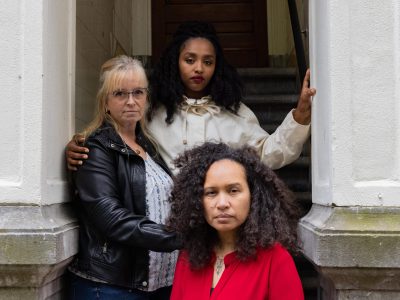
Via a WhatsApp group for victims of the scandal, Franciska Manuputty met Batya Brown, 35,  a part-time employee at a daycare center who is now pregnant with her fifth child. When the two were asked to address an anti-racism demonstration about their experiences they decided to collaborate on their speeches and provide one another with moral support. They were joined by Kristie Rongen, 45, a small truck driver, who had recently  confronted Prime Minister Rutte during a widely viewed live broadcast of a political TV show. 

While Rongen holds only Dutch citizenship, Batya Brown was born in Ethiopia. Manuputty’s parents are from the Maluku Islands, formerly a Dutch colony—now occupied by Indonesia. For the latter two women, their relationship with the Dutch state is informed by their ethnic identities, which is further compounded by the role that racism played in the tax scandal.

Brown was adopted as a child from Ethiopia, arriving in the Netherlands when she was six years old. Because of a bureaucratic error that she is fighting to correct, she is still ineligible for a Dutch passport. Meanwhile, in 2007 the tax authorities began demanding that she repay her benefits . The resulting financial problems forced her to move often and, while the tax authorities recently annulled her remaining debts, her struggle with the immigration authorities continues. In other words, she has been battling with both the tax authorities and the immigration office for her entire adult life.

Manuputty suffers from post-traumatic stress disorder and transgenerational trauma. Her grandfather is a South Mollucan, a member of an Indonesian indigenous group that fought in the Royal Netherlands East Indies Army (KNIL) alongside colonial forces in the Indonesian War of Independence (1945-9), then were brought to the Netherlands after the Dutch reneged on a promise to grant them territorial sovereignty. The Mollucan community feels humiliated to this day by their treatment at the hands of the Dutch. “As a victim of the child benefit scandal, I have been neglected and robbed of my dignity again,” said Manuputty, adding that she felt as though history were repeating itself.

Rongen acknowledged that she presents in her media appearances as a strong woman, which she is; but behind the scenes she is emotionally devastated. “I cry a lot, every day,” she said. Her ordeal with the tax authorities began in 2010, with her debt topping out at €92,000 ($123,000). After four years of debt counselling, the government annulled what was left of that amount and granted her compensation in December 2020. Her battle with psychological trauma is ongoing. She has dedicated herself to helping reunite parents with children they lost to foster care, a calling that provides her with a feeling of purpose. “When a mother messages me for help, I dry my eyes and get going again,” she said. In a matter-of-fact tone she added, “I would prefer not to live anymore. But what would happen to my children if I were no longer here?”

In addition to their media appearances and participation in anti-racism demonstrations earlier this year, the three women have initiated demonstrations of their own, to garner public support and amplify their demands. These include: cancellation of all the victims’ debts by the end of 2021; financial compensation of at least €1 million ($1.16 million) to each victim; and the immediate reunification of parents with children who were taken from them and put into foster care. They also want psychological support. And they want those responsible for the scandal to be brought to justice.

When the government resigned in January the women hoped the new administration would deal with the matter quickly, but they now understand the process will take years. One egregious reason for the slow pace: the commission tasked with defining the amount of compensation that each victim should receive is severely understaffed; at the current rate they will need 975 years to complete their work.

 “Applying for everything costs so much time and energy, which I would prefer to dedicate to my children,” said Batya Brown. Kristie Rongen added: “Instead of asking for more effort from the victims, they should just give every one of them half a million euros to settle the matter. Our lives have been destroyed.” 

Franciska Manuputty agrees. “I have been trying for years to regain my independence by setting up my own business,” she said, explaining that her applications for business loans have all been rejected because the “fraudster” label destroyed her credit rating. “I struggle for freedom, it’s in my genes, but I feel trapped in a prison without walls.”

The women have also reached out to other victims, organizing small events like picnics and activities for children, which they pay for via crowdfunding, just to relax and start healing together. Coming together has energized the women. “Our suffering has become visible,” said one. Then, with tears in her eyes and a voice choked with anger: “Years ago, when he was ten, eleven years old, I promised my oldest son that everything would be okay. He is 16 years old now! I am determined to keep my promise to him.” 
    [post_title] => 'I cry a lot, every day': Victims of the Dutch child benefits scandal fight for compensation
    [post_excerpt] => Thousands of Dutch families were destroyed by financial hardship after the tax authorities falsely accused them of submitting fraudulent applications for childcare tax benefits, requiring them to pay back the allowances they had received in their entirety—plus fines.
    [post_status] => publish
    [comment_status] => closed
    [ping_status] => open
    [post_password] => 
    [post_name] => i-cry-a-lot-every-day-victims-of-the-dutch-child-benefits-scandal-fight-for-compensation
    [to_ping] => 
    [pinged] => 
    [post_modified] => 2026-08-05 23:45:18
    [post_modified_gmt] => 2026-08-05 23:45:18
    [post_content_filtered] => 
    [post_parent] => 0
    [guid] => https://conversationalist.org/?p=3261
    [menu_order] => 171
    [post_type] => post
    [post_mime_type] => 
    [comment_count] => 0
    [filter] => raw
)
‘I cry a lot, every day’: Victims of the Dutch child benefits scandal fight for compensation

WP_Post Object
(
    [ID] => 2601
    [post_author] => 2
    [post_date] => 2021-05-12 00:11:58
    [post_date_gmt] => 2021-05-12 00:11:58
    [post_content] => Simons, who rose to fame as a glamorous television personality, leads an explicitly feminist, radical, intersectional party.

If you want to know how Sylvana Simons came to be the first Black woman in the Netherlands to head a political party elected to the House of Representatives, you’ll need to look back further than her glamorous 25-year career as a model, dancer, MTV host, television personality, and political activist. You’ll have to go back to when she dropped out of school and ran away from home at the age of 14 because there were “rules” she “didn’t agree with,” and then became a single mother at the age of 21, when she had not a penny to her name. 

It is this lived experience that informs Simons’ political views as leader of BIJ1 (“Together”), the explicitly intersectional, feminist and radical political party that she founded in 2016. Simons was elected to the House of Representatives in March, largely on the back of the urban youth vote. 

BIJ1 ran an impressively diverse list of candidates for parliament. Among the top 10 were five Black people, three of them women; a Muslim woman who is disabled; a trans woman; a sex worker; an artist and youth worker; and a woman of Indonesian background (Indonesia is a former colony of the Netherlands). The party’s manifesto breathed intersectionality. 

In April Simons made headlines with a scathing 5-minute speech in the House of Representatives on the failures of the government’s pandemic policies. “It turns out,” she said from the podium in the House of Representatives, “That allowing intensive care units to fill up with the goal of reaching herd immunity is harmful to the economy, harmful to our wellbeing, harmful to our freedom, harmful to our health, and has cost us many lives.” The government’s vaccine rollout had failed, she continued, and her party intended to pursue a parliamentary inquiry into the matter. 
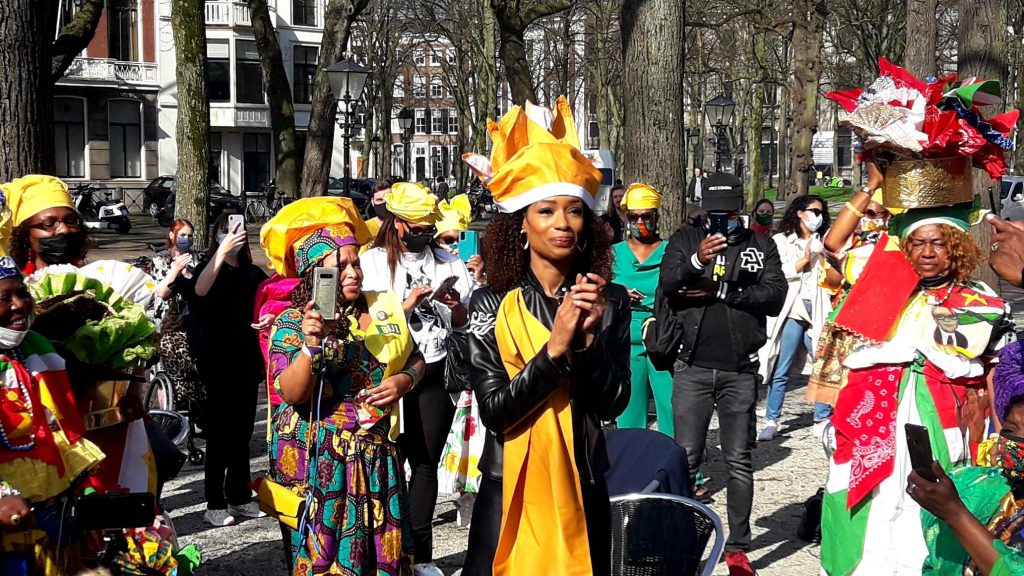
The speech garnered applause and a rush of positive publicity. For Simons, the pandemic debate was an excellent opportunity to show what her party stood for, and to push parliament to hold the government to account—an obligation she accuses them of having neglected. “What kind of country do we want to be?” she asked, rhetorically. “We propose systemic change. Do you want authorities to crush citizens, or to protect and help them?”  Sylvana Simons was born in 1971 in colonial Suriname, four years before the South American country won its independence from the Netherlands—where her family has lived since she was 18 months old. She has been a well-known media figure since the mid-1990s, when she was a presenter for Dutch MTV. But in 2015 her fame morphed into notoriety when, as the host’s side-kick on the popular talk show De Wereld Draait Door (The World Moves On), she pushed back against a guest who used a derogatory term for Black people. The backlash was immediate: Simons was targeted with a tsunami of racist, sexist attacks on social media.  Overnight, the popular media personality became the most hated woman in the Netherlands. The television guest appearances and invitations to give speeches at corporate events dried up, as the establishment rushed to distance themselves from the suddenly controversial Simons. But she told The Conversationalist that she has no regrets. “It was inevitable,” she said. "I had to practice what I preached: speak out if you are in a position to do so." The feminist writer and activist Anja Meulenbelt chuckled appreciatively upon seeing Simons suddenly regaining some of her pre-2015 popularity in the wake of her speech criticizing the government’s failed pandemic policy. Meulenbelt, an icon of 1970s second wave feminism, was one of the first people to join BIJ1. “Sylvana is audacious; she is not afraid of anything,” she said.  BIJ1 had succeeded, asserted Meulenbelt, where the established leftist parties had failed: “We don’t talk about representation; we are representation. We do what other leftist parties [only] talk about.”  The praise Simons received for her pandemic policy speech was remarkable for the frequency with which it was accompanied by disclaimers—such as, “I’m not a fan of hers, but..!” or “I didn’t vote for her, but..!” or “In general I don’t like her, but..!” Simons believes those disclaimers are just temporary. She has the stage now, and no longer needs opinion leaders and journalists for exposure. “People think that because of my anti-racism, my politics are exclusive,” she said, adding that the opposite is true. “My politics aren’t exclusive, but inclusive. I act against power. Against a government and institutions that don’t care about citizens but treat them like tools to keep the economy going. That affects all of us, regardless of the color of our skin. And sometimes that means pointing out that the situation of some groups, like Black people or disabled people, requires extra attention.”  Simons said that her now-famous speech had been “brewing” for a year. But the fluidity and incisiveness of her remarks reveal that she must have been thinking deeply for at least a decade about the issues she addressed so eloquently. Her words reflected a combination of heightened political awareness and outrage over not only the handling of the coronavirus pandemic but also over social justice issues like equality, humanity—and dignity. Part of her impact is based on her understanding of performance, said Aldith Hunkar, an independent Dutch-Surinamese journalist who has known Simons for many years. “She knows like nobody else which camera is pointed at her, and at which moment to look into it,” said Hunkar, who conducted a video interview in English with Simons earlier this month. She added that Simons was completely sincere—as well as “hyper intelligent.” Sheila Sitalsing, a Dutch-Surinamese political columnist for the veteran daily newspaper de Volkskrant, described Simons to The Conversationalist as “sensational,” adding that she has “flawless political intuition” and is “factual, calm, with a sharp eye for the rule of law.”  Simons is a huge fan of Mona Eltahawy, the uncompromising and outspoken Egyptian-American journalist, commentator and activist, but considers herself to be a “diplomat.” In describing her approach, Simons said, “I can find common ground with everybody,” no matter what their background. “I am not bothered by who you are,” she said. “This has to do with my life path.” Now 50 years old, Simons became a grandmother last year. Reflecting on her life as a high school dropout and single mother who started out as a TV dancer and worked her way up, she said. “I say with pride that I have hardly any formal education. I wasn’t flattened by a system that didn’t work for me. I overcame institutional hurdles, including racism and sexism, and despite society’s consistently low expectations of me. I learned to make connections with everybody. I consider that my strength.” But how did that life experience transform into a solidly grounded intersectional worldview seemingly overnight? Where did the theory come from?  Simons mentions Gloria Wekker, a Dutch-Surinamese professor emeritus in gender studies who authored the acclaimed seminal work on Dutch racism, called White Innocence: Paradoxes of Colonialism and Race. Wekker joined BIJ1, taking it upon herself to educate the new party leader—and was struck by how quickly Simons read and understood the texts.  “I asked Gloria which books I had to read,” said Simons. “The books made scientifically tangible what I have lived and felt throughout my life.”  Feminism is, naturally, a big part of the story. But Simons cannot answer the question of which comes first for her—feminism or anti-racism. During the interview, she chooses feminism: “But one cannot exist without the other and I may choose anti-racism next week.” Simons’s feminist, anti-racist message disrupts the Netherlands, a country that sees itself as a beacon of tolerance and progressiveness. She is not the only one speaking out fiercely against Dutch racism. A decade ago, the campaign “Kick out Black Pete” started, aiming to abolish the blackface tradition that pollutes the Dutch Sinterklaas (Santa Claus) festivities. And last year the Black Lives Matter demonstrations were numerous and huge in the Netherlands. Momentum was building for BIJ1’s politics. Surprisingly enough, Simons reveals that 15 or 20 years ago she defended Black Pete from foreign criticism. “I’d tell people to butt out of our traditions, even though I’ve hated Black Pete since I was a child. But I too suffered from internalized racism. You know, we are raised in the Netherlands to say that we don’t ‘see’ color, that it’s all kumbaya, but underneath that layer of kumbaya we deny identities.” Foreigners, in other words, are not the only people surprised to discover racism in the Netherlands. The Dutch themselves are surprised, too. “Our tolerance was a facade we were collectively hiding behind and that has only now started to crumble,” said Simons. Aldith Hunkar, the Dutch-Surinamese independent journalist, agreed. “The Netherlands has built this system over 500 years and it still refuses to see the implications,” she said. “It’s learning very slowly. Simons has changed the discourse already, but it reflects the rigid, dismal Dutch mindset that she is not yet on a pedestal.” Hunkar, 58, resigned in 2007 from a position she held for 14 years as a television presenter for NOS, the state broadcaster, after accusing it of racism in its editorial decisions.  To know where Sylvana Simons is coming from, one must consider those 500 years of Dutch colonial, racist history. On March 31, the day she was inaugurated into parliament, the party gave its leader a present: a traditional Afro-Surinamese religious ceremony, held at a public square close to the parliament building. A priestess offered a libation to ask the ancestors and God to give Simons power and wisdom.  [caption id="attachment_2609" align="aligncenter" width="840"] Afro-Surinamese ceremony honoring Sylvana Simons (center) on March 31.[/caption] Simons said the ceremony made her feel honored: “I was carried by the ancestors. As a child of the colonies, as Simba, the chosen one, I was honored. It meant a lot to me but also for the people who brought me to this point. They didn’t vote for a politician but for their daughter, sister, mother, aunt, and it is completely emotional. It was about spirituality, about keeping the connection with the people who gave their lives for our freedom.” Going forward, Simons will need all her strength. The same election that brought BIJ1 to parliament also handed victories to several fascist parties, some of which have been in the legislature for several years, pulling policies and the discourse to the right side of the political spectrum. Simons hopes to pull them back to the left. “Pictures of the ceremony were shared [online] and those on the extreme-right of the spectrum saw them too. Everybody saw that my community lifted me so high—who can touch me now? It gave me wings. I flew into parliament.” The official inauguration was short. The office assigned to her turned out to be in the former Ministry of Colonies. “That is no coincidence,” said Simons. “It closes the circle.” [post_title] => 'I act against power': Sylvana Simons is proudly disrupting politics as usual in the Netherlands [post_excerpt] => A glamorous television personality for 25 years, Simons has made history as the first Black woman elected to the House of Representatives as head of a political party—and one with an explicitly radical, feminist, intersectional platform. [post_status] => publish [comment_status] => closed [ping_status] => open [post_password] => [post_name] => i-act-against-power-sylvana-simons-the-netherlands-first-elected-female-black-party-leader-is-a-proud-disruptor [to_ping] => [pinged] => [post_modified] => 2026-08-06 21:04:29 [post_modified_gmt] => 2026-08-06 21:04:29 [post_content_filtered] => [post_parent] => 0 [guid] => https://conversationalist.org/?p=2601 [menu_order] => 206 [post_type] => post [post_mime_type] => [comment_count] => 0 [filter] => raw )
A portrait of Sylvana Simons arriving "for a ceremony where Dutch King Willem-Alexander marked the opening of the parliamentary year with a speech outlining the government's budget plans for the year ahead at the Grote Kerk, or Sint-Jacobus Kerk, (Great Church or St. James' Church) in The Hague, Netherlands, Tuesday, Sept. 21, 2021."

‘I act against power’: Sylvana Simons is proudly disrupting politics as usual in the Netherlands