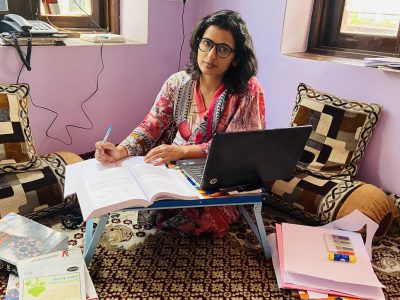
How women artisans in Kashmir are reconnecting with an old tradition to weave new hope.
Every morning, as the sun rises over the old city of Srinagar in Indian-administered Kashmir, 48-year-old Rafiqa Ramzan steps out of her modest home and walks through the maze-like alleys of her neighborhood to catch the bus to work. On the way, she prays at the famous nearby Sufi shrine, Hazrat Makhdoom Sahib (RA), for her 17-year-old son's well-being and the stability of her job.
Ramzan, a single mother, works as a katanvajian—a woman who spins pashmina (cashmere) wool—a craft she learned from her mother when she was just 10 years old. In her youth, she would often compete and spin alongside her friends in her locality, and remembers the soft background noise of the radio, filling the air with old Kashmiri songs and folktales. The job, however, wasn’t sustainable: She continued spinning in adulthood, making it her livelihood, but by her early thirties, the meager wages forced her to give it up. After abandoning her spinning wheel (called a "yinder" in Kashmiri) for over a decade, she only returned to her roots in early 2023 after joining Zaevyul.
Named for the Kashmir word for “delicate,” Zaevyul is a first of its kind artist-centric initiative that operates as a small factory, helping women revive and recreate the region's heritage pashmina shawls. Wajahat Qazi, a writer-turned-entrepreneur, created the initiative in 2022 as a for-profit social enterprise aimed at reviving the historic craft and providing dignified livelihoods to local artisans. Originally, Qazi distributed carded pashmina to women to spin at home, but logistical challenges prompted him to bring the entire production process in-house, something unusual within the industry. However, he soon found that the shift not only improved quality control, but also fostered trust among the women, many of whom come from conservative families.
“It was difficult initially to draw women to this proposition, but once they saw the workspace and the respect they were given, it took off,” he says.
Wajahat Qazi, founder of Zaevyul, providing instruction to a spinner. (Shoaib Mir)
Known as “soft gold,” pashmina was first introduced to Kashmir by the fifteenth century ruler Zain-ul-Abidin, affectionately called Budshah or Great King by his subjects. His reign left a lasting influence on the region's socio-economic fabric, one of which was inviting skilled artisans from Persia (modern-day Iran) to share their expertise with the local population. This included the rigorous techniques of spinning pashmina shawls, still practiced today throughout the region and the fashion world, from Brunello Cucinelli to Louis Vuitton and Hermes.
Over time, pashmina became synonymous with Kashmir's identity. And the women of the region have been an integral part of shaping the industry for centuries, as they are typically its leading artisans. But beginning in 2006, the craft became badly impacted by the influx of cheaper, machine-made imitations, degrading the market for hand-spun pashmina. According to Kashmir's Handicraft Department, there were an estimated 377,000 artisans in the region at the time, nearly half of them women. But as a result of the industry’s decline, dwindling incomes forced thousands of people to leave the craft and seek alternative livelihoods, Ramzan included.
"Before joining Zaevyul, I faced many difficulties,” she says. “I relied on my brothers, and seeing how everything is overpriced broke me inside. The thought of being a burden began to take a toll on my mental health. But by the Almighty's grace, I learned about Zaevyul, which changed my life.”
When she first began earning a living from spinning, Ramzan would take home 1500 to 2000 Rupees per month. The time and effort she invested in the labor-intensive spinning process did not match the meager remuneration she received, which also wasn’t enough to support her son. But now, at Zaeyvul, she earns 8000 to 10000 Rupees per month, and has found so much more than a higher income.
“Before, I would spin pashmina alone at home, but we share our joys and sorrows here,” she says with a smile. “This sense of community has started healing me from within and increased my productivity. Being here gives me a sense of empowerment like someone has given wings to a crippled bird."
Today, Zaevyul employs 40 people, including 30 women, who work as spinners, weavers, and administrative staff, all of whom operate out of a spacious, well-lit karkhana—a manufacturing house specifically designed for artisans. For Qazi, the entire process and purpose of Zaevyul is also multilayered.
“I was struck by the need to create something meaningful,” he says. “My focus turned to the handicraft sector, particularly pashmina, a craft historically sustained by a gendered division of labor—women spun and carded the delicate fibers, while men wove them into luxurious shawls.”
Meemah (who opted to go only by her first name), like Ramzan, also works at Zaevyul as a spinner, and similarly notes the financial stability the venture has given her, alongside improving her mental health and offering her a sense of direction.
“I have often been at the receiving end of the turmoil we’re living in,” she says. “There have been days where I used to feel entirely depressed…I wasn’t myself, and spinning pashmina takes patience. I had to stop. But after learning about this place and joining it, I have been helped a lot, both mentally and financially.”
She shares this as she meticulously spins her pashmina wool in its original white color.
“I pray that we get many more orders and that more women join us. It’s a relief to work in an office-like setting,” she continues. “This place is more than just a workplace. It's a place where we've met other women and formed a community. We're not lonely here. It's a 10-to-4 job with breaks for prayers, meals, and rest.”
Rafiqa Ramzan (in green) spins pashmina alongside her friends at work.(Shoaib Mir)
Zaevyul is especially conscious of honoring this work-life balance, and ensuring the safety of its employees. With approximately 700,000 troops deployed in the region, Kashmir is one of the world's most militarized conflict zones. The ratio of military personnel to civilians is particularly striking, with one soldier for every 30 locals, according to a report by the International Institute for Strategic Studies, a UK-based think tank. This makes everyday commuting for work a tedious endeavor. But Zaevyul provides transportation to alleviate this difficulty, relieving the potential stress it may cause for its workers. Every day, a bus ferries 30 women artisans from different parts of Srinagar to Zeevyul, located in the city’s outskirts.
"Given the political instability in Kashmir, it wouldn't have been possible for me to travel back and forth here without bus service,” Ramzan says as she boards the bus with other artisans to head home. “The environment here is safe, providing us all with a sense of security, for us and our families. Moreover, working here has given me a perfect work-life balance, which wasn't possible when I was spinning day and night alone at home."
Qazi notes that his employees’ continued “economic empowerment” is crucial to maintaining Zaevyul. Hand-spinning pashmina remains a labor-intensive process, and the wages must justify the cost. It also requires immense skill and patience for women who are typically largely responsible for the bulk of household work.
“If you’re not paying them well, it doesn’t make sense for them to dedicate their time to this craft,” he says.
The challenges, however, are manifold. The cost of hand-spun pashmina is significantly higher than machine-spun alternatives, limiting its reach. And while pashmina enjoys global brand recognition, the premium price of handmade products restricts its affordability. This has led to a decline in demand for hand-spun pashmina, which continues to push artisans out of the craft, some never returning.
Despite these hurdles, Qazi is committed to his vision of Zaevyul, continuing to operate on the principles of empathy, authenticity, and ethical production, all while reviving this pristine craft and creating a broader, positive socio-economic impact. It has certainly made a material and monetary difference to all who work there, but also offers them pride and dignity in the work itself.
Looking ahead, Qazi dreams of expanding Zaevyul. The current workspace can accommodate up to 200 women, but financial constraints remain a barrier. His next challenge will be to identify and connect with new markets, conscious consumers, and ethical buyers who are passionate about supporting marginalized artisans and craftspeople.
“Our premise is to revive the craft in its most authentic form and help more women and weavers,” he says.
Like the women he employs, for Qazi, Zaewuyl is more than a business—it’s a movement to preserve Kashmir’s cultural heritage while empowering its artisans, one thread at a time.
[post_title] => Threading the Needle
[post_excerpt] => How women artisans in Kashmir are reconnecting with an old tradition to weave new hope.
[post_status] => publish
[comment_status] => closed
[ping_status] => closed
[post_password] =>
[post_name] => pashmina-kashmir-artisans-cashmere-wool-zaewuyl-collective
[to_ping] =>
[pinged] =>
[post_modified] => 2026-08-03 23:16:26
[post_modified_gmt] => 2026-08-03 23:16:26
[post_content_filtered] =>
[post_parent] => 0
[guid] => https://conversationalist.org/?p=8093
[menu_order] => 25
[post_type] => post
[post_mime_type] =>
[comment_count] => 0
[filter] => raw
)
WP_Post Object
(
    [ID] => 3583
    [post_author] => 2
    [post_date] => 2021-12-09 23:56:55
    [post_date_gmt] => 2021-12-09 23:56:55
    [post_content] => Famous for its delicious honey, Kashmir has seen a decline in artisanal apiculture due to a confluence of political and environmental factors.

GANDERBAL, KASHMIR –Clusters of beehives dot the sprawling lawns outside the Rizvi family home in the Kashmiri village of Shalhar. Bees swarm the flowers and suck the marrow out of colorful petals. Towseefa Rizvi, 49, clad in protective gear, walks toward her hives; she manages 200 colonies of Apis mellifera, often referred to as the European or western honeybee. This district, located about a half-hour’s drive from Srinagar, boasts diverse flora, sprawling apple orchards, and extensive forests that are the reason Kashmir is famous for its uniquely delicious honey.

“I had never thought of doing something like this,” she says, gently opening a hive. “But this unusual job has both challenged and fascinated me.”

A mother of three, Rizvi has been beekeeping for more than a decade. She taught herself the necessary skills by researching online, watching and consulting with local apiarists, and through trial and error. In addition to running her own honey production busines, she now trains and supports new apiarists, especially women in her community. Beekeeping is a popular enterprise, she explained, because startup costs are low.

The average annual turnover from Rizvi’s 200 colonies is about $10,698 (monthly income in rural Kashmir is between $66 and $133). She retains an income of about $4,012 and puts the difference back into the business.

This part of Kashmir is deeply conservative. Women typically look down while walking outdoors; they do not speak in public or visit the homes of strangers unless accompanied by a male family member. Rizvi’s decision to become the first women in her district to launch her own business, let alone in this traditionally male-dominated occupation, was thus deeply unusual. But her husband, Syed Parvaz, 42, has supported her from the beginning; he is now a production manager in Kashmir Valley Agro Industry, which includes their honey-making business (Jammu and Kashmir is the only place in India that produces a rare variety of wild bush honey, he explained.) The couple are committed to releasing the untapped potential of the honey production industry in their region.

Inspired by Rizvi’s example, an increasing number of women from poor families are starting their own apiaries. They look up to her for showing them an income-earning business that they can run from home, a fact that was particularly relevant during the pandemic lockdown. Rizvi and her husband have registered around 500 beekeepers and have trained thousands of beekeepers in neighboring districts.

“I tell them if I can be an entrepreneur with limited education and skills, why can’t they,” says Rizvi. “I started beekeeping when there were hardly any women in the trade, but now we have so many around and if we cannot inspire and support each other then it would be our collective failure.”

The pandemic provided Rizvi with unexpected opportunities. During the lockdown she launched an online school to teach beekeeping, and then a website to sell a variety of products ranging from honey to herbal tea mixtures. She also renewed her commitment to sustainable farming practices, starting with cultivating her own vegetables to compensate for soaring prices and spotty access to markets. Bees, she pointed out, play “a major role” in sustainable agriculture.

[caption id="attachment_3585" align="aligncenter" width="840"] Towseefa Rizvi and Syed Parvez at their honey production facility.[/caption]

Some hope that, with an infusion of knowledge and skills, beekeeping could help revitalize Kashmir’s economy.

Unemployment in the territory is the highest in India, a fact that has particularly hurt people younger than 35, who are 70 percent of the population, and women—72.6 percent of whom are without work. More than two years of political upheaval, military curfews, the longest internet blackout in history, and then the pandemic lockdown, have had a devastating impact. The Kashmir Chamber of Commerce and Industries estimates that the regional economy has lost $7bn since 2019.

But the road to expanding beekeeping into a lucrative business is littered with obstacles, explained Sajad Hussain Parey, professor of entomology at Baba Ghulam Shah Badshah University. The government provides no social security to beekeepers—i.e, they are not insured—or training in modern methods. Most traditional beekeepers are unaware of critical  skills like seasonal hive management and bee pollen collection. As a result, honey production is low; a lack of marketing opportunities further undermines the earning potential of beekeeping. Quality control is also a problem, said Parey, because there is no central institution to monitor and test the honey for purity.

But an infusion of government funding could unleash the potential of Kashmir’s honey industry. What’s needed are training and market access to allow sustainable exploitation of Kashmir’s climate and natural vegetation. With honeybees around the world becoming increasingly vulnerable to climate change and the chemicals used in industrial apiaries, training local people in artisanal beekeeping and modern scientific methodology could create significant employment opportunities. A return to sustainable beekeeping methods would also encourage ecological awareness and rural development, promote small village industry, increase biodiversity —and could double farmers’ income from fruit and vegetable cultivation by complementing it with beekeeping.

Since almost everyone in Kashmir has a house and land, they have the space and means to engage in small and medium scale beekeeping at home, with minimal financial investment.

The regional government is working to generate new business opportunities in the production of bee byproducts like beeswax, propolis, bee venom, and royal jelly. In addition, it is attempting to expand the apiculture sector by increasing the number of beekeeping units, obtaining a GI tag for the region’s honey, and helping farmers increase their incomes by introducing modern technological methods.

Parvez and Rizvi have begun working on Integrated Pest Management to train apiarists in protecting their bees from pests and predators.

“A person should be confident to take care of bees,” says Syed, adding that the couple is in constant touch with institutions, research departments, and independent beekeepers across the world. Through their networks they are learning about skill training, trust building measures, and procurement of plants and machinery, as well as how to diversify their honey products and expand their market opportunities. By setting up sales outlets, they are also learning how to improve the income and employment of the beekeepers, assure sustainability and inspire more young unemployed people to take up the craft.

Rizvi explains that her ambition goes beyond just growing her own business. “The participation of more and more women in this field is my dream,” she said, adding that she is working to create “a sustainable revenue opportunity” for local people.

As Rizvi prepares to inspect her hives, which she does during the evenings, when the bees are less aggressive, she puts on her protective cap and coat. “A blooming garden is my office,” says Rizvi as bees buzz and hum in the hive. “And bees are like my family.”
    [post_title] => ‘Bees are like my family’: A female beekeeper is reviving honey production in Kashmir
    [post_excerpt] => After years of political upheaval, military curfews, months-long communications blockades, and then the devastating pandemic, Kashmir's economy is on its knees. Could beekeeping save it?
    [post_status] => publish
    [comment_status] => closed
    [ping_status] => open
    [post_password] =>
    [post_name] => bees-are-like-my-family-how-a-female-beekeeper-is-redefining-honey-production-in-kashmir
    [to_ping] =>
    [pinged] =>
    [post_modified] => 2026-08-05 18:20:35
    [post_modified_gmt] => 2026-08-05 18:20:35
    [post_content_filtered] =>
    [post_parent] => 0
    [guid] => https://conversationalist.org/?p=3583
    [menu_order] => 157
    [post_type] => post
    [post_mime_type] =>
    [comment_count] => 0
    [filter] => raw
)
WP_Post Object
(
    [ID] => 3121
    [post_author] => 2
    [post_date] => 2021-09-01 05:29:48
    [post_date_gmt] => 2021-09-01 05:29:48
    [post_content] => The regional economy is in a free fall due to political unrest, military closures, and the pandemic.

Five minutes’ walk from Srinagar’s Jamia Masjid, the largest mosque in Kashmir, is a modest two-story house. This is where Sakeena, 73, lives—and where she has been spinning pashmina wool by hand for more than a decade. She’s well known for her skill in spinning the finest and most delicate yarn from the region’s world-famous wool.

Zain-ul-Abidin, the fifteenth-century Sultan of Kashmir, introduced the art of pashmina weaving. He brought craftsmen from Persia to teach the local population various skills, which included making the wool shawls that are to this day a sought-after luxury item around the world. Kashmiri women have long been artisans of this heritage craft.

For Sakeena, weaving was a means of achieving economic stability. Her mother taught her and her two sisters to spin when she was an adolescent; when she married, she bought a spinning wheel (called a “yinder” in Kashmiri) for RS24, or about $0.32, and used her income to supplement the earnings of her husband, who was a tailor. “I used to earn RS150 ($2) for working five hours a day,” she said, explaining that “back then, that was enough for two proper meals.”

Until the 1990s pashmina wool was spun and woven at artisanal centers all over Kashmir. But with the rise of the Kashmiri armed struggle and the Indian government's military response, curfews and lockdowns led to a shift: people are now working primarily from home. A few remaining traditional spinners live in pockets of Srinagar, the capital of Kashmir. Sakeena is one of them, but she said that now there is “either no work or the wages paid are not enough to pay for one proper meal.”

The long military lockdowns of the past few years precipitated the decline of the pashmina industry by preventing or discouraging buyers from visiting the disputed territory. As a result, the number of female spinners has declined from a high of 100,000 in 2007 to just 15,360 in 2021, according to The Directorate of Handicrafts & Handlooms in Kashmir.

“Foreign tourists used to come to Kashmir to buy the shawls,” said Sakeena. But no longer. “My daughters have three yinders that have been lying unused for the last year in our attic,” she lamented, adding that they will sell them if the current situation continues much longer. “The Indian government promises to empower people, but in Kashmir, they are doing the opposite by making us economically weaker,” she said.

The politically unstable situation, the prolonged military lockdowns, and now the pandemic, have pushed the regional economy into a free fall. According to a 2020 report issued by the Kashmir Chamber of Commerce and Industry, more than 100,000 private sector jobs were cut after August 2019, when the Modi government precipitated an ongoing political crisis by revoking the Muslim-majority territory's limited autonomy.

Adnan Bashir, who owns a pashmina showroom on the banks of Dal Lake, one of Kashmir’s most renowned natural beauty spots, said that the months-long communications shutdown had severely undermined his business. “Around eight international orders were canceled because I was not able to contact the customer [due to the suspension of internet and mobile connectivity],” he said. One customer from Germany canceled a buying trip due to the military curfews. Bashir described his business’s condition as “critical,” and said he might have to look for another way to make a living.

Fahmeeda, a 67-year-old widow who asked that her real name be withheld, reluctantly sold her yinder last year for financial reasons. It had been a gift from her mother, she said, but she needed the money to buy medicine for her son. “This used to be a blessed craft for women like me,” she said, adding that she had supported her children with the money she made from spinning. “Last year, when Kashmir was under strict lockdown, I went out to purchase raw wool but soldiers chased me away by hitting me with their sticks,'' she wept. She now works as a cleaner in a private school for RS800 (just over $10) a month—compared to RS2600 ($35) before the lockdown that began in August 2019.

A recent shortage of raw pashmina has dealt yet another blow to the industry. Ordinarily the wool is imported from Ladakh, which lies on the disputed and ill-defined border between India and China; but in June long-simmering political tension erupted in a military clash that left 20 Indian soldiers dead and caused the suspension of trade between the two regions.

The introduction of power looms presents yet another threat to the 600-year-old pashmina craft. Merchants and artisans led a protest in late June to demand a ban on these looms, which pose a threat to the livelihoods of thousands of Kashmiris. The 1985 Handloom Protection Act forbids the industrialization of pashmina production, said Muhammad Lateef Salati, an activist from a family long engaged in artisanal pashmina production. The government, however, has failed to enforce the law.

Industrially produced pashmina is often sold falsely as authentic traditionally produced wool—a practice that undermines the value of the brand. By failing to enforce the law against manufacturers of mass-produced pashmina, the government shows that it is “not serious” about protecting the craft, said Salati.

Some Kashmiris are trying to safeguard traditional pashmina production by empowering local artisans.

Murcy, the daughter of a family long engaged in traditional pashmina production who divides her time between New Delhi and Srinagar, recently launched Fair Share Cashmere, a socially conscious online business initiative to sell hand-spun shawls made by local artisans. She said that she pays traditional female spinners the highest rate the market will bear. “We have been successful in bringing eight women back to this craft,” she said, adding with a smile that this “feels like a victory.”

The decline of traditional pashmina production in Kashmir has created a vacuum of employment for women who could once depend on the income they made from spinning wool to ensure that their families were fed. Now they are unemployed and, for the most part, voiceless. Murcy is one of a handful of locals who are trying to preserve the remnants of a once-thriving artisanal craft, despite the enormous political and economic challenges.
    [post_title] => 'This used to be a blessed craft for women': In Kashmir, artisanal pashmina weaving is disappearing
    [post_excerpt] => For hundreds of years, Kashmiri women could count on the artisanal craft of spinning, handed down from mother to daughter, to feed their families. Then came martial law and a pandemic.
    [post_status] => publish
    [comment_status] => closed
    [ping_status] => open
    [post_password] =>
    [post_name] => this-used-to-be-a-blessed-craft-for-women-in-kashmir-artisanal-pashmina-weaving-is-disappearing
    [to_ping] =>
    [pinged] =>
    [post_modified] => 2026-08-06 19:33:39
    [post_modified_gmt] => 2026-08-06 19:33:39
    [post_content_filtered] =>
    [post_parent] => 0
    [guid] => https://conversationalist.org/?p=3121
    [menu_order] => 183
    [post_type] => post
    [post_mime_type] =>
    [comment_count] => 0
    [filter] => raw
)
WP_Post Object
(
    [ID] => 2914
    [post_author] => 2
    [post_date] => 2021-07-15 20:11:07
    [post_date_gmt] => 2021-07-15 20:11:07
    [post_content] => The Modi government placed Kashmir under the longest internet shutdown ever imposed in a democracy.

Two prolonged lockdowns in Indian-administered Jammu and Kashmir have taken a toll on the region’s children. The first began on August 5, 2019, when the Modi government unilaterally revoked Article 370 of the constitution, which had guaranteed autonomy for the disputed region since 1947. To pre-empt protests, the government blocked internet access and phone connectivity, while the army deployed soldiers on the streets to implement draconian policies that included arrest and detention without charge, curfews, and mandatory home confinement. Schools and universities were closed for about six months. Two weeks after the military closure was lifted and schools reopened, the government in New Delhi announced a country-wide pandemic lockdown that closed all the schools and colleges in India—indefinitely. But while children in the rest of India were able to attend school online, the government refused to restore internet access in Kashmir.

The two million children of Kashmir missed nearly two years of formal schooling. Meanwhile, those from disadvantaged backgrounds had no means of accessing the internet even when the government restored access. The pandemic has exacerbated the digital divide between India’s rich and poor, since very few parents of children who attend public schools can afford smartphones to access online classes.

For those who live in remote areas that lack infrastructure, internet and mobile connectivity are poor even under normal circumstances. Now, with the pandemic keeping the schools closed, a recent BBC News report shows children in rural villages walking miles and even traversing mountains for an internet signal that might allow them to access their online schoolwork. But the signal is so weak that downloading tutorials can take hours. At that speed, online video classes are impossible.

[caption id="attachment_2923" align="aligncenter" width="740"] Kashmiri children walking home from school in winter.[/caption]

Mental health experts and teachers report that the lockdowns have also exacerbated pre-existing physical and mental health problems, causing trauma that could take generations to heal.

Dr. Majid Shafi, a clinical psychiatrist who treats children and adolescents in the central and southern districts of Kashmir said restrictions on children, who are confined to their homes for long periods during extended lockdowns, has adversely affected their physical, emotional, and cognitive health.

“Almost every parent of kids and teenagers in Kashmir is complaining these days about increased behavioral issues in their children,” said Dr. Shafi, adding that he had seen an “appreciable increase” in symptoms such as a feeling of hopelessness, anxiety, mood disorders, and a decline in academic performance

Isha Malik, a clinical psychologist at a government-run children’s hospital in Srinagar, said the months-long suspension of phone and internet connectivity had severely hampered delivery of mental health-care services. As a consequence, she said, many of her patients had relapsed or seen their symptoms worsen.

Ms. Malik, who also treats psychosocial and mental health problems in children and women at her own clinic in Srinagar, said that drug abuse among adolescents has increased with the lockdowns because they could not “release their pent-up emotions” by meeting up with friends. Data collected by physicians at Kashmir’s Institute of Mental Health & Neurosciences (IMHANS) shows that heroin consumption in Kashmir increased an astonishing 1,500 percent between 2016-19. There are only three addiction treatment centers for the region’s population of 12.5 million.

During the same period of 2016-19, IMHANS found that the number of children hospitalized in psychiatric wards increased from 17,000-30,000. One small survey conducted by a psychologist in Srinagar showed that 72 percent of school-age children said they felt a lack of purpose in life.

But even before the current lockdowns, Kashmir suffered from high rates of mental illness due to ongoing political unrest and repeated military incursions, going back to the 1990s.

According to a 2016 report, co-authored by psychiatrists and researchers from IMHANS and ActionAid International, the mental health situation in Kashmir was already “alarming.” The researchers found that 11.3 percent of the adult population suffered from mental illness, which is significantly higher than the Indian national average of 7.3 percent.

A 2015  study—jointly prepared by Doctors Without Borders, IMHANS, and the University of Kashmir—found that Kashmir was suffering from a mental health crisis of “epidemic proportions,” with 50 percent of women and 37 percent of men suffering from depression and/or PTSD.

In 2019, shortly after the Modi government revoked Kashmir’s autonomous status, the People’s Union for Civil Liberties (PUCL), roughly equivalent to the ACLU in the United States, released a fact-finding report that found the suspension of internet and phone communication had “hugely hampered” the medical system in its efforts to provide mental healthcare to patients in Kashmir—which mirrors the experience of Ms. Malik, the clinical psychologist in Srinagar.

Amit Sen, a New Delhi-based child and adolescent psychiatrist who was part of the PUCL fact-finding team that visited Kashmir in 2019, described his deep concern for the welfare of the region’s children in a powerful essay for The Indian Express. The city of Srinagar had become a ghost town, he wrote, with the children he had seen playing on the street during previous visits now absent. The minority of children who could access mental healthcare were suffering from “acute anxiety, panic attacks, depressive-dissociative symptoms, post traumatic symptoms, suicidal tendencies and severe anger outbursts.” The violent aggression and abuse perpetrated by the military on civilians, wrote Dr. Sen, could take “generations” to heal.
History of school closures
School closures are a familiar aspect of life in Kashmir. Students have called for academic strikes in response to political unrest—particularly after the army and government forces killed civilians. In 2016 there was a student strike to protest the military’s killing of Burhan Wani, a popular 21-year-old militant commander in southern Kashmir. In March 2018, the government closed academic institutions for 32 days, when protests erupted after military shelling resulted in the deaths of five members of a single family, along with two militants. In other words, the more recent lockdowns have only exacerbated long-simmering political tensions.
Digital divide, unequal access
Access Now, an international advocacy group that tracks internet shutdowns across the world, reported in March that the government’s seven-month suspension of Kashmir’s internet access in 2019-20 was the longest in any democracy. According to the group’s analysis, the Indian government blocks internet access more than any country on earth.

The Jammu-Kashmir Coalition of Civil Society, a prominent civil rights group, called the government’s communications blackout “digital apartheid.” Only in February 2021 did the government finally restore 4G mobile data service.

Umar Rashid Bhat, a public school teacher in Chandoosa, a village in northern Kashmir, says that 60 percent of his students are from households living below the poverty line, and thus cannot afford smartphones that would allow them to access online tutorials—or to participate in online classes via conference calls, which some private schools offered during the internet shutdown.

About one in five children attended private schools before the pandemic, but enrolment is dropping because the pandemic has put so many parents out of work and has thus made them unable to pay tuition. Meanwhile, 175,000 children have dropped out of public schools. Sharif Bhat, who heads the Jammu and Kashmir office of Save the Children, said the organization believes many of those children left school in order to find odd jobs that would help support their families during the precipitous economic downturn caused by the long lockdowns.

Shah Fozia Hussain, a government middle school teacher in Seer Shaksaz, a village about 37 miles from Srinagar, noticed that one of her eighth-grade pupils joined her online class after an absence of more than a month. The student told her privately that he had been out working with his father, who had been unable to earn a living for months due to the lockdowns. After saving for several months, the son had been able to buy a smartphone that enabled him to rejoin his class. “I was in tears when I heard his story,” said Ms. Hussain. For the hundreds of thousands of Kashmiri children who are suffering under the government’s decision to place nationalism over their welfare and the ongoing ravages of the global pandemic, owning a smartphone that allows them to access their basic right to an education has become a privilege.
    [post_title] => Kashmir's lost generation of children
    [post_excerpt] => Deprived of internet and phone access, cooped up at home under military lockdown and then a pandemic lockdown, Kashmiri children are under severe mental stress that is putting them in psychiatric words and causing them to turn to heroin.
    [post_status] => publish
    [comment_status] => closed
    [ping_status] => open
    [post_password] =>
    [post_name] => denied-school-internet-access-for-2-years-kashmiri-children-are-anxious-depressed
    [to_ping] =>
    [pinged] =>
    [post_modified] => 2026-08-06 20:38:21
    [post_modified_gmt] => 2026-08-06 20:38:21
    [post_content_filtered] =>
    [post_parent] => 0
    [guid] => https://conversationalist.org/?p=2914
    [menu_order] => 188
    [post_type] => post
    [post_mime_type] =>
    [comment_count] => 0
    [filter] => raw
)
WP_Post Object
(
    [ID] => 2696
    [post_author] => 2
    [post_date] => 2021-06-04 03:39:59
    [post_date_gmt] => 2021-06-04 03:39:59
    [post_content] => Changing attitudes and mentorship programs are nurturing an emerging generation of young women.

Numana Bhat, 34, is a postdoctoral researcher at the La Jolla Institute for Immunology in San Diego, where she focuses on understanding the biology that underlies the immune response to vaccines. Her husband, Raiees Andrabi, is Institute Investigator at the Department of Immunology and Microbiology at Scripps Research, a prestigious non-profit medical research center. Both are from Kashmir, the India-administered Muslim majority territory that has been convulsed by political violence for decades.

India and Pakistan have fought three wars over Kashmir, which is claimed by both countries. Meanwhile, the Indian military has put down popular insurgencies, which began in the late 1980s, with tactics that Amnesty International and Human Rights Watch have described as human rights abuses. Since 1989, more than 70,000 Kashmiris have been killed during these government crackdowns, while more than 8,000 have disappeared. Thousands of people have been detained without charge under the draconian Public Safety Act.

On August 5, 2019, Prime Minister Narendra Modi’s BJP government unilaterally revoked the constitutionally guaranteed autonomous status of the region, further dividing it into two federally governed union territories. The military imposed an unprecedented lockdown, blocking internet access and phone lines and intimidating journalists. As a result, seven million people were cut off from the outside world for several months.

Given the obstacles created by the political turmoil and violence in Kashmir, Dr. Bhat’s academic success is remarkable. And she is not alone; a notable number of Kashmiri women have become prominent scientists, despite periodic and unpredictable outbreaks of militarized violence, a lack of resources, and the pressure of traditional expectations.

After completing her B.A. and Master’s degrees in Kashmir, Dr. Bhat earned a PhD in biomedical sciences from Sanford Burnham Prebys Medical Discovery Institute, a non-profit medical research center in La Jolla, California. There she discovered that “a fascinating molecule called Regnase-1 acts as molecular brakes in antibody producing cells and prevents autoimmunity.”

[caption id="attachment_2698" align="alignnone" width="300"] Numana Bhat in her laboratory.[/caption]

She credits her mother and a dedicated high school biology teacher for endowing her with the tools and curiosity to pursue a career in biomedical science. But other gifted young women are not as fortunate: opportunities and resources for higher education in scientific research are scarce in Kashmir, “although the people themselves, both students and mentors at the university level, are capable of doing great things,” she said.

She added that she had heard about “people in mentoring positions” who made “discouraging remarks” to female students— including explicit pressure to channel their energy into getting married and having children rather than into post-graduate studies.

Nevertheless, Dr. Bhat said, she has noticed an increasing number of young Kashmiri women pursuing graduate studies and careers in scientific research both in India and abroad. She added that younger people were going outside the sciences to choose careers in humanities, journalism and the arts, “which is also quite refreshing to see.”
More challenges for women
Masrat Maswal, 33, is an assistant professor in chemistry at a government college in central Kashmir’s Budgam district.

She grew up middle class in an extended family where attention and money were scarce. Her parents paid more attention to her in high school, where she excelled academically and won praise from her teachers. But she said that Kashmiri society does not make it easy for young women who want to pursue post graduate work and demanding research positions in the sciences. “From the day you are born as a girl in a family in Kashmir, they start to prepare for your marriage; so choosing a career—particularly in science, which needs patience, persistence, hard work, sacrifices and an ample amount of time—is really hard,” she said.

[caption id="attachment_2704" align="alignnone" width="300"] Masrat Maswal at home in Kashmir.[/caption]

Her female students are often deterred from pursuing graduate work in the sciences by social pressures to marry and settle down when they are in their twenties. “We are losing a lot of talent,” she said, “Due to the prevailing socio-cultural norms of our society.”

The lack of proper infrastructure and lab facilities in Kashmir’s colleges also undermines the enthusiasm of both students and teachers, she added.
Family support matters
Amreen Naqash, 31, moved to New Zealand in 2019 to study for a doctorate in pharmacology and toxicology at the University of Otago. In her spare times she mentors students in her native Kashmir who want to pursue graduate studies either in India or abroad. Women, she observed, are showing more interest in looking for fellowships and pursuing graduate work in the sciences at universities outside India.

[caption id="attachment_2702" align="alignnone" width="200"] Amreen Naqash in her lab.[/caption]

“I’m in touch with some promising female undergrads from Kashmir, which makes me so glad,” she said. “It is such a wonderful feeling to guide them as they are in their prime career stage.”

Omera Matoo, 38, has a PhD in marine biology. She is an assistant professor in evolutionary genetics and physiology at the University of Nebraska in Lincoln, where her research is funded by the National Science Foundation (NSF).

Born and raised in Kashmir, Dr. Matoo earned her B.A. and Master’s degrees at Bangalore University, where she became friends with two classmates from different parts of India, both of whom came from families of scientists.

[caption id="attachment_2703" align="alignnone" width="300"] Omera Matoo in her lab.[/caption]

“Looking back, I realize that played a very big role in my career,” she said. All three of them decided to pursue doctorates in the sciences.
Limited opportunities
When Dr. Matoo applied in 2007 for a doctoral program at a university in the United States, she had to travel to New Delhi and Bangalore to take her GRE and TOEFL exams; at the time, there wasn’t a single coaching or test center in Kashmir.

The situation for prospective graduate students has since improved. Thanks to the internet, they can take standardized tests online. Mentoring initiatives like JKScientists have been established, with volunteers offering would-be graduate students help and advice.

“And then there are other Kashmiri scientists across the world who struggled along similar paths before making a mark in their chosen fields; and now they are giving back to their society by mentoring and guiding young students and aspiring researchers.”

Role models and social support structures, said Dr. Matoo, provide positive feedback for young people; this is especially true for female university students in Kashmir, who benefit from having their academic interests nurtured.

Dr Seemin Rubab, a professor of physics at the National Institute of Technology in Srinagar, is regularly approached by young girls from Kashmir for career guidance and counseling.

“Many times I’ve had to counsel their fathers and brothers to let them pursue their academic careers and avail themselves of opportunities outside Kashmir and India,” said Dr. Rubab.

Professor Nilofer Khan, acting Vice Chancellor at the University of Kashmir who has also served as Dean of Student Welfare and founder coordinator of Women’s Studies Centre, confirmed that for years a lack of family support has been a serious obstacle for women who wished to pursue doctoral studies, particularly when they were married with children.

“Very few females used to go for research studies in science subjects,” she said, adding that times were changing and female students were “proving their mettle” in the sciences.

The frequent government-imposed internet shutdowns are a serious problem for students facing application deadlines, said Dr. Matoo. Delayed exams and the lack of access to resources—“all these limiting things have a scale up effect, not to mention the consequences for mental health,” she said. But somehow these obstacles have not undermined the enthusiasm and academic focus of the young women from Kashmir who regularly reach out to her for guidance on making a career in science.

“I am constantly impressed and humbled by their resolve to make a bright future for themselves against all odds,” said Omera. “That gives me a lot of hope and in a way keeps me grounded.”
    [post_title] => Kashmiri women defy patriarchy & politics to pursue careers in the sciences
    [post_excerpt] => A notable number of Kashmiri women have become prominent scientists, despite periodic and unpredictable outbreaks of militarized violence, a lack of resources, and the pressure of traditional expectations.
    [post_status] => publish
    [comment_status] => closed
    [ping_status] => open
    [post_password] =>
    [post_name] => kashmiri-women-defy-patriarchy-politics-to-pursue-careers-in-the-sciences
    [to_ping] =>
    [pinged] =>
    [post_modified] => 2026-08-06 21:00:05
    [post_modified_gmt] => 2026-08-06 21:00:05
    [post_content_filtered] =>
    [post_parent] => 0
    [guid] => https://conversationalist.org/?p=2696
    [menu_order] => 199
    [post_type] => post
    [post_mime_type] =>
    [comment_count] => 0
    [filter] => raw
)



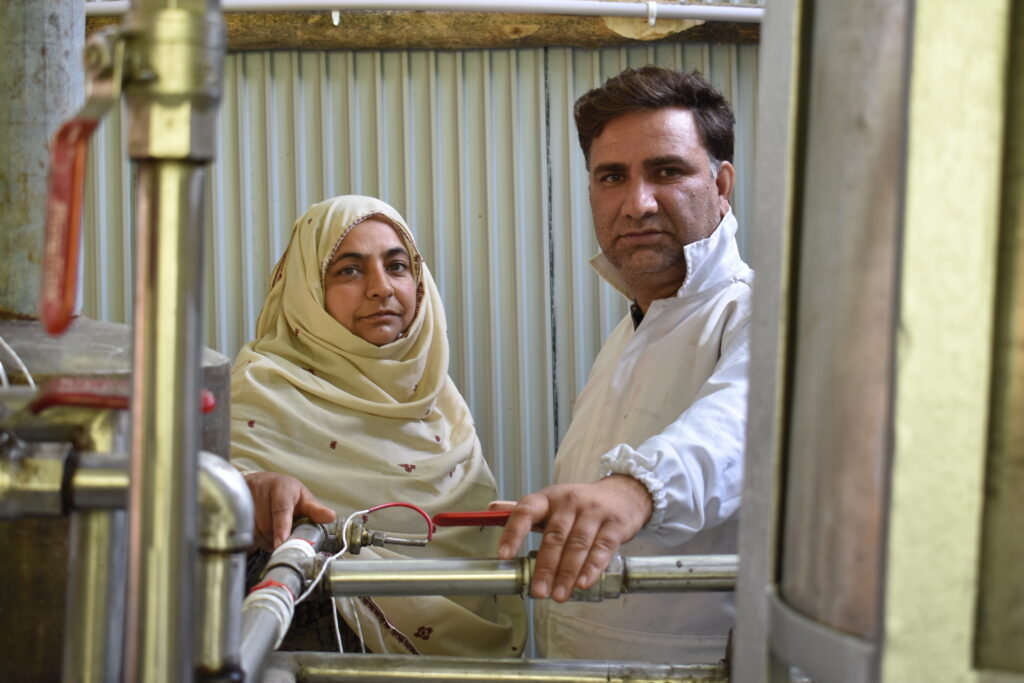 Towseefa Rizvi and Syed Parvez at their honey production facility.[/caption]
Some hope that, with an infusion of knowledge and skills, beekeeping could help revitalize Kashmir’s economy.
Unemployment in the territory is the
Towseefa Rizvi and Syed Parvez at their honey production facility.[/caption]
Some hope that, with an infusion of knowledge and skills, beekeeping could help revitalize Kashmir’s economy.
Unemployment in the territory is the 
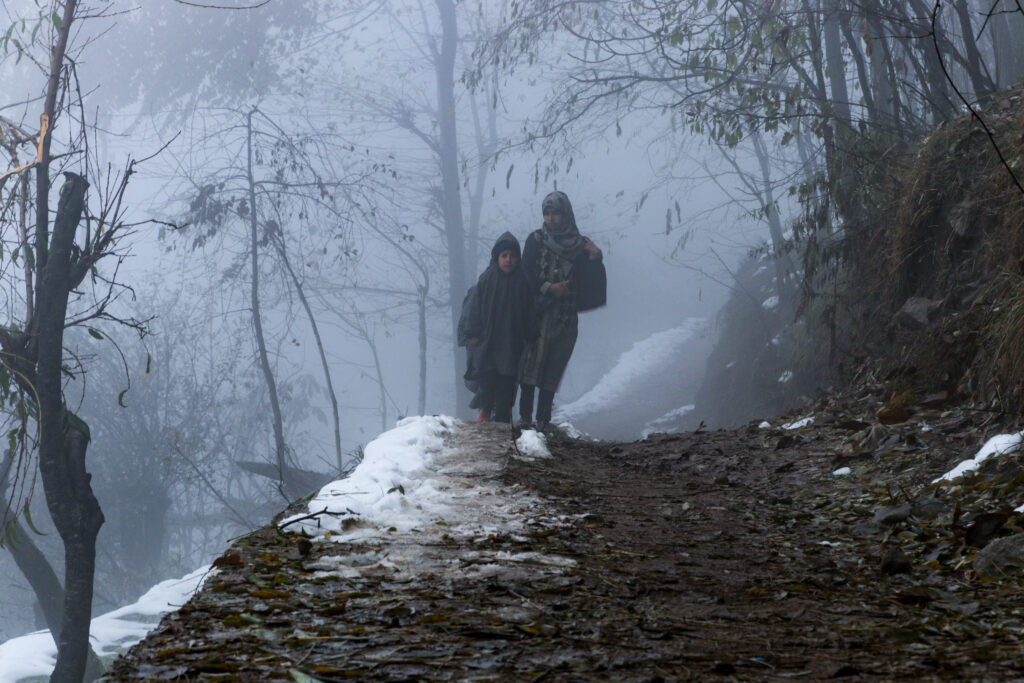 Kashmiri children walking home from school in winter.[/caption]
Mental health experts and teachers report that the lockdowns have also exacerbated pre-existing physical and mental health problems, causing trauma that could take generations to heal.
Dr. Majid Shafi, a clinical psychiatrist who treats children and adolescents in the central and southern districts of Kashmir said restrictions on children, who are confined to their homes for long periods during extended lockdowns, has adversely affected their physical, emotional, and cognitive health.
“Almost every parent of kids and teenagers in Kashmir is complaining these days about increased behavioral issues in their children,” said Dr. Shafi, adding that he had seen an “appreciable increase” in symptoms such as a feeling of hopelessness, anxiety, mood disorders, and a decline in academic performance
Isha Malik, a clinical psychologist at a government-run children’s hospital in Srinagar, said the months-long suspension of phone and internet connectivity had severely hampered delivery of mental health-care services. As a consequence, she said, many of her patients had relapsed or seen their symptoms worsen.
Ms. Malik, who also treats psychosocial and mental health problems in children and women at her own clinic in Srinagar, said that drug abuse among adolescents has increased with the lockdowns because they could not “release their pent-up emotions” by meeting up with friends. Data collected by physicians at Kashmir’s Institute of Mental Health & Neurosciences (IMHANS)
Kashmiri children walking home from school in winter.[/caption]
Mental health experts and teachers report that the lockdowns have also exacerbated pre-existing physical and mental health problems, causing trauma that could take generations to heal.
Dr. Majid Shafi, a clinical psychiatrist who treats children and adolescents in the central and southern districts of Kashmir said restrictions on children, who are confined to their homes for long periods during extended lockdowns, has adversely affected their physical, emotional, and cognitive health.
“Almost every parent of kids and teenagers in Kashmir is complaining these days about increased behavioral issues in their children,” said Dr. Shafi, adding that he had seen an “appreciable increase” in symptoms such as a feeling of hopelessness, anxiety, mood disorders, and a decline in academic performance
Isha Malik, a clinical psychologist at a government-run children’s hospital in Srinagar, said the months-long suspension of phone and internet connectivity had severely hampered delivery of mental health-care services. As a consequence, she said, many of her patients had relapsed or seen their symptoms worsen.
Ms. Malik, who also treats psychosocial and mental health problems in children and women at her own clinic in Srinagar, said that drug abuse among adolescents has increased with the lockdowns because they could not “release their pent-up emotions” by meeting up with friends. Data collected by physicians at Kashmir’s Institute of Mental Health & Neurosciences (IMHANS) 
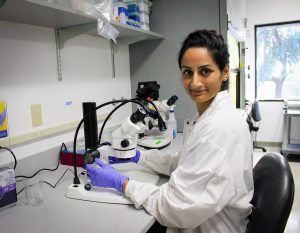 Numana Bhat in her laboratory.[/caption]
She credits her mother and a dedicated high school biology teacher for endowing her with the tools and curiosity to pursue a career in biomedical science. But other gifted young women are not as fortunate: opportunities and resources for higher education in scientific research are scarce in Kashmir, “although the people themselves, both students and mentors at the university level, are capable of doing great things,” she said.
She added that she had heard about “people in mentoring positions” who made “discouraging remarks” to female students— including explicit pressure to channel their energy into getting married and having children rather than into post-graduate studies.
Nevertheless, Dr. Bhat said, she has noticed an increasing number of young Kashmiri women pursuing graduate studies and careers in scientific research both in India and abroad. She added that younger people were going outside the sciences to choose careers in humanities, journalism and the arts, “which is also quite refreshing to see.”
Numana Bhat in her laboratory.[/caption]
She credits her mother and a dedicated high school biology teacher for endowing her with the tools and curiosity to pursue a career in biomedical science. But other gifted young women are not as fortunate: opportunities and resources for higher education in scientific research are scarce in Kashmir, “although the people themselves, both students and mentors at the university level, are capable of doing great things,” she said.
She added that she had heard about “people in mentoring positions” who made “discouraging remarks” to female students— including explicit pressure to channel their energy into getting married and having children rather than into post-graduate studies.
Nevertheless, Dr. Bhat said, she has noticed an increasing number of young Kashmiri women pursuing graduate studies and careers in scientific research both in India and abroad. She added that younger people were going outside the sciences to choose careers in humanities, journalism and the arts, “which is also quite refreshing to see.”
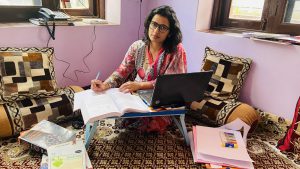 Masrat Maswal at home in Kashmir.[/caption]
Her female students are often deterred from pursuing graduate work in the sciences by social pressures to marry and settle down when they are in their twenties. “We are losing a lot of talent,” she said, “Due to the prevailing socio-cultural norms of our society.”
The lack of proper infrastructure and lab facilities in Kashmir’s colleges also undermines the enthusiasm of both students and teachers, she added.
Masrat Maswal at home in Kashmir.[/caption]
Her female students are often deterred from pursuing graduate work in the sciences by social pressures to marry and settle down when they are in their twenties. “We are losing a lot of talent,” she said, “Due to the prevailing socio-cultural norms of our society.”
The lack of proper infrastructure and lab facilities in Kashmir’s colleges also undermines the enthusiasm of both students and teachers, she added.
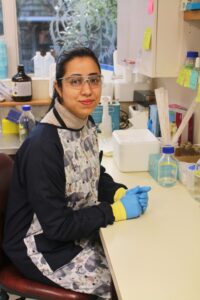 Amreen Naqash in her lab.[/caption]
“I’m in touch with some promising female undergrads from Kashmir, which makes me so glad,” she said. “It is such a wonderful feeling to guide them as they are in their prime career stage.”
Omera Matoo, 38, has a PhD in marine biology. She is an assistant professor in evolutionary genetics and physiology at the University of Nebraska in Lincoln, where her research is funded by the National Science Foundation (NSF).
Born and raised in Kashmir, Dr. Matoo earned her B.A. and Master’s degrees at Bangalore University, where she became friends with two classmates from different parts of India, both of whom came from families of scientists.
[caption id="attachment_2703" align="alignnone" width="300"]
Amreen Naqash in her lab.[/caption]
“I’m in touch with some promising female undergrads from Kashmir, which makes me so glad,” she said. “It is such a wonderful feeling to guide them as they are in their prime career stage.”
Omera Matoo, 38, has a PhD in marine biology. She is an assistant professor in evolutionary genetics and physiology at the University of Nebraska in Lincoln, where her research is funded by the National Science Foundation (NSF).
Born and raised in Kashmir, Dr. Matoo earned her B.A. and Master’s degrees at Bangalore University, where she became friends with two classmates from different parts of India, both of whom came from families of scientists.
[caption id="attachment_2703" align="alignnone" width="300"]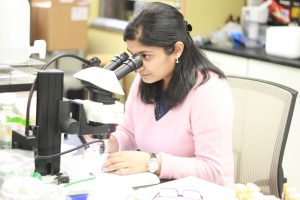 Omera Matoo in her lab.[/caption]
“Looking back, I realize that played a very big role in my career,” she said. All three of them decided to pursue doctorates in the sciences.
Omera Matoo in her lab.[/caption]
“Looking back, I realize that played a very big role in my career,” she said. All three of them decided to pursue doctorates in the sciences.