WP_Post Object
(
    [ID] => 1346
    [post_author] => 2
    [post_date] => 2019-08-23 16:48:03
    [post_date_gmt] => 2019-08-23 16:48:03
    [post_content] => More people are currently fleeing war and extreme poverty than at any time in history, but those who try to help often face criminal charges

The United Nations High Commissioner for Refugees (UNHCR) reports that 839 people have already died in 2019 trying to cross the Mediterranean. In 2018, the number of dead or missing was 2,277. At its height in 2016, 5,096 people died at sea. These are desperate people fleeing war and extreme poverty. But no state will take responsibility for them. 

Yet even as international accountability for human rights violations becomes a hollow joke, there are people who have taken it up themselves to dedicate their lives to rescuing and helping refugees, no matter what the personal cost. These are idealistic people who also have a firm grasp on reality: they know they cannot save the world, but they believe that capitulating to helplessness is not an option.

Salam Aldeen is the founder of Team Humanity, a Danish nonprofit dedicated to helping refugees who made the perilous journey across the Mediterranean to the Greek island of Lesbos. A Dane of Iraqi-Moldovan descent, Salam flew to Lesbos in 2015 to begin sea rescue operations two days after seeing the now-iconic image of Alan Kurdi, the three year old Syrian boy whose body washed up on a beach in Turkey. Alan and his family had been trying to reach Europe in an inflatable raft.

In January 2016, Greek authorities arrested Salam and four other humanitarian volunteers after they responded to a distress call from a group of refugees on a sinking rubber raft. The arresting officers accused them of crossing into Turkish waters with the intent to traffic refugees into Greece. Salam spent 48 hours in jail, and then two more years on trial, with prosecutors seeking a life sentence. The five men were acquitted of all charges in May 2018 and Salam immediately went back to work, this time building a women and children’s center adjacent to Moria, a notorious refugee camp on Lesbos that is known for violence and horrifying conditions. Moria was built for 3,000 people but shelters more than three times that many, mainly Syrian refugees and Afghan asylum seekers. 

The Team Humanity center is a reprieve for the 1,500 women and children who use it daily. “All women and children are welcome,” Salam said, noting that 11 is the cutoff age for boys. There’s a playground, and space for people to gather to dance, listen to music and watch movies. The center is funded entirely through private donations from all over the world. The money goes toward providing camp residents with necessities like food, diapers, winter clothes, and underwear. Salam gets wistful when he talks about building a school. “I don’t have funds for chairs and tables.”

On August 11th, the night of the Muslim festival of Eid-al-Adha, a group of men attacked the women’s center. “It was Eid, Ramadan had finished and everyone was happy. People went out. But then some troublemakers started making problems,” Salam says. 

https://vimeo.com/355385248

Salam described a scuffle between camp residents, which included a drunk man, volunteer security people restraining him, and a woman who screamed and pretended to faint. “It was all over quickly, Salam says. “She fainted for attention, it was a joke, and the drunk guy apologized.” But then, he says, a rumor started in the camp that someone had hit the woman. Salam estimated that between 100 to 200 men from Moria showed up, angry. There were only 26 volunteers working at the time, with additional women and children inside. When some men began to climb over the fence, Salam chased after them with sparklers and they ran off. 

https://vimeo.com/355385512

The local Greek police took an hour to arrive. “They don’t want to help. They don’t want us to be there. They want us to suffer so we go home,” Salam says. 

On August 14th, the Greek police returned, this time to rearrest Salam. “The police said the fireworks that I used to protect us were illegal,” Salam says. “They held me for over two hours, and at the same time brought someone in to report me for hitting him. I don’t know what they promised him for that, but it’s so corrupt.” 

He doesn’t expect the harassment will stop. Salam says he received a letter from the United Nations last week, also sent to the Greek government, which condemned the legal actions taken against Salam and the criminalization of humanitarian aid. Still, his biggest hope is for celebrity intervention — a “We are the World” moment to capture international attention.

Salam Aldeen is not the only humanitarian volunteer facing legal charges for aiding refugees. Pia Kemp, the German captain of a ship that was impounded for rescuing migrants at sea, recently announced she was turning down a medal from the city of Paris. Addressing the mayor of Paris, Kemp wrote in a Facebook post, “Madame Hidalgo, you want to award me a medal for my solidarian action in the Mediterranean Sea, because our crews 'work to rescue migrants from difficult conditions on a daily basis'...while you raid protests and criminalize people that are standing up for rights of migrants and asylum seekers. You want to give me a medal for actions that you fight in your own ramparts." Kemp reportedly faces 20 years in prison in Italy on charges of aiding in human trafficking.

There is no humanitarian exception to the European Union Directive that criminalizes aiding illegal migration. The burden of hosting refugees and asylum-seekers falls heavily on Mediterranean countries due to the Dublin Regulation, an EU law which states that people seeking asylum are the responsibility of the first European country they land in. At the same time, whistleblowers in the Greek government have accused the state of misappropriating EU funds meant for refugees, and awarding inflated contracts to local businesses. As Salam put it, “Finance crisis, bullshit, I see new cars. They didn’t have them in 2015, now they do.”

In Denmark, Salam’s home country, the government’s laws and rhetoric are increasingly anti-immigrant. In 2016, Denmark passed the controversial “jewelry law,” which allows the government to confiscate valuables from refugees to pay for their care. The law has not been enforced, but the symbolism remains. “I’m ashamed that Denmark doesn’t take refugees. That’s why I’m here helping people. I’m trying to show that it’s not every Danish person that feels this way,” says Salam. 

In 2018, Arizonan geography teacher Scott Warren was charged by Border Patrol with three felonies for aiding a pair of Central American migrants. His trial resulted in a hung jury. Federal prosecutors have refused to drop the charges since the mistrial, and plan to retry Warren on two felony harboring charges in November.

Warren’s case, like his European counterparts, failed in court because prosecutors could not prove intent to commit a crime. Still, Warren’s arrest is part of an escalating attack on humanitarian volunteers, who for years have put out jugs of water for dehydrated migrants traversing the desert along the United States’ southern border.

Migration flows will increase as the planet warms and regions become uninhabitable. The post-World War II liberal order, built upon freedom of movement and freedom from persecution has failed. The Refugee Convention was not written to account for massive influxes of people fleeing widespread violence and climate change. Permanent impermanence has been normalized - the most obvious example being Palestinian refugees, who were placed under their own UN agency in order to sidestep UNHCR. 

Ironically, during World War II, Syria played host to thousands of European refugees. Now that the tables have turned, Europeans are treating the refugee crisis like a game of hot potato, selling out basic principles in order to keep Muslims out. What began with a 2016 deal to return refugees to Turkey was followed by an even worse deal with Libya

In America, our government has behaved no better. Just this week, the Trump administration announced a new policy that would allow for indefinite detention of migrant families and children. Meanwhile, Haitians who have lived for decades on Temporary Protected Status (TPS) now face deportation since the Trump regime denied them renewal. 

The crackdowns are real, and until new institutions are constructed to provide accountability, legal or otherwise, we’ll return to the same solutions humanity has used throughout history. 

There’s a Jewish teaching, naaseh v'nishma, which means “we will do and we will hear.” If somebody shows up to your doorstep, feed them, give them a bed, and ask questions in the morning.

Tyrants have always used vulnerable populations as pawns in their games with one another. But there have always been people willing to sacrifice their bodies and voices for others. 

Salam and his family arrived in Denmark in 1992 after fleeing civil war in Moldova, but he insists that his past is irrelevant to what he’s doing now. “Everyone can do what I do. No money in the world can give you the feeling you get when you’re saving a human from drowning. I can’t explain it to you because it’s something insane. Giving a baby back to their mother after pulling them from the water, that is something I’ll never forget. People if they want to do something — know one thing — don’t think that you will get something back, but you’ll get peace with yourself. That feeling when you help somebody, this is your reward. You’ll understand, I did something good. Because one day, maybe it’s you who is going to run.”
    [post_title] => 'Saving lives is not a crime': When ordinary people sacrifice everything in the name of humanity
    [post_excerpt] => Tyrants have always used vulnerable populations as pawns in their games with one another. But there have always been people willing to sacrifice their bodies and voices for others. 
    [post_status] => publish
    [comment_status] => closed
    [ping_status] => open
    [post_password] => 
    [post_name] => saving-lives-is-not-a-crime-when-ordinary-people-sacrifice-everything-in-the-name-of-humanity
    [to_ping] => 
    [pinged] => 
https://vimeo.com/355385512
    [post_modified] => 2026-08-06 23:24:21
    [post_modified_gmt] => 2026-08-06 23:24:21
    [post_content_filtered] => 
    [post_parent] => 0
    [guid] => https://conversationalist.org/?p=1346
    [menu_order] => 305
    [post_type] => post
    [post_mime_type] => 
    [comment_count] => 0
    [filter] => raw
)

‘Saving lives is not a crime’: When ordinary people sacrifice everything in the name of humanity

WP_Post Object
(
    [ID] => 1323
    [post_author] => 2
    [post_date] => 2019-08-16 18:54:45
    [post_date_gmt] => 2019-08-16 18:54:45
    [post_content] => 

Theresa May was the only one willing and able to take on the job of trying to clean up the mess the boys made, but it was an impossible task.

Things started going downhill in the United Kingdom about 38 months ago. Well, it could be 41, if you really want to be precise. In February 2016, then-Prime Minister David Cameron announced that there would be a referendum on Britain’s membership of the European Union. The choice was between “Leave” and “Remain.”  At the time, the widely-held assumption was that the Remain campaign would win, with Cameron staying on for a few more years, and then eventually handing the reins to another Conservative politician of his choosing.

The results of the June 23, 2016 referendum shocked liberal Britons in particular and the world in general, just as much as the election of Donald Trump shocked Americans and the world four-and-a-half months later.

It is now August 2019 and Britain is getting ready to leave the bloc without a deal. Boris Johnson, the new prime minister and one of the leaders of the Leave campaign, has said a hard Brexit is his wish. Johnson replaced Theresa May on July 24, after she resigned in light of her failure to broker a deal to exit the EU that would satisfy her own party.

Remain voters feel ignored and unhappy; soft Brexit voters feel things are going too far and are unhappy; hard Brexiteers do not believe that Britain will leave the EU and are unhappy. The country is fractured and no person or party looks capable of bringing everyone together again.

David Cameron, meanwhile, is getting ready to publish his memoirs, which he reportedly wrote in a bespoke £25,000 ($30,000) shed, complete with wood-burning fireplace and sofa-bed, in the garden of his “quintessentially English” Cotswolds home. So, what went wrong?

The main answer, as it often is, comes from the hubris of men. First Cameron, with his unearned confidence, called the referendum to quell internal disagreements in his party. He was certain that he would win, and then he did not.

As the Remain campaign discovered slightly too late, a country that had just gone through six years of savage cuts to public services did not take kindly to the architects of said austerity warning them that if they voted to leave, there might be less money in the coffers. Many banks warned they would leave Brexit Britain, but such threats were not exactly convincing to those on the breadline, who had little hope of becoming more prosperous anytime soon.

The Remainers were convinced they would win easily, and were not ready for the Brexiteers’ intense, relentless and occasionally disingenuous approach to campaigning. Instead, they spent too much time trying to counter dubious claims about the EU, and not enough reminding people why the EU was a good thing for the country.

As one writer put it in the aftermath, “In confronting populist demagoguery, it isn't enough to attack its promulgators. To get people to turn out and vote in your favor, you also have to give them something positive to rally behind.”

That the debate was overwhelmingly male had something to do with this disastrous turn of events, perhaps. In May 2016, Labour grandee Harriet Harman hit out against the lack of female voices leading the referendum campaigns; she quoted a study, which found that only 16% of television appearances on EU issues had been women. She was largely ignored.

A month later Leave won, by 52% to 48%, and no-one quite knew what to do. After all, damaging over-confidence had not been a side-specific issue; when Conservative MPs Boris Johnson and Michael Gove gave their victory speeches on June 24th, they looked terrified.

It is now clear that senior figures in the Vote Leave campaign had spent little time preparing for what would happen if they were to win, instead running a campaign conveniently promising all things to all people. Do you want Britain to be a buccaneering nation, ultra-liberal and open to the world? Brexit can make that happen. Do you yearn for the Britain of the past, and wish your country could shut itself from the world, and from the people wanting to move to the islands? There’s a Brexit for that — and so on.

David Cameron, who was a Remainer, resigned from his office and retired from politics after the Leave campaign won the referendum that he had called. Within weeks Theresa May, who was also a Remainer, replaced him. She was not quite the best candidate, but she was the only one willing and able to take the job.

Boris Johnson, the face of the Vote Leave campaign, wanted to run for party leadership. But Michael Gove, the other face of Vote Leave, stabbed him in the back; Gove ran instead, and the party didn’t back him. The boys had made a mess and as is so often the case, a woman had to come in and pick up the pieces, much to the glee of the boys in question. As May won, one male Conservative MP welcomed the news with a hearty “here comes Mummy!” Dry heave is appropriate.

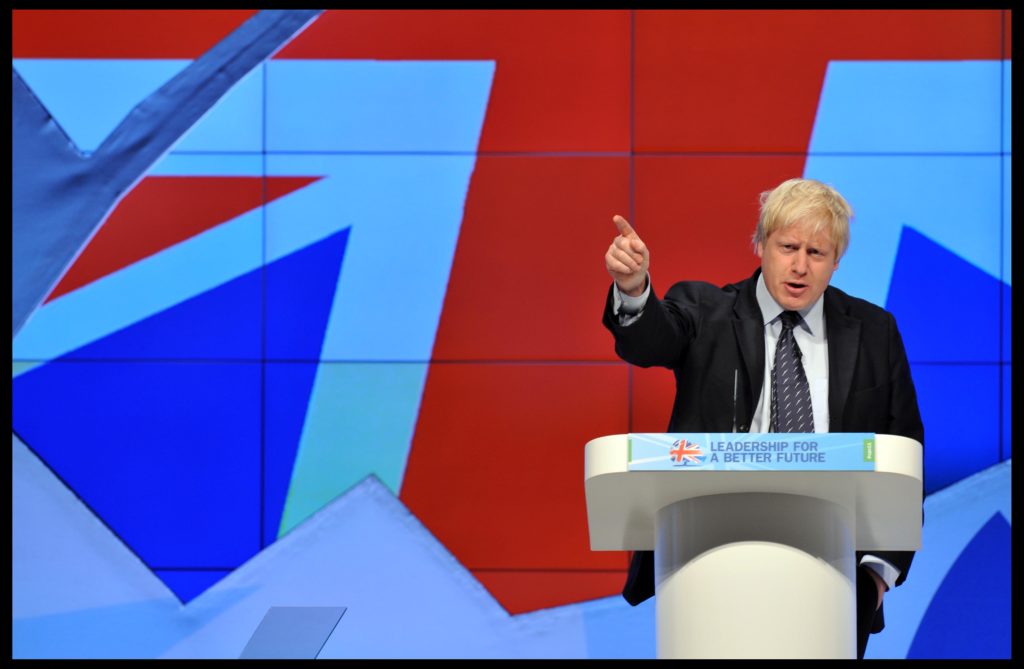
[caption id="attachment_1324" align="aligncenter" width="640"] Boris Johnson addressing the Conservative Party Conference in Manchester on October 4, 2011.[/caption]

This is where things could have picked up; the moment when the country could have come together. In a different world, May would have announced that the result of the referendum had been close, and that it called for a Brexit that kept Britain close to the European Union, in order to honour the winning side without alienating the others. Even if unenthusiastic about the compromise, Brexiteers could have rallied around her and accepted their narrow margin of victory, and Remainers could have gracefully accepted their defeat and constructively worked with those who had beaten them.

This, of course, is not what happened. Already in a tough position, May made her own life worse by pandering to the harder Brexiteers and, perhaps overcompensating for her Remainer past, all but ignoring everyone else. The Brexit fanatics used this opportunity to harden their lines every step of the way, while shellshocked Remainers floundered, and failed to do much but yap from the sidelines.

This is when things started to get steadily worse. Entire books could be written about what happened between the summer of 2016 and the summer of 2019, but in short: May called an election to get a bigger majority in Parliament and was instead left with no majority at all, the hard Brexiteers kept voting against the Brexit deal May got because they thought it wasn’t a hard enough Brexit, everyone else wasted more time arguing about whether they wanted no Brexit, a second referendum or a soft Brexit than doing anything else, and in a day of “indicative votes” (test votes), MPs showed that not a single Brexit outcome had a majority in the House of Commons.

If you want to picture it, it was a bit like one of those scenes in cartoon where the unlucky main character slips on a banana peel, stands up, steps on a rake, stands up again and then walks straight into a glass door, on repeat, for three years.

Still, the themes remained similar. There was the hubristic assumption from Remainers that as Brexit negotiations would get worse, enough people would fling back to their side (they didn’t), and the hubristic assumption from Brexiteers that all problems with the negotiations would simply fade away if people started believing in Brexit enough (they didn’t).

In a way, the natural conclusion to all this was always going to be Boris Johnson. The former London mayor is a serial cheater, has an unknown number of love children, no principles to speak of, and is interested in little but power. What he excels at is boisterous self-confidence, and an ability to speak with conviction on anything he believes would be useful for him to talk about. His gaffes are frequent and his blunders dangerous, but to his fans he represents the one true Brexit believer who can deliver on all those impossible promises. As has become received wisdom in Britain, it is sufficient to believe in things very hard in order to make them come true; he may not be fond of the comparison, but Johnson is the Tinkerbell of Brexit, Lost Boys very much in tow.

What happens now remains unclear; Johnson won on a platform of leaving the EU on the October 31st deadline “do or die.” He insists that leaving without a deal is not something he wants, but he will not bring May’s deal back to Parliament for one last go, and there is not enough time to negotiate another deal and get it through the Commons. Still, he believes something will happen therefore it must be true.

Members of Parliament, meanwhile, insist that they will stop Johnson from going for no-deal, despite the awkward fact that there is not much they can do about it. Still, they believe — well, you get the point.

As Westminster tribes keep fighting to see which will make the best Icarus, the country they govern remains entirely split along the lines drawn on June 23rd. Where you stand on Brexit is now as important (if not more) than which party you usually vote for, or any other characteristics identities are usually built upon.

It did not have to be this way, of course. The opportunities for healing were always going to be rare and complex, but they did exist and no-one took them up. After all, doing so would have involved coming to terms with reality, unpleasant and imperfect as it may be. Forty-one months on, Britain stands on the brink of destroying itself for no reason; by the time its economy tanks and it scrambles to rebuild its relationships with the EU and the rest of the world, it will be too late for anyone to be the bigger person.

Given the wider context, it might be unwise to suggest Brits now turn to culture from the continent for advice, but they could do worse than revisit the most famous scene from the cult French movie La Haine: “Heard about the guy who fell off a skyscraper? On his way down past each floor, he kept saying to reassure himself: So far so good... so far so good... so far so good. How you fall doesn't matter. It's how you land!”

https://www.youtube.com/watch?v=Uz9vgtXq_Hs

[post_title] => How less-than-great men brought Britain to its worst hour [post_excerpt] => It is now clear that senior figures in the Vote Leave campaign had spent little time preparing for what would happen if they were to win, instead running a campaign conveniently promising all things to all people. [post_status] => publish [comment_status] => closed [ping_status] => open [post_password] => [post_name] => how-less-than-great-men-brought-britain-to-its-worst-hour [to_ping] => [pinged] => [post_modified] => 2026-08-06 23:24:36 [post_modified_gmt] => 2026-08-06 23:24:36 [post_content_filtered] => [post_parent] => 0 [guid] => https://conversationalist.org/?p=1323 [menu_order] => 306 [post_type] => post [post_mime_type] => [comment_count] => 0 [filter] => raw )
How less-than-great men brought Britain to its worst hour

WP_Post Object
(
    [ID] => 1249
    [post_author] => 2
    [post_date] => 2019-07-26 15:46:59
    [post_date_gmt] => 2019-07-26 15:46:59
    [post_content] => Grassroots groups are organizing to protect undocumented immigrants.

In Passaic, N.J., a teenager refused to open her front door when awakened at 1 a.m., and hid with her parents through the small hours of the morning. In Houston,  Texas, a teenager’s post on Facebook alerted neighbors in a largely Hispanic community to the presence of four Immigration and Customs Enforcement agents in fatigues and bulletproof vests. ICE agents were also rebuffed in Brooklyn, N.Y. In Nashville, a group of neighbors formed a human chain to help shield a father and son from ICE agents as they walked from their truck to their home.

In response to President Trump’s threats to deport undocumented immigrants en masse, immigrant rights organizations mobilized to inform immigrants of their rights, by spreading information sheets on social media, and passing out flyers out in particularly vulnerable communities. What’s more, they’ve been joined in this effort by Democratic politicians and presidential candidates: Chicago Mayor Lori Lightfoot was out distributing Know Your Rights flyers; multiple New York City lawmakers attended a rally protesting the raids; the Los Angeles Police Chief Michel Moore has provoked the ire of federal agents by standing with the L.A. mayor Eric Garcetti as he informed residents that they don’t have to open the door to ICE agents unless the agents have a warrant.

Although the massive raids never materialized as promised, immigrants are more informed and better prepared than ever. And bystanders are also more informed and angrier than ever.

“The unapologetic publicizing of these threatened raids activated a different level of consciousness for allies not directly impacted,” Ambien Mitchell, an advocate at the New Sanctuary Coalition in New York City, told The Huffington Post’s Angelina Chapin. “Citizens are more outraged now than ever.”

“Allies developed sophisticated tools on all ends,” Sarah Cullinane, the director of immigrant rights organization Make The Road New Jersey, told Chapin. “I think this new level of sophistication arises from the constant and repeated threat to immigrant lives.”

Activists have been preparing for these raids since June, when they were first announced by the Trump administration and then subsequently postponed. The L.A. Raids Rapid Response Network run by the Coalition for Humane Immigrant Rights (CHIRLA) hands out copies of a judicial arrest warrant to immigrant families so that they can compare that text to the text of documents that ICE agents may hand them, to verify that the document is in fact a legal arrest warrant, CHIRLA’s Shannon Camacho told Democracy Now!’s Amy Goodman. Adelina Nicholls, from the Georgia Latino Alliance of Human Rights, said that they have visited with or spoken to more than 25,000 people across the state.

However, knowing your rights has its limits. A widely-shared video of ICE agents breaking a car window and dragging out the occupant aroused widespread outrage, but subsequent reporting revealed that the agents had a warrant and acted lawfully. (Although that report did not address an eyewitness’ claims that the agents threatened to shoot her when she asked about a warrant.)

Even if the promised large-scale raids have yet to materialize, the constant threat has created a culture of fear and anxiety for immigrant communities and their allies. Undocumented people worry about going to work every day, but have no choice if they want to continue to pay rent and other bills.

“Raids didn’t happen this weekend to the scale people were expecting them, but just the fear of knowing it could happen, it really terrorizes and traumatizes people in neighborhoods," Daniela Alulema, director of programs for the Center for Migration Studies in New York, told NorthJersey.com. "And that was reflected when you saw restaurants, churches and public places that are usually filled with people, they were just empty.”

Stacy Torres, a sociology professor, noticed a similar lull and depression in Oakland. “On the first day of planned immigration raids across the country last Sunday, eerie quiet settled over Fruitvale, the heavily Mexican and Central American neighborhood where I live in Oakland, Calif.,” she writes.

“Normally bustling places were deserted and somber. The feeling of a community holding its breath hung like a fog. Few vendors roamed the sidewalks selling raspados, ice cream and sliced mango. Missing were the mothers I glimpse from my porch walking with young children toddling alongside or babies expertly wrapped in cloth bound to their backs. The baseball diamond and playing fields of Brookdale Park remained empty. Finally, around 8:20 p.m., with the sky still tinged with faint light, the park filled with children and a group of men playing soccer on a neighboring field. The fog of fear had lifted, allowing everyone to burn energy pent up after a day of hiding.”

Although the threat of violence — the forced expulsion of immigrants is a kind of violence — may make some Americans feel big, places are being hollowed out whether people are forced to leave or not. [post_title] => Living in terror of the knock on the door [post_excerpt] => The constant threat has created a culture of fear and anxiety for immigrant communities and their allies. [post_status] => publish [comment_status] => open [ping_status] => open [post_password] => [post_name] => living-in-terror-of-the-knock-on-the-door [to_ping] => [pinged] => [post_modified] => 2024-08-28 21:11:30 [post_modified_gmt] => 2024-08-28 21:11:30 [post_content_filtered] => [post_parent] => 0 [guid] => https://conversationalist.org/?p=1249 [menu_order] => 311 [post_type] => post [post_mime_type] => [comment_count] => 0 [filter] => raw )

Living in terror of the knock on the door