WP_Post Object
(
    [ID] => 702
    [post_author] => 9
    [post_date] => 2019-03-08 15:33:45
    [post_date_gmt] => 2019-03-08 15:33:45
    [post_content] => In the decade Benjamin Netanyahu has been prime minister of Israel, his right wing narrative has come to dominate the country's political discourse while the progressive minority shrinks, flails, and finds its voice drowned out. But there is a way forward, and the prescription has powerful lessons for American progressives searching for a way to win back the White House

Israel has, over the past decade, appeared to be part of the global wave of right-wing populism. Parties considered far-right just over a decade ago are now seen as moderate, while extreme-right fringe parties are increasingly legitimized. The Svengali-like Benjamin Netanyahu has won every election since 2009. The right wing bloc of parties will probably win again in Israel’s national election on April 9 , with Netanyahu once again forming and heading the governing coalition. 

Israel’s lurch to the right is not, however, the work of a single political figure. Benjamin Netanyahu, the master political puppeteer, rode the right wing wave to buoy his personal fortunes, but his political success is rooted in events and ideas that developed over decades.

A populist narrative

The modern start of Israel’s shift to the right began with the collapse of the July 2000 Camp David Summit between Ehud Barak, then Israel’s prime minister, and Yasser Arafat, the late Palestinian leader. The failure of those negotiations led right-wing leader Ariel Sharon to make a provocative visit in September 2000 to the Jerusalem holy site that the Muslims call Haram al-Sharif; the Jews call it the Temple Mount. That event precipitated the Palestinian uprising that is now called the Second Intifada. During the violent years that followed, Jewish Israeli voters who had, until then, identified as left wing, defected en masse to the center and center right. Their change in political ideology was a response to the narrative proffered by Ehud Barak — i.e., that he had offered Arafat everything at Camp David, and not only had the Palestinian leader refused, but he had then set off the Second Intifada. This is a widely accepted narrative among Israeli Jews today. By 2005, the center had eclipsed the left wing. By 2008, a poll I conducted showed that nearly half of Israelis identified as right wing, up nearly 10 points from before the Intifada. Since then the percentage of voters who self-define as right wing has climbed to the low 50s; meanwhile, the Jewish left has been stable at around 15 percent, ever since the mid-2000s (20 percent of Israeli citizens are non-Jewish Arab Palestinians). Another narrative that has taken root amongst Israeli Jews is that Ariel Sharon made a peace offering in 2005 by unilaterally withdrawing IDF bases and Jewish settlements from Gaza; but that Palestinians responded with rocket fire on southern Israeli towns and a Hamas takeover of Gaza in 2007, which forced Israel into three wars. There are other interpretations of these events, but they have little traction in Israel. Israelis rarely consider the accusation that Ehud Barak is at least partly responsible for the failure of the Camp David talks in 2000 because he tried to dictate the terms with little leeway for negotiations. Or that Israel responded to the Second Intifada with collective punishment, temporary re-occupation of cities, suffocation of Palestinian economic livelihood and, as always, settlement expansion. Israelis definitely don’t recall that Ariel Sharon’s own advisor once said that the withdrawal from Gaza was politically calculated to stymie the peace process, by dividing Palestinians and weakening their leadership. Those arguments never registered in Israeli discourse, which largely explains why there is almost no domestic opposition to Israel’s 12 year-old, ongoing military siege of Gaza. Netanyahu won the 2009 election because he skillfully leveraged the popular Israeli version of recent events, the one about the Palestinians responding with violence to all of Israel’s peaceful overtures. But he combined that narrative with a deeper and older story — one that began more than four decades earlier.

The roots of resentment

In 1977 the Likud beat the Labor party for the first time. It did so by channeling the resentment and anger of Mizrahi Jews, those from Middle Eastern backgrounds, against the Ashkenazi (European) Jews. At the time, Ashkenazi Jews were Israel’s elite, dominating every aspect of the country’s economy, polity, and culture; Mizrahi Jews were the marginalized underclass. This class/ethnic dynamic still exists, although the manner in which it manifests has changed. Prior to 1977, Labor — Ben Gurion’s party — had dominated Israeli politics without interruption since the state’s founding in 1948. The Likud won in 1977 largely based on party leader Menachem Begin’s direct appeal to Mizrahi voters, whom he identified as a constituency that had been neglected by Labor. Since then, generations of Likud voters have remained unstintingly loyal to the party, which they consider the authentic, anti-elitist voice of the people. Netanyahu perpetuated the idea that the “people” vote for the right wing parties, and that a small cadre of the leftist (read: Ashkenazi) elite has for decades been fighting a relentless, bare-fisted battle to maintain their control over Israel’s major institutions — such as the media, for example. The deep-seated populist resentment that helped fuel Donald Trump’s success has plenty in common with the the worldview espoused by Netanyahu’s base. Since the investigation into corruption allegations against Netanyahu began to close in on the prime minister, his narrative has expanded. Now he accuses the Israeli justice system, the Attorney General, the police, and civil society of coming under the influence of the elite that he insists is trying to oust him, a democratically elected leader, from power. He repeatedly accuses them all of succumbing to subversive leftist political pressure to bring him down at all costs. Sound familiar? Many Israelis agree that Netanyahu is the victim of a vast, left-wing conspiracy. The day after the attorney general announced he was likely to indict Netanyahu on criminal charges, 42 percent agreed that the AG had succumbed to pressure from the media and the left. With substantial parts of the public on Netanyahu’s side, and a new level of extremist right-wing parties moving into the political mainstream, the upcoming elections are unlikely to bring a significant change.

How the left can win (again)

But this does not mean that liberals are permanently defeated. There is a way forward. Those who support a progressive agenda must commit to playing a long game, with better strategy. To achieve their goal, progressives can take a number of important steps. First, Israel is in urgent need of a coherent ideological alternative. The left has for years been apologizing for its beliefs and obfuscating its goals, out of fear that the right wing narrative is so all-powerful that anyone who tries to express an alternative view will fail at the voting booth. The result is the perception that the left is hiding something, with the subtext that it is hiding something nefarious. If they want to win, the progressive parties must be clear about their agenda. They should say that they want to end Israel’s occupation of the occupied Palestinian territories; that they want complete separation of religion and state; that they want to strengthen democratic norms; and that they want to strengthen civil society, to integrate minorities and marginalized populations. It wouldn’t hurt to adopt other progressive causes that are generally ignored in Israel, such as climate change. To be sure, Meretz, the party that represents those who are furthest left while still on the Zionist spectrum, openly promotes these basic goals. Meretz also faces the perennial danger of falling below the electoral threshold and seeing its political presence evaporate. Meretz’s problem is partly rooted in the current left-wing camp’s insistence on continuing to promote stale solutions that long ago lost their political credibility. The second major step, therefore, is for the Israeli left to propose new approaches to its core problems. For example: while nearly half of Israelis and a majority of Palestinians believe that a two-state solution is no longer feasible, the left-wing parties cling to this ever-more remote idea. A new generation of activists examining alternative solutions, such as a two-state confederation, can breathe new life into the debate because they recognize the failure of old approaches. Given that just 20 percent of Israeli society (Jews and Arabs) self-identify as left wing, there is no way for the left to win an election solely on votes from its base. Progressive parties need a compelling message that can win over voters from the center and even from the moderate right. In order to achieve this, they will have to swallow a bitter pill: they will have to humanize the right. And that is the third important strategy. Like anyone else, the Israeli left can be guilty of disparaging and dismissing those who disagree with them. But while Israel’s right-wing can afford to alienate their adversaries, the reverse is not true. Progressive forces, if they want to win, will have to forge partnerships. That means reaching out and being inclusive.

Finding common ground

“Reaching out,” however, cannot mean imitating right-wing themes. This fourth point is essential: progressives pretending to be hardline will never win votes. This lesson proves itself time and again; at present, the Israeli Labor party is barely crossing the electoral threshold in surveys, largely for this reason. Appealing to the right without imitating them means searching for specific areas of common cause, and forging partnerships where possible. For example, a majority of Israelis support positions that are generally viewed as liberal and progressive in the United States. Israelis across the political spectrum enthusiastically embrace LGBT rights, including support for surrogacy, adoption and marriage for same sex couples. Israel saw a vigorous wave of #MeToo exposés already in 2016, the year before it began in the U.S., and surveys regularly show high overall support for further gender equality and representation. Israel has a broadly liberal de facto approach to abortion; it has growing support for marijuana legalization, a strong universal health care system and widespread expectations of a strong social safety net.   Instead of assuming that everyone who is fearful of the Palestinians in the midst of a violent conflict is a fascist, progressives should help release Israel’s inner liberal spirit. This final prescription might not end the occupation overnight. But in the long game, perhaps Israeli Jews will recognize that their policies in the occupied territories are antithetical to the kind of society the majority wishes to build at home. There are lessons for American progressives in this prescription for Israeli politics. Pandering to the right will never be a winning case for voting left. Clarity about values, acknowledging what didn’t work in the past, and creative policymaking for the future are much more attractive. That’s the kind of approach that might cause a 2012 Obama voter who defected in 2016, to consider coming home.   Dr. Dahlia Scheindlin is a public opinion expert and a political consultant. Her articles have been published in Foreign Policy, the Forward, Haaretz, the Guardian, and the Huff Po and she is a frequent commentator for the BBC, Aljazeera, and France 24. She co-hosts The Tel Aviv Review podcast and writes regularly for +972 Magazine. Dr. Scheindlin lives in Tel Aviv. [post_title] => Lessons for American progressives from Netanyahu's Israel [post_excerpt] => A strategy for progressives in Netanyahu's Israel has a lot to teach American progressives in the age of Trump. [post_status] => publish [comment_status] => open [ping_status] => open [post_password] => [post_name] => what-american-progressives-can-learn-from-netanyahus-israel [to_ping] => [pinged] => [post_modified] => 2023-11-06 14:24:52 [post_modified_gmt] => 2023-11-06 14:24:52 [post_content_filtered] => [post_parent] => 0 [guid] => https://conversationalist.org/?p=702 [menu_order] => 350 [post_type] => post [post_mime_type] => [comment_count] => 0 [filter] => raw )
Lessons for American progressives from Netanyahu’s Israel

WP_Post Object
(
    [ID] => 408
    [post_author] => 2
    [post_date] => 2019-01-22 14:48:51
    [post_date_gmt] => 2019-01-22 14:48:51
    [post_content] => 

I thought I was doing the right thing, I was obeying orders, and now, of course, I see that it was unnecessary and wrong. But I don’t know what you mean by being upset….I didn’t personally murder anybody. I was just the director of the extermination program at Auschwitz.
—Rudolf Hoess, April 11, 1946 at Nuremberg.

Several years ago I began researching Nazi mens rea, the legal term for a criminal defendant’s mental state at the time a crime is committed, in order to explore what it means to obey unethical orders. How do evil people convince others to do their dirty work? What effect do hateful ideologies and propaganda have on individual agency? Can complicity in crimes against humanity be explained by obedience to hierarchies or coercion?

How does one rationalize or compartmentalize genocide? Towards that end, I compared a Jewish-American Army psychiatrist’s interviews with defendants during the Nuremberg Trials in 1946 to Hannah Arendt’s reporting for The New Yorker on Adolf Eichmann’s kidnapping from Argentina and subsequent trial in Israel in 1961, Eichmann in Jerusalem. You could call it an examination of the banality of evil, the concept Arendt coined while watching Eichmann testify. The project was fascinating, but also sickening and mentally and physically exhausting.

I discovered that any attempt to pin down the origin and nature of atrocities foundered when shifting from systemic failures onto issues of individual moral culpability.

This was especially true when dealing with the testimony of perpetrators. The result was a paradox, described by Emil Fackenheim as the “double move”: to seek an explanation but also to resist explanation.

The Nuremberg Trials disturbed observers not simply with revelations of mass atrocities, but also by the Nazis’ seeming normalcy and lack of remorse. Dr. Leon Goldensohn spent seven months studying the mental health of the Nuremberg defendants on assignment from the U.S. Army. Goldensohn regularly interviewed both defendants and witnesses, 33 in total. His notes were published in The Nuremberg Interviews: An American Psychiatrist’s Conversations with the Defendants and Witnesses.

Goldensohn, himself a Jew, treated the defendants as subjects in a study, hoping for signs of a distinctive Nazi pathology. He didn’t find one. There were common patterns of behavior and repetitive answers, but from Goldensohn’s notes it’s clear that each Nazi made their own impression on the doctor. Defendants for the most part used their time with him to rehearse their testimony.

The basic measure for competence to stand trial at Nuremberg was the ability to tell right from wrong (historically, competence was also measured by an awareness of one’s actions). The tribunal’s authority rested on the notion that individuals act of their own free will and that those who cannot tell right from wrong belong in an insane asylum, not prison.

Of all the defendants, only two were deemed incompetent to stand trial. As for the others, Goldensohn held that psychopathy or sadistic tendencies didn’t necessarily negate one’s ability to distinguish right from wrong. The most repulsive interviews were with Julius Streicher, editor of Der Stürmer, the Nazi tabloidWhile calling himself a Zionist, Streicher was the only defendant wholly unable to contain his anti-Semitic tirades. As Goldensohn put it: “He is of below-average intelligence, but all the same awoke one morning inspired to dedicate himself to becoming an ‘authority on anti-Semitism.’”

In order to get a conviction for each crime, prosecutors at Nuremberg not only had to prove that the Nazis committed the acts, actus reus, but also that they had the requisite mental state or intent when they did. Murder committed intentionally is punished more harshly than a murder committed in the heat of passion.

Since it was impossible to read their minds, this introduced an element of conjecture to the trials. How deliberate was the Final Solution? Who knew when and how far back did the plan go? Hitler was dead, so who was responsible? Why would anyone tell the truth?

The court drama played out over the original charge of conspiracy. Some scholars argue that the prosecution’s wish to prove that the defendants had all collaborated together in an organized conspiracy towards the Final Solution led them to exaggerate the intentionality and coherence of Nazi planning and policy. At trial, defense counsels were quick to point out the enormous confusion of authority in the Third Reich. In the hopes of having the conspiracy charges dismissed, Nazi defendants pled ignorance of the atrocities, blaming the compartmentalized system of Nazi administration.

There is evidence from Goldensohn’s interviews that even during the trial, Hermann Goering, the highest ranking Nazi defendant, was maintaining party discipline in prison. Goering’s plan for the defense was copied by the majority of defendants and involved ignoring the atrocities, or in the alternative, blaming Goebbels and Himmler, both conveniently dead. He disparaged lower-level officials’ claims when they contradicted his own, and proudly took responsibility for all but the extermination camps. No one living would account for those.

Goering was smooth:

We Germans consider an oath of fealty more important than anything….Mind you, I said almost anything. I don’t consider the extermination of women and children as proper even if an oath were taken. I myself can hardly believe that women and children were exterminated. It must have been that criminal Goebbels, or Himmler, who influenced Hitler to do such a dastardly thing.

The disconnect between language and reality was astounding. By Nazi reasoning, Goering’s stolen art was a major disgrace, whereas killing Jews was merely distasteful. In an interview with Otto Ohlendorf, commander of Einsatzgruppe D, one of the paramilitary death squads, Goldensohn couldn’t hide his disgust.

LG: Did your wife know of this business of the Einzatsgruppe?

OO: No.

LG: Have you seen her since 1941–42?

OO: I saw her, but never talked to her about those things. I didn’t think it was good conversation for a woman.

LG: But it’s all right to shoot women, not all right to talk to them about shootings?

OO: In the first place, I didn’t shoot women. I merely supervised.

Hans Fritzsche, one of the few defendants to be released, was the head of the Radio Division in Goebbel’s Ministry of Propaganda from 1942 onwards. His defense:

Pure idealism on my part. I can defend everything point by point. But I won’t try to do that, because everything I did, I did before the world public. On the other side of the picture is the fact that on the basis of my work, 5 million people were murdered and untold atrocities took place. It is purely a question of judgment as to whether a connection can be established clearly between these two things.

Fritzsche felt no personal responsibility for his actions spreading anti-Semitic propaganda. His idealism, aka his Hitler-worship, was to blame. It’s not that they hated Jews, you see. They were simply devoted to the Führer. The Führer made it legal to kill Jews; if it’s legal, it’s not murder.

Fifteen years later, Eichmann still blamed idealism for everything.

The psychiatrists who examined Eichmann pronounced him normal, or as one psychiatrist said, “more normal, at any rate, than I am after having examined him.” Still, the disconnect between systemic crimes and personal culpability remained. By Eichmann’s reasoning, his fixation on the Jewish question was the result of idealism. He was quoted once saying “Had I been born Jewish, I’d have been the most fervent Zionist!” As Arendt explained: an idealist was not merely a man who believed in an idea.

An idealist lived for his idea…and was prepared to sacrifice for his idea everything and, especially, everybody.

Eichmann might have personal feelings on a subject but he would never permit them to interfere with his actions if they came into conflict with his idea. This blind fanaticism allowed for some form of conscience so long as it did not obstruct the Nazi in the execution of his duties. For Eichmann that meant planning the deportation of Europe’s Jewish population.

Hannah Arendt was furious that Eichmann, like the Nuremberg defendants before him, had distanced himself from his crimes through mental gymnastics. She cut to the chase, arguing that he was guilty of crimes against humanity because the subjective element, his mens rea, was objective by virtue of complete obedience to the Führerprinzip. Eichmann not only obeyed orders, he obeyed the law.”

She advocated rethinking criminal intent altogether in cases of crimes against humanity. Arendt seized upon Eichmann’s distortion of Kant’s categorical imperative:

“Act in such a way that the Führer, if he knew your action, would approve it.”

Eichmann had abdicated his ability to think for himself, she said. In relinquishing himself to Hitler, Eichmann became strictly liable for the crimes he committed on Hitler’s behalf.

Strict liability in such cases resolved the issue of criminal intent and made it difficult for those who benefitted from the regime to then disavow it later, as “so-called inner emigrants.”

[Inner emigrants] were people who frequently had held positions, even high ones, in the Third Reich and who, after the end of the war, told themselves and the world at large that they had always been “inwardly opposed” to the regime. The question here is not whether or not they are telling the truth; the point is, rather, that no secret in the secret-ridden atmosphere of the Hitler regime was better kept than such “inward opposition.” As a rather well-known “inner emigrant,” who certainly believed in his own sincerity, once told me, they had to appear “outwardly” even more like Nazis than ordinary Nazis did, in order to keep their secret.

One such emigrant was Oswald Pohl, head of the SS Economic and Administrative Main Office, and witness at Nuremberg. In interviews, Goldensohn pushed back on Pohl’s answers:

Had he ever objected to the whole business?

OP: No. Nobody asked for my opinion. It would have done no good to protest anyway….I did not participate in the murder of the Jews.

I remarked that nevertheless, he did run all the concentration camps.

Yes, but the camps had nothing to do with it….Some of my present wife’s best friends were Jewish. That is proof enough of how I feel.

Such were the totalitarian perversions of the moral and legal order. How did such a distortion take place? It was a deadly mix of ideological fanaticism, authoritarian state structure, intellectual and linguistic conformity, a subjugation of conscience, and ultimately the ability to overcome an innate aversion to human suffering.

South African psychologist Pumla Gobodo-Madikizela conducted prison interviews with the infamous Apartheid death squad leader Eugene de Kock, serving consecutive life sentences and barred from amnesty under the Truth and Reconciliation Commission. De Kock was said to have repented and showed remorse, but in her book, A Human Being Died That Night, Gobodo-Madikizela writes that he exhibited outright similarities to the Nazis, particularly in his views on racism. Just like Eichmann and Streicher’s claims to Zionism, de Kock insisted that his zealously nationalist father equated Afrikaaner nationalism with the ANC’s struggle for freedom, that his father could not possibly have been a racist because he spoke multiple African languages, and “had he been Black, he would have joined the ANC.”

Just this past week, President Trump equated neo-Nazis to the anti-fascist protesters. Richard Spencer regularly equates white pride with black pride. Ben Carson is their Black friend.

When we consider history, we see that such mental gymnastics are not coincidental. If they were unique to Nazis, the Klan would not be marching and lynching postcards would not exist. When Trump said he could shoot someone on Fifth Avenue and his followers would support him, he was right. To paraphrase Nixon, It’s not murder when the President does it.” Destroying society’s moral compass promotes the politics of hate from a practical perspective.

In light of this, we must continue to study the nature of genocide and mass atrocities, not in an attempt to find definitive answers, but rather to illuminate the boundaries of what’s knowable. Expanding our collective imagination of what’s humanly possible is crucial if we’re ever going to stop embracing old horrors with new technologies.

[post_title] => What were the Nazis thinking when they killed all those people? [post_excerpt] => [post_status] => publish [comment_status] => open [ping_status] => open [post_password] => [post_name] => what-were-the-nazis-thinking-when-they-killed-all-those-people-2 [to_ping] => [pinged] => [post_modified] => 2024-08-28 21:11:31 [post_modified_gmt] => 2024-08-28 21:11:31 [post_content_filtered] => [post_parent] => 0 [guid] => https://conversationalist.org/?p=408 [menu_order] => 364 [post_type] => post [post_mime_type] => [comment_count] => 0 [filter] => raw )

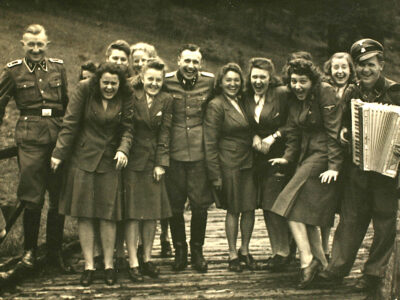
A sepia photo from 1944 of a group of about a dozen Nazi officers and auxiliaries—including Karl Höcker in the center—all openly laughing. The photo was taken at Solahütte, a "resort" where Nazis who worked at Auschwitz would vacation on weekends. They are all in uniform: The women wear long sleeved blazers and knee length skirts with flat shoes, and the men wear long sleeved military jackets and trousers tucked into tall boots. The man on the right is wearing a Nazi hat and is holding an accordion. They're standing on what appears to be a wooden bridge. There is grass behind them.

What were the Nazis thinking when they killed all those people?

WP_Post Object
(
    [ID] => 401
    [post_author] => 2
    [post_date] => 2019-01-22 14:44:10
    [post_date_gmt] => 2019-01-22 14:44:10
    [post_content] => 

By American exceptionalist logic, the United States is rich because Americans are good people who make good choices. Russians suffer because they’re dirty liars who don’t want to be happy.

As the Trump-Russia scandal continues to unravel, no one blinked when former Director of National Intelligence James Clapper said, “It is in [the Russian people’s] genes to be opposed, diametrically opposed to US and western democracies.” Excuse me? I had no idea that my DNA depended on an outdated, racist clash of civilizations. Tell me, sir: as a Russian-American Jew, will medical tests show trace amounts of Fifth Column in my blood?

Many will argue that statements like Clapper’s should be taken seriously but not literally. Even metaphorically, however, the statement is crap. The Russian people cannot be reduced to Putin’s regime, nor do they have an inherited cultural defect which can cured by exporting American capitalism or rule of law. Above all, their pride won’t allow them to submit to a culture that openly disdains them. What meeting of minds can there be when the likes of Vanity Fair and Louise Mensch treat the name “Vladimir” as an expletive?

According to a family anecdote, my father worked as a television engineer for the Soviet team taping the 1959 “Kitchen Debate” in Moscow between then Vice-President Richard Nixon and Soviet General Secretary Nikita Khrushchev. The exhibition of kitchen appliances as the fruits of American capitalism was meant to foment envy in Soviet households over Americans’ superior lifestyle. The whole episode was recorded in color using American technology.

When Nixon boasted about America’s technological prowess, Khrushchev angrily responded that the Soviets would soon catch up. And so they did. In my father’s retelling, his team got the American camera crew so drunk that the chumps didn’t notice when their equipment was stolen. The Soviet team copied down blueprints of the technology before returning the equipment.

I told this story in a class discussion years ago and the professor, a humorless Cold Warrior, looked at me and retorted, “Ah, now you make sense!” It wasn’t a compliment.

We agreed that the Soviets broke the rules, didn’t respect American property rights, and didn’t innovate as quickly. With his backhanded shade, however, he turned a tricky historical situation into a moral failing, a defect passed down to me by my family.

His judgment came with all the moral weight of a sheltered American who’d never been forced to choose between bad and worse. Black and white thinking is for people who’ve never lived in grey.

Many Americans hear that story and see American capitalism rising above the Soviet saboteurs who would undermine democratic norms just for kicks. My takeaway was that the Americans were arrogant idiots for thinking they could out-drink the Russians that day. To each their own.

Americans of every political stripe enjoy shitting on the Russians to make themselves feel superior. They’re rough around the edges, hahaha! They’ve lived through horror and had to make ugly choices to survive. The women are whores and the men will bury you. As Dan Soder’s comedy bit goes, “Russians are the scariest white people.” And some people seriously believe that — and wouldn’t want them dirtying our democracy.

By American exceptionalist logic, the United States is rich because Americans are good people who make good choices. Russians suffer because they’re dirty liars who don’t want to be happy.

The political sentiment on Trump-Russia in 2017 can be summed up as: “Americans got Trump because shady Russians got him elected — not because of racist nativists and political corruption. Russians got Putin because they’re ignorant animals who don’t believe in human rights.”

Democrats and Republicans are playing up ignorant stereotypes to deflect from America’s institutional collapse. Democrats don’t want to admit to themselves that there is a vicious contingent of Americans who want white supremacist dictatorship.

That must be the Russian influence, they say. Pshh. The Republicans, meanwhile, are glorifying Russia as a haven for corporate malfeasance and white supremacist patriarchy. Someone should tell Ann Coulter that Muslims make up the second largest religious population in Russia before she tries to move there.

Russophobia, like any irrational hatred, plays directly into unscrupulous hands. Vladimir Putin exploits American condescension in order to bolster power at home. Propaganda works best when it contains a kernel of truth. Russians haven’t forgotten the American journalists in Sochi who laughed at the poverty and corruption ruining their lives. Imagine the schadenfreude Russians felt when Lavrov rubbed Comey’s firing in our faces before playing our president for a fool in the Oval Office itself.

Even in our current situation, Americans still live in a richer country with a vastly better quality of life, but instead of acting maturely, we’re sitting poolside like ladies who lunch, teasing Russia mercilessly for daring to apply to the same country club. The European Union did the same to Turkey with equally disastrous results.

Mar a Lago-style diplomacy will steer us all off a cliff

When we don’t take the time to relate to our geopolitical adversaries, or we call their inferiority complexes stupid, we‘re rubbing salt in old wounds. No one responds well to that kind of behavior.

The other day a young conservative mentioned to me how much he loved that Russia “doesn’t care about human rights” — a dangerous sentiment we’re hearing echoes of from Trump and Theresa May. When I told him that Russians do care about rights — socioeconomic rights, for example— he was shocked that Russians aren’t a mythical people built to suffer in order to make us feel superior. He preferred to rationalize his prejudice rather than debate me, but he’d be better served letting go and sitting for an episode of The Americans. That show knows that Soviets were people too.


[post_title] => American Russophobia is real — and it’s helping Putin. [post_excerpt] => Russophobia, like any irrational hatred, plays directly into unscrupulous hands. Vladimir Putin exploits American condescension in order to bolster power at home. [post_status] => publish [comment_status] => open [ping_status] => open [post_password] => [post_name] => american-russophobia-is-real-and-its-helping-putin-2 [to_ping] => [pinged] => [post_modified] => 2024-08-28 21:11:31 [post_modified_gmt] => 2024-08-28 21:11:31 [post_content_filtered] => [post_parent] => 0 [guid] => https://conversationalist.org/?p=401 [menu_order] => 366 [post_type] => post [post_mime_type] => [comment_count] => 0 [filter] => raw )
American Russophobia is real — and it’s helping Putin.