A tour through Europe's past—and what lessons we might learn from its museums to fight authoritarianism today.
Interrupting the skyline in Tallinn, Estonia is a tall gray building, a relic of the country’s Soviet occupation. It looms over the medieval city, declaring its name in giant letters: HOTELL VIRU. Behind these letters is a secret 23rd floor, where the KGB (the Soviet Union’s security agency) would listen to the hotel’s visitors, as unsuspecting tourists sipping drinks in the restaurant just a floor below would point to the windows above them and ask, “Hey, what’s up there?”
Tourists at the hotel were spied on right up until April 1991, when the KGB left the building and shortly before the Soviet Union collapsed. While the KGB cleared away many important details, enough artifacts were left behind, including a room full of monitoring devices, that a museum was opened in 2011. It’s a constant reminder of what once happened here—a reminder of how personal freedoms can so easily be lost, and a reminder of what’s at the end of the road to authoritarianism. A road that several European countries might be on once again.
The Hotel Viru & KGB Museum is the first stop on my tour as I gather up the scattered pieces of Europe’s recent history of authoritarianism and ask whether we are paying enough attention to our present.
(Photo courtesy of Katie Dancey-Downs.)
As you walk into what our tour guide calls the “listening room,” it’s the musty smell that hits you first. “Oh no, it even smells like the Soviet Union,” tourists from neighboring Finland are reported to have said, according to our guide, Margit. In one glass cabinet, there is a selection of microphones, recording devices, and transmitters. In the 1970s, when the hotel opened, around 60 guest rooms were designated as special rooms, with an empty room next door so that one of these KGB microphones could be slotted through a small hole. By the next decade, advances in technology meant more rooms could be monitored, with vases and lamps becoming favorite spots for hidden microphones. Sitting on a glass shelf in front of us, there’s even an old handheld camera, once used as a way to collect compromising photographs when poked through bedroom walls.
The guests were not completely oblivious to any of this, Margit says; KGB monitoring was something of an open secret.
“Tourists in general were very cautious in the rooms,” she explains. Visitors would leave the water running, turn up the television volume, or cover vents with towels for privacy.
The microphones weren’t limited to bedrooms, either. Margit directs us to a circular, speckled-green set of cufflinks, fitted out with a hidden microphone. In another cabinet, there’s an ashtray and a gold-rimmed plate monogrammed with a bold black V, both with hidden microphones, too. Perfect for slipping onto the table in front of people of interest.
While this hotel was a symbol of the free Western world to the people who lived in Tallinn, Soviet citizens knew not to get too close to its front doors, unless they wanted to be dragged to the basement for an interrogation. During its prime, Hotel Viru was not unique—any hotel that welcomed tourists in the Soviet Union or Eastern Bloc had a KGB presence.
It’s easy to forget that Margit lived under this occupation, that she knew exactly what it meant to keep away from Hotel Viru. I won’t go so far as to call Margit yet another artifact, but the memories and experiences held by the woman standing before us, in her Viru-branded gilet, are an important part of the picture. She remembers how Estonians used to hold their hands in front of their faces when they talked to each other in the park to fend away lip readers. She remembers how much people wanted to work at Hotel Viru, because they got access to illicit foreign goods and received gifts from the tourists. She also remembers how the hotel preferred hiring married people, assuming they wouldn’t try and couple up with a foreigner—the only accepted reason for leaving the Soviet Union. (This was an appealing option for many, although it came with complications: Divorce was allowed, but taking children to a new foreign life was not—any child born in the Soviet Union was in effect owned by the state.) This atmosphere, Margit tells us, made people easier to control.
“You are free to leave,” Margit says at the end of our tour. “Nobody takes you to the basement, nowadays.”
(Photo courtesy of Katie Dancey-Downs.)
An atmosphere of control
Unfortunately, this “special atmosphere of control” is not consigned to museum display cabinets. In Europe today, illiberal ideologies are finding strong ground, with support for populist parties soaring in many countries—my own, the UK, included.
This atmosphere Margit told us about, and the spying on people of interest, is also still going on in Russia today. Soviet (now Russian) state security has had various different names, including the Cheka, then the NKVD, then the KGB. Nowadays, the former KGB is known as the FSB.
I cannot safely travel to Russia to tell you what this atmosphere is like. I’ve criticized Putin and interviewed enough Russian dissidents that I don’t think I would be particularly welcome. But in the same way that seeing the artifacts in Hotel Viru has brought to life the history of intense surveillance and the atmosphere of terror, there is similar evidence in our current times: from school teachers forced to teach propaganda and patriotic lessons to a state-backed messaging app with extensive surveillance capabilities.
The artifacts in Hotel Viru’s listening room show us how surveillance technology developed over the decades, and that it did not stop when the Soviet Union fell in 1991. Instead, we now have even more advanced technologies to contend with.
This isn’t limited to Russia. In the UK, live facial recognition cameras are being rolled out by police across the country. According to Big Brother Watch, a human rights group that campaigns against the practice, there are 10 regional police forces regularly using the technology, but many others use it for large events. Currently, there are no specific rules governing its use.
Here's how it works: Surveillance cameras snap individuals’ faces and make biometric prints, then compare them to a police watchlist for similar matches, with the software flagging people in real time. A tech-smart way to catch criminals, yes, but here the threat to freedom begins. The technology has been deployed in numerous city centers, with hundreds of thousands of faces scanned on the streets as well as at events like Notting Hill Carnival. There have been cases of people being misidentified, and accusations from Amnesty International that the practice “amplifies racist policing,” as Black people are most often misidentified.
Big Brother Watch notes that it’s usually authoritarian regimes that embrace live facial recognition—Russia and China, for example. The UK does not currently have an authoritarian regime. But pair this with growing support for far-right politics and the UK’s rollback on protest rights—including a new provision to limit “cumulative disruption” of protests—and we might have a problem on the horizon.
Silencing critics
Across the border from Estonia, in Latvia’s capital city of Riga, is the KGB building known as the Corner House. Of all the places I see on my museums tour, the Corner House is the most chilling. The one that stinks the most of death. As I walk around the dark and dingy complex of cells, where the paint is peeling off in long strips, the thing that makes my skin crawl is the knowledge that in this very place people had their liberties stripped in the most inhumane ways. Some of them even lost their lives, simply for opposing the regime.
A young guide shows us around the KGB cells which were used during the first and second Soviet occupations (with a Nazi occupation in the middle). He tells us that people could be arrested for reading a banned book, for joking about the Soviets, or for believing that Latvia could be free.
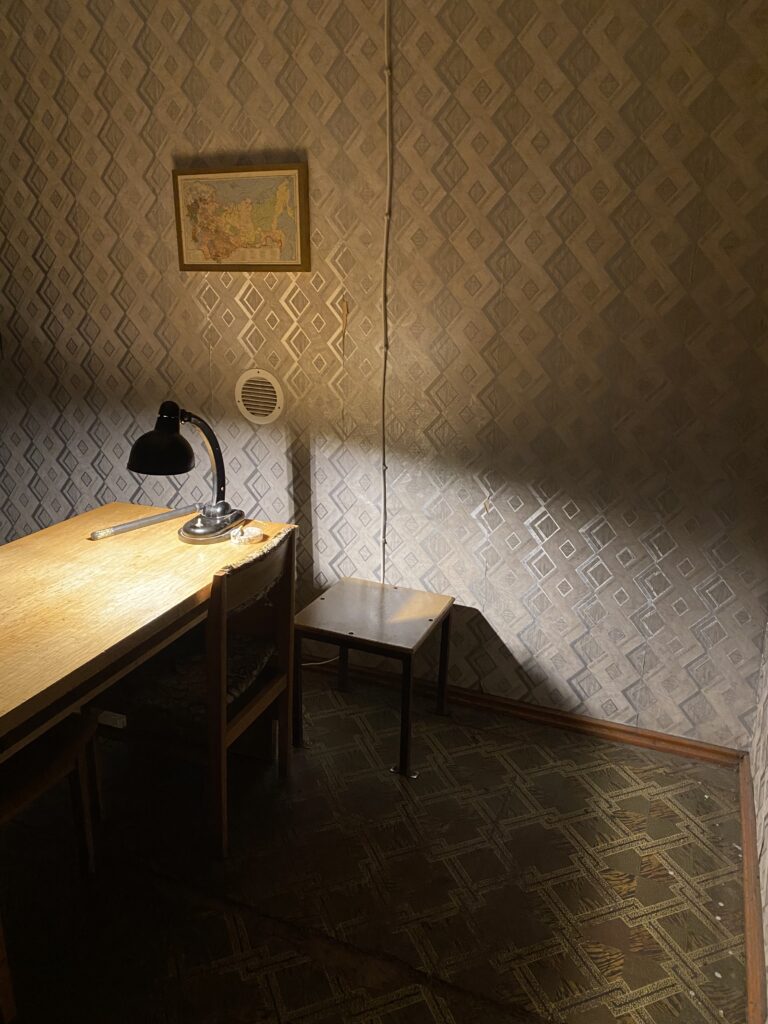
At some point, when we’re standing in the old interrogation room, the guide smacks a rubber stick on the desk and we all jump, a glimmer of what someone under KGB interrogation would face. In one cell, he tells us that 30 people would be inside at once, the window covered so they couldn’t tell what time of day it was, then he flicks on the bright lights so that we’re disoriented like the prisoners would have been. He points to the heating system that would be cranked up high, and the sole bucket used as a toilet and emptied once a day.
(Photo courtesy of Katie Dancey-Downs.)
It's with all this in mind that we are taken to the courtyard. This, he tells us, would have been a reminder to the prisoners of how the free world feels (and a way to make them willing to sign anything, including confessions). Above us there are bars and netting. To stop suicides from the interrogation room, we’re told.
We’re left there for a few minutes, in a space where prisoners would have been allowed to breathe fresh air once a week, walking in circles with their heads bowed, their feet trudging along the same concrete that we stand on now. It is a reminder that not all artifacts live in glass cabinets.
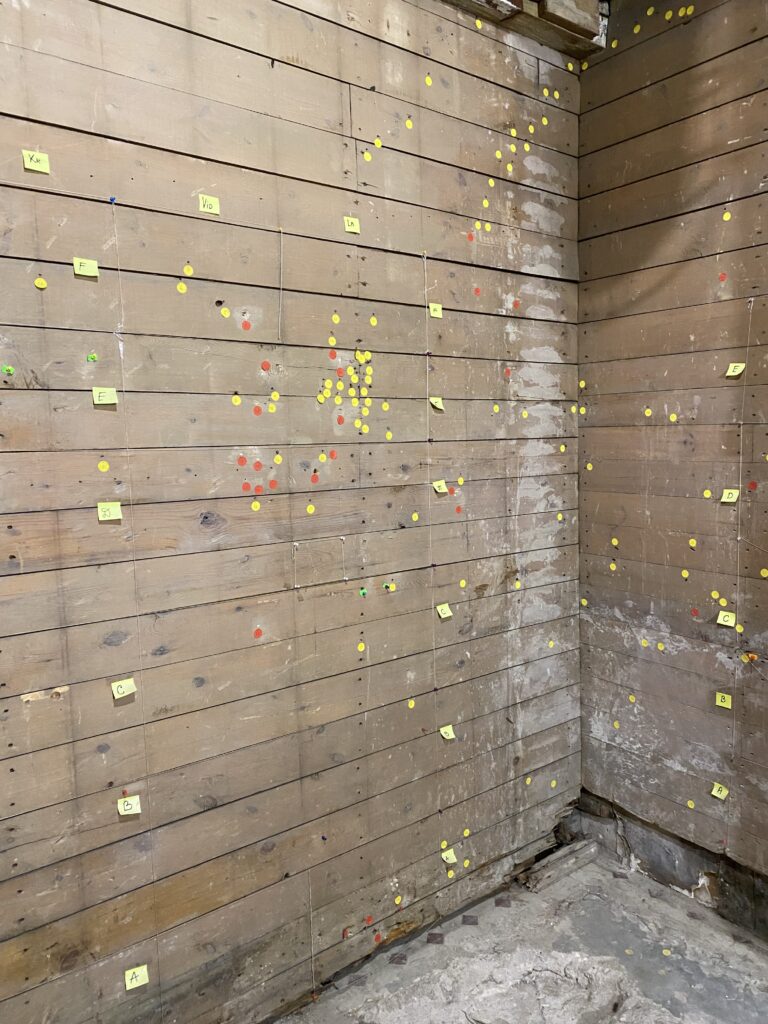
There is worse to come. In what was once an execution room, there are more than 200 bullet holes in the walls, marked with red and yellow stickers. They go back to 1940 and 1941, when prisoners were told to face the very same wall now before us, then shot in the back of the head. Researchers are still trying to find out whether executions continued here during the second Soviet occupation.
“We Latvians know the price of freedom,” the guide tells us. He also reminds us that this type of thing is still happening in Russia today.
Opposition leader Alexei Navalny is one recent, high-profile person to have lost his life while incarcerated by Russia in a penal colony north of the Arctic Circle, where he was killed with a dart frog toxin. But he is far from alone, as many other Kremlin critics or persecuted communities have been imprisoned or killed.
(Photo courtesy of Katie Dancey-Downs.)
This modern unease extends beyond Russia to Baltic states like Latvia, Estonia, and Lithuania. One person in Estonia told me that her daughter talks about how they would escape if their home was attacked. In neighboring Belarus—where state security is still called the KGB, and Russian influence is strong—more than 4,600 people have ended up as political prisoners since 2020. Many of those people are pro-democracy protesters and campaigners who stood up against dictator Alexander Lukashenko’s rule, including his rigged election win in 2020 and then 2025.
A short walk away from Riga’s Corner House, artifacts in the Museum of the Occupation of Latvia shine more light on the country’s dark history. If you’d forgotten about the KGB building already, your memory would be refreshed by this museum’s display of bullet casings and the keys for the prison cells, now housed in a glass box.
I land at a small bottle and blister pack of pills which turn out to be chlorprothixene and other antipsychotics used to “treat” dissidents imprisoned in psychiatric hospitals. This practice is not history, but still happening in Europe as I stand looking at these artifacts. I am reminded of Russia’s punitive psychiatry, where medicated treatment is forced onto political activists who have been sent to psychiatric units in response to their activism, and where they are brutalized.
And then we come to what might be one of the most terrifying tools of Soviet oppression: the concentration and forced-labor camps known as the Gulag. A quilted jacket with the number F358 sewn on the back is hanging up on display, this particular one having belonged to a woman called Leontīne Kriviņa, who in the 1950s was arrested for participation in a youth resistance group and sent to the Norilsk Gulag camp, 400km above the Arctic Circle, where temperatures could drop to -50C.
The personality cult
I’m now standing before a KGB-sponsored weekly newspaper, called Dzimtenes Balss, which translates as Voice of the Homeland. It was written specifically for Latvians in Western exile and—if we were in any doubt about its purpose—published by the “Committee for the Return to the Homeland” between 1958 and 1989. The Soviets wanted to repatriate Latvian émigrés, and propaganda like this was a vital tool in making that happen.
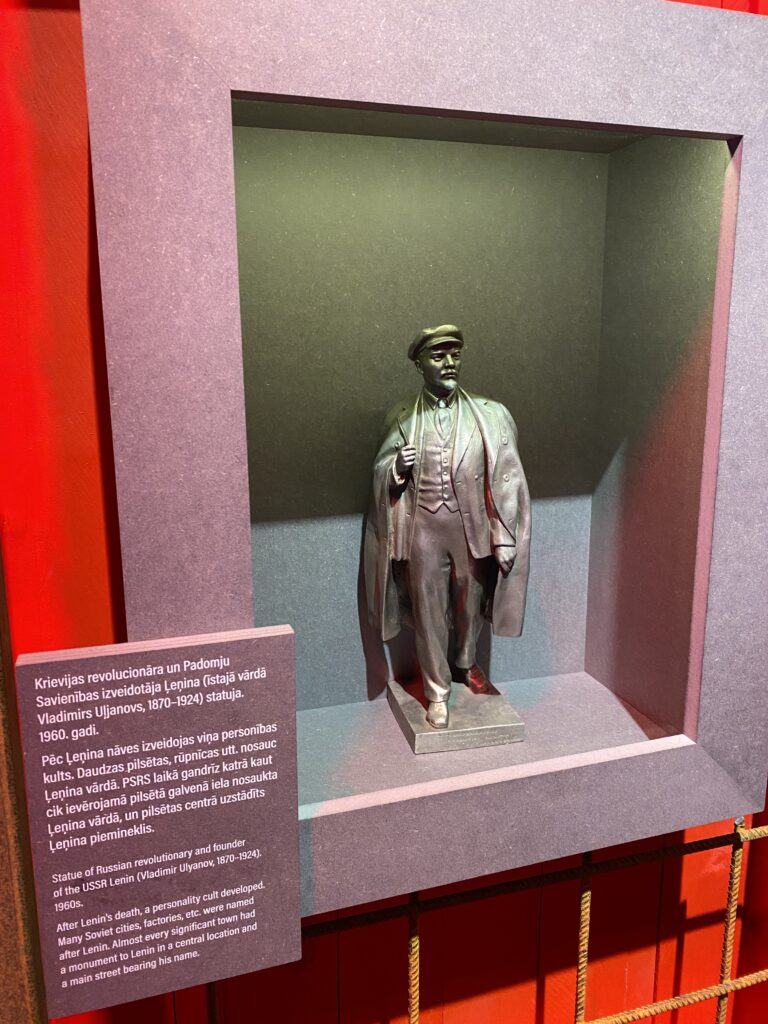
The Soviet Union had a well-oiled propaganda machine. Posters, films, lectures, theatre, newspapers, and radio were ways to shape the collective consciousness, and control society. Among these was the personality cult—which brings us to our next artifact: a small statue from the 1960s of Vladimir Lenin, the founder of the USSR, set inside a black display cabinet. The personality cult around him developed after his death, the description says, with many streets named after him and every significant town home to a monument. The “Lenin Cult” replaced the “Stalin Cult,” an information board explains, around three years after Stalin’s death, when the new leader Nikita Khrushchev denounced Stalin’s policies as a “departure from Lenin’s ideals.”
(Photo courtesy of Katie Dancey-Downs.)
There’s another artifact in this museum that speaks to this history of authoritarianism—a copy of Mein Kampf, Adolf Hitler’s memoir and manifesto. It’s chilling to see it in real life, something so feared and despised across the continent, and indeed the world. Something that represents the personality of the man who led a genocide and brought terror to Europe.
In today’s Europe, we have a personality cult problem once again. But the personalities in question don’t even need to bother writing a book: They have social media at their disposal.
The scapegoats
There’s one more thing that I want to show you in the Museum of the Occupation of Latvia. A fabric Star of David, faded with time, which would have been used by the Nazis to identify Jews. It’s one thing knowing about these yellow stars and how they were used, but it’s another to really see one, imagining who it might have been pinned on. Next to it, there are a couple of strings of numbers on what look like badges. One is brighter, and says 8533. They are identification numbers worn by Jews held in the Kaiserwald Concentration Camp or the Lenta factory in Riga. Tens of thousands of Jewish people were murdered in Latvia during the Holocaust.
While relatively short compared to their Soviet occupations, Estonia and Latvia were both subjected to Nazi occupations during World War II. Many people even welcomed the Nazis, hoping they would save them from the Soviets. What people soon learned is that no authoritarian regime is “better” than another. All are bad.
I went to Kraków, a medieval city in Poland’s south, which felt the full weight of a Nazi occupation from 1939 to 1945. Up to 20,000 Jews were forced into a purpose-made ghetto, before Heinrich Himmler ordered their deaths in 1943 and they were either shot, sent to labor camps, or sent to concentration camps where they remained as prisoners or were exterminated.
In Oskar Schindler’s Enamel Factory, the permanent exhibition Kraków Under Nazi Occupation tells this story. In one of the first displays, there is a circular wooden construction painted in yellows and blues, like something that might belong in an old-fashioned penny arcade, with pairs of binoculars set into each panel. It is a carousel of photographs, the images rendered in 3D, each one frighteningly immersive as it takes my whole field of vision. I have never seen Hitler’s face this close, as he shakes hands with another Nazi, or holds hands with a smiling girl—in the latter, they might even be dancing. Another shows a woman smiling and saluting in a Sieg Heil. Flags are draped from buildings and swastikas plastered on armbands. Not just seeing these photographs from over 80 years ago, but being inside the photographs, makes it all frighteningly real—which of course it was. The people smiling is what’s really terrifying.
As we face our own dangerous political shifts today, it scares me to think about the photographs that our generation’s great grandchildren will look at. Will they also sit in a museum like this, immersing themselves in the artifacts we’ve left behind and ask, “How did they allow this to happen?” Will they struggle to understand how so many people could welcome the far right rallies and shake hands with the populist leaders of today, the way I now struggle with the same? Or will ours be a generation that truly learns from its history, so that we do not allow the most atrocious things that have happened in the past to happen again?
(Photo courtesy of Katie Dancey-Downs.)
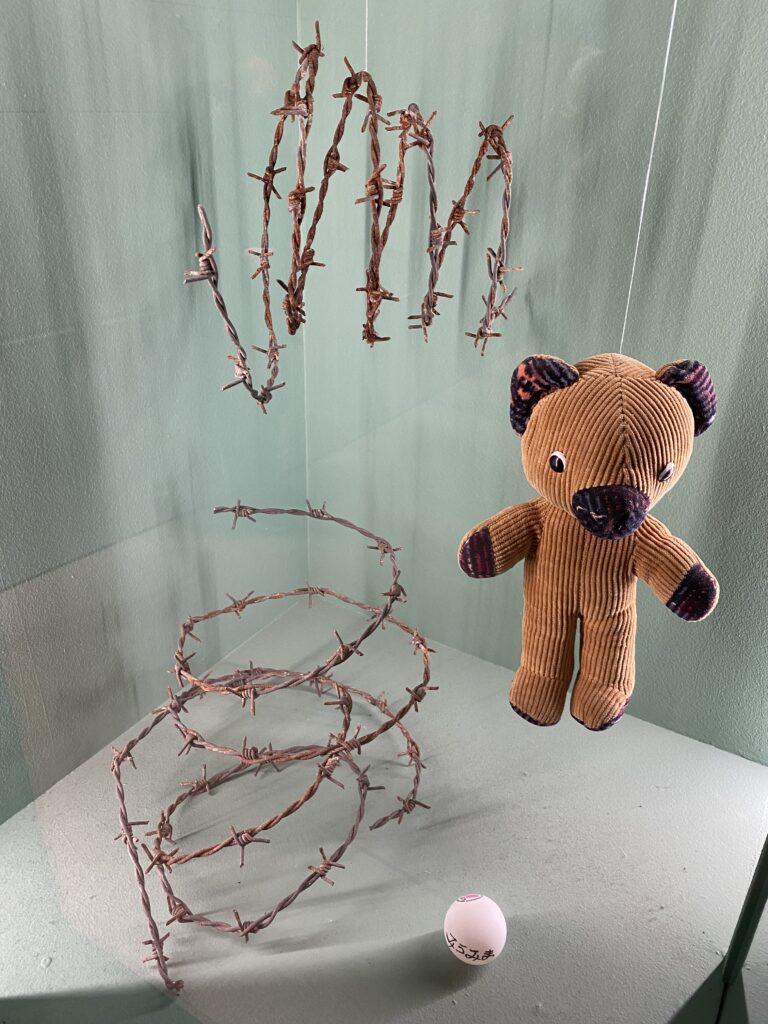
At the end of the Schindler Museum exhibit is a glass case containing two spirals of barbed wire. They are from KL Płaszów, a camp in Kraków built on Jewish cemeteries, which housed up to 25,000 prisoners at a time. It began as a forced labor camp and later became a concentration camp, a place of terror for Jews, Poles, Roma and political prisoners. Although it wasn’t an extermination camp, prisoners were indeed also executed here.
Many concentration camps have been preserved across Europe as a reminder of what happened during the Holocaust, when the Nazis murdered six million Jewish people, as well as other persecuted groups. Decades ago, I visited the Sachsenhausen concentration camp, north of Berlin, on a school history trip. I still remember, vividly, the “Arbeit Macht Frei” lettering on the gates, that awful, twisted phrase that translates as “Work Makes You Free.”
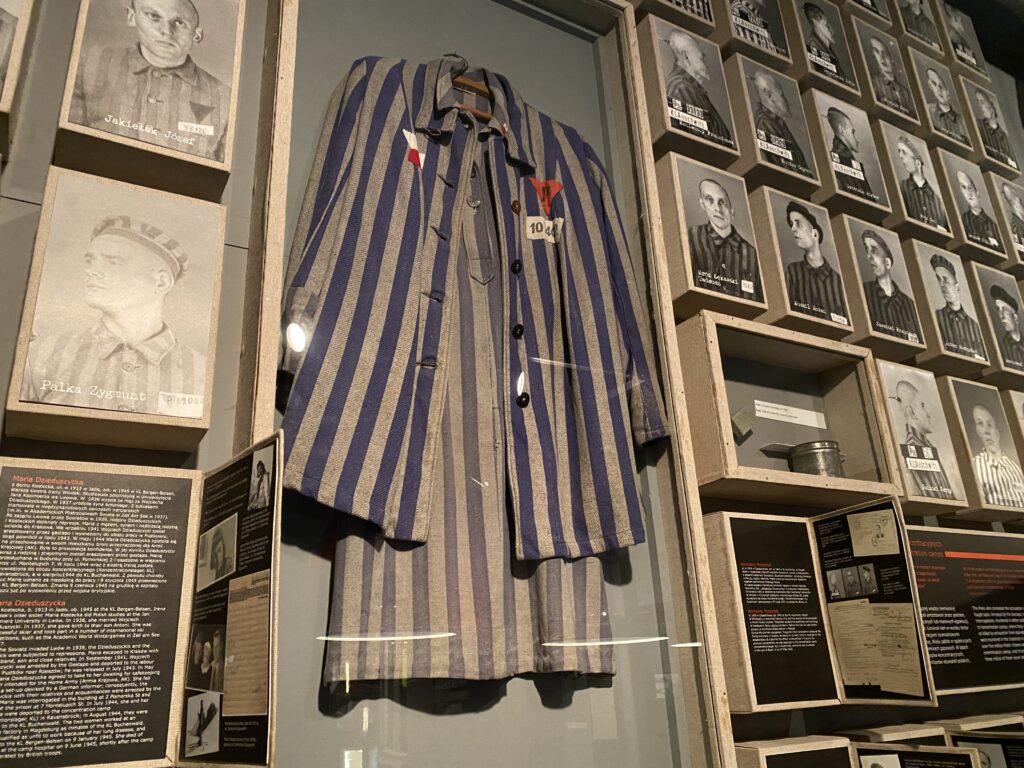
On the other side of Kraków, there is a blue and white striped uniform hanging up in the People of Kraków in Times of Terror exhibition, part of Muzeum Krakowa. A woman named Anna Pieczarka-Mikulskaw wore it while imprisoned in the German concentration camp KL Ravensbrück between 1942 and 1945. Her grandson gave it to the museum.
“Some of them came back home in the uniform,” the museum’s curator Grzegorz Jeżowski tells me.
The Holocaust is perhaps our starkest example of where scapegoating can lead. That barbed wire and that prisoner uniform in Kraków are reminders of what happened in Europe’s darkest hours. And yet today, far-right politicians are still villainizing minority groups, in particular Jews, Muslims, refugees, and LGBTQ+ people. It is not comparable with what the Nazis did, of course it isn’t. But we must never forget where this road can lead.
Today, in countries including Russia, Germany, Italy, and Georgia, there are growing political movements pushing for “traditional family values” and against LGBTQ+ rights. In Bulgaria, too, it is illegal to discuss LGBTQ+ topics in schools. There is a question mark over Hungary, which made global headlines for banning Pride marches under recently deposed strongman, Viktor Orbán. Recently in the German state of Saxony-Anhalt, the far right Alternative for Germany (AfD) won the state election, just falling short of gaining a majority, and leaving the rest of Europe shaken.
(Photo courtesy of Katie Dancey-Downs.)
Why we must visit the museum
Let me caveat what I’m about to say: I am not carrying the weight of lived or generational trauma, as others whose families have been persecuted by authoritarian regimes. But I believe it's vital we go to these museums and face the evidence head on, that we look at Mein Kampf, at the shoes of people murdered by the Soviet secret service units found in burial sites, at the microphones slipped into hotel rooms. Not just to remember what has happened in the past, but to make sure that we develop the necessary critical thinking required to understand and prevent what is already emerging in our present.
The museums I visited are just a handful of those dotted around Europe, with countless artifacts to remind us we are not immune to the possibility of ending up under authoritarianism. In Europe today, there are flickers of these tendencies—and not just in Russia and Belarus.
In Serbia and Turkey, journalists critical of the government live under serious threat, and protesters have faced violent clampdowns in Georgia since the Georgian Dream party claimed victory in the 2024 election—a result which Western pollsters said did not match exit polls. Both Turkey and Georgia’s leadership has been described as authoritarian.
And then there are countries where populist or illiberal politicians are waiting in the wings, steadily growing in popularity. Like in the UK, where there is an ever-growing personality cult around the anti-immigration Reform UK leader Nigel Farage, a man who has been accused by former schoolmates of antisemitic and racist bullying (which he denies) while more recently getting caught supporting a neo-Nazi event and using extremist slogans in personalized Cameo videos. As of May 2026, Reform UK was the most popular political party in the country, before a series of financial scandals consumed discussion around the party, dropping them to second place by August.
Similarly in France, Marine Le Pen’s far right National Rally is the country’s most popular party according to the most recent voting poll. And perhaps most shockingly, as of June 2026, the most popular political party in Germany is the far right nationalist AfD (Alternative für Deutschland), which is shaped by xenophobia, Islamophobia, antisemitism, and hostility to LGBTQ+ people.
Tyrants-gone-by echo in our current world, and illiberal politics serve as fertile ground for authoritarianism.
With all this in mind, the artefacts of terror and extremist politics in Europe’s museums are frightening, quite rightly. But in these same buildings, there are also always artefacts of hope.
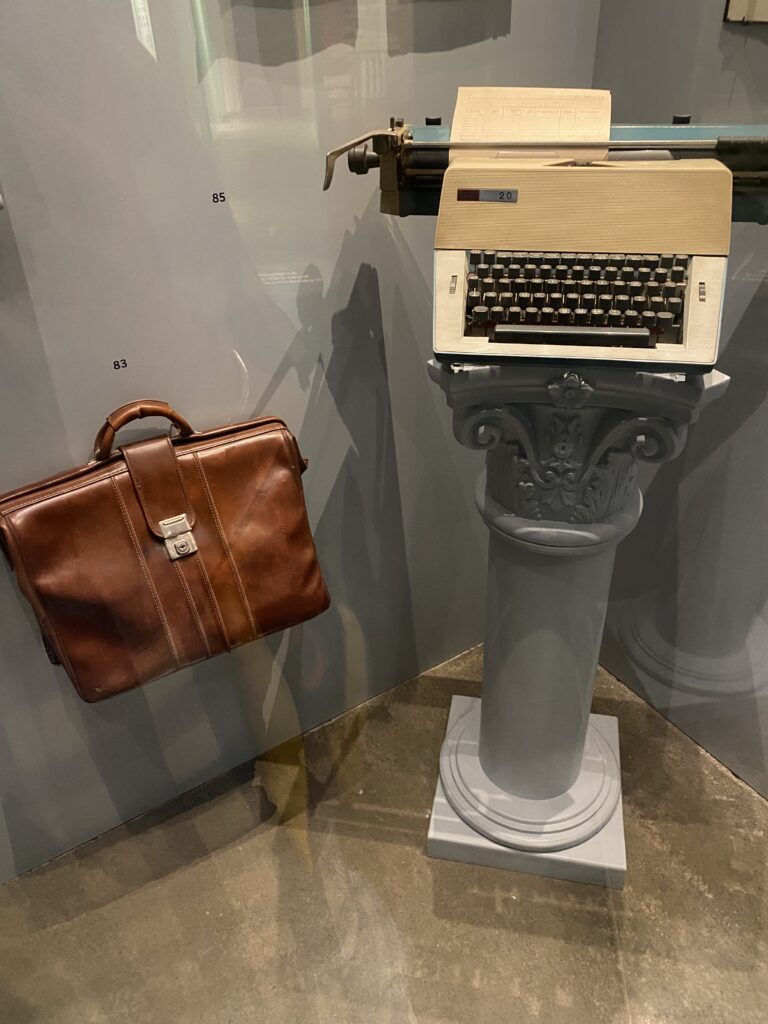
In the Vabamu Museum of Occupations and Freedom in Tallinn, there is not only evidence of the oppressions Estonians faced, but also of their resistance. Hanging up on the wall, a brown leather briefcase that belonged to Enn, an Estonian dissident who was arrested by the KGB numerous times, tells the story of a petition called the Baltic Appeal, calling for the independence of the Baltic states. The briefcase was big enough to carry a secret typewriter, which could be used to make and copy prohibited materials—and there’s one of those here too, a large clunky machine with a teal-colored carriage. They were considered so dangerous by the Soviet Union, that each typewriter had to be registered, but dissidents found ways to trick the authorities. This particular typewriter belonged to Irene, who, according to the museum’s digital guide, exchanged her tent to get it and then used it to make copies of the banned The Gulag Archipelago by Aleksandr Solzhenitsyn, an autobiographical work about life in the Soviet labor camps.
(Photo courtesy of Katie Dancey-Downs.)
Sitting proudly above the typewriter and the briefcase is a piece of samizdat, which dissidents were producing in the decades after Stalin died. These were self-published copies of prohibited texts—novels, journals, cookbooks, anything people wanted to read and couldn’t—which were passed around hand-to-hand, secretively.
There is a letter on the wall, too, signed by 40 Estonian figures from the cultural and scientific communities, against Russification. They collected these signatures in secret and sent the open letter to newspapers—even though ultimately, it resulted in many of them being punished, interrogated, or forced to publicly apologize.
Lastly, in the Museum of the Occupation of Latvia, there’s one incredible artefact that I sit in front of for a long time. It’s a video of people—ordinary people—holding their linked hands up high along the side of the road. It is a singing revolution. In August 1989, 1.5 million people across the three Baltic states—Estonia, Latvia, and Lithuania—created a 410-mile chain from Tallinn to Riga to Vilnius, held hands, and sang for their independence. A few months later, the Berlin Wall fell, and by 1991, all three countries were independent and free of Soviet occupation.
So much of authoritarian control is about isolating people, making them afraid of what they say and to whom they speak. These movements of resistance, then, these items that bond people, these relics, are all precious reminders of how people have resisted before. But we must go to the museum to truly see them. We must go to the museum to find hope in what can be overwhelming times. And we must go to the museum to arm ourselves with the lessons of history in the fight against a repeat of our worst moments.
[post_title] => Warnings from the Museum
[post_excerpt] => A tour through Europe's past—and what lessons we might learn from its museums to fight authoritarianism today.
[post_status] => publish
[comment_status] => closed
[ping_status] => closed
[post_password] =>
[post_name] => warnings-from-the-museum-authoritarianism-europe-history-estonia-latvia-poland-soviet-union
[to_ping] =>
[pinged] =>
[post_modified] => 2026-09-23 00:12:35
[post_modified_gmt] => 2026-09-23 00:12:35
[post_content_filtered] =>
[post_parent] => 0
[guid] => https://conversationalist.org/?p=11041
[menu_order] => 0
[post_type] => post
[post_mime_type] =>
[comment_count] => 0
[filter] => raw
)
On the history we see—and the history we don't—in "I'm Still Here."
When Eunice Paiva first learns that her husband Rubens has been murdered in the Oscar-nominated film I’m Still Here, the audience only sees her reaction to the news, but never actually hears what has happened. The scene is bewildering to watch: Sitting on the office couch in her bathing suit, having just returned from swimming in the sea by their house, Paiva’s hair is still dripping with saltwater when she finds out her life has been changed forever. But the audience doesn’t yet know why.
I’m Still Here takes place during the Brazilian military dictatorship of 1964 to 1985, and the scene almost functions like an emotional map of the fallout of fascism in Brazil—confusion over absence of information, followed by the heaviness of grief. Rubens’s murder is only confirmed to the audience much later in the film, when his now-widow specifically asks what has happened to her husband’s body. This is when the still-hazy facts fall into place: Rubens was kidnapped and murdered by the Brazilian right-wing military dictatorship, and his family will never see him again.
I’m Still Here is based on a true story: Both in the movie and in reality, the Brazilian government wouldn’t admit to killing Rubens until 25 years after the fact. For much of the film, this unknowing leaves both Paiva and the audience on uncertain ground—how can we react to news we didn’t really hear? And how do we grieve for someone we don’t yet know is dead?
It’s not surprising that one of the most talked about performances from the Academy Awards this year is Fernanda Torres’s quiet portrayal of Eunice Paiva, for which she has been nominated for Best Actress in a Leading Role. Yet the film’s impact is as much a credit to her performance as it is to the powerful true story behind it. The first Brazilian film to ever be nominated for Best Picture, I’m Still Here unveils a history that is often disputed or played down in both Brazil and the United States. It is a resurfacing of the prohibitive and visceral reality of living under the Brazilian military dictatorship: A “dissident” politician, Rubens Paiva was one of 434 people the regime kidnapped and murdered under the guise of stamping out communism and socialism, a move that was aided and abetted by the US during the Cold War. Rather than focus on his story, however, the film instead turns the lens on his wife, Eunice—one of the countless women and families those killings left behind. Through her perspective, there’s a surprising subtlety to I’m Still Here—and in its silences, there are embedded histories that the average non-Brazilian viewer might not be able to understand, but that give important context to the story being told.
At the end of March in 1964, the Brazilian military staged a coup d’etat in response to then-president João Goulart’s structural reforms, which sought to reduce class inequality through workers’ rights and agrarian reform. These changes were not well liked by Brazil’s elite, who, in particular, viewed the agrarian reform—which would see abandoned land redistributed to people without any—as prejudiced against owners of large swathes of land. The president’s relationship with unions and his support for the working class were also understood as the beginnings of communism in Brazil, rather than as an attempt to regulate workers’ rights in a country that was still operating under the same logics of the colonialism and slavery that founded it. The regime’s anti-communist position was an ideological win for the US, which resulted in the launching of Operation Brother Sam, a plan to logistically support the coup d’état should Goulart refuse to step down. After being forcibly ousted, Goulart was banned from running for political office for ten years and exiled to Uruguay with his family.
The violent stamping down of political dissent started early in the regime through heavy censorship of the media. The military controlled the newspapers, the radio broadcasts, and the TV news reels, only allowing positive news to be disseminated, and silencing any publications or people who had dissenting or critical opinions. Left-wing organizations and parties were dissolved and outlawed, often operating illegally to organize resistance against the government. These groups were also severely persecuted by the regime, including the Brazilian Workers’ Party, of which both Goulart and Rubens were members.
In I’m Still Here, the civilian struggle against this enforced silence is portrayed a few times, but perhaps most notably, when Eunice sends her oldest daughter Vera to London for an improvised gap year. Preemptively guarding against her daughter’s young sense of justice, Eunice does this to prevent Vera from joining the Students’ National Union out of fear for her safety. The organization operated illegally for 21 years throughout the dictatorship, and was key in organizing protests against the military government—but the consequences of getting involved in the resistance could be fatal. At least 39 students were murdered by the regime for organizing against them. Eunice knew that Vera, a young woman raised in a bohemian, left-wing household, would want to join the struggle against the dictatorship in college, and preferred to keep her safe in Europe until the regime subsided.
But even in London, the global consequences of the dictatorship were still evident. In a letter she sends home to her mother, Vera writes that she ran into Gilberto Gil, a Brazilian musician who was arrested without trial and detained for 57 days in 1968. After Gil was released, he was exiled from Brazil, and forced to leave the country alongside many other artists, including Caetano Veloso, Chico Buarque, and Raul Seixas. Yet despite the dictatorship's mass censorship efforts, by the 1970s, music consumption had boomed in Brazil—and the regime aimed their attention at the genres of samba, rock, and MPB (Brazilian Popular Music), which had formed a broad front against the Christo-fascist repression of the dictatorship. It is estimated that between 5,000 and 10,000 people were exiled from the country during this period, some of whom never returned. And it wasn’t just musicians: Many artists, intellectuals, journalists, filmmakers, and poets were also forced to leave, as a part of stamping out any voice that wasn’t favorable to the regime. The artists and musicians who were allowed to stay in Brazil had to submit their work to the government for approval before it was released, just to make sure the content wasn’t critical of the regime and that it promoted conservative, Christian values to the population. In I'm Still Here, the importance of Brazilian music during these dark times is displayed through the film’s soundtrack, which features some of the exiled artists, including Veloso and Gil.
The mass exile of musicians and artists is not uncommon in Latin American history—nor are state-sponsored disappearances and murders. Rubens’s disappearance and subsequent death in I’m Still Here is representative of what happened in Brazil, but the reality is that dictatorships across the continent have left thousands of families destroyed, forcing women to take up a fight they never signed up for and demand answers from their governments. In Chile, the Pinochet regime kidnapped and murdered 3,200 people, and to this day 1,500 of the disappeared have not been found. In Argentina, the government estimates 9,000 people were killed during the country's dictatorship, while civilian groups claim the number of victims is 30,000. I’m Still Here portrays the case of Eunice, who, in addition to her grief, did not have access to her husband’s estate and bank accounts until the state finally issued a death certificate 25 years later. But it could just as easily have been about any one of the parents behind the Madres de La Plaza de Mayo, an organization in Argentina that, for 46 years, has fought to find disappeared students taken by the Argentine military regime in the 70s.
“The dictatorships of South America were not a banana republic matter,” Torres said in an interview with Vogue. “They were part of the macro politics of the time. That’s why I always repeat that [Eunice is] a victim of the Cold War; she’s not a victim of the dictatorship of a banana republic country. People treat the dictatorships in South America like something that happened on that faraway continent. But it’s all part of the same story.”
This same story continues to this day. But in exposing this complicated history of silence, I’m Still Here pushes for these silences to end contemporarily, challenging how right-wing politicians in Brazil and abroad regularly downplay the past dictatorship today in pursuit of their own political goals. If the dictatorship wasn’t that bad, they argue, then extreme-right president Jair Bolsonaro has done nothing wrong in attempting to stage a coup d’état against the newly elected left-wing president in 2022. But even the film’s Oscar campaign makes its intention explicit: to bring this history to a new audience, and to draw attention to the US’s involvement in deposing democratic regimes in Latin America in order to continuously exploit the continent for profit and labor. In the process, it has even strengthened the anti-amnesty campaign for the individuals who attempted to stage the coup in 2022.
In this sense, by telling Eunice and Rubens’s story, I’m Still Here has broken the silence that still persists, and that still helps to support fascist regimes across the globe. Despite the murders, the kidnappings, and the right-wing rewriting of history, the stories of the victims of these regimes, kept alive by the family who lost them, can never be killed. I’m Still Here is a testament to the power of political art and cinema—something the military regime wanted to exterminate at all costs. In a bid to truly commit to remembering history, I’m Still Here argues that a present-day consciousness of fascism is the only way to stop it.
[post_title] => The Women the Dictatorship Left Behind
[post_excerpt] => On the history we see—and the history we don't—in "I'm Still Here."
[post_status] => publish
[comment_status] => closed
[ping_status] => closed
[post_password] =>
[post_name] => im-still-here-ainda-estou-aqui-brazil-military-dictatorship-fascism-academy-awards-fernanda-torres-eunice-paiva-rubens-best-actress-picture
[to_ping] =>
[pinged] =>
[post_modified] => 2026-08-03 23:19:36
[post_modified_gmt] => 2026-08-03 23:19:36
[post_content_filtered] =>
[post_parent] => 0
[guid] => https://conversationalist.org/?p=7948
[menu_order] => 27
[post_type] => post
[post_mime_type] =>
[comment_count] => 0
[filter] => raw
)
To believe things can get better, we must first accept they can get worse.
I find Trump so repulsive that I wasn't willing to engage with the reality of his second term until he won and I had no choice. In the weeks following, I braced myself for Christo-fascism, knowing every day he wasn’t president was a day to cherish. I told anyone who would listen to prepare for the worst.
In the days since he was sworn in, I’ve been frustrated but not surprised that people still don't get it. “Is he really a fascist?" "Was that really a Nazi salute?" "Is this really going to be thatbad?" Girl, yes. In fact, it’s probably going to be worse than most can imagine, considering it was a massive failure of imagination that led us here in the first place: American optimism has done us no favors this time around, and now we're all paying the price.
Millions failed to imagine that fascism really was popular enough to get Trump reelected. They failed to imagine that the outlandishly evil Project 2025 could really be the GOP manifesto, and clung to the obvious lies and denials of its authors (who are now overwhelmingly employed by the White House). Immigrants who fled failed states and autocracies only to vote for Trump failed to imagine this country having the exact same problems as the ones they’d left. It was a collective failure of imagination that the Supreme Court would actively cover for a coup, let alone that they’d reward the man who incited it with immunity. Personally, I failed to imagine that losing reproductive rights would have so little impact on white women's presidential votes; and these same women who chose to split their tickets failed to imagine state abortion protections could be undone by a national ban.
Americans have an escalating autocracy problem, but underlying that is an emotional and psychological problem. At every turn, we get tripped up by reality, especially around humanity's capacity for evil at scale, not to mention imperial decline. Putting these criminals in charge has likely poisoned the United States for generations. Anyone who thinks it will be over in four years is deluding themselves. But few want to wrap their heads around the fact that most checks on executive power are already gone. No one wants to imagine themselves being targeted until it's too late. We don’t want to believe that things can, and will, get worse. But our failures of imagination won't stop the bad things from happening. They’ll just ensure we won’t be prepared to handle them—which is exactly how we’ve ended up here.
There's a Russian proverb, "Когда я думала, что достигла дна, снизу постучали." "Just when I thought I'd hit rock bottom, someone knocked from below."
These last few weeks, I've been thinking a lot about Adolf Eichmann, architect of the Final Solution, and about people's readiness to accept lies at face value when the truth is too painful. It's the corollary of our failure to imagine atrocities before they happen. When Trump was elected the first time around, I wrote a piece on what the Nazis were thinking when they committed genocide—a warning on how dehumanization and propaganda create the conditions for mass murder. I compared the interviews a Jewish US Army psychiatrist did with the Nuremberg defendants to Hannah Arendt's Eichmann in Jerusalem, which argued that an autocratic cult of personality can lead mild-mannered people to abdicate their own moral compass and commit atrocities in the name of Dear Leader. Since then, the Eichmann tapes have surfaced—a 1957 recording of an interview Eichmann did in Buenos Aires, in which he admitted to a fellow Nazi that of course they knew they were murdering all those Jews, and he'd have been happy had they completed the job. Countless academics and practitioners, myself included, have spent decades debating the banality of evil and individual agency: whether people intentionally commit mass murder or are "just following orders." Fields have developed, careers have been made, and centers have been built around the question of whether perpetrators are cynics or true believers—when all this time Eichmann was just a fucking liar.
The day after Trump won last November, when Steve Bannon slithered out of some hole to rub Project 2025 in our faces, I thought: This is the Eichmann tapes all over again. The inauguration, and what has followed, has done little to change my mind. Take Elon's Nazi salute, which he performed (twice) at a fascist inauguration bought with his fascist money. The discourse and debate and scrambling that has followed has been nothing short of infuriating: Is the apartheid oligarch who runs a Nazi-friendly site, calls himself Kekius Maximus, promotes eugenics and the Great Replacement Theory, and bought the US presidency while campaigning for the German far-right a Nazi, or is it autism?
People are clinging to the fact that Musk is a troll, as if pushing boundaries then retreating isn't part of the fascist playbook. Trolling doesn't diminish his responsibility for his behavior, lessen the salute's impact, or alter the context in which he performed it. People similarly brushed off Trump's insistence that Haitians are eating pets as a joke, sharing cat memes that will haunt them when he ends Temporary Protected Status and deports their neighbors.
Orwell had words for the West's failure to imagine autocracy: "If you have grown up in that sort of [liberal] atmosphere it is not at all easy to imagine what a despotic regime is like….Such things as purges, secret police, summary executions, imprisonment without trial, etc are too remote to be terrifying. They can swallow totalitarianism because they have no experience of anything except liberalism." Orwell was writing here about Western leftists' apologism for Stalin (also embarrassingly still a thing in some circles), but the reasoning still applies.
This inability to imagine an end to America as we know it was more understandable during Trump's first round, though that still required ignoring our long history of white supremacy and corruption. At this point, the failure to acknowledge that far-right extremists are in charge of all three branches of government feels willful. The cognitive dissonance when a rich white man does a bad thing is astounding, no matter how many flagrant crimes he's committed in the past, how many people he's violated. Suddenly everyone's parsing intent like they're guest judges on Law and Order.
Is evil really banal? Or are we simply unable to process the insidious truth that extreme abuses of power are so common? Frequency and severity are not the same thing. I've been writing for over eight years now about the delusions of exceptionalism, and how the failure to imagine America's decline ensures it. I’ve also written at length about how abuse distorts reality, and how state abuses mirror interpersonal abuse. As a survivor of childhood narcissistic abuse, I watched otherwise decent adults ignore or make excuses for monstrous behavior they personally witnessed, because taking a stand would cost them too much, or at least more than throwing me under the bus might keep them up at night. I don't have to imagine the depths people will reach to avoid what's right in front of their eyes, because I've lived it. Abuse thrives where reality is too painful to digest, when people get exhausted, look away, give up, blame the victims, apologize for power and patriarchy, follow charlatans, accommodate in advance. Abuse leads us to blame the people or institutions who failed to keep us safe, even when they aren't the ones hurting us. Expected violence is perversely easier to accept than failed promises. And all of us are tired of being let down.
Unsurprisingly, lost in all the questions about why the Democrats have lost the information war, or why mainstream media keeps sane-washing a decompensating narcissist, is the fact that it's safer to attack Democrats for the things they didn't do than to pick a fight with Trump over the things he's done and is doing. To be clear, Democrats have absolutely betrayed voters' trust by campaigning on Republicans wanting to end democracy, and then caving to collegiality. How is it that in the past few days only AOC seems appropriately angry, and brave enough to show it? Meanwhile legacy media is on the path to both-sides-ing themselves into extinction, and wondering why they’ve lost everyone's trust. But whether or not their actions are motivated by corruption or naivete is, again, besides the point. Focusing on unprovable intent—what's in people's hearts and minds, whether bones are racist—is safer than confronting what's observable: that the federal government and civil rights are being dismantled before our eyes. Principles come at a cost, and most Americans, including Democratic leadership, seemingly do not want to pay. Bargaining to avoid a fight while someone is already beating you is the ultimate failure of imagination.
Scared people say and do dumb things, and many of us are terrified. But fascism feeds on fear, and it’s only through brave, principled opposition that we can begin to overcome these seemingly impossible circumstances. I founded The Conversationalist to combat the nihilism and despair that oligarchs and autocrats depend on, in the hopes that we'd stop the cancer from metastasizing. Only now that it's spread through the entire body politic do we get dire warnings from President Biden on his way out the door about the dangers of oligarchy and disinformation. Now that autocracy is entrenched, and we're deep into the destruction of democracy and rule of law, there are finally articles in the mainstream arguing what I was called hysterical for saying in 2016. Better late than never, but hardly a model of courage.
To be fair, denial is deeply human. Most of us crave a stable life that allows us to follow our dreams and our loved ones to thrive. Puncturing those dreams with the ugly reality of autocracy is a hard sell to those privileged enough to avoid it. But as American institutions collapse around us, those dreams move further and further away. Americans are so accustomed to the costs of our colossally bad ballot box decisions being born by voiceless others elsewhere, that we’ve kneecapped ourselves and expected it not to hurt. But if there’s one message I wish everyone would hear, it’s that this round is not going to be like the last one, and may last way longer, too.
A lot of the election autopsies have chosen to pit economic concerns as separate from the transphobia, misogyny, and xenophobia that Republicans ran on, which is odd considering how fascism works. In less than a week, we’ve already seen this play out via a blitz of ChatGPT-authored executive orders stopping refugee entry, attempting to end birthright citizenship, denying trans people's existence, and firing any federal employee who was part of a DEI program (including a snitch hotline for people who want to denounce their colleagues of color). It was a banner week for far-right terrorists with pardons for January 6 insurrectionists and anti-abortion extremists. Trump has threatened to invade Canada, and wants to reinstitute tariffs. He's withdrawing from climate treaties, ending FEMA, and withholding aid for California wildfires unless they cave to Republicans.
Taking hostages is par for the course: The message Trump was selling wasn’t economic prosperity for all, but economic prosperity for his supporters, at the expense of the rest. Fascism is all about prosperity through persecution. Help us get rid of the bad, undeserving folks, and there will be more left for you. No, not every Trump voter is chomping at the bit to deport 20 million people. Some just wanted to stick it to the incumbent administration, and others weren't paying much attention either way. Their intentions are irrelevant, however, because they gave the electorate's power away, and effectively voted for Americans to not freely and fairly vote again.
When you replace your civil servants and judiciary with loyalist hacks, and corrupt the processes that keep them in check, institutions do not hold. And yet most narratives still talk about future elections as if they’ll be recognizable. The US has devolved into what political scientists call competitive authoritarianism or electoral autocracy, a hybrid system that maintains the veneer of elections with rigged outcomes for the ruling party. A friend described our current state as Schroedinger's democracy: both here and not. Trump's primary focus in office will be making sure he never leaves again.
Unfortunately, Trump's not starting from scratch here, and he's got a lot of help. Between his first term; the coup; the captured Supreme Court that rejected the plain language of the 14th amendment to let him run for office again, and gave him immunity while president; the transnational cabal of autocrats, oligarchs, white supremacists, and religious fundamentalists rooting for him while actively plotting our dystopian future; and the Democrats' failure to mount proper opposition at any point along the way—the frog has already boiled several times over. Already there are Republican proposals to amend the Constitution and give him a third term. In this election alone, the GOP (with foreign assistance) suppressed the vote with legislation, lawsuits, Russian bomb threats, and other acts of violence, while billionaire oligarchs amplified extremist propaganda from captured media outlets and platforms. Rather than pay the consequences for these actions, all of them got to celebrate at the White House this week.
Before we become too cynical, it's important to remember: Just because Trump is determined to gut the country and die in office doesn't mean he'll succeed—electoral autocracies are fragile and we don't have to make it easy for him. He lacks the resources and the competence to accomplish all his goals. But picking a fight with a bully like Trump could lead to being targeted by him. He's coming for the DOJ, the civil service, the military, private business, late night TV hosts—his goal is to make it illegal to oppose him and require everyone to beg for his favor.
Cronyism and kleptocracy aren't new to this country. Historical examples include the robber barons and the Jim Crow South. In our current day, we have no safety net, healthcare is a scam, and guns are everywhere. And still, we have a lot to lose. People think eggs were expensive before. Just wait until they're double the price, half as available, and ten times more likely to poison you with avian flu. We're going to miss career civil servants, food safety, consumer protections, postal service, air and water quality, public health, public education, libraries, a free press, a depoliticized military, rule of law, and free and fair elections when they're gone. We're going to miss support for climate science, contraceptives, and measles vaccines. We're going to miss the immigrants who are the backbone of our economy and our culture. We're especially going to miss being able to remove the politicians responsible for predatory policies. A lot of Trump voters depend on Medicare and Social Security. Congrats, you’ve played yourself. It's not that we didn't have serious problems before. It's that in a year from now, we're going to be nostalgic for them. We're going to miss the good government we took for granted once it's gone.
Which isn't to say we should give up—quite the opposite. If there was ever a time to fight for our future, our values, and our communities—this is it. All is not lost. A failure to imagine the problem implies a failure to imagine its solution, as well. In fact, we must imagine how bad things can get in order to plan and prepare to overcome them. It isn’t too late—is never too late—to turn things around. There are millions of people around the globe that have fought fascism and won. We can learn from them, and from our past. Our history isn't just atrocities. We have so many role models, as well; people who fought under even worse circumstances for this country to be a better version of itself. We don’t have to wait for the next horror to happen before we choose to believe it’s possible to do the same.
[post_title] => A (State) Failure of Imagination
[post_excerpt] => To believe things can get better, we must first accept they can get worse.
[post_status] => publish
[comment_status] => closed
[ping_status] => closed
[post_password] =>
[post_name] => state-failure-of-imagination-fascism-autocracy-united-states-of-america-donald-trump-inauguration-elon-musk-nazi-salute
[to_ping] =>
[pinged] =>
[post_modified] => 2026-08-03 23:31:36
[post_modified_gmt] => 2026-08-03 23:31:36
[post_content_filtered] =>
[post_parent] => 0
[guid] => https://conversationalist.org/?p=7768
[menu_order] => 30
[post_type] => post
[post_mime_type] =>
[comment_count] => 0
[filter] => raw
)