WP_Post Object
(
    [ID] => 9113
    [post_author] => 15
    [post_date] => 2025-07-28 20:48:44
    [post_date_gmt] => 2025-07-28 20:48:44
    [post_content] => 

How younger generations are turning knitting and crochet into a community building affair.

The first known knitted project was a pair of socks. Discovered in Egypt, the socks featured colorwork made from indigo and white cotton, and were believed to date back to the 11th century, although the craft itself has likely existed for much longer. In the many decades since, knitting, crochet, and other fiber arts have become widespread and global, evolving from the work of artisans to a beloved pastime across generations, while still staying true to the original techniques used in the very first woven fabrics. And now, the craft has evolved once more—this time, at the hands of young people seeking a comforting hobby that gets them out of the house. 

This is what led Virginia Meinhausen, 28, and Lea Engler, 31, to take the leap and start Knitting Club Potsdam in Germany earlier this year. “Being part of a community in person is something [meaningful], not only just to speak to each other, it's also… Wow, so many people are doing this and we are doing this together,” says Meinhausen. “We are now meeting each other in a huge group once a month.” 

Since launching the club in March, Meinhausen says it’s grown to over 100 members. But this quick success isn’t unique to just Knitting Club Potsdam. In recent years, the age-old practice has found new meaning amongst Gen Z and Millennials, who have turned to knitting as a means of bringing back the “third place” and reconnecting with their peers. 

“I remember thinking, it’s crazy how many people don’t have a real hobby anymore,” says Isabelle Mann, textile business expert and owner of knitwear brand Fable and Failure. But she says this started to shift during the pandemic, as younger generations sought more analog ways to pass the time.

The trend first began online, rising to prominence through influencers like Petite Knit and platforms like Ravelry, with younger generations taking ancient techniques and adapting their garments and patterns to match modern trends. “People do appreciate knitting more again,” Mann says. She sees fiber arts as a community building affair for those between 25 and 35, and started her own club through her business in 2019 as a means of teaching and preserving the craft. She also believes that fiber arts skipped a generation, and that parents in the 90s and early 2000s simply never taught their Millennial and Gen Z children how to do it. Instead, these generations taught themselves—and eventually, as COVID lockdowns lifted, these same knitters decided it was time to take things offline. 

Craving human interaction and a break from their screens, hobbyists began coming together post-pandemic as a means of bringing back the “third place”: a neutral, physical space separate from home and work (or school). The concept is set on community building in-person, without having to spend much or any money to participate—something Gen Z feels that they’ve missed out on, and Millennials frequently mourn, as social media has increasingly replaced it online. 

Knitting clubs, in particular, have gained global interest in recent years, with communities expanding rapidly, even in small cities. The industry is expected to grow by $10.69 billion between 2024 and 2028, according to Technavio, a company that specializes in market research reports and industry analysis. 

In addition to creating bonds through a like interest, in-person knitting clubs are also helping young fiber artists learn new techniques faster and more effectively. When they began Knitting Club Potsdam, Meinhausen was a beginner and Engler was a seasoned knitter, having learned from her mother starting at 8 years old. The club currently has 60% beginner knitters and 40% advanced, according to Engler. Meinhausen, still a beginner herself, says she can’t believe the intricate project she’s working on now, which she credits to how quickly she’s learned since starting the club. She adds that advanced members “love to help,” which gives those just starting out the confidence to continue attending—and makes everyone joyful in the process. 

“I told Gini [Virginia] after the first meeting, for me, it was very calm. Everyone was smiling. Everyone [was] so, so happy,” Engler says. “I think this feeling is the best part.”

According to Meinhausen and Engler, knitting and crochet is very popular amongst young people in Germany, but the hobby has gained traction amongst 20- and 30-somethings in other places, as well. In New York, crochet designer Michelle Palacio is creating garments for her brand Venganza using crochet techniques from her Colombian grandmother. In Nepal, the Nepal KnotCraft Centre, founded in 1984, aims to help women of all ages build traditional skills in fiber arts. In Paris, Avril Bas, 26, and her co-president Alice Pierre-François, 28, launched a crochet club called Club Crochet Tricot in 2024, a club that is now officially recognized by the French government. She says membership is growing every week. 

“It's really incredible to have [this] place where a common hobby links people, and it helps us find similarly minded people that want to [enjoy] the same activities,” Bas says. “It's really beautiful.”

Bas says that starting the club, combined with her passion for knitting and crochet, contributed to her pursuing fiber arts full time. She fell in love with the tight-knit nature of the community, and now, their club’s efforts have “blossomed into something massive.”

“I started this club and all of a sudden I had like quadrupled my number of friends,” she says. 

Club Crochet Tricot meets on Sundays four times a month, with locations varying from scenic park picnics, local cafes, public libraries, and even the cinema. Between 40 and 100 people regularly attend their in-person crafting sessions, and there are always new and interested attendees week to week. Bas feels like younger generations long for this kind social interaction, building community around creativity—and her club is an outlet for that. She also says that she’s more than happy to be a “third place” for those who have been seeking it—and perhaps, that it’s a sign of more “third places” to come. 

“Everybody around our age wants to open a bookstore, plant store, cafe,” Bas says. “I feel like it’s going to happen.”

[post_title] => Weaving a New Third Place [post_excerpt] => How younger generations are turning knitting and crochet into a community building affair. [post_status] => publish [comment_status] => closed [ping_status] => closed [post_password] => [post_name] => third-place-fiber-arts-knitting-circles-clubs-crochet-weaving-community-crafts-artists-artisan [to_ping] => [pinged] => [post_modified] => 2026-08-03 22:33:13 [post_modified_gmt] => 2026-08-03 22:33:13 [post_content_filtered] => [post_parent] => 0 [guid] => https://conversationalist.org/?p=9113 [menu_order] => 5 [post_type] => post [post_mime_type] => [comment_count] => 0 [filter] => raw )
An embroidered illustration on fabric of a tree with women and sheep sitting or standing on the branches. In the background are rolling hills, and clouds in the sky.

Weaving a New Third Place

WP_Post Object
(
    [ID] => 8093
    [post_author] => 15
    [post_date] => 2025-04-02 21:03:11
    [post_date_gmt] => 2025-04-02 21:03:11
    [post_content] => 

How women artisans in Kashmir are reconnecting with an old tradition to weave new hope.

Every morning, as the sun rises over the old city of Srinagar in Indian-administered Kashmir, 48-year-old Rafiqa Ramzan steps out of her modest home and walks through the maze-like alleys of her neighborhood to catch the bus to work. On the way, she prays at the famous nearby Sufi shrine, Hazrat Makhdoom Sahib (RA), for her 17-year-old son's well-being and the stability of her job.  

Ramzan, a single mother, works as a katanvajian—a woman who spins pashmina (cashmere) wool—a craft she learned from her mother when she was just 10 years old. In her youth, she would often compete and spin alongside her friends in her locality, and remembers the soft background noise of the radio, filling the air with old Kashmiri songs and folktales. The job, however, wasn’t sustainable: She continued spinning in adulthood, making it her livelihood, but by her early thirties, the meager wages forced her to give it up. After abandoning her spinning wheel (called a "yinder" in Kashmiri) for over a decade, she only returned to her roots in early 2023 after joining Zaevyul. 

Named for the Kashmir word for “delicate,” Zaevyul is a first of its kind artist-centric initiative that operates as a small factory, helping women revive and recreate the region's heritage pashmina shawls. Wajahat Qazi, a writer-turned-entrepreneur, created the initiative in 2022 as a for-profit social enterprise aimed at reviving the historic craft and providing dignified livelihoods to local artisans. Originally, Qazi distributed carded pashmina to women to spin at home, but logistical challenges prompted him to bring the entire production process in-house, something unusual within the industry. However, he soon found that the shift not only improved quality control, but also fostered trust among the women, many of whom come from conservative families. 

“It was difficult initially to draw women to this proposition, but once they saw the workspace and the respect they were given, it took off,” he says.  

Wajahat Qazi, founder of Zaevyul, providing instruction to a spinner.  (Shoaib Mir)

Known as “soft gold,” pashmina was first introduced to Kashmir by the fifteenth century ruler Zain-ul-Abidin, affectionately called Budshah or Great King by his subjects. His reign left a lasting influence on the region's socio-economic fabric, one of which was inviting skilled artisans from Persia (modern-day Iran) to share their expertise with the local population. This included the rigorous techniques of spinning pashmina shawls, still practiced today throughout the region and the fashion world, from Brunello Cucinelli to Louis Vuitton and Hermes. 

Over time, pashmina became synonymous with Kashmir's identity. And the women of the region have been an integral part of shaping the industry for centuries, as they are typically its leading artisans. But beginning in 2006, the craft became badly impacted by the influx of cheaper, machine-made imitations, degrading the market for hand-spun pashmina. According to Kashmir's Handicraft Department, there were an estimated 377,000 artisans in the region at the time, nearly half of them women. But as a result of the industry’s decline, dwindling incomes forced thousands of people to leave the craft and seek alternative livelihoods, Ramzan included. 

"Before joining Zaevyul, I faced many difficulties,” she says. “I relied on my brothers, and seeing how everything is overpriced broke me inside. The thought of being a burden began to take a toll on my mental health. But by the Almighty's grace, I learned about Zaevyul, which changed my life.”

When she first began earning a living from spinning, Ramzan would take home 1500 to 2000 Rupees per month. The time and effort she invested in the labor-intensive spinning process did not match the meager remuneration she received, which also wasn’t enough to support her son. But now, at Zaeyvul, she earns 8000 to 10000 Rupees per month, and has found so much more than a higher income.

“Before, I would spin pashmina alone at home, but we share our joys and sorrows here,” she says with a smile. “This sense of community has started healing me from within and increased my productivity. Being here gives me a sense of empowerment like someone has given wings to a crippled bird." 

Today, Zaevyul employs 40 people, including 30 women, who work as spinners, weavers, and administrative staff, all of whom operate out of a spacious, well-lit karkhana—a manufacturing house specifically designed for artisans. For Qazi, the entire process and purpose of Zaevyul is also multilayered. 

“I was struck by the need to create something meaningful,” he says. “My focus turned to the handicraft sector, particularly pashmina, a craft historically sustained by a gendered division of labor—women spun and carded the delicate fibers, while men wove them into luxurious shawls.”

Meemah (who opted to go only by her first name), like Ramzan, also works at Zaevyul as a spinner, and similarly notes the financial stability the venture has given her, alongside improving her mental health and offering her a sense of direction. 

“I have often been at the receiving end of the turmoil we’re living in,” she says. “There have been days where I used to feel entirely depressed…I wasn’t myself, and spinning pashmina takes patience. I had to stop. But after learning about this place and joining it, I have been helped a lot, both mentally and financially.”

She shares this as she meticulously spins her pashmina wool in its original white color. 

“I pray that we get many more orders and that more women join us. It’s a relief to work in an office-like setting,” she continues. “This place is more than just a workplace. It's a place where we've met other women and formed a community. We're not lonely here. It's a 10-to-4 job with breaks for prayers, meals, and rest.”

Rafiqa Ramzan (in green) spins pashmina alongside her friends at work. (Shoaib Mir)

Zaevyul is especially conscious of honoring this work-life balance, and ensuring the safety of its employees. With approximately 700,000 troops deployed in the region, Kashmir is one of the world's most militarized conflict zones. The ratio of military personnel to civilians is particularly striking, with one soldier for every 30 locals, according to a report by the International Institute for Strategic Studies, a UK-based think tank. This makes everyday commuting for work a tedious endeavor. But Zaevyul provides transportation to alleviate this difficulty, relieving the potential stress it may cause for its workers. Every day, a bus ferries 30 women artisans from different parts of Srinagar to Zeevyul, located in the city’s outskirts. 

"Given the political instability in Kashmir, it wouldn't have been possible for me to travel back and forth here without bus service,” Ramzan says as she boards the bus with other artisans to head home. “The environment here is safe, providing us all with a sense of security, for us and our families. Moreover, working here has given me a perfect work-life balance, which wasn't possible when I was spinning day and night alone at home." 

Qazi notes that his employees’ continued “economic empowerment” is crucial to maintaining Zaevyul. Hand-spinning pashmina remains a labor-intensive process, and the wages must justify the cost. It also requires immense skill and patience for women who are typically largely responsible for the bulk of household work. 

“If you’re not paying them well, it doesn’t make sense for them to dedicate their time to this craft,” he says.  

The challenges, however, are manifold. The cost of hand-spun pashmina is significantly higher than machine-spun alternatives, limiting its reach. And while pashmina enjoys global brand recognition, the premium price of handmade products restricts its affordability. This has led to a decline in demand for hand-spun pashmina, which continues to push artisans out of the craft, some never returning. 

Despite these hurdles, Qazi is committed to his vision of Zaevyul, continuing to operate on the principles of empathy, authenticity, and ethical production, all while reviving this pristine craft and creating a broader, positive socio-economic impact. It has certainly made a material and monetary difference to all who work there, but also offers them pride and dignity in the work itself.  

Looking ahead, Qazi dreams of expanding Zaevyul. The current workspace can accommodate up to 200 women, but financial constraints remain a barrier. His next challenge will be to identify and connect with new markets, conscious consumers, and ethical buyers who are passionate about supporting marginalized artisans and craftspeople. 

“Our premise is to revive the craft in its most authentic form and help more women and weavers,” he says. 

Like the women he employs, for Qazi, Zaewuyl is more than a business—it’s a movement to preserve Kashmir’s cultural heritage while empowering its artisans, one thread at a time.

[post_title] => Threading the Needle [post_excerpt] => How women artisans in Kashmir are reconnecting with an old tradition to weave new hope. [post_status] => publish [comment_status] => closed [ping_status] => closed [post_password] => [post_name] => pashmina-kashmir-artisans-cashmere-wool-zaewuyl-collective [to_ping] => [pinged] => [post_modified] => 2026-08-03 23:16:26 [post_modified_gmt] => 2026-08-03 23:16:26 [post_content_filtered] => [post_parent] => 0 [guid] => https://conversationalist.org/?p=8093 [menu_order] => 25 [post_type] => post [post_mime_type] => [comment_count] => 0 [filter] => raw )
A photograph of a woman in a turquoise sari with a matching patterned scarf loosely wrapped around her head. She's sitting behind a spinning wheel, looking directly into the camera.

Threading the Needle

WP_Post Object
(
    [ID] => 5379
    [post_author] => 15
    [post_date] => 2022-12-02 17:59:05
    [post_date_gmt] => 2022-12-02 17:59:05
    [post_content] => 

Meet the artisans and designers who want to change where you think "luxury" comes from.

Forty years ago, in a small workshop in Sabzazar, Lahore, a young boy watched colors come to life in the form of peacocks, traditional Islamic patterns, and various depictions of his favorite Mughal stories, and fell in love with cotton printing. It was a process Aslam Mirza could watch for hours: the workers extracting natural dyes, sometimes even from vegetables; placing the stencils down for block printing; painstakingly stamping out each design; and creating rows and rows of unique patterns. He was fascinated by the way the machines and artisans came together to turn curtains, table runners, and more into usable art. It was the most beautiful thing he’d ever seen.

For Mirza, this art was also a connection to his ancestors: Under the name of Punjab Calico Printing, his family had been bringing beautiful tapestries and Mughal artwork to customers since 1868, helping to keep these delicate art forms alive. From a young age, Mirza knew that he wanted to carry on his family’s legacy, and today, he is the fourth generation in a business that has won multiple awards and accolades for their talent. But despite this rich family legacy, when he first expressed an interest in joining the family business, his father discouraged it; and by the time he was old enough to work, the once popular, 40-worker strong printing house had been left with almost nothing. “Pakistani handicrafts have long been left behind,” Mirza says. “When I attend small scale exhibitions I see that the younger generation wants nothing to do with [it] anymore.” 

Despite his father’s wishes, Mirza took over Punjab Calico Printing in 1982, and with a small team of workers, he continued to create the designs that had always awed him. He also made contact with brokers and middlemen who could get his work to larger cities where he thought more people might be interested. Still, despite their best efforts to stay on top of trends and keep prices low to attract more customers, it became pretty clear to Mirza and his fellow artisans that individual efforts could only go so far. State corruption, which Mirza describes as the mismanagement and at times pocketing of funds attributed to his sector, and a lack of attention given to artisans and their needs, meant there were no areas for growth and almost no platforms for artisans to feature their work and connect with customers, or even each other. It was only when Mirza was approached by Zain Ahmad some two and a half years ago that things started to change. 

Ahmed had then just started Rastah—a luxury urban wear brand fusing streetwear and traditional Pakistani crafts—and was looking to bring Mirza’s skill with Mughal art to his designs. For Ahmad, the main goal was to elevate a timeless talent to an international trend, and doing that meant challenging a lot of norms. Amidst local fashion trends having moved away from traditional crafts and a lack of access to international platforms, perhaps the biggest hurdle Rastah faced was challenging the decades old notion that anything made in Pakistan was automatically subpar. “Countries where artisanship can thrive have a very negative connotation with the tag ‘Made In Pakistan,’ which is controversial because if you look at luxury heritage brands globally, many are inspired by South Asian crafts but they won't acknowledge it,” Ahmad says. “You'll see block prints, hand woven fabrics, and more, but they're white washed to fit the narrative that sells abroad.”

Challenging these perceptions on a global scale was difficult enough on its own, but according to Ahmad, it has been just as difficult locally. Last year, the brand was embroiled in online controversy when customers accused them of exploitation due to their high prices compared to other Pakistani brands. It was only after Rastah made it into the wardrobes of high profile names like Hollywood’s Riz Ahmed and Bollywood’s Karan Johar that the criticism stopped. “We live in a Pakistan where people still live in a colonial hangover, and it shows us consumer psychology,” he says. “We need outsiders to validate things for us.”  

As Ahmad explains it, the high price point is meant to be a counter to the norm of middlemen exploiting artisans by buying their products for low prices, then upselling them and pocketing the profits. It’s a practice experts and activists in the industry have long been looking to end, but hasn’t proven easy—and not just for Rastah. Sara Ejaz, the head of business developments and partnerships at Vceela, an online marketplace promoting Pakistani handicrafts, says that despite wanting to make the selling process as direct as possible, the organization has faced multiple hurdles. For one, the lack of financial inclusion for women in Pakistan has been a major barrier for women artisans who want to take their skills (and profits) further. “We’re trying to get rid of the middleman process and when we get an order on Vceela, it directly notifies the artisan who is registered as a seller,” she explains. “But we ran into an issue where many of the women artisans who were registered would put up their brother’s, father’s, or husband’s account to receive payments because they didn’t have their own.” 

Still, it’s a start. Platforms and brands like Rastah, Vceela, Kaarvan Crafts Foundation, and Khudkaar are all examples of how Pakistani crafts can be amplified and made more desirable with the right structures in place, and in their own way, each of them is challenging social perceptions and inequality in order to champion the “Made in Pakistan” tag. Through these online marketplaces, artisans can access both local and international consumers directly, which otherwise wouldn’t have been possible for them. 

Thus far, most of the “Made in Pakistan” movement has been about perception and innovation. But while "artisan," "heritage," and "sustainability" have all become buzzwords across Pakistan’s newly "woke" fashion landscape, a sustainable movement needs to go beyond greenwashing and putting certain words on their labels, and instead focus on investing in the people behind the products. As founder of sustainability focused organization Zuka and long time PR head at Kaarvan, Mehr Husain explains that the ultimate goal is for artisans like Mirza to be able to retain customers on their own and achieve financial independence. “Just because one engages with artisans does not mean it is sustainable,” she says. “You need to train them so they are able to earn independently and you need to go beyond just creation of fashion products. This means you raise awareness and be advocates of highlighting what is wrong with the current models of fashion and work to protect local heritage, be it fabrics, skills, or craft. Sustainable support ultimately means upward social mobility for artisans.” So far, it seems to be working: Rabia, an artisan in Layyah—a small town in South Punjab, Pakistan—who works at Khudkaar, says the organization's online marketplace and marketing has been crucial in empowering artisans to believe that they, too, can create international level products with the right training and access. 

For Rastah, having their artisans have a direct stake in the products they create has played a major role in doing this, too. Building off of the hype from their initial collaboration, Ahmad decided to move past just fashion, and stock unique handmade products like Mirza’s tapestries directly onto his website. “When it comes to the products they create themselves, all the money earned on those goes to the artisan directly," Ahmad says. "We keep no part of it, we simply act as a connector between them and consumers." Before his collaboration with Rastah, Mirza’s tapestries would often sell for PKR 4000 to 5000, or $20 to $25 USD. “When I first told Aslam Saab [a term of respect used for elders] that I would stock his tapestry and price it at $300, he told me I was making a huge mistake and that no one would buy it, but it sold out.”

As the impact of these individual efforts comes together, benefiting from the accessibility that digital bridges provide, a somewhat unintentional movement is slowly starting to uplift those who have struggled in poverty for generations at the behest of their craft. Rastah—and Vceela, and many others—are proof of what artisans like Mirza have always known: that these crafts and traditions are undoubtedly unique, they just need other people to see it, too. But it can only happen working from the inside out, and it needs to be a collaborative effort. “Pakistani artisans are no less than anyone, they are just restricted because of their poverty,” Mirza says. “When people visit from abroad, they love our things but we don't like them ourselves. We need to start changing that.” Championing a “Made in Pakistan” label, and marketing it with pride, might just be step one in getting there.

[post_title] => Made in Pakistan [post_excerpt] => Meet the artisans and designers who want to change where you think "luxury" comes from. [post_status] => publish [comment_status] => closed [ping_status] => closed [post_password] => [post_name] => made-in-pakistan-rastah-mughal-artisans-luxury-fashion [to_ping] => [pinged] => [post_modified] => 2026-08-04 20:06:22 [post_modified_gmt] => 2026-08-04 20:06:22 [post_content_filtered] => [post_parent] => 0 [guid] => https://conversationalist.org/?p=5379 [menu_order] => 101 [post_type] => post [post_mime_type] => [comment_count] => 0 [filter] => raw )
A collage of images featuring a jacket with block printing, a close up of another jacket, parts of Pakistan's flag, and yellow and white price stickers in different currencies all over, with a deep brown background.

Made in Pakistan

WP_Post Object
(
    [ID] => 3121
    [post_author] => 2
    [post_date] => 2021-09-01 05:29:48
    [post_date_gmt] => 2021-09-01 05:29:48
    [post_content] => The regional economy is in a free fall due to political unrest, military closures, and the pandemic.

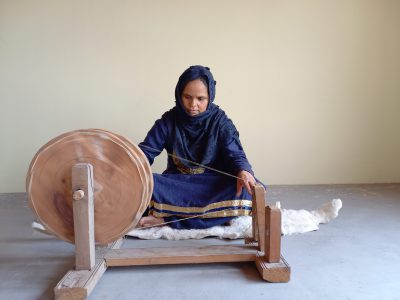
Five minutes’ walk from Srinagar’s Jamia Masjid, the largest mosque in Kashmir, is a modest two-story house. This is where Sakeena, 73, lives—and where she has been spinning pashmina wool by hand for more than a decade. She’s well known for her skill in spinning the finest and most delicate yarn from the region’s world-famous wool.

Zain-ul-Abidin, the fifteenth-century Sultan of Kashmir, introduced the art of pashmina weaving. He brought craftsmen from Persia to teach the local population various skills, which included making the wool shawls that are to this day a sought-after luxury item around the world. Kashmiri women have long been artisans of this heritage craft.

For Sakeena, weaving was a means of achieving economic stability. Her mother taught her and her two sisters to spin when she was an adolescent; when she married, she bought a spinning wheel (called a “yinder” in Kashmiri) for RS24, or about $0.32, and used her income to supplement the earnings of her husband, who was a tailor. “I used to earn RS150 ($2) for working five hours a day,” she said, explaining that “back then, that was enough for two proper meals.”

Until the 1990s pashmina wool was spun and woven at artisanal centers all over Kashmir. But with the rise of the Kashmiri armed struggle and the Indian government's military response, curfews and lockdowns led to a shift: people are now working primarily from home. A few remaining traditional spinners live in pockets of Srinagar, the capital of Kashmir. Sakeena is one of them, but she said that now there is “either no work or the wages paid are not enough to pay for one proper meal.”

The long military lockdowns of the past few years precipitated the decline of the pashmina industry by preventing or discouraging buyers from visiting the disputed territory. As a result, the number of female spinners has declined from a high of 100,000 in 2007 to just 15,360 in 2021, according to The Directorate of Handicrafts & Handlooms in Kashmir.

“Foreign tourists used to come to Kashmir to buy the shawls,” said Sakeena. But no longer. “My daughters have three yinders that have been lying unused for the last year in our attic,” she lamented, adding that they will sell them if the current situation continues much longer. “The Indian government promises to empower people, but in Kashmir, they are doing the opposite by making us economically weaker,” she said.

The politically unstable situation, the prolonged military lockdowns, and now the pandemic, have pushed the regional economy into a free fall. According to a 2020 report issued by the Kashmir Chamber of Commerce and Industry, more than 100,000 private sector jobs were cut after August 2019, when the Modi government precipitated an ongoing political crisis by revoking the Muslim-majority territory's limited autonomy.

Adnan Bashir, who owns a pashmina showroom on the banks of Dal Lake, one of Kashmir’s most renowned natural beauty spots, said that the months-long communications shutdown had severely undermined his business. “Around eight international orders were canceled because I was not able to contact the customer [due to the suspension of internet and mobile connectivity],” he said. One customer from Germany canceled a buying trip due to the military curfews. Bashir described his business’s condition as “critical,” and said he might have to look for another way to make a living.

Fahmeeda, a 67-year-old widow who asked that her real name be withheld, reluctantly sold her yinder last year for financial reasons. It had been a gift from her mother, she said, but she needed the money to buy medicine for her son. “This used to be a blessed craft for women like me,” she said, adding that she had supported her children with the money she made from spinning. “Last year, when Kashmir was under strict lockdown, I went out to purchase raw wool but soldiers chased me away by hitting me with their sticks,'' she wept. She now works as a cleaner in a private school for RS800 (just over $10) a month—compared to RS2600 ($35) before the lockdown that began in August 2019.

A recent shortage of raw pashmina has dealt yet another blow to the industry. Ordinarily the wool is imported from Ladakh, which lies on the disputed and ill-defined border between India and China; but in June long-simmering political tension erupted in a military clash that left 20 Indian soldiers dead and caused the suspension of trade between the two regions.

The introduction of power looms presents yet another threat to the 600-year-old pashmina craft. Merchants and artisans led a protest in late June to demand a ban on these looms, which pose a threat to the livelihoods of thousands of Kashmiris. The 1985 Handloom Protection Act forbids the industrialization of pashmina production, said Muhammad Lateef Salati, an activist from a family long engaged in artisanal pashmina production. The government, however, has failed to enforce the law.

Industrially produced pashmina is often sold falsely as authentic traditionally produced wool—a practice that undermines the value of the brand. By failing to enforce the law against manufacturers of mass-produced pashmina, the government shows that it is “not serious” about protecting the craft, said Salati.

Some Kashmiris are trying to safeguard traditional pashmina production by empowering local artisans.

Murcy, the daughter of a family long engaged in traditional pashmina production who divides her time between New Delhi and Srinagar, recently launched Fair Share Cashmere, a socially conscious online business initiative to sell hand-spun shawls made by local artisans. She said that she pays traditional female spinners the highest rate the market will bear. “We have been successful in bringing eight women back to this craft,” she said, adding with a smile that this “feels like a victory.”

The decline of traditional pashmina production in Kashmir has created a vacuum of employment for women who could once depend on the income they made from spinning wool to ensure that their families were fed. Now they are unemployed and, for the most part, voiceless. Murcy is one of a handful of locals who are trying to preserve the remnants of a once-thriving artisanal craft, despite the enormous political and economic challenges.
    [post_title] => 'This used to be a blessed craft for women': In Kashmir, artisanal pashmina weaving is disappearing
    [post_excerpt] => For hundreds of years, Kashmiri women could count on the artisanal craft of spinning, handed down from mother to daughter, to feed their families. Then came martial law and a pandemic. 
    [post_status] => publish
    [comment_status] => closed
    [ping_status] => open
    [post_password] => 
    [post_name] => this-used-to-be-a-blessed-craft-for-women-in-kashmir-artisanal-pashmina-weaving-is-disappearing
    [to_ping] => 
    [pinged] => 
    [post_modified] => 2026-08-06 19:33:39
    [post_modified_gmt] => 2026-08-06 19:33:39
    [post_content_filtered] => 
    [post_parent] => 0
    [guid] => https://conversationalist.org/?p=3121
    [menu_order] => 183
    [post_type] => post
    [post_mime_type] => 
    [comment_count] => 0
    [filter] => raw
)

‘This used to be a blessed craft for women’: In Kashmir, artisanal pashmina weaving is disappearing