How samba schools in Brazil are teaching Black history through the parades at Carnival.
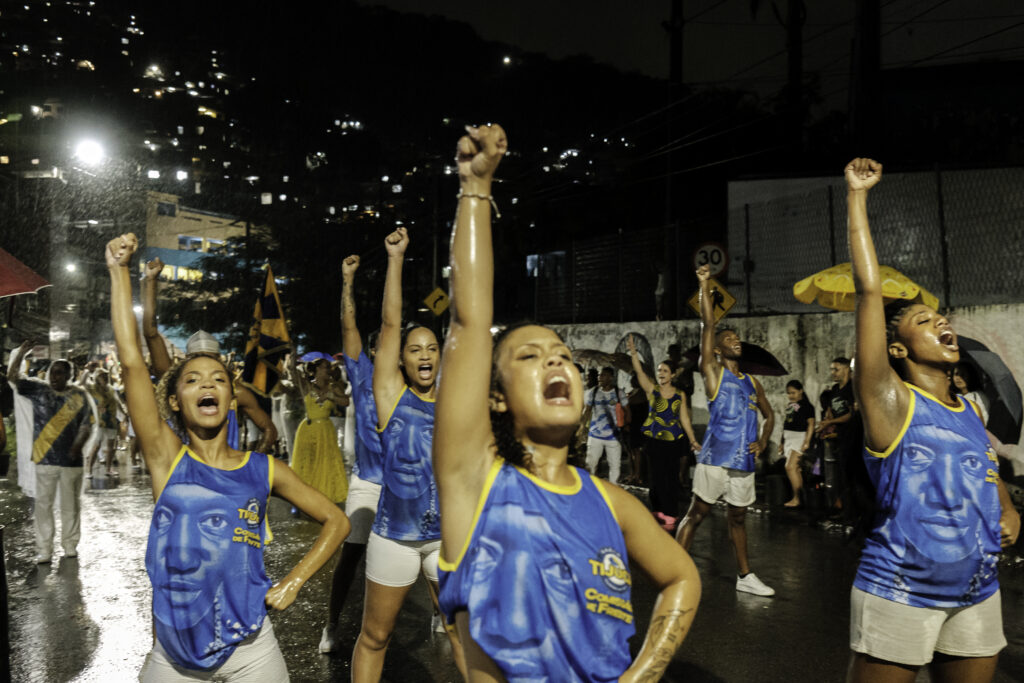
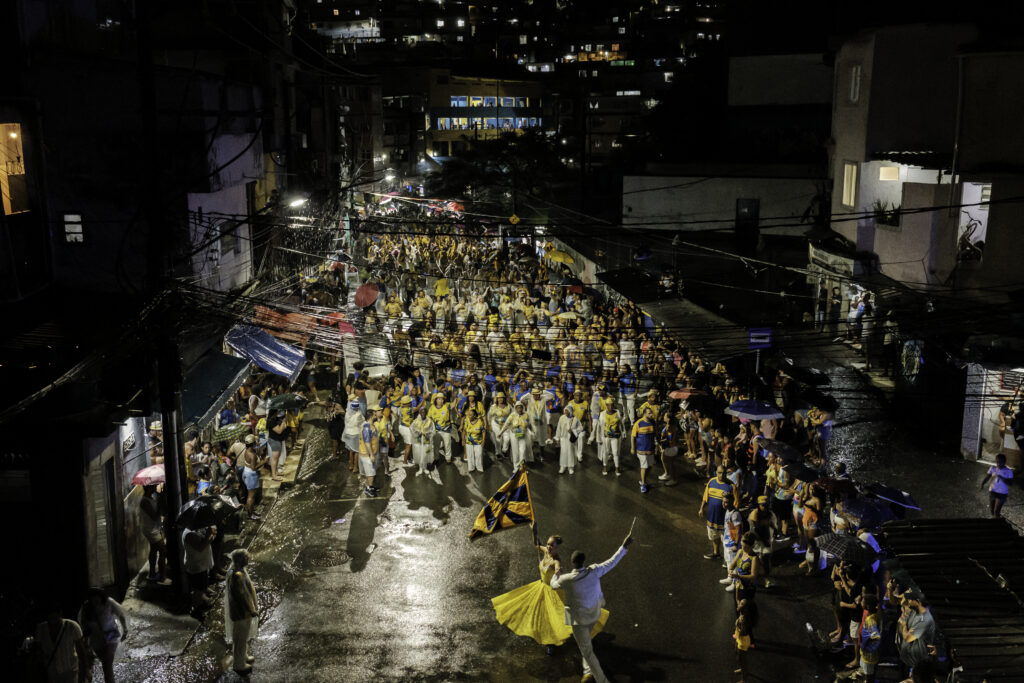
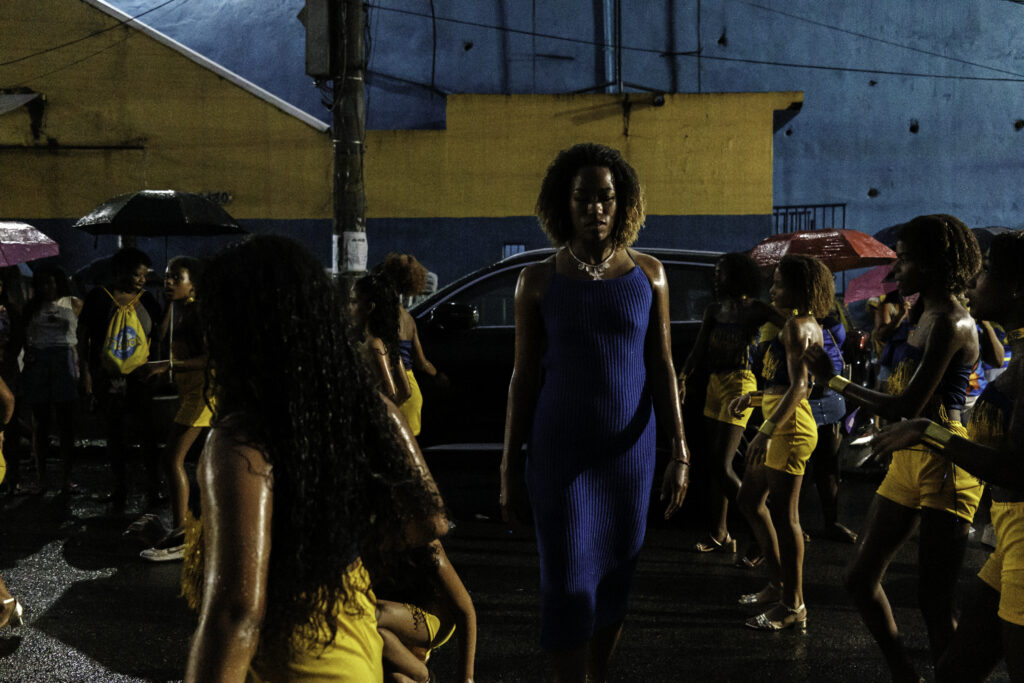
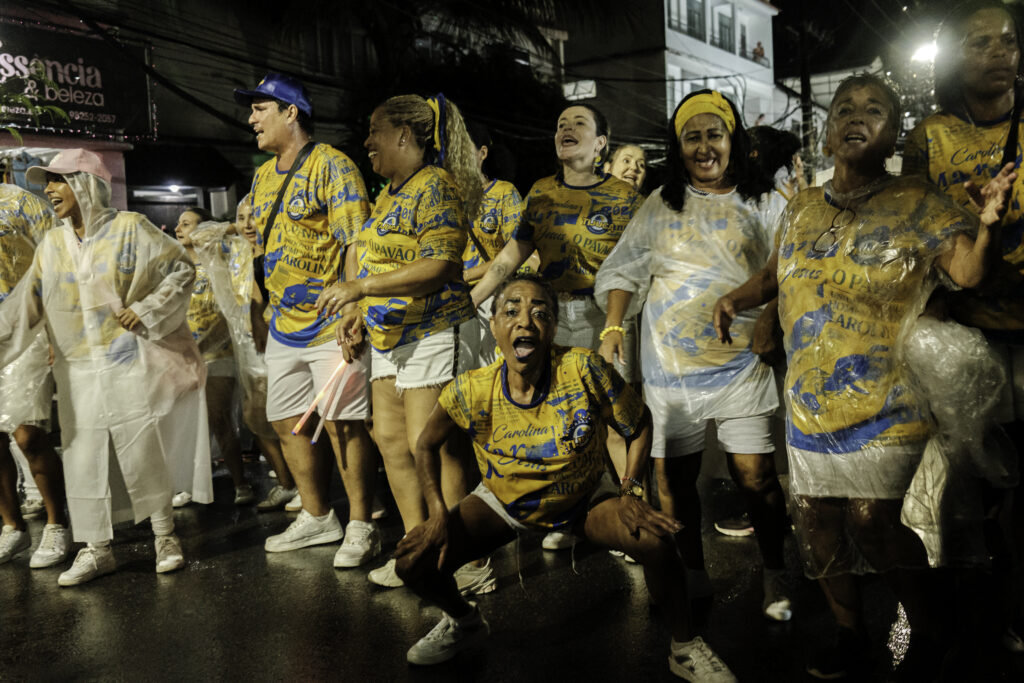
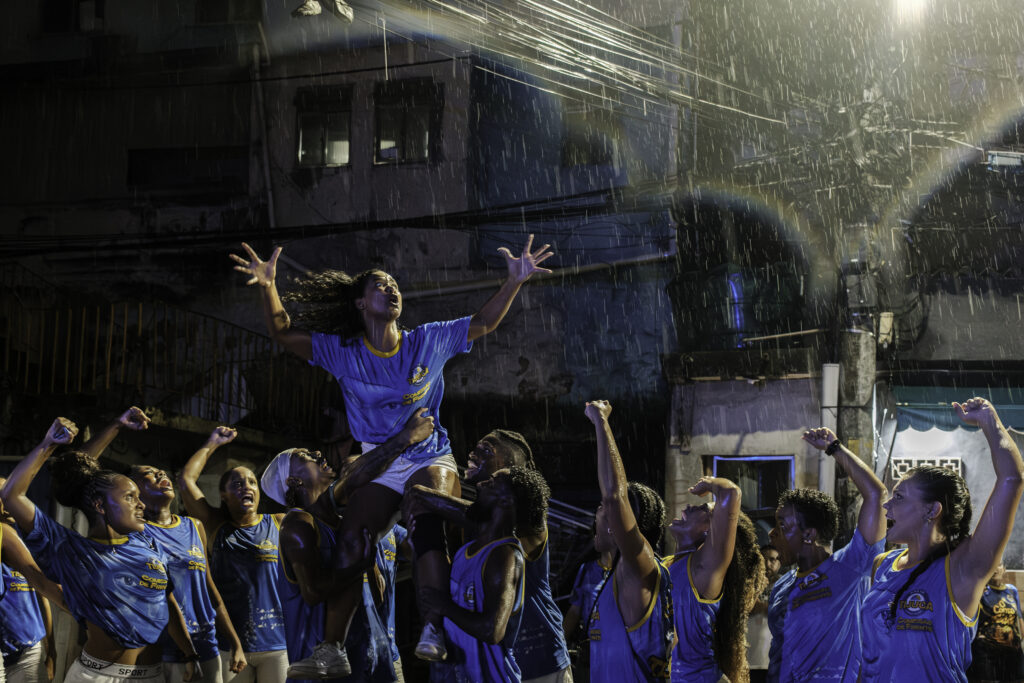
The torrential rain couldn’t stop Unidos da Tijuca, one of the oldest samba schools in Rio de Janeiro, Brazil, from rehearsing in the streets. On an evening in early February, dancers flooded the Morro do Borel community, moving their bodies in unison as a crowd cheered them on, shouting their loyalty to the samba school and dancing alongside them. The crowd had been waiting for hours for the rehearsal to begin, drinking beer and barbecuing, the evening already a celebration. Now, the sound of snare drums, quick and sharp, moved each spectator to sing along to the music, as the year's anthem began to play. The performance had officially begun.
Though the parades in Rio are world-famous, attracting a global audience for Carnival each year, the greatest show in the world still belongs to these communities, where the parades—a pivotal part of the season’s festivities—originated. It is also here that these samba schools work hard year-round to honor the parades’ original purpose: bringing marginalized histories that aren’t taught in Brazilian schools to the national stage.
“Since the 1930s, samba schools have been addressing themes closely related to Brazilian history,” historian Luiz Antonio Simas tells The Conversationalist. “This created a tradition in which Brazilian history, important figures from Brazilian history, and the country's natural beauty became recurring themes [at each parade].”
Leonardo Carrato
Founded in 1931, Unidos da Tijuca is one of 12 samba schools that compete during Carnival, each putting on a parade built from scratch that highlights a different piece of forgotten Brazilian history. For this year’s parade, Unidos da Tijuca chose to tell the story of Carolina Maria de Jesus, a Black Brazilian memoirist, poet, composer, playwright, and best-selling author, most known for her book Child of the Dark: The Diary of Carolina Maria de Jesus, published in 1960 and translated into 14 languages. Last year, the school chose to tell the story of Logun-Edé, an orisha of the Black Brazilian religion Candomblé, and the year before, the influence of Portuguese folk tales on Brazilian samba music.
Other competing schools chose different figures to celebrate this year: Acadêmicos do Salgueiro paid homage to Carnival designer and professor Rosa Magalhães, a samba school legend who won six Carnival championships in the 1980s. The samba school Paraíso de Tuiuti performed a parade about Afro-Cuban religious practices, with a whole chorus written in the Yorubá language. And the 2026 winner, Unidos do Viradouro, honored Moacyr da Silva Pinto, or Mestre Ciça, the school's legendary percussion conductor.
In telling these stories, Unidos da Tijuca and other samba schools aim to make marginalized histories—and Black history in particular—more accessible through popular culture, allowing them to keep these histories alive. The construction of the parade is a year-long process that starts again right after Carnival ends, beginning with each school democratically electing a theme, running a song competition, and translating history into a visual performance through choreography that involves hundreds of dancers.
But while the parades are a joyful culmination of the schools’ efforts, for the communities each samba school represents, it’s the lead-up to the final performance that often most solidifies the history being celebrated.
Leonardo Carrato
That rainy Sunday was Unidos da Tijuca’s last street rehearsal before the official parade at the Sambadrone, and party dwellers excitedly gathered to watch an intimate preview of what would later earn the school 7th place in the official competition. At 6 PM, onlookers dressed in the colors of Unidos da Tijuca—blue and yellow—waited outside of the school, a tall building painted in yellow. The energy was high as people gathered, and the song composed for this year’s parade played loudly through speakers at the closest bar, along with songs from previous years: "Logun-Edé - Santo Menino que Velho Respeita" (“Logun-Edé - The Holy Child Old Men Respect”) and "O Conto de Fados" (“The Tale of Fairies”).
As the time for the performance neared, people began singing along to the story of Maria de Jesus, one that mirrors the stories of many Black women in Brazil today. A single mother of three, Maria de Jesus lived in the favela of Canindé in São Paulo, where she spent her time picking up recyclables to sell, taking care of her children, and writing about her day-to-day life. One of her notebooks from this time would eventually become her first best-selling book, Child of the Dark, which sold 10,000 copies in its first week of publication in 1960—an achievement that was unheard of at the time, and still rarely met in Brazil now.
But the majority of the community was unfamiliar with these details of Maria de Jesus’s life before Unidos da Tijuca chose to tell her story for the 2026 parade. “It’s essential that we talk about a person who has been made invisible by society and by the Brazilian people,” Mariah Dantas, one of the principal dancers, tells The Conversationalist. “Almost nobody remembers her importance, or how impactful she was at the time, and how important she is today. Because many women still live in poverty like she did… This isn’t just about telling Carolina’s story, but also about highlighting that Black women still live like that, and that this needs to change.”
Many of these same women also live in Morro do Borel, and saw themselves reflected in Maria de Jesus’s story for the first time. “It was the perfect choice,” Carlos Batata, member of Unidos da Tijuca and president of Unidos da Tijuquinha, a version of the samba school for children, tells The Conversationalist. “The story was unknown, [but] with time, people got to know more about Carolina’s work, and now people sing the samba song and relate and cry to it, because there are parts of the lyrics—a phrase, a chorus—that represents each woman’s story here.”
Leonardo Carrato
To accurately tell Maria de Jesus’s story, Unidos da Tijuca worked with an academic consultant on everything from the writing of the samba song’s lyrics, the design of thousands of costumes and five floats, and even some of the choreography. (The practice of hiring a consultant is relatively new across samba schools, a union of institutional education and popular education that only began around 10 years ago.) This year, Unidos da Tijuca collaborated with researcher Fernanda Felisberto, a literature professor at the Federal University of Rio de Janeiro, who is a part of an editorial committee that has salvaged, re-edited, and published Maria de Jesus’s work in recent years.
“For a long time, we used to say that there are histories that traditional schools don’t tell, but that Carnival will tell those histories, almost as if they’re in opposition to each other,” Felisberto says. “But in reality, we are building a process that goes hand-in-hand, especially because hiring consultants has become more and more common for samba schools. So, samba schools today are learning from these traditional sources of knowledge. The challenge for Carnival is to translate that knowledge in a way that reaches more people.”
The act of performing in community is a large part of this translation, and in Morro do Borel, it is what has brought Maria de Jesus’s story back to life. “Sou a liberdade, mãe do Canindé / Muda essa história, Tijuca / Tira do meu verso a força pra vencer / Reconhece o seu lugar e luta / Esse é o nosso jeito de escrever,” both members of the samba school and party dwellers alike screamed at the top of their lungs during the street rehearsal. (“I am freedom, mother of Canindé / Change our history, Tijuca / Get the strength to win from my verses / Recognize your place in struggle / This is our way of writing.”)
Leonardo Carrato
For this year’s parade, Felisberto says the school intentionally focused on lesser known works by Maria de Jesus, like the music she composed and recorded, and the plays she wrote, which remain unreleased to the public. They hoped to show Maria de Jesus was more than her biggest successes, in part so that she is recognized for the breadth of her creative work, which never got as much exposure as her first book. “We want people to understand that Carolina was a multidimensional artist,” Felisberto says. “Child of the Dark constructed an image of Carolina that spotlighted precarity, which is how people see her today. The challenge was to humanize her, show her failures and successes beyond a narrative around her best-selling memoir.”
Like Felisberto, many view the Carnival parades not just as a celebration marginalized histories, but as a collective experience with a lasting impact. “I consider samba songs by samba schools to be historical documents,” Simas says, adding that in his 30 years working as a history teacher in public schools in Rio, he has used samba songs as pedagogical sources. “It’s a tool to start debates, we can analyze the lyrics, study the trajectory of some historical characters who are less talked about in formal education.”
For Unidos da Tijuca member Douglas Coutinho, studying samba songs even helped him to pass his university entry exams. “My history teacher used the samba song from 2008, ‘João e Marias’ by Imperatriz Leopoldinense, [in class],” Coutinho says. “The samba song helps teachers teach, and it helps students understand the material that is being taught.”
Leonardo Carrato
Perhaps most importantly, in telling and preserving these stories through samba parades, communities are able to reclaim the narrative from the dominant classes, which tend to dismiss or downplay the importance of marginalized histories. Sometimes, it also allows these stories to become the dominant narratives—at least, during Carnival, when the media’s attention turns to the communities these samba schools represent.
“Samba schools will tell us stories that are important for the people,” says Iara Cassano, a member of Acadêmicos do Salgueiro and a samba teacher. “The dominant narratives will tell histories that are important to the elites… Carnival gives us autonomy to tell our own histories.”
[post_title] => A History Lesson Through Samba
[post_excerpt] => How samba schools in Brazil are teaching Black history through the parades at Carnival.
[post_status] => publish
[comment_status] => closed
[ping_status] => closed
[post_password] =>
[post_name] => samba-school-forgotten-marginalized-black-history-rio-de-janeiro-brazil-carnival-parades-unidos-da-tijuca
[to_ping] =>
[pinged] =>
[post_modified] => 2026-03-20 02:25:49
[post_modified_gmt] => 2026-03-20 02:25:49
[post_content_filtered] =>
[post_parent] => 0
[guid] => https://conversationalist.org/?p=10356
[menu_order] => 0
[post_type] => post
[post_mime_type] =>
[comment_count] => 0
[filter] => raw
)
We’re kicking off a new gathering for our community, and you’re invited! Starting in February, we’re launching Conversation Club, a special new way to spotlight some of our favorite stories, by hosting conversations where writers can answer your questions and share more about how their stories came to be. It’s kind of like a book club, but you don’t have to read a whole book!
Read the article, come with questions (or not—just bring your mug of tea if that’s what you’re feeling), and be in community with us. It’s a casual, friendly discussion group and an encouraging space to stay curious, informed, and connected with fellow Conversationalist readers.
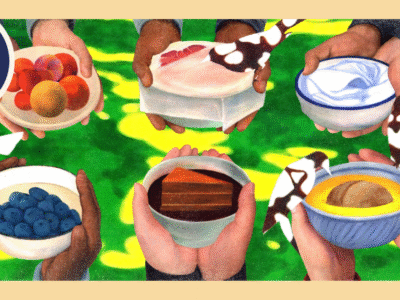
Our first Conversation Club will feature our Executive Director Erin Zimmer Strenio’s recent piece “A Helping of Something Hopeful”, about her weekly neighborhood potlucks and how they've nourished her community on multiple levels. How did she get the potluck up and running? How did she keep it going? How can you get one started in your own community? Erin will chat with our Executive Editor Gina Mei, sharing what she’s learned and answering other questions from the community, including readers just like you.
You can RSVP to our first Conversation Club below, and read Erin’s piece right here. We can’t wait to be in conversation with you. See you there!
How committing to a weekly neighborhood potluck has both fed and strengthened my community.
There’s a certain serendipity that happens at a potluck. Foods that have never mingled together find themselves side by side: jambalaya in a crockpot, a cardboard pizza box, a plastic tub of Trader Joe’s hummus, a platter of gluten-free brownies. None of it really makes sense when scooped together onto a plate, but all of the flavors blend like fast friends—and if you’re lucky, oftentimes, the people do, too.
It’s another Monday night, which for me, means another neighborhood potluck. Every week, a group of us meets in the same grassy area by the bay in our neighborhood outside of Providence, Rhode Island. This week, I brought a pesto pasta salad with random veggies I found in our fridge; last week, it was leftover ribs my husband made over the weekend; the week before, a bag of chips and salsa. As we set up shop on a foldout table, I can see the curious faces of people driving and biking by, wondering what the heck is going on. But for us, it’s just another Monday night. People start trickling in around 5:30pm and stay until the sun goes down. We catch up on each other’s lives, and watch the kids run around while helping ourselves to a second plate. Then, we pack up our things and say our goodbyes, knowing we’ll see each other again next week.
While these gatherings now feel like a staple in my life, I first learned the magic of weekly potlucks a few years ago, in my old neighborhood in New Orleans, Louisiana. It was 2022, and we were still feeling a bit socially raw, fresh out of our Covid bubbles. A neighbor friend started a group text, inviting us to gather every Monday at the playground for a whatever-you-have-lying-around potluck dinner and a good hang.
At first, the weekly cadence sounded like… a lot. Weekly? Really? Could my social battery handle it?
Yet after the first few months, it started feeling like an important ritual, and after the first year, it felt like a sacred space. The regular cadence was key. It allowed us to check in on each other and get to know our week-to-week rhythms. I could ask how Jen’s doctor’s appointment went last week, or if Joel had recipe-tested the chicken and dumplings he was planning for his upcoming popup restaurant. When I wanted someone to be my accountability-buddy to do that yoga class I kept swearing I’d do, I could ask if anyone else had been looking for an accountability-buddy, too. And with the standing weekly gatherings, all of this could happen in an intentional way, our commitment to a weekly meal slowly blossoming into something more.
After spending a couple of years social-distancing and mostly avoiding group gatherings, our neighborhood potlucks also felt like a joyful and much-needed form of social fitness, something scientifically proven to be just as important to our well-being as physical exercise. Maybe you’ve heard of Harvard's 85-year happiness study? It started in 1938 and followed 724 participants from their teens to old age. The participants regularly answered questions about their health and habits, their income and relationships, their joys and disappointments. The study also incorporated insights from their spouses and 1,300 of their descendants.
What did the study find to be the most important factor in determining a long and happy life? Strong, supportive relationships. Not cholesterol levels, or how many kettlebells you’ve lifted (although those things are important, too!)—but genuine human connection. It was a stronger indicator for happiness than even genetic predispositions, social class, or IQ.
This was also precisely what many of us were so starved for back in 2022. As the weeks went by, it felt like we had cracked the code to maintaining a genuine closeness with our neighbors. I also realized it wasn’t just the shared meal that was feeding us and allowing for deeper relationships to grow: It was our commitment to having it in the first place.
In New Orleans, I experienced the fruits of this firsthand. A group of us kept showing up, kept checking in on each other, kept extending the invite to other neighbor friends, and kept feeling the goodness of our Monday merriment spilling into the rest of the week. It was something to look forward to, something that consistently got our weeks started on a hopeful note. The Sunday scaries felt almost cured by the Monday potluck magic.
It was also a weekly reminder that, no matter what else was happening in the world, we were all still here, still showing up, and still feeding each other—with food, with friendship, with community, with care.
This commitment never felt burdensome, but instead, like a newfound necessity. In the age of TikToking your way down the street and scrolling in bed until you fall asleep, people are overconnected but undercommitted. Relationships, however, are built on commitment—and at least according to the Harvard study’s findings, that means our happiness is built on commitment, too. It’s a muscle to exercise like any other, and when we allow it to atrophy, our communities tend to suffer. But when we put the effort into consistently exercising it, our relationships and our communities begin to bloom.
It still impresses me that we managed to meet up every week for over a year, even with small kids and busy jobs and all the rest. I believe a big part of this was probably the fact that we met in a public space (the neighborhood playground), that was walking distance for all of us (no driving required), which also meant that nobody had to host (no need to clean your house).
The not-hosting part felt especially important. Nobody had to stress about people coming over and nobody had to deal with washing the dishes since we BYO’d our own plates and cutlery. We also never felt the pressure to bring anything fancy, a rule we established early on. One week it might be a bag of chips and the next it might be leftover birthday cake and maybe the next it would be homemade enchiladas if you had a little more time to cook. It all evens out in the potluck wash. And when everyone brings something, everyone leaves full.
When I moved to Rhode Island in 2024, I knew I had to keep my potluck muscles active in order to keep this little bit of magic alive, too.
I started a Whatsapp group and kept adding new neighbor friends to join as I met them. I scheduled the first potluck as a test run, just a couple months after we’d moved into our house. Given the big turnout (close to 40 people), I knew it could be a regular thing, so we started it up in earnest in the summer when the weather was more reliably outdoor-friendly. My husband and I began sending out a reminder on Monday mornings. And for the regular crew that started showing up each week, and telling other people to join, the potluck magic alchemized just as it had in New Orleans. I felt especially proud when I started seeing people I didn’t recognize who had heard about it through the neighborhood grapevine.
Every Monday, we’d arrive at the park with our foldout table and gingham tablecloth (adding a tablecloth instantly makes any gathering feel more special). For a quick second, I’d worry that nobody would show up. I’d feel a bit self-conscious, then I’d remember that even if nobody came, I’d still be outside eating with my family, which is a gift on its own.
I wouldn’t take it personally if people couldn’t make it (although a younger version of myself probably would have). But sure enough, people always did, and a mishmash of dishes would start appearing on the table. Hot dogs and mini quiche? Sure, why not! Barbecue ribs and a mountain of edamame? I mean, yeah, let’s do this! The neighborhood kids would run around on the grass and inevitably start piling on top of each other, like a Polaroid snapshot from 1995. No iPads or AI or any other tech-y shenanigans. Just some good ole wholesome potluck fun.
After a full summer of weekly potlucks, however, it became clear that one major difference between New Orleans and New England is, well, winter. In New Orleans, we could keep the weekly cadence humming along for most of the year. The summer heat and storm season did force some cancelations, but in Rhode Island, the days started growing dark by 6 p.m. and it was puffy coat season by Halloween, so we had to “close for the season” in October.
“I really miss our Monday potlucks,” neighbor friends have told me recently. Some have even offered to host in their homes, but this feels like breaking a key tenet. Removing the hosting pressure is a big part of what keeps our potlucks running so smoothly and solidly, so inclusively and so stress-freely.
While I know it’ll come back in full force once the weather warms up and the sunlight stretches back into dinner hours, I can still feel my potluck muscle craving exercise. We’ve been looking into community spaces that might be willing to host us during the winter, such as the library or the masonic center a few blocks away. Or the old-school bowling alley, which has some tables in the back. We’ve also been brainstorming other ways to stay connected during the colder, darker months. Perhaps a weekly walking club around the neighborhood? Or a soup swap (like a cookie swap, but for soup)?
But I also know that rest is important when it comes to exercise, too. And it’s during this wintry off-season that I’m discovering how much the seedlings of our summer potluck friendships have sprouted. People are still texting each other to check in, still asking each other for HVAC repair advice and babysitter recommendations. And thankfully I still have my accountability buddy checking in on how we might move our bodies this winter — she just suggested a 30-day “gentle burn workout” with short daily videos, asking if we could text each other once we’ve finished each as motivation and a healthy bit of peer pressure.
A potluck, of course, isn’t the only way to nurture and maintain our relationships, but it’s one that’s made me feel particularly hopeful. Commitment begets commitment, and makes the muscle stronger, something we can feel even when it’s not in use.
Bringing people together on a regular basis is also a reminder that small rituals can add up to something much bigger. In the months since our last potluck, our Providence community has been deeply hurting following the horrific mass shooting that took place at Brown University in December. We’ve been checking in on our neighbors, and feeling a wide range of emotions: grief, sadness, anger, anxiety, and heartbreak. But as we continue to grieve, our commitment to holding space for each other gives me hope that we’ll live another day, and share another meal, and continue to show up for each other, again and again.
[post_title] => A Helping of Something Hopeful
[post_excerpt] => How committing to a weekly neighborhood potluck has both fed and strengthened my community.
[post_status] => publish
[comment_status] => closed
[ping_status] => closed
[post_password] =>
[post_name] => hope-week-weekly-neighborhood-potluck-community-food-personal-essay
[to_ping] =>
[pinged] =>
[post_modified] => 2026-01-14 02:30:14
[post_modified_gmt] => 2026-01-14 02:30:14
[post_content_filtered] =>
[post_parent] => 0
[guid] => https://conversationalist.org/?p=9910
[menu_order] => 0
[post_type] => post
[post_mime_type] =>
[comment_count] => 0
[filter] => raw
)
How door-knocking for Mayor Mamdani restored my faith in the power of organized people to defeat organized money.
The thought of knocking on a stranger’s door once filled me with dread. It sounded uncomfortable at best, and potentially humiliating, or dangerous, at worst. What if someone slammed the door in my face or said something memorably vicious? I’m a 43-year-old white woman, raised in an upper-middle-class home in Buffalo, New York. My parents, respectively descended from Eastern European Jews and Sicilian Catholics, discussed politics and occasionally attended protests, but knocking on strangers’ doors wasn’t a big part of my childhood.
Yet in the last eight years, as I’ve gotten older and more politically active, I've begun to grasp the value of pushing through that discomfort. In April, before the summer’s Democratic primary, I started knocking on doors for then-New York City mayoral candidate Zohran Mamdani, and continued through Election Day in November. Altogether, I knocked on approximately 2,000 doors, usually with a partner, which was more fun and comfortable, if less efficient, than going alone.
Door-knocking shifts for Mamdani regularly drew dozens of New Yorkers, even in terrible weather, and on Monday and Tuesday nights, when fewer people are motivated to go out after work. I mostly knocked on doors in Brooklyn, where I live, but my fellow canvassers came from all over the city. Some were ideologically motivated, while others had concrete, pragmatic reasons for showing up, like the woman I met who joined a canvass because “the bus I took to get here took 40 minutes to make two stops.” (Making buses fast and free was one of Mamdani’s signature campaign promises.) Or the 40-something Afro-Latino couple who said they came out for the sake of their children’s future, because “right now, things aren’t looking so good.” Other first-time canvassers I encountered included a soft-spoken young woman named Fatima, a heavily tattooed, outgoing 20-something Asian-American guy, a shy middle schooler with her immigrant dad, and a young white man who praised the campaign's “immaculate vibes.”
One reason Mamdani means so much to so many New Yorkers is that he assembled a 100,000-person volunteer army—the largest in municipal history, and one of the most diverse. His volunteer base included young and middle-aged progressives of all stripes, and a substantial subset of Jewish New Yorkers, South Asians, and Muslims. Getting to know my fellow canvassers for hours and months at a time as we worked to expand that coalition was an extraordinary project in a perilous time for democracy. It demonstrated the hope that tens of thousands of us still feel, and how hard we are willing to work to make life better for ourselves and our neighbors.
Given how many doors we knocked throughout the city's five boroughs, the New Yorkers we reached were even more varied than the volunteers. During one general election canvassing shift in Kensington, a young Black woman opened the door to me and my friend Tania, who is Jewish. Although she didn’t initially recognize Mamdani’s name, as we went into our spiel, she realized he was the candidate her boyfriend had urged her to vote for. “Normally I wouldn’t tell a woman to do what her boyfriend says, but in this case, he’s right!” Tania said. (Our new friend smiled.)
Another striking moment came when an older man in South Brooklyn’s Sunset Park unsmilingly asked if I were Mamdani’s daughter. He seemed to be trying to determine why I was volunteering for a man to whom I had no apparent ethnic or religious ties. Why else would I be doing this? Mamdani was not, in fact, my father, I explained, but I believed so strongly in his agenda that I was volunteering anyway. The man kept his face blank. I wondered when someone had last knocked on his door.
Another day in Sunset Park, an older Spanish-speaking woman thanked me and my partner, who also spoke Spanish, for volunteering. She invited us into her home, where she and a small circle of relatives were celebrating her 90-year-old father’s birthday with balloons and cake. I’ll never forget the warmth and intimacy she offered us as total strangers.
In the last eight months, I’ve met Mamdani fans from Ireland, Germany, Sweden, Australia, and Canada. None could vote or contribute to the campaign, but some shadowed canvassers and interviewed volunteers, most commonly because they belonged to left-wing political parties and hoped to reproduce his success at home. Although he often emphasized that he was running a local race to benefit New Yorkers, it was clear Mamdani was also inspiring admirers around the world.
In addition to many happy, surprising, and rewarding encounters, I had my share of the awkward, unsettling, and agitating. There was the woman who saw my “New York Jews for Zohran” shirt and pretended to retch; when I moved toward her, thinking she might need help, she screamed, “That was about you, because you want my children dead!” There was the super who ordered us out of his building because we were supporting a candidate who, he falsely believes, “wants to kill all the Jews.” Another woman called my friend Allie “Nazi scum” and said she should just “put on the burqa [Mamdani will require] right now.”
Moments like these were reminders of the ugly racism our politics so often exposes. They shook me: I am rarely around people who would speak this way to anyone, let alone a stranger. But they also strengthened my resolve to work for and with people who lead with love, respect, and decency, and model those traits for others.
As of last week, New Yorkers have made one such person our mayor.
Just before the polls closed on Election Night, Tania and I met a man with two little girls with him on the street in Park Slope. He hadn’t planned to vote and realized he couldn’t make it to his polling site in time with the kids. After he left, I joked that we should have offered to babysit: “We can start delivering on Mamdani’s promise of free child care right away!” We were giddy with pre-election anxiety, and desperate to turn out every last vote.
A short time later, once it was clear Mamdani had won, my friends and I experienced one of the happiest moments of our lives. We were weeping and hugging and singing and cheering at what we’d accomplished together. All the neighbors we’d met on the ground were reflected in the voting blocs he’d won: older, moderate Black voters; young voters, including but not limited to white socialists; and immigrants, Muslim and non-Muslim alike. I’d knocked on doors before, but Mamdani’s campaign showed me just how powerful it could be.
Later, I wondered if we’d ever find a way to recapture that feeling and use it to drive ourselves forward in less happy and hopeful times. Could we love each other enough to keep doing the work that only occasionally produces such moments, even in times when there’s no end, and no payoff, in sight?
I’m still not sure how we’ll navigate this fundamental challenge of organizing. But being part of a political project that attracted the passionate support of New Yorkers in all five boroughs, and sympathizers around the world, has restored my faith in the power of organized people to defeat organized money. And although a huge part of Mamdani's appeal is that he ran on improving New Yorkers' daily lives, he also showed that grassroots campaigning works—and that contemporary politics can be a joyful and loving project that brings people together, rather than an ugly spectacle that thrives on negative attention, exploits our fears, fills us with anxiety, turns neighbors against each other, and leaves us feeling empty, sad, bitter, and alone.
In canvassing for Mamdani and other DSA-backed candidates, I saw how much people are craving community, connection, and fun. We need to create more opportunities like this—to move joyfully toward something, rather than slogging through a sales pitch for a mediocre candidate who’s better than their opponent in hopes of slowing what feels like an endless parade of horrors. In the last year—still emerging from the long shadow of a global pandemic—I’ve embraced more near-strangers than I had in the previous five. Now, there’s a bracing sense of possibility in the air—the unfamiliar feeling that good things can still happen, and we can make them.
[post_title] => Knocking On Hope's Door
[post_excerpt] => How door-knocking for Mayor Mamdani restored my faith in the power of organized people to defeat organized money.
[post_status] => publish
[comment_status] => closed
[ping_status] => closed
[post_password] =>
[post_name] => hope-week-door-knocking-new-york-city-mayor-zohran-mamdani-politics-election
[to_ping] =>
[pinged] =>
[post_modified] => 2026-01-13 18:46:44
[post_modified_gmt] => 2026-01-13 18:46:44
[post_content_filtered] =>
[post_parent] => 0
[guid] => https://conversationalist.org/?p=9905
[menu_order] => 0
[post_type] => post
[post_mime_type] =>
[comment_count] => 0
[filter] => raw
)
How women crab farmers along India's coast have linked their livelihoods to environmental conservation.
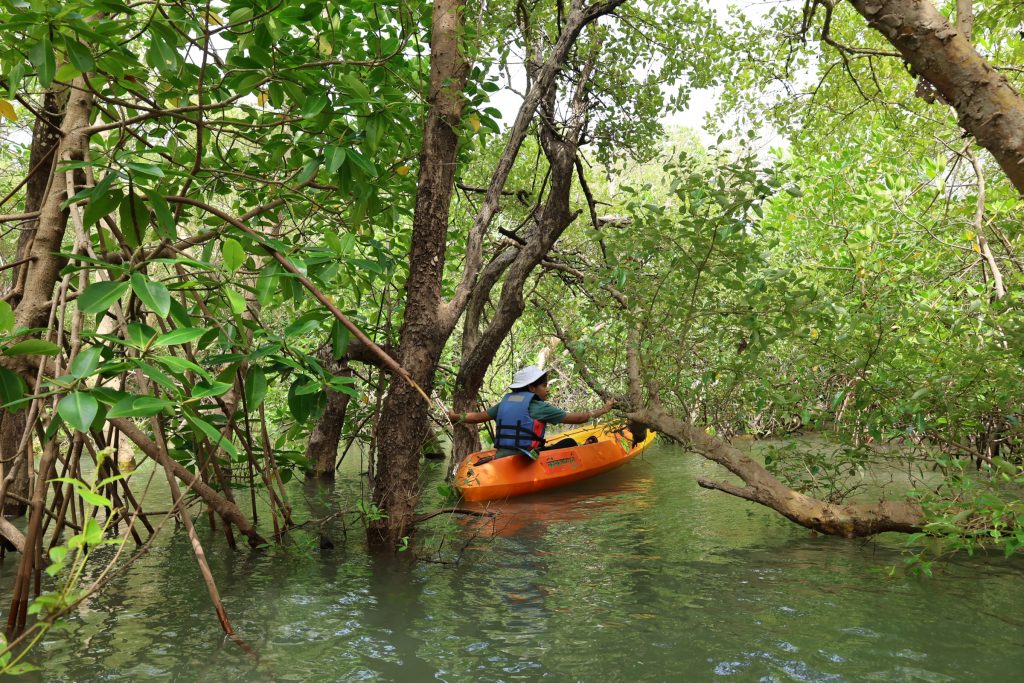
A soft current ripples near Jamdulwadi Island as 15-year-old Prachi Santosh Acharekar guides her canoe through the gnarled trunks of a mangrove forest.
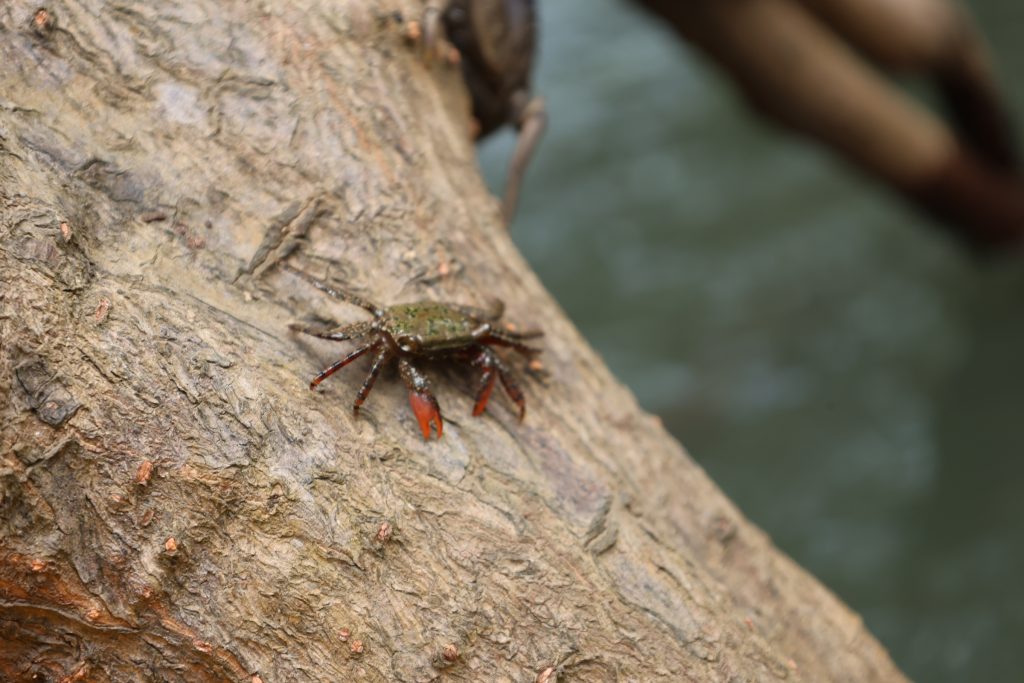
The afternoon sun warms the surface of the water, revealing a familiar scene to local communities around India’s Konkan coast: clusters of mud-covered crabs, basking on branches.
As she approaches them, she slows her boat. Prachi, a 10th-standard student, doesn’t just see mud crabs: She sees her future. Her focused gaze and deft handling of the boat are part of her autodidactic training, a testament to a burgeoning passion that runs deep within the Acharekar family.
Prachi Santosh Acharekar navigating her canoe through the mangroves, a part of her crab farming training.
Champions of the Mangroves
In Achara village, where she lives, crab farming season typically runs from October to May. When Prachi is fully inducted into her family’s business in about three years, during this time, she’ll be busy with preparations, stocking seed, feeding the crabs, and folding boxes to safely transport them once they’ve been harvested.
All of it will also formalize her role in a grassroots movement, led by women from India’s coastal belt: In Sindhudurg, women fisherfolk have become champions in linking their livelihoods with environmental conservation. Through crab farming, they’ve created a strong incentive to protect local mangroves, which serve as critical nursery habitats for mangrove crabs. The benefits of this are both economical and ecological: Alongside generating sustainable income for the women, the mangroves’ preservation stabilizes shorelines and mitigates erosion, enhancing coastal resilience against the impacts of climate change.
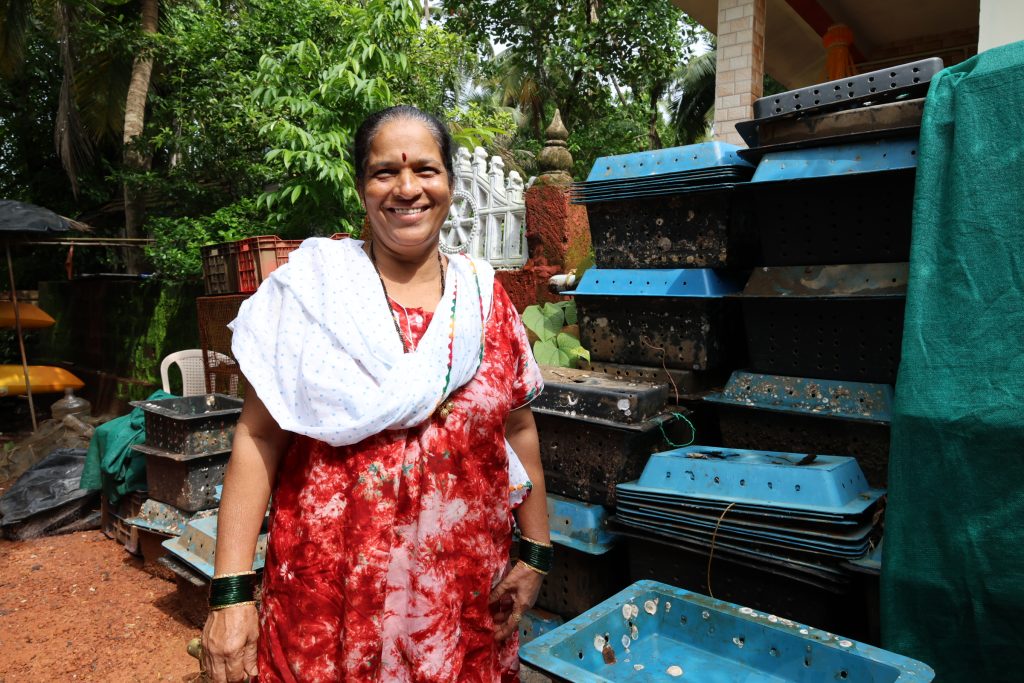
At the heart of this enterprise is Prachi’s aunt, 55-year-old Sonali Sunil Acharekar, a proud entrepreneur and leading member of Konkansparsh, one of Maharashtra’s pioneering women-led self-help groups (SHGs). Like all women of this SHG, for her, the mangrove is not just an ecosystem, but a dynamic marketplace.
“Be it dolphin safari, trekking, birdwatching, or traditional fishing, we do it all at Konkansparsh,” says Sonali, sitting in a charpoy at her home, surrounded by a vast area of mangroves. “But crab farming is our speciality. It is something we feel deeply attached to.”
Sonali and other leaders manage the entire crab farming supply chain, from feeding and harvesting the crabs to selling them. The process is meticulous but straightforward. Crab seeds are carefully placed one-by-one into fiber boxes. Each box is then deployed within the protected mangrove territories of Sindhudurg district, which boasts 6,940 hectares of mangroves perfectly suited for farming. Sonali also feeds the small raw fish stock twice daily, in the morning and evening. Then, once the crabs are ready, they’re harvested, boxed, and sold.
Sonali Sunil Acharekar in the backyard of her home in Achara village.
Overseeing the entire operation in this way has significantly enhanced the women’s access to resources, as well as to the market. The payoff is also demonstrable, including as a sustainable model: Last year, the Acharekar family, a seven-member unit that works in tandem, generated an impressive 150,000 INR ($1,706 USD) from the sale of 180 crabs. They also earned an additional 130,000 INR ($1,466 USD) from running mangrove safaris.
“It feels so good to partake in the process,” says Sonali. “This year, we intend to maintain 200 boxes fully. More boxes mean more business and more business means more prosperity.”
Their success also reinforces a crucial ecological benefit: According to research published in the Marine Biological Association of India, mud crab farming is not only a sustainable—and profitable—livelihood, but an essential strategy for mangrove conservation, supporting the region’s climate resilience through ecosystem protection. The mangroves provide a conducive natural habitat for raising mud crabs, or green crabs, commonly from the species Scylla serrata, which are indigenous to the region. By breeding and harvesting crabs, and building and tending to crabs pens in mangrove creeks, the women have both created a financial incentive for the mangroves' protection and helped to increase the local crab population.
In coastal areas, crabs are considered an economically significant species due to their huge demand. The crabs themselves can also tolerate a wide range of temperatures and salinities without destroying local ecosystems. But over the years, sand mining, saltwater intrusion, and rising water temperatures have contributed to a declining mud crab population, and are just a few of the ongoing stresses and trends that fisher communities have dealt with, and that local SHGs hope to tackle.
A wild baby crab crawls on the trunk of a mangrove tree.
In other coastal communities like Kerala, Maharashtra’s neighboring state, crab farmers who once caught wild juvenile crabs and had plentiful stock are grappling with rising costs and dwindling returns, as crabs have become scarce and stressed. Their annual incomes have dropped by 50,000 INR to 100,000 INR (around $600 USD to $1,200 USD) due to poor water quality, causing frequent disease outbreaks, pushing many farmers to downsize or cease operations altogether, largely due to reduced harvests linked to environmental degradation.
Sustainable crab models in coastal communities in Maharashtra aim to address the pressing problems of overfishing, habitat loss, and food insecurity through long-term economic stability. But without such practices, crab harvesting may yield fleeting profits, triggering ecological collapse and harm to a region’s inhabitants.
In addition to boosting the economy, this is part of why the SHG’s endeavors have been such a great boon to the area.
According to Kedar Palav, Livelihood Specialist at Sindhudurg’s Mangrove Foundation, women-led groups comprising 40 women have been active in Sindhudurg district during the 2024-25 crab farming season. “Our aim,” he notes, “is to facilitate strong livelihood opportunities for the women.”
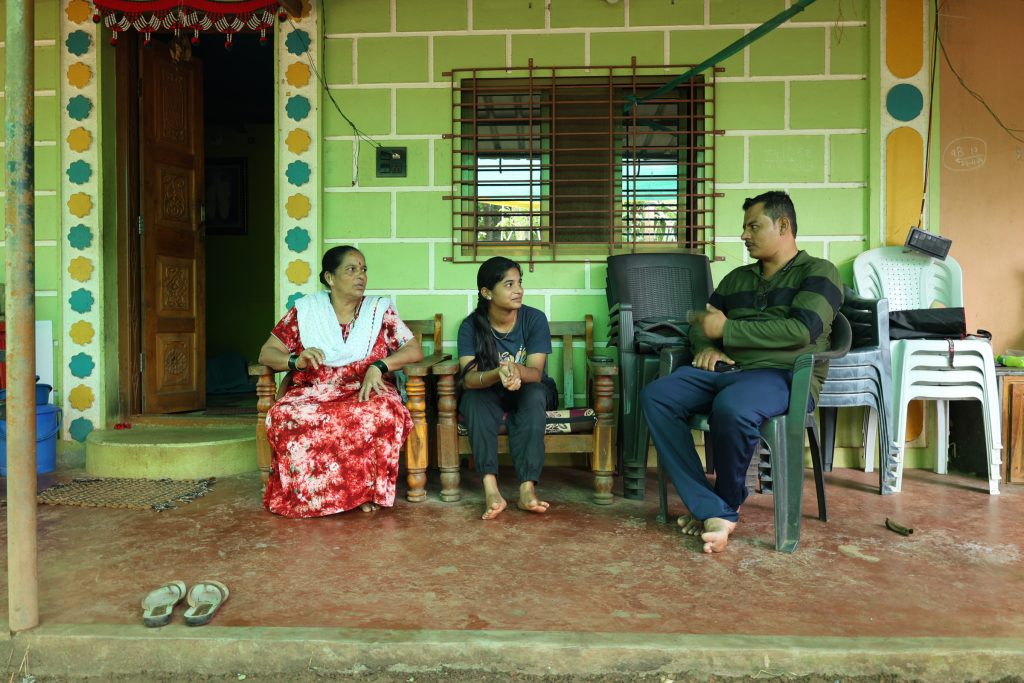
Sonali Sunil Acharekar (left) and her niece Prachi Santosh Acharekar (center) in conversation with Mayur Pansare (right), a Project Assistant for the Mangrove Foundation.
But even those with formal careers are drawn to the potential. Sonali’s 32-year-old son, Omprakash Sunil Achrekar, an engineering graduate, has embraced crab farming full-time; and Manish Tari, 22, an undergraduate in fisheries science, launched Manish Agro & Seafood with his father during the Covid-19 pandemic, specializing in vertical crab farming.
“We deal in red and green crabs,” says Tari. “A single piece per kilo can go up to 2,400 INR. It’s very lucrative.”
Navigating the Tides
Despite the economic potential, the journey is not without profound risks and hurdles. The most immediate occupational hazard, however, is theft.
“Theft of crabs is a big problem here,” says Sonali. “Sometimes diseases can spread in the backwaters, as well…A mortality rate of 20 percent is considered normal.”
It’s a challenge that has historically forced some farmers out of business. Samiksha Gaonkar, 50, from Pirawadi village, recalls being part of Sindhudurg’s very first crab culture group, which operated between 2014 to 2019. Despite each group member earning around 5000 INR per month, they were forced to shut down.
“Our crabs got suddenly stolen,” says Samiksha. “We could not keep a check on the thefts and then we had to pull out.”
Anagarajan Joshi, 58, a former crab farmer, at her friend’s home in Pirawadi village.
Another hurdle is the scarcity of crab seed. According to Palav, there is only one hatchery in India: the Rajiv Gandhi Centre for Aquaculture (RGCA) in the southernmost state of Tamil Nadu.
Sanjeevni Santosh Mithbavker,43, a member of the Vedoleshwar SHG, says crab farming has become more difficult as a result. “We lack seed,” she says. “If the supply of seed becomes easy, we can take this business forward.”
Despite the scarcity, Sanjeevni sold crabs worth 60,000 INR last season. But while business is “great,” seed still costs 25 to 30 INR for a single piece—makings it an expensive venture for the average crab farmer.
A Wave of Resilience
To counter these challenges, government and non-governmental efforts have actively focused their support on the most vulnerable communities, placing women at the forefront.
Government initiatives such as the Mangrove Conservation and Livelihood Generation Scheme, alongside international projects like Enhancing Climate Resilience of India’s Coastal Communities (ECRICC), have been instrumental in fostering local interest in Sindhudurg’s coastal villages, including Achara and Hadi. As part of the Mangrove Foundation’s intervention, women’s groups also receive substantial training and support, including expert talks, presentations, and hands-on workshops that offer extensive practical training.
On the ground, additional support comes from 34 Sagar Mitras—fisheries graduates who act as vital resources for the women. Mayur Vinayak Pansare, Project Assistant with the Mangrove Foundation, sees themselves in a family-like role. While they occasionally help fix issues, like crabs breaking through fiber boxes, he says, “It’s heartwarming to see these women coming forward and taking steps towards self-reliance.”
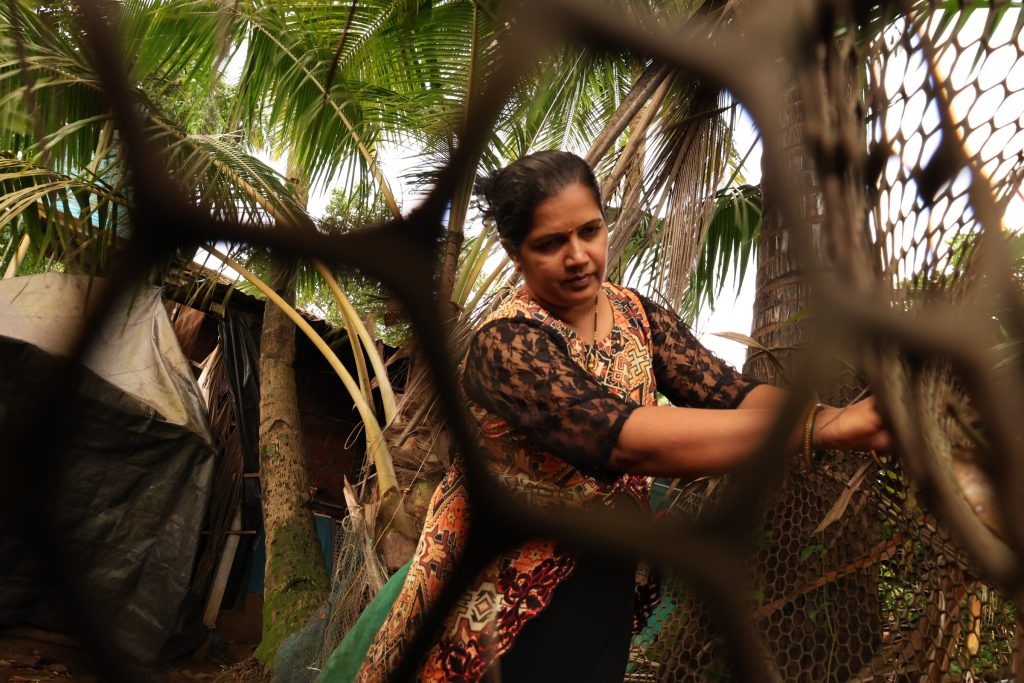
Sanjeevni Santosh Mithbavker, 43, mends nets at her home in Hadi village.
The financial assistance is also significant: The Achrekar family, for instance, received a substantial 90 percent subsidy from the Department of Fisheries and the Mangrove Foundation. Between 2021 and 2025, larger initiatives like the Pradhan Mantri Machi Sampada have backed an additional 124 fisheries projects, with women as a remarkable 60 percent of beneficiaries between 2021 and 2025, says Bahar Vithala Mahakal, Sindhudurg District Program Manager at the Fisheries Department.
This focus is clear across other programs, too: The Sindu Ratna Samrudhi Scheme saw a 70 percent rise in female beneficiaries in a single year, between 2022 and 2023.
Planting the Future
Women’s presence as crab sellers in Sindhudurg’s main fish market signals a generational shift in the industry: They’re taking center stage in an otherwise male-dominated marketplace. For Dakshita (who asked we only use her first name), her presence here is about more than selling her own yield—she’s also reclaiming a little more of herself.
“What is the need for middlemen when I can run my own business?” she says, waiting for customers.
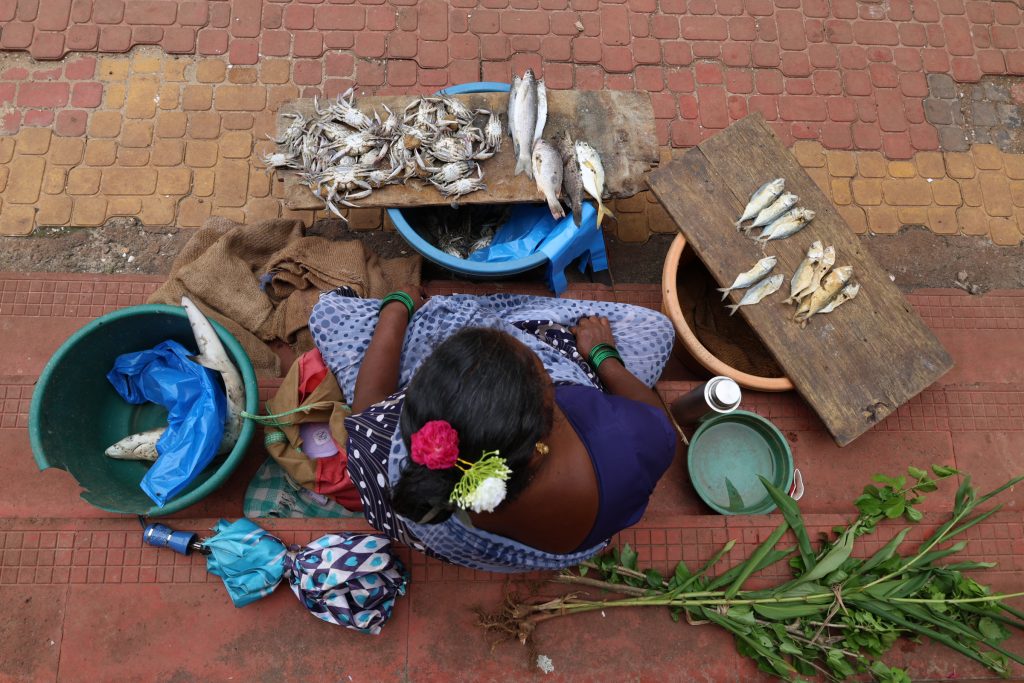
Dakshita, 50, sells green crabs at the Malvan fish market in Sindhudurg.
In Prachi’s case, the journey towards self-reliance began slowly. She initially “harbored no interest in crab farming.” But witnessing her family’s dedication and serving as a guide for tourists through the vibrant backwaters transformed her perspective, converting her initial disinterest into a passion.
In the shifting tides of the Maharashtra coast, Prachi represents the strong voice of a younger generation, seamlessly blending tradition with science to carve a new path forward. For them, crabs are the ‘green gold,’ promising economic returns.
While elder members strengthen their place in the market, Prachi is now articulating a dream that links her environment to her education, which she plans to pursue further by studying Marine Science.
“By protecting the mangroves, my crabs thrive,” she says. “The mangroves in return protect my family from storms, erosion, and the rising sea.”
A view of a mountain village in Sindhudurg.
In the nearby pond, Prachi and Sonali have also started to plant new mangrove saplings. Other efforts at sustainability have only grown. In 2017, scientists visited the area and told local crab farmers that in order to have a better catch, they needed to maintain cleaner water. To boost women’s participation in local water and pond management, women farmers are now being trained to regularly flush water through the crab ponds for freshness, monitor water quality, and prevent overcrowding. Since then, they’ve seen the return of many new birds in the area, from cattle egret to common sandpiper and Indian pond heron.
The tides speak louder than people in Sindhudurg’s coastal communities, and for these powerful women, mangroves stand like guardians along the coast. The more they nurture the mangroves, the more the mangroves give back to them, too. It’s a quiet partnership in nature, this connection between crab farmers and the mangrove forests, and a small step in healing the Earth.
[post_title] => Guardians of the Mangroves
[post_excerpt] => How women crab farmers along India's coast have linked their livelihoods to environmental conservation.
[post_status] => publish
[comment_status] => closed
[ping_status] => closed
[post_password] =>
[post_name] => crab-farmers-farming-aquaculture-india-mangroves-conservation-climate-change-ecosystem
[to_ping] =>
[pinged] =>
[post_modified] => 2025-12-17 18:26:06
[post_modified_gmt] => 2025-12-17 18:26:06
[post_content_filtered] =>
[post_parent] => 0
[guid] => https://conversationalist.org/?p=9839
[menu_order] => 0
[post_type] => post
[post_mime_type] =>
[comment_count] => 0
[filter] => raw
)
As immigrants, my friends and I depend on each other in ways I've never needed back home.
“Old Friends” is an ongoing series exploring the many ways that friendship changes shape in adulthood.
For months, I thought coming to New York City was a mistake. I’d accepted an unpaid internship in the city, leaving my home in Bogota to try living abroad. I dreamed of going to Broadway shows, dining out at different restaurants—enjoying all the fun New York had to offer. But instead, in addition to my internship, I ended up taking another job, just to afford rent. I worked sixteen hours a day, six days a week, with little time to socialize. I was burned out and deeply lonely. Then, one day, my friend Carolina suggested we go out after our internship and do something fun.
“We should go rollerskating at Rockefeller Center,” she said.
I used to skate for fun back in Colombia—my home country—when I was a teenager, but hadn’t gone in years. Still, I thought it was a great idea. Carolina was a talented skater, and we had so much fun looping around the rink that I was reminded of the joy skating had once made me feel.
For the first time in months, I was completely at ease. Then, as we were leaving the rink, I fell. When I looked down, my arm was shaped like the letter “s”: I’d broken my left wrist. Carolina, somehow, found the strength to pull me up, call an Uber, and take me to the nearest hospital. She waited with me for hours in the emergency room, where I learned I’d need nails and a cast to fix my broken bones.
As my arm healed, Carolina took the subway with me to work every day, protecting me from accidental bumps. She brushed my messy hair, pulled down my pants so I could pee, and dressed me up again; all things I’m not sure I’d ask even my closest friends to do for me back home.
At the time, we had only known each other for four months.
~
I once read an Instagram post that said being an immigrant is like becoming a dog: one year as an immigrant equals seven years of life experience. Friendships, then, become intense and profound more quickly than they might back home. Sometimes, out of necessity, they become deeper than our friendships back home, too.
Adult immigrants often find themselves profoundly alone. Our families and closest friends usually remain in our home countries, hundreds or even thousands of miles away. The friendships we form in our new lives, then, become everything to us: our support network, our first call, our emergency contacts.
In an unfamiliar city, we also seek familiarity. As immigrants, we tend to connect more deeply with people from similar cultural backgrounds, something especially meaningful when we suddenly become the “other” after a lifetime of living in a country where we are the “norm.” Sharing a language, traditions, and social cues lowers the barriers to intimacy: When someone understands the way you were raised, you don’t have to justify or over-explain everything you do.
Carolina was from Bogota, too, and had started at the same internship a week before I had. We had a lot in common: We both came from Catholic-conservative backgrounds, needed to be very mature at a young age, identified as feminists, had issues making friends, and wanted to start life from scratch in the city. We shared similar experiences growing up, and similar experiences since coming to New York. But our friendship deepened after I broke my wrist: I knew then that we could rely on one another. That if something ever happened to me again, she would take care of me—and if something ever happened to her, I’d take care of her, too.
Carolina isn’t the only immigrant friend I’ve felt this immediate intimacy with. One day, I was hiking with Nicol, a Peruvian friend. The trail was rocky and we had to march in rhythm just to move forward. Suddenly, a memory popped into my head: In primary school, I used to march like a soldier with the rest of my classmates. Military culture is deeply ingrained in Colombia because of our near century-long history of war and internal armed conflict. It felt silly, but I decided to share my memory with Nicol.
“Oh, yeah, we did that at my school, too,” she said. “It was so ridiculous. Our parents would come watch us march in squared formations.”
Of course. Peru, too, has a history of armed conflict, and military culture was a part of her primary school indoctrination as well. She didn’t make fun of me for what I thought might be a strange confession. Instead, she took my memory and treated it with care—turning it into something funny and shared.
I immediately felt closer to her, something unusual for me. I’ve always considered myself introverted. During my undergrad years in Colombia, I experienced severe social anxiety. I was trapped in an internal monologue that told me I was boring, strange, and hard to love. For nearly two years, I didn’t make a single friend. I built high walls around myself that kept everyone out. After a while, I made meaningful connections that have stayed with me, but I’d never found it easy.
When I migrated, I assumed I’d again struggle to make friends—especially since, on top of everything else, I now had to add “not fluent enough in English” to my long list of self-demeaning adjectives.
But when I started grad school in the States, I made friends within the first two weeks. At the time, I thought maybe I had changed somehow; become more at ease within myself, more confident. But looking back, I can see it was something else: My deep, human need to belong—and the comfort I felt around other Latin American students—had activated parts of me that had been frozen.
A couple of weeks ago, I spent the afternoon with María, a friend from Mexico. Before coming here, I had never had friends like her—extroverted, party lovers, heavy users of dating apps, full of energy. After a long conversation about how Latina diet culture has shaped our relationship to food and our bodies, I realized our friendship had grown strong, in spite of our differences, because it was rooted in something larger than us. Like with Carolina, and Nicol, and countless other immigrant friends, we were united by our need to resist a homogenizing environment. We were united by our shared confusion about U.S. social cues. We were united by our warmth, our humor, and our overlapping memories, even if we didn’t grow up in the same country.
“I’ve noticed you’re literally like my younger sister,” she told me. “The good girl who wants to fit in and carries the weight of your lineage. We’re very different, but there’s a strong emotional connection between us.” I realized then that she is, indeed, a lot like my older sister, too.
I’ve been in the U.S. for almost two years now, and I still find it hard to make American friends. Sometimes, people make xenophobic comments to me in the streets. When I meet people who grew up in the States, I quickly find myself running out of conversation topics, unable to find much common ground—something that still makes me feel out of place. But my immigrant friends are part of the reason I still want to stay, to put down roots.
At the end of the day, home is where you feel safe, loved, and cared for, rather than where you grew up. If I have friends who look after me, who resist the harshest expressions of discrimination and exclusion by my side—then here, I’ve found a place to call home.
Don’t get me wrong: I have beautiful, loyal friendships in Colombia, too. But my friends there don’t need me to survive. In Colombia, if I got sick, I could call my parents or sisters, and they would drop everything for me. But there, I had never been anyone’s emergency contact. My friends back home already had someone else to call—their own parents, siblings, partners.
In contrast, my friendships in New York became lifelong within months. I’m now the emergency contact for two friends. I’ve been the caregiver for one of them coming out of a medical procedure that needed anesthesia. Here, my friends and I depend on each other to be each other’s version of family, to be a shoulder to cry on, to be someone reliable for medicine delivery; as a party plus-one, a caregiver, a babysitter (or cat sitter!), among many other things.
The need to survive, to resist, to belong, and to be comforted—that’s what first pushed us together. But it’s the care, love, and familiarity that’s kept us bonded.
[post_title] => Emergency Contact
[post_excerpt] => As immigrants, my friends and I depend on each other in ways I've never needed back home.
[post_status] => publish
[comment_status] => closed
[ping_status] => closed
[post_password] =>
[post_name] => immigrant-friendships-migrant-friends-relationships-home-emergency-contacts-shared-language-culture-latin-america-immigration-personal-essay
[to_ping] =>
[pinged] =>
[post_modified] => 2026-01-15 19:22:16
[post_modified_gmt] => 2026-01-15 19:22:16
[post_content_filtered] =>
[post_parent] => 0
[guid] => https://conversationalist.org/?p=9098
[menu_order] => 3
[post_type] => post
[post_mime_type] =>
[comment_count] => 0
[filter] => raw
)
How younger generations are turning knitting and crochet into a community building affair.
The first known knitted project was a pair of socks. Discovered in Egypt, the socks featured colorwork made from indigo and white cotton, and were believed to date back to the 11th century, although the craft itself has likely existed for much longer. In the many decades since, knitting, crochet, and other fiber arts have become widespread and global, evolving from the work of artisans to a beloved pastime across generations, while still staying true to the original techniques used in the very first woven fabrics. And now, the craft has evolved once more—this time, at the hands of young people seeking a comforting hobby that gets them out of the house.
This is what led Virginia Meinhausen, 28, and Lea Engler, 31, to take the leap and start Knitting Club Potsdam in Germany earlier this year. “Being part of a community in person is something [meaningful], not only just to speak to each other, it's also… Wow, so many people are doing this and we are doing this together,” says Meinhausen. “We are now meeting each other in a huge group once a month.”
Since launching the club in March, Meinhausen says it’s grown to over 100 members. But this quick success isn’t unique to just Knitting Club Potsdam. In recent years, the age-old practice has found new meaning amongst Gen Z and Millennials, who have turned to knitting as a means of bringing back the “third place” and reconnecting with their peers.
“I remember thinking, it’s crazy how many people don’t have a real hobby anymore,” says Isabelle Mann, textile business expert and owner of knitwear brand Fable and Failure. But she says this started to shift during the pandemic, as younger generations sought more analog ways to pass the time.
The trend first began online, rising to prominence through influencers like Petite Knit and platforms like Ravelry, with younger generations taking ancient techniques and adapting their garments and patterns to match modern trends. “People do appreciate knitting more again,” Mann says. She sees fiber arts as a community building affair for those between 25 and 35, and started her own club through her business in 2019 as a means of teaching and preserving the craft. She also believes that fiber arts skipped a generation, and that parents in the 90s and early 2000s simply never taught their Millennial and Gen Z children how to do it. Instead, these generations taught themselves—and eventually, as COVID lockdowns lifted, these same knitters decided it was time to take things offline.
Craving human interaction and a break from their screens, hobbyists began coming together post-pandemic as a means of bringing back the “third place”: a neutral, physical space separate from home and work (or school). The concept is set on community building in-person, without having to spend much or any money to participate—something Gen Z feels that they’ve missed out on, and Millennials frequently mourn, as social media has increasingly replaced it online.
Knitting clubs, in particular, have gained global interest in recent years, with communities expanding rapidly, even in small cities. The industry is expected to grow by $10.69 billion between 2024 and 2028, according to Technavio, a company that specializes in market research reports and industry analysis.
In addition to creating bonds through a like interest, in-person knitting clubs are also helping young fiber artists learn new techniques faster and more effectively. When they began Knitting Club Potsdam, Meinhausen was a beginner and Engler was a seasoned knitter, having learned from her mother starting at 8 years old. The club currently has 60% beginner knitters and 40% advanced, according to Engler. Meinhausen, still a beginner herself, says she can’t believe the intricate project she’s working on now, which she credits to how quickly she’s learned since starting the club. She adds that advanced members “love to help,” which gives those just starting out the confidence to continue attending—and makes everyone joyful in the process.
“I told Gini [Virginia] after the first meeting, for me, it was very calm. Everyone was smiling. Everyone [was] so, so happy,” Engler says. “I think this feeling is the best part.”
According to Meinhausen and Engler, knitting and crochet is very popular amongst young people in Germany, but the hobby has gained traction amongst 20- and 30-somethings in other places, as well. In New York, crochet designer Michelle Palacio is creating garments for her brand Venganza using crochet techniques from her Colombian grandmother. In Nepal, the Nepal KnotCraft Centre, founded in 1984, aims to help women of all ages build traditional skills in fiber arts. In Paris, Avril Bas, 26, and her co-president Alice Pierre-François, 28, launched a crochet club called Club Crochet Tricot in 2024, a club that is now officially recognized by the French government. She says membership is growing every week.
“It's really incredible to have [this] place where a common hobby links people, and it helps us find similarly minded people that want to [enjoy] the same activities,” Bas says. “It's really beautiful.”
Bas says that starting the club, combined with her passion for knitting and crochet, contributed to her pursuing fiber arts full time. She fell in love with the tight-knit nature of the community, and now, their club’s efforts have “blossomed into something massive.”
“I started this club and all of a sudden I had like quadrupled my number of friends,” she says.
Club Crochet Tricot meets on Sundays four times a month, with locations varying from scenic park picnics, local cafes, public libraries, and even the cinema. Between 40 and 100 people regularly attend their in-person crafting sessions, and there are always new and interested attendees week to week. Bas feels like younger generations long for this kind social interaction, building community around creativity—and her club is an outlet for that. She also says that she’s more than happy to be a “third place” for those who have been seeking it—and perhaps, that it’s a sign of more “third places” to come.
“Everybody around our age wants to open a bookstore, plant store, cafe,” Bas says. “I feel like it’s going to happen.”
[post_title] => Weaving a New Third Place
[post_excerpt] => How younger generations are turning knitting and crochet into a community building affair.
[post_status] => publish
[comment_status] => closed
[ping_status] => closed
[post_password] =>
[post_name] => third-place-fiber-arts-knitting-circles-clubs-crochet-weaving-community-crafts-artists-artisan
[to_ping] =>
[pinged] =>
[post_modified] => 2025-12-17 02:03:35
[post_modified_gmt] => 2025-12-17 02:03:35
[post_content_filtered] =>
[post_parent] => 0
[guid] => https://conversationalist.org/?p=9113
[menu_order] => 5
[post_type] => post
[post_mime_type] =>
[comment_count] => 0
[filter] => raw
)
In immigrant families, sometimes your cousins can be your earliest friends.
“Old Friends” is an ongoing series exploring the many ways that friendship changes shape in adulthood.
“You don’t seem like an only child,” people often tell me after I reveal to them that I was raised without siblings. Unsure if this comment is a compliment or a backhanded remark, I usually shrug and reply with something like, “Well, I grew up with cousins…” But what I don’t often say is my cousins didn’t quite feel like siblings, either. They felt like something else.
The truth is I don’t have an unusual amount of cousins. Five first cousins in the U.S., and one in Estonia, who I’ve never met. A growing number of second cousins once removed (the children of my first cousins). And a scattered few second cousins twice or three times removed (my parents' cousins and their offspring, respectively). It’s my first cousins, though, that I’m closest with—in large part because, as is true for many immigrant families, they were also my first friends.
As new immigrants from the former Soviet Union, my parents relied on the built-in community of care provided by our extended family: an old-world-style network of grandparents, aunts, uncles, and cousins. But while the adults in my family did play a role in my Los Angeles upbringing, it was my cousins who did the majority of the caretaking.
Only seven years older than me, two of my cousins in particular were somewhere between my babysitters, part-time siblings, and friends. Together, we would spend long sun-soaked summer days playing outside my aunt and uncle’s apartment. We’d make up elaborate games based on movies we rented from Blockbuster or 20-20 Video, where an older cousin worked. Sometimes, we were the “karate family,” influenced by none other than The Karate Kid. In silent agreement, we’d transform into a group of vigilante karate enthusiasts, climbing parked cars and saving stray cats from danger; cats that my uncle would rescue and bring home from his job as an LAX cab driver. Sometimes we would write our own Nightmare Before Christmas-style songs, practice obsessively, and perform them for the whole family. OOOo spooky, oooo spooky….I see a big fat moon…in the skyyy….a very big fat mooon. Sometimes, we’d be aspiring horror film producers. We would borrow my dad’s precious camcorder and record over family home videos with our very own renditions of the Blair Witch Project, nostrils and all. We even made our own version of the movie Hocus Pocus, which we titled, “The Heart of a Little Girl.” I was the little girl.
Then, the sun would set and my aunt would come home from her job as a cashier at the local grocery store, and my mom and dad would pick me up after a day of English and bookkeeping classes at the community college; or after a day of driving rich kids around. And I would always, without fail, break into tears, grabbing onto the leg of one of my cousins as they would obediently lead me to the door.
Only other only-children can relate to the loneliness. The pit of despair that formed each time, as a child, you were plucked from a social event and brought back to your parents’ apartment where you were forced to find creative ways to entertain yourself. Before we had the internet (and even after), I would spend long hours talking to the bathroom mirror, pretending my reflection was someone else. When I was with my cousins, the loneliness disappeared. When I left them, it would come back heavier than before.
The research is shoddy, but it is believed there is a correlation between only-childness and loneliness. In fact, studies have found that, compared to adults who grew up with siblings, only children often become adults who have significantly less interaction with their relatives. This may be true for some onlies, but not for me. I still, to this day, have remained close to my cousins. Even the older ones who had no interest in me when I was a toddler and they were teenagers. The ones who acted more like older siblings than friends by simply ignoring me, or making fun of my unibrow because it would “build character.” The ones who drew sharpie tattoos on my favorite doll’s face in between shifts at the video store, and made up for it by buying me a coveted “Diana’s Parking Only: Keep Out” sign for my bedroom door. And I’m still close with the ones who played “karate family” with me, too.
Cousin in Russian translates directly to “once removed sibling”; but often, the term is just abbreviated to brother or sister. Same goes for other Eastern languages like Chinese, Japanese, Arabic, Thai, and Korean. This must have something to do with Western Individualism vs Eastern Collectivism. The cultural values placed on the community, rather than the individual, have slowly been eroded from Western society, leading to recent phenomena like the loneliness epidemic. But many immigrant families never fully abandon the cultures they came from, including mine—and ultimately, cousins have an important role to play in keeping it that way. They are role models. They are siblings. They are caretakers. They are friends. They preserve family traditions, like avoiding the aspic and playing Monopoly on Thanksgiving. They step in and help out when a family member is in the hospital; and when you get in a fight with your mom, they are one of the only people on earth that truly understands. Because that’s what families are for.
Of course, not every American family looks like mine. We are apparently in the middle of The Great Cousin Decline, coined by Faith Hill for The Atlantic. This is due to the usual suspects: U.S. population decline, women choosing to have children later in life, and parents having fewer children in general. As of 2022, about 55% of Americans live an hour away from their extended families, while highly educated Americans live even further. Immigrant families remain the exception. My own very American husband has little interaction with his cousins, mostly due to their geographical distance. But there is much to be lost in living apart. Hill reminds us that the often overlooked reason why cousins are especially important is that “they share something rare and invaluable: They know what it’s like to be part of the same particular family.” Growing up, that’s why the loneliness never stuck around too long: I always knew that my cousins were only a phone call away.
In the Oscar-nominated film A Real Pain (2024), a pair of cousins, Benji and David Kaplan, embark on a journey to Poland funded by their shared grandmother’s inheritance. It is meant to be a cathartic trip to both honor and witness where she came from and bear the weight of the concentration camp she survived. But the cousins could not be more different. David (played by the film’s writer-director, Jesse Eisenberg) chooses to settle into modern society and accept that life is suffering, while still doing what he can to enjoy it. Benji (played by Kieran Culkin, who won Best Actor in a Supporting Role for his performance) is the more nostalgic feeler, who cannot seem to settle down and process pain in a modern sense. He is overwhelmed by his grandmother’s loss, and, as it’s revealed later in the film, even tried to overdose on sleeping pills a few months before the trip. In Poland, Benji cannot stomach the juxtaposition of privileged American Jews riding first class on a train to tour concentration camps, and lashes out at the group. Eventually, David reaches his limit:
David Kaplan: ...I love him and I hate him and I wanna kill him... and I wanna be him, you know? And I feel, like, so stupid around him, you know, because he is so fucking cool and he just does not give a shit. And then... just, like, being here with him is just so fucking baffling to me, you know? It's just baffling, 'cause it's like: How did this guy come from the survivors of this place, you know?
Diego Alburez-Gutierrez, who studies kinship dynamics at the Max Planck Institute for Demographic Research in Germany, tells Hill in an interview that, “Cousins are essentially peers who can stretch your assumptions—without as much fear of the relationship ending if debates get heated.” In A Real Pain, we watch this play out: Once inseparable as children, the two cousins have since drifted further and further apart. But the cousins are also connected by their shared ancestral trauma and their unique perspectives on how to survive in modern society despite its contradictions. No matter their differences, neither will ever abandon the other.
My own relationships with my cousins have shifted over the years. I’ve become closer to some and drifted apart from others. There are religious differences, socio-economic differences, and the fact that we are simply in different stages of life. But when times get tough, we always reconnect. Like when my second cousin was diagnosed with Leukemia at a young age and I would visit her at the children’s hospital, or when our maternal grandmother who survived WWII died a few months before the pandemic, or when the most recent wars in the region broke out.
Cousins have our backs. They are our built-in friends. And from an evolutionary perspective, they have a biological stake in our survival. Our cousins are our companions for all of life’s curveballs. And while sometimes, we don’t get along, like siblings, cousins share both our family secrets and genetics. They share our lives.
I recently got married in Las Vegas by an Elvis impersonator at the famed Little White Chapel. This wasn’t an elopement, although that was our original intent. Once we started telling our friends and family about our plan, however, some insisted on coming.
Our wedding happened this past January, in the wake of the devastating Los Angeles wildfires that almost burned down my high school and destroyed so many homes of friends and acquaintances, I’ve lost count. My cousin, who was supposed to make a speech at the wedding, was evacuated from her home the night before her flight to Las Vegas. In a last ditch effort, she ended up driving with her husband, young son, and mother-in-law with nothing but the clothes on their back to make it in time for my ceremony, like a true cousin, sister, or friend, or maybe, something even better.
[post_title] => First Friends, Once Removed
[post_excerpt] => In immigrant families, sometimes your cousins can be your earliest friends.
[post_status] => publish
[comment_status] => closed
[ping_status] => closed
[post_password] =>
[post_name] => first-old-friends-cousins-immigrant-families-los-angeles
[to_ping] =>
[pinged] =>
[post_modified] => 2026-01-15 19:22:30
[post_modified_gmt] => 2026-01-15 19:22:30
[post_content_filtered] =>
[post_parent] => 0
[guid] => https://conversationalist.org/?p=8116
[menu_order] => 24
[post_type] => post
[post_mime_type] =>
[comment_count] => 0
[filter] => raw
)
On building something better than what we've been given.
I was a young writer relatively early in my career when Donald Trump won the presidency in 2016. Based out of California with most of the team in New York, I was also the only writer still online at the magazine where I worked when the election was called. In a fugue state, I wrote the story I’d been assigned: a neutral news piece laying out the facts. Then, I drank a Miller High Life and went to bed, knowing there wasn’t much else I could do until morning.
Two election cycles later, and again, I was the only one still online at my job when they announced the results of the race. But this time, my mother was sitting next to me. It was her fourth presidential election cycle as an American citizen, and watching the television screen, we both held our breath—not just in anticipation of the results, but for everything before and beyond them, and the chaos we knew would follow, regardless of who won.
When it was finally called, we both exhaled. Despite whatever other feelings we might have had as individuals, neither of us, I think, was surprised: Between us, there was a mutual understanding that anything is possible in America—for better but, more often, for worse.
~
It is impossible to convince someone who has bought into their own delusions that what they see in front of them is, in fact, a delusion. This fact is non-partisan, and applies as much to the Democratic Party as it does to the millions of Trump supporters who voted in favor of a candidate whose policies would cause them harm. If you are surprised by Trump’s victory this year, then you, too, have bought into a delusion—an idea of security either afforded to you by privilege or passivity or both. This is different from being disappointed, or scared, or even angry about it, although sometimes they can all feel the same.
“A system of supremacy justifies itself through illusion, so that those moments when the illusion can no longer hold always come as a great shock,” Ta-Nehisi Coates writes in his new book, The Message, which grapples with the narratives we tell ourselves in order to maintain our sense of moral righteousness when confronted with an immoral reality. Coates cites the Trump years as proof of this: The illusion of America has been crumbling for years, but accepting this requires facing your complicity in the facade—something not everyone chooses to do, particularly those that benefit from it.
Our democracy has long been broken. The 2024 election just tore down the last vestiges of the veneer for those still unable to see it. Now, the US must reckon with what remains. We cannot call ourselves a democracy when we live in a country where nearly 38 million people live below the poverty line, where basic healthcare isn’t a human right, and where ordinary citizens have no say in what wars we participate in and who we send weapons to. Nor can we call ourselves a democracy when the salary for a sitting member of Congress is more than twice the average total household income, and when the judges that sit on the nation’s highest court are appointed for lifelong tenures, able to change the fate of an entire generation, and entirely dependent on the political party in power when a justice either steps down or dies. Perhaps most obviously, we also cannot call ourselves a democracy when we elect a president based on an electoral college rather than a popular vote—and the outcome of any election, including this one, should not change our stance that this is fundamentally undemocratic; as is the frequent redlining, gerrymandering, redistricting, and voter suppression that happens openly and without shame.
This is not the track record of a country with a functioning moral compass, although it begs the question if a country can even have one. Morality is a thing for people, not for nation-states. Change in this country, in perhaps all countries, has almost always been reactionary. So, too, will change be on the other side of this, whatever shape “this” takes; something I would have said even prior to the election, because no amount of voting has ever been enough to save us from ourselves, to guarantee the safety of the millions affected by our government’s actions, or to definitively “fix” things for good.
A “functioning” democracy is dependent on the buy-in of its people, but I’d argue also on an electorate's collective desire to do what’s best for the majority of its populace. This baseline isn’t automatic, but built through its foundations, which are fortified by the choices we make each day in showing up for one another, far beyond the ballot box. When we treat voting as our only tool against oppression, we’ve already lost. When we only engage, and demand, and pay attention every two or four years, we’ve already lost. This doesn’t mean that voting isn’t important, just that we cannot solely rely on something that was originally designed to exclude the vast majority of us to enact meaningful change for that same majority.
“For the master’s tools will never dismantle the master’s house,” Audre Lorde said, something I see quoted time and time again. But people rarely seem to include the rest of the sentiment, and its context: “They may allow us temporarily to beat him at his own game, but they will never enable us to bring about genuine change. And this fact is only threatening to those women who still define the master’s house as their only source of support.” The reality, should we choose to see it, is our toolbox is often much larger than we believe it to be, our sources of support much wider. It is, I believe, our moral obligation to utilize both.
To do so, however, requires us not to do the work of our oppressors for them. “Without community there is no liberation, only the most vulnerable and temporary armistice between an individual and her oppression,” Lorde said in the same speech. “But community must not mean a shedding of our differences, nor the pathetic pretense that these differences do not exist.”
If a diverse people’s history of the country is our guide, when has the United States ever been a beacon of morality? When has what is ethically sound ever been achieved in this country without an uprising or without violence, or at least some degree of incivility? The modern Republican Party has always understood—and, arguably, romanticized—this in a way the Democratic Party has not, because the latter fundamentally believes the system works when it has continuously proven it doesn’t. (At least, never for all of us, or even for most.)
The real work, then, is in building the world we want to live in through organizing and action and care, not by solely relying on systems of bureaucracy and government that depend on our dysfunction and discord to keep us reliant on their mercurial benevolence in order to continue funding themselves. The work is in taking care of each other when the systems that purport to have our best interests at heart continuously fail to protect them. The work is in not only dreaming that something better is possible, but realizing it, every day, in our actions and in our communities, both close to us and far away. We achieve this by investing in our communities, not just financially, but through the creation of long-term, sustainable support systems and networks of care; by establishing community processes that encourage collaborative, collective decision-making and problem-solving; by sharing responsibility for our communities’ well-being and safety; and by making resources accessible to anyone who needs them, whether healthcare, food, or otherwise.
In spite of everything, we have done this. We are doing this. Even before the election, I saw the fruits of these efforts in my community every day: people rallying to find breastmilk for a baby who needed it, someone looking for help doing their dishes while struggling with their mental health, another person looking for housing leads after their current living situation proved unsafe. All three found the support they needed, not from the government, but from their neighbors.
So if you are seeking comfort right now, this is the one thing that has given some to me: We still have each other.
~
The day after the election, I text back and forth with a friend. He is disappointed, hungover, knee-deep in political analysis, doomscrolling.
“I left one country 15 years ago because I tried to be a part of something, and ultimately it led to me having to flee, and then everything got a lot worse than I even anticipated at that time,” he says. “Now I see the same thing happening here, but this time I don’t actually believe that anything will get better.”
What do you say to someone who’s already lived through worse? I tell him that I’m sorry and I love him and he deserves more.
~
In the lead-up to this year’s election, I am often very angry. Around me, a lot of people are, too. While some of this anger seems to circle around the election specifically, much of it does not—and it might be more accurate to say it is actually the election which is orbiting around the anger, and not the other way around. This is mostly because there’s been so much to be angry about: the way the United States continues to fund a genocide; the catastrophic reality of climate change; the endless threats to abortion and bodily autonomy; the rampant racism, transphobia, and xenophobia; how quickly the world has backslid into fascism, embracing right wing extremism in elections around the globe. All of it feels impossible to ignore, an endless cacophony of horrors; but still, some people manage, and this makes me angry, too.
None of this goes away after the election is over.
I’ve spent a lot of time thinking about anger since Trump was first elected in 2016; about its manifestations, its purpose. This curiosity began, in part, because of my own relationship to it: Historically, I’ve never been good at holding on to interpersonal anger, yet I’ve always felt it, deep and terrifying, in response to the world’s seemingly endless capacity for injustice, violence, and other forms of harm. I see it everywhere, notice the various shapes it takes. I learn that rage can be a guiding force when we really listen to it, or a parasite that hollows us out when we don’t. I ask my friends what pisses them off, discuss what our anger tells us about ourselves, and try to better understand what my anger might tell me about me.
What enrages us often reveals something that terrifies us, anger and fear just two sides of the same coin. People often vote (or don’t vote) because they’re angry about something. But fear, too, drives people to the polls: fear for how their lives might change if it goes one way or the other, fear for their livelihoods, their family, their friends, their safety, themselves, the world; and, inversely, fear of other people—although history suggests this isn’t anything new. “The sad truth of the matter is that most evil is done by people who never made up their minds to be or do either evil or good,” Hannah Arendt writes in The Life of the Mind, her final unfinished work. But somehow, this has always felt scarier to me, more dangerous, more unpredictable than the alternative. When morality is an afterthought, evil is gradual, more insidious, a slow burn that starts small, until eventually we’re so deep into it, it feels impossible to close the gap between where we are and where we were and where we want to be.
How, then, do we push back? The most optimistic answer I can come up with is by making the “good” so obvious a choice that there are actual consequences to being “evil,” rather than a deepening of the status quo. Rather than moving the threshold for what we accept, for how we categorize and define “good” and “evil,” we make up our minds not to waver from what we know is right—critically, not just in our elections, but in how we move through the world every day. It is stoking the fire of our anger, and our terror, and actually using it for good.
Back in 2020, I read On Anger, a Boston Review forum led by philosopher Agnes Callard. The book was released just before COVID shut everything down, a few months before that year’s election. “Maybe anger is not a bug of human life, but a feature—an emotion that, for all its troubling qualities, is an essential part of being a moral agent in an imperfect world,” editors Deborah Chasman and Joshua Cohen write in the book’s introduction. Some of the writers agree; others less so. There is debate on whether it is possible to be both justifiably angry and morally sound; whether anger is “useful” from an evolutionary standpoint; whether anger is, in fact, what makes us human. All seem to agree that it’s a powerful emotion; Callard, perhaps, most of all.
“When people commit injustice against us, we feel it: our blood boils,” she writes in the book’s seminal essay. “At that point, we have to decide how much we want to fight to quell our anger, how much effort we are going to put into repressing and suppressing that upswell of rage.”
“The answer,” she concludes, “is rarely none.”
~
The night of the election, a friend calls me, afraid and alone in her grief, her husband already asleep. “I feel guilty for calling,” she says. I tell her not to, that I’m glad she did. The next day, another friend calls. He asks why I sound so calm. “Aren’t you worried about NATO?” he asks. “I’m worried about NATO.”
“Well,” I say. “Everything is shit.”
“Everything is shit,” he repeats.
Another friend and I text back and forth on Election Day. “I’m so deeply jaded by this country at this point,” she says. “I feel like politicians aren’t as scared of us as they should be.” My response is immediate. “Well, to be fair, I don’t think we’ve given them enough reason to be.”
~
Much like America itself, the American Dream has always been one of deluded and individualistic self-exceptionalism, selling itself as a meritocracy when in reality, it is a lottery stacked in favor of a very small minority, the buy-in rarely worth the pay-out.
While American exceptionalism is unlikely to be the death of us all, it’s already been the death of too many of us, the vast majority not even American, but people whose greatest sin was being born somewhere the US had a financial and/or political interest in, a Venn diagram that I’m pretty sure is just a circle. But to believe this type of unfettered power through violence could be limitless and without consequence is foolish: Global imperialism is a cancer, and like all cancers, it ultimately feeds on the host. “Nobody is exceptional, we are all just people worthy of life and dignity,” writer Fariha Róisín posted in a message on Instagram. “US Americans made domination a world order and what they didn’t realize was that fascistic glean would rear its ugly head and turn inward.” It should come as no surprise that fascism is now in full bloom on American soil: Its keepers have been watering it for years.
There is little we can do but try to plant something better that might outgrow it, by not abandoning our humanity when it may feel “easier” to give it up. I often revisit Muriel Rekeyser’s poem, “Elegy in Joy,” as a reminder it is always possible to grow something new: “Not all things are blest, but the / seeds of all things are blest. / The blessing is in the seed.” Each choice we make is a seed, each choice a new beginning. Not all will bear fruit, but that doesn’t mean the planting is fruitless.
I know we—the collective we—will survive this, in part because there isn’t much of a choice. What devastates me and enrages me is how many will suffer unnecessarily in the process, how many already have; and the people who won’t survive this at all, who already haven’t. “Where there is power, there is resistance,” writes Foucault. And it’s true: As long as people give a shit, there will be resistance. As long as there are people who haven’t given into their own complacency, there will be resistance. And for all my own disillusionment, I’m not so far gone that I can’t see it’s there: Right now, there is despair, but despair is just a reminder there’s still something human left in you yearning for better, that there’s still some sliver of hope, kicking and screaming and furious and terrified, buried underneath the muck.
“Our roots are in the dark; the earth is our country,” Ursula K. Le Guin said during her commencement address at Mills College in 1983. “Why [do] we look up for blessing—instead of around, and down? What hope we have lies there…Not in the light that blinds, but in the dark that nourishes, where human beings grow human souls.”
It is also in this darkness where we must grow a backbone, because the longest stretch of the fight is always still to come.
~
Late Thursday afternoon, two days after the election, my mom’s phone dings. Looking at it, she groans.
“Forget it, Nancy Pelosi,” she says. “Jesus. It’s over!”
~
In the early afternoon, long before any of the polls closed on Tuesday, I began donating. Not to any political campaign (despite the onslaught of texts, I never understood what possible use my $20 would do in changing an election on Election Day), but to Palestine, to Sudan, to mutual aid. I signed up to make lunches for my unhoused neighbors. I spoke with friends. I chose to respond to a situation that felt dependent on the cooperation of millions, many not interested in mutual liberation, with small choices that felt, comparatively, within my control—a practice I try to keep in my everyday life. These actions may have been insignificant in the grand scheme of things, but they felt more significant than any vote I’ve ever cast, more fortifying. Closer to a version of the world I want to live in, but don’t.
At the 2001 Connecticut Forum, Toni Morrison was asked, “How do you survive whole in a world where we’re all victims of something?” She took a moment to gather her thoughts. “Sometimes you don’t survive whole, you just survive in part,” she said. “But the grandeur of life is that attempt. It’s not about that solution. It is about, you know, being as fearless as one can, and behaving as beautifully as one can, under completely impossible circumstances.”
For the last few years, so much has felt impossible. So much has felt enraging, and heartbreaking, and terrifying, and worse. But I’ve seen enough jokes about the relentlessness of living in “unprecedented times,” and counter-jokes from historians that the times are not, in fact, unprecedented at all, to know that what feels impossible is less impossible than we might believe.
“The worst thing about being human is our ability to adapt,” a friend tells me. But maybe it’s one of the best things, too. Even if we are no longer whole, we are changed—and it's precisely because of this change that we can begin to build a new whole from our parts.
[post_title] => Fear and Rage and Grief and Joy
[post_excerpt] => On building something better than what we've been given.
[post_status] => publish
[comment_status] => closed
[ping_status] => closed
[post_password] =>
[post_name] => united-states-2024-election-community-building-american-exceptionalism-fascism
[to_ping] =>
[pinged] =>
[post_modified] => 2024-11-20 07:25:41
[post_modified_gmt] => 2024-11-20 07:25:41
[post_content_filtered] =>
[post_parent] => 0
[guid] => https://conversationalist.org/?p=7425
[menu_order] => 36
[post_type] => post
[post_mime_type] =>
[comment_count] => 0
[filter] => raw
)
Why older women are dedicating their retirement to leaving a better world behind.
“I can’t get up!”
It was 5 a.m. when the dawn chorus was interrupted by a cry for help. An elderly woman had fallen while sneaking into a field with 25 other nanas, and the group rushed to her aid. “Are you alright?” one asked. They helped her stand up, brushing off her clothes and smoothing her hair. After ensuring she was fine to walk, the group pushed forward.
No nana could be left behind: These women were setting up an occupation.
It was a balmy August morning in Lancashire, a county in North West England known for its sweeping landscapes and greenery. But back in 2014, their idyllic community was facing an outside threat: Cuadrilla, an oil and gas giant and the only company in the United Kingdom with a license to frack, was about to commence shale gas exploration. If the hydraulic fracturing, or fracking, went ahead, then the site beneath the nanas’ feet would soon become an industrial wasteland—and the county’s residents would be forced to live with the consequences, unless someone was able to stop it.
(Rory Payne)
The nanas clambered over fences, quickly putting up signs and wrangling tent poles. By 6 a.m., the first tent was up. The women sat on the ground, drinking tea and watching the sun rise above the field that would be their home for the next three weeks. Technically, they weren’t all grandmothers, but before long, this group of anti-fracking activists from Lancashire would be known as the Nanas, both at home and abroad. They’d regularly stage demonstrations, roadside tea parties, and eventually, even a protest outside Buckingham Palace.
And they wouldn’t be alone: In other communities being torn apart by fracking, older people around the world have also been taking the fight into their own hands, spending their golden years in protest. But what makes someone dedicate their later life to activism? To give up the dream of pottering around the garden, pushing grandchildren on swings and enjoying long vacations and their long-awaited retirement?
As it turns out, many of them felt they didn’t have a choice.
Becoming an Activist
In the weeks leading up to their field occupation, the UK Nanas meticulously planned their invasion. What would they wear? How would they get there? Who would bring tea and cake? On the big day, at 3 a.m., they secretly gathered in a hotel basement nearby. Those in charge of wardrobe revealed what would become the Nana uniform: yellow tabards with a graphic of the red rose of Lancaster, proclaiming “Frack Free Lancashire,” alongside matching yellow headscarves. Tina Rothery, now 61, looked on with pride. She was a recent convert to activism, and her role was public relations. Just before leaving the hotel, she hit send on the press release announcing the Nanas’ 21-day field occupation to the world—having no idea that their fight against injustice was about to hit headlines and dominate her life.
As the women adapted to living in a field and spending their nights under canvas, the local milkman began making morning deliveries. Neighbors arrived at the site to indulge their curiosity, bringing ice to help the Nanas keep their food from spoiling or, in some cases, Tina says, to vent their anger.
“Why would you do this? It’s private land,” some of them would ask. But Tina was ready.
“Here’s the thing: You get us, 26 women with a bunch of tents and tent pegs—that’s bad, yeh?” she'd reply. “Or, you get at least a decade of drill rigs, and man camps, and all that goes on, and the noise, and the pollution, the threat to your water and all of that. These are your choices.”
“We’re here to let you know you do have a choice,” she’d continue. “You can stand up, and you can object.”
The UK Nanas. (Rory Payne)
Besides a few naysayers, though, Tina says the protest was relatively peaceful. She recalls the police weren’t too bothered by the presence of 26 older women, and largely left them alone. She says the police were, however, very concerned about the dozens of activists who soon descended on the field next door in support of them. These new protestors were from a group called Reclaim the Power, and they were organized. They brought solar panels, wind turbines, and compost toilets. On the final day of the Nanas’ occupation, they also led a pier-to-pier march, decked out in classic Nana-yellow with placards held high.
That same day, after three weeks of sleeping under canvas, soaking up activism knowledge from Reclaim the Power, and sharing their fears with a growing anti-fracking community, the Nanas took down their tents and searched the field to make sure they’d left nothing behind. They stuck a note on the farmer’s house, whose property they’d been occupying, and notified the police that they’d left. Despite nearly a month sleeping on the scratchy ground in makeshift beds, they felt stronger than ever.
The next day, they were sued by Cuadrilla. The legal papers said they were being fined thousands of pounds for the "eviction,” despite the fact they’d left of their own accord and had informed the landowner, press, and police. One of the Nanas would need to put their name forward and take on the cost. Though she couldn’t afford the fine, Tina stepped forward.
“You can’t get blood from a stone,” she says.
Still, they tried. Cuadrilla embroiled Tina in a legal battle for two years, first serving her the court papers at the Buckingham Palace protest. They wanted more than £55,000 (over $78,000) in legal fees and threatened her with a stint in prison if she didn’t pay up. After Tina finally provided evidence that she couldn’t pay the fees, the case was eventually dropped.
Tina Rothery. (Rory Payne)
Before getting involved with the Nanas, Tina had little experience in activism. She’d recently spent a year and a half caring for her sick mother, staying by her bedside and reminiscing about when they’d globe-trotted from London to Australia to Hong Kong together. This powerful woman, once a leading business executive, was dying, and there was nothing Tina could do. The feeling of helplessness consumed her. She couldn’t help her mother, and she couldn’t change the state of the world beyond her, which at the time, felt like it was spiraling towards further and further injustice. Both the Arab Spring and Occupy Wall Street dominated the news. She watched as uprisings against ruling parties unfolded, and looking to regain some semblance of control, Tina finally decided to join Occupy London in 2011, ending up as a de facto spokesperson.
By the time she received a leaflet on Cuadrilla’s fracking plans from a local residents' action group, Tina had zeroed in on how best to fight the whole system: You had to start closer to home. Until now she’d been trying to get to what she calls the “belly of the beast,” but this new awareness of fracking on her doorstep shifted her mindset—this single issue told the whole story of a broken system. The way she saw it, fracking was one very specific example of how the government was taking risks with people’s lives and affecting individual communities. The fight had come to her, and it was impossible to ignore. Instead of returning to London to join more protests aimed at the government and the wider system, Tina remained in Lancashire to fight Cuadrilla.
She was right about fracking’s impact on her community. In 2019, researchers Anna Szolucha from the University of Bergen, Norway and Damien Short from the University of London carried out a study published by research journal Geoforum to examine how people’s lives were affected during the fracking planning and approval process in Lancashire—and the results were harrowing. They called what they found a collective trauma: a slow-burn shock that ripped apart social lives and damaged the feeling of community.
"You can stand up, and you can object."
“Some residents experienced severe stress and anxiety. Many reported that they lost trust in the police and democracy,” Szolucha says. Residents felt a sense of loss, fear, betrayal, guilt, and anger as the fracking consultation went through its various stages. Notably, Fylde, the area of Lancashire where Cuadrilla planned to drill, has a high population of older people. Residents feared their once quiet country lives would change overnight, punctuated by trucks, drills, and an influx of workmen. The people of Lancashire objected strongly to this, and the County Council voted against moving forward with the fracking. But the Secretary of State overrode their decision, sweeping aside resident wishes, and approved the work. Residents felt betrayed and powerless.
They mounted a legal fight, but even as the case made its way through the courts, Cuadrilla continued preparing the worksite. The locals couldn’t stay silent. They did everything they could to delay the drilling, from slowing down the trucks to showing up to the site every day. Although it wasn’t a specific part of their research, Szolucha says she noticed older campaigners seemed more traumatized than their younger counterparts.
“Older campaigners, many of whom used to be Conservative voters or simply had a pretty Conservative outlook, were often enraged or in tears when they spoke to me about how disappointed they were with their political representatives and the police, who, in their eyes, allowed fracking to happen,” she says.
(Rory Payne.)
A Big Fight in a Small Town
The residents in Fylde aren't the only ones to have experienced this collective trauma, although not every town has been so unanimously against it. In Gloucester, Australia, when energy companies AGL and Halliburton began “consulting” with the locals about fracking for coal seam gas in 2009, it splintered the community—and made enemies out of neighbors.
“Don’t come near my place,” one woman in her eighties yelled at Dominique Jacobs and her foster children during a protest. “I’m going to fucking shoot ya!”
Dominique is a 59-year-old resident of Gloucester, and for nearly a decade, she’s dedicated herself to the fight against fracking—something not everyone agrees with. Sometimes, this means being on the receiving end of her neighbors’ threats during a peaceful demonstration through the town center. She brushes off these encounters with a laugh often bubbling under her voice. But in a town where so few people speak out against fracking, she feels like a pariah. It’s a small town, a farming community of around 3,000 residents. Everyone knows everyone’s business—and many don’t like hers. Even now, there are people her husband has worked with for 15 years who won’t speak to her because of her anti-fracking activism. There are shops she doesn’t go into. People were banking on the jobs fracking had been promising, and as they saw it, people like Dominique were standing in the way. But Dominique says the fracking companies don’t actually care about the community, and that part of why she became such a vocal activist against them was to prove it.
Dominique Jacobs. (Derek Henderson)
“They just leave this broken wreck of a place behind them,” she says.
Where Tina discovered activism in her later years, Dominique’s inner activist had been bubbling under the surface for most of her life. In her 20s, she was desperate to join the Franklin River blockade against a proposed dam, but couldn’t afford the travel expenses to get there. Instead, she and her husband spent the following years taking part in environmental campaigns and learning about climate change, but as soon as they became parents, their activism took a back seat. Three decades disappeared. Then, the protests appeared on her doorstep, and Dominique couldn’t sit back and watch any longer.
At first, Dominique didn’t know much about fracking. When it first arrived in Gloucester, she had been working in a preschool, and she recalls one of the parents who worked for the energy company trying to sell her on the benefits of allowing fracking in their town. There would be more job opportunities, for starters, they said. At the time, Dominique didn’t know any better, so she believed what they’d told her.
But soon, the big machinery arrived, care of Australian energy company AGL, drilling four wells in their once quiet town after initially proposing 110. In 2011, a group of local residents blockaded the corner of a dairy farm to prevent four more. Dominique started joining the protestors for a few hours at a time. The work slowed down, and as everyone awaited the results of a court challenge, the frackers eventually disappeared. By 2014, though, they’d returned.
“By then, we were really up to speed. We knew exactly what it was all about by then,” Dominique says. The local activists were no longer naive. They had a body of knowledge about what would happen to the landscape, the environment, and the people if the fracking were allowed to continue.
In October 2014, people gathered on the main road of Gloucester in a peaceful protest, populating the area with signs raising awareness about the negative impacts of fracking, like the contamination of land and water. As the small group of anti-fracking locals got into the swing of their protest, Dominique’s eye caught two yellow-clad women sitting on folding chairs, knitting needles clicking away. Fascinated, she walked over. The women were the Knitting Nannas Against Gas—a separate group from the UK Nanas, with similar motivations, tactics, and uniforms (but a slightly different spelling to their name). They were using what they called “gentle activism” to peacefully protest fracking.
If she wanted to join them, they told her, she should put on some yellow and get to knitting. So she did.
The Knitting Nannas. (Derek Henderson)
Dominique started spending three days a week manning a peaceful vigil in a little rotunda with a few other members of the community, but soon, knitting didn’t feel like enough: They wanted volunteers for arrestable actions. Dominique was fearful. She was a foster parent, and didn’t want to do anything to jeopardize that and lose her children. She chose to stick to the peaceful vigil, while others in the group went down to the gates of the fracking site and locked themselves onto it—a tried and true way to kick up a fuss. Dominique watched on as police arrested around 30 people.
Then, something happened that transformed Dominique from gentle activist to risk-taker; an experience that opened her eyes to the environmental devastation fracking could soon cause in her community. In January 2015, she and her family took a trip to Tara, Queensland, where fracking was much more developed than in Gloucester—and she was horrified.
“There was really no life anywhere,” she says of the ravaged areas she drove through. She describes two or three kilometers of road lined by huge ponds holding fracking wastewater. Forests were blocked off by metal fences. “Private property. No trespassing,” signs were plastered on the gates. Trailers, rigs, and grey infrastructure dotted the landscape. She was surprised by how industrialized it had become. Less than a decade earlier, it had been a farming community. Now, it was a wasteland.
“They just leave this broken wreck of a place behind them."
Driving through Tara, Dominique thought of the image the fracking company had sold the people of Gloucester. A little well, some cows grazing out on a green field, perhaps, and everyone enjoying a peaceful life, with no discernible difference to their community.
“When you go up there to Queensland, you go, ‘Oh my god. We've got no idea,’” Dominique says.
What she saw in Queensland was bleak, and a stark contrast to the traditional portrayal of Australia, one of sprawling landscapes teeming with biodiversity. But what happened in Queensland was far from unusual. Travel to Oklahoma, where fracking first began, and you’ll find a similar picture. Drills, industrialization, and wastewater ponds abound. Phillips 66, which used to be a subsidiary of ConocoPhillips but split in 2012, fracks the land there, and has become one of the largest energy exploration companies in the world. They produce millions of barrels of oil a day and are estimated to be worth around $50 billion—and some of its residents are furious about it.
Fracking and the Ponca Tribe
Environmental ambassador Casey Camp-Horinek has lived in Ponca City her whole life. She’s an Elder and Hereditary Drumkeeper of the Ponca Tribe of Oklahoma, and has recently turned 74.
When hundreds of people were arrested at Standing Rock in 2016, Casey was there. The Ponca people once lived further along the Missouri River, in a different region, and on that particular day, Casey was at a Tribal Historic Preservation Office meeting around 20 miles away. Mid-prayer, they got news that militarized police were heading to Standing Rock. They were going to forcefully evacuate the people at Treaty Camp who were standing up against the Dakota Access Pipeline.
Casey Camp-Horinek. (Ryan Red Corn)
Casey and the other Elders from the meeting arrived as observers, and found hundreds of people peacefully praying. Over the hill and across the road, militarized police lined up shoulder to shoulder, advancing. As they came closer, Casey stood in prayer with the other Elders. Her son was in a nearby prayer circle of around 50 people. Others were singing, drumming, or in ceremony. The peace was soon shattered. Armored trucks and tasers invaded the scene; peaceful protestors were blinded with pepper spray as they prayed. A security helicopter thundered overhead. Sound cannons erupted.
“It was a scene from a horror movie,” Casey says. She speaks slowly and deliberately, frequently pausing to think. “It was like what happened to us all throughout history, going through it again.”
The police reached the Elders. Casey was pulled down and her hands zip tied behind her back. Her son called out, asking them to at least leave the Elders alone. That day, 142 people were arrested by armed police in riot gear, numbers written on the detainees’ arms. Casey was Standing Rock 138. She had to watch as her son was beaten and dragged away, unsure of when she would see him again.
In the cells, tear gas hung on their clothes. Dozens of women were bundled into what Casey describes as dog cages.
“We sang prayer songs and victory songs, and we celebrated with each woman who was shoved into the cage with us and honored her for her bravery,” Casey says.
In many ways, it was nothing new. Casey’s stand against fracking and the extractive industries is inseparable from the disastrous consequences of colonialism that the Ponca Nation has suffered: the forced removal to Oklahoma from northeastern Nebraska, the children harmed at the boarding schools they were made to attend. There’s no short answer, she says, to explain how she got to where she is today.
“I guess one has to begin with the fact that I'm a daughter, and a granddaughter, and a great-granddaughter, and a survivor of a holocaust of when the Europeans came to these shores,” she says, speaking in her calm, grandmotherly tone. While Tina was new to environmentalism, and Dominique had spent decades as an activist in waiting, the struggle forced on Casey encompassed not only her whole life, but generations before her.
"We celebrated with each woman who was shoved into the cage with us and honored her for her bravery."
Casey uses strong words to describe what has been done to the Ponca Nation. She calls it a genocide. Nearly a third of the Ponca Tribe died due to their forced removal in the late 1800s. This history has been passed down through generations using oral traditions, which is how she continues to pass them on today. Many of the abuses she details have been well documented, ranging from colonizers gifting Indigenous people blankets laced with smallpox, to countless treaties made and broken, and the Ponca Nation’s 1.5 million acres being reduced to just a small township in Nebraska.
When the Ponca people were forcibly removed to Oklahoma, Casey’s grandparents were only around five or six years old. Their tribe was made to walk hundreds of miles, and many lives were lost along the way.
“At that time, Oklahoma was called Indian Territory. And it was to be the dumping grounds, the killing grounds, of all Native Americans,” Casey says. The Ponca people reached Oklahoma without their seeds and hunting instruments and were newly vulnerable to foreign diseases. Many of those who survived the journey did not survive the new territory.
And then, in 1911, the extractive industries arrived on Ponca land, looking for oil. The Bureau of Indian Affairs, a federal agency designed to manage relationships between the government and Indigenous communities, made decisions about their land without their consent. She says the extractive industries created “killing fields.”
Casey Camp-Horinek. (Ryan Red Corn)
As it was for Dominique’s community in Gloucester, fracking was presented to Indigenous communities with a positive spin. Today, energy giant Phillips 66 describes itself as “engaging with our communities in an environmentally just way.” A sustainability web page says that they are committed to “providing energy today with an eye on tomorrow,” and that they have the highest levels of responsibility and ethics. Their 2023 sustainability report makes bold claims of supporting biodiversity and restoring park land, and even has a section on connecting with Indigenous peoples “to build meaningful relationships, honoring them and their connection to the land in the regions where we do business.” The front cover of the report shows a sprawling refinery against a blue sky, with a solitary bird soaring overhead, assessing its industrial habitat.
But once the companies arrived, a different reality emerged.
Casey had heard many sustainable claims like these before learning the truth about how water is used in the fracking process. To start, hundreds of thousands of gallons of fresh water are injected into the earth, per well. The pressurized water, along with chemicals and sand, break open cracks below the surface and release gas. The unusable wastewater is then held in tanks, laced with fracking chemicals like hydrochloric acid, methanol, and petroleum distillates. An Environmental Protection Agency (EPA) report shows this toxic cocktail can leak into drinking supplies from unlined pits or spills, or even be injected directly into groundwater resources. Across a six year period ending in 2012, there were 151 spills in 11 states, according to the EPA’s analysis. They don’t have enough data to definitively say how much this is happening on a national level.
In the US, an average of over 3 million gallons of water were used per well between 2005 and 2015 and at least 239 billion gallons have been used across the US since 2005. This is according to a report from Environment America Research & Policy Center, an organization which researches and educates about environmental issues. At this scale, the potential harm is monumental: A report published in Nature Communications shows that fracking can increase radiation levels by as much as 40% over the background level, putting those living within about 12 miles of fracking sites at increased health risk. Casey says she has seen countless cancer cases in Ponca families, and that many children have developed breathing difficulties since fracking began in Oklahoma. Similar symptoms have been seen elsewhere, as well, with researchers at the Yale School of Public Health finding carcinogens from fracking could be contaminating air and water, increasing the risk of childhood leukemia. The Center for Environmental Health has also warned of how pollutants from fracking might impact children’s respiratory health.
“They don't tell you that it's creating radiation that they're going to dump into your yard,” Casey says.
“We are dying. We are being killed. We are suffering environmental genocide,” Casey says.
But however hopeless it might seem, Casey refuses to give up on fighting for this planet and its inhabitants. She is a part of nature, too, and that’s why she keeps pushing back.
"We are dying. We are being killed. We are suffering environmental genocide."
She’s not the only one fighting back in North America. Jesse Cardinal, Executive Director of Keepers of the Water, a group of Indigenous communities and environmental groups working together to protect nature, works with Elders responding to extractive industries across the Arctic Ocean Drainage Basin.
“The thing with the Elders is they remember a life where you can drink water without it having to be treated; they remember drinking straight from the streams; they have lived that life,” she says. They have seen the increase in sickness, mental health issues, and loss of culture, both since colonization and during this current period of extraction. Many Indigenous communities across North America are surrounded by lakes, streams, and creeks, but they are buying bottled water: We’re living in a time now, she adds, where our children don’t know that you can drink pure water.
“The Elders are amazing because having seen all this and lived through all this, they're still the voice of reason, and they're telling people what needs to be done,” Cardinal, who is from the Kikino Métis Settlement in Canada, says. She explains how they attend the rallies, go to meetings, and participate in workshops. “They know right from wrong,” she continues. “They also know that their time is going to end soon, and they don't want to leave this behind for future generations. They're so desperately trying to make change where they can before they leave this place.”
This sentiment seems to be a universal one for fracking’s elder protestors, whether in North America or elsewhere: They’ve lived the past, and many feel they have no choice but to protect the future. The only difference is in how they choose to do it.
With a key role in the UK Nanas, Tina tries to be the voice of reason and to speak up about what needs to happen to stop fracking. She leads demonstrations and raises her voice until she can’t be ignored—but does so in a way that welcomes others to join: She uses gentle protest.
The Craft of Gentle Activism
During the demonstrations in Fylde, Lancashire, the UK Nanas would meet at the community hub every Wednesday around 9:30 a.m., all dressed in white. Together, they would walk up the hill, arrive at the gates of the fracking site, and form a long line. They would then stand in silence for fifteen minutes in what they termed the “Call for Calm.” It was a moment of peace between the police and activists: The women tied ribbons to the gate, singing groups joined, and then they broke into a choreographed dance. People brought stews, quiches, vegan chocolate fudge cake. Once, actor Emma Thompson even made an appearance.
(Rory Payne)
To help bolster their efforts during this period, Tina heavily utilized social media, where she regularly live streamed the daily lives of the Nanas and their demonstrations. Across roughly 1,000 days between 2014 and 2019, Tina shared livestream after livestream on her Facebook page, where she cracked jokes, argued with police, captured people dancing and venting, and fumbled with the technicalities of filming in a beautifully human way. Most importantly to Tina, anyone could easily watch these videos and write comments in real time—wherever and whoever they were.
“I want anyone watching to think, ‘I could do that.’ So if you're eighty, and you're sat at home, I want you to feel it's accessible,” Tina says.
While the UK Nanas relied heavily on social media, in Australia, the Knitting Nannas have so far utilized a more unusual approach to their gentle activism: They play on people’s assumptions about sweet old ladies and use it to their advantage. They turn up to work sites, politicians’ offices, and anywhere else where a demonstration is needed, and they knit. While police officers might assume the Nannas are harmless, it can be a split second before they’re caught off guard and an elderly woman has chained herself to a fence.
In Oklahoma, Casey has a different approach to spearheading change: She is using legal frameworks to her advantage. Although the Ponca Nation passed a moratorium on any future fracking on their land, Casey says this was ignored, and fracking continues to this day. She grew frustrated. Then, she learned about the Rights of Nature.
At first, Casey was skeptical. She was at a meeting of Women’s Earth and Climate Action Network, where around 100 women from across the world spoke and presented solutions to various environmental issues. It was the co-founder of Movement Rights, Shannon Biggs, who introduced her to the Rights of Nature: a legal framework that recognizes that ecosystems have the right to exist, in the same way that humans do. Within this law, nature is no longer treated as property, and communities could stand up in court and fight for the rights of ecosystems.
"We're not protecting nature—we are nature, protecting itself."
Casey was reminded of the American Indian Religious Freedom Act of 1978. At the time of its introduction, her brother had scoffed and said, “If religion were truly free, why would they need to put a law around it?” She felt the same way about the Rights of Nature. But over time, as Casey talked to Shannon more, she began to see its potential. With the Ponca’s ability to create their own laws within their tribal jurisdiction, it could be a form of protection.
At the time, Casey was on the tribal council. She created a resolution, the Immutable Ponca Rights of Nature, and it became law in their court—the first time ever that an Indigenous community had recognized the Rights of Nature in tribal law. But Casey describes it as an old concept that’s just new on paper.
“This land is here forever. This water is here forever. These winds that blow are forever. You cannot eat, drink, or breathe that paper money or that plastic money. So the only way to go forward is for all of us, all human beings, to get on board and become those water protectors and land defenders. Because again, we're not protecting nature—we are nature, protecting itself,” she says.
This approach to activism is a different path from the ones Tina and Dominique have chosen. While their activism is about creating impactful moments and disrupting the system, Casey’s is about finding and implementing solutions—and loopholes. But for all of them, it’s ultimately about protection. When fracking threatens the natural world, these women have felt they have no choice but to be its protector.
The Switch
In a research paper on what they term “Nannagogy,” Larraine Larri and Hilary Whitehouse set out to discover what motivates older women to step out of their comfort zone to fight for the planet they will soon leave behind.
“What we found were women who had been marginalized due to age and gender, who were determined to be productive and creative social change agents taking action for a low-carbon future. Our data show many of these women had never done anything like this before,” they wrote.
When it comes to the specifics of that activism, Larri and Whitehouse refer to the Knitting Nannas’ activities as “Craftivism,” a term originally coined in 2003 by crafter and activist Betsy Greer, the “godmother of Craftivism.” In another paper, Larri writes, “In the case of the Nannas, Craftivism emboldens and empowers older women to challenge gender and age-related stereotypes to become vibrant and central actors in the broader social movement.”
The Knitting Nannas. (Derek Henderson)
But are gentle actions enough? Tina says the UK Nanas all had moments where they “switched,” where they decided that they were going to become more defiant. A lot of these women, she says, grew up in an era where they had to be obedient to their husbands, and during their activism, they had this moment of realization: Enough is enough.
Tina’s moment came in 2018, when she decided to take part in her first arrestable action. Up until that point, in all of their demonstrations, Tina had never technically done anything illegal. But as anti-fracking efforts started ramping up, eventually, she was asked to take part in a lock-on, where she would physically attach herself to a static object and block the gates to the fracking site in Lancashire. This would put more pressure on Cuadrilla. It would also break the law: Jail time would be imminent for anyone blocking the fracking site.
“I had always said no because I still want to set the example that you don't have to break the law to win,” she says.
Still, she thought, what if it made all the difference? If Tina was going to do a lock-on, it was now or never. With an upcoming injunction that would prevent trespassing on the exploration site, she was running out of time. So, she and her niece both said yes. The demonstration was called the Caravan of Love, and took months of planning. A group known as The Cooks invented devices for the protestors to lock onto, using hard to cut materials like cement and elevator cable. Lock-ons often end with police cutting through similar contraptions, power tools whirring close to activists’ arms. They were hoping that wouldn’t happen by creating something too dangerous for the attempt—not that this had stopped police before.
Tina remembers hiding up at the camp near the fracking site gates on the day of the demonstration, trying to keep away from the glare of security.
The fight had come to her, and it was impossible to ignore.
“We knew that at just after 2 a.m., someone was going to dump a whopping great caravan in the middle of the entranceway,” she says. The caravan concealed six men who were each locked onto a large household appliance, and once in place, would drop a huge cement foot from inside. The trailer was going nowhere. Its arrival was their cue. Two women ran up and thrust their arms into the vehicle, clipping themselves onto the men inside. Another pair locked themselves onto one side of the trailer together, and then, on the other side, Tina and her niece reached their arms through either end of a torpedo-shaped lock-on device with “love to my mum” written on it. They each clipped themselves onto a hook inside.
Tina stayed like that for 21 hours wearing incontinence pads and battling the discomfort of the outdoors. Eventually, she felt she couldn’t breathe, and the activists hatched a plan to help her escape. First, they’d distract the police, who were watching close by. Next, they’d make the switch.
“When you’re ready,” one of the other activists said.
“Quick, quick, I need some help with my pad,” Tina called out, doing her best to pretend that she really did need help, while the Nana who was attending to their personal care rushed to her “aid.”
This made the policeman standing nearby so uncomfortable, she says, that he walked off. Two other activists ducked under the tarpaulin covering Tina and her niece’s connected arms, taking their place as the two women snuck out. Tina stood up and tried to casually walk away from the scene. She was, of course, immediately arrested.
While Tina had been reluctant to do anything illegal in her anti-fracking efforts, however, after what she’d witnessed in Queensland, Dominique had been ready. Only a couple of years after becoming a Knitting Nanna, she traveled to the town of Pilliga in New South Wales, roughly 250 miles away from her home, to join their local fight against fracking—and jumped at the chance to escalate her actions.
“You kind of get to the point where you've done everything you possibly can do,” Dominique says. “What is there left to do except that? You've written so many letters, you've signed petitions, you've talked to your politicians, and they just leave you with no options. It's kind of empowering that you've finally been able to do something that has actually stopped something.”
(Derek Henderson)
Early in the morning one January day in 2016, with yellow parasols in hand to defend against the sweltering heat, Dominique and two other Nannas snuck up to the wire gates outside the fracking site, unfolded their chairs, and looped bike chains around their necks, attaching the opposite ends to the gate. Dominique settled into the lock-on and got out her knitting. Each Nanna had a buddy to support her, and eventually other Nannas arrived, throwing out tablecloths and setting up a high tea.
The police eventually ordered the buddies to leave, and tried to persuade the Nannas to do the same, Dominique recalls, telling them they’d made their point.
The Nannas didn’t budge. They knew they were likely to get arrested, but they weren’t going to give in.
The police got out the bolt cutters. They gave the Nannas one more chance to leave, and when they refused, each Nanna was arrested. They walked themselves to the police van. At the station, they weren’t put into cells but sat in the main office while their papers were processed, still wearing the straw hats that had protected them from the sun. When they finally left, it was to the sound of cheers as all the other Nannas lined the path in a guard of honor.
Dominique makes light of the situation now, but makes it clear that it was a desperate measure. They were out of options. Fracking was still happening, and gentle protest wasn’t making a big enough impact. Like Tina, she felt the same mounting pressure to force someone to listen.
"It's kind of empowering that you've finally been able to do something that has actually stopped something."
But for both women, that risk had been a choice—while for others, like Casey, even quiet protest was enough to be considered an offense. When she was arrested at Standing Rock, it wasn’t for something she'd chosen; it wasn’t for a moment of defiance. She was arrested while praying, arrested in spite of her peaceful presence, arrested in spite of the fact she was participating in the exact same vein of quiet protest that Tina and Dominique and countless other nanas around the world had participated in without punishment.
“I applaud the bravery of anyone who chooses to do nonviolent, direct actions. If that involves chaining themselves to equipment, I applaud that,” Casey says, making a particular point that she’s behind those other nanas in their actions. “I feel as if it’s time for everyone to take a stand in whatever form is necessary.”
In her younger years, Casey took part in similar actions that she describes as “pushing the envelope.” But now, as an Elder, her activism looks different. As an Indigenous woman, putting herself in the way of police would come at a higher price for Casey than it would for white activists.
“It always has,” she says. “I don’t see that as a changing trend.” Indigenous people have the second highest incarceration rate of any racial group in the United States. Casey says that if she drives her car to town with tribal tags on it, she knows she’s more likely to get stopped than if she had an Oklahoma tag.
“Yes, racism is alive. And Indigenous men and women on the front line are flagged by racist laws that are being put in place in places like Oklahoma, South Dakota, and many other places where there's large Indigenous populations,” she says. Specifically, Casey is, in part, referring to a law where anyone protesting against fossil fuels can face $100,000 fines or 10 years in prison. In stark contrast, both Tina and Dominique’s cases were eventually dropped, both still have clean criminal records, and both were treated with respect, even while getting arrested. Casey was not.
Something else happened for both Tina and Dominique and their local communities, too: Eventually, the fracking stopped. The same cannot be said for Casey and the Ponca Nation.
Gloucester. (Derek Henderson)
A Fight That’s Never Won
In summer 2019, people in Lancashire felt their homes shaken by tremors measuring 2.9 on the Richter scale. They were the UK’s largest fracking-related earthquakes to date. That November, the government halted procedures following a damning safety report that concluded there was no way to predict the probability or magnitude of future earthquakes. It finally felt like the fight was over—but Tina isn’t convinced.
“It's only a moratorium, and all we did was keep them at bay until we had enough seismic events and time to diminish their resources for it to impact them,” she says. Today, Tina stays vigilant because she still feels a responsibility to make the most of her time. “I feel like I got here really late, and so I've got a lot to do before I go,” she adds.
There are certainly still people in government who aren’t on the Nanas’ side: In the fall of 2022, during her short stint as UK Prime Minister, Liz Truss promised to lift the UK’s ban on fracking. While just a few weeks later, the new Prime Minster Rishi Sunak reversed the decision, it was definitive proof the fight is far from finished in the UK.
Meanwhile, in Australia, less than a month after Dominique’s lock-on in Pilliga, she was at home when the phone rang: The fracking in Gloucester was over. The energy company AGL was withdrawing, citing disappointing production volumes. It was so sudden and unexpected that she could barely believe it. She remembers feeling euphoric. The activists all hurried into town, gathered in the street, and popped bottles of champagne.
“No one could wipe the smiles off their faces. It was so beautiful,” she says. It was a small group of people from a small town who had fought something bigger. She says a lot of people called it the mouse that roared. But not every battle has been won.
"I feel as if it’s time for everyone to take a stand in whatever form is necessary."
In Oklahoma, fracking continues.
“We have so many societal ills caused by these colonists that it is just shameful. And that's not on us. I will not allow my people to ever feel guilt,” Casey says.
She continues to speak about solutions to environmental destruction and the Rights of Nature. She fights fracking because she has not been given any other choice. As of 2020, Oklahoma was the fourth-largest producer of natural gas in the US. There are 43,232 wells in the state, according to US Energy Information Administration data from 2019. The number of rigs is falling, but slowly; and earlier in 2021, a natural gas pipeline exploded in northwestern Oklahoma. But Casey is not giving up the fight.
None of them are. For Tina, Dominique, and Casey, their work will never truly be over, even if the battles in their hometowns have been won—or will be. For all three women and the hundreds of others fighting fracking, there will always be another energy company arriving, another community being ignored, another generation facing a threat. They persist because they feel they must, because they want to leave a better world behind. They fight because they feel you must do everything you can to stop injustice, even if you might not see the change in your own lifetime.
Which is why Tina has stayed so vigilant, even four years after the last work truck left Lancashire. It’s why Casey still leads prayer walks, taking her strong and peaceful demeanor directly to Phillips 66 refineries across Oklahoma. And it’s why every couple of weeks, you’ll find Dominique stationed outside the Federal Politician’s Office in New South Wales, Australia. Fracking in Gloucester might be over, but the drills are still in the ground in much of the country, and for as long as they are, she will be there—dressed in her yellow clothes, forcing the government to listen, and knitting.
(Rory Payne)
Photography by Rory Payne, Derek Henderson, and Ryan Red Corn. Additional editing by Mariana Heredia. Fact checking by Tadhg Stevens.
[post_title] => Meet the Anti-Fracking Nanas
[post_excerpt] => Why older women are dedicating their retirement to leaving a better world behind.
[post_status] => publish
[comment_status] => closed
[ping_status] => closed
[post_password] =>
[post_name] => anti-fracking-nanas-nannas-older-women-protesting-activism
[to_ping] =>
[pinged] =>
[post_modified] => 2024-08-28 21:15:11
[post_modified_gmt] => 2024-08-28 21:15:11
[post_content_filtered] =>
[post_parent] => 0
[guid] => https://conversationalist.org/?p=6092
[menu_order] => 71
[post_type] => post
[post_mime_type] =>
[comment_count] => 0
[filter] => raw
)
J.K. Rowling could have died a hero, but will instead be remembered by millions of her most ardent fans as a villain.
At first, it seemed subtle enough: Rowling would “like” tweets that framed trans women as men, toeing the line of support for transphobic rhetoric. Then, in 2019, she shifted from passive implied support to active commentary. She tested the waters by voicing support for Maya Forstater, the plaintiff in a UK employment lawsuit claiming she had been discriminated against for “gender-critical” tweets. On her website, best known for its charming Harry Potter-related Easter eggs, Rowling published a nearly 3,700 word essay decrying trans activism. She has even gone so far as to compare her opponents to Death Eaters, a Nazi-esque terrorist organization in the Harry Potter universe. Today, the author’s brand is practically unrecognizable to many longtime fans; if you emerged from a coma you entered in 1997, you might look at Rowling’s Twitter and assume that policing trans lives was her day job.
As one of the leaders of Fandom Forward (formerly The Harry Potter Alliance), an international nonprofit that helps Harry Potter fans and members of other fan communities become real-life heroes through activism, I had a front row seat to Rowling’s shocking transformation. I wasn’t just angry; I was heartbroken, especially since so many of my friends and collaborators in the Harry Potter fandom are trans. Having grown up in the Catholic school system, where people simply didn’t come out until adulthood, many of the first openly trans people I ever met were people I knew through this fan community.
Whether she accepts it or not, J.K. Rowling is fighting to destroy a safe haven that she helped create. She isn’t just collecting royalty checks or rolling around in champagne: She is using the power of storytelling to enact significant political and cultural outcomes for trans people who are merely trying to live freely, without the threat of violence or death.
Fortunately, fans who support trans rights are doing the same thing. I am one of them. As a child, pop culture was the lens through which I understood the world and myself. I didn’t just consume stories. I devoured them, and made them my own. I was born in the early ’90s, and grew up with the Hogwarts trio: The night in 2001 that my grandmother and aunt took me to see Harry Potter and the Sorcerer’s Stone, then set me up with a copy of the book, changed my life forever. I spent countless hours imagining myself at Hogwarts, fighting alongside my favorite characters. Would I be great at Quidditch like Harry and Ron? An intellectual like Hermione? Great with magical creatures like Hagrid? The ability for readers to place themselves in this magical universe and learn something about themselves in the process is part of why the story has endured for so long.
Like many children of my generation, I also understood the Harry Potter universe not as an escape from reality, but an invitation to tackle the world’s injustices. After all, Harry Potter, Ron Weasley, and Hermione Granger were never passive bystanders. Even at age 11, they stepped up to fight evil, often without the support or knowledge of the adults around them.
Today, I am part of a community of fans using the lessons we learned from Harry Potter to combat a rising tide of transphobic violence in the U.S. and U.K. The fandom’s response to Rowling's comments has been swift and impactful, creating a path forward that challenges Rowling’s ideas and fosters trans acceptance, all while offering options beyond a mere boycott. The Gayly Prophet, a Harry Potter podcast with a queer and trans lens, created a guide to firing J.K. Rowling that features countless suggestions for engaging with the franchise ethically, and even supporting trans rights through the purchase of fan-made merchandise. Fandom Forward’s Protego Toolkit provides resources and actions fans can take to lobby against anti-trans legislation, attend protests, volunteer for trans rights organizations, and make community spaces trans-friendly. A consortium of fan organizations called HP Fans Against Transphobia has collected thousands of signatures petitioning HBO against further enriching Rowling through the creation of a new Harry Potter television series. And our heroes themselves have even stepped up to be a part of this activism, too: Recently, Harry Potter star Daniel Radcliffe moderated “Sharing Space,” a Trevor Project web series featuring discussions with trans and nonbinary youth.
Whether it comes from the fandom or “Harry” himself, Rowling faces a powerful storm of collective action, rooted in love and community for trans lives. Because the truth is this: Fans have power, and as a collective, we can make a difference—sometimes even bigger than the thing that brought us together in the first place.
Media scholar Henry Jenkins defines fan activism as “forms of civic engagement and political participation that emerge from within fan culture itself, often in response to the shared interests of fans, often conducted through the infrastructure of existing fan practices and in relationships, and often framed through metaphors drawn from popular and participatory culture.” Simply put, fan activism allows fans to channel their creative energy and imagination into civic action—and it’s effective.
As an innovative practice, fan activism can take many forms, though many were popularized by what was once The Harry Potter Alliance, which I joined as a college sophomore in 2012. What started amid a rich ecosystem of transformative works on Harry Potter became a guiding force and community hub for hundreds of thousands of fans. The organization was founded in 2005 to address human rights violations in Sudan and raise money for Amnesty International at local wizard rock concerts in the Boston area. Today, we’ve turned our sights toward countless other causes, too.
In nearly 20 years, fan activists have developed innovative, powerful campaigns on a global scale. As a longtime volunteer and now as the co-chair of the board of directors at Fandom Forward, I have witnessed thousands of volunteers, often young students from various backgrounds, recognize and own their collective power through pop culture. Together, we have donated over 400,000 books and built libraries in underserved communities globally through Accio Books (now Book Defenders), connected with activist mentors at our Granger Leadership Academy (also known as Camp GLA), raised funds to bring three planes (aptly nicknamed Harry, Ron, and Hermione) full of rescue supplies to Haiti during the 2010 earthquake disaster, and even successfully lobbied Warner Bros. to use Fair Trade-certified cocoa products through our Not in Harry’s Name campaign.
The real magic and legacy of fan activism, however, is that it challenges corporate assumptions about what fandom is. The world’s greatest “superfans” are more than just passive media consumers who will buy and stream whatever you put in front of them. They are active participants who will remix and reinterpret your brand through the lens of their own experience. And they aren’t afraid to walk away from the brand itself when its creators do not align with their morals. The swift response to J.K. Rowling’s commentary on trans rights, as well as commentary on fatphobic, racist, and antisemitic tropes in the Harry Potter series, illustrates that pop culture is no longer a top-down hierarchical structure, with audiences waiting to absorb whatever studio executives have decided the masses should consume. Fans have willed ideas about their favorite stories into life. If they don’t agree with the harm a creator has caused, they can—and will—go elsewhere.
This trend is extraordinary not because it is new, but because it brings us one step closer to the heart of what storytelling looks like outside the shadow of corporate greed: not a means by which a few companies could reap profits endlessly, but a modern mythos by which our collective memory passes from generation to generation. Storytelling is one of the key elements that makes us human. For thousands of years, humans have told stories in order to survive. As our species evolved and circumstances changed, stories have shifted in purpose, meaning, and interpretation, but ultimately still exist to help us survive and build community. Fandom, and fan activism by extension, is simply a part of the storytelling evolution.
The passion, joy, and power of fandom is immeasurable. It is a magic that cannot be contained or tamped down, even as brands attempt to wrest control over the meaning and messaging behind their intellectual property. Organizing can still seem daunting, and those in it for the long haul will need plenty of ways to take care of themselves and their community. For fan activists, the hard work of organizing is often accompanied by opportunities to experience joy and self-care at community events, from wizard rock concerts to meditation retreats. In the fight against fascism and anti-democratic practices, my ability to engage in sustainable, joyful activism with other fans has given me hope beyond measure.
While Harry Potter has fostered some of the most popular forms of fan activism, the possibilities are endless, spanning countless other fan communities. The Fan Organizer Coalition, founded in 2021 and co-directed by Fandom Forward and Black Nerds Create, has sparked numerous cross-fandom collaborations. From ending voter suppression with Star Trek fans, to celebrating Indigenous geek culture, to educating Disney fans on how to fight the climate crisis, our civic imagination as fans and as storytellers knows no bounds.
[post_title] => Don't Underestimate Fan Activists
[post_excerpt] => No one knows how to organize like a fandom.
[post_status] => publish
[comment_status] => closed
[ping_status] => closed
[post_password] =>
[post_name] => fan-activism-fandom-activists-harry-potter-jk-rowling-transphobia-protests
[to_ping] =>
[pinged] =>
[post_modified] => 2024-08-28 21:15:11
[post_modified_gmt] => 2024-08-28 21:15:11
[post_content_filtered] =>
[post_parent] => 0
[guid] => https://conversationalist.org/?p=5901
[menu_order] => 81
[post_type] => post
[post_mime_type] =>
[comment_count] => 0
[filter] => raw
)
As a young girl, I had a spunky friend, who bossed me and dressed me, and she'd stand in her driveway, hand on her hip, taunting me, "How does it feel to want?"
It was a line in a film she saw.
At that time, I could not afford to want. But still, I wanted to have her hair, the way hairspray and crimping irons gave her that perfect Who’s The Boss, Alyssa Milano flair; her capacity to pick up dance moves, jumping off a chair like Janet Jackson in the “Pleasure Principle” video. I wanted her mom, how she sat with us at night and tickled our backs until we fell asleep, how she stocked the kitchen with healthy food, wheat germ, and honey.
Later, in foster care, I was nothing but a meat sack of want. I wanted privacy, time alone; I'd sometimes sit in the bathroom, door and eyes closed, blocking out everything outside. I wanted a home—a real home, with a dog and a family. I wanted to go back to my school where I was enrolled in accelerated classes—where I still had the freedom to dream of becoming a neurosurgeon, or a lawyer, or whatever profession would pull my mom and me out of poverty.
And the less I have, the more I want: Even now, I want ridiculous things with no purpose, the little capitalist elves getting to work on my brain. I want nail polish and lipsticks, nonsensical outfits—jumpers, one-pieces—boots, espadrilles, soaps and face creams. I want accolades, acceptance notices from fancy literary journals, and fellowships. And underneath it all, what I really want is love—to be seen, to be touched, to be held, to be kept, to be possessed wholly with all my good and all my naughty bits, a no turning away kind of love.
I want to move through the world with ease.
~
We try hard to make sense of things in a senseless time. My friend, who I'd spoken to every day before all this, but who's since been exposed to the virus, or some other cruel thing that has her sleeping and using an inhaler, says wistfully into the phone, "I miss malls."
Of malls, Frederic Jameson wrote in Postmodernism, “Overwhelmingly, our daily life, our psychic experiences, our cultural languages are processes performed in and contingent on commercial space.”
In the early days of the pandemic, I wonder what happens when we no longer have that commercial space or when that space becomes virtual. Where do we go when that pinnacle remains burning inside us, but the space to make it grow—disappears? What is America without the physical space to Want?
~
After World War II, Americans embraced the ideal of the suburbs. People moved away from big cities, and malls were a new indication of what LIVING would be like. For all those suburban households, the mall became the epicenter of activity, a place where we could brush arms with the Joneses. And all of us drove there—a luxury in itself. As Joan Didion writes in her essay "On the Mall," "as a child in the late Forties in California, I recall reading and believing that the 'freedom of movement' afforded by the automobile was 'America's fifth freedom.'"
The previous four were outlined in Franklin D. Roosevelt's 1941 State of the Union address: 1. Freedom of Speech, 2. Freedom of Worship, 3. Freedom from Want, 4. Freedom from Fear.
As for the third, what better homage is there to Want than the mall?
~
America's first malls were outdoors; they were to be community centers—our zocalo—where people could come together for social interaction. These first malls appeared in the 1920s. One of the earliest was opened in the California boom town of Lakewood. With its 154 acres and sprawling parking lot, the Lakewood Shopping Center transformed fields of lima beans into a big city suburb—a precursor for what was to come.
J.C. Nichols, generally regarded as the father of the shopping center for his role in developing Country Club Plaza in Kansas City (1924), established many of the mall’s fundamental merchandising and management concepts. Nichols’ 1945 Urban Land Institute publication, Mistakes We Have Made in Developing Shopping Centers, codified the tenets of the modern mall with a list of 150 maxims, which covered everything from strategies to ensure local political support to adequate ceiling heights.
In 1956, the first enclosed mall—Southdale, in Edina, a suburb of Minneapolis—changed everything. It also firmly cemented Austrian architect Victor Gruen as one of America's great mall pioneers. Gruen created a completely introverted building by enclosing once-open spaces and controlling the temperature, establishing the prototype for how we think of most malls today. As William Kowinski illustrates in Malling of America, once inside, the commercial potential of enormous spaces was realized in theatrical "sets" where "retail drama" could occur. Southdale was covered for practical reasons; Minnesota weather allows for only 126 outdoor shopping days a year. But the contrast between the freezing cold or blistering heat outdoors and the mall's constant 72 degrees was only accelerated by its atrium centerpiece, the Garden Court of Perpetual Spring, filled with orchids, azaleas, magnolias, and palms.
~
Kowinski identifies mal de mall (literal translation: bad of mall, which could be interpreted as mall sickness) as both stimulation and sedation, characterized by disorientation, anxiety, and apathy. Margaret Crawford writes in her essay “The World In A Shopping Mall” of The Gruen Transfer (named after Victor Gruen), which “designates the moment when a ‘destination buyer’ with a specific purchase in mind is transformed into an impulse shopper, a crucial point immediately visible in the shift from a determined stride to an erratic and meandering gait.”
These effects, in part, might help explain the expansion of the typical mall visit from twenty minutes in 1960 to nearly three hours today. Eventually, the mall became a place to cruise. For teenagers to hang out, and work, and steal, and kiss. Gallerias everywhere achieved a reputation as a safe place for singles to meet, and where "mall walkers"—senior citizens and heart patients seeking a safe place to exercise—could arrive before the shops opened to walk a measured route around the corridors.
To that end, terrazzo tiles were introduced in the '80s because developers thought the carpet would slow shoppers down. Architects also gradually increased lighting to create the illusion of longer afternoons. Finally, in 1992, the Mall of America opened, eventually featuring a whopping 5.6 million square feet of retail. The largest mall in North America, the mall sits just south of the Twin Cities, in Bloomington, Minnesota, and was built on the site of the former Metropolitan Stadium. To honor the location of home plate, the mall houses a plaque in its amusement park that commemorates a home run hit by hall-of-famer Harmon Killebrew on June 3, 1967—definitively placing this shopping center, and its absurd representation of excess, alongside America’s favorite past-time.
By the mid-90s, malls were being constructed at 140/year.
~
I was a latchkey kid when the Westside Pavilion finally arrived in Los Angeles in 1985; my young spunky friend who quoted movies about Want would raid her mother's empty Sparkletts of change, and we'd walk the two miles to the mall. We spent all day trying on clothes at Wet Seal and Contempo Casuals; we'd spend any money we had on Mrs. Fields' cookies or slices of pizza from Sbarro. We’d ride the escalator up and down.
Later the mall became a site for me to act out what feminist theorist Lauren Berlant calls "cruel optimism": “A relation of cruel optimism exists when something you desire is actually an obstacle to your flourishing.” During the holidays, I'd go to the mall and finger all the items, look on longingly at the shoes and handbags, listen to the music, and see the line for Santa, and a part of me secretly hoped that perhaps someone would see me, and take pity on me, and offer to buy me all the things. But no one ever did.
~
There is, of course, a conventional association between women and mall space. Iconic films like Valley Girl and Clueless. Roseanne Barr's television show, wherein her title character worked in the mall. And then, there's the music.
I’m shuttin’ shit down in the mall
And tellin’ every girl she’s the one for me
And I ain’t even planning to call
I want this shit forever man, ever man, ever man, ever man
—Drake, “Forever”
For rapper Drake, girls are granted equivalence to stores as sources for reaffirmation of male dominance and economic success in the hip-hop market. As early as 1998, mall space provided a similar referent for Jay Z in "Can I Get A?":
Do you need a balla? So you can shop and tear the mall up?
Brag, tell your friends what I brought ya
Jay Z directs his curiosities about mall space to female listeners, engaging end rhyme between “mall” and “balla,” a term initially used to describe wealthy athletes but which now refers to anyone or even anything admirable. While these dialogues with mall space certainly perpetuate the same anti-feminist stereotypes—positioning women as shoppers and as “shopped” by the male speakers—they reproduce the very real social relations that occur in mall space, both through the exchange of money for clothing, and sexually, through the bodies of the spatial practitioners.
For example, around 10 AM on April 12, 2019, a woman and her 5-year-old son were standing outside the Rainforest Café on the third floor of the Mall of America when 24-year-old Emmanuel Aranda approached. She asked him if they were in his way and should move. Mr. Aranda, without warning, picked her son up and threw him off the balcony. When asked why he did it, he said he was sick and tired of years of being rejected by women at the mall.
~
My generation, Generation X, could also be aptly named the Mall Generation, as we were around in the before times of malls and now in the after. The before times, for me, were riddled with trips to the local Kmart. A store that allowed for layaway, where we posed for studio-like holiday photos, drank bright blue or red slushies, and ate at the Kmart Cafe.
The first Kmart opened in San Fernando, California, in January 1962; 1500 miles north, and five months later, Sam Walton opened the first Walmart in Rogers, Alaska. Both were the blueprint for what a mall could be. In our small military town in northern California, Kmart was one of the few places to hang out. I touched and longed for all the items, imagined a need and a stealthiness with the camping gear, and extended the fictive dream of Capitalism—that somehow being near Jaclyn Smith's discount clothing line put me in closer proximity to becoming one of Charlie's Angels myself.
In the ‘80s, Ma got a job as a security officer for Kmart, and when they were robbed, she was blamed and then let go of. Years later, I worked graveyard at the Winchell's Donut, and I, too, was robbed and then fired. In reality, Jaclyn Smith's discount clothing line just put me closer to who I always was, a girl whose Ma's bounced check was on display at the Food King on Westwood Blvd. A girl who was called to the front of the class with all the other poor kids to get her lunch tickets. The tickets she tucked into the side of her Payless Shoesource ProWings, a brand of shoes all the kids talked smack about.
~
In researching genres, I recently discovered a form of ‘80s minimalist literature called “dirty realism,” also known as "Kmart realism." Author Paul McFedries, in the craft book Word Spy: The Word Lovers Guide To Modern Culture, defines the precursors of Kmart realism as “trailer park fiction, Diet-Pepsi minimalism, and hick chic.” Miriam Clark writes in Studies in Short Fiction that it "represent[s] and reproduce[s] the disintegration of public life [and] the colonization of private life by consumer capitalism."
Authors Bobbie Ann Mason and Joy Williams are most known for this genre, likely coined by author Tom Wolfe in reference to stories that mention Dairy Queens and third-rate motels. In his introduction to Patchwork: A Bobbie Ann Mason Reader, George Saunders writes, "You could say, as critics have, that Mason is writing about a particular form of late-twentieth-century American sadness, a moment during which something has fundamentally shifted in the American ethos. The way I would say it is that she is bearing witness to our descent into a new era of pure materialism."
~
If Bobbie Ann Mason is representative of Kmart realism, then I wonder who or what literature would represent Caruso realism. I'm speaking here of Rick Caruso, the Los Angeles mall developer and mayoral candidate. Caruso's The Grove and The Americana at Brand are the epitome of Los Angeles' animated spaces, spaces that are part fairy ground and part extensions of the body of Los Angeles. Caruso's intentional use of mall space and large multi-use dwelling-consumer spaces have become LA's theme park phantom limbs, filling the ghost imprint of the homes and apartment units bulldozed in the mid-20th century.
Both The Americana at Brand and The Grove are organized upon the idea of a city center—with a mix of architectural styles, building heights, materials used, and vast open spaces at their center. The Grove is reminiscent of 1930s Los Angeles; meanwhile, The Americana reflects the brick factory facades of the industrial era, with its massive elevator shaft with exposed steel beams.
Each of the two intends to appear to be a public space but is private property and is protected as such. But if mall decor and design are not explicit enough to tell young people of color or the unhoused that they are not welcome, more literal warnings can be issued. A bronze plaque placed at the Grove's southern entrance spells out the house rules: "The Grove is private property and has not at any time been dedicated to public uses," listing 18 activities from which visitors must refrain. While the two-acre park in the center of the Americana is technically public property, the private security force that patrols it prevents anyone from photographing with professional equipment without permission. "Sitting on floors, handrails, stairs, escalators, trash receptacles and other areas not specifically designed for seating” is also restricted. The Americana at Brand allows dogs on the property—except on its grassy area, and unless the dog in question is a pit bull.
Still, in a city that lacks accessible public space, The Grove and The Americana provide a peek into an alternate reality. Pedestrianized streets. Seamless sidewalks. Reliable transit. Shady trees. Alissa Walker writes in New York Magazine, “Yes, in theory, the Grove represents the dystopian future where billionaire developers have cordoned off our public spaces into oversurveilled fortresses. But in reality, elements of this future are very appealing to Angelenos. That’s why they go there. If they don’t readily admit that they do, they’re lying. Everybody loves the Grove.”
I will confess here that in recent years, I, too, have found some joy at my local outdoor mall—Americana at Brand—after one winter, as the fake snow blasted upon us, my now-wife bent down on one knee and proposed beside the iconic dancing water fountain.
~
In 1787, Grigory Potemkin, former lover of Empress Catherine II, supposedly erected phony portable settlements along the banks of the Dnieper River to impress the Russian Empress and her guests on their way to Crimea. He would then disassemble and reassemble the village along the way. Today, the term "potemkin" is used in politics and economics as any construction whose sole purpose is to provide an external façade to a country that is faring poorly, making people believe that the country is faring better.
As I write this, Caruso is running for mayor, and some Angelenos are concerned that he will try to apply these same guidelines and principles to the entire city. "You go to the Grove; it represents everybody in this great city of ours. It's every background. It's every color. It's every creed," Caruso told the Los Angeles Times editorial board earlier this year. Often compared to Walt Disney, the 63-year-old is known for a similar pseudo-urbanism, equal parts utopianism and nostalgia. He’s also known for switching his party affiliation for the race, as he was very publicly registered as a Republican three years ago. Caruso is now making it to the general election after sinking millions of his own money into ads for his campaign, featuring actors and personalities such as Gwyneth Paltrow and Snoop Dogg. The Americana, as I see it, is the modern-day Potemkin Village; and Caruso, the modern day Potemkin.
~
Being an off-brand kid—a Kmart kid, sometimes even in the time of malls—I was always consumed with desire; that achy want. The word consumption from the late 14th century to mean "wasting of the body by disease"; from Old French consumpcion, "A using up, wasting"; from consume, "the using up of material, destruction by use."
For me, it is a truly American experience to be overwhelmed with this desire to consume, to waste. I walk around my college campus and cut through USC’s University Village, a Caruso-endorsed project. In this instance, University Village is a $700 million multi-use development described by the LA Times as “a fantasia of just-add-water heritage, equal parts Disneyland and Hogwarts.” As trustee and longtime donor, Caruso has been quoted as stating, “It makes it a much more vibrant neighborhood.”
University Village is home to an Amazon pick-up center, a Target, a Trader Joe’s. But there’s most reliably a line outside of Dulce, an artisanal cafe and donut shop. I spy a plump matcha donut in the window dusted with sugar, a dollop of cream winking on the mouth-hole. I want it. Between classes, sweaty, and arm aching from my heavy book bag, I rush past a spa called Face Haus, where customers can stop in for an afternoon facial; I see the aestheticians, their face masks, an advertisement of a woman, her hair wrapped in a towel, eyes closed, relaxing beneath a cool layer of serums. I want it. Some days when I’m in need of comfort, a hug, words of encouragement, I linger a bit too long in front of Honeybird, with their southern fried chicken, banana cream pie; it smells like somebody’s home. I want it, too.
This year, I’ve received notice from two of my undergraduate students stating they had to leave the school after tuition was raised from the already-staggering $60k/year. They do not want to leave. I do not want them to leave. But they do not have what they need to stay. Money.
~
In 1943, The Saturday Evening Post published a series of oil paintings by the Americana artist Norman Rockwell that came to be known as “The Four Freedoms,” along with corresponding essays for each. “Freedom From Want” was published alongside an essay by Filipino writer and labor activist Carlos Bulosan. At the time, Bulosan was a migrant laborer working intermittent jobs when the Post tracked him down to contribute the essay. Initially, the Post lost it, and as there was no carbon copy, Bulosan had to track down the only other draft he had stashed at a bar in Tacoma.
Ultimately, Bulosan's essay proposed that while citizens had obligations to the state, the state had an obligation to provide sustenance to its citizens. Unlike Roosevelt, Bulosan presented the case that the New Deal had not already granted freedom from want as it did not guarantee Americans the essentials of life.
Lately, walking through University Village, I find myself thinking of Want. The facials, the nail salon, yes—but also, the grocery store. As an undergrad, every week, I’d buy a loaf of bread, a can of sweetened condensed milk, and a container of instant coffee. I’d pour the milk on my toast for breakfast and dinner and use it to lighten and sweeten my coffee. I remember the anguish of passing the fast food restaurants on my campus; how the credit card companies would set up tables right outside the Burger King. It worked.
In 2022, it costs up to $30 a day to park on campus, but if you can nab it, there’s free parking on Frat Row off of Hoover. Here, there are people tabling, too—but rather than signing students up for credit cards, they’re selling test strips people can put in their drinks to make sure they aren’t roofied. It works.
If you travel about twelve miles southeast from USC, you’ll hit The Compton Towne Shopping Center, a mall not designed by Caruso. You likely won’t find many USC students there. Compton, a city of 95,000 residents, acutely faces issues of racial injustice and structural inequality—issues that largely haven’t touched USC. Many of Compton’s residents are either unemployed, poorly paid, or ineligible for government assistance. Upwards of 1 in 5 Comptonians live in poverty—double the nationwide average. Compton also happens to be home to the largest city-based guaranteed income pilot project in the country, The Compton Pledge. According to the Compton Pledge website, “Local housing assistance in Compton is at capacity, presenting unaffordable hardships for a city where 46% of residents are renters. In Compton, rates of unemployment have risen to 21.9% since the beginning of COVID-19, and a growing number of residents regularly rely on food pantries.”
Ninety years after Franklin D. Roosevelt’s New Deal and local governments and private nonprofits are still trying to deliver on its promise. Ninety years after Franklin D. Roosevelt’s New Deal and we still haven’t achieved his promise of “Freedom From Want.” Because ninety years after Franklin D. Roosevelt’s New Deal, America can’t even deliver on freedom from need.
And what we need, of course, a mall can’t give us.
A small portion of this essay originally appeared in Lenny Letter.
Additional fact checking by Apoorva Tadepalli.
[post_title] => Freedom to Want
[post_excerpt] => What the mall tells us about American need.
[post_status] => publish
[comment_status] => closed
[ping_status] => closed
[post_password] =>
[post_name] => freedom-to-want-malls-america-need
[to_ping] =>
[pinged] =>
[post_modified] => 2024-08-28 21:15:12
[post_modified_gmt] => 2024-08-28 21:15:12
[post_content_filtered] =>
[post_parent] => 0
[guid] => https://conversationalist.org/?p=5265
[menu_order] => 104
[post_type] => post
[post_mime_type] =>
[comment_count] => 0
[filter] => raw
)