WP_Post Object
(
[ID] => 3704
[post_author] => 2
[post_date] => 2022-01-13 19:24:38
[post_date_gmt] => 2022-01-13 19:24:38
[post_content] => Officially, Dodik's secessionism is in reaction to a new law that bans genocide denial. But his true motives are more cynical and venal.
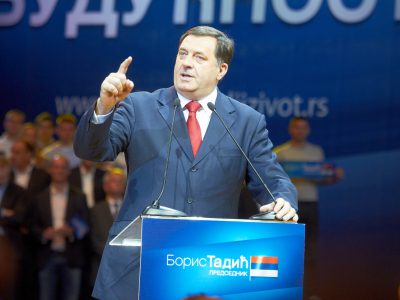
Bosnia and Herzegovina (BiH) appears to be coming apart at the seams. The Balkan state is currently embroiled in its worst political crisis since the 1992-1995 war, the bloodiest on European soil since the Second World War. The current tumult was triggered by Milorad Dodik, a Bosnian Serb nationalist politician and notorious demagogue, who has been leading calls for Republika Srpska (RS), the Serb-majority region established after the war, to “pull out” of the country’s central institutions—its armed forces, intelligence agency, and tax authority. Most recently, he and his party, the SNSD, have expanded their secessionist rhetoric to include the state police, the border police, and even the country’s constitutional court.
Dodik and his party are paving the way for the RS entity to secede from BiH in all but name. His calls to quit the state’s central institutions are a violation of BiH’s constitution and of the 1995 Dayton Peace Accords, which played a key role in ending the Bosnian War. According to that agreement, BiH is governed by a complex ethnic-based power system, which includes a tripartite presidency, wherein one Bosniak, one Serb, and one Croat simultaneously serve on the body and arrive at decisions via consensus. Or, at least, that is the theory. In practice, the system is marred by dysfunction and near constant obstruction, especially by Dodik and the SNSD.
What does he have to gain by pushing his war-scarred country dangerously close to the brink of another armed conflict? The answers are both cynical and predicated on a mix of political survival and ideology.
Officially, Dodik’s secessionist talk is based on his party’s rejection of a new law that criminalizes genocide denial. On July 23, 2020 the then High Representative, the Sarajevo-based international envoy who oversees the implementation of the 1995 peace agreement, Valentin Inzko, imposed a law banning the denial of all internationally recognized war crimes, crimes against humanity, and genocides (like the Holocaust). This means that anyone who denies that Serb nationalist forces committed genocide against Bosniaks during the 1992-95 war is now committing a crime.
For Serb nationalist leaders in BiH, this is an outrage. Genocide denial is a staple of their politics; Dodik’s regime has even funded bogus “commissions” to cast doubt on the well-established and forensically proven fact that Serb nationalist forces carried out widespread atrocities against Bosniak civilians while under the command of Radovan Karadzic and Ratko Mladic, both of whom were convicted of genocide by the International Criminal Tribunal for the former Yugoslavia (ICTY). Their convictions are largely concerned with the 1995 genocide in the eastern Bosnian town of Srebrenica, where Serb nationalist forces forcibly separated over 8,000 Bosniak men and boys from refugees nominally under the protection of the UN, transferred them to nearby fields and industrial buildings, and gunned them down. The New York Times report on the killings, quotes human rights officers and diplomatic officials who described it as “the worst crime since World War II.” Most experts and scholars, however, consider the totality of the Serb nationalist war effort in BiH to have been genocidal in nature, and not isolated merely to the events in Srebrenica.
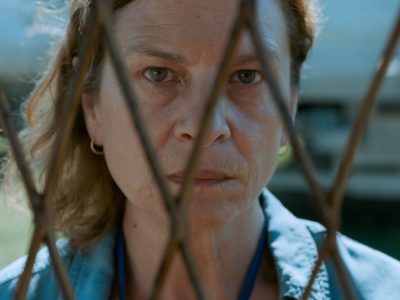
Read Jasmin Mujanovic's review of "Quo Vadis, Aida," a "shattering, essential" film about the Srebrenica killings.
The Bosnian parliament failed to pass its own legislation banning genocide denial because of obstruction by Dodik’s SNSD bloc and their coalition partners in the Croat nationalist HDZ. While the HDZ is not a secessionist party, they do want to further the ethnic fragmentation of BiH through the creation of a so-called “third entity,” a kind of Croat-dominated RS. Such an entity existed briefly during the war; its entire senior leadership was also convicted of crimes against humanity. Because Dodik sees the HDZ’s goals as a means of further undermining the central BiH state, he is happy to champion the HDZ’s interests.
In any case, Christian Schmidt, the new High Representative, has said the law imposed by his predecessor would remain in effect until parliament passed its own. Rather than engage in democratic niceties like parliamentary debate, Dodik has now shifted tactics to creating illegal parallel institutions. He has even threatened to recreate the “Army of the Republika Srpska” (VRS), the militia that committed the Srebrenica genocide.
Dodik has governed BiH’s RS as a virtual autocrat since 2006. Prior to the genocide, the areas of northern and eastern BiH that now constitute the entity were wholly multiethnic; today they are almost wholly Serb-dominated. Dodik is currently a member of BiH’s tripartite state presidency and has no official function within the RS, but the Serb enclave is his personal fiefdom in all but name. Once an American-backed reformist who helped eject Karadzic’s SDS party from power, Dodik has spent much of the last 16 years reinventing himself as a hardline nationalist. That has also meant violently cracking down on civil society, creating a regime-controlled media apparatus, and centering all real power in the entity of his own person.
Because of the Dodik regime’s near-authoritarian domination of the Serb entity, the SNSD is unlikely to lose power in the next BiH general elections, scheduled for October 2022. Moreover, because of the expansive power-sharing provisions of the Dayton constitution, Dodik and his Croat nationalist allies in the HDZ also (in)directly control large aspects of the state apparatus, a fact that has shielded leading figures in both parties from prosecution for a legion of criminal affairs and a smorgasbord of anti-constitutional activities. In October 2021, for instance, BiH’s BN TV reported that the SNSD government had allowed industrial grade oxygen tanks, unfit for human consumption, to be used in hospitals in the region. In December 2020, Dodik’s appointee on BiH’s central judicial oversight body was forced to resign in disgrace after he was caught on tape directing payoffs to underlings, and openly discussing how to sway justices.
It is this trinity—sectarian ultranationalism, autocracy, and kleptocracy—that is the nucleus of Dodik the person, and the regime he has constructed in RS. He wants to dismantle the Bosnian state because he needs all three to survive politically and because of venal, financial self-interest.
Dodik and his party have made the glorification of genocide denial one of their central ideological and electoral pillars. Without it, their political survival is in grave danger. The law banning genocide denial also creates politically and emotionally legitimate grounds for the High Representative to remove Dodik, which in turn would decimate his expansive criminal patronage networks. As noted in a January 5 U.S. Treasury Department brief, outlining the reasons for a new round of U.S. sanctions against him:
“Dodik…has established a patronage network in BiH from which he and his associates benefit. As one example of his corrupt actions, Dodik has provided government contracts and monopolies in the RS directly to close business associates. With his corrupt proceeds, Dodik has engaged in bribery and additional corrupt activities to further his personal interests at the expense of citizens in the RS.”
To be clear, the High Representative had grounds to remove Dodik already, but the SSND is hardly the only political party in BiH guilty of corruption, self-dealing, and abuse of office. Systematic genocide denial, however, packs a more robust, normative punch.
This also explains why Dodik has resisted implementing the “5+2 Agenda,” the formula set out in 2008 for the phasing out of the Office of the High Representative (OHR). The two most important pieces of that checklist are: the dispute over state properties on RS territory, the most sensitive of which are military installations that belong to the Bosnian Armed Forces; and “the entrenchment of the rule of law.” Both items strike at the heart of Dodik’s authoritarian autonomy in BiH. If Dodik agreed to respect the presence of Bosnian military bases on RS territory and to abide by the rule of law, including an appropriate genocide-denial law, he could secure the OHR’s departure. But he would also be undermining his own authority by accepting the state’s primacy over his fiefdom. That is why he is trying to get rid of the OHR without implementing the 5+2 Agenda.
Dodik ’s extremist gambit, however, reveals the true nature of his broader political project. He is not concerned about the anti-genocide law per se. He is worried because the OHR has shown that it is willing and still able to activate the Bonn Powers—i.e., its authority to use extra-constitutional powers to protect the integrity of the Dayton Accords—and this threatens Dodik’s own political survival.
What gives Dodik’s current efforts additional weight is not only that his party has begun using the RS assembly to formalize his purported “withdrawal” from state institutions, or his dismissing the legitimacy of Schmidt’s tenure at the OHR. That, in and of itself, does not make such acts legal. A sub-national assembly cannot unilaterally override the acts of a state parliament or the contents of international agreements—which is what the SNSD is doing—in any country on Earth, not even in BiH. But these actions indicate a degree of actual political courage Dodik’s regime has not hitherto displayed.
Dodik feels he can afford to be bold because he enjoys the support not only of Moscow and Belgrade, but also of Hungary, which is a member of the EU and NATO; he recently claimed to have the support of several additional EU member states. While the Russians had Schmidt barred from the UN Security Council—the first time a BiH High Representative was prevented from addressing the body—Hungary’s Viktor Orbán has said explicitly that he would prevent the EU from imposing sanctions against Dodik’s regime, even as his country pledged financial aid to the RS. Orbán, whose Fidesz party is notoriously racist, antisemitic, and anti-democratic, has also peddled thinly veiled Islamophobic conspiracy theories to buttress Dodik’s brinksmanship.
Where BiH goes in the months ahead remains to be seen. Dodik and his partners in the HDZ might try to scuttle the country’s next elections, in order to further the narrative that BiH is a “failed state” that should be partitioned among neighboring powers, in line with the contents of a recent non-paper written by the cabinet of Slovenia’s Prime Minister, Janez Jansa, another Dodik ally. The U.S. has imposed new rounds of sanctions on Dodik; on Alternativa Television, a regime-controlled TV station that broadcasts pro-Dodik propaganda; and on Dodik’s former appointee to BiH’s judicial oversight body. The U.S. is expected to add more names to the list in coming weeks. The UK and Germany have also threatened their own measures, though they have not yet initiated them. In the interim, Zeljko Komsic, the Chairman of BiH’s presidency, has warned that unless the international community works with local authorities to stop Dodik, “force will have to be the response.”
Komsic is not wrong. Whether because of his extremist politics or his criminal interests, Dodik is clearly replicating the 1992 march to war under presided over by Radovan Karadzic, the convicted genocidaire. For all his bravado, though, Dodik knows he does not have the necessary hard power to go up against the BiH security apparatus, as fragmented as it is. The fear, however, is that he is still gambling on the idea that if he concocts a serious enough crisis, Serbia and Russia will come to his aid—little green men and all. Such a scenario would create a vortex of instability and conflict in the strategic center of the Western Balkans that, as in the 1990s, would suck in neighboring states. With Russia threatening further aggression against Ukraine, the West can ill afford another security crisis in the volatile southeast of Europe.
[post_title] => A genocide-denying autocrat is threatening to throw a lit match into Bosnia's tinderbox
[post_excerpt] => Once a US-backed anti-nationalist reformist, Milorad Dodik has spent much of the last 16 years reinventing himself as a hardline nationalist politician.
[post_status] => publish
[comment_status] => closed
[ping_status] => open
[post_password] =>
[post_name] => a-genocide-denying-autocrat-is-threatening-to-throw-a-lit-match-into-bosnias-tinderbox
[to_ping] =>
[pinged] =>
https://conversationalist.org/2021/04/24/bearing-witness-to-genocide-quo-vadis-aida-is-a-shattering-essential-film/
[post_modified] => 2026-08-05 18:11:35
[post_modified_gmt] => 2026-08-05 18:11:35
[post_content_filtered] =>
[post_parent] => 0
[guid] => https://conversationalist.org/?p=3704
[menu_order] => 149
[post_type] => post
[post_mime_type] =>
[comment_count] => 0
[filter] => raw
)
 A still from the film shows Bosniaks taking refuge at the UN Dutch peacekeeper base in Srebrenica.[/caption]
In 1993, at the dedication of the U.S. Holocaust Museum, Elie Wiesel made an
A still from the film shows Bosniaks taking refuge at the UN Dutch peacekeeper base in Srebrenica.[/caption]
In 1993, at the dedication of the U.S. Holocaust Museum, Elie Wiesel made an