WP_Post Object
(
[ID] => 11278
[post_author] => 15
[post_date] => 2026-11-07 02:39:22
[post_date_gmt] => 2026-11-07 02:39:22
[post_content] =>
When slop doesn't sell, it pays to have a human touch.
Cultural Currency is a bi-monthly romp through the intersections of art, capital, and politics with writer Cara Marsh Sheffler.
If the past five years of living with generative AI in the marketplace have taught us anything, it’s that management is depraved. Fewer employers, it seems, feel they owe their workers. The idea of reciprocity has vanished. Labor has been utterly devalued. Instead, our culture worships a parasitic class of billionaires who have nothing to offer but intellectual theft, political corruption, and insipid mediocrity; all delivered via infrastructure built by the taxpaying plebes whose futures they despise and destroy. As the 99% struggle month to month, there is not a single corner left uncut. Every manager in the country is shooting off the same squirt gun at the roaring wildfire that is coming to kill us all: Hey, what if we tried AI and let some people go?
Some background: This column does not pay my mortgage, nor does my creative practice. So, like almost everyone else in a creative field, I take plenty of non-creative work. While many writers have academic tendencies, because my own weird career has existed more in art than book publishing, my paying work has tended more toward PR and luxury branding. I enjoy it, and I am also lucky to often work for or with my friends. But starting roughly two years ago, around once a week, I began receiving emails about “changing editorial protocol to incorporate AI” that triggered a reaction in me comparable to Clark Griswold’s psychotic break when gifted a Jelly of the Month Club membership. (“It’s the gift that keeps on giving the whole year!”) More disconcerting than losing gig after gig to AI was the deeper conviction that the institutional rot and delusional technofascism that has dogged my adult life would definitely not course-correct in time for me to execute a successful career pivot in my 40s. I did not and do not have that kind of faith in our near future.
To put it mildly, this came at a bad time. Budgeting is increasingly untenable everywhere, especially in NYC, where I live. According to the comptroller, over half of New Yorkers spend over 30% or more of their income on rent. Even the rightwing NY Post has reported that the cost of groceries has increased 20-33% since 2020. Meanwhile, billionaire wealth grew 25% percent globally last year alone; yet in the US, typical hourly compensation has risen by only 29% since 1979, even as American worker productivity has grown 80%-150% (depending on how it’s measured). Wage stagnation feels like a polite euphemism for getting royally fucked.
I wish I were writing from the trenches of late-stage capitalism; hell, I wish I were writing from the frontlines. But I’m not: As a freelance writer, I’m writing from the pine box. Or, more precisely, certain possibilities of my career are now buried in the pine box, as I am still very much alive and bitchy enough to point out that autocorrect tried to remove the subjunctive mood from the first sentence of this paragraph. Granted, this observation in and of itself probably won’t convince the average technocrat that we still need writers. (Jessica Lange voice: “There’s not going to be a subjunctive on Mars, you stupid slut!”) But nothing really needs to make sense when HAL 9000 is at the wheel; in our AI hellscape, grammar, syntax, and even good old cohesion are as quaint as trench warfare and, accordingly, have been left to die in No Man’s Land.
Despite the ubiquity of AI in public discourse, however, the freelance marketplace has recently changed its tune: Almost all the work I lost 18 to 24 months ago has started coming back.
I graduated from high school in 2000, so I have lived through three economic crashes during my adult working life. That’s also three times the lived experience necessary to know that—except for the friends who created opportunities for me as the market fell apart—no one has been hiring me back out of the goodness of their hearts. Instead, most of my freelance writing work has returned for one simple reason: Slop doesn’t sell.
AI slop is smooth to the point of blather—a word gruel so meaningless and anodyne as to be better left ignored. The attention economy is depleting us all; consumers are saving their eyes the strain. For every manager who said, Screw it, just put some words on a page, let AI do it, customers have slipped away. People can intuitively recognize slop even as it wears the human brain down. Their eyes don’t stick. They know something is off, even if they don’t have words for it. Journalistic organizations have produced playbooks of AI copy tells, while a handful of social media accounts break down how to spot AI in images. (Though the latter is admittedly getting trickier and trickier.) At the same time, Google is getting hilariously, terrifyingly stupid, as a direct result of a reliance on AI-driven searches. Even Forbes is reporting on how slop is hurting bottom lines.
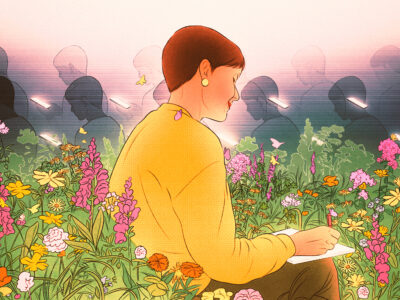
These days, when I’m hired for freelance work, I am given the same brief: Leave some fingerprints. I am now paid not so much as a human who writes, but as a writer who can leave a human trace—usually after AI was used somewhere in the process before a project was handed off to me.
What, exactly, is a fingerprint? It’s a series of grooves that gain purchase, and leaves little slicks of oil and grease, the messy residue of humanity. For a writer, that means stylistic fingerprints. While there is a romance to handprints—from the Lascaux Caves to the Hollywood Walk of Fame—fingerprints evoke culpability. Long the gold standard in forensic criminology, there is disturbingly little standardization in how to match them, and fingerprints have led to a number of wrongful convictions. Somehow, this feels apt: Even as I am hired back, it serves as a chilling little reminder that the writer will be the first to blame if things don’t work out. Our prints will be all over the failure—whether or not it was really our fault.
We all have bills to pay, and AI has certainly gotten in the way of me paying mine. Simultaneously, like it or not, today, most working writers have a hybridized relationship with AI. To me, this means that it is incumbent upon the writer to define what AI can and cannot do. Primarily, AI is iterative. It proffers answers without construing a thing, barfing out facts devoid of comprehension. Limited by its lack of consciousness, AI has no depth, no shine: It might construct, but it cannot constellate. It’s not quite a misnomer to call AI “intelligence” if one reduces intelligence to mere problem-solving. However, the reduction in the meanings of the words “artificial” and “intelligence” is paired with a certain omnipotence and unknowability—much like the meanings of the words “plastic” and “cancer.” If AI can perform a “creative” task, that task was probably not creative at all. AI cannot touch the kind of ineffable expression that matters to me, those traces of human creativity that are, as one writer once put it, commensurate with our capacity for wonder. Call me Jungian (not that anyone ever would on a Zoom call), but I believe consciousness is required for creative output. The bigger question is why do we want to replace human creativity at all?
On a practical level, by all means, let AI take dictation and turn the transcript into notes with an outline—that, of course, will need a human who was paying attention to check. Let it kick off a round of brainstorming, if you must. I wouldn’t begrudge a bot a PowerPoint deck any more than I’d begrudge my washing machine dirty clothes. AI should make our lives simpler. It should do dishes or sort toxic chemicals or help researchers image cancer cells—not take musicians’ work. But, what’s at stake when we offload the latter is more than just losing work that pays, especially in creative fields we historically undervalue, yet need in order to make life tolerable. Just as we cannot trust the free market to take care of the vulnerable, we cannot entrust the arts or our cultural legacy to it, either.
So why are we developing a technology that could destroy life as we know it within a decade, according to whistleblowers with scripts straight out of B horror movies? The answer is that we are not; the ketamine-snorting tech buffoons we have let run amok are. It’s their bottom line, but it's our culture, communities, and environment. Technology ought to serve all levels of society, not merely our tech overlords who see everyone else as nothing but consumers to be chewed up and spat out—or occasionally as useful producers who can leave fingerprints that encourage said consumers to consume. We need to stop feeding the beast. Instead, we need class consciousness. We need a Works Progress Administration. And we need to identify, to protect, and to fund the creative class.
When I lost almost all my work, I focused on projects and people who made my life feel more expansive, even as my prospects for income dwindled. I took work that paid for travel and creative projects that garnered more bylines. Without fronting on my part, no one looking at my CV would have had any idea how much my confidence or my bank account were hurting. Arthur Jafa, who has a stunning retrospective at the New Museum, said the following during a recent talk when asked about his perception of his success: “There’s not a map, I can’t give you a map. And if I could, this is not the road you want to travel. This fucking shit is like hair-raising, you know what I mean? Like my hair is fucking gray.”
While I was enjoying what I consider the biggest professional and personal successes of my life thus far, I simply had no idea where the money would be coming from, and reasoned that was a preferable problem to have than being unhappy or creatively unfulfilled. I just panicked a lot, like a real adult. I had no idea when the money would appear, like a real artist. Now that the work has returned, I’m also still digging myself out from a giant deficit (interest is real, even if the emails one sends to chase invoices, apparently, are not); and freelancers are always paid last (one can essentially borrow against us and we are powerless to charge interest, though a Freelancers’ Payment Fund has been proposed in NYC).
I wouldn’t tell anyone to do as I say or as I do. That said, if generative AI has allowed me to realize anything, it’s the centrality of my own fingerprint. And I don’t mean that in terms of capital. I remain cynical as ever about that exchange, but also determined to continue to fund my silly little life. Rather, I mean it in the sense that Heraclitus expressed when he wrote that character is fate. Many, maybe most, don’t get to explore and exercise their potential. But, if you are so lucky, your own unique ability to world-build both by yourself and with those around you is what matters—and you don’t need a creative career to do so. No bot can take that away. No bot can do that at all.
If AI is a cheap trick of a Turing Test that just happens to be destroying the planet, I’ll take consciousness, chaos, and mess. I’ll take shouting into the wind until it knocks me down to the ground for good. That’s what artists of all stripes have been doing since time immemorial, and lucky are we to count their fingerprints among us, to keep us going through it all.
[post_title] => The Fingerprint Brief
[post_excerpt] => When slop doesn't sell, it pays to have a human touch.
[post_status] => publish
[comment_status] => closed
[ping_status] => closed
[post_password] =>
[post_name] => the-fingerprint-brief-ai-slop-artificial-intelligence-cultural-currency-economy-technology-freelance-writing-human-creativity
[to_ping] =>
[pinged] =>
[post_modified] => 2026-11-07 02:39:24
[post_modified_gmt] => 2026-11-07 02:39:24
[post_content_filtered] =>
[post_parent] => 0
[guid] => https://conversationalist.org/?p=11278
[menu_order] => 0
[post_type] => post
[post_mime_type] =>
[comment_count] => 0
[filter] => raw
)

AI
WP_Post Object
(
[ID] => 11069
[post_author] => 15
[post_date] => 2026-09-29 17:27:36
[post_date_gmt] => 2026-09-29 17:27:36
[post_content] =>
Overnight, I lost some of my capacity to think and write. After fighting to get it back, I cannot imagine choosing to give those faculties over to a machine.
It started with a pain that felt—and sounded—like a crack of thunder at the base of my skull.
I had been prescribed a medication by my cardiologist that was meant to raise my blood pressure, which it did; so much that when I went to bed that night, I experienced a dangerous bout of supine hypertension, or raised blood pressure from lying down. Unaware of what had happened, I took my migraine medication as normal and went to sleep, not knowing that staying horizontal was the worst thing I could have done.
The next morning, I found myself unable to speak. I felt weak in my body, and even sitting up in bed took enormous effort. I lift weights regularly, but just bringing my hand to my head felt heavier than any deadlift. I have had migraines for almost 30 years, so I assumed I was just having one that was presenting differently. Over the days and weeks that followed, however, I felt progressively worse. I don’t remember the details well, but in my health diary, I diligently tracked every detail: My body was numb, my right side hurt, and I spent more time lying down than not. I also continued struggling to speak or even think. When I saw my headache nurse a month later, she was shocked by the state I was in. I was shaking and sobbing, trying to convey to her just how sick I felt. But while I have always had some difficulty with translating my thoughts into speech, all of a sudden, I found that my thoughts weren’t there, either. They were no longer trapped in my brain—I just didn’t have anything to say.
It took a few weeks for me to realize that the medication was to blame, and when I did, I stopped it cold turkey. Still, it took many months to recover. I wasn’t able to work or write unless the tasks were very straightforward and required no creative input, but even then, everything took me far longer than it once had. More than that, I suddenly couldn’t enjoy the things that had always made life worth living—reading, listening to music, watching movies. If an activity required any degree of focus or interpretation, it felt impossible.
After weeks of struggling to get out of bed or talk, I went to the doctor and asked for an MRI, which showed a white patch indicating brain damage. I took the results to my neurologist, who I regularly see for migraines and related disorders. He suggested that, based on the MRI and my symptoms, I may have had a transient ischemic attack (TIA), or “mini-stroke.”
In the months that followed, with aspirin and support from my medical team, I worked hard to be able to do the things I had previously loved, but still found no joy in them. Things that were once intuitive and essential felt insurmountable, like writing about how I felt or what I was experiencing. Reading—something that had provided escape and pleasure for my entire life—was newly boring. Relating things to others, even things I was ostensibly interested in, felt torturous; every conversation was excruciating.
My recovery has now taken years, but I am finally at a point where I feel almost as strong as I once did and as confident as I used to in expressing myself. Coincidentally, it is over these last three years that I have seen many people around me, even those I respect, struggle with the same things I found so difficult when I was re-learning how to think for myself.
Rather than being struck down by a neurological event, however, the main reason they have struggled with these things is because they have outsourced their faculties to AI.
There may be some application of so-called Artificial Intelligence, sometime, that benefits the lives of everyday people. Yet it is currently being forced into every area of art, marketing, and education, none of which have seemed to benefit. The Atlantic recently reported that film students (I studied film for both my BA and MA) now struggle to sit through entire movies. Many schools don’t believe that students can, or should, be assigned to read full novels. Many office workers increasingly use AI for every little task, while professional writers admit to using large language models (LLMs) like ChatGPT or Gemini to generate text instead of actually writing it themselves. (Not just ones you haven’t heard of, either: Nobel prize winner Olga Tokarczuk recently gushed about the benefits of AI, too.)
Advocates for LLMs promote them on the basis that they make everything easier, friction-free. But art is not supposed to be friction-free, nor the same as something anyone else could have produced with access to the right program. This is part of why it was so painful to lose my own ability to write after my TIA. Writing is how I make sense of the world, of my own thoughts, of what has happened to me. It is that combination of my own experiences, perspective and cultural input that makes my work unique. You might not like my work, or relate to it, and that’s OK: Nobody will ever write or create or interpret from the exact same place as another person. That is what makes writing worth reading, and what makes it worth the time and effort, not a randomly generated string of words. Learning and education, too, should be somewhat challenging, because the challenge is a significant part of what makes it so rewarding—something I would soon experience firsthand throughout my recovery.
At some point during the slow crawl through this period, I realized that the skills I’d lost might not come back to me without intervention and tremendous effort. I started to read books and articles again, very slowly, despite struggling to retain any information. I wrote just for the sake of it, even though it wasn’t as easy, rewarding, or even readable as it had once been. I started playing the piano, hoping that learning something new would spark something in me. I focused on studying Spanish. None of these things came easily, but they felt essential if I was to return to the person I had once been. Without my memory, without the capacity to be curious about the world, I was not myself. To come back to her, I had to force myself to do those things, no matter how difficult.
Maybe there were easier routes to normalcy, or at least a facsimile of it. Early in my recovery, if I had turned to AI, maybe I could have given the impression to my editors and friends that I was working at full capacity. But even when I was struggling most—even before I fully understood what had happened to me—it never occurred to me to use it. If anything, my experience made me double down on my aversion to LLMs, particularly in my line of work.
I personally boycott AI for a few reasons; the environmental impact is one. As an author, the wholesale theft of artists’ creative output is another, and something I find abhorrent. The end result of AI-generated text and images pretty much always sucks, and as a person who likes to look at and read things that don’t suck, that’s important. But I’m also old-fashioned: I write by hand, I paint, I take film photos, I listen to vinyl. I like things that are made by people, things that I can touch. I also think art matters, even when it’s imperfect or when it isn’t something I personally enjoy, because it was made by a person transmogrifying their experience into something that we can all share. “Art” made by a machine, then, is not art.
What I find most worrying, though, as a person who shares the world with so many heavy LLM users, is the impact on their brains’ ability to function—especially as someone who temporarily lost a degree of mine. In 2025, a study by MIT found that people who used ChatGPT to “write” showed less brain activity in neural networks associated with cognitive processing. The study divided 54 18- to 39-year-olds into three groups, and asked each to write SAT-level essays using ChatGPT, Google, or nothing. Using an EEG, the researchers found that of the three groups, ChatGPT users had the lowest brain engagement and consistently underperformed at “neural, linguistic and behavioral levels.” This isn’t really surprising news—after all, the LLM users in the study didn’t actually use their brains for the study. What is far more alarming is that their level of effort degraded over the course of several months, and they got lazier with each essay.
If you stop doing something because it’s hard, you will eventually lose the ability to do it entirely. Maybe turning to ChatGPT as a one-off for a late assignment won’t affect you, but the science shows that turning to it time and time again will. Think of other technological leaps, like the shift from writing by hand to typing on a typewriter or computer. Studies have found that handwriting activates a broader network of brain regions involved in motor, sensory, and cognitive processing. While I type for work, I have kept a handwritten diary since 2004, because I don’t want to lose that skill. In almost every area, doing things the hard way enables you to think and engage with ideas more deeply. Reading an article or a book yourself and determining its point will help you to remember the information in a more meaningful way than looking at a summary on Google.
There are many writers who are not luddites like me. There are writers, filmmakers, and artists who once produced great works without AI, who now vouch for the technology. But as someone who, overnight, lost some of their capacity to think and write, I cannot comprehend why a person would choose to give that faculty over to a machine.
Your thoughts are all you have. Your experiences, your unique way of seeing the world, your tastes. These are hard-won, often over decades of exploration. You may have to read hundreds of books or watch hundreds of movies that you don’t even like to arrive at what you do. If you’re a writer or artist, you might have to spend years being bad at the thing you love before one day, you aren’t so bad anymore. That work is worth doing.
When I was in the midst of my recovery, I was accepted into an artists’ residency in the dry, water-starved mountains of southern Spain, in an area currently blighted by wildfires. I was to spend two weeks in a house that was so isolated it took 15 minutes just to drive off the property on a dirt path. It took even longer to reach anything that resembled a store. This meant I was trapped, for two weeks, with no excuse to do anything but write. I was still very unwell, struggling to get out of bed and get myself together. But I didn’t want to let the opportunity pass.
There were several people in my residency—a poet, three other longform writers, and a photographer—in addition to the two people running it, who were both visual artists. I found writing very difficult over this period, but I managed to start working on some pieces that I was close to proud of. Each day, I would spend hours chained to my laptop just to produce something, even if it was something that would be edited or scrapped wholesale tomorrow.
It was on this trip that I gained new respect for the craft of writing—the fact that it is hard and takes so much time is part of its value. That struggle is how we figure out what we mean, what we think, what we really believe. I became more cognizant than ever of the importance of processing thoughts, words, and emotions myself. Prompting an LLM to produce text, meanwhile, does not require any effort, insight, or cognition whatsoever.
Writers and journalists who rely on AI often say that they only use it for this or that: only research, only editing, only outlining, not the actual writing. But it is all the writing. The time I spend swimming and working over an idea in my head is also writing, even if there isn’t a laptop in sight. When I am lazily cuddling my dog on the couch and suddenly realize how I’m going to write the next part of a story, I am writing. When I am in the bath and remember the exact right word for a feeling, I am writing. The fact that writing—that any form of art—requires so much of us is a part of what makes it so valuable. The fact that it is by a person, with their own experiences of the world, makes it even more so.
There are parallels to be drawn between the loss of cognitive capability that I experienced and had to work hard to regain and the degradation that cognitive offloading can cause in people who are overly reliant on LLMs. The good news is that being a loyal ChatGPT user doesn’t give you brain damage—at least, as far as we now know. If you want to, there is nothing medically stopping you from regaining the skills you may have lost. If you once knew how to do something that you’ve since spent months handing over to LLMs, it is likely that when you try to do that work alone again, you will struggle without the support of the machine you’ve come to rely on. What worries me more is the people who have never learned to do the work themselves at all, such as students and young people, who may never develop the skills necessary to do anything on their own. Teachers and professors are fighting to change this, and to get students to think for themselves, even tricking them with hidden AI prompts in exercise briefs, but it’s not enough. People have to want to do things themselves, and we have to foster a culture that supports and encourages this.
Those months I spent not being able to read, write, speak, or otherwise communicate the way I had always been able to were frightening and isolating. It took a long time to claw myself back, and it could just take another neurological episode to set me back months, or worse, again. I don’t take those regained skills for granted anymore, because I learned firsthand how much is lost when we can no longer form our own opinions or share our perspective with the world. Finally, I can take great pleasure in reading, in watching movies, in talking and writing about what I think and feel again. Being able to do something yourself, even and especially when it’s difficult, is rewarding. Seeing a paragraph or a painting, however imperfect, and knowing that it came from inside you feels good, even if it’s not where you’d like to be right now. It’s never too late to keep trying—no matter how difficult it is to get to where you hope to be.
[post_title] => In Defense of Difficulty
[post_excerpt] => Overnight, I lost some of my capacity to think and write. After fighting to get it back, I cannot imagine choosing to give those faculties over to a machine.
[post_status] => publish
[comment_status] => closed
[ping_status] => closed
[post_password] =>
[post_name] => personal-essay-artificial-intelligence-llms-brain-damage-transient-ischemic-attack-chatgpt-opinion-op-ed-recovery
[to_ping] =>
[pinged] =>
[post_modified] => 2026-09-29 17:27:38
[post_modified_gmt] => 2026-09-29 17:27:38
[post_content_filtered] =>
[post_parent] => 0
[guid] => https://conversationalist.org/?p=11069
[menu_order] => 0
[post_type] => post
[post_mime_type] =>
[comment_count] => 0
[filter] => raw
)