Unlearned historical lessons from Jacques-Louis David’s retrospective at the Louvre.
Cultural Currency is a bi-monthly romp through the intersections of art with writer Cara Marsh Sheffler.
Many of us have had enough of living through Interesting Times. As an American raised in the misguided, batshit optimism between the fall of the Berlin Wall and 9/11, I often feel as if my adult life has been lit by the glow of a global garbage fire no one conditioned me to anticipate—a garbage fire lit by the US government, and tended to with as much care as it lavishes on the Eternal Flame. For this reason, I was eager to see the monumental Jacques-Louis David retrospective at the Louvre earlier this year: David is, in many ways, the official court painter of Interesting Times. He lived through some of the most shocking regime changes in European history and both painted and propagandized them.
Born in 1748 during the ancien régime, David rose through the traditional, royally patronized ranks to become a painter known for his austere style and his focus on Neoclassical themes. Though socially connected, during the heyday of the salon, he was tormented by a benign facial tumor that impeded his speech, somewhat setting him apart from polite society. When the French Revolution kicked off, he dove into radical politics and befriended Maximilien Robespierre, the architect of the Reign of Terror, which saw some 17,000 public executions by guillotine. David served in government designing festivals, monuments, and uniforms; he also sat on the Orwellian Committee For Public Safety and voted for the death of Louis XVI. When Robespierre fell, David went to prison for the better part of a year, but kept his own head. A few short years later, he rose to prominence once more as the official court painter of Napoleon, outliving the empire, only to die in 1825 in exile in Brussels. Remarkably, this was a voluntary exile: the restored Bourbon King had invited him to serve as court painter, despite knowing David voted to guillotine his brother.
If this Louvre show was any indicator, the French curatorial class is still vaguely terrified of one of its most emblematic painters and unsure of what to make of him, the same way French elected officials are still afraid of an electorate that once managed to chop up its ruling class. The Internet likes to joke the White House would be covered in shitand on fire if Trump were governing France and, there is, perhaps, some truth to this. The French are known as feisty, indignant, and quick to strike or riot in a way that we Americans deem “bad for business.” Each time I’m in the country for any kind of civil unrest, it is not hard to imagine how they conceived of the guillotine, a sublime machine of both political horror and political theater concocted under the cynical pretense of science, democracy, and progress (cf., Liberté, Égalité, Fraternité).
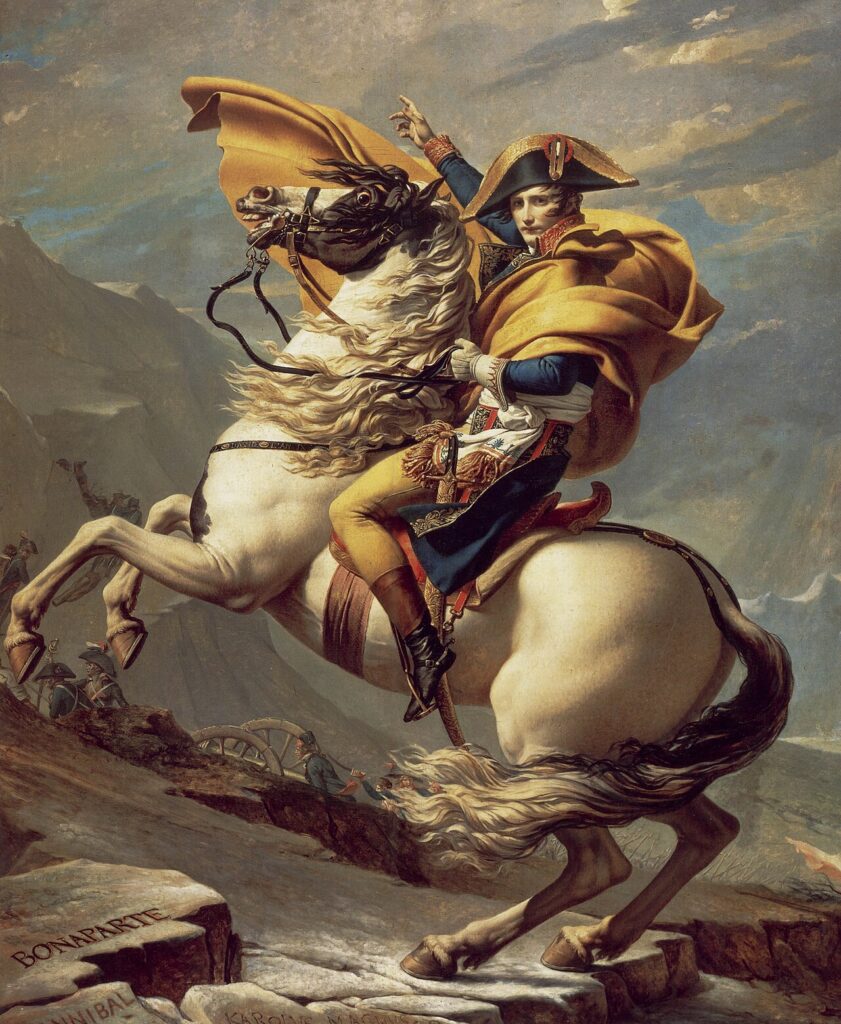
"Napoleon Crossing the Alps" by Jacques-Louis David
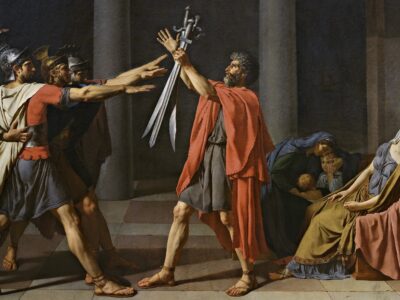
A Neoclassical master, David’s most famous paintings include “The Oath of the Horatii” (1785), “The Death of Marat” (1793), “Madame Récamier” (1800), “Napoleon Crossing the Alps” (1801), and “The Coronation of Napoleon” (1807). The show was organized chronologically to chart the violent, winding historical path between these paintings, and David’s relationship to each regime he served. His evolution marks him at best as a cipher, and at worst, the most corrupt hypocrite. But David was hardly alone in changing alliances to survive: Talleyrand, the French statesman and contemporary political chameleon survived five regimes in succession, brazenly switching sides to do so. When he died, Metternich, his Austrian nemesis, sarcastically remarked, “I wonder what he meant by that?” In many ways, that question felt like the animating force of the David exhibition. One could easily assert he was an artist without scruples who went where the moment and money took him. But, that’s too simplistic. David painted the long, strange journey through the phases of one’s life, one’s country, and one’s era. He painted the life and death of ideas and the flesh-and-blood people who lived them; his works testify to the gap between espoused ideals and lived reality—between pulling the trigger and watching the body fall.
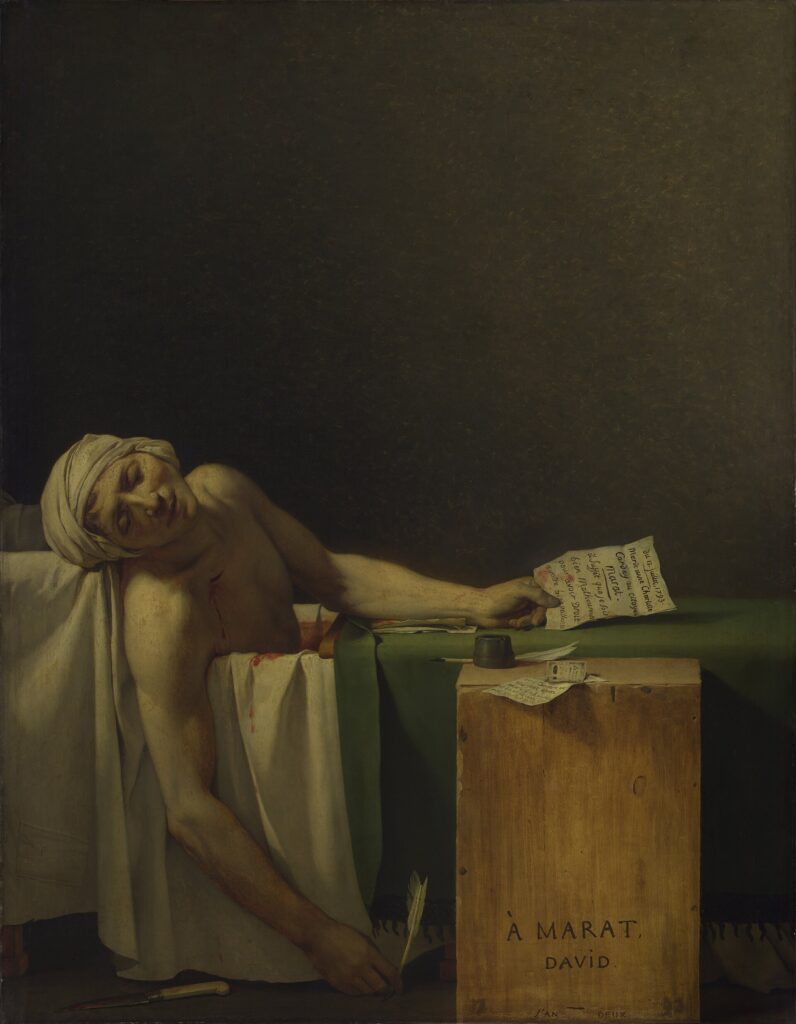
Hot-headed and famously difficult from the jump, David attempted suicide the second time he failed to win the Prix de Rome in 1772. His third time was the charm, however, and he proved to be a prescient artist: His themes of stoicism and self-sacrifice conveyed through Neoclassical renderings of Athens and the Roman Republic foretold a great deal of politics and fashion, from the empire waistlines to the rise of democracy in modern Europe. His earliest successful paintings, such as “The Oath of the Horatii”, are impressive, even as they are also re-imagined scenes from a mind untested by political reality. The 1784 painting is literally bloodless: men swear to die for a cause while their wives cry in a corner. Nine years later came “The Death of Marat”, a visceral masterwork of propaganda. Oddly, when I first came upon it in the exhibit, I said to myself, “Welp, there it is,” and meandered into the next room. It wasn’t until I re-entered the gallery, painted green to match the solemn background of the composition, that I realized I had seen a copy: The entire room was filled with painted copies that had been disseminated across France. I turned around to face the utterly electrifying Real One. You didn’t need to know a thing about art to figure out which one it was: a painting of the cold, calculated stabbing of a vulnerable man in his bathtub, the artist’s own murdered best friend, dead for the Republic.
"The Death of Marat" by Jacques-Louis David
David’s political journey is also evident in the gap between his stiff, slightly asexual representation of so many female figures in his earlier allegorical paintings, versus the real and vibrant women he painted with loose brushstrokes and incredible intelligence in his portraits, such as that of Marie-Louise Trudaine.David’s own wife, Marguerite-Charlotte, divorced him in 1789 for being a regicide, but they remarried after he was released from prison, raising four children together who sat for him often. For a painter often criticized as unfeeling, his portraits of married couples are a delight: “father of chemistry” Antoine Lavoisier and his wife (and underappreciated fellow chemist) Marie-Anne Paulze dominates his depiction of them together in the lab; he also painted a tender double portrait of Antoine and Angelique Mongez, simply because they were great friends of his, as an inscription attests.
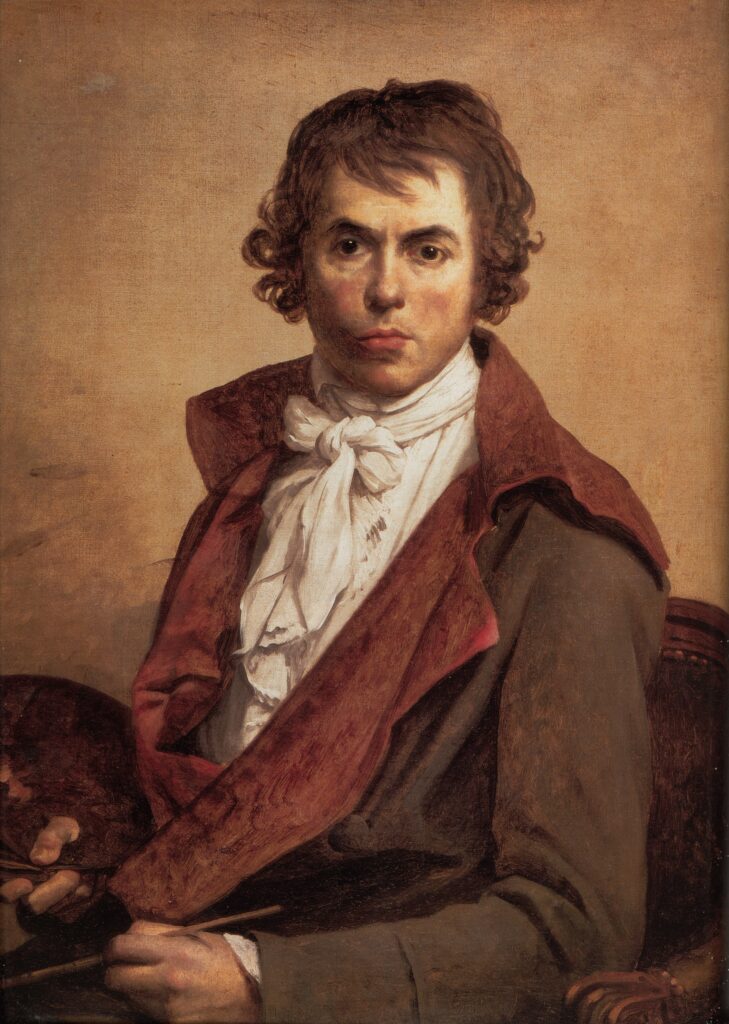
That he eagerly chased an ideal (or three) is nothing novel or noteworthy, but his art became more compelling the more tested he was by events. The more shit spiraled out of control, the more David understood the power of the narrative—as well as when to turn it off completely. His self-portrait in prison is a high watermark of decontextualizing. It’s a testament to that ever-present gap between our personal political thoughts and our complicated, shared realities. Finding an authentic perspective on that gap is impossible: If the Renaissance painters taught us about visual perspective, David demonstrated that perspective on current events is a lie. In fact, his best use of literal perspective is a metaphorical one. In his great portrait of Comte Antoine-Français de Nantes he shows us the cost of living through Interesting Times: The count, once a fiery, young revolutionary, became a Napoleonic crony. David painted him from below, so he literally looks down his nose at viewers. His contemptuous face and saggy jowls are articulated with unsparing detail, a countenance juxtaposed with and choked out by finery—the lace, the velvet cape, and a medal for the ideals he betrayed along the way. Survival is an exercise in brutality. This sellout—the sellout—David says, is what winning actually looks like. This is the political happily ever after.
I came to this show as a citizen of a different empire presently running amok. France forged the United States’ first alliance and, like so many American allies to come, was left holding the bag. (This should have been a caveat emptor for future allies: Leopards do not change their spots, and Americans do not change their stars and stripes—but we Yanks are, if nothing else, fantastic at sales.) Funds sent to aid the American Revolution helped bankrupt the French crown and sparked a chain of events that cost the French king his head. All the while Thomas Jefferson meddled in The Declaration of the Rights of Man from his Parisian salon, Sally Hemings was enslaved in the next room. From this eventful early alliance, France and the US allegedly share ideals (cf., the Enlightenment), but we don’t exactly share historical roots. One major difference was reflected in a telling piece of wall text in the show: the role of the Catholic church. Next to the OG “Death of Marat”, the curator alluded to how revolutionary France needed martyrs to fill the void left by the abrupt banishment of the Catholic Church and the monarchy. Hours after Marie Antoinette was beheaded, “The Death of Marat” was unveiled at the Louvre, recently changed from palace to museum. That is to say, a cult of the state was invoked to fill the void of state religion.
Self-portrait by Jacques-Louis David
To this New Yorker, it often feels laïcité—the French principle of secularity—demands its own sort of worship. Religious freedom in France looks to me more like a hole in the ground where a Catholic church once was. Rather than a new structure where all are welcome and inclusion is additive, it’s one that demands the sacrifice or sublimation of all other cultural tenets for those wishing to be included. This creates toxic conditions as France wrestles with a number of postcolonial realities, including a large Muslim minority. Those limitations on the public imagination for an honest plurality were, to me, somehow reflected in this state-funded exhibit’s unwillingness or inability to reach final conclusions about David—and his attempts to fill that civic-religious void with new meaning. If America’s fundamental struggle is with equality, France’s is with diversity. Today, the French do not understand their secularity is exclusionary, much the same way we Americans don’t understand our democracy is a fiction.
Unlike France, we never have had a class revolution in the United States. In 1776, a bunch of rich lawyers told a king far away to fuck off, then immediately turned around and did business with him without changing all that much on the ground. That’s why the 13th Amendment is still, somehow, just sinking in. Ironically, white Americans scored many of their freedoms from Britain when the country was still a colony: Even the pope of the Enlightenment himself, Voltaire, envied the British their Parliament and the rights it accorded in the mid-18th century. From France, we may have learned exceptionalism, but we never learned real revolution. In America, the “revolution” was just another nice thing that only rich white people could have; in France, the revolution cost the upper class their heads.
If the French figured out how to stop deifying the king, maybe someday we can figure out how to stop deifying billionaires. And if we do, maybe someone will stay alive long enough to paint the whole drama as it unfolds. Doing so requires vanity, opportunism, gall, cruelty, and a profound degree of hypocrisy. However, it also requires bravery, and for that bravery, David was rewarded with awareness of some very modern dilemmas that keep his work relevant: of knowing it is impossible to portray a scene without altering it; of knowing all art is inherently political; of knowing the stories we tell control our realities; and of knowing that you will be judged as harshly as you judged others—and going through with it anyway, charging into The Void, no matter the cost.
[post_title] => Painting as It Burns
[post_excerpt] => Unlearned historical lessons from Jacques-Louis David’s retrospective at the Louvre.
[post_status] => publish
[comment_status] => closed
[ping_status] => closed
[post_password] =>
[post_name] => jacques-louis-david-retrospective-louvre-art-cultural-curreny-history-museum-france-united-states
[to_ping] =>
[pinged] =>
[post_modified] => 2026-04-03 19:30:30
[post_modified_gmt] => 2026-04-03 19:30:30
[post_content_filtered] =>
[post_parent] => 0
[guid] => https://conversationalist.org/?p=10407
[menu_order] => 0
[post_type] => post
[post_mime_type] =>
[comment_count] => 0
[filter] => raw
)

A look at the cross-continental sloshing of capital beneath the art market bubble.
Cultural Currency is a bi-monthly romp through the intersection of art and capital with writer Cara Marsh Sheffler.
Lately, a series of memes, graphs, and cartoons have gone viral, all asserting variations of the same thing: “The entire U.S. economy right now is 7 companies sending a trillion fake dollars back and forth to each other.” The source diagram for this claim was published in Bloomberg last October, in a piece highlighting why all these circular deals—largely between the usual AI suspects, such as Nvidia, Microsoft, and OpenAI—indicate a likely bubble. Together, this cloud-based clusterfuck has generated a $1 trillion AI market and $192.7 billion in 2025 Venture Capital investments. As of yet, however, they’ve also yielded scant indications of any productivity gains whatsoever.
Unsurprisingly, we’re starting to see this reflected in the art itself. To my eye, the art fair circuit of today largely seems to exist to dare to dream what slop—Merriam-Webster’s 2025 word of the year—might look like in the flesh, spread out across a couple of hundred booths. Nearly 55 galleries participated for the first time at New York’s Armory fair this year, the second since Frieze purchased it in 2023. When I attended, I wondered how many of them actually belonged at Javits Convention Center. Surely, taste is subjective, but to me—and the art advisor who gifted me a VIP Pass—there wasn’t enough champagne in the joint to make the fair look anything close to well curated. I heard many whispers that the Armory show hadn’t sold all of its booths and, as a result, what they let in looked like the kind of upscale beach art you’ll see next to a store that only sells white clothing or Vilebrequin swim trunks in Amagansett. When you figure booths are about $40K, the metallic driftwood art made sense: That's nothing to the very rich, who spend about as much if not more on a Christmas vacation. A booth might placate any number of ailing family dynamics, from a bored spouse to a listless kid.
Of course, many large corporations simply fudge the numbers when the going gets tough. They pay good money for sunnier analyses. But when paired with the news of Frieze’s expansion, this dissonance should ring alarms: Something is up. Why open more fairs when the ones they already have are neither profitable nor novel and of dubious artistic merit?
The cross continental slosh has a pattern, after all. It’s a game of appearances played across the globe until resources totally, utterly run out, and crash violently. As Ernest Hemingway famously put it: “‘How did you go bankrupt?’ ‘Two ways. Gradually, then suddenly.’” And, in the meantime, it is of the utmost importance to set up shop someplace new while the goods still have some value, and the brand hasn’t yet been completely tarnished.
In the art world, this is panning out in a palpable way. It's one thing to talk about AI slop as a harbinger of economic doom, or the imminent insolvency of Social Security, but it's even wilder as a bubble indicator to see mid-tier and blue chip galleries sliding horribly in Western world capitals, while the same art fairs that are coughing and wheezing in the West open entirely new ventures in Gulf States. Rather than cultivate a new base of collectors that might sustain art markets on a local level, the industry is continuing to cater to the uber wealthy, wherever it can find them—even as this model fails miserably in the West.
Of course, the art market isn’t quite a Ponzi Scheme, if you consider that the original investors aren’t technically promised an artificially high rate of return off the bat. But neither is, say, Nvidia, which hasn’t stopped its CEO from openly insisting his company “isn’t Enron” as its stock price tumbles. Like other markets, the art market continues on by force of its ability to lure in new investors. Frankly—to bring up Michael Burry again—the notion of carrying a certain tranche of goods from market to market in search of new investors while bundling them together (in this instance, as a fair), strikes me as a sort of arty CDO (collateralized debt obligation). Magical circular thinking abounds in budget offices across the board, from art to tech to government. But, I would argue, when consulting the US Treasury’s page explaining how the national debt is structured seems helpful in understanding our current predicament…it’s not looking good.
Perhaps there is someone in Abu Dhabi who will be thrilled to learn of the art world’s KKK: Koons, Kapoor, and Kaws. But you don’t need to read that US Treasury page to know who will be left holding the bag when the cross-continental slosh finally goes splat. Even if Frieze is able to eke out an existence from selling balloon dog sculptures to billionaires, it won't protect them from the inevitable pop, although it might provide a little delusional cushion in the meantime. As critic Jerry Saltz recently cautioned in an Instagram post, quoting Yale School of Management’s Magnus Resch, “Let’s be clear: multi-million dollar trophy auctions don’t reflect the health of the market. They reflect its distortion. What the art world needs isn’t more $50 million headlines. It needs more $5,000 collectors.”
To any working artist, that Resch observation has the infuriating tenor of the proverbial “Fork Found In Kitchen” headline. We need more art for art’s sake, much as we need communities that are affordable for creators. However, today’s collector class values art that functions as investment, not the health and cultivation of anything so quaint and unremunerative as artistic communities, or even individual artists. In the same way, corporations now chiefly exist to create value for investors, rather than to provide goods and services to consumers—let alone provide any kind of reciprocal benefit to workers.
To be perfectly clear, today’s billionaire class is one mostly disinterested in public works or philanthropy. Art collection itself is not about collecting objects that carry beauty or even status, but rather ones that accrue value and allow them to hide more money from the tax man. After all, the art world KKK is not an unholy trinity of art but rather a bundle of financial tools. If 1989’s independent cinema gave us The Cook, the Thief, His Wife & Her Lover, 2026’s art market has given us The Collector, the Tax Attorney, His Wife & Her Art Advisor. Whether or not Frieze’s latest venture succeeds, the West cannot flatter itself that these new markets of Middle Eastern buyers seek Western signifiers of wealth so much as access to more of our gloriously opaque financial tools: to wit, the art itself. (That Richter will really tie the Swiss bank vault together!)
Perhaps the greatest work of art right now, then, is this art market bubble itself, that sloshes so showily as it grows. It is the work of a collective that daringly splits the newly irrelevant hair between metonymy and metaphor, spanning continents, industries, and banking systems. It performs the same wistful, elegant, melancholic drift of Albert Lamorisse’s 1956 children’s classic, The Red Balloon, aping the film’s Gallic ennui with a Chanel sweater set for the booth and Ruinart champagne in the VIP room, dragging a damning homogenizing aesthetic in its wake like a dead zone in the ocean. And all it touches turns to slop as it grows and grows, for only homogenized slop signifies fungible, quantifiable value.
This homogenizing force and its flattening aesthetics are not unique to the art world, and might be handily encapsulated in 2025’s Q4 neologism, “chubai,” meaning something “chopped but also spiritually Dubai.” (Examples were given as Soho House, Goyard, and Carbone.) All the world’s a shopping mall, to borrow from the Bard. Beige is inescapable. Travel to any continent you like and you’ll find the same shit at every fair, much as the same internationally braindead flagship fashion stores anchor every fancy downtown strip in every major city around the world.
After all, that’s what a bubble does: it floats away, to foreign lands, all year round. As long as the ultra-rich need to keep their money safe from taxes, the art market will obviously continue to spurn its own sustainability—and why shouldn’t it? What market model indicates a path that creates something other than a tiny panic room full of winners, and utter doom for every other poor schmuck who won’t make it to the slopes of Gstaad this winter? Middle and working classes are so 20th-century, and the art market bubble is just one of many that’s eventually going to pop.
We live in a global society that valorizes the iterative as novel, lionizing AI and utterly unable to tell the difference between a tool and its master. Asses and elbows are easily conflated and confused. The art market itself has more to say about the state of contemporary art—and of the economy, of what the government has promised us and won’t deliver, and to what ends the tech world will go to deem anything innovative if it might push up stock prices to enrich that selfsame collector class—than a lot of art does. The sound of shit hitting the fan is perhaps a soothing one, a sort of white noise pedaled in Instagram ads. Or perhaps that sound is the sloshing itself, crossing continents and coming home in a fantastic, tidal fashion, to crash upon our shores.
[post_title] => "The Collector, the Tax Attorney, His Wife & Her Art Advisor"
[post_excerpt] => A look at the cross-continental sloshing of capital beneath the art market bubble.
[post_status] => publish
[comment_status] => closed
[ping_status] => closed
[post_password] =>
[post_name] => the-collector-the-tax-attorney-his-wife-her-art-advisor
[to_ping] =>
[pinged] =>
[post_modified] => 2026-02-12 19:44:35
[post_modified_gmt] => 2026-02-12 19:44:35
[post_content_filtered] =>
[post_parent] => 0
[guid] => https://conversationalist.org/?p=10167
[menu_order] => 0
[post_type] => post
[post_mime_type] =>
[comment_count] => 0
[filter] => raw
)
On modern wealth's bland aesthetics, the reopening of the Frick, and the meaning behind our Gilded Age nostalgia.
Cultural Currency is a bi-monthly romp through the intersection of art and capital with writer Cara Marsh Sheffler.
In his recent New York Times article, “Beige is the Color of Money,” Guy Trebay explored the prevalence of muted palettes in the homes and playgrounds of the rich around the world, from St. Moritz to the Sun Valley. “In past eras,” Trebay writes, “the wealthy tended to attire themselves in the richest of colors: indigo, crimson, the purple of nobilities and kings. We are no longer in that era. These days, the hue preferred by the richest people on earth is that most bland and mousy of non-colors — beige.” Trebay argues this shift has come to the fore during a populist moment, as the “rich hunker down in khaki camouflage.” He posits that being clad in “the anodyne colors of baby food, tea cookies or screensavers: latte, oatmeal, cream, butterscotch, café au lait” signals the notion of wealth in reserve, not something to be flaunted before the frothing fury of the masses. Trebay quotes Alessandro Sartori, the artistic director of Ermenegildo Zegna, as saying, “The ultrawealthy don’t want to show off, and beige colors are good in that sense…This class of people is super discreet and doesn’t want to be seen.”
This is bullshit. Rather, I would argue, beige is a marker of how they want to be seen. And unsurprisingly, compared to its colorful predecessors, it’s a hell of a lot less interesting to look at. Aspirational wealth, now the color of barf, is especially barfy. Intriguingly, it also seems to have sparked a bit of unexpected nostalgia for when the rich spent their money on batshit, exhilarating displays of filthy lucre, rather than on a $30,000 Loro Piana cardigan that makes both the wool it is made of and the person wearing it look like a virgin.
After a five-year renovation, a temple of that sort of old-school, jewel-toned ostentation has reopened on Manhattan’s Upper East Side, at the base of the Museum Mile: The Frick Collection. Ever since it reopened to the public on April 17, the museum has been so booked solid that the only way to get in on a given day is to cough up $90 for a membership. The line snaking around the block indicates this is no deterrent whatsoever. Boasting a hundred-foot-long gallery covered in the most sensual green velvet wallpaper the nation of France could produce, illuminated by a skylight that runs the entire length of the room, the Frick is the pinnacle of everything modern wealth is not. I confess I could lose an afternoon staring at its emerald walls alone, never mind the Corots, Turners, Goyas, and El Grecos that line them.
The Frick is a civilized place: There are no cameras or children allowed. Renovation aside, it is also a museum deliberately out of pace with the modern world. True to its namesake, Henry Clay Frick was a top-tier robber baron: coal and coke magnate, business partner to Andrew Carnegie and Andrew Mellon, union-buster extraordinaire. His taste reflects it. If money could buy it in 1906, his mansion on the prime corner of 70th Street and Fifth Avenue probably has it. A gargantuan Rembrandt self-portrait? Check! An entryway made of ten tons of Breccia Aurora Blue marble leading to an indoor fountain? Check! An Aeolian pipe organ? Check! Holbein’s portrait of Sir Thomas More? Check! A Fragonard room and a Boucher room? Check, check! (Randy Baroque artists always travel best in pairs.)
Despite occupying such a rarefied niche, both tourists and locals continue to flock to the Frick in droves, celebrating the extraordinarily beautiful shit one rich person managed to buy and keep in his freakishly expensive piece of real estate. However, in our oligarch-besotted cultural moment, it does make me wonder why this is the kind of blue-blooded wealth we red-blooded Americans seem to be so nostalgic for.
For starters, the blood in America isn’t truly blue. For all one might say about Old New York Society—from Mrs. Astor’s ballroom to Edith Wharton—we can all agree old money isn’t so old on our side of the pond. No; the Frick, then, isn’t a temple of old wealth, but a bastion of what American rich used to be perceived as. Think of Scrooge McDuck back-stroking through his ducats; Daddy Warbucks tap-dancing; Mr. Potter scowling in his boardroom; Prince Akeem before his Randy Watson Brooklyn drag; or, most simply, Donald Trump himself, who, as Fran Lebowitz put it, “is a poor man’s idea of a rich man.”
One need not do a deep read of The Protestant Ethic and the Spirit of Capitalismto know that ever since a raggedy pack of religious extremists dropped anchor at Plymouth Rock in 1620, this country’s inhabitants have had some fucked up ideas about wealth. Notably, New England’s Calvinist pilgrims subscribed to the doctrine of predestination: they believed God knew from the jump whether you were going to heaven or to hell—free will and the quaint American myth of bootstraps be damned. The Pilgrims also believed that God showed favor by showering wealth and good fortune upon His “elect,” and that God’s elect demonstrated their status through a lifetime of righteousness and upstanding behavior. This has quite certainly set a tone that persists well into 2025: Americans are desperate people who have deluded themselves into thinking they can become respectable. And that, to us, means rich.
To this day, American “blue-bloods” claim descent from Mayflower stock, as did Henry Clay Frick. This tenuous—one might even say aspirational—connection is reflected in his art collection, and his proclivity for the Dutch masters, who painted the Calvinist aristocracy. The Mayflower itself was funded by Dutch Calvinists, the upper class of what was then the richest country in the world. Like the uber wealthy of today, the Calvinist elite showed their wealth in what they thought were subtle ways. They also did not not want to be seen. Rather, they wanted to be perceived as favored by God but in control of themselves—and, undoubtedly, of others (all that Bible study did little to put them off the slave trade). Like the Beige Hordes on the slopes of Courchevel today, they also preferred monotone—albeit darker hues. Simultaneously, they wore the richest fabrics, lace, and stonking pearls, all studiously catalogued in paintings eventually collected by the likes of Henry Clay Frick. Although scholarship speaks to the “restraint” in this era of fashion, I doubt a starving man in 17th-century Amsterdam would have perceived much holding back in the sumptuous, candlelit banquet tables groaning with all manner of fish, fowl, fruit, flower, crystal, and silver depicted in countless Dutch still lifes—and now hung on the Frick’s emerald green walls. Four hundred years later, I wonder if those glorious spreads were allowed to rot or wilt in the studio.
Curiously, given the beige miasma, much ink has also been spilled about the “New Gilded Age,” and how big, loud 80s bling is back—supply-side shoulder pads and caviar. At first blush, this may seem like a contradiction, but one must remember it's a nerd version of such bling of yore, a taste memorably summed up in Rebecca Shaw’s Guardian headline, “I Knew One Day I’d Have to Watch Powerful Men Burn the World Down, I Just Didn’t Expect Them to Be Such Losers.” Yes, Zuck got his MAGA makeover and is sporting chains and Balenciaga—so much for the de rigueur Prius and Uniqlo hoodie from HBO's Silicon Valley. But Zuck’s Maui Ewok-chic hideaway has nothing on Henry Clay Frick's Fifth Avenue digs, and offers nothing new to wealth’s aesthetics but cheap imitation. Henry Clay Frick brought Old World Wealth over to the New to demonstrate his own preeminence. Grandeur and history were entirely the point. For Zuck and his billionaire brethren, there largely isn’t one.
In an interview with comedian Dan Rosen for his Middlebrow podcast, “cyberethnographer” Ruby Thelot discussed why he believes the tech elite don't collect art: “A lot of my friends in tech in SF, besides maybe video games, are not interested in being an audience to culture that is not about them…When I am in front of the painting over there…I need to accept that I am not the center of the activity. I need to understand something else, right? I’m not optimizing myself. When you run you can beat your time. Either I like the painting or I don’t like the painting. There isn’t a clear metric around it.” Of course, Henry Clay Frick is at the center of his art, as long as his museum-mansion bears his name: he bought it and, because of his immense wealth, we get to see it all in one place. (Tellingly, his favorite painting he bought was said to be Goya’s “The Forge” which depicted the metalworking that made him a rich man.) But the Beige Bros lack the ability to see it this way, or with any nuance. Similarly, this framework also explains why the splashiest art commission Zuck has made was a seven-foot sculpture of his wife, a monstrosity brought into this world by Daniel Arsham, famed for luxury brand collaborations and toy cars.
In the same interview, Thelot talks about how the culture is poorer when an audience for the arts is not cultivated from a young age and the world is run by engineers who live to work and order food to their desks on DoorDash. He implies that the striving goals of such a class of workers are simply optimization of the mind, the body, and, of course, the bank account. He sees it as a “tragedy” that they cannot tell a Monet apart from a Manet. He pins the blame on the death of liberal arts education and core curriculums.
Whatever the cause, today’s drip simply isn’t the same. The Old Masters art market has crashed. Dead is the notion of owning old, expensive booty from empires of yore that require knowledge of craft and scholarship to appreciate. The Frick is a jaw-dropping floorshow of exactly that, and a testament to its staying power when compared to the bling of today. After all, what would a Tech Bro museum look like? Would it have its own crypto currency? Would it boast a ketamine-fueled gala on the playa at Burning Man? Or would it simply be a subtly textured, puckered ecru circle of hell underneath Satan’s frozen asshole in the Divine Comedy? (Full disclosure, that is exactly how I imagine the playa at Burning Man.)
Anyone with a smartphone is treated to breathless news coverage of the rich: lavish events and vacations and jewels. But before rockets and megayachts (and make no mistake, Henry Clay Frick owned a steamship and the 19th-century equivalent of a rocket: a private rail car), the rich collected the booty handed down (read: stolen) from one empire to the newly ascendant one. They valued provenance, because they believed it placed them squarely in its lineage. It became their own heritage, like the family trees we Americans are so short on. To own a Roman mosaic or bust was to embody a bit of Caesar. This narrative of empire is today the backbone of most major museums, a correlation that is a pet topic of mine. It is also exactly why the Frick feels so familiar and so august: it’s like a mini museum in which one God-fearing, union-busting man lived, an experience we can microdose ourselves by walking through it.
Of course, the art of the rich still crowds the walls of museums. Just as surely, that art reflects the power of certain dealers, just as it always has. Joseph Duveen, who famously said, "Europe had a great deal of art, and America had a great deal of money," was the famed dealer to the robber barons in the Gilded Age. He maintained four separate accounts for Henry Clay Frick alone. In New York City right now, four major museum retrospectives feature contemporary artists represented by a single blue-chip gallery, Hauser and Wirth. The rich and their servants still do a great deal to shape our notions of culture and refinement. But that 19th-century robber baron wealth is what built US museums and spread the seductive, Calvinist lie that a world where the rich were stewards of nice things was a world where the rich maybe deserved to have those nice things. Sometimes, the rich even shared them with the plebes, usually after they died out of noblesse oblige,or simply hating their kids.
Nostalgia for the Gilded Age is nostalgia for a world order that perhaps kept us down, but at least made a little bit of sense (if you squinted hard enough at the Dutch still life). Today, we have Kaws at every art fair and Katy Perry dismayingly back from space in one piece. TikTok is rife with alleged “home improvements” that destroy historic homes in pursuit of a Kardashian aesthetic that somehow manages to be both spare and maximalist. Rebecca Shaw was right: today’s rich are cringe. Beige, however, is not a matter of seeking inconspicuousness; it is a part of the cultural poverty that plagues our ruling class, whose libraries go no further than A for Ayn Rand. Beige is the color of a desert of ideas, as well as what the earth will look like once the billionaire class has destroyed it. Ultimately, it doesn’t matter whether or not one considers the hue ostentatious. Mark Twain, who coined the term “Gilded Age,” once wrote, “The man who is ostentatious of his modesty is twin to the statue that wears a fig-leaf.” After all, it also doesn’t matter what someone is wearing when you’re under their boot. But that won’t stop me from renewing my Frick membership (or—full disclosure—borrowing my mom’s).
[post_title] => Robber Barons vs. Beige Bros
[post_excerpt] => On the reopening of the Frick, modern wealth's bland aesthetics, and the meaning behind our Gilded Age nostalgia.
[post_status] => publish
[comment_status] => closed
[ping_status] => closed
[post_password] =>
[post_name] => frick-collection-reopening-new-york-museum-gallery-art-beige-wealth-aesthetics-calvinists
[to_ping] =>
[pinged] =>
[post_modified] => 2025-09-16 06:23:08
[post_modified_gmt] => 2025-09-16 06:23:08
[post_content_filtered] =>
[post_parent] => 0
[guid] => https://conversationalist.org/?p=8570
[menu_order] => 16
[post_type] => post
[post_mime_type] =>
[comment_count] => 0
[filter] => raw
)
The real price of admission for Julie Mehretu’s Subprime Mortgage Mural.
Cultural Currency is a bi-monthly romp through the intersection of art and capital with writer Cara Marsh Sheffler.
A very distressing thing happened recently: I agreed with Steve Bannon. In a recent interview withthe New York Times’ Ross Douthat (more distressing still: being at such a loss about our hellscape slide into dictatorship that I voluntarily listened to Ross Douthat), Bannon said, “The financial crisis of 2008 brought on by the established order…is one of the greatest financial scandals in the history of this country.” By most estimates, over 8 million jobs were lost, and unemployment in the United States more than doubled. When the housing bubble burst, 3.1 million Americans filed for foreclosure—or one in every 54 homes. Meanwhile, the banks that helped perpetrate the crisis profited handsomely, as they successfully gambled on the country’s housing market collapse. This titanic feat of moral turpitude and greed was dissected by Michael Lewis in his book The Big Short: Inside the Doomsday Machine, later made into a film. “None of the crooks or the criminals that did this were ever held accountable,” Bannon insisted, and, yes, I agree. ”None of the elites in this country were ever held accountable for it.”
The elites who benefited weren’t just bankers, either. In the midst of that crisis, artist Julie Mehretu received a $5 million commission from Goldman Sachs to dominate its headquarters’ lobby in Lower Manhattan. Goldman, of course, was one of the banks most embroiled in the Subprime Mortgage Crash—and by accepting its money, Mehretu indirectly became embroiled in it, too. Completed in 2009, the commission, titled “Mural,” was described by Calvin Tompkins in the New Yorker in 2010 as “[h]undreds of precisely defined abstract shapes in saturated colors—small dots and squares, straight and curving lines, larger geometric or free-form shapes ranging from several inches to several feet in length—[moving] across [the wall] in an oceanic sweep.”
For the sake of clarity and precision, this article will henceforth refer to the work as the Subprime Mortgage Mural. And while at the time it was unveiled, Tompkins alluded to a touch of hand-wringing, he very quickly exonerated the artist for accepting Goldman’s money:
"Financial institutions have been taking a lot of hits lately for their role in precipitating the fiscal crisis. The behavior of Goldman Sachs, in particular, has infuriated nearly everybody, from Congress and the Federal Reserve to the New York Times editorial board and Rolling Stone, which described the firm as ‘a great vampire squid wrapped around the face of humanity’…None of this was in the air in 2007, though, when Goldman commissioned Mehretu to do the painting."
For the record, the crisis definitively started in August, 2007. But regardless, Tompkins further exonerates Mehretu by claiming that, allegedly, most of the money didn’t end up in her pocket: “The firm paid five million dollars for ‘Mural,’ about eighty per cent of which went into fabrication costs (including salaries for up to thirty studio assistants) during the two years she spent working on it.” (I would love to see a budgetary breakdown of these expenses given what I know of the lives of my peers who work in the arts and in fabrication, but alas.)
Mehretu has been back in the news as of late—this time not for accepting a large sum of blood money, but for spending it. Last autumn, it was announced she had dropped a $2 million donation to the Whitney to ensure anyone under 25 would have free admission. On the face of it, this was a lovely gesture. However, it begged the question: If the end goal was to make the museum more accessible to all, regardless of income, why was that inclusion sponsored by someone who could only afford to pay for it as a result of perhaps the most violent shift of capital and wealth redistribution in our lifetimes?
It wasn’t the first time the museum had accepted this kind of money, either indirectly (through donors like Mehretu) or directly (the Whitney is also sponsored by Goldman and Bank of America and many other fiscal institutions). But if homeownership is the main means of creating generational wealth in this country—wealth that BIPOC have been historically and repeatedly shut out of in the United States—it should feel especially troubling when a cultural institution is being funded by the banks most responsible for why so many people can’t afford the price of admission in the first place.
This problem isn’t uniquely American. Whilst grappling with its own quaint connection to empire and looting, the British Museum is also struggling to make the museum free for all…whilst taking money from British Petroleum to achieve it. France and Italy, though historically proud of their august, state-sponsored cultural institutions, are increasingly taking large-scale cultural funding from the private sector, including fashion conglomerates such as LVMH Moët Hennessy Louis Vuitton and Kering. Those two companies largely underwrote the recent restoration of Notre Dame.
Yes, ghastly people have been patrons of expensive art throughout history. But they did so, in many if not most cases, to trumpet their own glory and paint what we might call the victor’s narrative. Then, as today, we need to ask who is letting us in the door and what they want us to see and why. If we continue to let such people and corporations fund publicly accessible art in the United States—which could charitably be called an endangered democracy—what stories will our cultural institutions tell? What values will they have? If we are having this conversation around painkillers and petroleum, then it is essential that we have it about banks, too.
Let us begin with the Subprime Mortgage Mural itself. In that same New Yorker piece, aptly titled “Big Art, Big Money,” Tompkins describes the Subprime Mortgage Mural thusly: “There are four layers of markings in ‘Mural,’ and many of them implicitly refer to the history of finance capitalism—maps, trade routes, population shifts, financial institutions, the growth of cities.”
However, you almost definitely wouldn’t be able to identify any of this when looking at it. This is work that is, in a word, corporate—as is much, if not all, of Mehretu’s work. It won’t inspire the security guards to discover class consciousness when they clock in. It won’t drive the bankers to jump off the ledge in shame (not that the windows open wide enough). Mehretu’s work is slick: so slippery that meaning slips away, elusive as that subprime lending rate or 20th-century retirement plan. It is as vague as the name of a new miracle drug: No one knows how it works, only that it costs a shitload of money.
And, lest you doubt my judgment on this, or Tompkins’, or the fact that Mehretu took $5 million from Goldman right after the fucking Subprime Mortgage Crash (did she ever stop and wonder…too soon?), American Express also entrusted Mehretu to “re-imagine” teeny-weenie murals on limited edition Amex Platinum cards in 2021, a collaboration dressed up as a “sponsorship” of the Studio Museum in Harlem. It is hard to imagine how anodyne art must be to literally grace the front of a credit card, but one has to hand it to Mehretu: She is a very canny capitalist at any scale. Her work thrives on institutional affiliation.
Indeed, what does it mean to be a corporate darling of an artist? What does it mean to take such ill-gotten gains and produce what purports to be social commentary? After all, Mehretu’s stated aim is to marry political commentary and landscape art. In a talk with Art21, titled “Politicized Landscapes,” she said, “The abolitionist movement, the Civil War, the move towards emancipation, all of these social dynamics that are a part of that narrative we don't really talk about in regards to American landscape painting. And so what does it mean to paint a landscape and try and be an artist in this political moment?"
Cosmetics, of course, is essential to the politics of the Subprime Mortgage Mural and the Whitney donation it enabled. And Mehretu poses an especially illustrative case of the ethical dilemmas incurred by funding a museum with private sector money. This is because the optics of her donation involved not merely her art, but also her own biography. The Whitney has courted its own fair share of controversy around such treacherous PR terrain, from a curatorial scandal around a painting of Emmett Till in the 2017 Biennial and a board member’s ties to tear gas to accusations of union-busting and exquisitely ham-handed social media that gets no love in the comments section. Perhaps it's no surprise that a museum named after a robber baron is slow to realize it has to cover its woke bases.
Unsurprisingly, articles about Mehretu tend to spill a fair amount of ink on her identity, as does the Whitney’s artist biography of her. However, I would wager that you wouldn’t be able to guess one goddamn thing about her if you looked at her paintings. Yet, she insists they are political. In a Guardian profile titled, “Julie Mehretu paints chaos with chaos – from Tahrir Square to Zuccotti Park,” Mehretu says of her process of creating a large-scale abstract work about the uprising in Egypt, “I don’t ever work in a way where something is an illustration of an event, but when something is occurring at the same time I see it as very informed by that, I was in here working on New York, and I’m drawing, and this thing is unfolding: I have al-Jazeera on the computer livestream, I’m paying attention to NPR…So I was looking architecturally at New York, and then suddenly I’m back in Africa. And then the painting grows through drawing after drawing, layer after layer.”
Looking at the piece one wonders: Is it insidious? Is it beneficent? It is the upholstery on my Aunt Sarah’s couch and curtains in her high-rise on Yellowstone Boulevard in Queens? Shapes skip and scamper about, lines zig and zag, maybe to evoke a network of some kind. There is color, pop, crackle, lacquer. There is balance, there is motion, there is form. There is sinew, texture, chaos almost threatening to find order and just the reverse: a hint of breakdown and frenzy. This is probably the most compelling aspect of the work to my eye, but also a damning endorsement of stasis: No matter which way you view it (a wave good-bye or hello to a world order), flux is the norm. Change is a threat never realized, reduced to a flat trophy on an enormous wall. The work is fundamentally corporate in that, it’s decorative and, upon viewing it, mostly you will glean that it is a megalithic mural that occupies VERY expensive real estate. That is what matters most to corporate art, ultimately: The placement is where it derives its power. In this light, it’s ironic if not hilarious that Mehretu often claims to reference the Occupy Wall Street movement, including in her Guardian interview. She has, if nothing else, come to occupy Wall Street.
Is Mehretu’s identity or community conveyed in her paintings in any meaningful or discernible way? Her work is often quite beautiful and inarguably well made. And art, of course, doesn’t have to say anything about politics at all. However, if you are going to spew political opinions, as she did for the Guardian or for her show at the Whitney in 2021, maybe don’t take that Goldman money when all those dreams of home ownership and generational wealth are barely cold in the ground. One cannot speak truth to power when one is on power’s payroll. In that sense, truthfully, it doesn’t matter what Julie Mehretu looks like or to whom she is married: She has still been bought.
Much has been made recently of how our so-called Culture Wars have distracted from a more obvious Class War. America is famously allergic to the idea of class, even if it’s as endemic and obvious as our obsession with faith, all while we claim to be secular. Last month, Laverne Cox spoke incisively of how America likes to scapegoat trans people, who make up less than 1% of our population, while billionaires, who also constitute 1% of our population, are actually the source of our woes. Indeed, just how badly have we all been played when Laverne Cox and Steve Bannon can agree on something?
As both museum patrons and people, we deserve public art and institutions that are better than the identity politics pushed by those who do nothing but take the money and run—only to pay lip service to inclusivity during New Yorker interviews. But the same political class of billionaires that has bought both political parties has also bought all of our cultural institutions. The big donors are the same on every wall and at every gala. If this tautological clusterfuck feels familiar, it should come as no surprise that Mehretu is one of the Obamas’ favorite artists. Of course the Democrats have that special distinction of believing the lie that they, too, can take billionaire money but somehow represent the marginalized. In reality, they are spineless whores bought by the same tax evaders as the Republicans—and the Whitney—just less honest about it. Mehretu is tellingly on Obama’s walls and on Amex cards alike—much like the Democratic party is enamored of the image of politics while taking objectively filthy money. Representation and promises of accessibility feel pretty hollow when they are sponsored by the same people who screwed millions of Americans out of their homes. This is a form of representation that is optics and optics only when people’s actual lives are getting crushed by a larcenous economy.
Sure, art does not have to be explicitly political to be good, but this art in particular is looking an awful lot like the worst of neoliberal politics right now: girl-boss abstraction about commerce that took subprime lending crisis blood money from Goldman and gave it back to the Whitney as penance. Mehretu’s art and the economy surrounding it encapsulate how identity politics have been cynically manipulated by big money on the alleged left, which isn’t left at all: It is money serving money, which is all money will ever serve. It is art about ignoring the little people. It is art for a media landscape that has no idea what the hell anyone in this country is thinking and cannot predict a single fucking election. It is art that restates the obvious opaquely and with no particular flair, like Pete Buttigieg explaining why all the planes are falling out of the sky on MSNBC. It is art that has the gall to reframe a whole lot of nothing as something beneficial, when all it does is launder the money and decorate the walls of the very, very rich, while lying about inclusivity to the poor. In short, it is art that confirms this sinking feeling that we’ve all been had by some great circle jerk every time oil execs, technocrats, bankers, and other swindlers hold open the museum doors for us: Have a little culture! As a treat! And it’s another reminder that, like our political institutions, we need our cultural institutions to represent something other than big donors who preach inclusion while robbing us blind.
[post_title] => Free Entry, but at What Cost?
[post_excerpt] => The real price of admission for Julie Mehretu’s Subprime Mortgage Mural.
[post_status] => publish
[comment_status] => closed
[ping_status] => closed
[post_password] =>
[post_name] => julie-mehretu-mural-goldman-sachs-housing-financial-crisis-whitney-museum-new-york-art
[to_ping] =>
[pinged] =>
[post_modified] => 2025-07-10 16:34:47
[post_modified_gmt] => 2025-07-10 16:34:47
[post_content_filtered] =>
[post_parent] => 0
[guid] => https://conversationalist.org/?p=8002
[menu_order] => 26
[post_type] => post
[post_mime_type] =>
[comment_count] => 0
[filter] => raw
)
Cultural Currency is a bi-monthly romp through the intersection of art and capital with writer Cara Marsh Sheffler.
“Yes! We Have No Bananas” was a monster hit—a chart-topper before the advent of charts—when it came out in 1923. A giddily nonsensical tune, the song begins, “There's a fruit store on our street / It's run by a Greek.” This Greek produce man—inspired by an actual fruit vendor on Long Island—answers every customer’s question with a “yes,” even when out of stock: “We have an old fashioned to-mah-to / A Long Island po-tah-to / But yes, we have no bananas / We have no bananas today." Art, of course, resists interpretation. Frivolous and upbeat, the ditty captured the freewheeling spirit of the Roaring 20s; however, just a decade later, in the midst of a global economic crash, it was used as an anthem during the 1932 food shortages in Belfast.
Meaning is in the eye—or the ear—of the beholder. Price, however, is a different matter. We know what money can buy. Today, most bananas in the United States cost between 50¢ and 75¢ per pound. However, one particular banana, duct-taped to a wall by artist/art world provocateur Maurizio Cattelan and titled “The Comedian,” commanded a staggering $6.2 million at auction late last month.
When “The Comedian” debuted at Art Basel Miami in 2019, it was sold as an edition of three: two of the works went for $120,000 each and a third was anonymously purchased and donated to the Guggenheim (where one cannot help but see it, as the curators say, in dialogue with Cattelan’s gold toilet). The press kit put out by Galerie Perrotin, which brought “The Comedian” to Miami, emphasized that the work was ironic; that it referenced the banana’s role in slapstick entertainment as well as its status in capital markets (more on that in a bit); and that the banana itself would, naturally, need to be replaced every few days, as would the tape. “The Comedian” had its fair share of critics—and Instagram photo-ops—but the press around the work only truly ramped up when, citing a skipped breakfast, a visitor to an exhibition of Cattelan’s work at Seoul’s Leeum Museum of Art ripped it off the wall and ate it.
On the primary market, the media coverage of “The Comedian” garnered a giggle or perhaps an eye roll—at worst, mild to moderate confusion. On the secondary market, however, it bombed: not because of arguments over the work’s artistic merits, but because of a different controversy altogether. The initialNew York Times coverage thought to give passing mention to the produce man—not Greek, but Bengladeshi—who sold the banana seen in the iteration of “The Comedian” on the block at Sotheby’s. A few days later, a second reporter decided to go back and interview Shah Alam, who had sold the piece of fruit in question for 35¢. Alam is a widower from Dhaka who used to work as a civil servant before uprooting himself to move to the States and be nearer his surviving family. He splits a basement apartment with five other men in the Bronx and, when the Times reporter informed him of the hammer price of the banana, he broke down and cried, saying, “I am a poor man…I have never had this kind of money; I have never seen this kind of money.”
At this juncture, the story elicited what may be properly identified as the Three Stages of Internet Outrage: 1) a comments section choked with indignation; 2) voluminous posts across social media platforms; 3) multiple GoFundMe campaigns attempting to make things “right.” Cattelan, admittedly, did not help himself much in the article, writing the reporter, “Honestly, I feel fantastic…The auction has turned what began as a statement in Basel into an even more absurd global spectacle…In that way, the work becomes self-reflexive: The higher the price, the more it reinforces its original concept.”
Cattelan added that he was “deeply” moved by Alam’s tears, but that “art, by its nature, does not solve problems—if it did, it would be politics.” Some internet wags quipped that art which solves problems would, in fact, be design; others simply told the artist to go fuck himself. Many seemed to willfully ignore the part of the article which emphasized Cattelan saw none of the auction’s proceeds himself, as artists on the secondary market never do. But somehow, it seemed besides the point.
Like it or not, no one questions that “The Comedian” is art, as the mainstream art world and academia have come to define it. Cattelan is the inheritor of an artistic precedent set by Marcel Duchamp’s “Fountain” (1917), which was essentially a signed urinal. Whether or not one cares for a linear representation of art history, the notion that a simple daily object could constitute a work of art and, also, really piss off (pun intended) a wider audience is well over a century old. And, whatever outrage Duchamp’s readymade may have sparked in New York, that reaction still paled in comparison to the riot that Igor Stravinsky’s “Rite of Spring” had provoked in Paris four years prior. It was, however, Duchamp who, in turn, paved the way for artists to incorporate this media furor into their own works, a legacy which, in addition to Catellan and many others, includes Andy Warhol and his own bananas.
The sad and sordid history of the banana itself is also nothing new. Nor is it new to me: my personal investment in the banana may be traced back to a book I co-authored with Johannah Herr in 2021. The Banana Republican Recipe Book elucidates how the CIA worked hand-in-glove with United Fruit (now known as Chiquita Brands) to effect regime change and keep Latin America friendly to US economic interests at catastrophic human and environmental cost. Most readers of Nobel Laureate Gabriel García Márquez are familiar with the banana massacre, which happened nearly a century ago, in 1928. That shameful chapter has been repeated over and over in many Latin American countries, and also accounts for the strange phenomenon that, in New York City, an apple from nearby Dutchess County costs six times what a banana from, say, Ecuador or Honduras does. Similarly grotesque is the legacy of the pesticides that enable Ecuador and Honduras, countries two thousand miles apart, to grow the exact same banana.
Art, after all, trades in symbols, and whether or not Cattelan intended it, this freighted meaning of the banana is baked into “The Comedian,” as much as Charlie Chaplin’s comedic interventions with the fruit. A banana is something silly and light with a quite rotten underbelly. But why was the outrage around this banana so fresh?
This brings us to the final piece of the puzzle: the buyer. Rich people who make money in horrifying ways have spent their money on stupid shit since time immemorial, and indeed, a lot of that stupid shit has been art. Immediately after the auction, Cattelan’s billionaire collector went public with his purchase on X:
"I’m thrilled to announce that I’ve bought the banana 🍌!!! @SpaceX @Sothebys I am Justin Sun, and I’m excited to share that I have successfully acquired Maurizio Cattelan’s iconic work, Comedian for $6.2 million. This is not just an artwork; it represents a cultural phenomenon that bridges the worlds of art, memes, and the cryptocurrency community. I believe this piece will inspire more thought and discussion in the future and will become a part of history. I am honored to be the proud owner of the banana 🍌and look forward to it sparking further inspiration and impact for art enthusiasts around the world.
Additionally, in the coming days, I will personally eat the banana 🍌as part of this unique artistic experience, honoring its place in both art history and popular culture. Stay tuned!"
Keeping his word, he ate. Moreover, in taking pains to kiss the ring (or ass, depending on your politics) of Trump oligarch-crony Elon Musk by tagging SpaceX, Sun drew the scrutiny of reporters who noticed that he spent nearly $30 million of his own money in one of Trump’s crypto schemes.
For as tacky and crappy as I personally find crypto bro culture, I believe his purchase was incredibly apt for a crypto bro to have made. After all, cryptocurrency leverages the idea of fungibility into currency no longer tied to central banks or governments. The philosophical notion of fungibility was explored at length by Weimar Marxists and cultural theorists like Theodor Adorno, who wrote in Minima Moralia in a chapter titled “Auction”: “Unfettered technics eliminates luxury, not by declaring privilege as a human right, but by severing the possibility of fulfillment in the midst of raising general living standards…For in the middle of general fungibility, happiness clings without exception to what is not fungible.” As the world becomes increasingly commodified and the value assigned to goods collapses into their existence as data, the meaning of currency changes. Even art itself is a commodity that can be borrowed against. Indeed, why not get in on this pre-apocalyptic speculative action with a fun piece of fruit?
For many of us, I would argue the most honest answer is likely a sort of moral jolt: this sudden proximity between the astronomical cost of one banana and the very raw, real pain of a man who lost everything to move across the world and live closer to his kin, was just too much for us to bear. It was, I believe, a glitch in the code (or the “shock” that collage and montage can produce, according to another Weimar theorist, Walter Benjamin). The juxtaposition was too close for comfort and too suddenly presented to us to process it as business as usual, which it absolutely is. This drama niftily encapsulated the consumer dystopia we have all bought into and no one can afford to leave—and forced us to see it for what it is.
The question, then, is how do we simultaneously retain our humanity and our ability to use cultural tools to tell stories that matter, and keep ourselves sane? We must consider what is lost in this elision of meaning and worth. Goods and symbols will only continue to collapse into cold, hard, data-driven currency held at an ever greater distance from earthbound plebes too poor for the SpaceX shuttle ride. As they do, it only becomes more essential that we keep these stories of suffering alive enough in our brains to make better choices every day, and to be better to one another.
We used to look to art for this sort of thing. I hope we still do, even if Cattelan’s flippant comments make it clear that, like his buyer, he’s officially too rich to give a shit about the rest of us. Until we can figure out how to center the concerns of those whom this ravenous global economy preys upon instead of the Suns and Musks of the world, “The Comedian”’s joke is on us.
[post_title] => What Could One Banana Cost?
[post_excerpt] => When art sparks outrage.
[post_status] => publish
[comment_status] => closed
[ping_status] => closed
[post_password] =>
[post_name] => maurizio-cattelan-the-comedian-auction-banana-art-shah-alam-controversy-backlash
[to_ping] =>
[pinged] =>
[post_modified] => 2024-12-06 21:05:56
[post_modified_gmt] => 2024-12-06 21:05:56
[post_content_filtered] =>
[post_parent] => 0
[guid] => https://conversationalist.org/?p=7515
[menu_order] => 35
[post_type] => post
[post_mime_type] =>
[comment_count] => 0
[filter] => raw
)