WP_Post Object
(
    [ID] => 56
    [post_author] => 3
    [post_date] => 2020-09-03 16:41:12
    [post_date_gmt] => 2020-09-03 16:41:12
    [post_content] => Published on December 15, 2016, this analysis of the Trump presidency is remarkably prescient.

As a writer and journalist, I’ve been lucky enough to have a long, varied and exciting (and sometimes too exciting) career. A few years ago, I worked with a genuine, bona fide narcissist. The kind of man who once bragged about his diagnosis while dismissing the “asshole shrink” who made it.

Without going into too much detail, here are a few things you can expect from a narcissist in a position of power:

He won’t take responsibility for mistakes.

At most, he will force himself to pretend to take responsibility, while scheming to shirk it in the end anyway. He will, however, hog credit for successes, whether they are his or not. This is why you absolutely have to stop being shocked when Trump says a nasty lie about the CIA and then doesn’t care about the consequences. He will never care. Consequences are for losers.

Everything is always someone else’s fault, and he’ll mess with your head to keep it that way. Here’s a classic exchange between me and my old colleague:

Him: … And let’s focus on that topic tomorrow. Me: OK. ***day goes by*** Me: …So I was writing about this topic and I think… Him: [Screaming, interrupting] WHY AREN’T YOU FOCUSED ON THIS OTHER TOPIC INSTEAD? THIS IS A NIGHTMARE. YOU’RE A NIGHTMARE. WHAT’S WRONG WITH YOU? WHAT KIND OF A JOURNALIST ARE YOU? Me: But you said… Him: [More screaming, more interrupting] I NEVER SAID THAT.

Basically, you couldn’t have a normal conversation with my colleague, because every conversation was a battle he had to win. If he found himself in a corner, he just lied.

You can’t appeal to a narcissist’s morals and ethics.

For them, morals are a weakness and you’ll lose their respect for trying. You’ll never persuade them with ethical arguments, but don’t let that corrupt your own moral compass in the process. When I was being verbally abused by my narcissist colleague, I worked hard to keep the moral high ground. When he insisted that the world was upside-down, it was necessary to keep right and wrong clear in my own head. Why should someone sick like that set the standard for my behavior, let alone explain my reality?

Don’t waste your time expecting a narcissist to change.

Before Trump won, there was all this talk about how he’ll become more “presidential” should he win, because he will realize the gravity of his responsibility. Hahaha — what a joke!

Now people are telling you that it’s OK, Trump will be “presidential” when he’s sworn in. Those people are wrong. You know, sometimes it’s necessary to admit that things are exactly as bad as they seem. I did it. You can too. This doesn’t mean you get to sink into a deep, apathetic depression about the state of things, it just means facing what is happening to our country and society head on. The emperor is naked, but you won’t go blind looking at him.

Disengagement is always the best policy, but when you can’t disengage, remember to not let the narcissist play you off other people.

Narcissists can’t form healthy bonds with others, and therefore do their best to destroy others’ healthy bonds through divide and conquer tactics.

My narcissist colleague would badmouth others around me, trying to make me feel like his special confidante. I realized he was badmouthing me to others simultaneously. I wasn’t important to him, I was just being isolated and used. Look at how Trump humiliated Mitt Romney. Trump didn’t do it because he’s some brilliant tactician, he did it because he pathologically dominates others.

Speaking of “brilliant tacticians” — don’t buy in to the image of grandiosity these people like to project.

Narcissists fake it ‘till they make it. They bluster, and people give in to the bluster. This doesn’t mean that they are smarter than you, it just means that they’re better at the game of “chicken.”

I noticed that my colleague liked to surround himself with people who were conscientious and, in many ways, vulnerable to him precisely because they were conscientious. He enjoyed making people feel guilty and insecure. This kind of abuse is so rampant because it’s everyone’s best kept secret — those of us who have been abused elsewhere are perfect targets for further abuse.

A narcissistic leader won’t inspire genuine loyalty in his inner circle, which is why he forces compliance. 

People have mercenary approaches to narcissists in power: “Oh, I just need the money,” or “Oh, let’s see what he can do for me,” that kind of stuff. Sadly, those who stick around too long get “Stockholm syndrome-ed” to the point of no return. Just look at Trump’s marriage. Melania acts like his well-coached prisoner, not his wife.

Meanwhile, does someone like Kellyanne Conway look like a true believer to you? Please. This lack of loyalty is precisely why narcissists are always working with incomplete information. It is their primary weakness and must be exploited.

These people have big plans they often can’t deliver on.

They’re too bored, enraged or hysterical, which are not particularly efficient emotions. Or it’s because hard work is rarely glamorous and seemingly unrewarding at first. Or maybe it’s because they spend all their time hiring and firing their latest favorites.

You’re going to argue, “But Trump made billions.” Says Trump. We can’t check that fact because he’s shady and avoids all accountability. He won’t even make his tax returns public.

We do know he had his father’s support, and a narcissist’s knack for abusing others’ vulnerability. It’s why he’s such an effective sexist and racist, though maybe not such a brilliant businessman. In short, Trump succeeded because money makes more money, not due to his great ideas. Don’t let the lifestyle and the babes surrounding him fool you.

I remember how my colleague would say literally anything just to maintain the appearance of power and control. People who didn’t know him took him at his word. But observing him closely, I became disillusioned. Seeing his lies for what they were helped protect my sense of self from his verbal assaults.

Narcissistic leaders need adulation and refuse to listen to things they don’t want to hear (i.e., the truth).

Besides vulnerable folks, my old colleague had to surround himself with incompetent people who made him the center of their universe (sometimes the vulnerability and the incompetence overlapped). He mistook empty praise for loyalty.

This is why members of the press should be wary about falling into Trump’s trap. He will seek to punish anyone who in any way deviates from him, because the truth is a betrayal of his worldview. And his worldview is the only one that matters.

If you’re a journalist who depends on access — you’re going to have an especially hard time. Use your access for good. Stockpile what you know. Stay organized.

Narcissists in power do everything they can to drain you of your energy.

They are relentless. They argue, cajole, whip up hysteria, insult, demand that you please them, etc. It’s important to keep quiet about what you value, because they will go nuclear just to take it from you and force you into submission.

The bottom line with a narcissist is that they demand that all attention be focused on them, at all times. If you can’t disengage, don’t try and reason with them. You must learn to conserve your energy, pick your battles, and just. remember. to. breathe.

. . .

In summation, I’d like to be completely honest : You are not going to win with powerful narcissists when you play their games. The minute you’ve started playing, you’ve already lost.

But being realistic about the person you’re dealing with will save your mental health. Don’t let them into your head to prey on your insecurities.

These people do real psychological damage. This is why The Conversationalist places so much emphasis on the roots of and consequences of authoritarianism.

[post_title] => I used to work with a narcissist. Here is my advice on dealing with Donald Trump [post_excerpt] => You’ll never persuade them with ethical arguments, but don’t let that corrupt your own moral compass in the process. [post_status] => publish [comment_status] => open [ping_status] => open [post_password] => [post_name] => i-used-to-work-with-a-narcissist-here-is-my-advice-on-dealing-with-donald-trump [to_ping] => [pinged] => [post_modified] => 2024-08-28 21:08:26 [post_modified_gmt] => 2024-08-28 21:08:26 [post_content_filtered] => [post_parent] => 0 [guid] => https://conversationalist.org/?p=56 [menu_order] => 249 [post_type] => post [post_mime_type] => [comment_count] => 0 [filter] => raw )

I used to work with a narcissist. Here is my advice on dealing with Donald Trump

WP_Post Object
(
    [ID] => 1767
    [post_author] => 2
    [post_date] => 2020-05-14 22:00:58
    [post_date_gmt] => 2020-05-14 22:00:58
    [post_content] => A scientist-turned-businessman believes he can make a profit by harvesting carbon dioxide from the atmosphere and turning it into synthetic limestone.

In 2006 Brent Constanz, a marine biologist who had studied corals for over 20 years, founded a company called Calera to produce cement with carbon dioxide. Constanz believed he could make a profit from harvesting toxic emissions to make the world’s most in-demand product with a method that was not only environmentally sound – but which actually helped reduce carbon emissions. He later thought using carbon dioxide to create concrete was the way to go and in 2012 launched Blue Planet, with the aspiration to pull 25 billion tons of carbon dioxide annually out of the air’s foul breath and turn it into synthetic limestone. Blue Planet manufactures synthetic limestone out of carbon dioxide – the toxic gas that is an industrial byproduct.  Synthetic limestone, when broken down into small pebbles and added to water and cement, becomes concrete, the second largest commodity in the world after water.

Today, carbon in the atmosphere has hit 415 parts per million—the highest level in the 800,000 years for which we have reliable data. In the pre-industrial era, it was below 300 parts per million. The excess carbon in the atmosphere traps heat on Earth, turning up the global thermostat.

Sanjeev Khagram, dean of the Thunderbird School of Global Management at Arizona State University, said that Blue Planet’s method of turning carbon into synthetic limestone was an effective means of reducing carbon dioxide emissions in the atmosphere. While presenting a paper on the subject at the Davos World Economic Forum this year, Khagram said that “carbon farming” was an opportunity for entrepreneurs to “turn a profit of $1 to $10 trillion” per year.

“Blue Planet’s is indeed a market-based approach to tackling climate change,” said Rick Parnell, CEO of the Foundation for Climate Restoration,  an organization that aspires to restore atmospheric CO2 levels to pre-industrial levels by 2050. Parnell also advocates private sector initiatives like that of Constantz’s. “You can't wait for the governments to act, we need to act now,” he said. His partner, MIT graduate Peter Fiekowsky, said that until now Bill Gates was the only person funding carbon removal. He added that recent government initiatives were “at one tenth the scale we need.”

Carbon farming on a large scale would indeed solve a major environmental issue while creating a whole new industry, said Casper Ohm, a data scientist in the field of environmental sustainability. Ohm is editor-in-chief of Water Pollution, an online resource about water and the environment. “The investment to pull 25 billion tons of C02 per year would require a huge amount of capital,” he said.  “It all depends on money.”

For other experts, carbon trading is controversial for ethical and environmental reasons.

“It is kind of like enabling other companies to release more carbon carbon dioxide [so that] another company can take it out of the atmosphere, [which allows] the first company to keep creating more carbon dioxide,” said Lisa Schaefer, a systems engineer who founded Thinq.tv, a video streaming platform developed at Arizona State University that hosts live grassroots conversations about current events.

The first company, explained Schaefer, could be investing in making its infrastructure and processes greener, but instead will now pay a contractor to clean up what they are putting out into the atmosphere.  Schaefer also believes the amount of carbon Blue Planet promises to pull out of the atmosphere might have the counter-productive effect of encouraging the production of more concrete.

“Only 10 billion tons of concrete are produced every year, not including the recycling of old concrete and other cheaper materials for making concrete,” she said. There appears to be no demand for 25 billion tons. She added: “We certainly don't want to encourage companies to manufacture more concrete even if it is a ‘green one.’”

Constantz was, until January 2020, in discussions with a wide range of industrial emitters, including cement and steel plants about initiatives to establish manufacturing plants around the world. The Covid-19 pandemic has brought those discussion to a temporary halt, but Constanz expects them to resume once the crisis has passed.

But even in these times of insecurity, global stasis, and introspection, Fiekowsky, who invested in Blue Planet years ago (Leonardo DiCaprio and  Don Kennedy, the former president of Stanford University, are also investors), says there are parallels to be drawn between how different countries are addressing climate change and Covid-19.

“Singapore and South Korea decided they wanted to control the virus. The US and the UK said, well, let's just minimize the impact of the virus,” Fiekowsky said. As of this writing, the US has reported 1,259,108 cases and 75,781 deaths and the UK 207,977 cases and 30,689 deaths, while South Korea reports 10,822 cases and 256 deaths and Singapore 21,707 cases and 20 deaths. “Obviously, it's horrible. To just minimize what you really want to get rid of,” said Fiekowsky.

Governments were giving short shrift to the urgent need for policy to deal with climate change before the pandemic, which has since drowned out the conversation about the issue.  Constanz pointed out that while the United States government has allocated $2 trillion to address the Covid-19 emergency, far more will die from climate change.

Ismail Serageldin, the former  Vice-President for Environmentally and Socially Sustainable Development at the World Bank, famously said in 1995 that "if the wars of [the twentieth century] century were fought over oil, the wars of the [twenty-first] century will be fought over water — unless we change our approach to managing this precious and vital resource."

Climate change will continue to ravage the Earth even after a vaccination for the Covid-19 virus becomes available. It is thus a crisis that we cannot afford to sideline, even during a global health crisis. To that point, climate expert Professor Robert Devoy of Ireland’s Coastal Marine Research Center issued a stark warning in a 2015 interview. “The last time the planet warmed this much,” he said, “88 percent of life disappeared.”

 
    [post_title] => Can private industry save the environment with for-profit green initiatives?
    [post_excerpt] => Harvest carbon and turning it into synthetic limestone could be an effective means of reducing carbon dioxide emissions in the atmosphere.
    [post_status] => publish
    [comment_status] => closed
    [ping_status] => open
    [post_password] => 
    [post_name] => can-private-industry-save-the-environment-with-for-profit-green-initiatives
    [to_ping] => 
    [pinged] => 
    [post_modified] => 2024-08-28 21:08:26
    [post_modified_gmt] => 2024-08-28 21:08:26
    [post_content_filtered] => 
    [post_parent] => 0
    [guid] => http://conversationalist.org/?p=1767
    [menu_order] => 267
    [post_type] => post
    [post_mime_type] => 
    [comment_count] => 0
    [filter] => raw
)

Can private industry save the environment with for-profit green initiatives?

WP_Post Object
(
    [ID] => 1710
    [post_author] => 2
    [post_date] => 2020-04-24 02:31:36
    [post_date_gmt] => 2020-04-24 02:31:36
    [post_content] => Working from home under lockdown has highlighted some unanticipated gender and class issues.

I have a vivid memory of a 1990s television commercial for a then-state-of-the-art cordless phone. It portrayed an industrious young businesswoman working her way through the weekend from home. Her three young daughters appear and beg her to drive them to the beach. The woman is torn; she loves her kids, but she’s also a dedicated Career Woman, and, weekend or no, she has work to do.

The last shot of the ad shows the woman taking her daughters to the beach—and joining a conference call from her new cordless phone as they frolic in the waves. Technology, the ad suggested, would set a new generation of women free by allowing them to work from anywhere: with the right phone, you could spend time with your kids without sacrificing that promotion!


Fast forward to 2020 and a world reeling from a global pandemic. The ad now seems both dated and antithetical to modern concepts of gender roles and work-life balance (why can’t the children’s other parent take them to the beach? why is the person struggling to balance work and family always a woman? why should anyone have to join a conference call on a Saturday?). Now facing a grim choice between economic pain and physical risk are the huge number of people whose jobs cannot be performed from home—grocery store clerks, warehouse workers, transit workers, and health care providers, to name a few—as well as those whose employers are refusing to let them work from home, even in cases where their jobs can be done remotely.

Those who can work from home are the lucky minority. According to a survey conducted by the U.S. Bureau of Labor Statistics, 29 percent of wage and salary workers had the option of working from home in 2017-18, and 25 percent did so at least some of the time. Most of them are high-earning white collar workers. Of civilian workers, a category comprised of both private industry and state and local government workers, only 7 percent have access to “flexible” work, or telework.

The COVID-19 crisis has transformed a white-collar job perk into a necessary means of protecting the health of workers, businesses, and the overall economy. This is why, in the span of a few weeks, so many companies have gone from resisting to mandating it.

Organizations seeking to advance women in the workplace have been pushing for companies to allow flexible and/or at-home work since the 1970s. Women would benefit the most from these arrangements, the theory went, because they were expected to perform a greater share of domestic labor. Why should an ambitious, hardworking woman be held back in her career simply because she had to pick up the kids at 3pm or get dinner on the table by 7?

Today, women still do more child care and housework than men, but many fathers are playing a greater role in their children’s lives than did men of previous generations. Male and female, single and married, parents and child-free, many workers value the flexibility and freedom of working from home at least some of the time—being able to let in the plumber, sign for a package, go to the gym, walk the dog, or prepare a home-cooked meal reduces stress across the board.

Before the pandemic—and even now, in the midst of it—many organizations were and are reluctant to allow staff to work from home. Although more companies have been allowing at-home work in the last 20 years, the last decade saw a small backlash, led most notably by Marissa Mayer, who banned remote work when she took over Yahoo in 2013. Some employers worried that workers didn’t have the training or equipment necessary to work productively from home, or that being at home would be too distracting. Some managers feared a loss of control and didn’t trust employees to get work done. Mayer, Steve Jobs, and others believed that collaboration, connectedness, and innovation suffer when employees aren’t interacting with each other in person.

Now that working from home has, in some cases, gone from a reward reserved for upper management to a requirement of the job, more people are discovering its downsides. As a young entrepreneur named Adam Simmons told CBC News in 2019, "I think [working at home] is really damaging for your mental health…It definitely was for mine. I felt very, very lonely.”

When Simmons worked from home, he was alone. But due to pandemic-induced school and day care closures, many of today’s office workers are trying to meet the demands of full-time jobs while caring for children. An acquaintance recently described a meltdown her toddler son had while she was working from home. “He asked for a snack WHILE eating a snack,” she wrote in a Facebook post. “I said, ‘You’re already eating an apple,’ and he threw himself on the ground, moaning, ‘No, I need a snaaaaaaack!’” Never has the professor whose children famously interrupted a live BBC News interview in 2017 been more relatable.

Newer technologies like instant chat and video conferencing have made it easier than ever to work from home, if not necessarily more pleasant. Jeremy Bailenson, a professor of communication at Stanford and founding director of the university’s Virtual Human Interaction Lab, wrote about why so many people find Zoom meetings more exhausting than in-person ones in a recent Wall Street Journal op-ed.

Bailenson’s research suggests that employees now attending hours of Zoom meetings per week are experiencing “nonverbal overload.” The grid format of ten-person Zoom meetings, in which each participant stares at you from the screen for the entire time in an eerie echo of “The Brady Bunch,” can be “draining,” he wrote. In real-life meetings, we can “control our personal space,” whereas “for every minute we are in Zoom, we have staring faces inches from our own.”

Employers resist allowing people to work from home in part because they fear a dip in productivity. But research and workers’ experiences during the pandemic indicate that allowing (or requiring) work from home is in fact a boon to management. As Bailenson wrote in The Wall Street Journal, “people are forced to pay attention” on Zoom to a greater degree than in person. Even Kevin Roose, author of a recent New York Times op-ed entitled, “Sorry, but Working From Home is Overrated,” acknowledged that studies show remote workers are more efficient and productive and “tend to take shorter breaks and fewer sick days” than their on-site peers.

Advocates have emphasized for years that allowing employees to work from home at least some of the time can save companies money—e.g., by reducing office size or eliminating the need to rent one and slashing the cost of utilities, janitorial services, supplies, equipment, and furniture. According to a 2014 NBC News story, a typical business would save, on average, $11,000 per year by allowing employees to work from home just half of the time.

As Roose pointed out, having trouble separating work life from home life is a downside for workers, but not for bosses looking to “squeeze extra efficiency out of [their] employees.” Indeed, employees who now have to work from home because of the pandemic are encountering what one described in a recent career advice column as, “expectations that because we’re at home all the time anyway, we should be online and available at almost all times” and “being asked to do extra work during the evenings…because everyone knows we’re all here anyway.”

Without “the normal excuse of having plans,” the advice seeker wrote, “I'm finding it hard to say no.” Overwhelmed and/or abusive managers are already taking advantage of this situation; more than one person has noticed that they are working more hours now than they were before the pandemic, often because they’re replacing their daily commute with another hour or three of work.

Extra hours aside, working from home is not for everyone. Some—extroverts, parents of young children, people who value a clear separation between work and home—will be delighted to return to their offices as soon as it is safe to do so. Others, having discovered that they can work just as well (or better) from home, will not easily give up their newfound freedom.

For many companies, allowing people to work remotely at least some of the time makes sense for employers and employees alike, with or without a global pandemic. And it will be difficult for management to continue insisting it’s not feasible when workers have been doing it for months. Forcing adults to spend eight or more hours a day on-site is as outdated and ludicrous as running an ad that equates weekend work with women’s liberation.
    [post_title] => What the pandemic is teaching us about working from home
    [post_excerpt] => Now that working from home has, in some cases, gone from a privilege reserved for upper management to a requirement of the job, more people are discovering its downsides.
    [post_status] => publish
    [comment_status] => closed
    [ping_status] => open
    [post_password] => 
    [post_name] => what-the-pandemic-is-teaching-us-about-working-from-home
    [to_ping] => 
    [pinged] => 
    [post_modified] => 2024-08-28 21:08:26
    [post_modified_gmt] => 2024-08-28 21:08:26
    [post_content_filtered] => 
    [post_parent] => 0
    [guid] => http://conversationalist.org/?p=1710
    [menu_order] => 272
    [post_type] => post
    [post_mime_type] => 
    [comment_count] => 0
    [filter] => raw
)

What the pandemic is teaching us about working from home

WP_Post Object
(
    [ID] => 1646
    [post_author] => 2
    [post_date] => 2020-03-05 20:16:47
    [post_date_gmt] => 2020-03-05 20:16:47
    [post_content] => The tech executive turned data justice warrior is celebrated as a truth-telling hero, but there's something a bit too smooth about this narrative arc.

A few months ago, I was contacted by a senior executive who was about to leave a marketing firm. He got in touch because I’ve worked on the non-profit side of tech for a long time, with lots of volunteering on digital and human rights. He wanted to ‘give back’. Could I put him in touch with digital rights activists? Sure. We met for coffee and I made some introductions. It was a perfectly lovely interaction with a perfectly lovely man. Perhaps he will do some good, sharing his expertise with the people working to save democracy and our private lives from the surveillance capitalism machine of his former employers. The way I rationalized helping him was: firstly, it’s nice to be nice; and secondly, movements are made of people who start off far apart but converge on a destination. And isn’t it an unqualified good when an insider decides to do the right thing, however late?

The Prodigal Son is a New Testament parable about two sons. One stays home to work the farm. The other cashes in his inheritance and gambles it away. When the gambler comes home, his father slaughters the fattened calf to celebrate, leaving the virtuous, hard-working brother to complain that all these years he wasn’t even given a small goat to share with his friends. His father replies that the prodigal son ‘was dead, now he’s alive; lost, now he’s found’. Cue party streamers. It’s a touching story of redemption, with a massive payload of moral hazard. It’s about coming home, saying sorry, being joyfully forgiven and starting again. Most of us would love to star in it, but few of us will be given the chance.

The Prodigal Tech Bro is a similar story, about tech executives who experience a sort of religious awakening. They suddenly see their former employers as toxic, and reinvent themselves as experts on taming the tech giants. They were lost and are now found. They are warmly welcomed home to the center of our discourse with invitations to write opeds for major newspapers, for think tank funding, book deals and TED talks. These guys – and yes, they are all guys – are generally thoughtful and well-meaning, and I wish them well. But I question why they seize so much attention and are awarded scarce resources, and why they’re given not just a second chance, but also the mantle of moral and expert authority.

I’m glad that Roger McNamee, the early Facebook investor, has testified to the U.S. Congress about Facebook’s wildly self-interested near-silence about its amplification of Russian disinformation during the 2016 presidential election. I’m thrilled that Google’s ex-‘design ethicist’, Tristan Harris, “the closest thing Silicon Valley has to a conscience,"(startlingly faint praise) now runs a Center for Humane Technology, exposing the mind-hacking tricks of his former employer. I even spoke —critically but, I hope, warmly—at the book launch of James Williams, another ex-Googler turned attention evangelist, who “co-founded the movement”of awareness of designed-in addiction. I wish all these guys well. I also wish that the many, exhausted activists who didn’t take money from Google or Facebook could have even a quarter of the attention, status and authority the Prodigal Techbro assumes is his birth-right.

Today, when the tide of public opinion on Big Tech is finally turning, the brothers (and sisters) who worked hard in the field all those years aren’t even invited to the party. No fattened calf for you, my all but unemployable tech activist. The moral hazard is clear; why would anyone do the right thing from the beginning when they can take the money, have their fun, and then, when the wind changes, convert their status and relative wealth into special pleading and a whole new career?

Just half an hour flipping through my contacts produced half a dozen friends and acquaintances who didn’t require a ‘road to Damascus’ conversion to see what was wrong with big tech or the ways governments abuse it. Nighat Dad runs the Digital Rights Foundation in Pakistan, defending online freedom of expression and privacy for women, minorities and dissidents. That’s real courage. Gus Hosein has worked in tech and human rights for over 20 years, runs Privacy International, the UK-based non-profit, and is the most visionary thinker I know on how to shake up our assumptions about why things are as they are.  Bianca Wylie founded the volunteer-run Open Data Institute Toronto, and works on open data, citizen privacy and civic engagement. The “Jane Jacobs of the Smart Cities Age,” she’s been a key figure in opening up and slowing down Alphabet’s Sidewalk Labs juggernaut in Toronto. Aral Balkan runs Small Technology Foundation and works on both the tools and the policies to resist surveillance capitalism. Unafraid of being unpopular, even with other activists, Balkan freely hammers rights organizations or conferences for taking big tech’s sponsorship money while criticizing the companies’ practices. In the western Balkans, hvale vale works tirelessly and cheerfully on women's rights, sexual rights and the political and practical path to a feminist internet. Robin Gross,  a Californian intellectual property lawyer, could have put her persistence and sheer pizazz to work defending big entertainment companies, but instead she’s worked for decades against the copyright maximalism that strangles artists’ creativity and does nothing to increase their incomes. I would love to hear their voices amplified, not (just) the voices of those who took a decade and more to work out the rottenness at the core of big tech.

Ex-Google lobbyist Ross Lajeunesse left the company in 2019 over its censored search engine for China and also because of homophobic, sexist and racist work practices. He’s now running for a Democratic senate nomination, and recently wrote a classic of the ‘scales have fallen from my eyes’ genre, called “I Was Google’s Head of International Relations. Here’s Why I Left.” Its lede is “The company’s motto used to be “Don’t be evil.” Things have changed.”

Really? Has Google really changed? Lajeunesse joined in 2008, years into Google’s multi-billion dollar tax avoidance, sexist labor practices and privacy hostility and continued to work there through the years of antitrust fines, misuse of personal health data, wage fixing, and financially pressuring think tanks. Google didn’t change. It just started treating some of its insiders like it already treated outsiders. That only looks like radical change if you’ve never thought too hard about what you are doing and to whom.

One hundred thousand people work for Google/Alphabet; some of them have much more power than others. The point isn’t whether Lajeunesse is or isn’t culpable for the many acts of the enormous company he represented—as its chief lobbyist in Asia for several years—it’s that of all the people who spent the decade of 2010-20 working thanklessly to expose and reduce the firm’s monopolistic abuse and assault on global privacy, it’s the ex-lobbyist who gets our attention now.

We all need second chances. Even if we don’t need those fresh starts ourselves, we want to live in a world where people have a reason to do better. But the prodigal tech bro’s redemption arc is so quick and smooth it’s barely a road bump. That’s because we keep skipping the most important part of the prodigal son story—where he hits rock bottom. In the original parable, the prodigal son wakes up in a pig sty, starving, and realizes his father’s servants now live better than he does. He resolves to go home to the people and place he did not value or respect before. He will beg to be one of his father’s servants. He accepts his complete loss of status. But instead of chastising and punishing his prodigal son, the rejoicing father greets him joyfully and heads off the apology with a huge party. It’s a great metaphor for how to run a religion, but a lousy way to run everything else.

Prodigal tech bro stories skip straight from the past, when they were part of something that—surprise!—turned out to be bad, to the present, where they are now a moral authority on how to do good, but without the transitional moments of revelation and remorse.  But the bit where you say you got things wrong and people were hurt? That’s the most important part. It’s why these corporatized reinventions feel so slick and tinny, and why so many of the comments on Lajeunesse’s train wreck post on Medium were critical. The journey feels fake. These ‘I was lost but now I’m found, please come to my TED talk’ accounts typically miss most of the actual journey, yet claim the moral authority of one who’s ‘been there’ but came back. It’s a teleportation machine, but for ethics.

(While we’re thinking about the neatly elided parts of the prodigal tech bro story, let’s dwell for one moment on the deletion of the entire stories of so many women and people of color barely given a first chance in Silicon Valley, let alone multiple reinventions.)

The only thing more fungible than cold, hard cash is privilege. The prodigal tech bro doesn’t so much take an off-ramp from the relatively high status and well-paid job he left when the scales fell from his eyes, as zoom up an on-ramp into a new sector that accepts the reputational currency he has accumulated. He’s not joining the resistance. He’s launching a new kind of start-up using his industry contacts for seed-funding in return for some reputation-laundering.

So what? Sure, it’s a little galling, but where’s the harm?

Allowing people who share responsibility for our tech dystopia to keep control of the narrative means we never get to the bottom of how and why we got here, and we artificially narrow the possibilities for where we go next. And centering people who were insiders before and claim to be leading the outsiders now doesn’t help the overall case for tech accountability. It just reinforces the industry’s toxic dynamic that some people are worth more than others, that power is its own justification.

The prodigal tech bro doesn’t want structural change. He is reassurance, not revolution. He’s invested in the status quo, if we can only restore the founders’ purity of intent. Sure, we got some things wrong, he says, but that’s because we were over-optimistic / moved too fast / have a growth mindset. Just put the engineers back in charge / refocus on the original mission / get marketing out of the c-suite. Government “needs to step up”, but just enough to level the playing field / tweak the incentives. Because the prodigal techbro is a moderate, centrist, regular guy. Dammit, he’s a Democrat. Those others who said years ago what he’s telling you right now? They’re troublemakers, disgruntled outsiders obsessed with scandal and grievance. He gets why you ignored them. Hey, he did, too. He knows you want to fix this stuff. But it’s complicated. It needs nuance. He knows you’ll listen to him. Dude, he’s just like you…

I’m re-assessing how often I help out well-established men suddenly interested in my insights and contact book. It’s ridiculous how many ‘and I truly mean them well’s I cut out of this piece, but I really do, while also realizing I help them because they ask, or because other people ask for them. And that coffee, those introductions, that talk I gave and so much more of my attention and care—it needs to go instead to activists I know and care about but who would never presume to ask. Sometimes the prodigal daughter has her regrets, too.

So, if you’re a prodigal tech bro, do us all a favour and, as Rebecca Solnit says, help “turn down the volume a little on the people who always got heard”:
  • Do the reading and do the work. Familiarize yourself with the research and what we’ve already tried, on your own time. Go join the digital rights and inequality-focused organizations that have been working to limit the harms of your previous employers and – this is key – sit quietly at the back and listen.
  • Use your privilege and status and the 80 percent of your network that’s still talking to you to big up activists who have been in the trenches for years already—especially women and people of colour. Say ‘thanks but no thanks’ to that invitation and pass it along to someone who’s done the work and paid the price.
  • Understand that if you are doing this for the next phase of your career, you are doing it wrong. If you are doing this to explain away the increasingly toxic names on your resumé, you are doing it wrong. If you are doing it because you want to ‘give back,’ you are doing it wrong.
Do this only because you recognize and can say out loud that you are not ‘giving back’, you are making amends for having already taken far, far too much.   [post_title] => The Prodigal Techbro [post_excerpt] => Prodigal tech bro stories skip straight from the past, when they were part of something that—surprise!—turned out to be bad, to the present, where they are now a moral authority on how to do good, but without the transitional moments of revelation and remorse.   [post_status] => publish [comment_status] => closed [ping_status] => open [post_password] => [post_name] => the-prodigal-techbro [to_ping] => [pinged] => [post_modified] => 2024-08-28 21:08:26 [post_modified_gmt] => 2024-08-28 21:08:26 [post_content_filtered] => [post_parent] => 0 [guid] => http://conversationalist.org/?p=1646 [menu_order] => 279 [post_type] => post [post_mime_type] => [comment_count] => 0 [filter] => raw )

The Prodigal Techbro

WP_Post Object
(
    [ID] => 1199
    [post_author] => 5
    [post_date] => 2019-07-11 14:36:49
    [post_date_gmt] => 2019-07-11 14:36:49
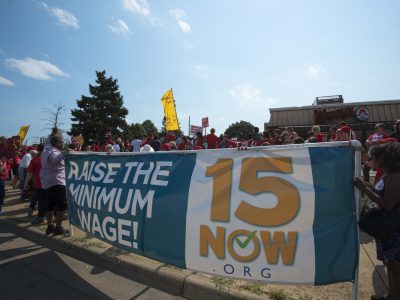
    [post_content] => Liberal politicians are taking up a grassroots challenge to raise the minimum wage, for both humanitarian and pragmatic reasons

This week, four New Hampshire politicians have accepted the Minimum Wage Challenge (on Twitter: #MinimumWageChallenge or #LivetheWage). They will attempt to live on the $290 that a full-time employee earning minimum wage takes home at the end of the week. The four politicians, all Democrats, are promoting a bill to raise the state minimum wage to $12 an hour by 2022. The Concord Monitor reports that while Republican Governor Chris Sununu hasn’t weighed in on this bill specifically, he has raised the old claim that raising the minimum wage will hurt businesses.

In recent decades opponents of a rise in the minimum wage claimed it would “kill jobs” as companies and “American small businesses” cut staff or turned to automation to keep costs down. New research, however, tells a different story — as The Washington Post reports. Some of the benefits of higher minimum wage include: fewer suicides; reduced recidivism; higher worker productivity; more consumer spending; and falling poverty rates.

As for the assertion that increasing the minimum wage kills jobs: A study published this May in The Quarterly Journal of Economics finds that the number of low-wage jobs has remained “essentially unchanged” in the five years following a minimum wage increase. Unfortunately, the Congressional Budget Office, in analyzing the impact of raising the federal minimum wage to $15/hour, has used outdated research and arrived at overly pessimistic conclusions.

Last year, Disneyland workers set an example for the world by rallying to protest wage disparity between a CEO raking in more than $100 million a year and the rock-bottom wages of park workers, three-quarters of whom report that they don’t make enough to cover their basic expenses each month.

“What these workers are doing, standing up against the greed of one of the most powerful and profitable corporations in America, takes an enormous amount of courage,” Bernie Sanders writes in a 2018 op-ed for The Guardian. He continues:

"If they are able to win a livable wage with good benefits from Disney, it will be a shot heard around the world. It will give other low-wage workers at profitable corporations throughout the country the strength they need to demand a living wage with good benefits."

The workers won an agreement to bump wages to $15/hour in 2019. Jeff Bezos caved under similar pressure and agreed to raise wages for Amazon workers to $15/hour. but even so, critics say that the increase still fails to keep pace with the cost of living in places like Orange County, where a Disney park and resort are located. Still, every win is worth celebrating, and the wins add up: According to a study by the National Employment Law Center, the Fight for $15 movement has won a $68 billion raise for 22 million low-wage workers in cities across America.   [post_title] => Once a left wing issue, the struggle for a livable minimum wage has become mainstream [post_excerpt] => Credible research finds that the number of low-wage jobs has remained “essentially unchanged” in the five years following a minimum wage increase. [post_status] => publish [comment_status] => open [ping_status] => open [post_password] => [post_name] => once-a-left-wing-issue-the-struggle-for-a-livable-minimum-wage-has-become-mainstream [to_ping] => [pinged] => [post_modified] => 2024-08-28 21:08:26 [post_modified_gmt] => 2024-08-28 21:08:26 [post_content_filtered] => [post_parent] => 0 [guid] => https://conversationalist.org/?p=1199 [menu_order] => 315 [post_type] => post [post_mime_type] => [comment_count] => 0 [filter] => raw )

Once a left wing issue, the struggle for a livable minimum wage has become mainstream