WP_Post Object
(
[ID] => 3963
[post_author] => 2
[post_date] => 2022-03-17 09:00:40
[post_date_gmt] => 2022-03-17 09:00:40
[post_content] =>
We need narratives that explore our shared problems and point the way toward collective liberation, but South Asian stories in U.S. popular culture haven’t kept pace with our new political realities.
Until 9/11, I didn’t feel a strong need to see my ethnicity represented in American pop culture. Growing up in the U.S. as South Asian was an experience in cultural invisibility, but not one that was necessarily undesirable. GenXers and older Millennials came after the hippie era, which convinced mainstream American culture that Indian culture could be summarized with yoga, incense, and kirtans, and there was little in the 1980s and 1990s to dispel those lingering narratives, or to ground South Asians authentically in popular culture. What we did see, whether it was Amy Irving in brownface playing an Indian princess, or Apu in The Simpsons, was often problematic and unrepresentative.
This situation changed over the last two decades. The first film I saw in theaters after 9/11 was Mira Nair’s Monsoon Wedding, which played at New York City’s storied Paris Theater, right outside the Plaza Hotel. Steeped in joyous chaos and vitality, the film, which is set in New Delhi, portrays an exuberant, extended upper middle class family gathered at the home of the bride’s family to celebrate her arranged marriage to a suitably handsome Indian doctor. Tinged with a hint of tragedy and immersed in love for both family and the kind of colorful Desi spectacle Pico Iyer calls a “marigold tapestry,” the film was an escape, a connection, and a salve in the recovering-but-still-desolate city. I hadn’t realized how much I needed it.
The only previous occasion on which I'd had an inkling of this need was while watching Nair's 1991 film Mississippi Masala. This bittersweet and boundary-breaking love story stars Denzel Washington as Demetrius, a Black American man from a working class background, and Sarita Choudhary as Mina, an Indian woman born in Uganda. After Idi Amin expelled all the “foreigners” in 1972, Mina, who at one point in the film says she has never been to India, lives with her family in a small-town Mississippi motel owned by relatives who represent the great wave of migration from Gujarat to the U.S. during the 1980s and 1990s. The film pulsates with the same vibrancy that would be seen in Monsoon Wedding 10 years later.
But while Monsoon Wedding tells a deeply Indian story, Mississippi Masala tells a deeply American one. As Durba Mitra writes in an essay celebrating the film’s 30th anniversary, Mississippi Masala is a “love story wrapped in histories of postcolonial displacement, settler colonialism, and the shadows of Jim Crow, offer[ing] an account of the cruel circuitous routes of displacement and migration to the American South.” The film is one of the first mainstream American artworks to show both the discrimination experienced by the Indian-American diaspora, and the anti-Black racism the community directs at the Black people amongst whom they now live. Even 30 years later, it stands out as a political inquiry that interrogates what it means to seek liberation through young, urgent love across race, class, and culture.
A scene from 'Mississippi Masala,' Mira Nair's 1991 film starring Sarita Choudhury and Denzel Washington.
Mitra notes in her essay, “The Indian diaspora in the U.S. has always been imagined in the American political landscape as a people neither here nor there.” South Asians who were either born in the U.S. or came as children following the 1965 Immigration Act were so few in number—even today there are only 5.4 million—that, Mississippi Masala aside, the microculture of American-born GenX Desis made little more than a blip in popular culture. On the one hand, this environment provided a kind of freedom in which we could try to shape culture and community without a spotlight. We could try to form bonds of solidarity in the face of entrenched political, cultural, religious, national, and caste lines that separated our peers on the subcontinent and were embraced by diaspora members who clung to their xenophobic, racist, or communal ideologies. On the other hand, the community could be insular and, existing in what Shilpa Davé calls “ambiguous racialized space,” both the victim and the perpetrator of discrimination.
Events in post 9/11 America made clear the need for South Asian stories with political and cultural specificity in mainstream culture. The months immediately after that terrible day were a period of intense discrimination, surveillance, violence, and Islamophobic and anti-immigrant policies. As Representative Pramila Jayapal said, “9/11 changed what it meant to be Arab, Muslim, or South Asian in this country.” Jayapal delivered her remarks during the first ever Congressional hearing on Discrimination and Civil Liberties of Muslim, Arab, and South Asian communities, held over twenty years after 9/11. Finally.
Representation in this political context matters. Rashad Robinson, the prominent civil rights activist, rightly warns us not to mistake presence for power: Being in a room doesn't necessarily establish a direct line to decision making. None of us relates to the experience of being South Asian in the same way, and none of us should have to represent any or all of the rest of us. But one of the adverse effects of underrepresentation is to convince members of a minority community that they lack power within the dominant culture—that access and opportunity are limited, and their own stories will be unheard or filtered through stereotypes. In an essay about Lisa Ling’s food docuseries on Asian food in the U.S., Marina Fang writes: “Asian Americans often start from the default position of being “the other.” We have to explain ourselves, usually to a white audience.” In this kind of cultural environment, the need to present perfect or one dimensional characters—a pillar of the toxic “model minority” myth—takes root, and division and misunderstanding flourish.
Presence and visibility may not be the entire solution to these problems. They are nevertheless crucial levers toward power. And the years between 9/11 and the 2016 U.S. election—marked by cross-MENASA community organizing to fight discrimination and state violence —gave rise to a mini renaissance of South Asian content that explored and played with the place South Asians occupy in the U.S. cultural landscape.
Rampant xenophobia in the post-2016 world makes the need for solidarity, representation, and narrative shift even stronger. But the South Asian diaspora community has splintered over the past few years. Rising authoritarianism—from Trump to Brexit to Modi—emboldened Hindu nationalists in India and around the world, greatly exacerbating existing caste and religious discrimination. On the international stage, South Asians have been slow to rise in defense of our common humanity. It feels like a fraught time to embrace South Asian identity and a deeply precarious time around the world. We desperately need narratives that explore our shared problems and point the way toward collective liberation, but South Asian stories in U.S. popular culture haven’t kept pace with our new political realities.
I’ll admit to some satisfaction these days at seeing so much South Asian content made by people in front of and behind the camera. South Asian actors are playing a variety of dynamic, complicated, and sexy (but not exoticized) characters in content ranging from the color-blind casting of Bridgerton and The Green Knight, to the coming-of-age stories in Never Have I Ever and Spin, to superheros (that most American of genres) as seen in Eternals and Ms Marvel.
In this landscape, the character that most closely represents me, at least demographically, is Seema in …And Just Like That. Played by Sarita Choudhary (who also played Mina in Mississippi Masala), Seema is a GenX New Yorker, unapologetically sexual, self-made, fabulous, and untethered to familial or cultural expectations. She is refreshing. I understand why the show disappointed many viewers with its portrayals of aging, race, class, consumerism, gender, and sexuality, but a small part of me enjoyed watching a glamorous brown woman of a certain age chewing up the scenery.
But reality these days always creeps in. It's hard to get past what is happening politically in the South Asian community and watch even escapist content with unadulterated joy. As I watched her, I couldn’t help but wonder: Is Seema enough?
Her character comes from what appears to be an upper caste Hindu background and lives the life of a one percenter in Manhattan, with a private driver and a luxurious wardrobe of exceedingly expensive designer clothes, shoes, and handbags. She sits in privilege and has origins in what is now the oppressor class in India. As do I. Not all South Asians are privileged—far from it, especially in terms of race, class, or caste. But for a community that is small in numbers, we have a relatively high level of power and privilege. This is what Seema, as fabulous as she is in some ways, also represents.
In the current state of our world, confronting society from our perspective as South Asians should require us to interrogate where we sit along the spectrum of power. What is our collective responsibility? Where do we have social power, and where do we use it for good? We need rich, complex stories that explore these questions. We need more than a few of these stories every decade.
I want to know what Demetrius and Mina would do in our world. That’s the story I’m looking for now. We are living in monstrous, devastating times. We need lightness, escape, and joy—and a more inclusive roster of characters that will shape the way people perceive one another. Even more so, we need to tell stories of solidarity.
[post_title] => Representation matters: South Asians in American pop culture since 9/11
[post_excerpt] => During the 30 years since Mira Nair's groundbreaking film 'Mississippi Masala,' the representation of South Asians in American pop culture has evolved significantly. But is it enough?
[post_status] => publish
[comment_status] => closed
[ping_status] => open
[post_password] =>
[post_name] => representation-matters-south-asians-in-american-pop-culture-since-9-11
[to_ping] =>
[pinged] =>
[post_modified] => 2024-08-28 21:14:02
[post_modified_gmt] => 2024-08-28 21:14:02
[post_content_filtered] =>
[post_parent] => 0
[guid] => https://conversationalist.org/?p=3963
[menu_order] => 129
[post_type] => post
[post_mime_type] =>
[comment_count] => 0
[filter] => raw
)




 Hazal Sipahi, host of the podcast "Mental Klitoris."[/caption]
When she was a child growing up in provincial Turkey, Sipahi said, sexuality was only discussed in whispers; but as soon as she could speak English, she found an ocean of sexuality content available on the internet.
“I searched for information online and found it, only because I was curious,” she said. “I also learned many false things on the internet, and they were very hard to correct later on.”
For example, Sipahi explained, “For so long, we thought that the hymen was a literal veil like a membrane.” In Turkey there is a widespread belief that once the hymen is “deformed,” a woman’s femininity is damaged, and she somehow becomes less valuable as a future spouse.
“Mental Klitoris” is both Sipahi’s public service and her means of self-expression. She uses her podcast to correct misunderstandings and disinformation, to go beyond censorship and to translate new terminology into Turkish.
“I really wish I had been able to access this kind of information when I was around 14 or 15,” she said.
More than 45,000 people listen to Mental Klitoris, which provides them with access to crucial information in their native tongue. They learn terms like “stealthing,” “pegging,” “abortion,” “consent,” “vulva,” “menstruation,” and “slut-shaming.” Sipahi covers all these topics on her podcast; she says she’s adding important new vocabulary to the Turkish vernacular.
She’s also adding a liberal voice to the ongoing discussion about feminism, “Which became even stronger in Turkey after #MeToo.” She believes her program will lead to a wave of similar content in Turkey.
“This will go beyond podcasts,” she said. “We will have a sexual opening overall on the internet.”
Inspired by contemporary creatives like Lena Dunham (“Girls”), Michaela Coel (“I Might Detroy You”),
Hazal Sipahi, host of the podcast "Mental Klitoris."[/caption]
When she was a child growing up in provincial Turkey, Sipahi said, sexuality was only discussed in whispers; but as soon as she could speak English, she found an ocean of sexuality content available on the internet.
“I searched for information online and found it, only because I was curious,” she said. “I also learned many false things on the internet, and they were very hard to correct later on.”
For example, Sipahi explained, “For so long, we thought that the hymen was a literal veil like a membrane.” In Turkey there is a widespread belief that once the hymen is “deformed,” a woman’s femininity is damaged, and she somehow becomes less valuable as a future spouse.
“Mental Klitoris” is both Sipahi’s public service and her means of self-expression. She uses her podcast to correct misunderstandings and disinformation, to go beyond censorship and to translate new terminology into Turkish.
“I really wish I had been able to access this kind of information when I was around 14 or 15,” she said.
More than 45,000 people listen to Mental Klitoris, which provides them with access to crucial information in their native tongue. They learn terms like “stealthing,” “pegging,” “abortion,” “consent,” “vulva,” “menstruation,” and “slut-shaming.” Sipahi covers all these topics on her podcast; she says she’s adding important new vocabulary to the Turkish vernacular.
She’s also adding a liberal voice to the ongoing discussion about feminism, “Which became even stronger in Turkey after #MeToo.” She believes her program will lead to a wave of similar content in Turkey.
“This will go beyond podcasts,” she said. “We will have a sexual opening overall on the internet.”
Inspired by contemporary creatives like Lena Dunham (“Girls”), Michaela Coel (“I Might Detroy You”),  Tuluğ Özlü[/caption]
Asked to describe how she feels when she crosses the barriers created by widely shared social taboos about human sexuality, Özlü, who lives in Istanbul’s hip
Tuluğ Özlü[/caption]
Asked to describe how she feels when she crosses the barriers created by widely shared social taboos about human sexuality, Özlü, who lives in Istanbul’s hip  Rayka Kumru[/caption]
Kumru said one of the current barriers to freedom in Turkey was the lack of access to comprehensive sexuality education, information and skills such as sex-positivity, critical thinking around values and diversity, and communication about consent. She circumvents that barrier by informing her viewers and listeners about them directly.
“Once connections and a collaborations are established between policy, education, and [particularly sexual] health, and when access to education and to shame-free, culturally specific, scientific, and empowering skills training are allowed, we see that these barriers are removed,” Kumru explains. Otherwise, she says, the same myths and taboos continue to play out, making misinformation, disinformation, taboos, and shame ever-more toxic.
Rayka Kumru[/caption]
Kumru said one of the current barriers to freedom in Turkey was the lack of access to comprehensive sexuality education, information and skills such as sex-positivity, critical thinking around values and diversity, and communication about consent. She circumvents that barrier by informing her viewers and listeners about them directly.
“Once connections and a collaborations are established between policy, education, and [particularly sexual] health, and when access to education and to shame-free, culturally specific, scientific, and empowering skills training are allowed, we see that these barriers are removed,” Kumru explains. Otherwise, she says, the same myths and taboos continue to play out, making misinformation, disinformation, taboos, and shame ever-more toxic.
 Şükran Moral[/caption]
When it comes to female sexuality, Moral said, Turkey’s art scene is still conservative. “There’s self-censorship among not only creators, but also viewers and buyers, so it’s a vicious cycle.”
Part being an artist, particularly one who challenges the position of women, she said, is seeing a reaction to her work. “When art isn’t displayed,” she asked, “how do you get people to talk about taboos?”
Turkish academia also suffers from a censorship of sex studies.
Dr. Asli Carkoglu, a professor of psychology at Kadir Has University, said it was not easy finding a precise translation for the English word “intimacy” in Turkish.
“There’s the word ‘mahrem,’” she said, but that term has religious connotations.
The difficulty in interpretation, she explains, illustrates the problem: In Turkey, intimacy has not been normalized.
President Recep Tayyip Erdogan and his conservative Justice and Development Party (AKP) have many times expressed support for gender-based segregation and a conservative lifestyle that protects their interpretation of Muslim values.
Erdogan, who has has been in power since 2003, has his own ways of promoting those values.
“At least three children,” has long been the slogan of Erdogan’s population campaign, as the president implores married couples to expand their families and increase Turkey’s population of 82 million.
“For the government, sex means children, population,” Dr. Carkoglu explained.
Dr. Carkoglu believes that sex education should be left to the family, but “when the government acts as though sexuality is nonexistent, the family doesn’t discuss it. It’s the chicken-and-egg dilemma,” she said.
So, how do you overcome a taboo as deep-rooted as sexuality in Turkey? Carkoglu believes that that the topic will have to be normalized through conversations between friends.
“That’s where the taboo starts to break,” she said. “Speaking with friends [about sexuality] becomes normal, speaking in public becomes normal, and then the system adapts.”
But for many Turks, speaking about sexuality is very difficult.
Berkant, 40, has made a living selling sex toys at his shop in the city of Adana, in southern Turkey, for the past two decades. But he said that he’s still too embarrassed to go up to a cashier in another store and say he wants to buy a condom.
“It doesn’t feel right,” he said, adding he doesn’t want to make the cashier uncomfortable.
He is seated comfortably at his desk as we speak; behind him, a wide selection of vibrators are arrayed on shelves.
Berkant and his older brother own one of three erotica shops in Adana. Most of their customers are lower middle class; one-third are female. “Many of them are government workers who come after hearing about us from a friend,” he said.
The shopkeeper said female customers phone in advance to check whether the shop is “available,” meaning empty.
He said he often refers women who describe certain complaints to a gynecologist.
“I see countless women who are barely aware of their own bodies,” he said.
Dr. Doğan Şahin, a psychiatrist and sexual therapist, said that the information women in Turkey hear when they are growing up has a lot to do with their avoidance of discussions about sex, even when the subject concerns their health.
[caption id="attachment_2971" align="aligncenter" width="1600"]
Şükran Moral[/caption]
When it comes to female sexuality, Moral said, Turkey’s art scene is still conservative. “There’s self-censorship among not only creators, but also viewers and buyers, so it’s a vicious cycle.”
Part being an artist, particularly one who challenges the position of women, she said, is seeing a reaction to her work. “When art isn’t displayed,” she asked, “how do you get people to talk about taboos?”
Turkish academia also suffers from a censorship of sex studies.
Dr. Asli Carkoglu, a professor of psychology at Kadir Has University, said it was not easy finding a precise translation for the English word “intimacy” in Turkish.
“There’s the word ‘mahrem,’” she said, but that term has religious connotations.
The difficulty in interpretation, she explains, illustrates the problem: In Turkey, intimacy has not been normalized.
President Recep Tayyip Erdogan and his conservative Justice and Development Party (AKP) have many times expressed support for gender-based segregation and a conservative lifestyle that protects their interpretation of Muslim values.
Erdogan, who has has been in power since 2003, has his own ways of promoting those values.
“At least three children,” has long been the slogan of Erdogan’s population campaign, as the president implores married couples to expand their families and increase Turkey’s population of 82 million.
“For the government, sex means children, population,” Dr. Carkoglu explained.
Dr. Carkoglu believes that sex education should be left to the family, but “when the government acts as though sexuality is nonexistent, the family doesn’t discuss it. It’s the chicken-and-egg dilemma,” she said.
So, how do you overcome a taboo as deep-rooted as sexuality in Turkey? Carkoglu believes that that the topic will have to be normalized through conversations between friends.
“That’s where the taboo starts to break,” she said. “Speaking with friends [about sexuality] becomes normal, speaking in public becomes normal, and then the system adapts.”
But for many Turks, speaking about sexuality is very difficult.
Berkant, 40, has made a living selling sex toys at his shop in the city of Adana, in southern Turkey, for the past two decades. But he said that he’s still too embarrassed to go up to a cashier in another store and say he wants to buy a condom.
“It doesn’t feel right,” he said, adding he doesn’t want to make the cashier uncomfortable.
He is seated comfortably at his desk as we speak; behind him, a wide selection of vibrators are arrayed on shelves.
Berkant and his older brother own one of three erotica shops in Adana. Most of their customers are lower middle class; one-third are female. “Many of them are government workers who come after hearing about us from a friend,” he said.
The shopkeeper said female customers phone in advance to check whether the shop is “available,” meaning empty.
He said he often refers women who describe certain complaints to a gynecologist.
“I see countless women who are barely aware of their own bodies,” he said.
Dr. Doğan Şahin, a psychiatrist and sexual therapist, said that the information women in Turkey hear when they are growing up has a lot to do with their avoidance of discussions about sex, even when the subject concerns their health.
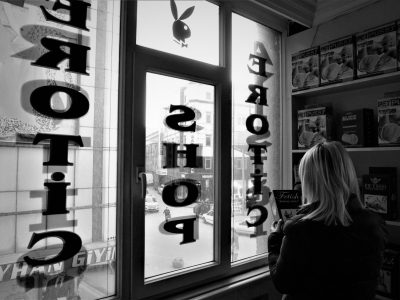
[caption id="attachment_2971" align="aligncenter" width="1600"] Advertisement for men's underwear in Izmir, Turkey.[/caption]
Men don’t really care whether the woman is aroused, willing or having an orgasm, he said. Unless the problem is due to pain, or vaginismus, couples rarely head to a therapist, he adds.
“[Women who grew up hearing false myths] tend to take sexuality as something bad happening to their bodies, and so, they unintentionally shut their vaginas, leading to vaginismus. This is actually a defense method,” he told The Conversationalist.
“They fear dying, they fear becoming a lower quality woman, or that sex is their duty.”
While most Turkish women find out about their sexual needs after getting married, the doctor says that, based on research he completed about 10 years ago, men tend to fall for myths about sexuality by watching pornography, which plants unrealistic fantasies about sex in their minds.
“Sexuality is also presented as criminal or banned in [Turkish] television shows. The shows take sexuality to be part of cheating, damaging passions or crimes instead of part of a normal, healthy, and happy life.”
He recommends that couples talk about sexuality and normalize it. Talking is crucial, and so is the language used in those conversations.
Bahar Aldanmaz, a Turkish sociologist studying for her PhD at Boston University, told The Conversationalist why talking about menstruation matters.
“A woman’s period is unfortunately seen as something to be ashamed of, something to be hidden,” she said. (According to Turkey’s language authority, the word “dirty” also means “a woman having her period.”)
“There are many children who can’t share their menstruation experience, or can’t even understand they are having their periods, or who experience this with fear and trauma.”
And this is what builds a wall of taboo around this essential issue, the professor says. It is one of the issues her non-profit organization “We Need To Talk” aims to accomplish, among other problems related to menstruation, such as period poverty and period stigma.
Female hygiene products are taxed as much as 18 percent—the same ratio as diamonds, said Ms. Aldanmaz. She adds that this is what mainly causes inequality—privileged access to basic health goods, the consequence of the roles imposed by Turkish social mores.
“Despite declining income due to the COVID-19 pandemic, there is a serious increase in the pricing of hygiene pads and tampons. This worsens period poverty,” Aldanmaz says. She offers Scotland as an example of what would like to see in Turkey: free sanitary products for all.
During Turkey’s government-imposed lockdown in May 2021, several photos showing tampons and pads in the non-essential sales part of markets stirred heated debates around the subject, but neither the Ministry of Family and Social Services nor the Health Ministry weighed in.
“We are fighting this shaming culture in Turkey,” Aldanmaz says, “by understanding and talking about it.”
[post_title] => Sexually aware and on air: Beyond Turkey's comfort zone
[post_excerpt] => Turkish podcasts that host frank conversations about sexuality are smashing taboos and filling information vacuums.
[post_status] => publish
[comment_status] => closed
[ping_status] => open
[post_password] =>
[post_name] => sexually-aware-and-on-air-beyond-turkeys-comfort-zone
[to_ping] =>
[pinged] =>
[post_modified] => 2024-08-28 21:14:02
[post_modified_gmt] => 2024-08-28 21:14:02
[post_content_filtered] =>
[post_parent] => 0
[guid] => https://conversationalist.org/?p=2949
[menu_order] => 187
[post_type] => post
[post_mime_type] =>
[comment_count] => 0
[filter] => raw
)
Advertisement for men's underwear in Izmir, Turkey.[/caption]
Men don’t really care whether the woman is aroused, willing or having an orgasm, he said. Unless the problem is due to pain, or vaginismus, couples rarely head to a therapist, he adds.
“[Women who grew up hearing false myths] tend to take sexuality as something bad happening to their bodies, and so, they unintentionally shut their vaginas, leading to vaginismus. This is actually a defense method,” he told The Conversationalist.
“They fear dying, they fear becoming a lower quality woman, or that sex is their duty.”
While most Turkish women find out about their sexual needs after getting married, the doctor says that, based on research he completed about 10 years ago, men tend to fall for myths about sexuality by watching pornography, which plants unrealistic fantasies about sex in their minds.
“Sexuality is also presented as criminal or banned in [Turkish] television shows. The shows take sexuality to be part of cheating, damaging passions or crimes instead of part of a normal, healthy, and happy life.”
He recommends that couples talk about sexuality and normalize it. Talking is crucial, and so is the language used in those conversations.
Bahar Aldanmaz, a Turkish sociologist studying for her PhD at Boston University, told The Conversationalist why talking about menstruation matters.
“A woman’s period is unfortunately seen as something to be ashamed of, something to be hidden,” she said. (According to Turkey’s language authority, the word “dirty” also means “a woman having her period.”)
“There are many children who can’t share their menstruation experience, or can’t even understand they are having their periods, or who experience this with fear and trauma.”
And this is what builds a wall of taboo around this essential issue, the professor says. It is one of the issues her non-profit organization “We Need To Talk” aims to accomplish, among other problems related to menstruation, such as period poverty and period stigma.
Female hygiene products are taxed as much as 18 percent—the same ratio as diamonds, said Ms. Aldanmaz. She adds that this is what mainly causes inequality—privileged access to basic health goods, the consequence of the roles imposed by Turkish social mores.
“Despite declining income due to the COVID-19 pandemic, there is a serious increase in the pricing of hygiene pads and tampons. This worsens period poverty,” Aldanmaz says. She offers Scotland as an example of what would like to see in Turkey: free sanitary products for all.
During Turkey’s government-imposed lockdown in May 2021, several photos showing tampons and pads in the non-essential sales part of markets stirred heated debates around the subject, but neither the Ministry of Family and Social Services nor the Health Ministry weighed in.
“We are fighting this shaming culture in Turkey,” Aldanmaz says, “by understanding and talking about it.”
[post_title] => Sexually aware and on air: Beyond Turkey's comfort zone
[post_excerpt] => Turkish podcasts that host frank conversations about sexuality are smashing taboos and filling information vacuums.
[post_status] => publish
[comment_status] => closed
[ping_status] => open
[post_password] =>
[post_name] => sexually-aware-and-on-air-beyond-turkeys-comfort-zone
[to_ping] =>
[pinged] =>
[post_modified] => 2024-08-28 21:14:02
[post_modified_gmt] => 2024-08-28 21:14:02
[post_content_filtered] =>
[post_parent] => 0
[guid] => https://conversationalist.org/?p=2949
[menu_order] => 187
[post_type] => post
[post_mime_type] =>
[comment_count] => 0
[filter] => raw
)