A tour through Europe's past—and what lessons we might learn from its museums to fight authoritarianism today.
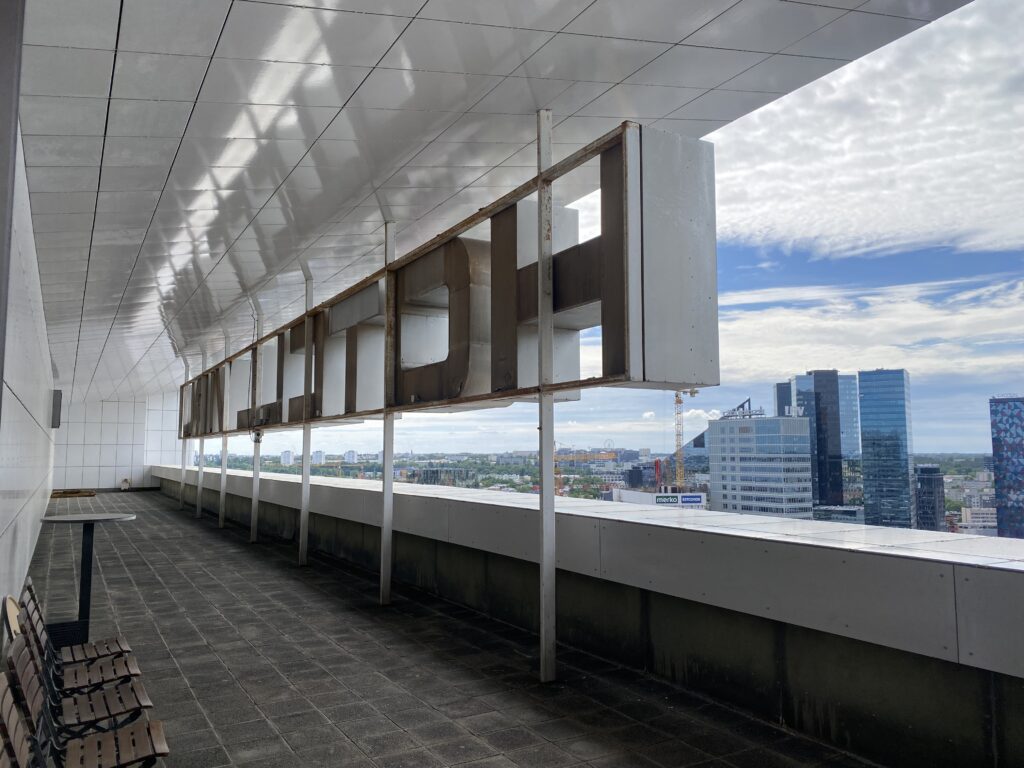
Interrupting the skyline in Tallinn, Estonia is a tall gray building, a relic of the country’s Soviet occupation. It looms over the medieval city, declaring its name in giant letters: HOTELL VIRU. Behind these letters is a secret 23rd floor, where the KGB (the Soviet Union’s security agency) would listen to the hotel’s visitors, as unsuspecting tourists sipping drinks in the restaurant just a floor below would point to the windows above them and ask, “Hey, what’s up there?”
Tourists at the hotel were spied on right up until April 1991, when the KGB left the building and shortly before the Soviet Union collapsed. While the KGB cleared away many important details, enough artifacts were left behind, including a room full of monitoring devices, that a museum was opened in 2011. It’s a constant reminder of what once happened here—a reminder of how personal freedoms can so easily be lost, and a reminder of what’s at the end of the road to authoritarianism. A road that several European countries might be on once again.
The Hotel Viru & KGB Museum is the first stop on my tour as I gather up the scattered pieces of Europe’s recent history of authoritarianism and ask whether we are paying enough attention to our present.
(Photo courtesy of Katie Dancey-Downs.)
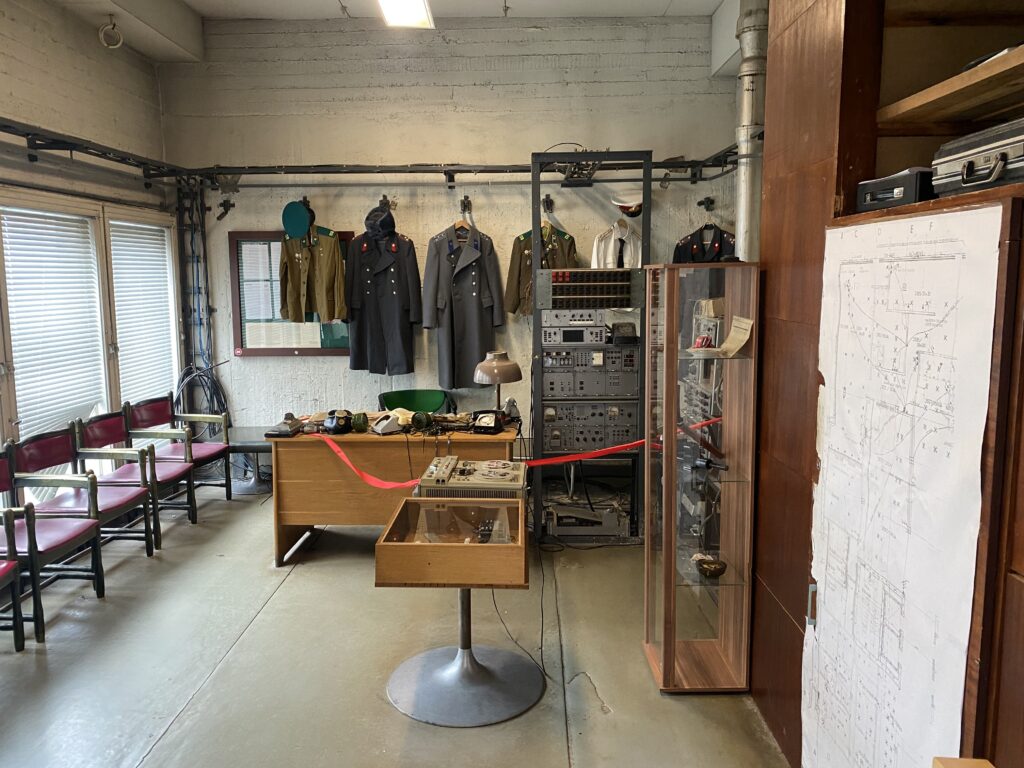
As you walk into what our tour guide calls the “listening room,” it’s the musty smell that hits you first. “Oh no, it even smells like the Soviet Union,” tourists from neighboring Finland are reported to have said, according to our guide, Margit. In one glass cabinet, there is a selection of microphones, recording devices, and transmitters. In the 1970s, when the hotel opened, around 60 guest rooms were designated as special rooms, with an empty room next door so that one of these KGB microphones could be slotted through a small hole. By the next decade, advances in technology meant more rooms could be monitored, with vases and lamps becoming favorite spots for hidden microphones. Sitting on a glass shelf in front of us, there’s even an old handheld camera, once used as a way to collect compromising photographs when poked through bedroom walls.
The guests were not completely oblivious to any of this, Margit says; KGB monitoring was something of an open secret.
“Tourists in general were very cautious in the rooms,” she explains. Visitors would leave the water running, turn up the television volume, or cover vents with towels for privacy.
The microphones weren’t limited to bedrooms, either. Margit directs us to a circular, speckled-green set of cufflinks, fitted out with a hidden microphone. In another cabinet, there’s an ashtray and a gold-rimmed plate monogrammed with a bold black V, both with hidden microphones, too. Perfect for slipping onto the table in front of people of interest.
While this hotel was a symbol of the free Western world to the people who lived in Tallinn, Soviet citizens knew not to get too close to its front doors, unless they wanted to be dragged to the basement for an interrogation. During its prime, Hotel Viru was not unique—any hotel that welcomed tourists in the Soviet Union or Eastern Bloc had a KGB presence.
It’s easy to forget that Margit lived under this occupation, that she knew exactly what it meant to keep away from Hotel Viru. I won’t go so far as to call Margit yet another artifact, but the memories and experiences held by the woman standing before us, in her Viru-branded gilet, are an important part of the picture. She remembers how Estonians used to hold their hands in front of their faces when they talked to each other in the park to fend away lip readers. She remembers how much people wanted to work at Hotel Viru, because they got access to illicit foreign goods and received gifts from the tourists. She also remembers how the hotel preferred hiring married people, assuming they wouldn’t try and couple up with a foreigner—the only accepted reason for leaving the Soviet Union. (This was an appealing option for many, although it came with complications: Divorce was allowed, but taking children to a new foreign life was not—any child born in the Soviet Union was in effect owned by the state.) This atmosphere, Margit tells us, made people easier to control.
“You are free to leave,” Margit says at the end of our tour. “Nobody takes you to the basement, nowadays.”
(Photo courtesy of Katie Dancey-Downs.)
An atmosphere of control
Unfortunately, this “special atmosphere of control” is not consigned to museum display cabinets. In Europe today, illiberal ideologies are finding strong ground, with support for populist parties soaring in many countries—my own, the UK, included.
This atmosphere Margit told us about, and the spying on people of interest, is also still going on in Russia today. Soviet (now Russian) state security has had various different names, including the Cheka, then the NKVD, then the KGB. Nowadays, the former KGB is known as the FSB.
I cannot safely travel to Russia to tell you what this atmosphere is like. I’ve criticized Putin and interviewed enough Russian dissidents that I don’t think I would be particularly welcome. But in the same way that seeing the artifacts in Hotel Viru has brought to life the history of intense surveillance and the atmosphere of terror, there is similar evidence in our current times: from school teachers forced to teach propaganda and patriotic lessons to a state-backed messaging app with extensive surveillance capabilities.
The artifacts in Hotel Viru’s listening room show us how surveillance technology developed over the decades, and that it did not stop when the Soviet Union fell in 1991. Instead, we now have even more advanced technologies to contend with.
This isn’t limited to Russia. In the UK, live facial recognition cameras are being rolled out by police across the country. According to Big Brother Watch, a human rights group that campaigns against the practice, there are 10 regional police forces regularly using the technology, but many others use it for large events. Currently, there are no specific rules governing its use.
Here's how it works: Surveillance cameras snap individuals’ faces and make biometric prints, then compare them to a police watchlist for similar matches, with the software flagging people in real time. A tech-smart way to catch criminals, yes, but here the threat to freedom begins. The technology has been deployed in numerous city centers, with hundreds of thousands of faces scanned on the streets as well as at events like Notting Hill Carnival. There have been cases of people being misidentified, and accusations from Amnesty International that the practice “amplifies racist policing,” as Black people are most often misidentified.
Big Brother Watch notes that it’s usually authoritarian regimes that embrace live facial recognition—Russia and China, for example. The UK does not currently have an authoritarian regime. But pair this with growing support for far-right politics and the UK’s rollback on protest rights—including a new provision to limit “cumulative disruption” of protests—and we might have a problem on the horizon.
Silencing critics
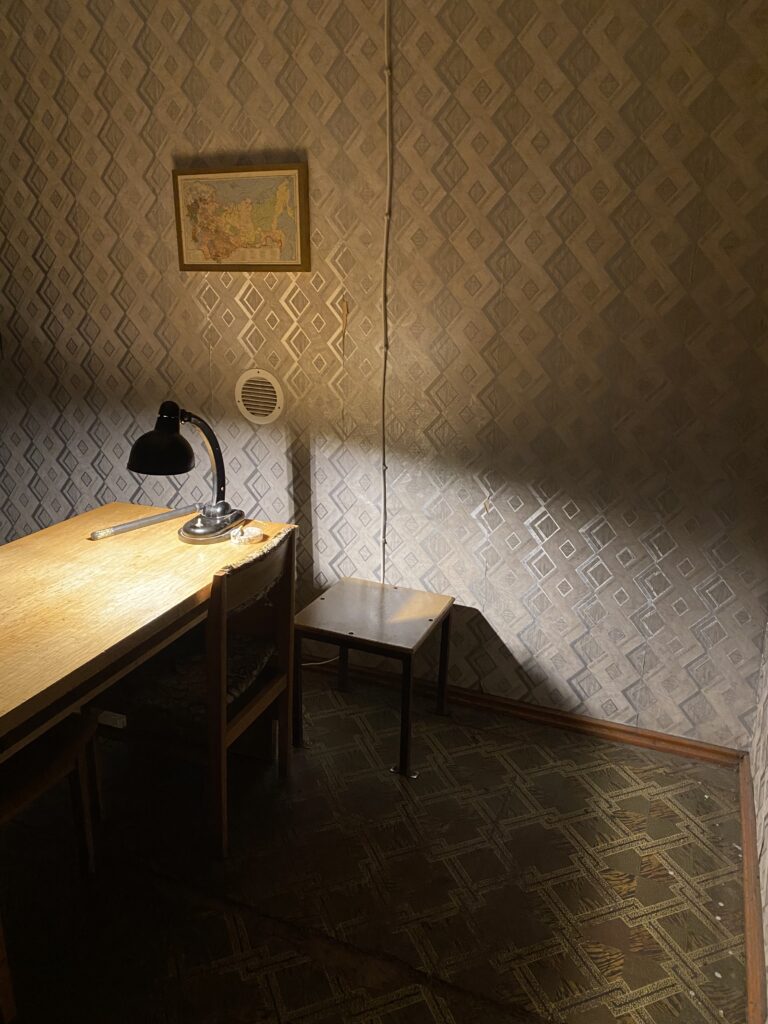
Across the border from Estonia, in Latvia’s capital city of Riga, is the KGB building known as the Corner House. Of all the places I see on my museums tour, the Corner House is the most chilling. The one that stinks the most of death. As I walk around the dark and dingy complex of cells, where the paint is peeling off in long strips, the thing that makes my skin crawl is the knowledge that in this very place people had their liberties stripped in the most inhumane ways. Some of them even lost their lives, simply for opposing the regime.
A young guide shows us around the KGB cells which were used during the first and second Soviet occupations (with a Nazi occupation in the middle). He tells us that people could be arrested for reading a banned book, for joking about the Soviets, or for believing that Latvia could be free.
At some point, when we’re standing in the old interrogation room, the guide smacks a rubber stick on the desk and we all jump, a glimmer of what someone under KGB interrogation would face. In one cell, he tells us that 30 people would be inside at once, the window covered so they couldn’t tell what time of day it was, then he flicks on the bright lights so that we’re disoriented like the prisoners would have been. He points to the heating system that would be cranked up high, and the sole bucket used as a toilet and emptied once a day.
(Photo courtesy of Katie Dancey-Downs.)
It's with all this in mind that we are taken to the courtyard. This, he tells us, would have been a reminder to the prisoners of how the free world feels (and a way to make them willing to sign anything, including confessions). Above us there are bars and netting. To stop suicides from the interrogation room, we’re told.
We’re left there for a few minutes, in a space where prisoners would have been allowed to breathe fresh air once a week, walking in circles with their heads bowed, their feet trudging along the same concrete that we stand on now. It is a reminder that not all artifacts live in glass cabinets.
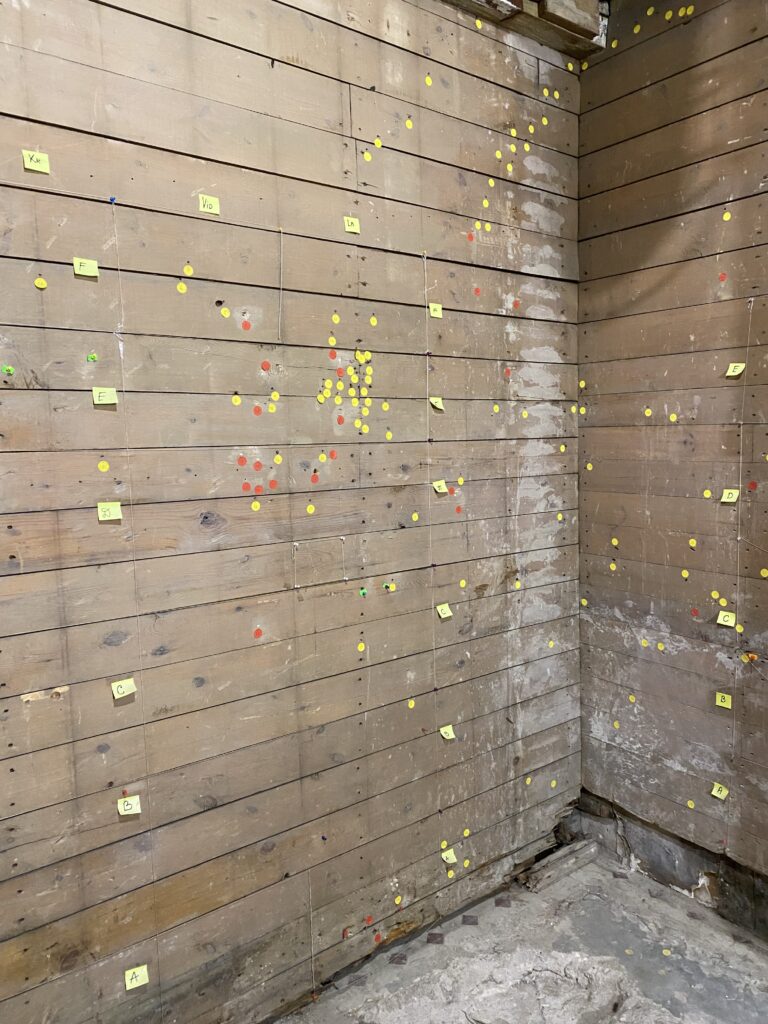
There is worse to come. In what was once an execution room, there are more than 200 bullet holes in the walls, marked with red and yellow stickers. They go back to 1940 and 1941, when prisoners were told to face the very same wall now before us, then shot in the back of the head. Researchers are still trying to find out whether executions continued here during the second Soviet occupation.
“We Latvians know the price of freedom,” the guide tells us. He also reminds us that this type of thing is still happening in Russia today.
Opposition leader Alexei Navalny is one recent, high-profile person to have lost his life while incarcerated by Russia in a penal colony north of the Arctic Circle, where he was killed with a dart frog toxin. But he is far from alone, as many other Kremlin critics or persecuted communities have been imprisoned or killed.
(Photo courtesy of Katie Dancey-Downs.)
This modern unease extends beyond Russia to Baltic states like Latvia, Estonia, and Lithuania. One person in Estonia told me that her daughter talks about how they would escape if their home was attacked. In neighboring Belarus—where state security is still called the KGB, and Russian influence is strong—more than 4,600 people have ended up as political prisoners since 2020. Many of those people are pro-democracy protesters and campaigners who stood up against dictator Alexander Lukashenko’s rule, including his rigged election win in 2020 and then 2025.
A short walk away from Riga’s Corner House, artifacts in the Museum of the Occupation of Latvia shine more light on the country’s dark history. If you’d forgotten about the KGB building already, your memory would be refreshed by this museum’s display of bullet casings and the keys for the prison cells, now housed in a glass box.
I land at a small bottle and blister pack of pills which turn out to be chlorprothixene and other antipsychotics used to “treat” dissidents imprisoned in psychiatric hospitals. This practice is not history, but still happening in Europe as I stand looking at these artifacts. I am reminded of Russia’s punitive psychiatry, where medicated treatment is forced onto political activists who have been sent to psychiatric units in response to their activism, and where they are brutalized.
And then we come to what might be one of the most terrifying tools of Soviet oppression: the concentration and forced-labor camps known as the Gulag. A quilted jacket with the number F358 sewn on the back is hanging up on display, this particular one having belonged to a woman called Leontīne Kriviņa, who in the 1950s was arrested for participation in a youth resistance group and sent to the Norilsk Gulag camp, 400km above the Arctic Circle, where temperatures could drop to -50C.
The personality cult
I’m now standing before a KGB-sponsored weekly newspaper, called Dzimtenes Balss, which translates as Voice of the Homeland. It was written specifically for Latvians in Western exile and—if we were in any doubt about its purpose—published by the “Committee for the Return to the Homeland” between 1958 and 1989. The Soviets wanted to repatriate Latvian émigrés, and propaganda like this was a vital tool in making that happen.
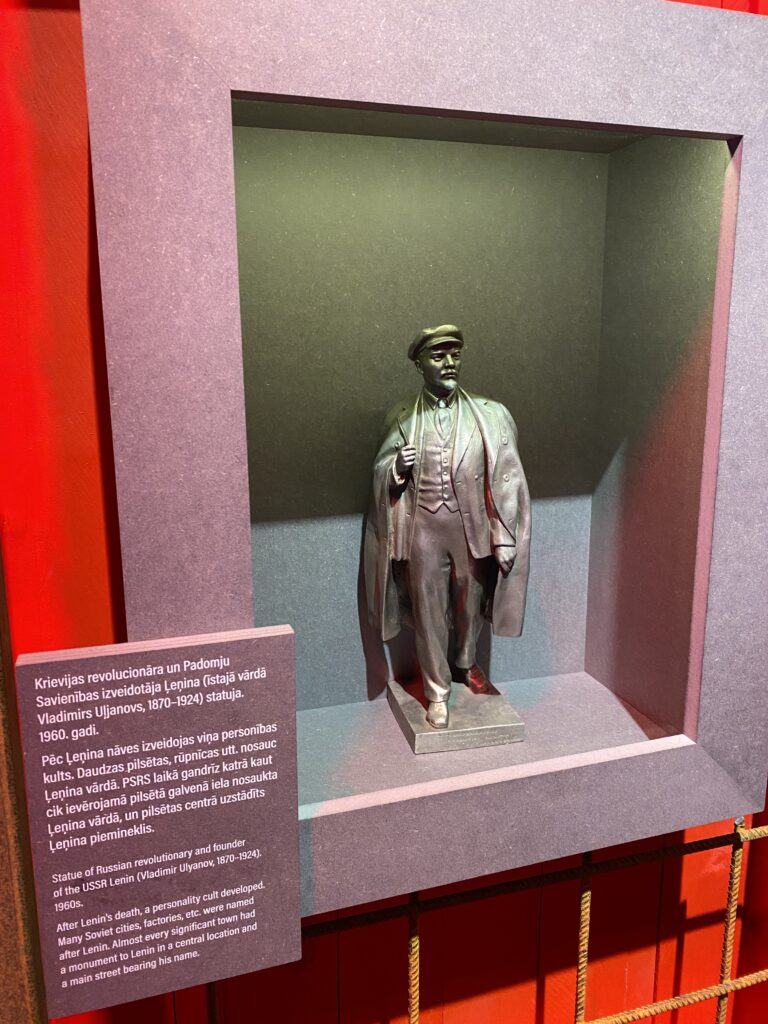
The Soviet Union had a well-oiled propaganda machine. Posters, films, lectures, theatre, newspapers, and radio were ways to shape the collective consciousness, and control society. Among these was the personality cult—which brings us to our next artifact: a small statue from the 1960s of Vladimir Lenin, the founder of the USSR, set inside a black display cabinet. The personality cult around him developed after his death, the description says, with many streets named after him and every significant town home to a monument. The “Lenin Cult” replaced the “Stalin Cult,” an information board explains, around three years after Stalin’s death, when the new leader Nikita Khrushchev denounced Stalin’s policies as a “departure from Lenin’s ideals.”
(Photo courtesy of Katie Dancey-Downs.)
There’s another artifact in this museum that speaks to this history of authoritarianism—a copy of Mein Kampf, Adolf Hitler’s memoir and manifesto. It’s chilling to see it in real life, something so feared and despised across the continent, and indeed the world. Something that represents the personality of the man who led a genocide and brought terror to Europe.
In today’s Europe, we have a personality cult problem once again. But the personalities in question don’t even need to bother writing a book: They have social media at their disposal.
The scapegoats
There’s one more thing that I want to show you in the Museum of the Occupation of Latvia. A fabric Star of David, faded with time, which would have been used by the Nazis to identify Jews. It’s one thing knowing about these yellow stars and how they were used, but it’s another to really see one, imagining who it might have been pinned on. Next to it, there are a couple of strings of numbers on what look like badges. One is brighter, and says 8533. They are identification numbers worn by Jews held in the Kaiserwald Concentration Camp or the Lenta factory in Riga. Tens of thousands of Jewish people were murdered in Latvia during the Holocaust.
While relatively short compared to their Soviet occupations, Estonia and Latvia were both subjected to Nazi occupations during World War II. Many people even welcomed the Nazis, hoping they would save them from the Soviets. What people soon learned is that no authoritarian regime is “better” than another. All are bad.
I went to Kraków, a medieval city in Poland’s south, which felt the full weight of a Nazi occupation from 1939 to 1945. Up to 20,000 Jews were forced into a purpose-made ghetto, before Heinrich Himmler ordered their deaths in 1943 and they were either shot, sent to labor camps, or sent to concentration camps where they remained as prisoners or were exterminated.
In Oskar Schindler’s Enamel Factory, the permanent exhibition Kraków Under Nazi Occupation tells this story. In one of the first displays, there is a circular wooden construction painted in yellows and blues, like something that might belong in an old-fashioned penny arcade, with pairs of binoculars set into each panel. It is a carousel of photographs, the images rendered in 3D, each one frighteningly immersive as it takes my whole field of vision. I have never seen Hitler’s face this close, as he shakes hands with another Nazi, or holds hands with a smiling girl—in the latter, they might even be dancing. Another shows a woman smiling and saluting in a Sieg Heil. Flags are draped from buildings and swastikas plastered on armbands. Not just seeing these photographs from over 80 years ago, but being inside the photographs, makes it all frighteningly real—which of course it was. The people smiling is what’s really terrifying.
As we face our own dangerous political shifts today, it scares me to think about the photographs that our generation’s great grandchildren will look at. Will they also sit in a museum like this, immersing themselves in the artifacts we’ve left behind and ask, “How did they allow this to happen?” Will they struggle to understand how so many people could welcome the far right rallies and shake hands with the populist leaders of today, the way I now struggle with the same? Or will ours be a generation that truly learns from its history, so that we do not allow the most atrocious things that have happened in the past to happen again?
(Photo courtesy of Katie Dancey-Downs.)
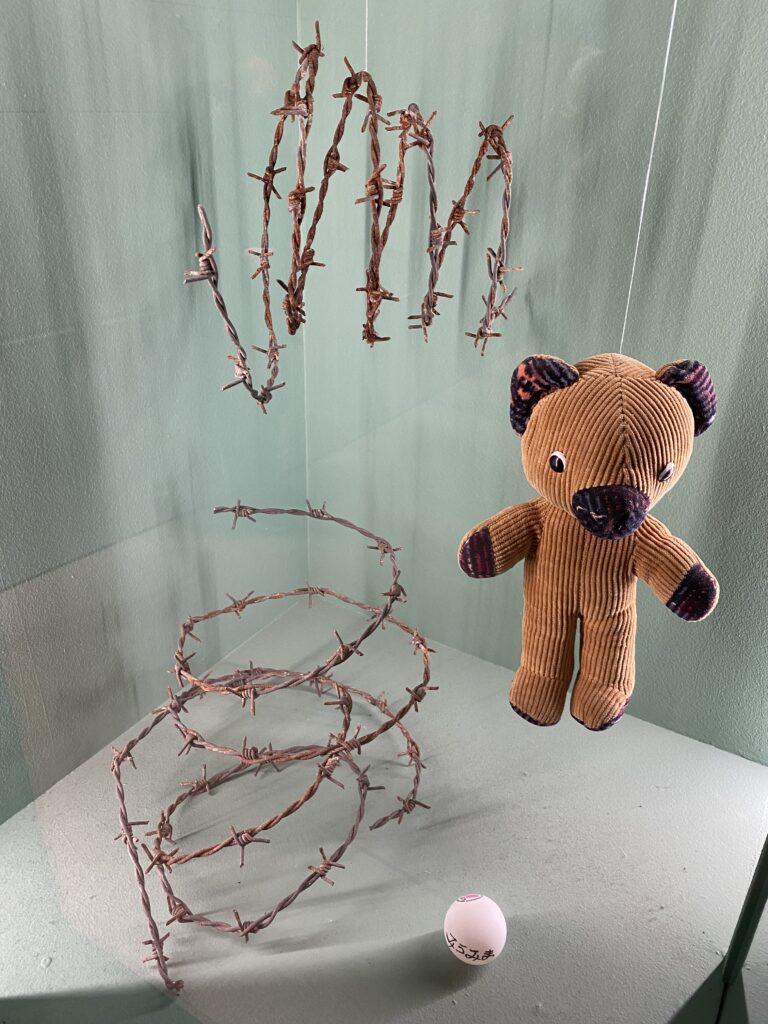
At the end of the Schindler Museum exhibit is a glass case containing two spirals of barbed wire. They are from KL Płaszów, a camp in Kraków built on Jewish cemeteries, which housed up to 25,000 prisoners at a time. It began as a forced labor camp and later became a concentration camp, a place of terror for Jews, Poles, Roma and political prisoners. Although it wasn’t an extermination camp, prisoners were indeed also executed here.
Many concentration camps have been preserved across Europe as a reminder of what happened during the Holocaust, when the Nazis murdered six million Jewish people, as well as other persecuted groups. Decades ago, I visited the Sachsenhausen concentration camp, north of Berlin, on a school history trip. I still remember, vividly, the “Arbeit Macht Frei” lettering on the gates, that awful, twisted phrase that translates as “Work Makes You Free.”
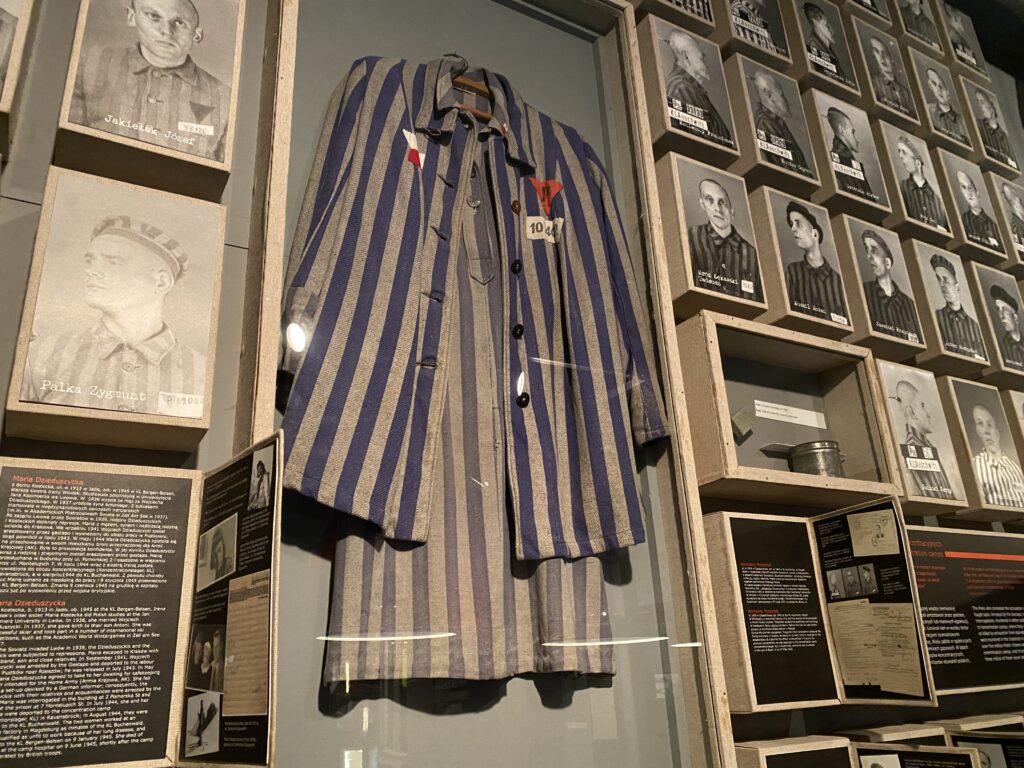
On the other side of Kraków, there is a blue and white striped uniform hanging up in the People of Kraków in Times of Terror exhibition, part of Muzeum Krakowa. A woman named Anna Pieczarka-Mikulskaw wore it while imprisoned in the German concentration camp KL Ravensbrück between 1942 and 1945. Her grandson gave it to the museum.
“Some of them came back home in the uniform,” the museum’s curator Grzegorz Jeżowski tells me.
The Holocaust is perhaps our starkest example of where scapegoating can lead. That barbed wire and that prisoner uniform in Kraków are reminders of what happened in Europe’s darkest hours. And yet today, far-right politicians are still villainizing minority groups, in particular Jews, Muslims, refugees, and LGBTQ+ people. It is not comparable with what the Nazis did, of course it isn’t. But we must never forget where this road can lead.
Today, in countries including Russia, Germany, Italy, and Georgia, there are growing political movements pushing for “traditional family values” and against LGBTQ+ rights. In Bulgaria, too, it is illegal to discuss LGBTQ+ topics in schools. There is a question mark over Hungary, which made global headlines for banning Pride marches under recently deposed strongman, Viktor Orbán. Recently in the German state of Saxony-Anhalt, the far right Alternative for Germany (AfD) won the state election, just falling short of gaining a majority, and leaving the rest of Europe shaken.
(Photo courtesy of Katie Dancey-Downs.)
Why we must visit the museum
Let me caveat what I’m about to say: I am not carrying the weight of lived or generational trauma, as others whose families have been persecuted by authoritarian regimes. But I believe it's vital we go to these museums and face the evidence head on, that we look at Mein Kampf, at the shoes of people murdered by the Soviet secret service units found in burial sites, at the microphones slipped into hotel rooms. Not just to remember what has happened in the past, but to make sure that we develop the necessary critical thinking required to understand and prevent what is already emerging in our present.
The museums I visited are just a handful of those dotted around Europe, with countless artifacts to remind us we are not immune to the possibility of ending up under authoritarianism. In Europe today, there are flickers of these tendencies—and not just in Russia and Belarus.
In Serbia and Turkey, journalists critical of the government live under serious threat, and protesters have faced violent clampdowns in Georgia since the Georgian Dream party claimed victory in the 2024 election—a result which Western pollsters said did not match exit polls. Both Turkey and Georgia’s leadership has been described as authoritarian.
And then there are countries where populist or illiberal politicians are waiting in the wings, steadily growing in popularity. Like in the UK, where there is an ever-growing personality cult around the anti-immigration Reform UK leader Nigel Farage, a man who has been accused by former schoolmates of antisemitic and racist bullying (which he denies) while more recently getting caught supporting a neo-Nazi event and using extremist slogans in personalized Cameo videos. As of May 2026, Reform UK was the most popular political party in the country, before a series of financial scandals consumed discussion around the party, dropping them to second place by August.
Similarly in France, Marine Le Pen’s far right National Rally is the country’s most popular party according to the most recent voting poll. And perhaps most shockingly, as of June 2026, the most popular political party in Germany is the far right nationalist AfD (Alternative für Deutschland), which is shaped by xenophobia, Islamophobia, antisemitism, and hostility to LGBTQ+ people.
Tyrants-gone-by echo in our current world, and illiberal politics serve as fertile ground for authoritarianism.
With all this in mind, the artefacts of terror and extremist politics in Europe’s museums are frightening, quite rightly. But in these same buildings, there are also always artefacts of hope.
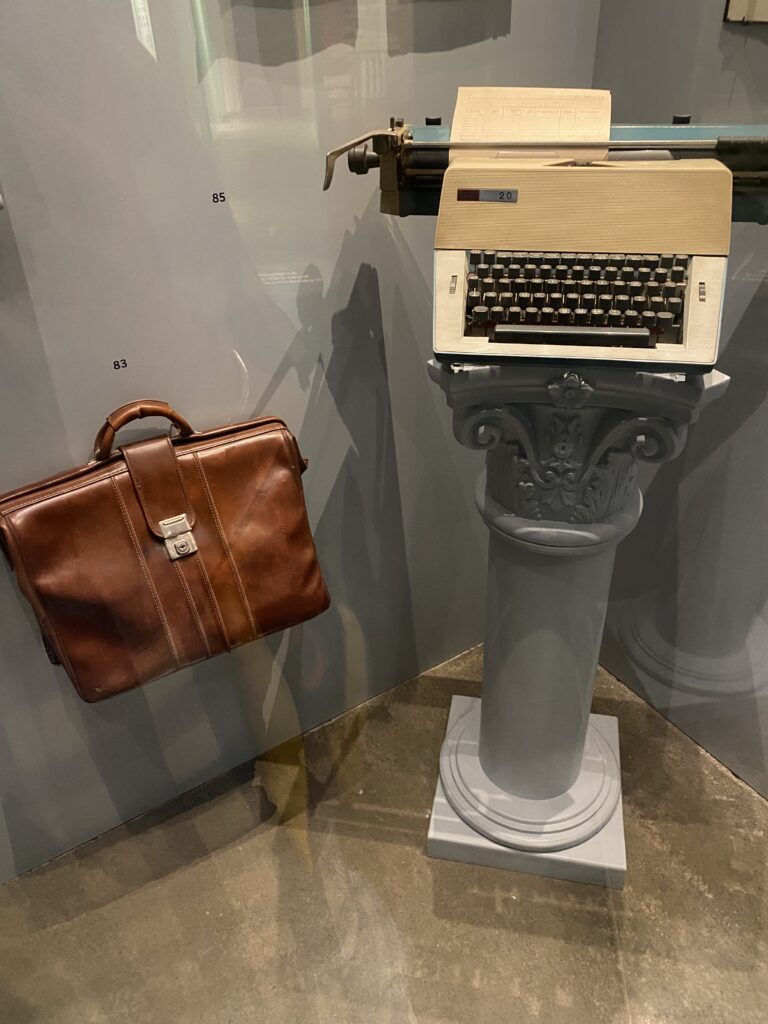
In the Vabamu Museum of Occupations and Freedom in Tallinn, there is not only evidence of the oppressions Estonians faced, but also of their resistance. Hanging up on the wall, a brown leather briefcase that belonged to Enn, an Estonian dissident who was arrested by the KGB numerous times, tells the story of a petition called the Baltic Appeal, calling for the independence of the Baltic states. The briefcase was big enough to carry a secret typewriter, which could be used to make and copy prohibited materials—and there’s one of those here too, a large clunky machine with a teal-colored carriage. They were considered so dangerous by the Soviet Union, that each typewriter had to be registered, but dissidents found ways to trick the authorities. This particular typewriter belonged to Irene, who, according to the museum’s digital guide, exchanged her tent to get it and then used it to make copies of the banned The Gulag Archipelago by Aleksandr Solzhenitsyn, an autobiographical work about life in the Soviet labor camps.
(Photo courtesy of Katie Dancey-Downs.)
Sitting proudly above the typewriter and the briefcase is a piece of samizdat, which dissidents were producing in the decades after Stalin died. These were self-published copies of prohibited texts—novels, journals, cookbooks, anything people wanted to read and couldn’t—which were passed around hand-to-hand, secretively.
There is a letter on the wall, too, signed by 40 Estonian figures from the cultural and scientific communities, against Russification. They collected these signatures in secret and sent the open letter to newspapers—even though ultimately, it resulted in many of them being punished, interrogated, or forced to publicly apologize.
Lastly, in the Museum of the Occupation of Latvia, there’s one incredible artefact that I sit in front of for a long time. It’s a video of people—ordinary people—holding their linked hands up high along the side of the road. It is a singing revolution. In August 1989, 1.5 million people across the three Baltic states—Estonia, Latvia, and Lithuania—created a 410-mile chain from Tallinn to Riga to Vilnius, held hands, and sang for their independence. A few months later, the Berlin Wall fell, and by 1991, all three countries were independent and free of Soviet occupation.
So much of authoritarian control is about isolating people, making them afraid of what they say and to whom they speak. These movements of resistance, then, these items that bond people, these relics, are all precious reminders of how people have resisted before. But we must go to the museum to truly see them. We must go to the museum to find hope in what can be overwhelming times. And we must go to the museum to arm ourselves with the lessons of history in the fight against a repeat of our worst moments.
[post_title] => Warnings from the Museum
[post_excerpt] => A tour through Europe's past—and what lessons we might learn from its museums to fight authoritarianism today.
[post_status] => publish
[comment_status] => closed
[ping_status] => closed
[post_password] =>
[post_name] => warnings-from-the-museum-authoritarianism-europe-history-estonia-latvia-poland-soviet-union
[to_ping] =>
[pinged] =>
[post_modified] => 2026-09-23 00:12:35
[post_modified_gmt] => 2026-09-23 00:12:35
[post_content_filtered] =>
[post_parent] => 0
[guid] => https://conversationalist.org/?p=11041
[menu_order] => 0
[post_type] => post
[post_mime_type] =>
[comment_count] => 0
[filter] => raw
)