
WP_Post Object
(
    [ID] => 10772
    [post_author] => 15
    [post_date] => 2026-07-22 19:39:36
    [post_date_gmt] => 2026-07-22 19:39:36
    [post_content] => 

It's been over four years since I moved to Japan, and I'm still baffled by the country's food sexism.

My first visit to Japan was a flurry of city lights, fresh sushi, and cherry blossoms in 2017. Between crying (joyful tears) three times in the Studio Ghibli Museum, and chasing down a cotton candy rainbow in Harajuku, I returned to the U.S. thinking, That was the best trip of my life. But on my second visit two years later, I started seeing the societal cracks I’d initially overlooked. While talking to a local near Tokyo’s Arakawa River about our favorite Japanese foods, I excitedly shared my love for strawberry shortcakes.

“That’s for women,” he replied.

I was stunned.

It’s been over four years now since I moved to Tokyo. My early ignorant bliss of Japan being a fantasyland—when it is in fact a very real place with very real problems—has long subsided. But my echoing bafflement over the country’s food sexism has remained and only grown over time. 

Japan has a misogyny problem. In June 2023, the country faced international criticism for sending a male minister, instead of a woman, to lead a G7 meeting on women's empowerment. According to the 2024 Global Gender Gap Report (a way to measure gender equality across categories like economic participation, education, health, political empowerment, and more), Japan ranked 118th out of 146 countries. And despite electing its first female prime minister in 2025, which on the surface, seemed like a win for equality, it was a superficial victory: Prime Minister Sanae Takaichi ascended to power as a hardline conservative who championed traditional gender roles. She even voted against a woman becoming Emperor in 2021, echoing her political party’s stance on maintaining the country’s sexist male-only succession rule. The decision risks the end of Japan's 1,500-year-old monarchy, the oldest continuous hereditary dynasty in the world.

In a society built upon patriarchy (and actively maintaining it), these entrenched beliefs have far-reaching ripple effects that seep into the fabric of everyday life. Groping on packed commuter trains and notorious workplace harassment are just the tip of the misogynistic iceberg. From lingering high heel mandates to the negative social stigmas around showing cleavage, there are countless other everyday instances that feel like never-ending microaggressive daggers, magnifying the depths of the country’s prejudice and discrimination against women. It shouldn’t be surprising, then, that this bleeds into the country’s relationship with food. It’s even unusual for women to be sushi chefs, due to false beliefs that women’s hands are too warm to handle raw fish and that menstruation can impact a person’s ability to taste. 

As a professional food writer, I’ve long been privy to how sexism impacts dining culture. But in Tokyo, it’s something I’ve seen and experienced firsthand. Recently, while working on a restaurant guide, I pushed my normal ramen-eating limits by visiting 10 different shops in a month, continuously finding myself in a line of mostly, if not all, men. It’s common to see queues of men in business suits waiting for hot ramen throughout the city, but it was only after seeing it so often up-close that I picked up on—and felt—the stark gender imbalance.

Reading restaurant reviews in Japanese only further confirmed my growing suspicions. “This ramen isn’t good for women because it’s too big” was a common theme; or on the flip side, “This place is amazing! Even I, as a [mere] woman, can eat the whole bowl!!!” There was also a constant pattern of reviewers mentioning whether it was acceptable for women to dine alone at certain ramen shops, or if the ramen was “light” enough for women to eat. 

The message across these reviews was clear: Women can have ramen, but it can’t be too large, or too fatty, and must be somewhere acceptable to the male gaze.

What I’ve seen for ramen is the same for sweets, but the inverse. Inside many dessert shops, a sea of women customers quietly sit and enjoy their cakes and other pastries, without a man in sight. The bare walls, minimal decor, and ambient slurping sounds of a standard ramen shop are replaced with detailed crown modeling and the clinking of tiny forks on floral porcelain plates. Lines of men in business suits are swapped with lines of women in dresses and skirts. While I have also seen men in these shops on occasion, they are often accompanied by a woman on what appears to be a date. 

As an “outsider,” especially as an American living in Japan, I recognize it’s easier to notice and be critical of a culture that’s not my own. After all, the U.S. has its own sexist food norms, and is far from immune to toxic stereotypes around food. Remember Women Laughing Alone with Salad? Or when tall, bearded men were wrapping meat logs in bacon? Today, guys are slapping raw meat down on countertops so hard and so often that it’s become background noise on TikTok, all while the current administration uses MAHA and MAGA to strengthen the stereotype of meat consumption as a cultural symbol of “traditional” masculinity. The U.S. might have slightly greater gender parity with regards to desserts (even though they still lean more heavily towards women), but like many countries, we are not exempt from our own forms of food misogyny. 

This is to say, Japan’s culturally-specific gendered relationships with food do not live in a void. There is home-grown food sexism in Japan, yes, but there are just as many beliefs that have developed via global influences, including its diet culture amongst women.  

Despite the ongoing patriarchal stronghold, cultural shifts in food have also started to emerge here. There’s a rise in a movement called ramen girls (or ramen joshi in Japanese), where some women make a concerted effort to slurp down as much ramen as they can. Women ramen influencers have also attracted large audiences in recent years, like Satoko Morimoto, who proudly claims to eat more than 600 bowls of ramen a year and has amassed over 53,000 Instagram followers. More men are leaving the post-war “carnivorous” image behind and are embracing the sweeter things in life, too. Some refer to them as “herbivore men,” a term that can carry a derogatory image because of its outward rejection of old masculine ideals—but they persist all the same. 

When I do witness a man enjoying dessert alone in a room full of women, or a woman dining solo going ham on a bowl of tsukemen—I think to myself, YES! To me, it’s a small, quiet act of resistance against gender expectations. There’s a lot of room for progress, but these small changes can have a snowball effect in changing not just Japan’s food culture but more widely, its entrenched national sexism. I believe anyone, regardless of their gender, should be able to eat ramen, little cakes, and whatever else they want, whenever they damn well please. The food doesn’t care, so why should we? 

When I think back to my second trip to Japan, I always remember my chat with that Tokyo local. After he told me that cake was only for women, I asked him, “Do you not like shortcakes? They’re so good!” He looked away shyly. “I do,” he said, “but I don’t tell people.”

Wherever he is, I hope he’s more than just occasionally throwing down on the tallest, thickest slices of strawberry shortcake out there, fully owning his sweet tooth for all to see.

[post_title] => Let Men Eat Cake (and Women Eat Ramen) [post_excerpt] => It's been over four years since I moved to Japan, and I'm still baffled by the country's food sexism. [post_status] => publish [comment_status] => closed [ping_status] => closed [post_password] => [post_name] => japan-food-sexism-culture-ramen-cake-desserts-tokyo-eating-sanae-takaichi-soapbox [to_ping] => [pinged] => [post_modified] => 2026-08-03 20:28:01 [post_modified_gmt] => 2026-08-03 20:28:01 [post_content_filtered] => [post_parent] => 0 [guid] => https://conversationalist.org/?p=10772 [menu_order] => 0 [post_type] => post [post_mime_type] => [comment_count] => 0 [filter] => raw )
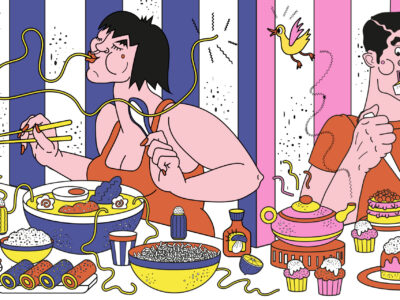
An illustration of a woman on a blue striped background eating a bunch of ramen, next to a man on a pink striped background eating a bunch of desserts.

Let Men Eat Cake (and Women Eat Ramen)

WP_Post Object
(
    [ID] => 2847
    [post_author] => 2
    [post_date] => 2021-06-24 17:25:51
    [post_date_gmt] => 2021-06-24 17:25:51
    [post_content] => British Vogue's interview with the Pakistani Nobel Peace Prize laureate set off a storm of virulent criticism in her native Pakistan.

The July issue of British Vogue departs notably from the usual fare of supermodels, pop stars, and actresses. Wearing a traditional salwar kameez and matching head scarf, Malala Yousafzai—“survivor, activist, legend”—gazes serenely through honey-colored eyes. Her warm smile is slightly lopsided, a permanent reminder that she survived a gunman’s bullet to her head. She is a Nobel Peace Prize laureate and one of the world’s most admired activists for the education of girls and women; and yet, she conveys neither artifice nor arrogance.

The interview, conducted by London-based journalist Sirin Kale, reads like the transcript of a lighthearted conversation between two young women sitting in a café. Malala, now 23 and just graduated from the University of Oxford, happily answers questions about what she likes to eat, how she spends her time, and what her plans are for the future.
 
View this post on Instagram
 

A post shared by British Vogue (@britishvogue)

But when asked about her romantic life Malala became so visibly uncomfortable that her interviewer felt as though she were “torturing a kitten.” In the extremely conservative area of northern Pakistan called Swat, where Malala was born and raised, falling in love or having a boyfriend is considered shameful and dishonorable. But, later, she nonetheless offers some ambivalent comments about marriage.

“I still don’t understand why people have to get married. If you want to have a person in your life, why do you have to sign marriage papers, why can’t it just be a partnership?”

In Pakistan, these anodyne comments set off a firestorm of virulent criticism. Social media users called her a “prostitute” and “traitor”; and the hashtag #ShameonMalala trended for days. Z-list celebrities attempted to capitalize on the Malala hatred by issuing sanctimonious statements about marriage, while newspaper columns analyzing the interview made headlines for weeks. A so-called preacher in the conservative north of Pakistan declared that he would assassinate the young woman for violating the sanctity of Islam. By now Malala is used to Pakistanis expressing outrage at what she does and says. But the magnitude of this backlash was particularly intense. Upper middle-class women, who tend to be more educated and thus supposedly more worldly, were particularly critical of Malala for voicing reservations about marriage. In Pakistani Facebook groups, they wrote that Malala’s head injury had probably caused brain damage; or they mocked her appearance, commenting that of course she was against marriage—with her disfigured face, she would never find a husband. How to explain this vicious torrent of outrage? Perhaps these well-heeled, well-educated urban women were lashing out because by questioning the value of marriage, Malala had implicitly criticized the institution from which most Pakistani women derive their identity, status, and privilege. Pockets of liberalism do exist in Pakistan. A 23-year-old woman from a rich family in Lahore, Islamabad or Karachi might be allowed to choose her spouse—even to date or have a boyfriend. But saving face is essential; cultural and religious standards must be upheld. Those who rebel against society’s mores are expected to do so discreetly. It’s a rare woman in Pakistan who remains single by choice. By questioning whether partnership and love should require religious and legal sanction, Malala unintentionally held up a mirror that reflected all the burdens and restrictions of marriage. That is why these women responded to the interview by having a complete meltdown: Their own internalized misogyny trumped whatever lip service they usually give to female solidarity and sisterhood. Their lambasting of Malala, the so-called “darling of the West,” was reminiscent of the ritual of “salvaging” in The Handmaid’s Tale, when the Handmaids gleefully pull on the rope that hangs the condemned woman to death. Of course Malala does have many supporters in her home country, where she’s often called the “Pride of Pakistan.” They counter the haters by holding up examples of Malala’s positive influence in Pakistan and the rest of the world—like the Malala Fund, mentioned in the Vogue interview, which is rebuilding schools in her native Swat, in several African countries, and in Gaza. Few people know about this important work, or that the Fund supports the work of policy reformists who are overhauling Pakistan’s creaky education system. Those who love Malala are happy that she survived the assassination attempt and thrived; that Pakistan’s military defeated the Taliban; and that something excellent can come out of Pakistan, a place where life is difficult and often grim. Pakistanis are under a lot of pressure these days. The country faces serious economic problems even as it tries to recover from decades of dictatorship and terrorism; matters are further complicated by the country’s continued involvement in geopolitical conflicts with India and Afghanistan. Salaries remain low even as inflation and taxes continue to rise. Quality education, health care, and job security are all in short supply. Working-and middle-class people feel the economic frustrations most acutely; for them, dignity and security are a mirage. On popular television talk shows broadcast each night, upper-class Pakistanis argue about the causes of their country’s malaise—e.g., corruption, government incompetence, and the erosion of moral values. But instead of looking for ways to strengthen the country internally, they blame external bogeymen such as India, “the West,” and anyone who seems to be working against Pakistan’s interests. Malala has become a lightning rod for these people. Every time she does something that makes the news, she’s accused of making the country look bad. The usual round of accusations and bizarre conspiracy theories are trotted out: Her shooting was a staged drama so she could obtain a foreign passport; she has been chosen by Western and Jewish overlords to become prime minister of Pakistan one day; her many prestigious awards are in fact compensation for the role she plays in a master plan to dismantle Pakistan altogether. They speculate that Malala is actively working against her own country. On the Vogue cover, Malala is traditionally but elegantly attired: She wears a crimson dupatta draped gracefully over her head and shoulders and a matching crimson kameez; the backdrop is the same shade of crimson—the color of blood, the color of revolution, of love—and she holds one hand up to her face, right where her facial muscles droop because of her injuries. She’s careful to portray herself visually as respectful of her Pashtun heritage. But it’s getting harder to keep her intelligent mind and her ideas as carefully curated. This tension will only grow as she navigates through life: In Pakistan, every word she says will be parsed and every action criticized. Having completed her formal education, Malala is now considering what she should do with the considerable money and influence she has accumulated over the last six years. Besides the Nobel Prize, there is the Malala Fund (Bill and Melinda Gates and Angelina Jolie are donors) as well as appearances at Davos and the United Nations. For some, this is too much power for a young woman from a valley in Swat, Pakistan. Her friends Greta Thunberg, the climate activist, and Emma (‘X’) Gonzalez, the Parkland shooting survivor and anti-gun activist, both of whom have also been targeted by vicious critics, can relate. Malala’s detractors often ask why other young victims of terrorism, especially boys, don’t receive the same treatment as the young woman from Swat. But most people don’t know what happened to these victims, whom they believe are stranded in Pakistan, locked out of the privilege and influence that Malala wields. Waleed Khan is a university student who was shot in a 2014 Taliban terrorist attack on the Army Public School in Peshawar. Like Malala, Khan went to the UK for treatment and stayed on to pursue his education; Malala and her family supported him throughout his ordeal. In the wake of the controversy over the Vogue interview, Khan tweeted: “From a long time I have been seeing images of me and Malala circulating around. I would like to request everyone please stop this comparison. We can’t uplift one person by degrading the other. Malala is an inspiration for many young ppl like me and millions around the world.” With so many programs for improving the lives of girls funded by Western NGOs and foreign missions, many complain that boys are left behind. Some of this is fair criticism; but some is sexist backlash in a society accustomed to conferring automatic privilege upon boys and men. Elevating Malala above male victims of similar violence sparks fears about another Western conspiracy to rend Pakistan’s social fabric and make women more powerful than men. The degradation of others considered to have gained too much wealth or prominence is called Tall Poppy Syndrome, a term that originated in Australia. In Pakistan, Malala is the home-grown variety; both men and women want to cut her down because they think she’s gotten too big and gone too far. But not everyone reacts with so much jealousy or negativity to Malala. Many Pakistanis openly adore her; and the government of Pakistan gave her full support and security when she came to Pakistan on a secret trip in 2018. Hundreds of little girls study in the schools she has opened in the Swat Valley. Across the country, plenty of people recognize that those who shot Malala in the head are the real enemies of Pakistan. Malala rarely comments on this negativity, although when she came to Pakistan in 2018, she told the BBC that she couldn’t understand it. But in the three years since that visit, Malala has grown and evolved from a girl into a woman. The biggest sign that she’s ready for the next phase in her life, and that the hatred doesn’t faze her, is a meme, popular among millennials, that she tweeted a few days after the Vogue cover was released online. It’s a GIF of Elmo, the Muppet character, standing with his arms raised in front of a backdrop of flames dancing behind him. For Malala, this is the equivalent of a mic drop. [post_title] => Hating Malala is now 'en vogue' in Pakistan [post_excerpt] => The 23 year-old Nobel laureate's cover photo and interview for British Vogue set off a storm of virulent criticism in her native Pakistan. [post_status] => publish [comment_status] => closed [ping_status] => open [post_password] => [post_name] => hating-malala-is-now-en-vogue-in-pakistan [to_ping] => [pinged] => [post_modified] => 2026-08-06 20:42:02 [post_modified_gmt] => 2026-08-06 20:42:02 [post_content_filtered] => [post_parent] => 0 [guid] => https://conversationalist.org/?p=2847 [menu_order] => 193 [post_type] => post [post_mime_type] => [comment_count] => 0 [filter] => raw )
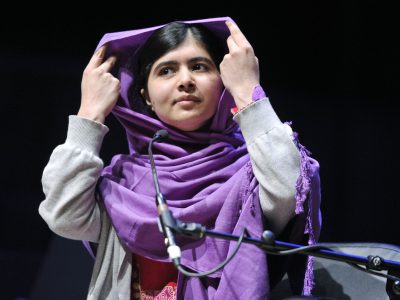
Hating Malala is now ‘en vogue’ in Pakistan

WP_Post Object
(
    [ID] => 2686
    [post_author] => 2
    [post_date] => 2021-06-01 17:56:08
    [post_date_gmt] => 2021-06-01 17:56:08
    [post_content] => The true bulwark against Trumpism is at the state and local level.

In the eyes of many locals, Nate McMurray’s campaign was a fool’s errand. He was running for Congress as a Democrat in New York’s 27th congressional district, where a greater percentage of residents voted for Trump in 2016 than in any other district in the state. District 27 is vast: it includes Orleans, Genesee, Wyoming, and Livingston counties, parts of Erie, Monroe, Niagara, and Ontario, suburbs of Buffalo and Rochester, and farm country; altogether, it is home to over 700,000 people. Around 42 percent of voters are registered with the Republican or Conservative parties.

McMurray is a fierce critic of former president Trump; he champions Medicare For All, gun control, and legalizing marijuana. When he first ran, he lost narrowly to Republican Chris Collins, who was then under federal indictment; Collins later resigned from Congress and pled guilty to conspiracy to commit securities fraud. Celia Spacone, a retired psychologist who was a McMurray campaign volunteer, told me in 2019, “Collins was indicted on felony charges, and people still didn’t want to hear about a Democratic candidate.”

After Collins resigned, McMurray ran against Republican nominee Chris Jacobs in a June 2020 special election to fill Collins’ seat, and again lost by a relatively narrow margin. When McMurray challenged Jacobs in the November 2020 general election, he lost by a much wider margin. (The presidential election boosted turnout across the board, leading to a surge of Republican voters.)

Recent research suggests that the Democratic Party might have benefited from McMurray’s willingness to run in a race that he was all-but-predestined to lose. The mere fact that a forceful, energetic candidate ran a high-visibility campaign in the district mobilized volunteers, energized Democrats, and might even have boosted Joe Biden’s vote share.

According to election data compiled by the Daily Kos, Trump beat Hillary Clinton by 25 points in District 27 in 2016. District voters went for Trump again in 2020, but the margin narrowed significantly, from 25 to 16 points. There are a number of possible reasons for that shift, including the pandemic and/or local voters’ preference for Biden over Clinton. But the fact that a Democrat put up a fight was good for democracy—and good for the party. (Collins faced a Democratic challenger in 2016, too, but her campaign didn’t attract as much attention as McMurray’s, in part because her platform wasn’t as bold and Collins wasn’t yet under indictment; as a result, the race wasn’t as close.)

As a candidate, McMurray worked hard and made a point of courting supporters in often-overlooked rural counties. Rural Democratic county committee chairs were especially supportive of his campaign. “Nate brought a lot of energy and passion to his races that really excited a grassroots following,” Judith Hunter, chair of the Livingston County Democratic Committee, told The Conversationalist. “That was a very impressive thing and surely helped candidates up and down the ballot.”

Hunter also chairs the Democratic Rural Conference of New York State, which represents New York’s 47 rural counties (the state has 62 counties in total). It can be tough to get people to show up to volunteer and vote for down-ballot candidates, she said, and it was easier to recruit campaign volunteers for McMurray because he was running for Congress. Still, she added, “Once people understand what a campaign needs in terms of volunteer power, it’s something a certain proportion respond to, and they’re not going to go away.”

Recently, the progressive organization Run For Something partnered with data firms Kinetic21 and BlueLabs to analyze the effect of down-ballot races on Biden’s performance in the 2020 presidential election. They found that contested state legislative races—those in which both Democrats and Republicans ran, rather than just Republicans—yielded a small but notable (0.3-1.5 percent) boost for Biden. Even when a down-ballot Democrat loses, the fact that they bothered to run can benefit a presidential candidate. This is known as the “reverse coattails” effect—the reverse happens when a down-ballot candidate rides the “coattails” of a popular presidential candidate.

Ross Morales Rocketto, co-founder and chief program and recruitment officer of Run For Something, explained during a phone interview why progressive candidates should run, even in places where they are likely to lose. One reason is that doing so could boost the candidate at the top of the ticket. Another big reason, he said, citing an old sports adage, is that “You miss 100 percent of the shots you don't take.” Given how unpredictable the results of redistricting can be, the Democratic Party doesn’t know which races may turn out to be competitive. And given that the most recent census likely undercounted Latinos, Rocketto said, Democrats should rethink their tendency to avoid running candidates in deep-red areas.

“What ends up happening is that people who live in these areas only see Democrats as the caricatures they are on Fox News or Parler or Infowars or other conservative media outlets,” he said. “But when you have a candidate there, going to their door, they get to see one of their neighbors—somebody who actually lives in their community and likely shares some of their values—talking about another way [to address local problems].” It’s especially effective, Rocketto noted, when candidates stay focused on local issues. Rocketto sees ensuring that Democrats run for local office even in districts where they have little chance of winning as part of the long-term work necessary to reverse “some of the polarization that we currently see.”

In 2016, Leah Greenberg cofounded the progressive organization Indivisible, which she now co-directs, to help counter Trump’s agenda. Greenberg, whose family is from small-town Alabama, has also spoken about how powerful it can be for residents of red and/or rural areas to encounter self-identified progressives in their communities. Democrats who live in red states sometimes compare the experience of revealing their politics to friends and neighbors to LGBTQ peoples’ experience of “coming out.” As Hannah Horick, who chairs the Ector County Democratic Party in Texas, told Politico in 2020, a number of West Texas Democratic organizers are also openly LGBTQ. According to Horick, a friend once told her it was harder to come out as a Democrat in West Texas than it was to come out as gay.

Running as a Democrat in places that have historically been hostile to Democrats is less quixotic than it used to be. This is partly because voters of color have grown as a share of the electorate in recent years, while white voters, who are likelier to support Republicans, have declined. Hispanic voters account for increasingly large shares of the electorate, particularly in battleground states like Arizona, Florida, and Nevada, and red states like Texas. And thanks to the extraordinary efforts of local organizers and pro-voter registration, anti-voter suppression groups like Fair Fight, around 130,000 more black people registered to vote in Georgia in 2020 as compared with 2016.

The GOP has sought to counteract demographic shifts and efforts to expand the electorate by making it harder to vote. Since the record turnout of the 2020 election, Republican legislators have proposed over 250 laws that would limit mail-in, early, and Election Day voting in 43 states throughout the country. In March, Georgia’s Republican governor made it a crime to distribute food or drink to voters as they wait in line to cast their ballots. A recent Washington Post analysis characterized Republican efforts to restrict voting as “potentially…the most sweeping contraction of ballot access in the United States since the end of Reconstruction.”

Steve Phillips, a senior fellow at the Center for American Progress, has long argued that the key to making Democratic gains in Republican strongholds is to register and mobilize voters, specifically black and Latino voters, most of whom vote Democratic. Millions of eligible voters, including many people of color, did not vote in 2016 or 2020. Youth turnout “surged” in 2020—53 percent of eligible young voters (ages 18 to 29) voted in 2020, versus 45 percent in 2016—but that still means nearly half stayed home. A perennial fight within the Democratic Party is whether to focus on winning over swing voters or mobilizing eligible voters who never or rarely vote, most of whom would theoretically vote Democratic.

Yet it would be short-sighted to assume that a diversifying electorate will eventually ensure that the Democrats remain in power indefinitely. In a country as large, diverse, and gerrymandered as the United States, the Party cannot rely on voters of color and/or young voters alone. Political demographer Ruy Teixeira recently reflected on a book he cowrote with John Judis in 2002, in which the two analysts posited that demographic changes in the U.S. would benefit the Democratic Party. “Democrats should take advantage of a set of interrelated social, economic and demographic changes, including the growth of minority communities and cultural shifts among college graduates,” he wrote of the book’s central argument, adding, “But we also emphasized that building this majority would require a very broad coalition, including many voters drawn from the white working class.”

That crucial nuance, Teixeira said, was lost. Instead of cultivating support among multiple groups at once, including working-class people of all races, “many Democratic pundits, operatives and elected officials have falsely come to believe that demographics are destiny.”

Ideological, ethnic, and generational differences within communities of color make it unwise to take these voters for granted. Just over a third of Asian American and Pacific Islander (AAPI) voters backed Trump in 2020, with the former president also gaining support among Latino and Black male voters. Conversely, as Nate Cohn noted in a recent analysis for The New York Times, Democrats have made gains among white voters in recent years, and Republicans can no longer take that constituency for granted.

None of these shifts happened overnight. That’s why dedicated and appealing candidates, especially those running for local office, can gradually increase Democratic viability in conservative areas. Even if they lose the first time, or the first couple of times, their campaigns can make a difference. In local races, if a candidate is known, trusted, and has a plan to improve their neighbors’ daily lives, that often matters more than their stance on national issues. Run For Something asks candidates seeking its endorsement whether or not they agree with a series of statements on racial justice, income inequality, immigration reform, LGBTQIA+ and gender equality, climate change, and gun violence. But candidates who emphasize local issues, Rocketto said, “tend to do better than folks who allow their races to become nationalized.”

Marché Johnson lost her first city council race in Montgomery, Alabama by just six votes, then ran again and won by 174 in April. At the end of the day, she told me, it’s everyday issues that matter the most. “Everyone needs their trash done on time, everyone needs their roads cleaned, everyone needs their lights up,” she said. “So I focus more on the problems and getting viable solutions.”

Raising money is one of the main challenges progressive candidates face in places where the Democratic Party is virtually nonexistent. “The issue this always comes down to is resources,” Rocketto said, “and competition for those resources.” The money, he said, is there, but it tends to go to high-profile candidates in widely watched races, rather than to local candidates whose races cost less and who are better-positioned to win with adequate support.

“If the Party had been treating state legislative elections with the same level of priority that we treated the U.S. Senate over the last 10 years, we probably wouldn't be struggling with [state-level voter suppression bills] today,” Rocketto said. It’s easy to convey the urgency of beating Trump, he added, acknowledging that doing so was equally critical to the Democratic agenda. It’s harder to explain that the true bulwark against Trumpism is at the state and local level. “People actually do care about this work,” he added. “They just don't always care about it with their money.”

Strong local candidates, he said, tend to be “super-charged organizers,” which brings its own set of benefits. He mentioned a candidate who lost a race in a small town in Missouri in 2017, and later harnessed the energy and contacts he had cultivated during that campaign to advocate for environmental issues before the city council. “It’s good for the civic health of a place to have these folks running,” Rocketto concluded, “even if you know they're going to end up losing.”
    [post_title] => How a political candidate can help their party win—by losing
    [post_excerpt] => Even when a down-ballot Democrat loses, the fact that they bothered to run can benefit a presidential candidate. 
    [post_status] => publish
    [comment_status] => closed
    [ping_status] => open
    [post_password] => 
    [post_name] => how-a-political-candidate-can-help-their-party-win-by-losing
    [to_ping] => 
    [pinged] => 
    [post_modified] => 2026-08-06 21:00:45
    [post_modified_gmt] => 2026-08-06 21:00:45
    [post_content_filtered] => 
    [post_parent] => 0
    [guid] => https://conversationalist.org/?p=2686
    [menu_order] => 200
    [post_type] => post
    [post_mime_type] => 
    [comment_count] => 0
    [filter] => raw
)

How a political candidate can help their party win—by losing