
WP_Post Object
(
    [ID] => 4701
    [post_author] => 15
    [post_date] => 2022-08-31 21:00:03
    [post_date_gmt] => 2022-08-31 21:00:03
    [post_content] => 

Making friends in your 20s is one thing. Making friends as a mom in my mid-30s felt nearly impossible.

Old Friends” is an ongoing series exploring the many ways that friendship changes shape in adulthood. 

You wouldn’t know it to meet me now, but as a child, I was deeply, almost paralyzingly shy. I struggled with new situations, always anxious that everyone around me knew something I didn't—what to say to boys, what to wear, how to act. It was the '90s, so I was often alone, in the benign neglect style of parenting that was so prevalent back then. I spent most of my days riding my bike around, making up games for myself, finding comfort in the solitude. I felt woefully unequipped for socialization of any kind, something that wasn’t helped by the fact that my family moved a lot, and I changed schools often. I wish I could say this was because of something practical like work, but really, my parents were just bohemian and broke. My mom once moved us across the country because she had a dream about the mountains out West, mountains she’d never seen in real life. So I retreated into myself, choosing to focus on making a small number of very close friends, rather than a wide social circle. 

But it wasn’t quite enough, the way nothing really is in adolescence. My younger sister was always the social butterfly in our family: People were (and still are) attracted to her warm, joyful nature and eagerness to include everyone in on the joke. She’s thoughtful and funny and kind, and watching her make friends has always been a pleasure, even when I was jealous of her ability to do it. You can’t imagine how difficult it is to admit to your younger sister that she’s better at making friends than you, but I was stuck and she was the one to set me free. I finally asked her outright one day, in the safety of our shared bedroom, full of Tiger Beat posters and Barbies, how she did it. She told me I needed to adopt a “fake it till you make it” approach, not just to friendships, but with my shyness in general. 

And it worked. I pretended not to be shy long enough that I actually became less shy. I cultivated a more open and less guarded approach to friendships and social scenes, and slowly, I became more comfortable meeting new people. In my early 20s, this led to a solid group of close friends and a large network of acquaintances that made the first half of that decade so exciting and fun—though not without its own drama and heartache. 

Then, halfway through my 20s, I left my hometown of Vancouver, Canada and moved to Toronto. At the time, it was a little uncomfortable having to make a new group of friends in a new city, but I was going out, I was meeting people at work, and there didn’t seem to be a huge barrier to recreating the social life I’d had in a different city. I settled deeper into the relationships I had: Some friendships got better, some faded away, some ended very painfully. With no need to make new friends, my skills atrophied.

When I met and married my husband, things shifted again. His friends and my friends became our friends. Merging our lives in the biggest, most important ways necessarily meant bringing together how and with whom we socialized, and I embraced it. I loved seeing this disparate group of people become a community that we took care of and who took care of us. This was made abundantly clear when we had our first child, and this big group of people came together to feed and look after us in the painful postpartum phase. 

But the cruelty of finally leaning into the friendships you’ve cultivated over decades is that you start to feel like you don’t have room in your life for new ones. In my early 30s, I closed rank. I shed acquaintances, avoided making new pals at work or when going out, and focused on maintaining a very close inner circle of friends, a lot like I had when I was a kid. On the one hand, that meant easy, comfortable friendships where we’d developed a rhythm that was second nature. On the other, I can admit I also took a lot of those close relationships for granted, picking some friends apart when they irritated me, or not putting in the kind of work either of us used to when we were first becoming friends. 

And it probably would have gone on like that for many more years, until my husband and I, along with our five month old son, moved to the UK in 2018. 

As far as relationships go, it’s an accepted truism that the older you get, the harder it is to make new friends. Whether it’s a lack of time for the friends you already have, feeling overwhelmed by the rigors and responsibilities of life, work, and family, or just plain old apathy about chatting up fresh faces—“no new friends,” as Drake more aptly put it—it can seem not just impossible, but unnecessary to open up your world of acquaintances after, say, your 20s. I readily accepted, even embraced this idea myself, up until we moved to a new country and I was forced to start from scratch. 

Making friends in a new city in your 20s is one thing, starting over again as a mom in my mid-30s felt nearly impossible. It took me right back to elementary school, to feeling like there was a shorthand that I was missing, a piece of the puzzle I’d dropped on the way to the playground. I found it hard to meet people at work because I had to rush home at five for daycare pickup and it was tricky to meet up on weekends because I was still breastfeeding every few hours. 

Yet, paralyzing loneliness is a good motivator—at least it was for me. I forced myself to be as open and willing as I had been as a child. This meant reaching out to fellow parents for play dates as often as possible, including strangers I met in the park near our house, painful as that was to do. It was like rebuilding my atrophied muscle: I had to do friendship rehab just to make one or two new friends. 

But it was also invigorating. Forging a close relationship with a stranger for the first time in almost a decade reminded me of how necessary it is not to cut yourself off from the world. The relief of having someone to call on for a walk or a vent or both was incalculable. Working on that part of myself after so many years not only led to making new friends, but also made me appreciate the friendships I had back in Toronto, the community I’d spent years building. 

When we decided after a couple of years to move back, I was determined to bring this energy home with me. Being curious about people, making an effort to see the good and work through the bad, especially after the pandemic, felt (and feels) like radical self-care. It was precisely because making friends in London was so difficult, that has made making friends in Toronto so exciting—I want to make the effort. I love stretching my sense of community in a place I’ve always called home, where it would be so, so easy to just coast and take all of it for granted. It seems so obvious now, once you’re on the other side, but it really is true that no one knows what they’re doing; some of us are just fumbling a little less. 

And after nearly twenty years, I think I’m done faking it: I may have actually made it. 

[post_title] => No New Friends [post_excerpt] => [post_status] => publish [comment_status] => open [ping_status] => open [post_password] => [post_name] => no-new-friends-in-mid-30s [to_ping] => [pinged] => [post_modified] => 2026-08-04 20:34:11 [post_modified_gmt] => 2026-08-04 20:34:11 [post_content_filtered] => [post_parent] => 0 [guid] => https://conversationalist.org/?p=4701 [menu_order] => 117 [post_type] => post [post_mime_type] => [comment_count] => 0 [filter] => raw )
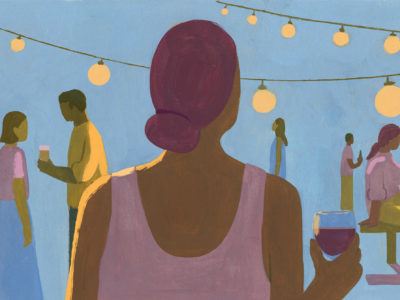
A painting of a woman from behind, holding a glass of wine and looking out at a party where everyone is socializing.

No New Friends

WP_Post Object
(
    [ID] => 4729
    [post_author] => 15
    [post_date] => 2022-08-31 16:30:00
    [post_date_gmt] => 2022-08-31 16:30:00
    [post_content] => 

A story of two deaths and an engagement.

Old Friends” is an ongoing series exploring the many ways that friendship changes shape in adulthood. 

“My friend Rachel is getting married.”

I say the words in my head, and out loud, and marvel at the way the syllables align; laugh a bit at the obvious joke about the 2008 movie; pull my mouth into a half-smile as I imagine Rachel as I knew her best, someone I sat with during tenth grade biology and who gifted me so many of the foundational touchstones of my personhood now. Rachel, goofy and unguarded and easily earnest, who spurred me to be my weirdest and wildest self. Rachel, who introduced me to Britpop; who introduced me to a lot of music, actually, including the artist Annie, whose song “Heartbeat” is a top five for sure. Rachel, who taught me to be funny in the exact way that would make her giggle, an expression and sound I can picture without any dimming over the distance of space and time.

The thing is, I haven’t seen Rachel in person in over a decade. Before this past year, the last time I’d spoken to her was back in 2017, when our friend L, who’d sat at that same bio table, passed away, and knowing that she and L had been as close as sisters, I’d reached out to Rachel over a flurry of texts. We made the kind of promises that happen over death, to be more present and ready for each other in the now. And I thought I’d meant it, but I couldn’t follow through. When everyone descended back on our hometown for the funeral, I demurred, citing life and time and work—and did I mention life?—letting the memory of who I was to them attend instead.

There were real reasons why I didn’t go back. I was in the throes of an internal gender crisis as I assessed and tried to repress my rejection of womanhood, a bridle bit that was carving a waterfall of blood from my metallic mouth. I was still reeling from a big move—out of Los Angeles, my home for seven years, and into a domicile with the man who’d become my spouse—and hadn’t quite found my footing, financially and otherwise, in this new place. But the most elemental reason I didn’t go back to New Jersey was that I didn’t know what to say to the friends I’d essentially left behind when I moved to California and decided to become the person I couldn’t be back home. Back where I knew and loved them. Back where I maybe not loved, but at least thought I knew, myself.

~

Four years later, death is what brings me back to Rachel again. She’d always been attuned to what one might call the “pop girls,” and in the early 2000s, that included Girls Aloud, the British girl group whose impact and influence never quite crossed the Atlantic like their most popular predecessors the Spice Girls' had. Rachel had made a hagiography out of their music and careers—as a group, as individuals—with the expertise of a stan, which she was. And then, last fall, one of the members of Girls Aloud passed away suddenly, at an age where your first reaction is, “That’s too young.”

I read the headline on the music blog I’ve been reading since high school and felt the impact in two waves: first, a sharp kick in the throat, and then, a dull pang tunneling through my chest cavity and into my gut, where it settled into the heavy, heady ache of guilt. I needed to tell Rachel. Did she already know? Did she still care? Would she want to talk about it with me, and could this transparent bid for reconnection actually in turn open the door for us to discuss everything I now knew about myself and everything I didn’t know about her? 

~

We fell out over a boy, or at least that’s how I framed it. After my high school ex and I broke up, he’d stayed on the East Coast for college like most of the people I’d gone to school with and made plans with them and reached out to them and made them feel wanted and seen, and that included Rachel. Meanwhile, I’d crossed the country and immediately began my free bitch makeover montage, seeking nothing less than sublimation, to seem cooler, smarter, more self-possessed than I’d ever felt in the town where I’d grown up, to leave my body behind and diffuse into a sun-baptized spirit. I quite literally tried to shed my body of its mass, its baggage, its racialized cocoon, to cultivate the effortless, weightless glow of success and satisfaction that’d make people look at me, want me, and maybe even accept me. No wonder my ex broke up with me over a video call right before Halloween our freshman year; no wonder my attempts at conversations with my once-best friends became buckshot in sparse forests, doves with clipped wings released to their doom, cursory “happy birthday”s and then merciful silence. It didn’t matter that our high school friend group started to break apart on its own, that many of the friends my ex had “won” in the breakup custody battle didn’t stay friends with him or each other. I surrendered my past completely, and more than anyone else, I surrendered Rachel. 

Honestly, the loss of most of those friendships was for the best. And eventually, I figured out how to become the kind of person I wanted to be without brutalizing myself for the achievement of that want. But I never got over Rachel, who was one of the only people I knew from back then who went on to work in the entertainment world, too; whose influence in my life goes down to my marrow. 

I went alone to a Robyn concert and thought, “Rachel would’ve gone with me.” I went to parties and wondered what she’d think of their soundtracks, because she was the one who’d taught me how to listen to—really listen to—and contextualize music. In many ways, she was my shadow sensei and my twin, not in the biological sense but in the Hilton Als essayistic way. A mirrored soul, someone who knew how to draw the best of me out of myself. 

I’d never told her any of this because nobody we grew up with talked about friendship like that. But maybe we’d always picked up a singular frequency from each other. When I heard through the grapevine that she’d come out in college, I yearned to tell her that I understood even though I hadn’t come out in my own way to myself then. When I did come out, I’d often imagine, unbidden, how I would break the news to her. How she’d process it; whether she’d recoil from or reach for me, whether she’d still recognize our similarities despite the new difference between us.

~

I stared at the headline and imagined a world where I took my regret to the grave, and texted her something that, between the lines, simply said: I miss you, I miss you, I miss you.

We talked for what felt like and actually was hours. Her girlfriend-now-fiancée had to remind her of the life outside our impassioned recollections and brutal revelations. Our mutual admirations and jealousies and drafted but scrapped overtures. She asked me what happened back then, and I told her with no shame or fear or gloss, the kind of honesty we’d never achieved as friends. 

And really, we’re barely friends now. I don’t know the rhythms of her day-to-day life and she doesn’t know mine. We haven’t talked at length since that first outpouring, but we both agreed that all we could do was keep placing stones in the river that’d grown between us. I text her every time I think of her and she does the same. She’s back into British girl pop again and told me when she sang Little Mix at karaoke. I asked her for her address to send her flowers for her engagement though I’m not (and didn’t/don’t expect to be) invited to whatever ceremony she’s got planned. I won’t be in New York for a while and she won’t be in California anytime soon, but the door is open if/when one of us crosses over the same expanse that’d once divided us.

I want to shake my younger self by the shoulders and tell her/them that the only thing that ever kept me from rekindling these kinds of connections was my own damn ego, so fixated on the idea that something was broken that I couldn’t imagine reforging it into not the thing it was, but the thing it could be. I want to leap across the country and shake Rachel’s shoulders and promise, really promise, that I won’t let our friendship become a memory again. I want to watch her face morph with indescribable emotion as she sees me and I want to know she sees my face go through the same. 

Maybe I’m coming on too strong. It’s true, whirlwind courtships have slimmer odds than ones that grow from deeply planted roots. So here I am, enriching the soil; soon, though, I hope to have more flowers for her.

[post_title] => How Do You Reconnect with Someone You Haven't Spoken to in a Decade? [post_excerpt] => [post_status] => publish [comment_status] => open [ping_status] => open [post_password] => [post_name] => how-to-reconnect-with-someone-you-havent-spoken-to-in-a-decade [to_ping] => [pinged] => [post_modified] => 2026-08-04 20:40:10 [post_modified_gmt] => 2026-08-04 20:40:10 [post_content_filtered] => [post_parent] => 0 [guid] => https://conversationalist.org/?p=4729 [menu_order] => 122 [post_type] => post [post_mime_type] => [comment_count] => 0 [filter] => raw )

An illustration of a photo album, with two people in different photos reaching out across the page towards each other.

How Do You Reconnect with Someone You Haven’t Spoken to in a Decade?

WP_Post Object
(
    [ID] => 4690
    [post_author] => 15
    [post_date] => 2022-08-31 16:00:00
    [post_date_gmt] => 2022-08-31 16:00:00
    [post_content] => 

In my 20s, this question consumed me. Then, I asked a better one.

Old Friends” is an ongoing series exploring the many ways that friendship changes shape in adulthood. 

At the nadir of the Great Recession, as I prepared to hurl my about-to-graduate self into a labor pool that looked more like a quicksand pit, my many preoccupations about the future—Where would I live? How would I pay the bills? What would I do, in both a cosmic and literal sense?—were always overshadowed by a quietly devastating question: Why don’t I have any friends?

The thought was born of confusion more than self-pity. I had plenty of flaws, yes, but I wasn’t a uniquely unlikeable person, nor an especially cruel or boring or stupid one. At no point had I ever made a conscious decision to reject friendships; in fact, I craved them with a somewhat pathetic sincerity. Yet, for whatever reason, most days I woke up feeling deeply alone and went to bed feeling the same way.

Soon I’d learn this was normal, that feeling like you have no friends is one of the most universal experiences of being an adult in the 21st century. Every year there’s a new study that quantifies our collective loneliness. The specific statistics are irrelevant, the takeaways interchangeable. The numbers say little we don’t already know. Who needs an expert to explain that a society built around perpetual, exponential growth must demand ever-greater exertion and attention from an increasingly exhausted population, and that this state of affairs sucks ass?

On some level it was nice to know my misery had company. But not that nice. It certainly wasn’t enough to allay my fear that I was trying my best to make friends and failing miserably. No matter how often (or where) I put myself out there, I had nothing to show for it. Desperation is a stinky cologne, and it often felt like the more I yearned for friendship, the faster people ran away from me. After two years of playing pickup basketball at the local YMCA, I’d bonded with zero other humans. My weekly trips to the meditation center were wonderful, but even joining a “Dharma Friends” group didn’t yield any actual friends. I chatted with classmates in the halls after lectures and struck up conversations with strangers at the bus stop, often with the promise that we’d grab a drink later. We never wound up grabbing a drink later.

My inability to make friends would’ve made more sense if I’d been a “real” adult, I reasoned. If I’d had the excuse of a kid who ate up all my free time, or a career that chained me to a desk. It would’ve made more sense if I’d just moved to the area: Minnesota is notoriously inhospitable to newcomers. None of this was true, though. The only remaining explanation? The problem was me. 

In hindsight, I think this was correct, but not for the reasons I imagined.

Compared with all the time 21-year old me spent pondering why I didn’t have any friends, I spent very little wondering how I might be a good friend to others. I don’t think I was unique in this regard: Young people are typically (if not always accurately) regarded as self-centered. In any case, my own needs were so urgent and ravenous that I had no brain space to contemplate the needs of anyone else. My obsession with having friends made me poorly suited to be one myself.   

Another thing I’d rarely considered was if the question of Why don’t I have any friends? was even valid. It’s not like nobody was ever nice to me. The YMCA basketball guys, for example, may not have invited me over to play video games—but we did spend 5-10 hours a week hooping together, cracking jokes and talking good-natured smack. And some of the people I’d met at the meditation center had shown me remarkable kindness. There was the yoga teacher who’d stay after class to help me practice headstands (and, much to my surprise, commiserate about trying to quit smoking). Or the avuncular gentleman who carved me a beautiful portable altar after I told him I was moving to South Korea. I remember admiring the wood’s live edge and choking up as he hugged me goodbye. Isn’t that something friends would do, even if we’d never hit the bars together? 

And then, a strange thing happened: I left the place I’d spent most of my life and promptly made a bunch of friends. 

The change of scenery didn’t hurt, and finally having a small-but-steady source of income wasn’t bad either. (How invisible you can feel in a city when you have no money, and how limited your options for socializing become when a $5 drink is beyond your budget!) On Thursday nights, we’d have barbecue feasts and sing karaoke; on weekends we’d go to mud festivals or lewd sculpture parks. At last my life was full of the friendship I’d craved, the bubbly and adventurous camaraderie of beer commercials and Benetton ads. This miracle didn’t happen because I somehow got smarter or funnier or cooler, though—all the attributes I’d thought were essential for having friends. Instead, I’m pretty sure it happened because I got more curious about other peoples’ lives and less obsessed with my own.

Looking back, it feels unsatisfying to say that my reintroduction to friendship came thanks to a change in my material conditions. People can’t just pack up and move if they feel alone in their town or city, and finding a decent job has always been easier said than done. But it feels equally unsatisfying to say it happened because I shifted how I thought about things—as if the only thing standing between me and a brunch table full of chums was a pinch of positive thinking.

When it comes to making friends as an adult, the deck is indeed stacked against us. It’s not just me: This is a shitty and difficult time to be alive. Life under a hypercompetitive capitalist regime is hostile to the conditions that make friendships possible. We have little free time for long meandering chats, and we have few nice public spaces in which to have them. We’re taught from birth to view ourselves as consumers and competitors. We’re punished for having any vulnerabilities. You could say this makes friendship more urgent than ever… but when hasn’t it been urgent?

All these points are true in a big picture sense, which made it essential (in my case, at least) to ignore the big picture. Ignoring stuff tends to get a bad rap—but for me it was an act of liberation instead of neglect. When I started paying less attention to my own neuroses about friendship and the structural reasons it felt so out of reach, I had more time and energy to pay attention to other people. I started to notice little things about the ways they talked, moved, thought, ate. This was genuinely interesting to me, and it turned out that taking an interest in others was a good way to get them interested in me, too. Not all the time, but often enough that I felt less alone. 

In the decade-plus since my existential friend crisis, my thoughts about friendship have changed so much they might as well belong to a different person. My urge to impress morphed into an urge to care. This shift didn’t happen because I gritted my teeth and tried extra hard to be nicer; it came when I took a break from beating myself up to notice all the fascinating humans moving around me. There’s an old Buddhist joke that goes, “Don’t just do something, sit there.” And as silly as it might sound, not trying to fix my friend problem was the first and most important step to letting it fade away. 

I wish I could go back and explain all this to about-to-graduate me, but who knows if he would have listened. Maybe he had to experience it all firsthand for himself. Better late than never, though, and better now than even later. What a blessing it is to realize that we don’t have to be better to be worthy of friendship. What a relief to know that flowers bloom even if we don’t pull them up by their petals. 

[post_title] => "Why Don't I Have Any Friends?" [post_excerpt] => [post_status] => publish [comment_status] => open [ping_status] => open [post_password] => [post_name] => why-dont-i-have-any-friends-culture [to_ping] => [pinged] => [post_modified] => 2026-08-04 20:40:51 [post_modified_gmt] => 2026-08-04 20:40:51 [post_content_filtered] => [post_parent] => 0 [guid] => https://conversationalist.org/?p=4690 [menu_order] => 123 [post_type] => post [post_mime_type] => [comment_count] => 0 [filter] => raw )
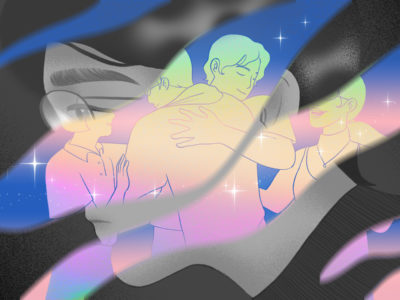
A black and white illustration of a man looking melancholy; a colorful illustration of him surrounded by friends is breaking through the "canvas."

“Why Don’t I Have Any Friends?”