A tour through Europe's past—and what lessons we might learn from its museums to fight authoritarianism today.
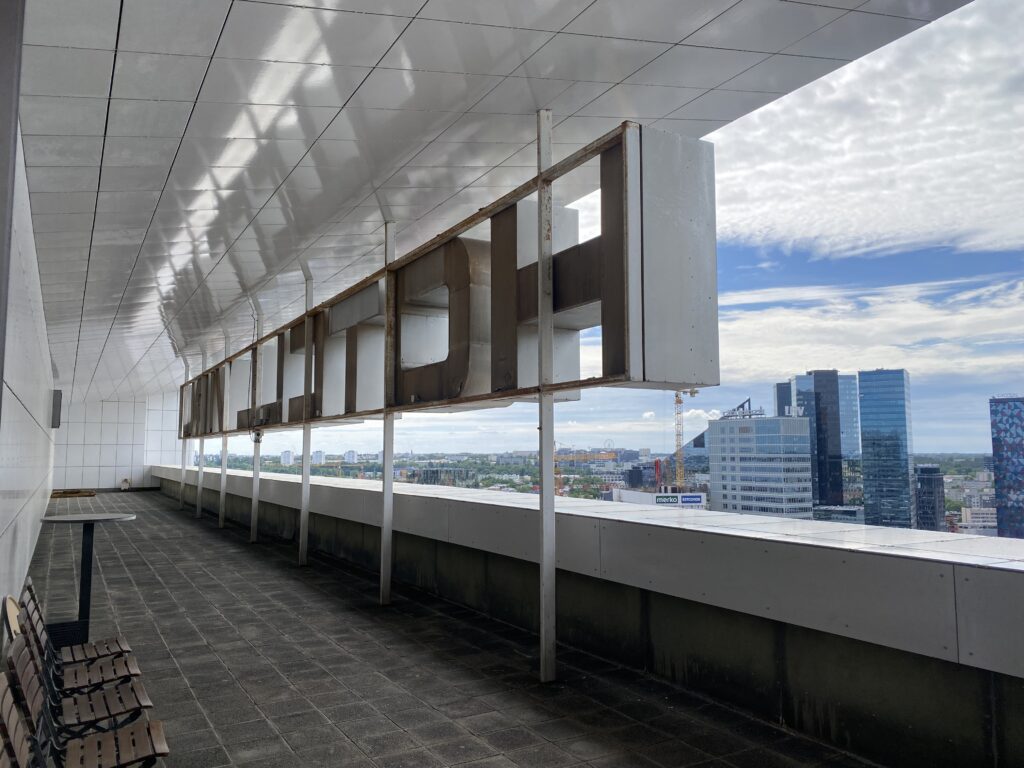
Interrupting the skyline in Tallinn, Estonia is a tall gray building, a relic of the country’s Soviet occupation. It looms over the medieval city, declaring its name in giant letters: HOTELL VIRU. Behind these letters is a secret 23rd floor, where the KGB (the Soviet Union’s security agency) would listen to the hotel’s visitors, as unsuspecting tourists sipping drinks in the restaurant just a floor below would point to the windows above them and ask, “Hey, what’s up there?”
Tourists at the hotel were spied on right up until April 1991, when the KGB left the building and shortly before the Soviet Union collapsed. While the KGB cleared away many important details, enough artifacts were left behind, including a room full of monitoring devices, that a museum was opened in 2011. It’s a constant reminder of what once happened here—a reminder of how personal freedoms can so easily be lost, and a reminder of what’s at the end of the road to authoritarianism. A road that several European countries might be on once again.
The Hotel Viru & KGB Museum is the first stop on my tour as I gather up the scattered pieces of Europe’s recent history of authoritarianism and ask whether we are paying enough attention to our present.
(Photo courtesy of Katie Dancey-Downs.)
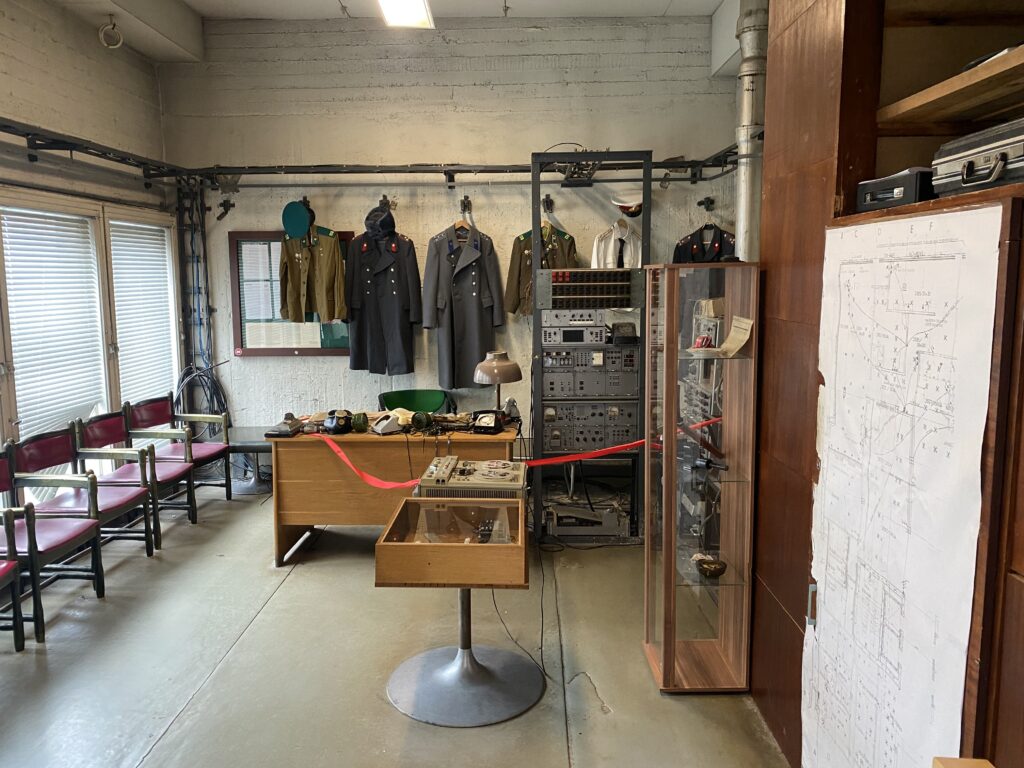
As you walk into what our tour guide calls the “listening room,” it’s the musty smell that hits you first. “Oh no, it even smells like the Soviet Union,” tourists from neighboring Finland are reported to have said, according to our guide, Margit. In one glass cabinet, there is a selection of microphones, recording devices, and transmitters. In the 1970s, when the hotel opened, around 60 guest rooms were designated as special rooms, with an empty room next door so that one of these KGB microphones could be slotted through a small hole. By the next decade, advances in technology meant more rooms could be monitored, with vases and lamps becoming favorite spots for hidden microphones. Sitting on a glass shelf in front of us, there’s even an old handheld camera, once used as a way to collect compromising photographs when poked through bedroom walls.
The guests were not completely oblivious to any of this, Margit says; KGB monitoring was something of an open secret.
“Tourists in general were very cautious in the rooms,” she explains. Visitors would leave the water running, turn up the television volume, or cover vents with towels for privacy.
The microphones weren’t limited to bedrooms, either. Margit directs us to a circular, speckled-green set of cufflinks, fitted out with a hidden microphone. In another cabinet, there’s an ashtray and a gold-rimmed plate monogrammed with a bold black V, both with hidden microphones, too. Perfect for slipping onto the table in front of people of interest.
While this hotel was a symbol of the free Western world to the people who lived in Tallinn, Soviet citizens knew not to get too close to its front doors, unless they wanted to be dragged to the basement for an interrogation. During its prime, Hotel Viru was not unique—any hotel that welcomed tourists in the Soviet Union or Eastern Bloc had a KGB presence.
It’s easy to forget that Margit lived under this occupation, that she knew exactly what it meant to keep away from Hotel Viru. I won’t go so far as to call Margit yet another artifact, but the memories and experiences held by the woman standing before us, in her Viru-branded gilet, are an important part of the picture. She remembers how Estonians used to hold their hands in front of their faces when they talked to each other in the park to fend away lip readers. She remembers how much people wanted to work at Hotel Viru, because they got access to illicit foreign goods and received gifts from the tourists. She also remembers how the hotel preferred hiring married people, assuming they wouldn’t try and couple up with a foreigner—the only accepted reason for leaving the Soviet Union. (This was an appealing option for many, although it came with complications: Divorce was allowed, but taking children to a new foreign life was not—any child born in the Soviet Union was in effect owned by the state.) This atmosphere, Margit tells us, made people easier to control.
“You are free to leave,” Margit says at the end of our tour. “Nobody takes you to the basement, nowadays.”
(Photo courtesy of Katie Dancey-Downs.)
An atmosphere of control
Unfortunately, this “special atmosphere of control” is not consigned to museum display cabinets. In Europe today, illiberal ideologies are finding strong ground, with support for populist parties soaring in many countries—my own, the UK, included.
This atmosphere Margit told us about, and the spying on people of interest, is also still going on in Russia today. Soviet (now Russian) state security has had various different names, including the Cheka, then the NKVD, then the KGB. Nowadays, the former KGB is known as the FSB.
I cannot safely travel to Russia to tell you what this atmosphere is like. I’ve criticized Putin and interviewed enough Russian dissidents that I don’t think I would be particularly welcome. But in the same way that seeing the artifacts in Hotel Viru has brought to life the history of intense surveillance and the atmosphere of terror, there is similar evidence in our current times: from school teachers forced to teach propaganda and patriotic lessons to a state-backed messaging app with extensive surveillance capabilities.
The artifacts in Hotel Viru’s listening room show us how surveillance technology developed over the decades, and that it did not stop when the Soviet Union fell in 1991. Instead, we now have even more advanced technologies to contend with.
This isn’t limited to Russia. In the UK, live facial recognition cameras are being rolled out by police across the country. According to Big Brother Watch, a human rights group that campaigns against the practice, there are 10 regional police forces regularly using the technology, but many others use it for large events. Currently, there are no specific rules governing its use.
Here's how it works: Surveillance cameras snap individuals’ faces and make biometric prints, then compare them to a police watchlist for similar matches, with the software flagging people in real time. A tech-smart way to catch criminals, yes, but here the threat to freedom begins. The technology has been deployed in numerous city centers, with hundreds of thousands of faces scanned on the streets as well as at events like Notting Hill Carnival. There have been cases of people being misidentified, and accusations from Amnesty International that the practice “amplifies racist policing,” as Black people are most often misidentified.
Big Brother Watch notes that it’s usually authoritarian regimes that embrace live facial recognition—Russia and China, for example. The UK does not currently have an authoritarian regime. But pair this with growing support for far-right politics and the UK’s rollback on protest rights—including a new provision to limit “cumulative disruption” of protests—and we might have a problem on the horizon.
Silencing critics
Across the border from Estonia, in Latvia’s capital city of Riga, is the KGB building known as the Corner House. Of all the places I see on my museums tour, the Corner House is the most chilling. The one that stinks the most of death. As I walk around the dark and dingy complex of cells, where the paint is peeling off in long strips, the thing that makes my skin crawl is the knowledge that in this very place people had their liberties stripped in the most inhumane ways. Some of them even lost their lives, simply for opposing the regime.
A young guide shows us around the KGB cells which were used during the first and second Soviet occupations (with a Nazi occupation in the middle). He tells us that people could be arrested for reading a banned book, for joking about the Soviets, or for believing that Latvia could be free.
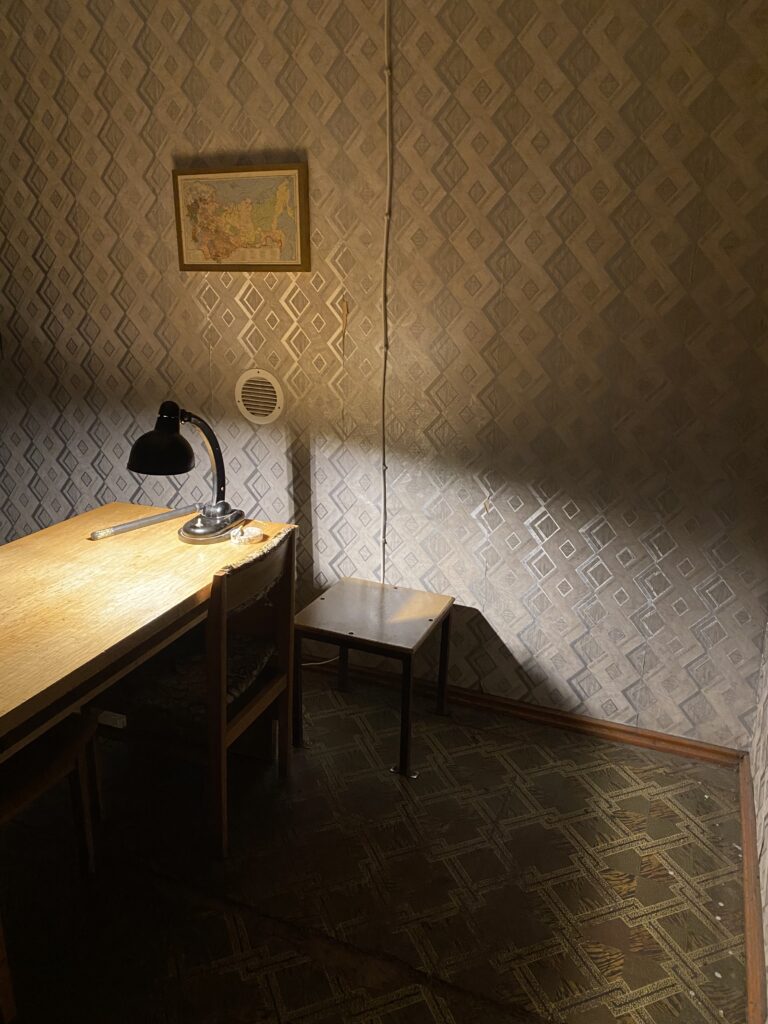
At some point, when we’re standing in the old interrogation room, the guide smacks a rubber stick on the desk and we all jump, a glimmer of what someone under KGB interrogation would face. In one cell, he tells us that 30 people would be inside at once, the window covered so they couldn’t tell what time of day it was, then he flicks on the bright lights so that we’re disoriented like the prisoners would have been. He points to the heating system that would be cranked up high, and the sole bucket used as a toilet and emptied once a day.
(Photo courtesy of Katie Dancey-Downs.)
It's with all this in mind that we are taken to the courtyard. This, he tells us, would have been a reminder to the prisoners of how the free world feels (and a way to make them willing to sign anything, including confessions). Above us there are bars and netting. To stop suicides from the interrogation room, we’re told.
We’re left there for a few minutes, in a space where prisoners would have been allowed to breathe fresh air once a week, walking in circles with their heads bowed, their feet trudging along the same concrete that we stand on now. It is a reminder that not all artifacts live in glass cabinets.
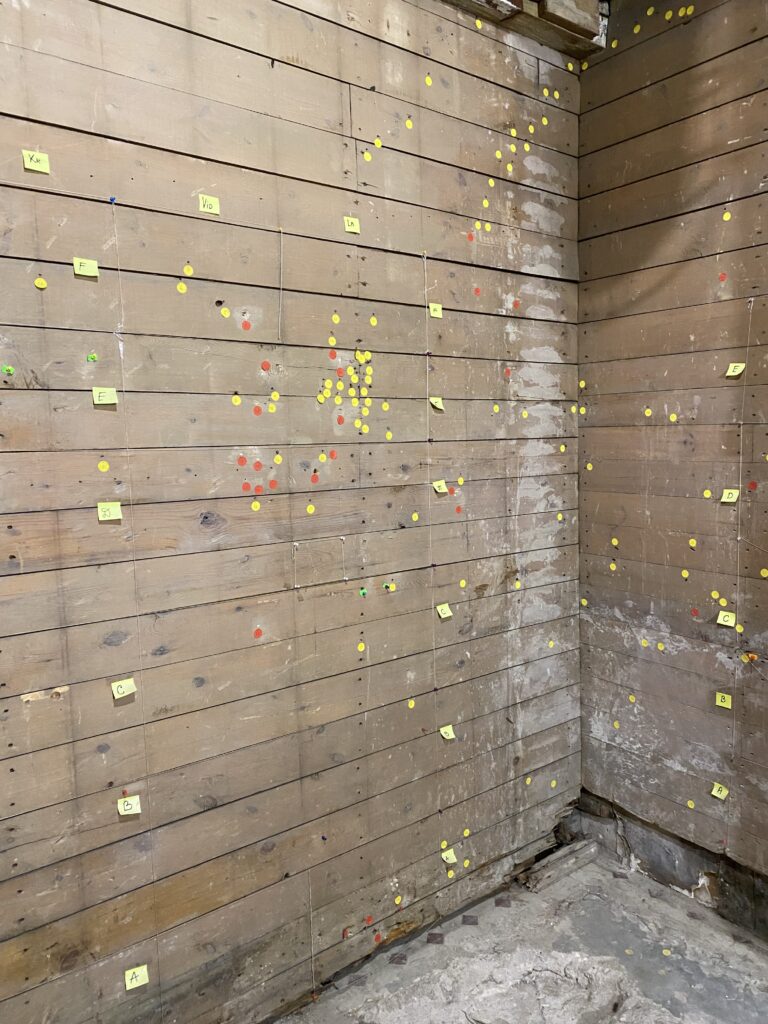
There is worse to come. In what was once an execution room, there are more than 200 bullet holes in the walls, marked with red and yellow stickers. They go back to 1940 and 1941, when prisoners were told to face the very same wall now before us, then shot in the back of the head. Researchers are still trying to find out whether executions continued here during the second Soviet occupation.
“We Latvians know the price of freedom,” the guide tells us. He also reminds us that this type of thing is still happening in Russia today.
Opposition leader Alexei Navalny is one recent, high-profile person to have lost his life while incarcerated by Russia in a penal colony north of the Arctic Circle, where he was killed with a dart frog toxin. But he is far from alone, as many other Kremlin critics or persecuted communities have been imprisoned or killed.
(Photo courtesy of Katie Dancey-Downs.)
This modern unease extends beyond Russia to Baltic states like Latvia, Estonia, and Lithuania. One person in Estonia told me that her daughter talks about how they would escape if their home was attacked. In neighboring Belarus—where state security is still called the KGB, and Russian influence is strong—more than 4,600 people have ended up as political prisoners since 2020. Many of those people are pro-democracy protesters and campaigners who stood up against dictator Alexander Lukashenko’s rule, including his rigged election win in 2020 and then 2025.
A short walk away from Riga’s Corner House, artifacts in the Museum of the Occupation of Latvia shine more light on the country’s dark history. If you’d forgotten about the KGB building already, your memory would be refreshed by this museum’s display of bullet casings and the keys for the prison cells, now housed in a glass box.
I land at a small bottle and blister pack of pills which turn out to be chlorprothixene and other antipsychotics used to “treat” dissidents imprisoned in psychiatric hospitals. This practice is not history, but still happening in Europe as I stand looking at these artifacts. I am reminded of Russia’s punitive psychiatry, where medicated treatment is forced onto political activists who have been sent to psychiatric units in response to their activism, and where they are brutalized.
And then we come to what might be one of the most terrifying tools of Soviet oppression: the concentration and forced-labor camps known as the Gulag. A quilted jacket with the number F358 sewn on the back is hanging up on display, this particular one having belonged to a woman called Leontīne Kriviņa, who in the 1950s was arrested for participation in a youth resistance group and sent to the Norilsk Gulag camp, 400km above the Arctic Circle, where temperatures could drop to -50C.
The personality cult
I’m now standing before a KGB-sponsored weekly newspaper, called Dzimtenes Balss, which translates as Voice of the Homeland. It was written specifically for Latvians in Western exile and—if we were in any doubt about its purpose—published by the “Committee for the Return to the Homeland” between 1958 and 1989. The Soviets wanted to repatriate Latvian émigrés, and propaganda like this was a vital tool in making that happen.
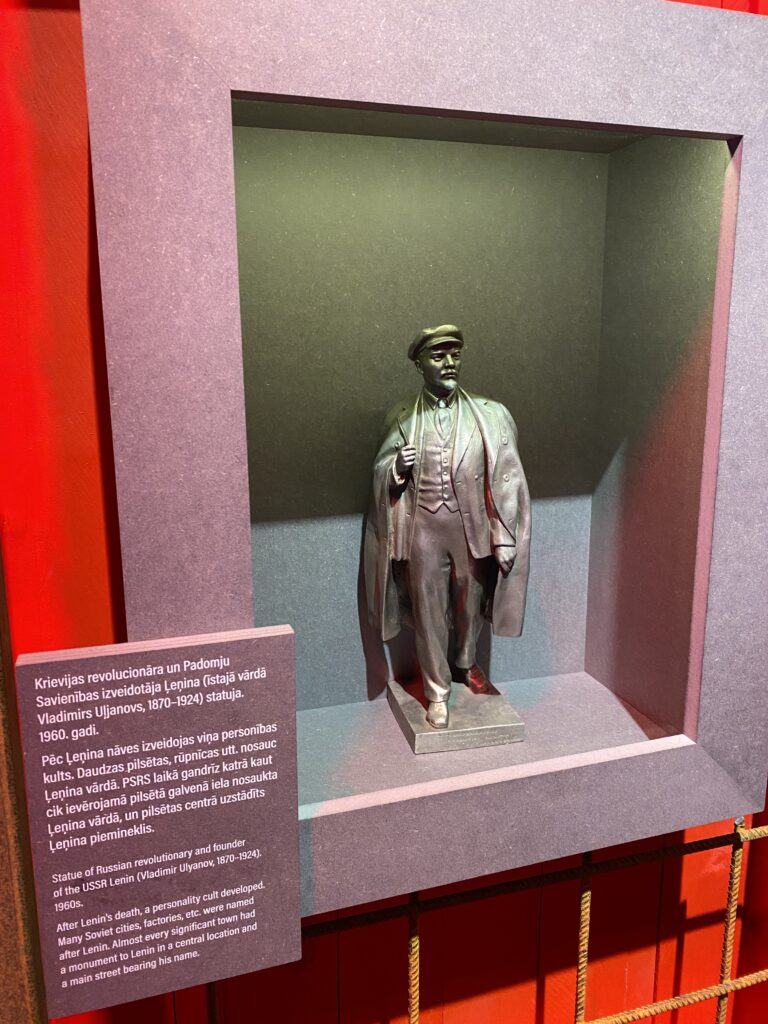
The Soviet Union had a well-oiled propaganda machine. Posters, films, lectures, theatre, newspapers, and radio were ways to shape the collective consciousness, and control society. Among these was the personality cult—which brings us to our next artifact: a small statue from the 1960s of Vladimir Lenin, the founder of the USSR, set inside a black display cabinet. The personality cult around him developed after his death, the description says, with many streets named after him and every significant town home to a monument. The “Lenin Cult” replaced the “Stalin Cult,” an information board explains, around three years after Stalin’s death, when the new leader Nikita Khrushchev denounced Stalin’s policies as a “departure from Lenin’s ideals.”
(Photo courtesy of Katie Dancey-Downs.)
There’s another artifact in this museum that speaks to this history of authoritarianism—a copy of Mein Kampf, Adolf Hitler’s memoir and manifesto. It’s chilling to see it in real life, something so feared and despised across the continent, and indeed the world. Something that represents the personality of the man who led a genocide and brought terror to Europe.
In today’s Europe, we have a personality cult problem once again. But the personalities in question don’t even need to bother writing a book: They have social media at their disposal.
The scapegoats
There’s one more thing that I want to show you in the Museum of the Occupation of Latvia. A fabric Star of David, faded with time, which would have been used by the Nazis to identify Jews. It’s one thing knowing about these yellow stars and how they were used, but it’s another to really see one, imagining who it might have been pinned on. Next to it, there are a couple of strings of numbers on what look like badges. One is brighter, and says 8533. They are identification numbers worn by Jews held in the Kaiserwald Concentration Camp or the Lenta factory in Riga. Tens of thousands of Jewish people were murdered in Latvia during the Holocaust.
While relatively short compared to their Soviet occupations, Estonia and Latvia were both subjected to Nazi occupations during World War II. Many people even welcomed the Nazis, hoping they would save them from the Soviets. What people soon learned is that no authoritarian regime is “better” than another. All are bad.
I went to Kraków, a medieval city in Poland’s south, which felt the full weight of a Nazi occupation from 1939 to 1945. Up to 20,000 Jews were forced into a purpose-made ghetto, before Heinrich Himmler ordered their deaths in 1943 and they were either shot, sent to labor camps, or sent to concentration camps where they remained as prisoners or were exterminated.
In Oskar Schindler’s Enamel Factory, the permanent exhibition Kraków Under Nazi Occupation tells this story. In one of the first displays, there is a circular wooden construction painted in yellows and blues, like something that might belong in an old-fashioned penny arcade, with pairs of binoculars set into each panel. It is a carousel of photographs, the images rendered in 3D, each one frighteningly immersive as it takes my whole field of vision. I have never seen Hitler’s face this close, as he shakes hands with another Nazi, or holds hands with a smiling girl—in the latter, they might even be dancing. Another shows a woman smiling and saluting in a Sieg Heil. Flags are draped from buildings and swastikas plastered on armbands. Not just seeing these photographs from over 80 years ago, but being inside the photographs, makes it all frighteningly real—which of course it was. The people smiling is what’s really terrifying.
As we face our own dangerous political shifts today, it scares me to think about the photographs that our generation’s great grandchildren will look at. Will they also sit in a museum like this, immersing themselves in the artifacts we’ve left behind and ask, “How did they allow this to happen?” Will they struggle to understand how so many people could welcome the far right rallies and shake hands with the populist leaders of today, the way I now struggle with the same? Or will ours be a generation that truly learns from its history, so that we do not allow the most atrocious things that have happened in the past to happen again?
(Photo courtesy of Katie Dancey-Downs.)
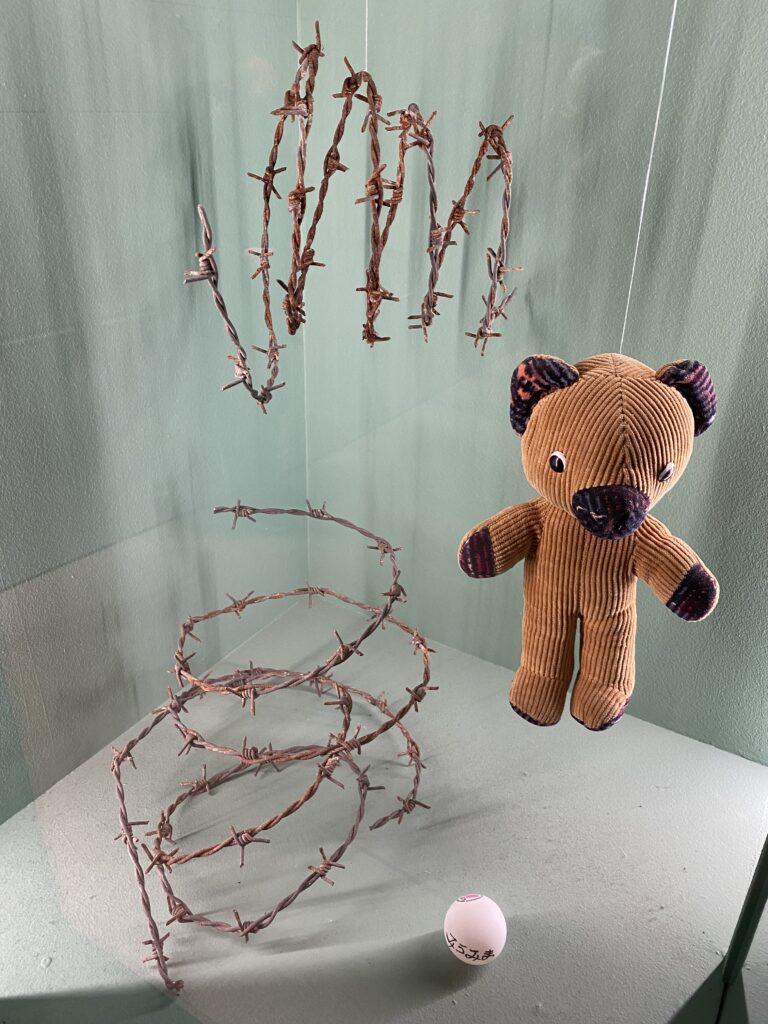
At the end of the Schindler Museum exhibit is a glass case containing two spirals of barbed wire. They are from KL Płaszów, a camp in Kraków built on Jewish cemeteries, which housed up to 25,000 prisoners at a time. It began as a forced labor camp and later became a concentration camp, a place of terror for Jews, Poles, Roma and political prisoners. Although it wasn’t an extermination camp, prisoners were indeed also executed here.
Many concentration camps have been preserved across Europe as a reminder of what happened during the Holocaust, when the Nazis murdered six million Jewish people, as well as other persecuted groups. Decades ago, I visited the Sachsenhausen concentration camp, north of Berlin, on a school history trip. I still remember, vividly, the “Arbeit Macht Frei” lettering on the gates, that awful, twisted phrase that translates as “Work Makes You Free.”
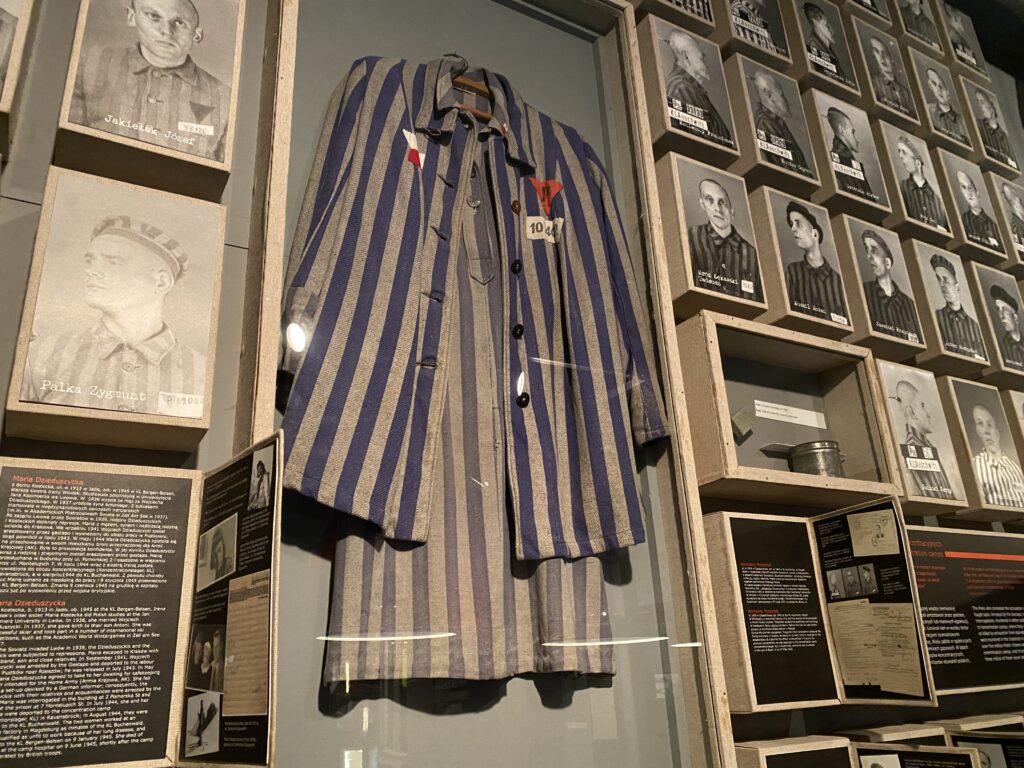
On the other side of Kraków, there is a blue and white striped uniform hanging up in the People of Kraków in Times of Terror exhibition, part of Muzeum Krakowa. A woman named Anna Pieczarka-Mikulskaw wore it while imprisoned in the German concentration camp KL Ravensbrück between 1942 and 1945. Her grandson gave it to the museum.
“Some of them came back home in the uniform,” the museum’s curator Grzegorz Jeżowski tells me.
The Holocaust is perhaps our starkest example of where scapegoating can lead. That barbed wire and that prisoner uniform in Kraków are reminders of what happened in Europe’s darkest hours. And yet today, far-right politicians are still villainizing minority groups, in particular Jews, Muslims, refugees, and LGBTQ+ people. It is not comparable with what the Nazis did, of course it isn’t. But we must never forget where this road can lead.
Today, in countries including Russia, Germany, Italy, and Georgia, there are growing political movements pushing for “traditional family values” and against LGBTQ+ rights. In Bulgaria, too, it is illegal to discuss LGBTQ+ topics in schools. There is a question mark over Hungary, which made global headlines for banning Pride marches under recently deposed strongman, Viktor Orbán. Recently in the German state of Saxony-Anhalt, the far right Alternative for Germany (AfD) won the state election, just falling short of gaining a majority, and leaving the rest of Europe shaken.
(Photo courtesy of Katie Dancey-Downs.)
Why we must visit the museum
Let me caveat what I’m about to say: I am not carrying the weight of lived or generational trauma, as others whose families have been persecuted by authoritarian regimes. But I believe it's vital we go to these museums and face the evidence head on, that we look at Mein Kampf, at the shoes of people murdered by the Soviet secret service units found in burial sites, at the microphones slipped into hotel rooms. Not just to remember what has happened in the past, but to make sure that we develop the necessary critical thinking required to understand and prevent what is already emerging in our present.
The museums I visited are just a handful of those dotted around Europe, with countless artifacts to remind us we are not immune to the possibility of ending up under authoritarianism. In Europe today, there are flickers of these tendencies—and not just in Russia and Belarus.
In Serbia and Turkey, journalists critical of the government live under serious threat, and protesters have faced violent clampdowns in Georgia since the Georgian Dream party claimed victory in the 2024 election—a result which Western pollsters said did not match exit polls. Both Turkey and Georgia’s leadership has been described as authoritarian.
And then there are countries where populist or illiberal politicians are waiting in the wings, steadily growing in popularity. Like in the UK, where there is an ever-growing personality cult around the anti-immigration Reform UK leader Nigel Farage, a man who has been accused by former schoolmates of antisemitic and racist bullying (which he denies) while more recently getting caught supporting a neo-Nazi event and using extremist slogans in personalized Cameo videos. As of May 2026, Reform UK was the most popular political party in the country, before a series of financial scandals consumed discussion around the party, dropping them to second place by August.
Similarly in France, Marine Le Pen’s far right National Rally is the country’s most popular party according to the most recent voting poll. And perhaps most shockingly, as of June 2026, the most popular political party in Germany is the far right nationalist AfD (Alternative für Deutschland), which is shaped by xenophobia, Islamophobia, antisemitism, and hostility to LGBTQ+ people.
Tyrants-gone-by echo in our current world, and illiberal politics serve as fertile ground for authoritarianism.
With all this in mind, the artefacts of terror and extremist politics in Europe’s museums are frightening, quite rightly. But in these same buildings, there are also always artefacts of hope.
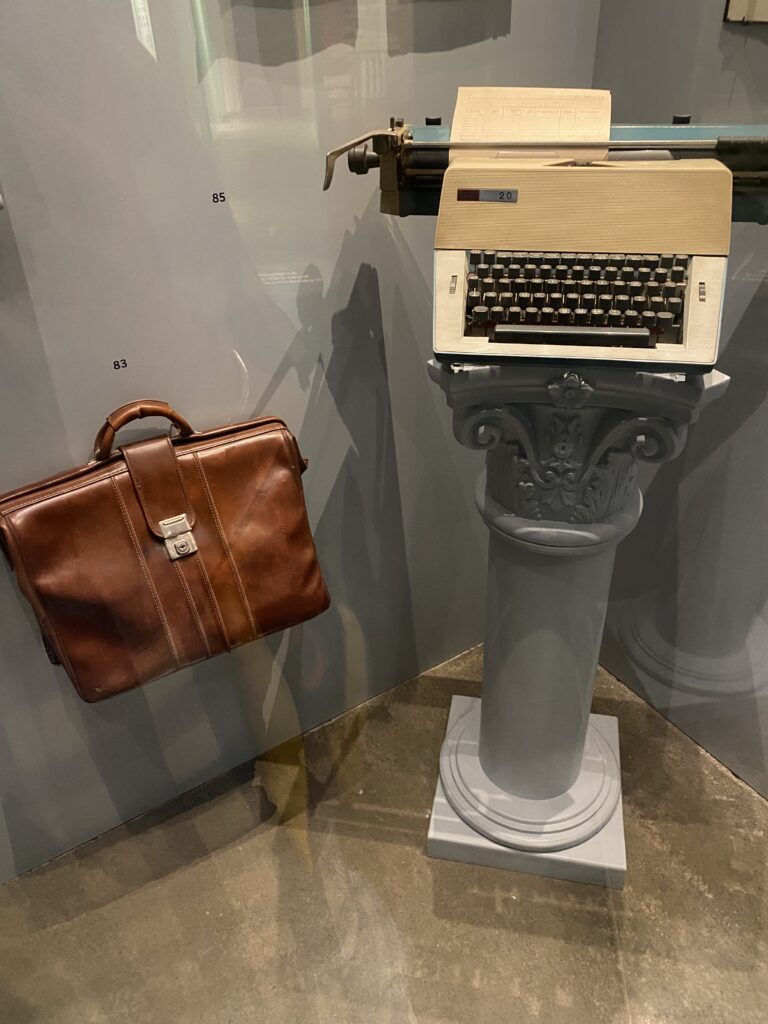
In the Vabamu Museum of Occupations and Freedom in Tallinn, there is not only evidence of the oppressions Estonians faced, but also of their resistance. Hanging up on the wall, a brown leather briefcase that belonged to Enn, an Estonian dissident who was arrested by the KGB numerous times, tells the story of a petition called the Baltic Appeal, calling for the independence of the Baltic states. The briefcase was big enough to carry a secret typewriter, which could be used to make and copy prohibited materials—and there’s one of those here too, a large clunky machine with a teal-colored carriage. They were considered so dangerous by the Soviet Union, that each typewriter had to be registered, but dissidents found ways to trick the authorities. This particular typewriter belonged to Irene, who, according to the museum’s digital guide, exchanged her tent to get it and then used it to make copies of the banned The Gulag Archipelago by Aleksandr Solzhenitsyn, an autobiographical work about life in the Soviet labor camps.
(Photo courtesy of Katie Dancey-Downs.)
Sitting proudly above the typewriter and the briefcase is a piece of samizdat, which dissidents were producing in the decades after Stalin died. These were self-published copies of prohibited texts—novels, journals, cookbooks, anything people wanted to read and couldn’t—which were passed around hand-to-hand, secretively.
There is a letter on the wall, too, signed by 40 Estonian figures from the cultural and scientific communities, against Russification. They collected these signatures in secret and sent the open letter to newspapers—even though ultimately, it resulted in many of them being punished, interrogated, or forced to publicly apologize.
Lastly, in the Museum of the Occupation of Latvia, there’s one incredible artefact that I sit in front of for a long time. It’s a video of people—ordinary people—holding their linked hands up high along the side of the road. It is a singing revolution. In August 1989, 1.5 million people across the three Baltic states—Estonia, Latvia, and Lithuania—created a 410-mile chain from Tallinn to Riga to Vilnius, held hands, and sang for their independence. A few months later, the Berlin Wall fell, and by 1991, all three countries were independent and free of Soviet occupation.
So much of authoritarian control is about isolating people, making them afraid of what they say and to whom they speak. These movements of resistance, then, these items that bond people, these relics, are all precious reminders of how people have resisted before. But we must go to the museum to truly see them. We must go to the museum to find hope in what can be overwhelming times. And we must go to the museum to arm ourselves with the lessons of history in the fight against a repeat of our worst moments.
[post_title] => Warnings from the Museum
[post_excerpt] => A tour through Europe's past—and what lessons we might learn from its museums to fight authoritarianism today.
[post_status] => publish
[comment_status] => closed
[ping_status] => closed
[post_password] =>
[post_name] => warnings-from-the-museum-authoritarianism-europe-history-estonia-latvia-poland-soviet-union
[to_ping] =>
[pinged] =>
[post_modified] => 2026-09-23 00:12:35
[post_modified_gmt] => 2026-09-23 00:12:35
[post_content_filtered] =>
[post_parent] => 0
[guid] => https://conversationalist.org/?p=11041
[menu_order] => 0
[post_type] => post
[post_mime_type] =>
[comment_count] => 0
[filter] => raw
)
The real price of admission for Julie Mehretu’s Subprime Mortgage Mural.
Cultural Currency is a bi-monthly romp through the intersections of art, capital, and politics with writer Cara Marsh Sheffler.
A very distressing thing happened recently: I agreed with Steve Bannon. In a recent interview with the New York Times’ Ross Douthat (more distressing still: being at such a loss about our hellscape slide into dictatorship that I voluntarily listened to Ross Douthat), Bannon said, “The financial crisis of 2008 brought on by the established order…is one of the greatest financial scandals in the history of this country.” By most estimates, over 8 million jobs were lost, and unemployment in the United States more than doubled. When the housing bubble burst, 3.1 million Americans filed for foreclosure—or one in every 54 homes. Meanwhile, the banks that helped perpetrate the crisis profited handsomely, as they successfully gambled on the country’s housing market collapse. This titanic feat of moral turpitude and greed was dissected by Michael Lewis in his book The Big Short: Inside the Doomsday Machine, later made into a film. “None of the crooks or the criminals that did this were ever held accountable,” Bannon insisted, and, yes, I agree. ”None of the elites in this country were ever held accountable for it.”
The elites who benefited weren’t just bankers, either. In the midst of that crisis, artist Julie Mehretu received a $5 million commission from Goldman Sachs to dominate its headquarters’ lobby in Lower Manhattan. Goldman, of course, was one of the banks most embroiled in the Subprime Mortgage Crash—and by accepting its money, Mehretu indirectly became embroiled in it, too. Completed in 2009, the commission, titled “Mural,” was described by Calvin Tompkins in the New Yorker in 2010 as “[h]undreds of precisely defined abstract shapes in saturated colors—small dots and squares, straight and curving lines, larger geometric or free-form shapes ranging from several inches to several feet in length—[moving] across [the wall] in an oceanic sweep.”
For the sake of clarity and precision, this article will henceforth refer to the work as the Subprime Mortgage Mural. And while at the time it was unveiled, Tompkins alluded to a touch of hand-wringing, he very quickly exonerated the artist for accepting Goldman’s money:
"Financial institutions have been taking a lot of hits lately for their role in precipitating the fiscal crisis. The behavior of Goldman Sachs, in particular, has infuriated nearly everybody, from Congress and the Federal Reserve to the New York Times editorial board and Rolling Stone, which described the firm as ‘a great vampire squid wrapped around the face of humanity’…None of this was in the air in 2007, though, when Goldman commissioned Mehretu to do the painting."
For the record, the crisis definitively started in August, 2007. But regardless, Tompkins further exonerates Mehretu by claiming that, allegedly, most of the money didn’t end up in her pocket: “The firm paid five million dollars for ‘Mural,’ about eighty per cent of which went into fabrication costs (including salaries for up to thirty studio assistants) during the two years she spent working on it.” (I would love to see a budgetary breakdown of these expenses given what I know of the lives of my peers who work in the arts and in fabrication, but alas.)
Mehretu has been back in the news as of late—this time not for accepting a large sum of blood money, but for spending it. Last autumn, it was announced she had dropped a $2 million donation to the Whitney to ensure anyone under 25 would have free admission. On the face of it, this was a lovely gesture. However, it begged the question: If the end goal was to make the museum more accessible to all, regardless of income, why was that inclusion sponsored by someone who could only afford to pay for it as a result of perhaps the most violent shift of capital and wealth redistribution in our lifetimes?
It wasn’t the first time the museum had accepted this kind of money, either indirectly (through donors like Mehretu) or directly (the Whitney is also sponsored by Goldman and Bank of America and many other fiscal institutions). But if homeownership is the main means of creating generational wealth in this country—wealth that BIPOC have been historically and repeatedly shut out of in the United States—it should feel especially troubling when a cultural institution is being funded by the banks most responsible for why so many people can’t afford the price of admission in the first place.
This problem isn’t uniquely American. Whilst grappling with its own quaint connection to empire and looting, the British Museum is also struggling to make the museum free for all…whilst taking money from British Petroleum to achieve it. France and Italy, though historically proud of their august, state-sponsored cultural institutions, are increasingly taking large-scale cultural funding from the private sector, including fashion conglomerates such as LVMH Moët Hennessy Louis Vuitton and Kering. Those two companies largely underwrote the recent restoration of Notre Dame.
Yes, ghastly people have been patrons of expensive art throughout history. But they did so, in many if not most cases, to trumpet their own glory and paint what we might call the victor’s narrative. Then, as today, we need to ask who is letting us in the door and what they want us to see and why. If we continue to let such people and corporations fund publicly accessible art in the United States—which could charitably be called an endangered democracy—what stories will our cultural institutions tell? What values will they have? If we are having this conversation around painkillers and petroleum, then it is essential that we have it about banks, too.
Let us begin with the Subprime Mortgage Mural itself. In that same New Yorker piece, aptly titled “Big Art, Big Money,” Tompkins describes the Subprime Mortgage Mural thusly: “There are four layers of markings in ‘Mural,’ and many of them implicitly refer to the history of finance capitalism—maps, trade routes, population shifts, financial institutions, the growth of cities.”
However, you almost definitely wouldn’t be able to identify any of this when looking at it. This is work that is, in a word, corporate—as is much, if not all, of Mehretu’s work. It won’t inspire the security guards to discover class consciousness when they clock in. It won’t drive the bankers to jump off the ledge in shame (not that the windows open wide enough). Mehretu’s work is slick: so slippery that meaning slips away, elusive as that subprime lending rate or 20th-century retirement plan. It is as vague as the name of a new miracle drug: No one knows how it works, only that it costs a shitload of money.
And, lest you doubt my judgment on this, or Tompkins’, or the fact that Mehretu took $5 million from Goldman right after the fucking Subprime Mortgage Crash (did she ever stop and wonder…too soon?), American Express also entrusted Mehretu to “re-imagine” teeny-weenie murals on limited edition Amex Platinum cards in 2021, a collaboration dressed up as a “sponsorship” of the Studio Museum in Harlem. It is hard to imagine how anodyne art must be to literally grace the front of a credit card, but one has to hand it to Mehretu: She is a very canny capitalist at any scale. Her work thrives on institutional affiliation.
Indeed, what does it mean to be a corporate darling of an artist? What does it mean to take such ill-gotten gains and produce what purports to be social commentary? After all, Mehretu’s stated aim is to marry political commentary and landscape art. In a talk with Art21, titled “Politicized Landscapes,” she said, “The abolitionist movement, the Civil War, the move towards emancipation, all of these social dynamics that are a part of that narrative we don't really talk about in regards to American landscape painting. And so what does it mean to paint a landscape and try and be an artist in this political moment?"
Cosmetics, of course, is essential to the politics of the Subprime Mortgage Mural and the Whitney donation it enabled. And Mehretu poses an especially illustrative case of the ethical dilemmas incurred by funding a museum with private sector money. This is because the optics of her donation involved not merely her art, but also her own biography. The Whitney has courted its own fair share of controversy around such treacherous PR terrain, from a curatorial scandal around a painting of Emmett Till in the 2017 Biennial and a board member’s ties to tear gas to accusations of union-busting and exquisitely ham-handed social media that gets no love in the comments section. Perhaps it's no surprise that a museum named after a robber baron is slow to realize it has to cover its woke bases.
Unsurprisingly, articles about Mehretu tend to spill a fair amount of ink on her identity, as does the Whitney’s artist biography of her. However, I would wager that you wouldn’t be able to guess one goddamn thing about her if you looked at her paintings. Yet, she insists they are political. In a Guardian profile titled, “Julie Mehretu paints chaos with chaos – from Tahrir Square to Zuccotti Park,” Mehretu says of her process of creating a large-scale abstract work about the uprising in Egypt, “I don’t ever work in a way where something is an illustration of an event, but when something is occurring at the same time I see it as very informed by that, I was in here working on New York, and I’m drawing, and this thing is unfolding: I have al-Jazeera on the computer livestream, I’m paying attention to NPR…So I was looking architecturally at New York, and then suddenly I’m back in Africa. And then the painting grows through drawing after drawing, layer after layer.”
Looking at the piece one wonders: Is it insidious? Is it beneficent? It is the upholstery on my Aunt Sarah’s couch and curtains in her high-rise on Yellowstone Boulevard in Queens? Shapes skip and scamper about, lines zig and zag, maybe to evoke a network of some kind. There is color, pop, crackle, lacquer. There is balance, there is motion, there is form. There is sinew, texture, chaos almost threatening to find order and just the reverse: a hint of breakdown and frenzy. This is probably the most compelling aspect of the work to my eye, but also a damning endorsement of stasis: No matter which way you view it (a wave good-bye or hello to a world order), flux is the norm. Change is a threat never realized, reduced to a flat trophy on an enormous wall. The work is fundamentally corporate in that, it’s decorative and, upon viewing it, mostly you will glean that it is a megalithic mural that occupies VERY expensive real estate. That is what matters most to corporate art, ultimately: The placement is where it derives its power. In this light, it’s ironic if not hilarious that Mehretu often claims to reference the Occupy Wall Street movement, including in her Guardian interview. She has, if nothing else, come to occupy Wall Street.
Is Mehretu’s identity or community conveyed in her paintings in any meaningful or discernible way? Her work is often quite beautiful and inarguably well made. And art, of course, doesn’t have to say anything about politics at all. However, if you are going to spew political opinions, as she did for the Guardian or for her show at the Whitney in 2021, maybe don’t take that Goldman money when all those dreams of home ownership and generational wealth are barely cold in the ground. One cannot speak truth to power when one is on power’s payroll. In that sense, truthfully, it doesn’t matter what Julie Mehretu looks like or to whom she is married: She has still been bought.
Much has been made recently of how our so-called Culture Wars have distracted from a more obvious Class War. America is famously allergic to the idea of class, even if it’s as endemic and obvious as our obsession with faith, all while we claim to be secular. Last month, Laverne Cox spoke incisively of how America likes to scapegoat trans people, who make up less than 1% of our population, while billionaires, who also constitute 1% of our population, are actually the source of our woes. Indeed, just how badly have we all been played when Laverne Cox and Steve Bannon can agree on something?
As both museum patrons and people, we deserve public art and institutions that are better than the identity politics pushed by those who do nothing but take the money and run—only to pay lip service to inclusivity during New Yorker interviews. But the same political class of billionaires that has bought both political parties has also bought all of our cultural institutions. The big donors are the same on every wall and at every gala. If this tautological clusterfuck feels familiar, it should come as no surprise that Mehretu is one of the Obamas’ favorite artists. Of course the Democrats have that special distinction of believing the lie that they, too, can take billionaire money but somehow represent the marginalized. In reality, they are spineless whores bought by the same tax evaders as the Republicans—and the Whitney—just less honest about it. Mehretu is tellingly on Obama’s walls and on Amex cards alike—much like the Democratic party is enamored of the image of politics while taking objectively filthy money. Representation and promises of accessibility feel pretty hollow when they are sponsored by the same people who screwed millions of Americans out of their homes. This is a form of representation that is optics and optics only when people’s actual lives are getting crushed by a larcenous economy.
Sure, art does not have to be explicitly political to be good, but this art in particular is looking an awful lot like the worst of neoliberal politics right now: girl-boss abstraction about commerce that took subprime lending crisis blood money from Goldman and gave it back to the Whitney as penance. Mehretu’s art and the economy surrounding it encapsulate how identity politics have been cynically manipulated by big money on the alleged left, which isn’t left at all: It is money serving money, which is all money will ever serve. It is art about ignoring the little people. It is art for a media landscape that has no idea what the hell anyone in this country is thinking and cannot predict a single fucking election. It is art that restates the obvious opaquely and with no particular flair, like Pete Buttigieg explaining why all the planes are falling out of the sky on MSNBC. It is art that has the gall to reframe a whole lot of nothing as something beneficial, when all it does is launder the money and decorate the walls of the very, very rich, while lying about inclusivity to the poor. In short, it is art that confirms this sinking feeling that we’ve all been had by some great circle jerk every time oil execs, technocrats, bankers, and other swindlers hold open the museum doors for us: Have a little culture! As a treat! And it’s another reminder that, like our political institutions, we need our cultural institutions to represent something other than big donors who preach inclusion while robbing us blind.
[post_title] => Free Entry, but at What Cost?
[post_excerpt] => The real price of admission for Julie Mehretu’s Subprime Mortgage Mural.
[post_status] => publish
[comment_status] => closed
[ping_status] => closed
[post_password] =>
[post_name] => julie-mehretu-mural-goldman-sachs-housing-financial-crisis-whitney-museum-new-york-art
[to_ping] =>
[pinged] =>
[post_modified] => 2026-08-03 23:17:35
[post_modified_gmt] => 2026-08-03 23:17:35
[post_content_filtered] =>
[post_parent] => 0
[guid] => https://conversationalist.org/?p=8002
[menu_order] => 26
[post_type] => post
[post_mime_type] =>
[comment_count] => 0
[filter] => raw
)
How can any institution be ethical when it's an obsequious representation of the values of its extraordinarily rich funders?
Follow the money. That was the dictum that propelled Woodward and Bernstein in All the President’s Men; it was also the hunch Andrea Fraser followed when she published 2016 in Museums, Money, and Politics—essentially the museum world equivalent. This latter work touts a cast of familiar characters—Basses and Sacklers and Kochs, oh my!—navigating finger food in evening wear, far from the madding pillories of MSNBC, but still dedicatedly pushing the same agenda through their presence on museum boards. This is America: Perhaps it’s only natural that Harlan Crow, the same hand that greases Clarence Thomas, has built a Dallas museum of Asian Art (to say nothing of his so-called “Garden of Evil”). Or that it took Laura Poitras’s 2022 documentary about Nan Goldin’s crusade against the Sackler family getting all the way to Oscar season for their misdeeds to actually come to light. Follow the money—at any museum or in any national political campaign (because yes, it’s the same money, as Fraser deftly and exhaustively points out)—and it will only lead to one familiar place: disappointment.
Or, in this case, a multimillionaire’s doorstep.
Shelby White, whose money built the Metropolitan Museum of Art’s Greco-Roman wing, visited by more than 3 million people annually, is in a pickle. An avid collector of antiquities, White is no stranger to law enforcement, having previously cooperated in repatriating artifacts she had purchased to their countries of origin, including Yemen, Turkey, and Italy. Yet little could have prepared her for the sublime institutional irony of the scandal that unfolded in her living room earlier this year. According to The New York Times:
[The police] showed up, unannounced, with a search warrant at her spacious Sutton Place apartment in Manhattan at 6 a.m. The rooms inside were filled with antiquities, some of which had been purchased from dealers who would later be accused of trafficking in illicit artifacts. Many were displayed in their own nooks or cabinets, and set off by lighting that enhanced their appeal. “It is literally a museum,” said Matthew Bogdanos, the head of the district attorney’s Antiquities Trafficking Unit, which visited the apartment several times.
The collection removed from her apartment included were four stolen sections of an Anatolian columned sarcophagus valued at $1 million, a bronze statuette of the emperor Lucius Verus valued at $15 million, and a Roman bronze bust of an unknown man valued at $3 million—by any definition, a veritable trove. Rather than marvel at the secluded museum she’d amassed, however, I found myself wondering: What is a museum if not a rich person’s living room someone deigned to open to the public? And what, exactly, is the point of putting all of this stuff in one place?
Most of the objects we see displayed in museums grapple with the Big Mysteries. Whether oriented toward art, culture, ethnography, or science, a museum enshrines systems of understanding it all. These institutions collect, constellate, and disseminate a narrative of perceived truth. The problem inherent to any of this is the same as with any narrative: the limitations (and biases) of the narrator. Humans are blinkered by the boundaries of their own perception and countless barriers to understanding imposed by the context and times in which they live. Heap on top of this the basic problem of who has the privilege to curate or collect in the first place, and—last but not least—who holds the aforementioned purse strings that keep the lights on at any institution in question, and the narrative gets muddy. Joan Didion famously wrote that we tell ourselves stories in order to live, but what are we keeping alive?
At its core, an art museum is essentially a narrative of empire. If, as Napoleon quipped, history is a set of lies agreed upon, a museum is their physical manifestation. Aptly, the Met—the grandest, most august museum in a city that likes to think of itself as the center of the world—boasts all the baubles that connote having made it, including a few once owned by Napoleon himself. Cleopatra’s needle, the Temple of Dendur, Greek goodies faded polychrome or ghostly blanched, Persian carpets, Old Masters, Estruscan jewels, Japanese lacquer, South Asian sacred sculpture, Chinese vases, Senegalese masks, Polynesian canoes. The good, old stuff! All in one place, the best of it all from every corner of the globe.
But the best according to whom? The Met is a museum of objects rich people, like Shelby White, value; it is a narrative of wealth and what signals it. Accordingly, the place has no shame at trafficking in stolen goods, and enlisting lawyers to stonewall the looted parties (e.g., Greece) with reams of contracts and receipts to establish provenance. It’s a Red State mentality with Blue State wall text. The institution has the dirty opioid moneyand the dirty oil money. Its worldview is unabashedly human-centric, each wing featuring a different culture trying to figure out what the hell it all means—most often, a whole lot of fucking, being born, and dying. Religious fanaticism is rife. Social hierarchy abounds. Women are mostly subjugated and objectified. The Hall of Arms and Armor would make any 2nd Amendment enthusiast blush with delight. Inveterate elitists, the Met celebrates the winners. It doesn’t have time for the downtrodden or the poor because they didn’t leave nice enough shit behind. Or any shit at all.
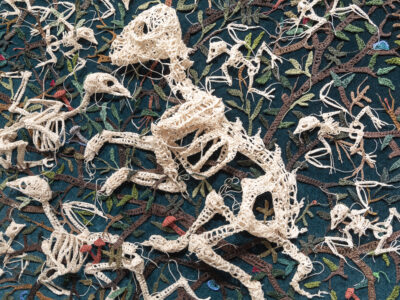
This is the tale nailed literally and metaphorically by Andrea Fraser in her book and throughout her career as a performance artist. As a writer, similar institutional critique has been my own stock and trade: Recently, I was engaged by artists Caitlin McCormack and Kat Ryals to write text for their exhibit at Elijah Wheat Showroom, Souvenirs of the Wasteland. The show imagines what a museum would look like after the apocalypse, specifically imagining objects more akin to the Met’s cousin across Central Park, the American Museum of Natural History. In a sense, the show is a museum of unnatural history—a curated glimpse of the world left behind after human intervention. In this installation, microplastics have usurped the Hall of Gems; the Great Pacific Garbage Patch drifts triumphant as a continent—terra firma on a planet mankind has rendered uninhabitable. McCormack and Ryals offer a survey of what thrives in the Anthropocene’s wake: mutant lifeforms melded with garbage, eerie radioactive hues, and dark odes to effluvium, ephemera, fast fashion, and immortal trash.
Contributing wall text for this show gave me the chance to think about how the AMNH presents another model of institutional storytelling: What, one may ask, is a museum of natural history attempting to catalog? And why and how is this very peculiar blend of objects in it? How do we get from, say, a tree stump from the Redwood Forest to a Chinese wedding chair? The museum-hopping visitor will notice the same object that is considered “art” on the east side of Central Park becomes a “craft” once it has migrated to Central Park West. “Folklore” presents a thorny problem as a catch-all term when it refuses to elevate a cultural practice to literature, organized religion, or art, thus othering whichever culture it is attempting to include. The AMNH is a blind spot, enshrined. And despite seeming more innocent than the Met, the AMNH is also on the take from the Brothers Koch; Richard Gilder, for whom the museum’s new wing is named, specialized in short-selling.
Still, the AMNH attempts a more science-centric—ergo, necessarily progressive—worldview. True to progressive form, it also cannot see why its stances are problematic. It is a paean to preservation full of dead, endangered animals. There are literal dinosaurs. Its Hall of Human Origins is named for the family of an unevolved former NY governor. Everyone claims they are there for some granola story of the Earth’s origins, but really, the whole operation is funded by the Hall of Gems—containing some of the bloodiest of diamonds and other problematically sourced stones in the world, much of it tracing back to America’s echt-capitalist, J. P. Morgan.
AMNH is also a core sample of outmoded notions of progressivism layered on top of one another and bisected in vitrines, from problematic conservationist Teddy Roosevelt (whose hats are on display downstairs) to present patron saint of PBS and New York native son Neil deGrasse Tyson. It makes one wonder not only about the vastness of the universe but how our own NPR perspective on it will soon become invalid. Margaret Mead was undoubtedly what would have passed as “woke” in her own time, but her legacy is displayed in a way in the AMNH that means the only name and face in the whole area of the museum that concerns Oceania is that of a white woman. She is further celebritized in a warren of rooms strictly about her, and while there are attempts to correct the narrative, they are inconsistent and frequently at odds with one another. On the first floor, the diorama of Peter Stuyvesant meeting unnamed Leni Lanape (Hackensack) has an incredibly powerful treatment of corrective scholarship on the glass. Meanwhile, upstairs, we find “exotic” cultures othered in dioramas depicting far reaches of the globe from Tashkent to Timbuktu; but we don’t see, for example, a diorama populated by a blonde Swedish family arguing over which allen wrench to use in front of some IKEA furniture.
Both the Met and the AMNH are flawed. One model tells the story of the human perception of meaning and our quest to make the mortal coil a bit more bearable; it is a story of status and hierarchy, and the ugly, inescapable truth that inequality and the suffering of most are the cost of beauty and luxury for few. The other model tells the story of the impact of humans on Earth, with the great caveat that it’s the world’s most unreliable narrators telling it: humans. (And, again, the ones footing the bill to even tell the story in the first place are arguably some of the worst among us—many of whom directly profit from the planet’s degradation.)
No matter how intricate or well researched a palimpsest—at any cultural institution—it will never solve the problem of perspective. We can never escape ourselves or the times in which we live. Maybe this is the best we ever do—and maybe that’s fine. Maybe seeing museums as deeply flawed but instructive monuments to that attempt at understanding, rather than as definitive catalogs, is the best way to allow them to teach us about ourselves. Sometimes, we need the reminder not to believe something just because it’s written on the wall.
[post_title] => There's No Such Thing as an Ethical Museum
[post_excerpt] => How can any institution be ethical when it's an obsequious representation of the values of its extraordinarily rich funders?
[post_status] => publish
[comment_status] => closed
[ping_status] => closed
[post_password] =>
[post_name] => ethics-museums-metropolitan-museum-of-art-american-natural-history-shelby-white-sackler
[to_ping] =>
[pinged] =>
[post_modified] => 2026-08-04 18:03:10
[post_modified_gmt] => 2026-08-04 18:03:10
[post_content_filtered] =>
[post_parent] => 0
[guid] => https://conversationalist.org/?p=5993
[menu_order] => 76
[post_type] => post
[post_mime_type] =>
[comment_count] => 0
[filter] => raw
)