WP_Post Object
(
    [ID] => 11044
    [post_author] => 15
    [post_date] => 2026-10-15 12:22:02
    [post_date_gmt] => 2026-10-15 12:22:02
    [post_content] =>
Why I think looksmaxxers have more in common with trans people than they'd like to admit.


“Hi, nice to meet you, I’m Allison.” This is a sentence I have fought to say, yet despite my warm intentions, occasionally, what the other person hears is an out of tune piano. Their confusion doesn’t typically last for more than a breath, but to me, that brief pause can feel like an eternity.


I don’t believe this apprehension is always derived from hate; as humans, we constantly look for boxes to put people in, to help us understand one another. Maybe that momentary hold is from the contrast between my feminine name and my “masculine” voice. Maybe it’s simply my own internal struggles. But on days where I am not busy questioning if my rights have been taken away yet, I have a peculiar thought: Are trans people the only ones who experience this introduction anxiety, or do cis people feel it, too?


In previous decades, there were aesthetic archetypes—such as the tomboy, the metrosexual, or even the neon-racoon-striped-hair scene kids—that bent the gender binary, allowing room for desperately needed gradients of self-expression. Each of these have lost their cultural tether over time. Twenty years ago, what made a man and what made a woman appeared to be looser. Today, the culturally dominant aesthetics are the “clean girl,” the “gym bro,” and “stealth wealth.” The diversity of self-expression has been snuffed out.


This cultural shift has taken place alongside American politics using trans existence as an attention-diverting scapegoat. The societal pressures and heightened scrutiny placed on trans bodies has had some unforeseen consequences: Cisgender people are now suffering from more rigid standards of gender, too. Women athletes are being subjected to invasive sex testing for not fitting what society deems “woman enough.” The WNBA is being targeted as a political hotbed of discourse centered around the league not having a clear enough definition of what a woman is, resulting in routine harassment both on the court and off of it. Heterosexual dating has increasingly been framed by influencers and “experts” alike as something transactional, asking how the man can provide and what the woman can offer in return.


Over the past several years, there has also been a rise in lifestyle content targeted towards men centered around hustle culture, exuberant wealth, and extreme fitness—broadly referred to as the “manosphere.”


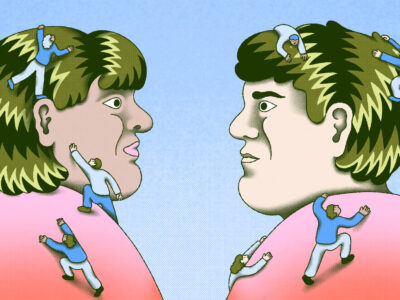
Within this sphere of influence is the “looksmaxxing” community, a collective of individuals who have game-ified their appearance and, nonconsensually, the appearances of everyone else. Originally a cross-section of manosphere and incel (involuntary celibate) content, this collective of mostly men is fixated on making themselves as attractive as possible, as determined by what looksmaxxers deem to be a “mathematical” formula. Their scale ranges from zero to eight (“chud” to “chad”), but the online forums are very quick to tell you that an eight is almost impossible to achieve—only one in twelve billion will ever reach that score. Do these men fear being a 4.5, I wonder? When they say “nice to meet you,” do they worry that someone might notice their canthal tilt is slightly out of the ideal five-to-seven degree range?


I find a strange amount of empathy for these fears: I am always working towards having people perceive me how I see myself internally. The journey of self-actualization is not an easy one, but whether looksmaxxers want to admit it or not, it's also one that we share. Looksmaxxers message each other on forums asking where to get a reliable peptides dealer, or what methods they can use to ascend the scale. Trans women flock to forums to do much of the same, seeking advice on how to do their makeup, or tips for passing. Passing and ascending might as well be synonyms. To “pass” is the coveted goal for many of being perceived as a cisgender woman, to “ascend” is to get one step closer to becoming the ideal man. There is more in common between us than even I’d like to admit. (Maybe if they weren’t so hateful, we could even form a union one day.)


I struggle to share this empathy willingly, as the poster boy for this culture is a 20-year-old influencer named Braden Peters, who goes by the name “Clavicular.” Peters currently has over one million followers on TikTok, and was even profiled by The New York Times earlier this year, where he was referred to as a “social media sensation” and “a beacon for a group of narcissistic, status-obsessed young men.”


This profile feels especially frustrating, in part for the legitimacy it has afforded both Peters and the looksmaxxing movement. In it, he does not shy away from expressing his belief that he is above the law. (A belief underlined by an image he posted to Twitter/X stating “men’s facial features may sway criminal sentencing.”) There is even a subsection titled “No More Politics" where the reporter dives into Peters’ use of racial slurs, as well as all the time he has spent with self-proclaimed white supremacists and influencers charged with rape and human trafficking, including brothers Andrew and Tristan Tate, arrested in Miami last July.


 In September 2026, Peters—like his friends—was also charged with rape, after allegedly drugging and raping a 17-year-old girl. These charges are connected to a separate sexual battery charge from earlier this year.


The looksmaxxing movement sits comfortably nestled under the manosphere umbrella alongside other hateful movements, such as blackpill and incel cultures. (In fact, many looksmaxxers often post using the same hashtags.) Like its sister movements, there is also a consistent pattern of violent escalation and dehumanization of anyone who doesn't fit within the system that looksmaxxers follow, ranging from cyberbullying to explicit forms of interpersonal physical violence.


This is, perhaps, the most crucial difference between transgender people and looksmaxxers. While arguably victims of the same cultural pressures, looksmaxxers are able—and choose—to identify with the aggressor. The most horrifying part to me in all of this is that Peters’ act of violence might not be a disqualifier for adoration, or continued participation in the most problematic aspects of the looksmaxxing movement. As looksmaxxing has unfortunately made its way into the cultural zeitgeist, I personally refuse to allow it to separate from its hateful, racist, misogynistic origins. But to create fundamental change, all of us must do the same: Peters’ case must be a wake up call to not de-sensitize ourselves to this movement, including the inevitable harm it has already caused, and the harm it will likely continue to cause if left unchecked.


Looksmaxxers’ relationship to gender expression and identity hasn’t ultimately protected them from judgement (and depending on how Clavicular’s case plays out, perhaps neither from consequence): The brutal scrutiny they’ve placed onto others has ended up reflected back toward themselves. Although most looksmaxxers are born male, society's expectations of men have gotten more extreme. Within manosphere culture, you must be fit, tall, and disciplined. So if you’re a short man who experiences joy, you might feel incongruent with your gender. Like many trans people, they, too, are experiencing a form of gender dysphoria, a psychiatric diagnosis that refers to the psychological distress that results from an incongruence between one’s sex assigned at birth and one’s perceived gender identity. Rather than an internalized journey, however, looksmaxxers continuously take in these negative external pressures and fire them back at each other—along with everyone else. Peters himself has stated that “men aren’t supposed to be happy.” The difference is that looksmaxxers believe others should suffer alongside them, and that often, they should ultimately suffer worse.


It's important to acknowledge that trans women are not immune to toxicity. There are niche corners of the culture centered around categorizing each other as “doll” or “brick,” which to some, simply translates as passing or not passing. Thankfully, this is not the dominating narrative for the trans community—it's actually the opposite: No matter where someone is on their self-actualization journey, whether day negative ten or day one hundred, our appearance doesn’t change that we are women. Anyone who says otherwise is rightfully shamed, quite the opposite approach to the one that looksmaxxers take, where it doesn’t matter how far on your looksmaxxing journey you are, god help you if you are 4.5 on their scale—or worse, a woman.


Still, the perpetual burden of incongruence isn’t something I’d wish on my worst enemy. We are all dolls, and deserve the grace of autonomy and self-expression. I hope looksmaxxers can also feel that warmth—from each other and themselves—soon. But to get there, they must first reckon with the collective trait at the root of their ugliness: hate. Because no matter how effective their peptides or hard the hammer hits their jawline, the only true path to their ascension to chad-hood might just depend on their finally embracing the opposite.

    [post_title] => A Letter to the Chads from a Doll
    [post_excerpt] => Why I think looksmaxxers have more in common with trans people than they'd like to admit.
    [post_status] => publish
    [comment_status] => closed
    [ping_status] => closed
    [post_password] =>
    [post_name] => a-letter-to-the-chads-from-a-doll
    [to_ping] =>
    [pinged] =>
    [post_modified] => 2026-10-15 12:31:53
    [post_modified_gmt] => 2026-10-15 12:31:53
    [post_content_filtered] =>
    [post_parent] => 0
    [guid] => https://conversationalist.org/?p=11044
    [menu_order] => 0
    [post_type] => post
    [post_mime_type] =>
    [comment_count] => 0
    [filter] => raw
)