On Vashlovani Street, Tbilisi's queer community chooses joy.
Dozens of people line Vashlovani Street, passing cigarettes and sharing gossip as they take in some fresh air outside the packed Success Bar.
Inside Tbilisi’s oldest LGBTQ+ bar, founded in 2000, dozens more are dancing under the shimmering light of a disco ball as a rotating set of DJs spin records to fundraise for Palestine. Instead of a cover charge, the event organizers are asking for donations while an online map of queer sites in Gaza is projected on the wall.
Hosting public events like these is risky in Georgia due to laws criminalizing “LGBT propaganda,” yet this won’t be the only queer event in the country’s capital this past spring. Success Bar will also host a karaoke night, drag show, lip sync battle, and tarot reading. Friends will gather at the neighboring Mozaika and Mi Moza bars to share a drink in a safe space. Activists will also host a tour of Tbilisi’s LGBTQ+ heritage, including stops at sites honoring Soviet-era figures such as ballet dancer Vakhtang Chabukiani, film director Sergei Parajanov, and writer Elene Akhvlediani.
Nia Gvatua—owner of Success Bar, one of Georgia’s first LGBTQ+ bars—at a drag party in Tbilisi.
Locals have nicknamed this lone block of Vashlovani Street—with its mix of bars, restaurants, secondhand shops, and former NGO offices—“100 Meters of Freedom.” It symbolizes how, in light of increasingly restrictive laws and violence, Georgia’s queer community has carved out a small yet joyous space for itself, a space that grows increasingly difficult to preserve as the community flees Tbilisi for safer cities.
Gvantsa “Pertso” Pertia is a 25-year-old UX designer and Vespa aficionado who first got involved in community organizing in 2019. Their now-partner, Mariam Kvaratskhelia, had just co-founded Tbilisi Pride, a non-governmental organization that aimed to host an annual queer march—the country’s first. The inaugural march had to be rescheduled from June to July due to security concerns after government crackdowns against anti-Russia protesters; meanwhile, the powerful Orthodox Church criticized the event for going “against the Christian faith.” Yet Pertia remembers those early years fondly.
“Everything was not perfect, but right now we think that it was the golden period for queer activism,” Pertia tells me, speaking in English. Other LGBTQ+ campaigns would flourish during those years thanks to European funding—including from UN Women and the Eurasian Coalition on Men’s Health—supporting research on Georgia’s queer history. The transgender rights group Temida and the online platform GrlzWave would also reach tens of thousands with their social media campaigns about period poverty, safe sex, trans rights, and elections.
When the Covid-19 pandemic began, Pertia recalls Tbilisi’s queer community quickly organizing to support one another, with volunteers distributing hand sanitizers and food. Then, in 2021, Tbilisi Pride held its second Pride march, despite counter-protesters attacking marchers before the event could get underway. Thousands of people, including at least a dozen Orthodox priests, had gathered nearby, chanting anti-LGBTQ slogans and burning a rainbow banner.
Vashlovani Street from above.
Pertia was there, and remembers some of the counter-protesters trying to physically seize the LGBTQ marchers. One grabbed Pertia before they heard a loud explosion, and suddenly felt they were “shot with something” to the stomach, which knocked them to the ground. More than 50 people, including human rights advocates and journalists, were injured. Pertia has offered testimony in a case that’s expected to be brought before the European Court of Human Rights.
“It was five years ago but it's still a really big trauma for queer society,” they say.
In 2022, Tbilisi Pride held a small festival and a film screening, but no march. The next year, counter-protesters attacked the group’s private festival, forcing Pertia and their friends to evacuate. Photos of thousands of men waving Georgian flags and setting fires at the festival circulated in the international media in the days after.
This rise in physical violence against Georgia’s LGBTQ+ community had deeper roots: It corresponded with a rise in hateful political rhetoric from the ruling Georgian Dream party.
Following the start of its full-scale war against Ukraine in 2022, Russia began exerting growing influence over Georgia. That December, the government adopted a gender equality framework that was lauded by international organizations, even as Georgia’s queer activists feared it erased transgender people from the public sphere by defining only two sexes. In May 2023, then-Prime Minister Irakli Garibashvili traveled to Budapest to speak at the Conservative Political Action Conference, where he warned of “coercing false freedoms” like “LGBTQ+ propaganda.” “Our main weapon and foundation is traditional, Christian, conservative, family values,” he declared.
Within a year, Garibashvili’s government designated May 17, long recognized as the International Day Against Homophobia, Transphobia and Biphobia, as “Day of Family Purity and Respect for Parents.” It also passed a “Foreign Agents" law requiring non-governmental organizations that received more than 20% of their funding from outside the country to register with the government. The law particularly impacted LGBTQ+, women’s, and press freedom groups that drew funding from largely European donors. It also adopted a “Law on Family Values and Protection of Minors” that criminalized LGBTQ+ "propaganda." The Georgian Dream party would go on to win re-election in a 2024 race widely regarded as rigged.
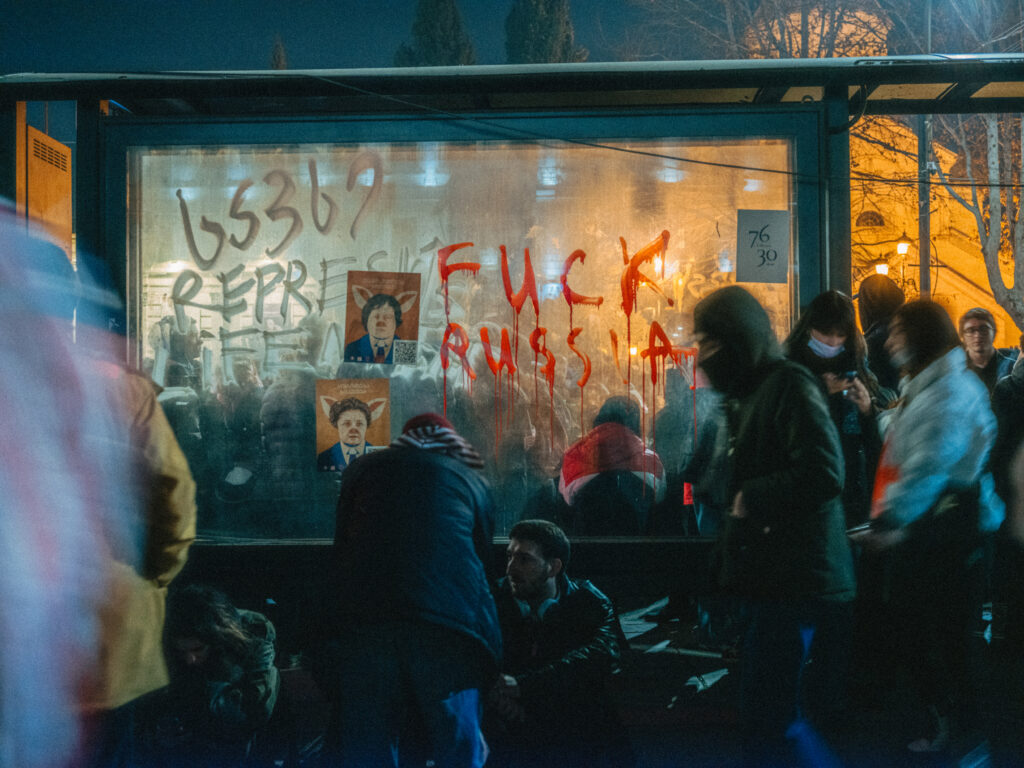
“Fuck Russia” written at a bus stop during a demonstration against the “Foreign Agents” law.
“We cannot talk about LGBT (issues) because it's ‘popularization,’” Pertia says, referring to the law banning public gatherings, displaying rainbow flags, and LGBTQ+ books and films. “You cannot get any medical support if you are trans because a doctor can go to prison for many years. I cannot have this LGBT tattoo on me because they can fine me,” they say, pointing to a rainbow flag on their upper arm.
As the risks of being out in public continued escalating, Tbilisi Pride decided not to host a celebration in 2024. The landscape for Georgia’s entire LGBTQ+ community grew even more challenging the following year, when the government passed a second law strengthening the foreign agents law.
“We are acting for Georgia's interests, not for foreign countries. I'm working for Georgia's queer community,” says Mariam Guliashvili, a strategic communications and advocacy officer at the Equality Movement, one of Georgia’s oldest and largest LGBTQ+ service providers. The new foreign agent laws have created “a lot of self-censorship practices,” she says, forcing many NGOs to quit. Despite cuts to the psychological support programs they once offered, the Equality Movement is still offering HIV/AIDS testing, counseling, and pre-exposure prophylaxis (PrEP) medication to prevent HIV transmission. “Every employee is now working mainly on a voluntary basis or on very low wages.”
Many LGBTQ+ Georgians, however, don’t have that privilege, and have sought asylum in Belgium or Spain. Guliashvili has decided to stay. “I'm not judging no one for leaving the country or giving up,” she says, “because we have been living in horror for the last three years.”
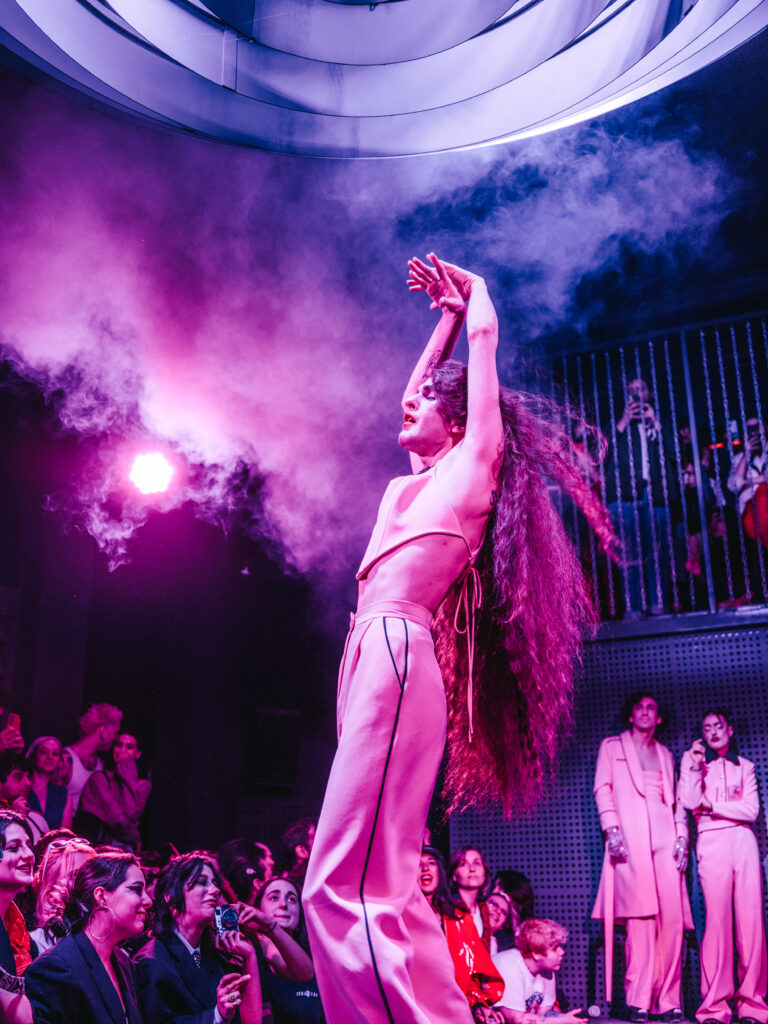
Artist and activist Lucrezia performing during a drag ball at Mtkvarze.
At the women’s and LGBTQ+ rights group GrlzWave, project leads Martha Geliashvili and Inga Ghoghoberidze say they and most of their colleagues have second jobs or freelance projects that support their activism. Nonetheless, when I sat with the pair on an unseasonably warm day in May at a cafe near Vashlovani Street, they told me GrlzWave was organizing film and book clubs focused on women’s and LGBTQ+ rights. The group is also using its online platform to publish videos about Georgia’s political prisoners, like journalist Mzia Amaglobeli, who was arrested at a 2025 anti-regime protest. “We are talking to them, family members, because propaganda is working and they are trying to dehumanize these people,” said Ghoghoberidze. All of these political prisoners remain behind bars.
As May spilled into summer, the teams at GrlzWave, the Equality Movement, and the former Tbilisi Pride found new ways to celebrate Pride Month. In June, dozens of LGBTQ+ organizers turned out for a “Queer Community Camp” organized by Pertia and fellow former members of Tbilisi Pride. After a weekend in the countryside spent practicing yoga and attending workshops on LGBTQ+ art and history, the organizers returned re-energized and ready to host a “Queer Corner” at an international music festival in Tbilisi in July. In social media posts on their new social media platform, Queer Initiative, Pertia can be seen beaming as they dance at the festival in a pink muscle tee that reads “I let femmes top me” and a rainbow bead-lined sun hat.