WP_Post Object
(
    [ID] => 10772
    [post_author] => 15
    [post_date] => 2026-07-22 19:39:36
    [post_date_gmt] => 2026-07-22 19:39:36
    [post_content] =>
It's been over four years since I moved to Japan, and I'm still baffled by the country's food sexism.


My first visit to Japan was a flurry of city lights, fresh sushi, and cherry blossoms in 2017. Between crying (joyful tears) three times in the Studio Ghibli Museum, and chasing down a cotton candy rainbow in Harajuku, I returned to the U.S. thinking, That was the best trip of my life. But on my second visit two years later, I started seeing the societal cracks I’d initially overlooked. While talking to a local near Tokyo’s Arakawa River about our favorite Japanese foods, I excitedly shared my love for strawberry shortcakes.


“That’s for women,” he replied.


I was stunned.


It’s been over four years now since I moved to Tokyo. My early ignorant bliss of Japan being a fantasyland—when it is in fact a very real place with very real problems—has long subsided. But my echoing bafflement over the country’s food sexism has remained and only grown over time.


Japan has a misogyny problem. In June 2023, the country faced international criticism for sending a male minister, instead of a woman, to lead a G7 meeting on women's empowerment. According to the 2024 Global Gender Gap Report (a way to measure gender equality across categories like economic participation, education, health, political empowerment, and more), Japan ranked 118th out of 146 countries. And despite electing its first female prime minister in 2025, which on the surface, seemed like a win for equality, it was a superficial victory: Prime Minister Sanae Takaichi ascended to power as a hardline conservative who championed traditional gender roles. She even voted against a woman becoming Emperor in 2021, echoing her political party’s stance on maintaining the country’s sexist male-only succession rule. The decision risks the end of Japan's 1,500-year-old monarchy, the oldest continuous hereditary dynasty in the world.


In a society built upon patriarchy (and actively maintaining it), these entrenched beliefs have far-reaching ripple effects that seep into the fabric of everyday life. Groping on packed commuter trains and notorious workplace harassment are just the tip of the misogynistic iceberg. From lingering high heel mandates to the negative social stigmas around showing cleavage, there are countless other everyday instances that feel like never-ending microaggressive daggers, magnifying the depths of the country’s prejudice and discrimination against women. It shouldn’t be surprising, then, that this bleeds into the country’s relationship with food. It’s even unusual for women to be sushi chefs, due to false beliefs that women’s hands are too warm to handle raw fish and that menstruation can impact a person’s ability to taste.


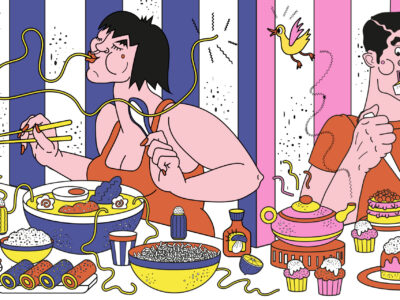
As a professional food writer, I’ve long been privy to how sexism impacts dining culture. But in Tokyo, it’s something I’ve seen and experienced firsthand. Recently, while working on a restaurant guide, I pushed my normal ramen-eating limits by visiting 10 different shops in a month, continuously finding myself in a line of mostly, if not all, men. It’s common to see queues of men in business suits waiting for hot ramen throughout the city, but it was only after seeing it so often up-close that I picked up on—and felt—the stark gender imbalance.


Reading restaurant reviews in Japanese only further confirmed my growing suspicions. “This ramen isn’t good for women because it’s too big” was a common theme; or on the flip side, “This place is amazing! Even I, as a [mere] woman, can eat the whole bowl!!!” There was also a constant pattern of reviewers mentioning whether it was acceptable for women to dine alone at certain ramen shops, or if the ramen was “light” enough for women to eat.


The message across these reviews was clear: Women can have ramen, but it can’t be too large, or too fatty, and must be somewhere acceptable to the male gaze.


What I’ve seen for ramen is the same for sweets, but the inverse. Inside many dessert shops, a sea of women customers quietly sit and enjoy their cakes and other pastries, without a man in sight. The bare walls, minimal decor, and ambient slurping sounds of a standard ramen shop are replaced with detailed crown modeling and the clinking of tiny forks on floral porcelain plates. Lines of men in business suits are swapped with lines of women in dresses and skirts. While I have also seen men in these shops on occasion, they are often accompanied by a woman on what appears to be a date.


As an “outsider,” especially as an American living in Japan, I recognize it’s easier to notice and be critical of a culture that’s not my own. After all, the U.S. has its own sexist food norms, and is far from immune to toxic stereotypes around food. Remember Women Laughing Alone with Salad? Or when tall, bearded men were wrapping meat logs in bacon? Today, guys are slapping raw meat down on countertops so hard and so often that it’s become background noise on TikTok, all while the current administration uses MAHA and MAGA to strengthen the stereotype of meat consumption as a cultural symbol of “traditional” masculinity. The U.S. might have slightly greater gender parity with regards to desserts (even though they still lean more heavily towards women), but like many countries, we are not exempt from our own forms of food misogyny.


This is to say, Japan’s culturally-specific gendered relationships with food do not live in a void. There is home-grown food sexism in Japan, yes, but there are just as many beliefs that have developed via global influences, including its diet culture amongst women.


Despite the ongoing patriarchal stronghold, cultural shifts in food have also started to emerge here. There’s a rise in a movement called ramen girls (or ramen joshi in Japanese), where some women make a concerted effort to slurp down as much ramen as they can. Women ramen influencers have also attracted large audiences in recent years, like Satoko Morimoto, who proudly claims to eat more than 600 bowls of ramen a year and has amassed over 53,000 Instagram followers. More men are leaving the post-war “carnivorous” image behind and are embracing the sweeter things in life, too. Some refer to them as “herbivore men,” a term that can carry a derogatory image because of its outward rejection of old masculine ideals—but they persist all the same.


When I do witness a man enjoying dessert alone in a room full of women, or a woman dining solo going ham on a bowl of tsukemen—I think to myself, YES! To me, it’s a small, quiet act of resistance against gender expectations. There’s a lot of room for progress, but these small changes can have a snowball effect in changing not just Japan’s food culture but more widely, its entrenched national sexism. I believe anyone, regardless of their gender, should be able to eat ramen, little cakes, and whatever else they want, whenever they damn well please. The food doesn’t care, so why should we?


When I think back to my second trip to Japan, I always remember my chat with that Tokyo local. After he told me that cake was only for women, I asked him, “Do you not like shortcakes? They’re so good!” He looked away shyly. “I do,” he said, “but I don’t tell people.”


Wherever he is, I hope he’s more than just occasionally throwing down on the tallest, thickest slices of strawberry shortcake out there, fully owning his sweet tooth for all to see.

    [post_title] => Let Men Eat Cake (and Women Eat Ramen)
    [post_excerpt] => It's been over four years since I moved to Japan, and I'm still baffled by the country's food sexism.
    [post_status] => publish
    [comment_status] => closed
    [ping_status] => closed
    [post_password] =>
    [post_name] => japan-food-sexism-culture-ramen-cake-desserts-tokyo-eating-sanae-takaichi-soapbox
    [to_ping] =>
    [pinged] =>
    [post_modified] => 2026-08-03 20:28:01
    [post_modified_gmt] => 2026-08-03 20:28:01
    [post_content_filtered] =>
    [post_parent] => 0
    [guid] => https://conversationalist.org/?p=10772
    [menu_order] => 0
    [post_type] => post
    [post_mime_type] =>
    [comment_count] => 0
    [filter] => raw
)