
WP_Post Object
(
    [ID] => 10428
    [post_author] => 15
    [post_date] => 2026-04-10 23:52:48
    [post_date_gmt] => 2026-04-10 23:52:48
    [post_content] => 

How the archival work of librarians and other activists helps preserve more than just history.

In 1979, as the Iranian hostage crisis played on American television screens 24/7, the television producer, librarian, activist, and intellectual Marion Stokes began recording the news broadcasts on tape. The live coverage—across all channels, at all hours—launched what we now recognize as the never-ending, ambient flow of media. Simultaneously, Stokes recognized a shift in the narrative America was telling about itself, and the role of media manipulation toward pro-American policies. So, for the next 30 years, she recorded any and all TV news broadcasts, commercials included. All of it was then archived, stacks of VHS tapes quickly accumulating in her Philadelphia apartment, as portrayed in the 2019 documentary Recorder: The Marion Stokes Project

This kind of project by an individual who operates outside of an institution was a radical endeavor: When Stokes began, broadcast channels didn’t archive their own material, often erasing tapes so they could reuse them due to cost. But Stokes’ project and its often innocuous content would also foreshadow the long-term value of guerrilla archives, both in preserving an accurate historical record and holding the media—and government—to account. Activist archives began as a practice in the 1960s, when organizers filled in the historical gaps where universities and institutions could not. These, however, were collective efforts; Stokes operated individually, until eventually, her son donated the recordings to the Internet Archive, where digitized selections are now available online. “By [Stokes] having that collection, it means the scholars, artists, and researchers have access to the information without paying for it,” says Shola Lynch, filmmaker and Professor of the Art and Visual Culture at Spelman College. “Because when our history is bound up in commercial hands, that's problematic.” 

Stokes’ practice of recording any and all materials resembles the history of what is now called  “memory work,” or individuals who preserve the photographs, documents, and ephemera of a community. A relatively recent tradition, this form of archiving has taken on new meaning in a digital era where data sets can be wiped and personal data sold, seemingly without consequence. Following the start of the second Trump presidency in January 2025, more than 2,000 datasets suddenly disappeared from Data.gov, the U.S.’s government's data portal. Since then, the Trump administration has overhauled even more data, including entire web pages and important coding tools for researchers and climate scientists

Over the last five decades, open source tools and government data have been integral to preserving the historical record and maintaining public infrastructure in the United States. According to America’s Essential Data, New Orleanians received smoke alarms because fire departments used American Community Survey (ACS) data to identify neighborhoods most in need. School districts could (previously) make the case for increased teacher salaries using the Department of Education’s Civil Rights Data Collection (CRDC) to highlight underpaid teachers. Residents could avoid scams in their community based on federal Consumer Sentinel data. Now, these records are liable to disappear from the internet, possibly forever. 

The government is ultimately responsible for preserving a record of its own actions. But when federal agencies are unable to preserve all their data, or willfully choose not to, it begs the question if this work is best done by civil society and those outside of the government. Guerrilla archives—whether digital or analog like Stokes’—are generally nonpartisan acts of preservation to serve the public good. There’s the Internet Archive, which has been archiving the web and other cultural artifacts since 1996, and Vanderbilt Television News Archive, which provides the most comprehensive chronicling of evening television news broadcasts in the world. There’s also the End of Term Archive—one of the largest of these projects in progress—which downloads all government information at the end of each presidential term. It’s a grassroots alternative to the National Archives and Records Administration (NARA), which notoriously did not receive all of the presidential records from the first Trump administration in 2021 as mandated under the Presidential Records Act. (Trump promptly fired the head of NARA when he re-entered office in 2025.)

Despite having distributed its data more digitally over the last 20 years, the government has not issued any dedicated preservation or access strategy for its information. Additionally, the current laws and policies around government data preservation are outdated and inadequate. This hole in the system has compelled librarians to join the race to copy digital federal archives, beginning in 2016 with the Data Rescue movement, which drew over 1500 volunteers for dozens of hackathon-style events throughout the year. “Distrust re-orients care,” researcher Laura Rothfritz wrote in her analysis of these early efforts for Big Data & Society. When a public distrusts a system and a possible threat is identified, however, anxiety can be mobilized into producing future forms of infrastructure.

As the situation becomes more dire, these efforts have only expanded. Today, the Public Data Project runs within the Library Innovation Lab at Harvard Law School, collecting and authenticating all federal datasets, more recently including the Smithsonian Institute’s public domain data. So far, they have downloaded the entirety of Data.gov, copied it, and digitally signed it with a provenance mark to authenticate its origins. The project launched in early 2025 as part of Harvard Law School’s repository system, which dates back centuries. 

“I think a lot of us in the library and technology communities are sort of waking up to the fact that we need to have a strategy in place for the preservation and access of government data beyond what the government provides,” says Molly Hardy, the Project Lead for the Public Data Project. Their team also works closely with the Data Rescue Project, a grassroots nonprofit preserving massive data sets and consisting entirely of volunteers. 

“Public data infrastructures have long been considered essential components of democratic governance, scientific accountability, and civic participation,” Rothfritz continues in her Big Data & Society piece. Much like our city’s infrastructure, however, we don’t recognize its value until it's broken. It is the invisible fiber that holds democracy together, from our roads and postal service to job numbers and environmental data. Increasingly, its preservation is also a task that has been left to individuals and communities. In October 2025, the nonprofit organization Internet Archive celebrated archiving its trillionth web page on its most popular service, the Wayback Machine, an initiative that allows users to find web page screenshots from specific dates. It has become an essential tool and digital service for independent organizations and guerrilla archivists alike. (The largest archive on the internet, dedicated to “universal access to all knowledge,” has not been without its setbacks however: In 2024, it suffered a data breach affecting millions of users and a copyright infringement case over its digital lending library.)

The Invisible Histories Project, a nonprofit organization based in North Carolina, has been preserving the digital history and cultural memory of LGBTQ+ life in the South using tools like the Wayback Machine. “We could no longer trust institutions to protect marginalized histories,” says Maigen Sullivan, the Co-Executive Director of Invisible Histories. She recalls a community effort at the start of last year to preserve government and university pages with references to diversity offices, along with flyers and photos. According to Sullivan, by August and September 2025, when universities returned to term, about a quarter of those pages were already gone. “This is the only evidence, other than what individuals might hold, that exists,” she says.

Invisible Histories has also built its own server because of mistrust in corporations like Google and Microsoft that store and hold onto their data, another issue facing digital archivists. The organization has endured two cyberattacks—one in 2023, and the other in 2025—since its founding in 2017. Because of this, they’ve considered cybersecurity training and increased security for potential threats against the archive. “If you feel like you're hopeless and helpless and have nothing to do, archiving is a tool of resistance and anyone can do it,” says Sullivan.

These examples of digital mutual aid have become essential for documenting history, and are one way to combat historical revisionism. Activist archives also continue to challenge which institutions have a say in the historical record, nationally and beyond. Zakiya Collier, a Brooklyn-based archivist, says individual archives preserve more than just data. “I think that memory work has a liberatory capacity to it,” she says. “I use that term because it calls on a legacy of people who dedicated their time and energy to preserving history in their homes, communities, churches, attics, and basements. They decided something was important to document and keep.”

Collier, who has worked as the digital archivist in the Schomburg Center for Research in Black Culture in the New York Public Library, now works with the organization Archiving the Black Web, which trains archivists to document a more inclusive history of the internet. Its potential to create more live archives and documentations of the web aims to contribute to a more equitable historical view of how we catalogue our lives online. 

As data and information is getting purposefully disappeared from the internet—an increasingly fertile ground for fascist ideology—archiving becomes increasingly necessary, or else, the public cannot bear witness to itself. In April 2025, the National Park Service erased references to Harriet Tubman on its webpages. The following month, Trump issued an executive order sanitizing federal cultural institutions by accusing the Smithsonian Institute of promoting “race-centered ideology” in its exhibit, “The Shape of Power: Stories of Race and American Sculpture.” The USDA ended its annual survey of hunger in America two weeks before the government shutdown in October 2025, affecting the distribution of food stamps. 

Data is information and has become a weapon in the digital age. But both individuals and communities are not powerless to fight back. With the rapid monopolistic takeover of media platforms, it’s no surprise that users are beginning to archive their own data and leaning towards physical media. Sales of vinyl are up, print book sales are rising, and DVD collections are in.

“All archives create futures,” says a voiceover in Recorder: The Marion Stokes Project, as news broadcasts and infomercials from Stokes’ archive flash in rapid pace onscreen. The organization of information by the lay person may help overcome barriers of the institutionalized index and history, as the threat of excessive online information and its disappearance still looms large for activist archives. But this work has become even more critical, not only for deciding how the past will be remembered, but how an imagined future might pull from its past to mobilize this kind of anticipatory care in the present.

[post_title] => On Guerrilla Archives in the Disinformation Age [post_excerpt] => How the archival work of librarians and other activists helps preserve more than just history. [post_status] => publish [comment_status] => closed [ping_status] => closed [post_password] => [post_name] => guerrilla-archives-activism-protest-history-preservation-politics-marion-stokes-media [to_ping] => [pinged] => [post_modified] => 2026-04-23 15:59:16 [post_modified_gmt] => 2026-04-23 15:59:16 [post_content_filtered] => [post_parent] => 0 [guid] => https://conversationalist.org/?p=10428 [menu_order] => 0 [post_type] => post [post_mime_type] => [comment_count] => 0 [filter] => raw )
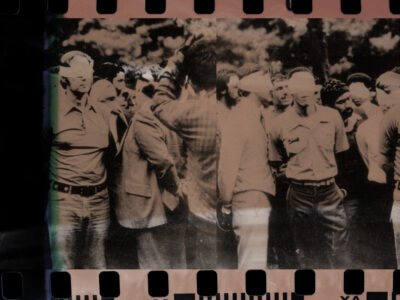
Photo illustration by The Conversationalist, featuring a film strip imposed over a photo from the Iranian hostage crisis. (Getty/Alamy)

On Guerrilla Archives in the Disinformation Age

WP_Post Object
(
    [ID] => 9787
    [post_author] => 15
    [post_date] => 2026-02-03 20:58:23
    [post_date_gmt] => 2026-02-03 20:58:23
    [post_content] => 

While at surface level, #WeirdTok is all fun and games, it also cuts to something deeper about being human.

Soapbox is a series where people make the case for the sometimes surprising things they feel strongly about.

The user who makes delightful felt animations. Wild, dramatically narrated video montages about horses at Costco and skeletons at Subway. A creator building a sprawling fortified terracotta city in a forest, an armored hand periodically creeping into frame to demonstrate the latest structure. Programming cards to play Coldplay’s “Clocks” on an antique mechanical organ. Witches in unsettling paper maché masks. A man who goes in deep on the technicalities of the musculoskeletal anatomy of mythical creatures. A tractor set to EDM.

“This is a hilarious and brilliant way to use your weed zapper technology LMAO how do you always find the best TikToks??? My FYP is never this obscure,” my friend and colleague Erin Biba replied when I shared the tractor video to Bluesky. I took her question as a challenge: How weird could my For You Page get? With a bit of effort, as it turns out: very, very weird.

#WeirdTok is a magical, fascinating, bizarre, wonderful, confusing, sometimes horrifying place filled with myriad wonders, delights, and, unfortunately, the inevitable incursion of AI slop. It is also art I genuinely, unironically love. It’s fucking great. And thanks to TikTok’s highly powerful algorithm, the app has learned what I like—and what I do not—with uncanny alacrity. If the FYP throws most people a hodge-podge of content it thinks is popular—horses for the horse girls, tradwives in beige kitchens cooking cereal from scratch, political commentators weighing in on the minutia of the Trump administration—for me, it has been forced to come up with the unpopular. The artisanal videos made by fellow strangeness enthusiasts, with 200 views and three baffled comments from normies wondering how they got there.

Delightfully, the more #WeirdTok I interact with, and the more extensive those interactions—watching all the way through, saving, liking, commenting—the more the weird juice flows. And flow it does. Surrealist skits in a Japanese restaurant. An artist projecting an animation of a horse onto a cityscape from the back of a bicycle. Musical stylings. A heavy equipment operator riding in the bucket of an excavator to the tune of “Cotton-Eyed Joe.” Elaborate frame-by-frame stereoscopic graffiti. Cats playing theremins. Dizzying animations of skeletal anatomy. More musical stylings: Suited brass bands chasing runners in a park while playing the “Mission Impossible” theme. Dazzling woodcock fancams. People wearing cardboard bug costumes with cutouts for their faces and writhing around in a parking lot.

Refusing to keep these gems to myself, several nights a week, I select a carefully curated #WeirdTok to share on Bluesky. I always tag Erin, who replies with a different weird video SHE has found. Over the months, our interactions have attracted a small band of loyal followers akin to those who wait to see how many eels show up under a bridge every morning; a small, fun, silly bright spot in dark times.

This shouldn’t be mistaken for escapism—delightful as it may be to watch remote control cars carrying a payload of pastel plushies while crushing autumn leaves, or a man’s surreal video series about his sleep paralysis demon, or a woeful potato taking a shower. Rather, the utter randomness of #WeirdTok—and the community that has formed around it—feels inherently strange and ungovernable, a necessary connection to humanity during a fucking scary time to be alive. We cannot survive if we cannot find joy: Surrounded by the fall of empire and the rise of fascism, I DO want to watch a whimsical video of wizard puppets jerkily animated in outdoor locations, thank you—and as it turns out, other people do, too.

While at surface level, #WeirdTok is all fun and games, it also cuts to something deeper about being human and the way art can transcend linguistic and social boundaries. I’m a long-time fan of so-called “outsider art.” Strange performance pieces. Unsettling musical compositions. Surreal found object exhibitions. Art cars and bohemian silliness. Whole communities centered around radical living, such as Bombay Beach along the Salton Sea.

These spaces feed my deep and abiding affection for weirdness, but also for making a place for art that is unconventional, highly specific, challenging. #WeirdTok, too, is often produced by self-taught, working-class artists exploring the world without feeling bound to whatever the rules of art are supposed to be. Art that is increasingly difficult to make in the modern era because of how expensive it has become to simply live. Gone are the days of the WPA and its serious investment in arts and creativity in the United States, or the arts grants that contributed to a flowering of culture in the U.K. in the 1960s and ‘70s. Instead, our cities are filled with creeping homogeneity, Airbnbs, and flipper homes trying to cash in on reputations of countercultures that now can’t actually afford to exist in those same places, while the true radicals are forced to the margins, such as the Ghost Ship collective in Oakland, destroyed by a fire in 2016 that killed 36 people. In the face of this, supporting weird art is essential.

It's also a surprisingly human thing to do. The cream of the #WeirdTok crop doesn’t use artificial intelligence, and in fact, actively defies even the most feverish robot hallucinations. Human weirdness is original. It comes from somewhere deep in the heart, not a blender filled with other people’s creativity and run on high for 30 seconds before being blorped out and shoved in your face. It is produced for the love of the game.

To discover a truly unhinged video feels hard-earned, a sort of reverse algorithmic manipulation. It is also, fundamentally, a rejection of technofascism and the bland hegemony tech companies want to force upon all of us, to turn us into passive consumers gobbling up slop and rolling in garbage while the world burns.  As a very specific niche, #WeirdTok often only makes it way to the right viewers, often without captions, hashtags, or explanations. It simply is, waiting to be discovered as you scroll. Some nights I am hit with banger after banger, saving every other video for future enjoyment and sharing, the FYP and I in a groove, unstoppable. It is like wandering the streets of a new city with no destination in mind, my favorite way to travel, finding new, intriguing things around every corner. It’s an experience that reminds me of the “old internet,” a long-gone place that we all once inhabited and loved, where it was possible to randomly stumble upon a painstakingly hand-coded website, human-made, then never see it again.

The ephemerality of TikTok is also an important element of #WeirdTok, and not just because the videos can vanish at the click of a button. At times, it feels like a fever dream, one that is frustratingly elusive to explain to people outside this liminal space. From an entirely practical perspective, there is also a “you had to be there” sense that is escalating as the app’s future in the U.S. grows increasingly uncertain. After a forced deal with Oracle, it appears ByteDance will be licensing its algorithm, but TikTok’s future overall is a big unknown as its new parent company brings its own biases and priorities to the table, all under the looming hand of the Trump administration. Will this change squeeze the joy from the FYP, as weird art serves no purpose under capitalism? If so, where will the weird art go next?

There is a sense of being on the rooftop at a wild party, watching the grey fingers of dawn slowly creep over the horizon, knowing that in daylight, everything will look very different. Yet, #WeirdTok is a reminder that even if this party ends and people trickle home, shedding feathers and sequins on transit, weird art, human ingenuity, joyous creativity, will endure. There will always be another party, and no matter where it shows up and who will be there, it will exist.

[post_title] => How Weird Can Your For You Page Get? [post_excerpt] => While at surface level, #WeirdTok is all fun and games, it also cuts to something deeper about being human. [post_status] => publish [comment_status] => closed [ping_status] => closed [post_password] => [post_name] => soapbox-weirdtok-tiktok-videos-social-media-outsider-weird-art-strange-unusual-fun-content [to_ping] => [pinged] => [post_modified] => 2026-02-03 21:00:39 [post_modified_gmt] => 2026-02-03 21:00:39 [post_content_filtered] => [post_parent] => 0 [guid] => https://conversationalist.org/?p=9787 [menu_order] => 0 [post_type] => post [post_mime_type] => [comment_count] => 0 [filter] => raw )
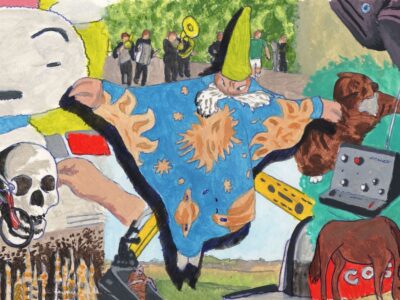
An illustration depicting various #WeirdTok videos.

How Weird Can Your For You Page Get?

WP_Post Object
(
    [ID] => 5838
    [post_author] => 15
    [post_date] => 2023-05-03 17:29:33
    [post_date_gmt] => 2023-05-03 17:29:33
    [post_content] => 

How social media influencers are challenging stereotypes both within and outside of Muslim communities—just by being themselves.

In this very digital age, I wouldn’t describe myself as much of a social media person. Despite my active Twitter presence, which I attribute to work, and the occasional procrastination scroll on Instagram, which always ends up longer than expected, I’ve just never really found much joy in it. Even back when most people dreamed of becoming bloggers, I never saw the appeal: I couldn’t relate to their desire to share their lives so publicly, and felt a disconnect with their content as a result. 

Then, around January last year, I discovered With Love, Leena. The account follows the day to day life of Texas-based content creator Leena Snoubar, covering everything from fashion to parenting to all things lifestyle. In one video, she gives a tutorial on how she removes makeup stains from her hijabs. In another, she shares an intimate day out with her mother and sisters, where they grab brunch and go wedding dress shopping for her youngest sister. Scrolling through her account, I found myself feeling—for the first time—like I was actually getting something out of my Instagram experience: I’d never come across a Muslim influencer who was so visibly Muslim and yet didn’t feel the need to justify or be bound by their religion. 

It was only when I came across Leena that I realized my feelings of disconnect on social media had less to do with the platforms themselves, and more to do with the kind of content I was seeing. Maybe it was the algorithm or just my lack of social media engagement, but I was almost exclusively served either general fashion and beauty content—which I assumed was because of my gender—or Islamic videos, with little in between. It made me feel alienated in terms of my other interests, and like I had to separate my religious identity from the rest of me, or else somehow justify their intermingling. 

For a lot of young Muslims, being online as a visibly Muslim person creates a pressure to either always be preaching Islamic content or advocating for our religious identity. When I first started out as a journalist, I often felt a heavy responsibility to justify my identity, and to prove, somehow, that Muslim women were not limited to the stereotypes projected onto us. But constantly having to justify my identity also meant constant emotional labor, and as I quickly learned, this only ever led to burnout. It’s a pressure that content creator Maliha—who says she’s been an “internet girlie” since before influencers became popular—is very familiar with. “I started out with my YouTube channel, and then Instagram, and because a lot of my content was cosplay I became the ‘hijabi cosplayer,’” she says. “But I’m not very good with having a niche, and when I moved to TikTok, I started making content that I connected to more, mostly rants and healing—social justice-y stuff.” Despite pivoting directions with her content, though, she soon found that her audience hadn’t changed or expanded at all: Maliha says that even though her content wasn't Islamic, TikTok’s algorithm was almost exclusively showing her videos to other Muslim users. 

This sort of systemic stereotyping, that comes from both outside and within Muslim communities, is exactly what some influencers like Leena and Maliha are challenging with their diverse content. Despite living continents apart, I immediately felt a connection to Maliha—one that came from so many shared experiences, not just as Muslims, but also as young women. She’s just an average twenty-something, sharing her everyday thoughts, laced with a little humor and, often, a lot of sarcasm. I’m not the only one who has felt a connection to her work, either: Maliha says that her role as a content creator has helped her make friends across the globe. 

For 20-year-old Younis AlZubeiri, this sense of community has played a big role in his own content creating journey. “My overarching goal with my content was to also be that outlet for other Muslims on the internet that didn’t really have someone to look to online,” he says. “In the world of Andrew Tates and [other] horrible role models to young kids, especially Muslims, I tried to just be a source of good to them.” He first started creating content at 14, making videos about comics just for himself. But slowly, his focus started shifting. “When I had followers who looked like me tell me about my impact on them, there was a light that switched,” he shares. Now, he has over 100,000 followers on TikTok, where he shares videos exploring culture and entertainment and diversity within both. 

Along with creating spaces of acceptance for Muslims from all walks of life, many of these influencers are also challenging what it means to be visibly Muslim in 2023. This means fighting stereotypes offline, too: Amira Rahmat, a food and travel blogger, often embarks on solo trips and says she’s always met with surprise when people see a young Muslim woman traveling alone. “When I post content on my page, a lot of the comments I see are, ‘Oh, you’re so brave to travel alone,’” Amira shares. But likewise, she says many of her commenters are inspired by her videos: For many Muslim women, who have to fight back stereotypes that Muslim women’s pardah or religious restrictions keep them confined to their homes, seeing women like Amira and being able to share in her experiences has become a crucial part of shaping their confidence and self reflection. 

It may seem like these are just a bunch of random creators covering various topics, but that’s the point. In this age of growing Islamophobia, they’ve begun to play a very important role in humanizing all of us beyond our hijabs and beards and masjids. They’re creating their own spaces, where being Muslim doesn’t impact or influence all the other parts of themselves. This is just as pivotal within our community as it is outside of it: Muslims who find themself stuck between proving themselves to other Muslims and justifying themselves to non-Muslims seeing creators just being honest and unapologetic about whatever topic they’d like can give us a lot of strength on the days we most need it. “It’s such a fine line to be a Muslim artist in any capacity,” says Dubai based content creator Emad. Whether or not you talk about religion, he continues, you’ll be judged by Muslim and non-Muslim creators alike, and pigeonholed by both. “For someone like me, I wanted to get into Muslim content because it’s fun. [But] so many times it happens that you become a ‘Muslim creator’ and then you do a fun TikTok dance and suddenly you’re not a Muslim creator because you’ve apparently done something wrong.”  

This isn’t always easy. But when the polarized opinions and criticism become too much, Younis says that humor helps—especially when met with harmful alt-right and other extremist narratives. “I can’t just post about being a leftist and expect them to change,” he says. “You have to go about it in another light and try to convey the point you’re trying to make through humor.” These are baby steps, he adds, but making viewers laugh can challenge pre-existing notions that all Muslims are the same and that they don’t exist outside of a one-dimensional identity.

These small steps go a long way, and are already making a difference for creators (and viewers) around the world. Pakistan-based food blogger Emon Malik says the content creator economy has been growing in her country, and credits that to the growing diversity of creators. And the number of Muslim content creators is only growing.

“With more [diverse] content creation, people are more informed,” Amira says. “It comes from personal experiences, not Google, and it’s more raw and authentic.” It’s also more relatable—and for me, inspiring. When I see content creators like Leena or Maliha or Amira, it gives me the push I need to be more unapologetically myself. As these content creators have shown me, I’m more than my religious identity, but I don’t have to hide it away, either.

[post_title] => The New Faces of Being Visibly Muslim Online [post_excerpt] => How influencers are challenging stereotypes both within and outside of Muslim communities—just by being themselves. [post_status] => publish [comment_status] => closed [ping_status] => closed [post_password] => [post_name] => muslim-tiktok-social-media-islam-representation-content-creators-influencers-advocacy [to_ping] => [pinged] => [post_modified] => 2024-08-28 21:15:11 [post_modified_gmt] => 2024-08-28 21:15:11 [post_content_filtered] => [post_parent] => 0 [guid] => https://conversationalist.org/?p=5838 [menu_order] => 84 [post_type] => post [post_mime_type] => [comment_count] => 0 [filter] => raw )
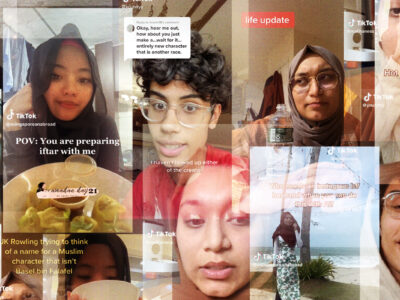
A collage of screenshots, from various Muslim TikTok content creators, engaging in all sorts of different styles of content creation. In one video, the creator is dressed in a banana suit; in another, the creator is answering a question about cosplay; in another, it appears to be a cooking tutorial. The screenshots are overlapping, with various degrees of opacity, giving the feeling of rich, diverse array of content.

The New Faces of Being Visibly Muslim Online