WP_Post Object
(
    [ID] => 8823
    [post_author] => 15
    [post_date] => 2025-09-09 21:36:41
    [post_date_gmt] => 2025-09-09 21:36:41
    [post_content] => 

Over-processed produce is disconnecting us from where food comes from.

The way it looked promised richness and flavor. Sharp green leaves, stemless, in a transparent plastic package with the words “organic” and “triple-washed.” It was something I’d never seen before: ready-to-eat spinach with no dirt, worms, or roots. In Colombia, my home country, produce always needed to be washed. Spinach, in particular, needed extra effort, because it was always sold as a whole. I usually soaked it in vinegar and lemon for half an hour to kill any parasites or bacteria. But in the United States, everything seemed easy, fast, and reliable—no soaking required. I bought the bag of spinach, and prepared a fresh salad with goat cheese and walnuts. In less than two minutes, it was on my plate. I chewed and chewed. But while there was a hint of spinach in whatever those leaves were, it was certainly not spinach

In Colombia, I lived in Bogotá, a densely populated and urbanized area. With reduced access to green spaces, I felt most connected to nature through food. Vegetables came from the earth and still carried the signs: roots that once absorbed nutrients, stems that transported water and sugars, bugs that had nibbled on the same leaves I would soon eat, too. Seeing all this reminded me that my food had been grown, not manufactured. It connected me to the farmers who had cultivated, cared for, and harvested it. I felt grounded when peeling, chopping, smelling, washing, and eating my produce. At the end of the day, I was manipulating something that came from the earth.

When I moved to New York City in 2022, I noticed how little people manipulated their food by comparison. Grocery stores sold pre-washed and pre-cut vegetables, and people just opened the packages and threw food on a plate and called it a meal. They didn’t need to bother getting their hands dirty, because their food was already chopped and sanitized. 

To me, this disconnect was clearly separating people from nature, making food’s origins feel unfamiliar. When people don’t see, feel, and taste the whole flavor of produce, they also feel less encouraged to eat it. A mango that once grew on a tree, appears nature morte—a dead nature—in a plastic container, more like a granola bar than fruit. In Colombia, produce tasted intense and complex. Spinach, for example, tasted bitter, earthy, and savory. A friend from Peru tells me she avoided fruit her first year in New York because it tasted too sugary and artificial. Another friend from Mexico will only eat pineapple, because she thinks other fruits taste as if they’ve been diluted in a water and sugar solution.

The University of Florida found the reason that fruits, like tomatoes, taste so insipid in the U.S. is because, in the pursuit of higher yield, disease resistance, and shelf life, the genes responsible for flavor were bred out. While unsanitized produce may be risky for gastrointestinal health, GMO and ready-to-eat produce isn’t necessarily always “safer,” either. Processing facilities or farms, for example, frequently wash greens with water and chlorine. While safe in small doses, regular consumption can pose health risks. Other additives, like preservatives or antioxidants, might also cause immune diseases and antibacterial resistance

It’s also just unnatural. A Colombian friend living in San Francisco tells me she once forgot about a bag of mandarins for two months. When she rediscovered them, they were still edible. “The mandarins were supposed to be spoiled,” she said. “What kind of component do they have to survive for months?” 

It is a universal truth that Western society is obsessed with germs. We fear bacteria so much that we do everything we can to isolate ourselves from it, no matter the source. But when it comes to food, are we truly that delicate—unable to tolerate mud on our fingers or on the ground beneath our feet? Is our obsession reinforcing the binary vision that nature is dirty and dangerous, and human creations safe and clean? And what are we robbing ourselves of in the process?

Research published in Communications Psychology found that the more people interact with nature, the more fruits and vegetables they eat. While this affects us all, it disproportionately affects some of us more than others: Access to nature and socioeconomic and racial inequalities in U.S. urban areas have long been related. Simultaneously, the more urban the environment, the fewer healthy food choices are available—especially amongst Black and Hispanic communities, who often have less access to green spaces. 

Community gardens and farmers markets help mitigate this gap. They also provide more affordable prices than grocery stores for organic and whole produce. I used to visit a community garden in Queens, where I learned how to compost and take care of the crops they had, allowing me to feel close to food again like I once did in Colombia. I have also tried to buy my produce in farmers markets that sell whole foods, rather than their chopped and sanitized counterparts. But access to these spaces is limited. Community gardens can’t produce the amount of food necessary to feed the whole city. Farmers markets are only in certain neighborhoods and on specific days a week, limiting access for working-class people. Not everyone has the privilege to eat spinach from the earth and not a bag.

I don’t have a solution to this disconnection. But I do know this: We understand the world through our senses. The feel of a vegetable in our hands, the smell of it, the taste, reminds us we exist because of the earth, what we feed ourselves comes from the earth, and that our cells are built from the earth, too. Our bodies evolved alongside the earth. Our ancestors touched soil, grew food, harvested crops, and fed their communities with their hands. And it seems likely for our collective wellbeing that we still need to do everything in our power to do the same.

[post_title] => Food is Meant to Be Touched [post_excerpt] => Over-processed produce is disconnecting us from where food comes from. [post_status] => publish [comment_status] => closed [ping_status] => closed [post_password] => [post_name] => food-groceries-united-states-colombia-produce-packed-pre-washed-cut-processed-gmo-ready-to-eat-fruits-vegetables-treatment [to_ping] => [pinged] => [post_modified] => 2026-01-15 19:21:57 [post_modified_gmt] => 2026-01-15 19:21:57 [post_content_filtered] => [post_parent] => 0 [guid] => https://conversationalist.org/?p=8823 [menu_order] => 10 [post_type] => post [post_mime_type] => [comment_count] => 0 [filter] => raw )
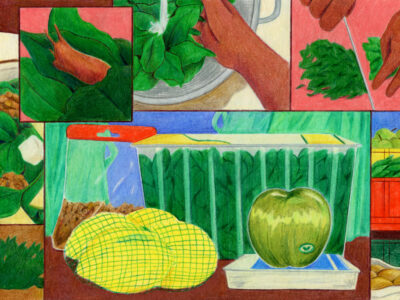
An illustration with different panels of a salad being prepared. On the left, a panel with a plate of spinach salad with walnuts and goat cheese on a placemat next to a fork, over a panel with spinach growing in the wild. Across the top, a panel with a close-up of spinach with a snail on it; a panel where spinach is being rinsed in a colander; and a panel where spinach is being chopped. On the bottom, a large panel in the center with pre-packed groceries: a giant plastic tub of spinach, a bag of lemons, an apple with a sticker on it, a bag of walnuts, a package of feta. On the bottom right, organic vegetables in plastic crates and piles.

Food is Meant to Be Touched

WP_Post Object
(
    [ID] => 9098
    [post_author] => 15
    [post_date] => 2025-08-01 17:42:22
    [post_date_gmt] => 2025-08-01 17:42:22
    [post_content] => 

As immigrants, my friends and I depend on each other in ways I've never needed back home.

Old Friends” is an ongoing series exploring the many ways that friendship changes shape in adulthood. 

For months, I thought coming to New York City was a mistake. I’d accepted an unpaid internship in the city, leaving my home in Bogota to try living abroad. I dreamed of going to Broadway shows, dining out at different restaurants—enjoying all the fun New York had to offer. But instead, in addition to my internship, I ended up taking another job, just to afford rent. I worked sixteen hours a day, six days a week, with little time to socialize. I was burned out and deeply lonely. Then, one day, my friend Carolina suggested we go out after our internship and do something fun.

“We should go rollerskating at Rockefeller Center,” she said.

I used to skate for fun back in Colombia—my home country—when I was a teenager, but hadn’t gone in years. Still, I thought it was a great idea. Carolina was a talented skater, and we had so much fun looping around the rink that I was reminded of the joy skating had once made me feel. 

For the first time in months, I was completely at ease. Then, as we were leaving the rink, I fell. When I looked down, my arm was shaped like the letter “s”: I’d broken my left wrist. Carolina, somehow, found the strength to pull me up, call an Uber, and take me to the nearest hospital. She waited with me for hours in the emergency room, where I learned I’d need nails and a cast to fix my broken bones. 

As my arm healed, Carolina took the subway with me to work every day, protecting me from accidental bumps. She brushed my messy hair, pulled down my pants so I could pee, and dressed me up again; all things I’m not sure I’d ask even my closest friends to do for me back home. 

At the time, we had only known each other for four months. 

~

I once read an Instagram post that said being an immigrant is like becoming a dog: one year as an immigrant equals seven years of life experience. Friendships, then, become intense and profound more quickly than they might back home. Sometimes, out of necessity, they become deeper than our friendships back home, too.

Adult immigrants often find themselves profoundly alone. Our families and closest friends usually remain in our home countries, hundreds or even thousands of miles away. The friendships we form in our new lives, then, become everything to us: our support network, our first call, our emergency contacts. 

In an unfamiliar city, we also seek familiarity. As immigrants, we tend to connect more deeply with people from similar cultural backgrounds, something especially meaningful when we suddenly become the “other” after a lifetime of living in a country where we are the “norm.” Sharing a language, traditions, and social cues lowers the barriers to intimacy: When someone understands the way you were raised, you don’t have to justify or over-explain everything you do. 

Carolina was from Bogota, too, and had started at the same internship a week before I had. We had a lot in common: We both came from Catholic-conservative backgrounds, needed to be very mature at a young age, identified as feminists, had issues making friends, and wanted to start life from scratch in the city. We shared similar experiences growing up, and similar experiences since coming to New York. But our friendship deepened after I broke my wrist: I knew then that we could rely on one another. That if something ever happened to me again, she would take care of me—and if something ever happened to her, I’d take care of her, too. 

Carolina isn’t the only immigrant friend I’ve felt this immediate intimacy with. One day, I was hiking with Nicol, a Peruvian friend. The trail was rocky and we had to march in rhythm just to move forward. Suddenly, a memory popped into my head: In primary school, I used to march like a soldier with the rest of my classmates. Military culture is deeply ingrained in Colombia because of our near century-long history of war and internal armed conflict. It felt silly, but I decided to share my memory with Nicol.

“Oh, yeah, we did that at my school, too,” she said. “It was so ridiculous. Our parents would come watch us march in squared formations.”

Of course. Peru, too, has a history of armed conflict, and military culture was a part of her primary school indoctrination as well. She didn’t make fun of me for what I thought might be a strange confession. Instead, she took my memory and treated it with care—turning it into something funny and shared. 

I immediately felt closer to her, something unusual for me. I’ve always considered myself introverted. During my undergrad years in Colombia, I experienced severe social anxiety. I was trapped in an internal monologue that told me I was boring, strange, and hard to love. For nearly two years, I didn’t make a single friend. I built high walls around myself that kept everyone out. After a while, I made meaningful connections that have stayed with me, but I’d never found it easy.

When I migrated, I assumed I’d again struggle to make friends—especially since, on top of everything else, I now had to add “not fluent enough in English” to my long list of self-demeaning adjectives.

But when I started grad school in the States, I made friends within the first two weeks. At the time, I thought maybe I had changed somehow; become more at ease within myself, more confident. But looking back, I can see it was something else: My deep, human need to belong—and the comfort I felt around other Latin American students—had activated parts of me that had been frozen. 

A couple of weeks ago, I spent the afternoon with María, a friend from Mexico. Before coming here, I had never had friends like her—extroverted, party lovers, heavy users of dating apps, full of energy. After a long conversation about how Latina diet culture has shaped our relationship to food and our bodies, I realized our friendship had grown strong, in spite of our differences, because it was rooted in something larger than us. Like with Carolina, and Nicol, and countless other immigrant friends, we were united by our need to resist a homogenizing environment. We were united by our shared confusion about U.S. social cues. We were united by our warmth, our humor, and our overlapping memories, even if we didn’t grow up in the same country.

“I’ve noticed you’re literally like my younger sister,” she told me. “The good girl who wants to fit in and carries the weight of your lineage. We’re very different, but there’s a strong emotional connection between us.” I realized then that she is, indeed, a lot like my older sister, too.

I’ve been in the U.S. for almost two years now, and I still find it hard to make American friends. Sometimes, people make xenophobic comments to me in the streets. When I meet people who grew up in the States, I quickly find myself running out of conversation topics, unable to find much common ground—something that still makes me feel out of place. But my immigrant friends are part of the reason I still want to stay, to put down roots. 

At the end of the day, home is where you feel safe, loved, and cared for, rather than where you grew up. If I have friends who look after me, who resist the harshest expressions of discrimination and exclusion by my side—then here, I’ve found a place to call home. 

Don’t get me wrong: I have beautiful, loyal friendships in Colombia, too. But my friends there don’t need me to survive. In Colombia, if I got sick, I could call my parents or sisters, and they would drop everything for me. But there, I had never been anyone’s emergency contact. My friends back home already had someone else to call—their own parents, siblings, partners. 

In contrast, my friendships in New York became lifelong within months. I’m now the emergency contact for two friends. I’ve been the caregiver for one of them coming out of a medical procedure that needed anesthesia. Here, my friends and I depend on each other to be each other’s version of family, to be a shoulder to cry on, to be someone reliable for medicine delivery; as a party plus-one, a caregiver, a babysitter (or cat sitter!), among many other things. 

The need to survive, to resist, to belong, and to be comforted—that’s what first pushed us together. But it’s the care, love, and familiarity that’s kept us bonded.

[post_title] => Emergency Contact [post_excerpt] => As immigrants, my friends and I depend on each other in ways I've never needed back home. [post_status] => publish [comment_status] => closed [ping_status] => closed [post_password] => [post_name] => immigrant-friendships-migrant-friends-relationships-home-emergency-contacts-shared-language-culture-latin-america-immigration-personal-essay [to_ping] => [pinged] => [post_modified] => 2026-01-15 19:22:16 [post_modified_gmt] => 2026-01-15 19:22:16 [post_content_filtered] => [post_parent] => 0 [guid] => https://conversationalist.org/?p=9098 [menu_order] => 3 [post_type] => post [post_mime_type] => [comment_count] => 0 [filter] => raw )
Illustrator of the silhouettes of two women, one braiding the hair of the other. They are in shadow, standing in front of a window with a sunrise, while the rest of the room is shrouded in darkness.

Emergency Contact

WP_Post Object
(
    [ID] => 8116
    [post_author] => 15
    [post_date] => 2025-04-04 16:06:16
    [post_date_gmt] => 2025-04-04 16:06:16
    [post_content] => 

In immigrant families, sometimes your cousins can be your earliest friends.

Old Friends” is an ongoing series exploring the many ways that friendship changes shape in adulthood. 

“You don’t seem like an only child,” people often tell me after I reveal to them that I was raised without siblings. Unsure if this comment is a compliment or a backhanded remark, I usually shrug and reply with something like, “Well, I grew up with cousins…” But what I don’t often say is my cousins didn’t quite feel like siblings, either. They felt like something else. 

The truth is I don’t have an unusual amount of cousins. Five first cousins in the U.S., and one in Estonia, who I’ve never met. A growing number of second cousins once removed (the children of my first cousins). And a scattered few second cousins twice or three times removed (my parents' cousins and their offspring, respectively). It’s my first cousins, though, that I’m closest with—in large part because, as is true for many immigrant families, they were also my first friends. 

As new immigrants from the former Soviet Union, my parents relied on the built-in community of care provided by our extended family: an old-world-style network of grandparents, aunts, uncles, and cousins. But while the adults in my family did play a role in my Los Angeles upbringing, it was my cousins who did the majority of the caretaking. 

Only seven years older than me, two of my cousins in particular were somewhere between my babysitters, part-time siblings, and friends. Together, we would spend long sun-soaked summer days playing outside my aunt and uncle’s apartment. We’d make up elaborate games based on movies we rented from Blockbuster or 20-20 Video, where an older cousin worked. Sometimes, we were the “karate family,” influenced by none other than The Karate Kid. In silent agreement, we’d transform into a group of vigilante karate enthusiasts, climbing parked cars and saving stray cats from danger; cats that my uncle would rescue and bring home from his job as an LAX cab driver. Sometimes we would write our own Nightmare Before Christmas-style songs, practice obsessively, and perform them for the whole family. OOOo spooky, oooo spooky….I see a big fat moon…in the skyyy….a very big fat mooon. Sometimes, we’d be aspiring horror film producers. We would borrow my dad’s precious camcorder and record over family home videos with our very own renditions of the Blair Witch Project, nostrils and all. We even made our own version of the movie Hocus Pocus, which we titled, “The Heart of a Little Girl.” I was the little girl.

Then, the sun would set and my aunt would come home from her job as a cashier at the local grocery store, and my mom and dad would pick me up after a day of English and bookkeeping classes at the community college; or after a day of driving rich kids around. And I would always, without fail, break into tears, grabbing onto the leg of one of my cousins as they would obediently lead me to the door. 

Only other only-children can relate to the loneliness. The pit of despair that formed each time, as a child, you were plucked from a social event and brought back to your parents’ apartment where you were forced to find creative ways to entertain yourself. Before we had the internet (and even after), I would spend long hours talking to the bathroom mirror, pretending my reflection was someone else. When I was with my cousins, the loneliness disappeared. When I left them, it would come back heavier than before. 

The research is shoddy, but it is believed there is a correlation between only-childness and loneliness. In fact, studies have found that, compared to adults who grew up with siblings, only children often become adults who have significantly less interaction with their relatives. This may be true for some onlies, but not for me. I still, to this day, have remained close to my cousins. Even the older ones who had no interest in me when I was a toddler and they were teenagers. The ones who acted more like older siblings than friends by simply ignoring me, or making fun of my unibrow because it would “build character.” The ones who drew sharpie tattoos on my favorite doll’s face in between shifts at the video store, and made up for it by buying me a coveted “Diana’s Parking Only: Keep Out” sign for my bedroom door. And I’m still close with the ones who played “karate family” with me, too. 

Cousin in Russian translates directly to “once removed sibling”; but often, the term is just abbreviated to brother or sister. Same goes for other Eastern languages like Chinese, Japanese, Arabic, Thai, and Korean. This must have something to do with Western Individualism vs Eastern Collectivism. The cultural values placed on the community, rather than the individual, have slowly been eroded from Western society, leading to recent phenomena like the loneliness epidemic. But many immigrant families never fully abandon the cultures they came from, including mine—and ultimately, cousins have an important role to play in keeping it that way. They are role models. They are siblings. They are caretakers. They are friends. They preserve family traditions, like avoiding the aspic and playing Monopoly on Thanksgiving. They step in and help out when a family member is in the hospital; and when you get in a fight with your mom, they are one of the only people on earth that truly understands. Because that’s what families are for. 

Of course, not every American family looks like mine. We are apparently in the middle of The Great Cousin Decline, coined by Faith Hill for The Atlantic. This is due to the usual suspects: U.S. population decline, women choosing to have children later in life, and parents having fewer children in general. As of 2022, about 55% of Americans live an hour away from their extended families, while highly educated Americans live even further. Immigrant families remain the exception. My own very American husband has little interaction with his cousins, mostly due to their geographical distance. But there is much to be lost in living apart. Hill reminds us that the often overlooked reason why cousins are especially important is that “they share something rare and invaluable: They know what it’s like to be part of the same particular family.” Growing up, that’s why the loneliness never stuck around too long: I always knew that my cousins were only a phone call away.  

In the Oscar-nominated film A Real Pain (2024), a pair of cousins, Benji and David Kaplan, embark on a journey to Poland funded by their shared grandmother’s inheritance. It is meant to be a cathartic trip to both honor and witness where she came from and bear the weight of the concentration camp she survived. But the cousins could not be more different. David (played by the film’s writer-director, Jesse Eisenberg) chooses to settle into modern society and accept that life is suffering, while still doing what he can to enjoy it. Benji (played by Kieran Culkin, who won Best Actor in a Supporting Role for his performance) is the more nostalgic feeler, who cannot seem to settle down and process pain in a modern sense. He is overwhelmed by his grandmother’s loss, and, as it’s revealed later in the film, even tried to overdose on sleeping pills a few months before the trip. In Poland, Benji cannot stomach the juxtaposition of privileged American Jews riding first class on a train to tour concentration camps, and lashes out at the group. Eventually, David reaches his limit:

David Kaplan: ...I love him and I hate him and I wanna kill him... and I wanna be him, you know? And I feel, like, so stupid around him, you know, because he is so fucking cool and he just does not give a shit. And then... just, like, being here with him is just so fucking baffling to me, you know? It's just baffling, 'cause it's like: How did this guy come from the survivors of this place, you know?

Diego Alburez-Gutierrez, who studies kinship dynamics at the Max Planck Institute for Demographic Research in Germany, tells Hill in an interview that, “Cousins are essentially peers who can stretch your assumptions—without as much fear of the relationship ending if debates get heated.” In A Real Pain, we watch this play out: Once inseparable as children, the two cousins have since drifted further and further apart. But the cousins are also connected by their shared ancestral trauma and their unique perspectives on how to survive in modern society despite its contradictions. No matter their differences, neither will ever abandon the other. 

My own relationships with my cousins have shifted over the years. I’ve become closer to some and drifted apart from others. There are religious differences, socio-economic differences, and the fact that we are simply in different stages of life. But when times get tough, we always reconnect. Like when my second cousin was diagnosed with Leukemia at a young age and I would visit her at the children’s hospital, or when our maternal grandmother who survived WWII died a few months before the pandemic, or when the most recent wars in the region broke out. 

Cousins have our backs. They are our built-in friends. And from an evolutionary perspective, they have a biological stake in our survival. Our cousins are our companions for all of life’s curveballs. And while sometimes, we don’t get along, like siblings, cousins share both our family secrets and genetics. They share our lives.

I recently got married in Las Vegas by an Elvis impersonator at the famed Little White Chapel. This wasn’t an elopement, although that was our original intent. Once we started telling our friends and family about our plan, however, some insisted on coming. 

Our wedding happened this past January, in the wake of the devastating Los Angeles wildfires that almost burned down my high school and destroyed so many homes of friends and acquaintances, I’ve lost count. My cousin, who was supposed to make a speech at the wedding, was evacuated from her home the night before her flight to Las Vegas. In a last ditch effort, she ended up driving with her husband, young son, and mother-in-law with nothing but the clothes on their back to make it in time for my ceremony, like a true cousin, sister, or friend, or maybe, something even better.

[post_title] => First Friends, Once Removed [post_excerpt] => In immigrant families, sometimes your cousins can be your earliest friends. [post_status] => publish [comment_status] => closed [ping_status] => closed [post_password] => [post_name] => first-old-friends-cousins-immigrant-families-los-angeles [to_ping] => [pinged] => [post_modified] => 2026-01-15 19:22:30 [post_modified_gmt] => 2026-01-15 19:22:30 [post_content_filtered] => [post_parent] => 0 [guid] => https://conversationalist.org/?p=8116 [menu_order] => 24 [post_type] => post [post_mime_type] => [comment_count] => 0 [filter] => raw )
An illustration in colored pencil showing photos taped to a wall. The background photos are muted, but the center photo is in vivid color, showing three children of different ages sitting on top of a white car. One is a young girl wearing a blue shirt and pink socks, and next to her is a boy with a backwards green cap with his arm around her. On the hood of the car, a girl with blonde hair in a pink shirt and green shorts holds a black cat.

First Friends, Once Removed

WP_Post Object
(
    [ID] => 7357
    [post_author] => 15
    [post_date] => 2024-10-25 17:34:53
    [post_date_gmt] => 2024-10-25 17:34:53
    [post_content] => 

Why you should pay attention to Arizona's Proposition 314 this election.

This article is a part of Down-Ballot, a weeklong series highlighting state measures worth watching in the 2024 United States election.

Emily Sotelo Estrada knows firsthand the ramifications of letting local police departments enforce federal immigration laws.

She was seven years old when her father was supposed to pick her up from school one day but never arrived. Later, she discovered he’d been taken into custody by local law enforcement after a traffic stop. Her father spent almost five months separated from his family before they were eventually reunited. 

“It’s a really hard thing to understand as a child that, because your parents don't have proper documentation, that they’re gone,” says Sotelo Estrada, who grew up in Prescott, Arizona, about an hour and a half north of Phoenix. “It’s something that’s really hard and traumatic for children and because of that, I grew up in fear of law enforcement.”

Sotelo Estrada’s parents are immigrants from Mexico, and her father had been arrested after the 2010 passage of Arizona’s Senate Bill 1070—colloquially known as the “show me your papers” law—which allowed local and state law enforcement agencies to ask for proof of citizenship if they suspected someone was in the country without authorized documentation. It was one of the strictest anti-immigration laws in the country, and its passage led to both national and international outcry, including marches and boycotts.

Sotelo Estrada, 20, now attends Arizona State University, and is one of many activists throughout the state speaking out against a new measure—Proposition 314—that will ask voters to once again let the state enforce federal immigration laws. She is currently an Arizona’s Future Fellow with Aliento, a youth-led organization that advocates for undocumented immigrants, Deferred Action for Childhood Arrivals (DACA), and families with mixed immigration statuses within their household. Through this leadership development program, she’s been working to educate voters on the potential effects of the proposition, hosting voter registration drives, and conducting outreach campaigns within her community and on college campuses.

If passed, Proposition 314 would make it a state crime for migrants to enter the country at any location that’s not a port of entry, allow state and local police to arrest noncitizens who have entered the country illegally, and allow state judges to order deportations. The proposition would also criminalize migrants who knowingly submit false documentation when applying for federal, state, or local public benefits, as well as those who submit false information or documents to an employer to avoid detection of employment eligibility under the E-Verify program. (E-Verify is an online system that allows employers to confirm whether their employees can work in the United States.) If passed, the law would also enact certain penalties, such as an additional five years added to any prison sentence for anyone who knowingly sells fentanyl that was smuggled into the United States and causes the death of another person. 

The Republican-controlled Arizona State Legislature passed a similar law in March during the legislative session, but Democratic Gov. Katie Hobbs vetoed the measure. At the time, Hobbs said the bill would hurt businesses and communities around the state while overburdening law enforcement and potentially attracting lawsuits.

The state legislature referred the measure to the November ballot in June, and in August, the Arizona Supreme Court helped the proposition clear a final hurdle after it rejected a legal challenge from Latino advocacy groups who questioned the constitutionality of the law, allowing it to remain on the ballot.

In the leadup to the election, Proposition 314 has drawn the ire of activists, civic groups, religious leaders, and even some law enforcement personnel, who view the measure as an unfunded mandate that could pack the state’s prisons, overwhelm police and sheriff’s departments, promote racial profiling, and instill fear into immigrant communities throughout the state. 

“It’s a huge overreach in regard to law enforcement overstepping boundaries, leading up to potential racial profiling,” says Alicia Contreras, executive director of Corazón Arizona, an interfaith grassroots organization that has spoken out against the proposition. “It really puts extreme risk and harm in our community, and when we talk about our communities, that’s our Black, brown, [and] indigenous people of color in [our] community.”

Corazón Arizona has worked with a coalition of other groups to conduct voter registration drives, host a press conference, engage the community through town halls and roundtable conversations, and work with faith leaders to help educate their congregations, Contreras says. She believes the work will continue beyond election day.

“Nov. 5 is not the end,” she said. “We’re going to continue to fight with our communities, organize with our communities, and stand up to unjust laws.”

Contreras referred to the proposition as “SB 1070 on steroids,” saying it could cause further division within communities across the state and harm Arizona’s most vulnerable populations.

“It is not going to support us, and, to be clear, it does nothing to improve our immigration system,” says Contreras, who organized and protested against SB 1070 14 years ago.

Arizona recently ranked as the state with the highest number of migrant crossings, although the number of crossings along the Mexico border have plummeted after President Joe Biden enacted asylum restrictions this summer. Biden implemented the restrictions at a time when more Americans, including Democrats, have become more resistant to immigration

In Arizona, a poll released in September by Noble Predictive Insights showed that Arizona voters overwhelmingly supported Proposition 314, with 63% saying they would support it and 16% saying they would vote in opposition to the measure. However, if passed by voters, Proposition 314 wouldn’t become law unless a similar measure in Texas, Senate Bill 4, is deemed constitutional. The Texas law, which was passed by its state legislature in 2023, has been blocked due to legal challenges.

The state’s Republicans have continually described the arrival of migrants as an “invasion,” with Republican State Sen. John Kavanagh saying during a televised debate last month that the proposition would attempt to address problems caused by the “tsunami of illegal immigrants.”

According to Kavanagh, Proposition 314 is supposed to target the “worst of the worst” such as drug smugglers, human smugglers, those on the terrorist watchlist, and others who wouldn’t qualify for asylum.

Kavanagh, who supported SB 1070 and defended the controversial law during the debate, said this measure is supposedly different because of its “laser beam” focus on stopping criminals and smugglers, instead of authorizing law enforcement to conduct roundups of migrants.

Democratic State Rep. Analise Ortiz called the proposition “unconstitutional” and a “waste of your tax dollars” during the debate with Kavanaugh. She also argued that it wouldn't “secure the border” and invoked its similarities to New York City’s stop-and-frisk policy, turning law enforcement and civil servants into immigration agents without the financial backing. 

Sotelo Estrada, meanwhile, only remembers the trauma of not seeing her dad for months, and has expressed fear that children and their families could experience the same hardships if this proposition is approved by voters.

“No matter your immigration status, it’s going to impact so many different families within the state of Arizona,” she says. “Our biggest thing is we don’t want children to grow up in fear.”

[post_title] => When Local Police Enforce Federal Immigration [post_excerpt] => Why you should pay attention to Arizona's Proposition 314 this election. [post_status] => publish [comment_status] => closed [ping_status] => closed [post_password] => [post_name] => arizona-proposition-314-immigration-border-control-patrol-law-enforcement-deportation-law-united-states-election-2024 [to_ping] => [pinged] => [post_modified] => 2026-01-15 19:23:09 [post_modified_gmt] => 2026-01-15 19:23:09 [post_content_filtered] => [post_parent] => 0 [guid] => https://conversationalist.org/?p=7357 [menu_order] => 38 [post_type] => post [post_mime_type] => [comment_count] => 0 [filter] => raw )
An illustration of the welcome sign for the state of Arizona, with a white star in the center emitting red and yellow stripes, with the text "The Grand Canyon State Welcomes You." The sign is in front of a brick wall, and behind a chainlink fence with barbed wire.

When Local Police Enforce Federal Immigration

WP_Post Object
(
    [ID] => 7331
    [post_author] => 15
    [post_date] => 2024-10-23 04:23:19
    [post_date_gmt] => 2024-10-23 04:23:19
    [post_content] => 

Why you should pay attention to the Wisconsin Citizenship Voting Requirement Amendment this election.

This article is a part of Down-Ballot, a weeklong series highlighting state measures worth watching in the 2024 United States election.

As voters around the United States prepare for a tight presidential race between Vice President Kamala Harris and former President Donald Trump, they will also have to make pivotal decisions on ballot referendums in their respective states. In Wisconsin, one of the questions this year revolves around noncitizen voting. 

Noncitizen voting is illegal at the state and federal level in the U.S. On voter registration forms, people must sign under the penalty of perjury that they are a citizen, facing punishment of fines, imprisonment, or deportation if they are not. But on a local scale, noncitizen voting is allowed in some cities and towns in Vermont, California, and Maryland, allowing residents to cast a vote in school board and city council elections. 

At this time, there are no elections in Wisconsin that allow for noncitizen voting. Wisconsin previously allowed noncitizen voting in 1848, but that was disallowed by 1912. In a ballot initiative on deck for Nov. 5, however, a coalition of Wisconsin Republicans are seeking to change language in the state’s constitution around citizen voting, making it as explicit as possible that noncitizens cannot vote in any election in Wisconsin. 

Currently, the state’s constitution reads “every United States citizen age 18 or older who is a resident of an election district in this state is a qualified elector of that district who may vote in an election for national, state, or local office or at a statewide or local referendum.” The referendum, however, would change the language to “only a United States citizen age 18 or older who resides in an election district may vote in an election for national, state, or local office or at a statewide or local referendum.”

A yes vote for the Wisconsin Citizenship Voting Requirement Amendment would allow the language change and a no vote would prevent any changes to the constitution. 

Behind the bill

There are 14 Wisconsin state senators and 41 state representatives behind the push to pass this referendum, an effort which began in September of 2023

While several members of the Wisconsin Legislature did not reply to requests for interviews, Sen. Julian Bradley, a Republican among the coalition that introduced the ballot measure, told the Milwaukee Journal Sentinel that their goal is to make it extremely difficult for noncitizens to ever have an opportunity to vote in Wisconsin. He also said he wants less room for interpretation around the law. 

"If you want to vote in elections, then you have to declare your citizenship, and you have to go through the process," he told the Sentinel.

However, Debra Cronmiller, the executive director of the League of Women Voters of Wisconsin, says the initiative is unnecessary and could foster misinformation. The league was one of 30 organizations that has endorsed a no-vote on the Wisconsin Citizenship Voting Requirement Amendment and also released a toolkit with information about the ballot. 

“It creates an opportunity to suggest, imply, whatever word you want to insert there, that this is a problem. This is not a problem. That's been documented time and time again,” she says. “It makes me wonder, is the real motivation here not to change the constitution to prohibit noncitizens from voting in municipal races, but is it to fuel a conversation that is more about us and them, who should have the rights and who shouldn't have the rights.”

Cronmiller compared the Wisconsin Citizenship Voting Requirement Amendment to a 2011 push by Republicans in Wisconsin to require voter IDs during elections. She said that on its surface, both sound good: ensuring that only citizens of Wisconsin are voting in elections. But she also pointed out the unintended consequences of these policies. In the case of voter IDs, not everyone has a driver's license or works for the state or is a member of a tribal community. And in 2017, the Associated Press reported that the law ultimately turned eligible voters away as a result. 

“There's too many people who were unnecessarily disenfranchised because of what sounded like a good idea,” she says. “We suspect [the same] in this instance, where only a citizen should vote sounds good, but the constitution actually already guarantees that.”

The Wisconsin Elections Commission, a six-member board created in 2015 to oversee election processes, reported 30 potential cases of fraud from July 1, 2023 through September 12, 2024. However, none of the cases were related to citizenship, and most were related to people voting twice or involved people with felonies. 

In October of 2023, a woman in Wisconsin was charged with election fraud for voting in an April school board election, despite not being a citizen. But she admitted to the act, saying that it was a misunderstanding and that her daughter-in-law completed the paperwork due to an English language barrier, according to the Milwaukee Journal Sentinel. She has since entered into a deferred prosecution agreement and the charges will be dismissed. 

Anti-immigrant concerns

Christine Neumann-Ortiz, executive director of Voces de la Frontera, a Wisconsin organization that works with the civil rights of immigrants, says the drive behind the ballot initiative is anti-immigration sentiment and disinformation.

“My greatest concern is that this is being used to create a narrative that is intended to motivate part of Trump’s MAGA base to turn out on election day and based on how people look, and if they’re not English dominant, they will try to intimidate and harass U.S. citizen voters to try to steal the elections,” she says. 

Neumann-Ortiz is also concerned that the ballot initiative is part of a longer-term strategy of voter suppression.

“It’s been a very calculated agenda by the right wing,” she says. “There’s been a relentless attack on eroding voting rights.”

She pointed to a lawsuit, Cerny v Wisconsin Elections Commission, filed by a citizen in Wisconsin in August. In the case, Ardis Cerny, a resident of Pewaukee, sued the commission and the Wisconsin Department of Transportation to challenge how the state verifies the citizenship status of voters with drivers licenses. Cerny alleges that the commission does not check the registration of applicants with the Department of Motor Vehicles list of driver’s licenses and identification cards to ensure they have citizenship. The lawsuit is still ongoing. 

Neumann-Ortiz believes that the amendment would “disenfranchise so many people,” because when residents become naturalized U.S. citizens, they don’t have to go to the DMV to update immigration status, meaning the documentation isn’t always aligned. When they register to vote, however, they have to show evidence of citizenship, she says. 

Immigrants who are working to gain citizenship are not interested in registering to vote illegally and jeopardizing their future, Neumann-Ortiz added. 

“It’s more anti-immigration rhetoric, it’s more disinformation, and it’s voter suppression for all voters,” she says. “It’s an attack on democracy.”

The Wisconsin constitution has been amended 148 times, with the most recent change in April of 2023. In regards to voting, previous amendments have been made to expand rights based on race, gender, and age. It will also not be the only state where noncitizen voting is on the ballot in November: Idaho, Iowa, Kentucky, Missouri, North Carolina, Oklahoma, and South Carolina also have ballot measures regarding noncitizen voting this year, according to the National Conference of State Legislature, a coalition of members of state legislatures around the U.S.

“This question on the ballot sounds pretty good, but what you have to do as a conscientious voter is look behind the question. Why is it being asked? What could be the unintended consequences?” Cronmiller says. “Our elections are fair, they're safe, they're accountable, only the people who should be getting ballots are getting ballots. There's no problem to fix here and I think we're actually potentially creating a future problem by enacting this particular constitutional change.”

[post_title] => Is Noncitizen Voting Actually a Non-Issue? [post_excerpt] => Why you should pay attention to the Wisconsin Citizenship Voting Requirement Amendment this election. [post_status] => publish [comment_status] => closed [ping_status] => closed [post_password] => [post_name] => noncitizen-voting-wisconsin-citizenship-voting-requirement-immigration-local-state-federal-united-states-election-2024 [to_ping] => [pinged] => [post_modified] => 2026-01-15 19:22:58 [post_modified_gmt] => 2026-01-15 19:22:58 [post_content_filtered] => [post_parent] => 0 [guid] => https://conversationalist.org/?p=7331 [menu_order] => 40 [post_type] => post [post_mime_type] => [comment_count] => 0 [filter] => raw )
A colorful illustration of a city hall, with red tape over its front doors. The top of the roof mimics a vote-by-mail drop-off box, with a completed ballot halfway into it.

Is Noncitizen Voting Actually a Non-Issue?

WP_Post Object
(
    [ID] => 3951
    [post_author] => 2
    [post_date] => 2022-03-10 22:04:05
    [post_date_gmt] => 2022-03-10 22:04:05
    [post_content] => 

Language around migration can be confusing, and the way it’s used can impact meaning. When is someone an immigrant? When are they a refugee?

Immigration. It’s a topic at the heart of political arguments and family dinner table rows all around the world. It drives tabloid headlines. But it’s an issue that’s poorly understood by many people. What makes someone a refugee, and what’s an economic migrant? Why do people leave their homes? How easy is it to cross a border?

This is your immigration cheat sheet — an introduction to how humankind migrates. It’s the why, how, and where. The emotional toll many have to face, and the opportunities others enjoy. The changing policies that are impacted by the world in which we live.

What is immigration?

Language around migration can be confusing, and the way it’s used can impact meaning. When is someone an immigrant? When are they a refugee? Meanwhile, the word migrant is often used as an umbrella term for everybody moving somewhere new, regardless of the reason — it isn’t specific to refugees. Here’s a breakdown of some key terms.

Immigration vs. emigration

The difference between immigration and emigration is about whether you’re coming or going. People immigrating are moving into a new country to live, where they become immigrants. Whereas emigration relates to those leaving.

People might also talk about net migration. This is a calculation to show whether more people are moving into a country, than out of it, affecting the overall population. If there are more immigrants to a country than people emigrating, it’s known as positive net migration.

Immigration vs. migration

Moving into a new place is known as immigration. Migration, on the other hand, is the actual act of moving. It’s when people (or birds) leave one location and journey towards another. People might cross multiple borders, or they might even stay in the same country and migrate to a different area.

Immigration under duress

Not all migration is through choice. Many people are forced to move away from their countries, leaving behind homes and loved ones. 

  • Refugees

There are 84 million people in the world who have been forcibly displaced, either within their own countries or beyond its borders. People forced to flee their home countries for fear of being persecuted are known as refugees, and they’re often at risk due to their political beliefs, religion, race, nationality, membership of a particular social group, or sexual orientation. They might be facing war or violence in their home countries. Under the Universal Declaration of Human Rights, people are guaranteed the right to seek asylum in another country. They’re also protected from refoulement, where states must not return refugees to places where their lives or freedom would be under threat.

  • Asylum seekers

Refugees who have made an application to stay in a new country, but have not yet received a decision, are known as asylum seekers. They can only make that application once they’re in the new country. As of 2021, there are 4.4 million people waiting on asylum applications across the world. Some travel through several nations before making an application — there is no obligation for people to seek asylum in the first country in which they arrive. Asylum procedures can be complicated, involving interviews, lengthy legal processes, and even detention-like accommodation.

  • Trafficked people

Human traffickers take advantage of people’s vulnerabilities. Those escaping risky situations, or deceived into believing strangers can find themselves in disastrous situations. Victims of human trafficking can be forced into sexual exploitation, slavery, marriage, or crime. It happens both across borders and within people’s home countries.

Immigration: a brief history

People have migrated throughout the whole of history, from early human movement out of Africa to periods of colonialism. It’s nothing new. But the ways migrants are treated and the factors that drive movement are ever shifting. Climate change is forcing more people to leave their homes, and technological advances mean those who want to work from anywhere often can. The Coronavirus pandemic forced countries to close their borders, and some governments used it as an excuse to turn away people.

Immigration laws

Here’s a snapshot of how immigration laws have changed in recent history, and the moments that made big impacts:

  • United Kingdom
  • During World War II, the UK took in around 70,000 Jewish refugees fleeing Nazi Germany. British children from cities and towns, known as evacuees, were sent to live in the British countryside, or even in other nations, away from the threat of bombs.
  • After World War II, the country needed help rebuilding cities and staffing the healthcare system, and invited people from the Commonwealth to move to the UK. Those arriving from the Caribbean were known as the Windrush generation. They were automatically British subjects. However, in 2017, it became clear that the Home Office had wrongly deported commonwealth citizens, after destroying documentation which would have proved their right to live and work in the UK.
  • The introduction of the Immigration Act in 1971 put an end to Commonwealth citizens enjoying more rights in the UK than those from other nations.
  • In 2016, the UK voted to leave the European Union. On 31 January 2020, Brexit came into force, putting an end to freedom of movement for British citizens in the EU.

  • The European Union and Schengen area
  • In 1951, six European countries joined together with the key aim of preventing further war and furthering economic growth. Through the European Economic Community, workers were eventually given the right of free movement in 1968.
  • In 1992, the European Union (EU) was created. Freedom of movement for all EU nationals was enshrined in law. Two years later, Iceland, Liechtenstein, Norway, and Sweden were also included in free movement measures.
  • The creation of the Schengen Agreement means that citizens can now travel across 26 European countries (four of which are non-EU) without facing border controls. It is a passport-free zone.

  • United States
  • The United States has long been known as a country of immigrants. In 1892, the country’s first immigration station opened — Ellis Island.
  • The Immigration Act of 1924 brought big changes. Fears of communism were spreading, and many Americans wanted to separate themselves from other nations after the horrors of the First World War. Racism and discrimination increased and the new law limited migration based on nationality. In the same year, the US border patrol was established to stop illegal immigrants crossing into the country.
  • In 1965, the nationality-based quota system finally came to an end with the Immigration and Nationality Act.
  • During the Trump administration, the environment for refugees became more hostile. People were forced to wait in Mexico, and anyone traveling through other countries before arriving in the US was denied the right to claim asylum. Some refugees are sent to Guatemala in a “safe third country” agreement.

  • Japan
  • Japan has a reputation for strict immigration controls. For much of history, the country has been fairly isolated, with little mix of other ethnicities.
  • Between 1905 and 1945, a large number of people from Japanese territories migrated to the mainland - they were Korean, Chinese, and Taiwanese. After World War II, controls tightened.
  • The 1952 Immigration Control and Refugee Act made it difficult for foreigners who wanted to live and work long-term in Japan.
  • By the 1990s the aging population was causing labor shortages, and some unskilled workers were given opportunities to move to Japan. Many other visa controls were tightened. 
  • In 2021, the government shelved a bill which would have allowed asylum seekers to be pushed back to their home countries when their applications were under appeal.

  • Uganda
  • During World War II, Uganda hosted around 7,000 Polish refugees. From this point, the country continued to welcome groups of people in need of refuge.
  • Uganda now has the largest number of refugees across the whole of Africa. It has an open-door policy, and people from neighboring East African countries arrive to seek safety. Refugees are given plots of land on arrival, access to healthcare and education, and the right to work - it’s known as a self-reliance model. This isn’t the whole story, and there are many challenges, but Uganda’s refugee policies are largely considered progressive. Nearly 1.5 million refugees now live in Uganda.

Immigration visas

Variations of passports and visas have existed throughout history, but up until World War I people could move fairly freely — although the opportunities might not have been as numerous. Following the war years and subsequent security fears, passports as we know them now came into being. 

In 1920, the League of Nations set a global standard for the documents. While Western countries were keen for these identity documents, many other countries were against the idea and saw them as restrictive. With the introduction of passports, came entry visas, with the same goal of national security. Just a year after the League of Nations meeting, the US introduced an act that put a quota on the number of immigrants allowed into the country.

How different nations approach immigration visas is constantly in flux. EU citizens don’t require visas to move to other EU states, while nations like New Zealand, Australia, and Canada are pickier in who they welcome into their countries. There’s a large expat population in Singapore, and depending on which country you come from, getting a visa could be fairly straightforward.

World events impact visa restrictions. The coronavirus pandemic means some countries require anyone entering to be vaccinated. Technological advancements and a rise in working from home have created changes too. Estonia, Cape Verde, and Barbados are just some of the countries offering digital nomad passports, allowing people to enjoy residency in a new place, while their career continues from a laptop.

What immigration is like today

  • United Kingdom
  • Immigration laws are in a state of flux in the United Kingdom. Since Brexit, this island nation no longer allows people from the EU to live, study, or work in the country visa-free, as was the case before. In the rest of the EU, citizens can move freely. 
  • Following Brexit, the UK has a points-based immigration system. 
  • The government wants to change the asylum laws and push back people arriving via irregular routes. Many are forced to cross the English Channel on dangerous boats or stowed in lorries, for a lack of a safe alternative.
  • The UK granted British citizenship to 146,483 people in 2021 and gave residence documents to 10,135 people from EEA (European Economic Area) countries. The nation gave protection to ​​13,210 asylum seekers in the same year.

  • United States
  • People who want to call the United States home must first get an immigrant visa. When they land on US soil, they become a Lawful Permanent Resident (LPR), allowing them to apply for jobs and live in the country. After five years, they can apply for US citizenship.
  • There are different rules for immediate family members of US citizens, who have to meet certain eligibility criteria. Skilled workers can also get special visas on a temporary or permanent basis.
  • Refugees can apply to become LPRs one year after arriving or receiving asylum. They go through a complicated system.
  • 707,362 people received permanent residence status in 2020, a figure likely impacted by the pandemic. Previous years have usually exceeded 1 million.  29,916 people arrived in the US as refugees in 2019.

  • Japan
  • Japan is facing a labor shortage and a shrinking population. For a country long-averse to immigration, things might be about to change. The country plans to start welcoming skilled workers to stay in the country indefinitely. Until now, their visas have only been valid for five years and didn’t extend to family members. Many of the workers come from Vietnam and China.
  • The country operates on a points-based system for foreign professionals. Most people need a Certificate of Eligibility, applied for by their sponsor in Japan.
  • People between 18 and 30 can apply for a working holiday visa, which lasts for a year.
  • Japan has a low rate of accepting asylum seekers, compared to other wealthy countries. 
  • Japan welcomed 115,000 immigrants in 2018, which was around 15 percent more than the previous year.

  • South Africa
  • People who want to emigrate to South Africa can first apply for a temporary residence permit, before looking towards permanent residency. 
  • After working in the country for five years, people can apply for permanent residency. Those partnered with or related to a South African citizen can also apply, as well as some other categories.
  • South Africa has the largest number of immigrants in Africa — in total about 2.9 million, just under 5 percent of the population. 255,200 of them are displaced people.
  • Policies have become less welcoming to refugees in recent years, with 96 percent of all asylum cases rejected in 2019.

  • Sweden
  • Sweden is a member of the EU, which means that anyone within the Schengen area is free to live and work in the country. Non-EU/EEA citizens need an offer of work to apply for residency.
  • Different European countries have different refugee policies. Sweden had a welcoming refugee policy until 2016, and offered permanent residency visas to refugees. Since then, the number of applications being granted has declined. In 2021, the new government replaced the offer of permanent visas with temporary ones. However, the country continues to accept 5,000 quota refugees a year, who are people that UNHCR (the UN’s Refugee Agency) select to be housed in safe countries.
  • Sweden welcomed 82,518 migrants in 2020, which has steadily dropped from double that in 2016. The number is likely to have been impacted further by the Coronavirus pandemic. There were 12,991 new asylum seekers in the same year.

  • Saudi Arabia

Why people migrate

Whether choosing to set up home in a new country or forced to make journeys across borders, there are many reasons people migrate. Economic need or opportunity is a huge driver, while war and violence displace millions every year. People move to join family, study abroad, or retire. And throughout history and today, Indigenous communities have been forced from their native lands.

Migrating for economic reasons

Money is a huge driver of migration. Many people are forced to move, because of a complete lack of opportunity to earn a living in their region. Economic migration is often viewed as a choice, but poverty, dangerous working conditions, or food insecurity can mean some people have little choice but to leave their homes. For these people, migration is a case of survival. 

Others choose to migrate because they can earn higher wages in other countries, find more opportunities, or follow particular career paths. Professionals from all over the world take opportunities to make homes in new countries. 

Some migrant workers face economic insecurity in their own nations. For these people, the jobs on offer when they migrate are often the ones that nationals don’t want to take on. These industries can be unregulated and migrant workers are at risk of exploitation.

Demographic changes also impact migration. Aging populations come hand-in-hand with labor shortages, leaving a need for young workers. As of 2018, Japan is facing the greatest skills shortage in the world, followed by Turkey, Greece and India.

According to the World Migration Report 2020, there are 164 million migrant workers. They make up 70 percent of all migrants.

Migrating for safety reasons

There are 26.6 million refugees worldwide, with a further 48 million people displaced within their own countries, according to UNHCR. More than two thirds of these people have traveled from Syria, Venezuela, Afghanistan, South Sudan, and Myanmar. In these countries and others, people face war, violence, and persecution. Syrians have witnessed executions in the street and had their towns and villages bombed. Politically-driven violence and food insecurity in Venezuela forces people to leave. The recent fall of Afghanistan to the Taliban has put people in serious danger.

In Ethiopia, the Oromo people face violence and persecution, as do other specific groups of people across the world. LGBTQIA+ people are often forced to leave countries that outlaw homosexuality, or face prison, violence, or even death. In the Democratic Republic of Congo, unrest and fighting between different groups means people are forced to flee. In some nations, citizens face mandatory military service. In Eritrea, that service sometimes becomes indefinite

In North Korea, human rights barely exist. There is no access to media from outside the country, famine is rife, and citizens are conditioned to devote themselves to the ‘Great Leader.’ Defectors have little choice but to put themselves in the hands of smugglers. If they are caught escaping, they face forced labor camps. China does not recognize North Koreans as refugees, and so those who are caught are returned.

Many people who become refugees for safety reasons are forced to choose between leaving family behind in dangerous situations, or putting their loved ones at more risk on perilous journeys. It is an impossible decision. For those making the journey alone, they may have to wait years for an asylum decision before accessing family reunification channels, where some can be reunited with their families.

Migrating for family reasons

Many people cross oceans to be closer to their families. Some refugees aim for specific countries because they already have family connections, which they hope will make integration easier. Others are the partners or children of migrant workers. Then there are people who have been apart from their families, and choose to reconnect with them: they might be caring for elderly parents, seeking comfort after changes of circumstance, or moving in with different family members. Some have new family ties — through marriage, long-term relationships, or adoption.

Depending on which country they’re applying from, some people with refugee status can go through family reunification channels to bring their loved ones into their new home country.

In 2018, around 1.9 million people moved to OECD (Organization for Economic Co-operation) countries for family reasons. Around 40 percent of family migrants live in the US.

Climate migration

The climate crisis is a growing concern. So too is climate migration. As our planet heats up, geography and weather patterns are disrupted. Island nations like Tuvalu are witnessing rising sea levels before their very eyes and people are reluctantly making migration plans. Storms, droughts, and floods are battering communities across the world, forcing people to relocate. To adapt to climate change, people are moving. Most people are displaced within their own countries, others are crossing borders.

Papua New Guinea is one nation under threat from climate change. Between 2008 and 2013, 151,000 people were displaced in the country, and two thirds of those were due to environmental hazards.

In Peru, people’s livelihoods are impacted by climate change. Glacial melting and temperature extremes mean fishers and farmers are facing new challenges — as are the people relying on these food sources. People are forced from rural areas into cities. Many face floods, landslides, cold, and drought.

Australia was hit by bush fires in both 2019 and 2020, forcing thousands of people from their homes and causing huge destruction to the environment.

In 2020, 30.7 million people around the world had to migrate because of disasters. 98 percent of those disasters were caused by weather and climate.

Barriers to immigration

Immigration isn’t easy. Once geographical and emotional barriers have been navigated, there are those conditions imposed by governments. And when people are accepted into countries, they might face new challenges  — language and cultural barriers, racism, and finding work. The coronavirus pandemic has put another barrier in the way, causing backlogs and closing borders.

Government paperwork

For people who’ve been forcibly displaced, one of the first barriers to immigration can be a lack of passport. People who’ve fled their homes with nothing have difficulty proving their identity or crossing borders safely. When it comes to accessing jobs and education, it can be hard to prove education levels without physical certificates. Once people have applied for asylum, complicated processes, technicalities, or a lack of support can leave people with rejected claims or facing deportation.

Migrants who have relocated willingly are still at the hands of bureaucracy. Lengthy forms or restrictive visas can dissuade people from migrating, or they might be rejected for visas. For people on temporary visas in certain countries, accessing permanent residency can be a stressful process that takes years. I could mean staying in unpleasant jobs just to hold on to a sponsor, or paying out vast sums of money.

There are other pieces in the paperwork puzzle. Criminal record checks, medical reports, and vaccination certificates, to begin with. Couples and families might need to prove that they’re in genuine relationships.

Language

People applying for citizenship in some countries have to prove their knowledge of language and culture.

Asylum seekers can be acutely affected by language barriers. A lack of suitable translators leads to some claims being misinterpreted. People can be, and are, returned to unsafe countries due to being misunderstood or not being given enough opportunity to represent themselves. Accessing services and assimilating into wider society can also prove tough when people are learning a new language from scratch, all whilst dealing with the impact of trauma.

Financial requirements

Immigration can come with a huge price tag. Aside from the usual costs of moving home (along with flights and international haulage), there might be expensive visa fees.

Beyond this, some countries impose further financial requirements, like the salary that migrant workers need to earn. Those applying for family visas in countries like the UK and Canada might have to prove that they can financially support the people they want to bring over. In Australia, those applying for student visas need to prove that they can financially support themselves. In South Africa, anyone who wants a retired person’s visa needs to prove that they earn at least R37,000 (nearly $2,500 US) per month.

Restrictions on migrants

Migrants don’t always have the same rights as nationals. Asylum seekers in many countries are prohibited from working or studying while their applications are being assessed, which can make supporting themselves difficult, as well as impacting their wellbeing. Even though many have been through traumatic experiences, some asylum seekers are held in detention centers. They can be unsanitary and crowded.

In some countries, immigrants are required to pass a language test, undergo medical tests for things like Tuberculosis, or pay extra to access healthcare systems.

People arriving on some visas might be advised not to leave the country again — for example fiancé(e)s arriving on a family visa before the wedding takes place — or risk having to reapply. 

The future of immigration

The climate crisis, a health pandemic, and political tensions are all playing into how migration is changing. People stayed put as borders closed to stop the spread of a virus, while others were forced to flee their homes regardless. Technological advances offer greater opportunities for global citizens, while far right politics threaten freedom of movement. How countries respond to refugees is in constant flux, and there are at the same time both positive and worrying trends.

According to Move by founder of FutureMap, Parag Khanna, throughout history we humans have been driven to migrate by five forces: climate change, demographics, politics, economics, and technology. Climate change, now more so than in recent centuries, is going to have a huge impact on migration. It is already happening.

As the US moves further away from the Trump administration, which was famously hostile towards migrants, the UK closes its borders to many. The effects of Brexit are coming into being. Tension in Russia casts a shadow over Europe and beyond. And people left at risk in Afghanistan are still awaiting the refuge that so many countries have promised. 

Whether the world chooses to build more bridges, or more walls, is yet to be seen.

[post_title] => A beginner’s guide to immigration [post_excerpt] => When is someone an immigrant? When are they a refugee? Meanwhile, the word migrant is often used as an umbrella term for everybody moving somewhere new, regardless of the reason — it isn’t specific to refugees. [post_status] => publish [comment_status] => closed [ping_status] => open [post_password] => [post_name] => a-beginners-guide-to-immigration [to_ping] => [pinged] => http://refugeehome.uk/eritrean-students-forced-into-indefinite-military/ [post_modified] => 2024-08-28 21:11:29 [post_modified_gmt] => 2024-08-28 21:11:29 [post_content_filtered] => [post_parent] => 0 [guid] => https://conversationalist.org/?p=3951 [menu_order] => 132 [post_type] => post [post_mime_type] => [comment_count] => 0 [filter] => raw )

A beginner’s guide to immigration

WP_Post Object
(
    [ID] => 3833
    [post_author] => 2
    [post_date] => 2022-02-10 08:00:49
    [post_date_gmt] => 2022-02-10 08:00:49
    [post_content] => 

The Phosphoros Theatre makes plays with, for, and by asylum seekers in the UK. Its amateur actors travel all over the country to perform, telling their own stories in the form of a fictionalized narrative. 

__

“On a chair on a ship in the middle of the ocean.”

“The bed I shared with my grandfather at home.”

“A sofa-bed in Belgium that I could hardly fit on.”

The characters on the stage have all been forced by their circumstances to sleep in uncomfortable places. As the lights come up, the audience learns that the actors are all asylum seekers and refugees who have come to the UK. In All The Beds I Have Slept In, produced by Phosphoros Theatre, they describe their perilous journeys from their dangerous home countries to a place they hoped would offer them freedom and safety.

Phosphoros’s plays emerge from the minds of its actors. To create this production, the company got together over a weekend, played drama games, and brainstormed. They had stories to share but needed a theme to anchor them. They realized that what their stories had in common was beds, in that all of them had once slept on proper beds at home but then, during their long journeys, they had moved from one strange bed to another. Often, they had had nowhere to sleep but the cold ground. On stage, that theme became a prop that was central to the action—sometimes a bed on wheels that served as a place to sleep or a place to talk. Sometimes, the bed was even a boat.

By the end of the creative weekend playwright Dawn Harrison had a wealth of material. During the writing process she checked in with the actors by WhatsApp to verify what kinds of expressions they might use, to make sure the dialogue reflected their voices accurately.

“A charpai on top of my roof in Afghanistan when it was too hot to sleep inside,” is how one of the performers, a young man named Syed Haleem Najibi, described his bed.

Syed is studying to be an engineer, while simultaneously touring with the theater company—which makes productions with, for, and starring refugees and asylum seekers. In theory one’s bed is a “place of comfort,” but this has not been the case for many of these refugees. “I've slept on the street, and I've slept in forests and fields,” Syed said. Going into this project “I understood the value of a bed,” he said, adding that the stories were “very personal. All the actors, he said, wanted to tell their stories in their own voice and “not the way the media or the politicians are showing it.”

Syed has been with the company since its first production in 2016, but All the Beds I Have Slept In has been his most emotional acting experience . Refugee audience members often approach him after his performance and tell him that they heard their own story in his words. “I'm representing all these people who don't have the opportunity to be standing on a stage like this and tell the stories the way they want to,” Syed says.

All the actors in the production came to the UK as teenage asylum seekers. They are used to telling their stories, but usually to lawyers, social workers, and interpreters who then retell their stories for them. Syed wants people in the UK to get to know refugees and hear their stories directly.

The message he wants to convey is that  “nobody would be willing to leave their family, leave their homeland, leave their friends, just like that for no reason. You don't leave home unless home is not safe for you.”

Missing home

“A blanket in the rescue ship that pulled me from the sea.”

When he arrived in the UK as a teenager in 2012, Syed was full of hope. He believed he had arrived in a country that would respect and recognize his human rights. But like his character in All The Beds I Have Slept In, who glosses over the difficulties of his life in the UK as he describes it to his brother back home over the phone, Syed’s experience was not what he had hoped.

Once in the UK, he discovered that he was at the start of another journey, this time through the bureaucracy—the asylum system, the care system, the education system. It was a “hostile” experience, he said. He had to fight for his rights, and his battle continues.

Being part of a touring theater company has changed Syed’s experience of living in the UK. He’s met people in every part of the country and has come to know a huge range of organizations that support refugees. And he has made new friends. He says he now has a new family called “Phosphoros.”

Nevertheless, said Syed, Britain does not feel like home. “I am constantly reminded that I don't belong here, by the system and by society,” he says. Compounding that feeling, the House of Commons recently passed the controversial “Nationality and Borders bill,” which, if approved by the House of Lords and passed into law, would make it harder for people to claim asylum in the UK. This bill could even allow the government to strip people of their citizenship without notice.

“It's shocking to hear that even somebody with British citizenship can be removed and sent back to their country of birth,” Syed says.

On a 2019 visit to Afghanistan Syed realized that his country no longer felt like home. People there saw him as a foreigner rather an Afghan. “I realized that I'm just a tourist in Afghanistan and I don't belong there,” he said. “I don’t belong anywhere.”

Afghanistan from afar

“In a stranger’s flat in Nice.”

During his previous life in Afghanistan, Syed went to school. But there was no future for him there, with seemingly never-ending war all around him. The extreme instability was impossible to bear, and so he decided to leave

In August, tensions in Afghanistan increased again when the U.S. pulled its remaining troops out of the country, leaving a power vacuum that the Taliban filled within days. Syed found it “heartbreaking” to watch this unfold from abroad, knowing his family was still there. He says that people he knows are now going weeks without their salaries and, unable to buy food, have become desperate.

Towards the future

 “A carpet in church the night before a spiritual celebration.”

Syed no longer sees a future in Afghanistan and is now focused on building his life in the UK. He’s studying sustainable energy engineering, and hopes to contribute toward ending the climate crisis.

But he’s also hoping that those who follow his path will have a better future. “I'm hoping to see a system, not just in the UK, but all around the world, treating migrants, refugees, and asylum seekers with dignity and respect,” he says.

Syed wants to continue acting with Phosphoros even as he starts his engineering career. He’s proud to use his personal experience as a piece of art, and education, to help people see refugees as human beings. To treat them with the dignity and respect they are so often denied.

In the play, a stranger offers kindness to a boy called Mohamed, who is continuing his journey towards the UK. He offers him a place to stay for the night. He buys his train ticket. It is this kindness that allows Mohamed to travel without fear. But the stranger doesn’t wait to be thanked. Instead, he said that he was going to get a coffee and strolled away.

“When he said he was getting a coffee, he meant goodbye.”

[post_title] => 'In our own words': refugee actors share their stories on stage [post_excerpt] => The Phosphoros Theatre makes plays with, for, and by asylum seekers in the UK. Its amateur actors travel all over the country to perform, telling their own stories in the form of a fictionalized narrative.  [post_status] => publish [comment_status] => closed [ping_status] => open [post_password] => [post_name] => in-our-own-words-refugee-actors-share-their-stories-on-stage [to_ping] => [pinged] => [post_modified] => 2024-08-28 21:15:12 [post_modified_gmt] => 2024-08-28 21:15:12 [post_content_filtered] => [post_parent] => 0 [guid] => https://conversationalist.org/?p=3833 [menu_order] => 140 [post_type] => post [post_mime_type] => [comment_count] => 0 [filter] => raw )
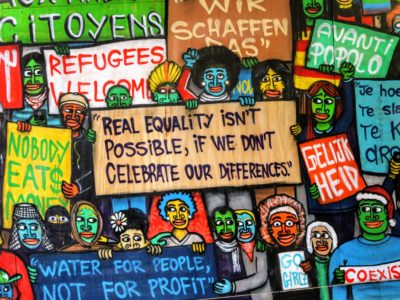
‘In our own words’: refugee actors share their stories on stage

WP_Post Object
(
    [ID] => 3767
    [post_author] => 2
    [post_date] => 2022-02-03 01:15:03
    [post_date_gmt] => 2022-02-03 01:15:03
    [post_content] => Zemmour's racism and anti-immigrant positions are not new, but his misogyny reveals where the ideological fault line lies between the new and the old far right.

Éric Zemmour, a prominent French journalist and television personality who espouses extreme-right views, announced in November that he would be a candidate for president of the Republic. He doesn’t yet have enough signatures to run in the April election, but his potential candidacy has captured enormous media attention, revealing significant support from the far right and even from some subcultures of the moderately conservative right.

Zemmour has almost no chance of being elected president, though he might poach some votes from Marine Le Pen, the leader of the Rassemblement National (RN, or National Rally; formerly the FN, or National Front). Nevertheless, a trickle of ministers and smaller political parties continue to join his newly established Reconquête (Reconquer) party, even as he is involved in a series of high profile scandals involving several accusations of sexual assault, an extramarital relationship with a much younger woman, and three court cases on accusations of inciting racist hatred.

While he has won supporters for his extreme positions on Muslims and immigration, Zemmour polls low with women. Marine Le Pen has reorganized her campaign accordingly, and Zemmour —with seven accusations of sexual assault currently pending and more than a few misogynist tracts under his belt—was obliged, for reasons of realpolitik, to declare himself a “feminist, like the next man.”

A darling of the culture wars

Zemmour, 63, rose to prominence in the 1990s as a columnist and commentator. Back then he espoused a “union of the right”—i.e., a coalition of the moderate right Républicains and the far-right Front National (FN). He became a darling of the culture wars with his essay Le Premier Sexe (2006), a gender panic polemic on the purported “feminization” of men in France. The book—yes, its title is a riposte of Simone de Beauvoir’s feminist book The Second Sex—sold over 100,000 copies.  He followed this with a novel, Petit Frère (2008), in which he attacked “anti-racist angelism," and then a trilogy that sold even better than Le Premier Sexe—Mélancolie française (2010), in which he recounts the history of France; Le Suicide français (2014), where he argues that the French nation has become degenerate since the student-led uprisings of 1968; and Destin français (2018), a sort of autobiography in which he describes various historical events that have influenced his worldview. He ends the final essay with a polemic against the growing influence of Islam on French society. Zemmour’s most recent book, La France n’a pas dit son dernier mot (France Hasn’t Had Its Last Word), published in 2021, sold 165,000 copies within three weeks. Cherished by his followers as “an intellectual” and tolerated by others as a kind of maverick TV personality—a buffoon, perhaps, like the former journalist Boris Johnson, or like Donald Trump—Zemmour is, thanks to his many books, a frequent guest on television news and culture programs. He uses these prime-time opportunities to air his views on the decline of French society, the clash of civilizations, immigration and assimilation, national preference, and national identity. He is one of the figures responsible for bringing the “great replacement theory,” the fear that France’s “native” (white) population will be replaced by (brown) non-European people, into the mainstream discourse. Whilst lamenting the passage of France’s heroic age—Napoleon, etc.—Zemmour manages to align himself with both President Charles de Gaulle, who led the French resistance during the Nazi occupation of France, and the Nazi collaborator Marshall Philippe Pétain, Vichy France’s chief of state. This pairing is an ingenious move, presenting two historical figures who represented opposing political views as representatives of France’s lost past, when strong men took charge. Jean Marie Le Pen, the former leader of the far-right FN, made the mistake of expressing his support for Pétain while denouncing de Gaulle—at a time when de Gaulle was still an extremely popular figure in France. Zemmour expresses support for both men, which is novel.

A racist's racist

Zemmour is the son of Jewish immigrants from Algeria and is himself a practicing Jew who attends an Orthodox synagogue. That has not stopped him from aligning himself with the antisemitic far right, or from saying that Pétain was right to deport non-French Jews to concentration camps—because in doing so he saved some French-French Jews (of the 75,000 Jews deported from France, 72,500 were murdered) . Zemmour has transitioned smoothly from being an “outspoken” voice in the discourse around political correctness as it morphed into what we now call a “debate” on “cancel culture.” Today he is a comfortable anti-feminist, traditionalist, misogynist, homophobe, anti-abortionist, and a “critic” of the legacy of the social movements of the 1960s. He also deplores gender studies and writes in Le Premier Sexe that rape trials qualify as the “judiciary surveillance of desire.” In the months before he announced his candidacy, Zemmour reveled in several personal and legal scandals that further raised his public profile. In September Paris Match’s cover showed him frolicking in the sea with Sarah Knafo, his 28 year-old assistant and campaign manager, whom he has known since she was 13 years old (she is the daughter of family friends). Zemmour recently confirmed that Knafo is his “companion” and is pregnant with his baby, to the delight of the press, which speculates endlessly about Mylène Chichportich, his wife of 40 years: Is she suffering or indifferent as she stands silently at his side? While Knafo is something of a protégée to Zemmour, she is in her own right a perfectly terrifying and precocious extreme right militant. As a university student she was active in the FN and in a student association called Critique of European Reason, through which she got down with the sovereigntists and Euroskeptics, and met prominent right wing thinkers like Alain Finkielkraut. At 25 she did an internship at the French embassy in Tunis. She then authored a “handbook,” based on what she’d learned in North Africa about migration routes, on how to facilitate the deportation of undocumented migrants from France. His frequent trips in and out of court keep the press talking about Zemmour, too. His January 17 conviction for inciting racial hatred was his third. A judge fined him 10,000 euros ($11,400) for having said, on live television, that unaccompanied migrant minors “have nothing to do [in France], they’re rapists, assassins, that’s all they are, you have to send them back to where they came from.” Meanwhile, at one of his November rallies, Zemmour’s militia-style bodyguards beat up an anti-racist activist in a brawl reminiscent of Trump rally scenes.

A radical ideologue

French commentators have pointed out that the country’s media is falling into the trap of giving free publicity to Zemmour, just as the U.S. media made the mistake of broadcasting Trump’s rallies live without commentary and of reporting incessantly on his tweets, giving him massive free publicity on mainstream evening and cable news programs. Like Trump, Zemmour overwhelms the media with provocative soundbites, which are often in the form of attacks on journalists. As a result, media outlets are drowning in a sea of far-right madness—reporting and broadcasting Zemmour’s racist, sexist, and fascist comments repeatedly, without analysis or critique. The fact that Zemmour’s ideas are splayed bittily across television and internet platforms, and that only certain people read his books from beginning to end, works to obscure their character as a complete ideology. His misogyny, abhorrence for the student-led uprisings of 1968, dislike of modernity, and hatred of Muslims are connected and inform each other. A quick online search brings up a list of citations to go with each of Zemmour’s ideas, presented like an inventory of the contents of a bag belonging to the fasciste du jour. Zemmour deliberately muddies the extremism of his complete ideology by presenting his ideas in a willfully confusing, often “third positionist” manner— i.e., expressing right wing ideas in the language of left-wing ones. For example, in his books he offers a critique of the monogamous couple and, ostensibly, praise for polyamory. But this is not advocacy for free love. Rather, it is an expression of approval for a premodern society in which married men had multiple mistresses and in which women had no means of leaving an unhappy marriage. In French third positionism is roughly translated as confusionniste — which is a better term, perhaps, because the deliberate effort to create confusion is a salient and defining characteristic of contemporary fascism. Writing about Zemmour is challenging because it’s almost impossible to avoid the trap of either reproducing his ideas without comment, or presenting them with expressions of shock and outrage. In either case, the writer is amplifying Zemmour’s ideology, thus giving him yet more free publicity. Zemmour and his fellow far right television personalities have succeeded in shifting the Overton window of the French discourse. Fueled by the country’s growing and fertile climate of Islamophobia, which is partly a reaction to a series of high profile, violent terrorist attacks over the last six years, the center and center-right are now taking positions that were once considered far right. In a recent illustration of this shift, Macron’s government drafted and passed the Loi de Séparatisme, a law to “strengthen republican values.” The law targets and seeks to repress the Muslim community and its cultural expression, which conflicts with France’s aggressive secularism. As such, it is a populist attempt to exploit, or give lip service to, the idea that a cultural “great replacement” has happened, or is happening, in France. It is perhaps surprising that the extreme right—identitarian and antisemitic as it is—might choose Éric Zemmour over Marine Le Pen. Zemmour, though born in France, is the offspring of an Algerian-Berber Jewish immigrant family, while Le Pen is white and descended from France’s best-known fascist dynasty. Zemmour’s background has been a subject of conversation on fan forums for Papacito (a far-right influencer with a popular YouTube channel who supports Zemmour) and on gaming websites, where eager 20-year-old neo-Nazis agree that while his Jewishness is a bit of a problem, he’s kind of an Ubermensch.

The fault line in the far right

Physically, Zemmour cuts a slight figure, with, as Harrison Stetler put it, “massive ears folding out around [a] receding jaw.” He bears no physical resemblance to the towering Aryan figures of Donald Trump or Boris Johnson, or to the topless horse rider Vladimir Putin. His possible success amongst extreme right voters — a smattering of ultra-conservative Christians, neo-Nazi groups, far right influencers, lapsed FN or Républicains voters—seems to be derived from his capacity to embody discursively a kind of straight talking, Trumpian masculinity (and whiteness), not seen in French politics since Jean-Marie Le Pen led the FN. He espoused a more overt brand of racism than that of his daughter Marine, the heir to the party’s leadership. Marine Le Pen, meanwhile, has in recent years made a dive for the center, trying to clean up her party and kicking out embarrassing family members such as her niece (who now wants to run with Zemmour) and her father, who infamously described the Holocaust as “a detail of history” and, as a French military officer, tortured people during the Algerian war. The effect of Marine’s efforts to take the party mainstream was to alienate her most right-wing voters, who have become disillusioned with her perceived political correctness. While Le Pen herself has said she is “against gay marriage,” she has also pink-washed her party in an effort to appeal to LGBT groups and even has several gay deputies. Recently Le Pen revealed that for the last five years she has been living in secret with a woman, her “childhood friend” Ingrid. “There are no men in my house, even the cats are female,” Marine said in a widely watched TV interview broadcast in early November. The critical fault line between Zemmour and Le Pen is, clearly, misogyny. Zemmour positions himself against a “cosmopolitan” political correctness that purportedly welcomes homosexuality and feminizes extreme right politics. Those who oppose Marine Le Pen’s leadership of the FN perceive her as having emasculated her daddy’s once-great party. One might wonder what is more prominent in Zemmour’s ideology—a hatred of women, or a hatred of Muslims and immigrants? But this would be the wrong question. Zemmour’s essay Le Premier Sexe shows his misogyny and his racism to be, if not interchangeable, on a continuum with one another. It shows the strong link between “theories” of feminization and the great replacement, which usually advances the racist theory that Muslims, Jews, and other non-white people will soon replace white people. It starts out as a great replacement theory about gender, advancing the idea that French men have become feminized through a culture that elevates “feminine values.” Men, he writes, are allowing themselves to be replaced by women and become total pussies, whereas a real man is a “sexual predator, a conqueror.” It is of course a polemic: his histrionic dismay at the purported fragility of contemporary French men is motivated by his belief in a naturalized masculine power (and violence), ready and waiting to be resuscitated. His essay is a spurious patchwork of loosely connected observations on advertising, football, cinema, sport, dubious “facts” and statistics, and hardcore conspiracy theories. He advances the theory that the purported feminization of men is due to the influence of “single mothers, sixty-eighters and feminists,” plus a homosexual conspiracy that wants to denaturalize sex and create a society segregated along the lines of gender. According to Zemmour, the plot is to eradicate male body hair because it would remind men of their natural “bestiality, virility,” and to set up conspiratorial alliances in cities between immigrants, single women, and gays. The speed with which he moves from roots to rootless cosmopolitans is, frankly, startling. By the end of Le Premier Sexe all this scattered madness joins up with his other great preoccupation—Muslims and immigrants. The great replacement of gender becomes just the great replacement, tout court. Hurtling through an account of the liberalization of divorce and abortion, he claims that French men have “laid their phalluses down,” thus declaring France “an open land, waiting to be impregnated by a virility from outside.” This has happened, he writes, because Christianity is a pussy religion. Outside of the Western world, he writes, men defend their dominant position “like a treasure” and refuse to align the “status” of their women with that of the Europeans. The argument is not simply that white French men are becoming more like women, but that they will be replaced by a masculine revolution of foreign (Muslim) men who are concentrated in France’s suburbs. Despite the book’s highly misogynistic character, which shows Zemmour’s hatred for women and especially feminists, part of his argument is that Black and Arab men, with their machismo and their desire to dominate, present a danger to…Western white women and feminists. Zemmour can claim as much as he likes that he is now a feminist. His entourage of female influencers, FemmesAvecZemmour (WomenWithZemmour), are flocking to make the same racist argument about women’s safety in an effort to make a feminist of old Zemmour. But Zemmour is quite different from other leaders. He manages to present himself as a real man, a man’s man, a man who speaks his mind, while remaining, a wily, self-satisfied intellectual who espouses a hardcore and explicit ideology. Whether he becomes a candidate in the presidential election or not, it’s quite clear that his prominence is symptomatic of a rightward shift in France, and in any case such extreme right mobilizing has already made its impact on the policies of the center. [post_title] => Softbois in France: a feminist perspective on the rise of Éric Zemmour [post_excerpt] => Zemmour's racism and anti-immigrant positions are not new, but his misogyny reveals where the ideological fault line lies between the new and the old far right. [post_status] => publish [comment_status] => closed [ping_status] => open [post_password] => [post_name] => softbois-in-france-the-rise-of-eric-zemmour-from-a-feminist-perspective [to_ping] => [pinged] => [post_modified] => 2026-01-15 21:27:58 [post_modified_gmt] => 2026-01-15 21:27:58 [post_content_filtered] => [post_parent] => 0 [guid] => https://conversationalist.org/?p=3767 [menu_order] => 144 [post_type] => post [post_mime_type] => [comment_count] => 0 [filter] => raw )
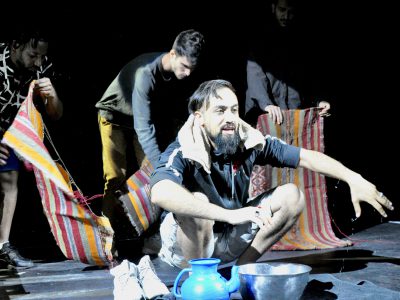
"Eric Zemmour surrounded by supporters at the end of his meeting at the Trocadero on March 27, 2022."

Softbois in France: a feminist perspective on the rise of Éric Zemmour

WP_Post Object
(
    [ID] => 3756
    [post_author] => 2
    [post_date] => 2022-01-27 21:13:29
    [post_date_gmt] => 2022-01-27 21:13:29
    [post_content] => Forced sterilizations on detained migrant women is in line with the US's long, sordid history of eugenics.

Last month, the Department of Homeland Security (DHS) briefed House Democrats on allegations concerning several gynecological procedures, including hysterectomies, that a physician performed on migrant women in Immigration and Customs Enforcement (ICE) custody at the Irwin County Detention Center in Ocilla, Georgia—allegedly without their informed consent. The incidents became public knowledge in September 2020, after a consortium of human rights groups filed an explosive report on behalf of Nurse Dawn Wooten, a whistleblower who worked at the detention center.

In a December 3 letter signed by the chairmen of the House Committees on Homeland Security and Oversight and Reform, legislators wrote: “We are concerned that Dr. [Mahendra] Amin may have been performing unnecessary surgical procedures to defraud DHS and the Federal government without consequences.” The letter, which is addressed to DHS Secretary Alejandro Mayorkas, also requested information on the steps the Department has taken to review treatment Dr. Amin provided and ensure migrants receive proper medical care in the future.

The Conversationalist confirmed a December 15 DHS briefing with two committee staffers, both of whom declined to share additional details about the information presented. A staffer from the Committee on Homeland Security clarified that this was a DHS review of the Irwin County Detention Center and not a general review of migrant detention facilities, although Congress requested the Department to brief them on the matter months ago.

The December 3 letter says, “the Committee on Homeland Security requested a briefing on August 10, 2021, on DHS’s efforts to review the suitability of detention facilities. To date, DHS has not fulfilled this request. We ask that you ensure the Committees receive this briefing without further delay.”

On January 3, the DHS released a report that found “the facility’s chronic care, continuity of care, and medical policies and procedures to be inadequate” but did not find that unnecessary or unwanted hysterectomies had been performed. The report does, however, quote an ICE employee who alleges that there is a systemic issue in the ICE leadership that makes the agency “unwilling to listen to concerns or complaints about detention facilities.”

Nurse Dawn Wooten worked at the Irwin County Detention Center (ICDC) for three years. She says that Dr. Amin, who was referred to as the “uterus collector,” had performed hysterectomies on at least 20 women without their consent. Many of these women did not speak English well enough to consent to the procedures or understand what had been done to them. Thirty-five women are now suing ICE over Dr. Amin’s abuse.ICDC, run by a for-profit prison company called LaSalle Corrections, also came under harsh scrutiny for their botched COVID-19 response, which sparked hunger strikes and protests among detainees early in the pandemic.

The Georgia-based advocacy group Project South filed the complaint, which describes a filthy, insect-infested facility with inadequate COVID-19 safety precautions, where staff refused to test symptomatic detainees and fabricated medical records. Detainees who protested the conditions were punished with beatings, pepper spray, and solitary confinement. Nurse Wooten told The Intercept that she was demoted after raising concerns with her supervisors.

“It is deeply concerning that neither DHS nor the private prison company running Irwin have yet to face accountability for the medical abuse that migrant women faced at Irwin,” Azadeh Shahshahani, the Legal and Advocacy Director with Project South said in an email statement to The Conversationalist. “This is setting an awful precedent. Congress and the Biden Administration must act now.”

The joint committee investigation subpoenaed LaSalle Corrections in November 2020 after the company refused to turn over medical records on the procedures Dr. Amin performed. Dr. Tony Ogburn, Department Chair of Obstetrics and Gynecology at the University of Texas Rio Grande Valley, reviewed those records. He concluded that Dr. Amin’s care “did not meet acceptable standards.”

“My concern is that he was not competent and simply did the same evaluation and treatment on most patients because that is what he knew how to do, and/or he did tests and treatments that generated a significant amount of reimbursement without benefitting most patients,” Dr. Ogburn concluded in a November 2021 letter to the Georgia Medical Board.

Following pressure from lawmakers, activists, and advocacy groups, DHS Secretary Mayorkas announced he would sever ties with LaSalle Corrections in May 2021, though migrants were not removed from the facilities until September 2021—a full year after Project South filed Nurse Wooten’s whistleblower complaint with the ICE administration.

While these abuses came to light during the Trump presidency the lack of accountability continues under the Biden Administration, with migrant arrests now at a 21-year high. The current administration has ramped up deportations under a Trump-era health policy that allows the government to expedite the process without giving migrants the opportunity to apply for asylum. The government claims the rushed deportations are a COVID-19 safety precaution.

Under Title 42, the Trump Administration expelled 444,000 migrants. Under Biden, this number has already reached 690,000. COVID-19 still runs rampant in migrant detention centers and in prisons such as New York City’s Rikers Island, where more than one-fifth of the incarcerated population has tested positive.

Immigration advocates have been disappointed with the new administration. Since taking office, Biden has filed 296 executive orders on immigration, 89 of which have reversed actions taken by the Trump administration such as the travel ban on Muslim majority nations and construction of the border wall.

When Dawn Wooten stepped forward to make a whistleblower complaint about the medical abuses at ICDC, international headlines about “mass hysterectomies” sparked outrage and comparisons to Nazi Germany. Others placed the story within a long history of American eugenics that targeted Black, brown, disabled, and indigenous women.

“People with Spanish surnames were disproportionately sterilized during the period of peak eugenics in the 1920s through the 1950s,” says Heather Dron, a Research Fellow at the Sterilization and Social Justice Lab at the University of Michigan.

During the twentieth century, U.S. states subjected over 60,000 people to sterilization without consent, with over 30 states establishing eugenics boards. State governments targeted minorities, the disabled, and others who did not fit into “social norms” for forced sterilization.

From 1929 to 1974 North Carolina ordered as many as 7,600 women sterilized— a majority of whom were Black women from low-income backgrounds. Margaret Sanger and Dr. Gregory Pincus exploited government birth control centers in Puerto Rico to subject one-third of the female population to sterilization procedures, often without their consent, purportedly to address “overpopulation” and poverty on the island. Under the Family Planning Services and Population Research Act of 1970 physicians sterilized an estimated 25 percent of Native American women of childbearing age in a six-year period.

Adolf Hitler writes admiringly in Mein Kampf of eugenics policies practiced in the U.S. “There is today one state in which at least weak beginnings toward a better conception [of immigration] are noticeable. Of course, it is not our model German Republic, but [the United States], in which an effort is made to consult reason at least partially. By refusing immigrants on principle to elements in poor health, by simply excluding certain races from naturalization, it professes in slow beginnings a view that is peculiar to the People's State.”

Heather Dron’s research focuses on eugenic sterilization in California, where roughly 20,000, or one-third, of U.S. sterilizations were performed starting from 1909.

“There was a law on the books between 1909 and 1979 that allowed for the sterilization of institutionalized people housed in psychiatric hospitals, or in homes for what was then called the ‘feeble-minded,’” Dron says. “Sterilization was seen as a solution to all these other social problems. They saw it as a way to keep these people out of institutions.”

While eugenics laws in California have been repealed, sterilizations have continued. A 2013 investigation by Mother Jones revealed that 148 women in two California prisons were sterilized from 2006 to 2010.

“You get a similar dynamic there,” says Dron, referring to the recent ICE cases. “There were a few people who were performing a lot of procedures who seemed like they didn’t have a great ethical practice in general.”

There is no evidence to suggest that Dr. Mahendra Amin was motivated to perform these surgeries for anything other than financial compensation. Last month's letter from House Democrats expressing concerns that Dr. Amin performed these surgeries to “defraud the government” further supports this theory.

“It sounds like there’s some sort of incentive to perform surgical interventions because you’re paid per intervention and some people took advantage of that,” Dron says of Dr. Amin’s case. “But you have to read that with a little bit of skepticism because often we point to these bad actors and say it’s just them as opposed to a system that systematically thinks that people who are incarcerated shouldn’t have kids.”

The breaking news of hysterectomies performed on migrant women in ICE custody barely made it through one news cycle before news of Ruth Bader Ginsberg’s death broke just days later. Her death was followed by a swift Republican push to nominate a third Supreme Court Justice under Trump just weeks ahead of the 2020 election.

The media might choose to remember the hysterectomies performed at the Georgia ICE facility as a particularly egregious act that happened under a uniquely evil administration. That would be a huge mistake.

According to a December 2021 article in The Texas Tribune, the number of immigrants held in ICE detention centers has increased by more than 50 percent since Biden took office. Moreover, the investigation into Dr. Amin’s medical practice has been conducted on Biden’s watch.

Detentions have been accompanied by a spike in border crossings in 2021. Biden has downplayed this as a seasonal phenomenon while Republicans have pointed to plans to offer 11 million migrants a path to citizenship as cause for the surge. Others say the migrants are motivated by growing instability in their home countries. With less attention on the issue of migration, Biden has gotten away with his continuation of the “remain in Mexico” policy by pointing to Title 42, which has been extended twice by the Centers for Disease Control and Prevention, as a matter of public health.

Under the Biden Administration, we no longer hear overtly fascist rhetoric from the White House aimed at migrants, but detainees at ICE facilities continue to suffer from extreme medical neglect and abuse as COVID-19 cases soar.

In order to prevent us from reliving the past, we need to understand the circumstances that led us to where we are today. Ending Trump’s remain in Mexico policies, fulfilling a campaign promise to offer migrants a path to citizenship, and holding Dr. Amin and LaSalle Corrections responsible for their medical abuses would be a great place to start.

 
    [post_title] => The 'uterus collector': the surgeon who performed coerced hysterectomies on detained migrant women
    [post_excerpt] => The forced sterilizations are in line with the U.S.'s long, sordid, racist history of eugenics. 
    [post_status] => publish
    [comment_status] => closed
    [ping_status] => open
    [post_password] => 
    [post_name] => the-uterus-collector-the-scandal-of-the-surgeon-who-performed-coerced-hysterectomies-on-detained-migrant-women
    [to_ping] => 
    [pinged] => 
    [post_modified] => 2024-08-28 21:14:02
    [post_modified_gmt] => 2024-08-28 21:14:02
    [post_content_filtered] => 
    [post_parent] => 0
    [guid] => https://conversationalist.org/?p=3756
    [menu_order] => 145
    [post_type] => post
    [post_mime_type] => 
    [comment_count] => 0
    [filter] => raw
)

The ‘uterus collector’: the surgeon who performed coerced hysterectomies on detained migrant women

WP_Post Object
(
    [ID] => 3432
    [post_author] => 2
    [post_date] => 2021-11-11 12:08:43
    [post_date_gmt] => 2021-11-11 12:08:43
    [post_content] => Throughout her journey, the 9-year-old Syrian refugee girl-puppet was greeted by both loving crowds and anti-migrant protesters. 

A huge crowd gathers outside the National Theatre in London’s Southbank. Children run around during the last moments of daylight. A choir stands ready. They are waiting for Amal. Heads turn and people point, as a giant puppet rounds the corner. As she walks into the courtyard, a solo voice sings out her name. The audience is silent.

Amal tentatively explores the crowd, peering into the faces in front of her. She bends down to touch a child’s hand, and an elderly woman appears to give her words of heartfelt comfort. The mood is electric. When Amal finally leaves the National Theater, the crowd follows her across Waterloo Bridge, accompanying her as she continues to her next destination. 

She might just be a puppet, but Amal represents something very real. She embodies a nine-year-old Syrian refugee, who has taken the same journey as many unaccompanied minors across Europe. Her name is Arabic for “hope.” Amal started her journey on the Turkey-Syria border, kicking off Good Chance and Handspring Puppet Company’s travelling festival, The Walk, and journeying 8,000 kilometers (5,000 miles) to find a home in Manchester, UK.

We were all invited to join Amal as she traveled across Turkey, Greece, and Italy, where she was met with both love and hostility. Amal has finally arrived in the UK, just as its government is proposing potentially hugely consequential changes to its immigration system, changes which could actually land those making dangerous journeys like Amal’s in jail. 

Thankfully for Amal, as she made her final steps across Europe, she was welcomed and given a home. Will the same be true for real migrant children?

Amal’s next steps in Europe

As Amal left Italy, to begin the final leg of her journey, she took her first steps through south-eastern France and into Switzerland. In Geneva, she played in the fountains outside the United Nations Office, and placed her hand on The Broken Chair, a 12-metre sculpture of a seat with a snapped leg, designed to raise awareness of the victims of landmines. There were many such poignant moments during The Walk. “The fact that this journey is based on a real route that many thousands of children have walked, and some have lost their life on, means that we are entrusted with a great responsibility to represent their stories in an honest and complicated way, showing the hardship but also the beauty of their journeys,” Amir Nizar Zuabi, artistic director of The Walk and Good Chance, told me.  “We take this responsibility very seriously, because we know that as big as Amal is, so is the impact of her journey.” Amal moved on from Switzerland, stepping next into Germany, home to the EU’s largest population of displaced people. When she arrived in Stuttgart, she made friends with a giant robotic puppet, part of the Dundu Family of German puppets that have brought together audiences internationally since 2006 with spectacular light and music shows. As nighttime arrived, Amal met more of the family, as they lit up the darkness. When unaccompanied minors like Amal first arrive in Germany, they’re taken into the care of the local youth welfare office, explains Jonathan Sieger, head of the Bürgerzentrum community center and executive board member of NGO Kölner Spendenkonvoi, which assists newly arrived refugees. These young people are then placed with relatives, a foster family, or a suitable facility, and they must be given a legal guardian, as is the case—although not necessarily the reality—across much of Europe. One of the main risks young refugees face, Sieger says, is developing long term trauma. “What we are lacking in Germany is general psychological treatment for refugees. Especially for unaccompanied minors, this help is crucial,” Sieger says. This same sentiment has been echoed by organizations across the continent.  Organizations like Bürgerzentrum are supporting young refugees to settle into their new homes. From its base in Cologne, Bürgerzentrum offers cooking workshops, theater classes, cultural events, and trips. Amal’s journey did not end here, but if it did, perhaps she would have found a warm welcome. As Amal bid farewell to Germany, she continued across Belgium, and then into France.

Walking through France

In the mountain region of Briançon, Amal embarked upon the treacherous path that many refugees have used to cross from Italy into France. She gazed at an exhibition of artwork made from the objects and clothes left behind by those who had traveled before her. In Paris, she saw the Eiffel Tower, and in Lyon she walked through the park with new friends. There was music wherever she went: brass bands, accordions, drumbeats. Amal was treated with dignity and celebration, but this is not always the reality for refugees in northern France. Police use violence and tear gas, which has been documented by Refugee Rights Europe and others. Safe Passage International is an organization helping child refugees reach safety and reunite with family, and it works across the UK, France, and Greece. In France, most of the people they support are sleeping on the street when they first come into contact with them. “Having fled war and persecution, there are thousands of children stuck on the streets or in refugee camps across Europe—nobody can call that safe for a child. Children are at serious risk of violence, exploitation and trafficking. These are children left in limbo and exposed to incredibly dangerous situations,” says the organization’s CEO, Beth Gardiner-Smith.  Amal then made her way to Calais flanked with cheers and flags. This is often the spot where people cross over to the UK. It was the people of the Calais Jungle, a refugee camp that the French government had destroyed in 2016, which served as the original inspiration for Amal. It was also the birthplace of an earlier Good Chance production, The Jungle, about the people who gathered at an Afghan café in the refugee camp. Despite all this, the Mayor of Calais objected to Amal passing through the area and refused to approve a permit. Like many young refugees before her, Amal crossed the English Channel to the UK. But unlike fellow young refugees, the company of Good Chance actors accompanying Amal crossed the water safely, with passports in hand and comfortable places to sleep on either side of the journey.

Arriving on UK shores

On a grey day toward the end of October, Amal finally stepped onto the shore in Folkestone, Kent, in the south-east of England. The actor Jude Law, who is an ambassador for The Walk, held her hand as she walked down the pier, where schoolchildren welcomed her and gave her a passport, blanket, and cookies. The day after Amal’s arrival, supporters flocked to Parliament Square in London to join the Refugees Welcome Rally, organized by a collective of refugee organizations. The protest took place in opposition to the government’s new “Nationality and Borders Bill,” which parliament is currently considering. The Conservative government has stated three objectives for this bill: 
  • “To make the system fairer and more effective”;
  • “To deter illegal entry into the UK”;
  • “To remove from the UK those with no right to be here.”
In her opening speech for the bill, Home Secretary Priti Patel said: “The British people have had enough of open borders and uncontrolled migration[...] Enough of dinghies arriving illegally on our shores, directed by organized crime gangs.” She went on to outline some of the proposed changes, which include a maximum prison sentence of four years for those “entering the country illegally” and additional powers for the Home Office’s Border Force.  The policies outlined in the bill contravene the UN Refugee Convention, which states that refugees should not be penalized for the manner in which they enter a country if they are coming from somewhere where their life or freedom has been threatened.  According to Safe Passage International, the UK government’s bill is aimed, foremost, at deterring migrants and refugees who wish to enter the UK, but fails to address the reasons people leave their countries. “The UK Government’s Nationality and Borders Bill will cruelly punish refugees who turn to us for compassion and safety, whilst doing nothing to break the business model of smugglers who exploit the lack of safe passage to the UK,” says the organization’s CEO, Beth Gardiner-Smith. “We urge this government to tear up these cruel plans and instead open safe routes for refugees seeking sanctuary in the UK.” There are currently no visas that would allow a person to travel legally to the UK and claim asylum.  “It’s deeply concerning that virtually the only way now for child refugees to reach the UK from France—regardless of their age, vulnerability, family links or community ties—is to risk a dangerous journey in the back of lorries or on dinghies across the Channel,” Gardiner-Smith added. If passed, the bill could see many asylum seekers deported to a third country, particularly those who have already traveled through what are considered “safe nations.” The government will introduce “reception centers,” which could resemble the controversial Napier Barracks, criticized for their “squalid” conditions. The bill also paves the way for keeping refugees offshore, where they are detained in so-called processing centers in a third country. Safe Passage International is calling on the UK government to allow entry to people seeking asylum in cases where they already have family in the UK. They also say the situation for refugees has worsened since Brexit because the EU’s Dublin Regulation, which provided the criteria for defining which country is responsible for examining a refugee’s asylum application, has not yet been replaced with a UK equivalent.  Thankfully, there is a strong network of local organizations across the UK supporting young refugees, like the Kent Refugee Action Network (KRAN). Daniel and Osama are two of KRAN’s youth ambassadors. They are also refugees; now they support people who are making the same journeys that they did.  Three years ago, KRAN started a Youth Forum, where young refugees meet to discuss different issues that affect them—like accommodation, education, and mental health. Youth ambassadors like Daniel and Osama act as a bridge between these young people and the organization. In the forum, young people often describe the contrast between their expectations and their experiences in seeking asylum in the UK. In most instances, they’ve faced challenges at every stage. These stories also highlight the essential role of organizations like KRAN and the Refugee Council, and Refugee Action. Despite the challenges he’s faced, Daniel has felt welcomed in the UK and does not believe the country’s new immigration plan represents the sentiment of the wider public. The bill is now in the report stage and awaiting its third reading, after passing its second reading by 366 votes to 265. With a Conservative majority, it seems likely the bill will pass. But there could be legal challenges to Priti Patel’s plan for a Border Force to push back boats carrying refugees.

Meeting Amal

Both Daniel and Osama met Amal in Kent. They described it as an extraordinary experience. “It really represents our stories, it represents the suffering that we have been through,” Osama says. “You have this emotional feeling when you see that people are coming just [to see] a puppet and [to give] their warm greetings.” At the beginning of this month, Amal finally found a home in Manchester. Local schools, refugee communities, and the Manchester International Festival created a spectacle for her arrival: a flock of puppet birds. As Amal moved among the crowd, a flight of swallows acted as her guide, their wings illuminated and flapping gently around Amal. These birds know migration too, making dangerous journeys every year between the UK and South Africa. “I know that the arrival into the UK specifically, though not only the UK, is not a simple one. Amal and the children she represents only start a much longer journey once they reach their final destinations,” The Walk director Zuabi says. Zuabi, nonetheless, has hopes for Amal, a puppet who represents all young refugees: “We are not born refugees, it is a circumstance, and this circumstance should be as short as possible.”  If the Nationality and Borders bill is passed, the future could look bleak for asylum seekers hoping for refuge and welcome in the UK. Already, the Border Force has been spotted practising sea push back techniques. Napier Barracks is still operating. But the open arms with which Little Amal has been welcomed and the persistent work of grassroots refugee organizations show that the British people care, and will stand up for their new neighbors. It’s there in Amal’s name—there is hope. [post_title] => Little Amal arrives in the UK as parliament considers a bill that would see her deported [post_excerpt] => Enthusiastic crowds greeted the 10 year-old unaccompanied Syrian refugee girl, even as parliament considered a bill that would make thousands of refugees ineligible to stay in the UK. [post_status] => publish [comment_status] => closed [ping_status] => open [post_password] => [post_name] => little-amal-arrives-in-the-uk-as-parliament-considers-a-bill-that-would-see-her-deported [to_ping] => [pinged] => [post_modified] => 2024-08-28 21:15:12 [post_modified_gmt] => 2024-08-28 21:15:12 [post_content_filtered] => [post_parent] => 0 [guid] => https://conversationalist.org/?p=3432 [menu_order] => 164 [post_type] => post [post_mime_type] => [comment_count] => 0 [filter] => raw )

Little Amal arrives in the UK as parliament considers a bill that would see her deported

WP_Post Object
(
    [ID] => 3193
    [post_author] => 2
    [post_date] => 2021-09-22 03:32:26
    [post_date_gmt] => 2021-09-22 03:32:26
    [post_content] => Her message to the world: please don't forget the refugee children.

A little girl is walking alone from Syria to England. She is 11 feet and 6 inches tall.

Little Amal (Arabic for “hope”) is actually a giant puppet. She represents the thousands of refugee children who have been displaced from their home countries. This nine-year-old Syrian girl is now journeying from Turkey, across Europe, and to the U.K., as part of an 8,000 kilometer (5,000 mile)  travelling festival titled The Walk.

At the end of July, Amal began her journey as a “refugee” in Gaziantep, Turkey, home to half a million Syrians. People holding lanterns aloft surrounded her, lighting up the night. As she moved through the streets, Amal reached out to balconies where children stood watching, and gently touched their hands as they smiled down at her. Orbs of light sparkled overhead, and a choir welcomed her with song. Many of the people participating in the street theater were themselves refugees.

Amal is now halfway through this theatrical journey created by Good Chance, a theater company founded in the Calais refugee camps in 2015, in collaboration with the Handspring Puppet Company. Communities in Turkey, Greece, and Italy, where she’s continued her journey, have found different ways to welcome her — sometimes with love, and sometimes with hostility. But how close is Amal’s experience to that of real refugee children?

Setting off in Turkey

The rest of Amal’s journey through Turkey was likewise filled with celebration and theatrical wonder. In Adana, a flock of model birds accompanied her across the Taşköprü stone bridge, held up proudly on long sticks by both children and adults in the local community. She played with the children of Tarsus, who crowded in together for a chance to touch her hands. In the Kaleiçi Bazaar in Denizli, portraits of refugees who had journeyed through Turkey were projected onto walls as she appeared. “I think the most common reaction is wonderment, followed by curiosity. People have been receiving her very warmly in many places,” says Amir Nizar Zuabi, artistic director of The Walk and Good Chance. “One of the most astonishing things for me as artistic director on this project, was the true generosity and creativity that this evoked from people,” he says. “This project is only possible because of a network of thousands of people that have devoted time, energy, and their creativity to create these welcoming events along the way.” Turkey is a poignant place for this journey to begin. It hosts the biggest population of refugees in the world. The “best interests of the child” principle, part of the United Nations Convention of the Rights of the Child, is enshrined into law here, which means that all unaccompanied young refugees must, in theory, be given suitable accommodation and a guardian. But according to the Asylum Information Database (AIDA), many children are in fact abandoned by the state which doesn’t offer the protections they are promised. AIDA has also pointed out the state sometimes appoints inappropriate guardians, such as people without the right qualifications, or who aren’t a relative, leaving refugee children with no other choice but to beg in the street. Were Amal settling in Turkey, accessing education could also be a real problem. Approximately 400,000 Syrian children residing in the country are not receiving an education, according to Human Rights Watch and Turkey’s Ministry of Education, Amal, however, is not settling in Turkey. On her last day in the country, she stood on the shores of Çesme as the sun set, ready to take a boat to Greece. In these waters, many refugees like her have lost their lives. Zuabi commented on the potency of that moment, as Amal looked into the horizon, almost motionless.

Hostility in Greece

Little Amal’s journey in Greece was, at times, quite tumultuous. It began with music, with a whole community arriving to meet her off the boat in Chios and welcome her with song. But in other towns, she faced fury. “In a city called Larissa in Greece, she became a symbol of the refugee problem, she was shouted at and even violently attacked,” says Zuabi. Protesters threw stones at Amal. And in Meteora, people voted to ban Amal from walking through their village, because they did not want a Muslim child walking through a Greek Orthodox space. More violence was threatened against Amal in other towns and villages along her route. “From that moment, her appearances in Greece created a strong sense of solidarity. I think the reaction she induces is specific to the context of the country we are in, and even more specific to the city and the population we meet,” Zuabi says. “One thing I know for sure is that nobody stays indifferent.” 
In spite of the threats against Amal, people still came together to welcome her in Athens. While some events had to be cancelled, Amal took to a rooftop in Athens to meet locals. From this vantage point, Zuabi says, he could see people wiping tears from their eyes. On the Walk With Amal Instagram account people responded to the video of the violence with an outpouring of love and solidarity—more than double the number of comments than their other popular videos. There were messages like, “I'm so proud that I walked with you Amal, hand in hand with my children!” and “We want to welcome you, celebrate you and keep you safe.”  In Ioannina, Amal walked between the Katsikas refugee camp and the city centre. In the camp, Zuabi says there was a sense of pride; people felt celebrated. As she walked on, the local community presented lightboxes filled with messages of hope: “You are our rainbow” and “Step by step,” they said.  When unaccompanied minors arrive in Greece, they are detained in reception centres until they’ve been processed and a place in a shelter found for them, but backlogs mean they can be left waiting for months. Their accommodation is often unsuitable, and spaces are limited. Human Rights Watch has witnessed young people living amongst the general population of Greece’s Moria Camp, because the areas designated for children are beyond capacity. Some children have to fend for themselves, sometimes sleeping in the open despite the fact that, under Greek law, unaccompanied children should be placed in safe accommodations and placed under guardianship. Irida Pandiri is responsible for shelters for unaccompanied minors through her work with the Association for the Social Support of Youth (ARSIS), a Greek NGO that assists young people in difficulty or danger. She says the larger reception centres in which people are detained are simply not appropriate for children, in part because they cannot leave the facilities to go to school. Meanwhile, the guardianship promised to these young people is not provided.  “Guardianship, it is almost a joke in Greece,” she says. “When they are in the detention facilities, there are no guardians.” This, for ARSIS, is a crucial issue. Education is also a major problem, with Greek schools often reluctant to register refugee children; even in cases where registration is possible, Covid restrictions often prevent them from leaving the camp to attend. In order to make it to these reception centres, young refugees must come face-to-face with authorities hoping to send them back to Turkey. Their “welcome” to Greece is full of violence: their belongings are confiscated and they are frequently turned away, in clear violation of their human rights. Many such experiences have been documented by organizations like the Border Violence Monitoring Network and Refugee Rights Europe. Just as the response to Amal’s reception in Greece was mixed, so has ARSIS found its ability to do its work challenged by uneven support in various communities. “In the years since 2017-2018, in the areas where we are trying to establish shelters, unfortunately, the communities weren’t so welcoming,” Pandiri says. But ARSIS continues to support young refugees as best it can. The organization has eight centres for unaccompanied children across Greece, and they operate safe zones in some of the larger camps. Other NGOs also offer child protection services, legal advice, and recreational activities. As Amal took her final steps in Greece toward Piraeus Port, she was guided by more singing and live music. The protests in Greece were loud, but the welcome was louder.

Walking through Italy

Little Amal is now walking through Italy. She arrived in Bari, where an Italian nonna, or grandmother, arrived to give her guidance. This nonna, a puppet just a few inches shy of Amal’s height, pulled her for a hug and imparted upon her some words of wisdom. [caption id="attachment_3195" align="aligncenter" width="640"] Little Amal greeted by an Italian nonna, or grandmother, in Bari, Italy.[/caption] Italy has welcomed Amal warmly, but this experience might be far from the reality for actual young refugees. Andrea Costa is president of Baobab Experience, an organization supporting displaced people who have arrived in Italy. The organization is also a humanitarian partner of The Walk. “Italy—and I’m very sad to say this, because I love my country—is changing,” Costa said. Although it has traditionally welcomed foreigners, negative media coverage of migration and the rise of far-right politicians have led to a changed country, he said, adding: “It's pretty difficult for unaccompanied minors to make their way in Italy.” In Italy, solidarity with refugees has now been criminalized in a number of ways. In June 2019, Italy banned NGOs from carrying out search and rescue operations. In the area of Ventimiglia, several people have been charged for giving food to refugees, after a municipal decree outlawed the practice. “Before, people felt ashamed to be racist,” said Costa. But now, people who want to help refugees must do so surreptitiously.  Like Turkey and Greece, Italy has policies and procedures in place that are designed to protect unaccompanied children. They are given a permit to remain until they are 18 years old. They can’t be pushed back to other countries, they must be accommodated, and they cannot be detained.  But in practice, these rights aren’t always respected. As the coronavirus pandemic swept through Italy, the government used private ships to quarantine incoming refugees. According to a report from the Italian Association for Juridical Studies on Immigration (ASGI), some children were held on these ships for 10-15 days (although some people report this is far longer) before their ages were assessed. Human Rights Watch reported that children were being illegally pushed back from Italy to Greece, another abuse of rights. These are young people who have most likely already faced tremendous trauma. Costa describes Italy as a transit country for refugees. While many young people choose to move through the country rather than claim asylum, they are at risk. “We have an extremely high number of unaccompanied minors who don't want to stay in Italy, but want to go directly to France, to Germany, to Holland, to Belgium, because they know that even for minors, just like for all the other migrants, it's much better organized in other European countries,” Costa said. According to Human Rights Watch, many young refugees cite a lack of access to education and poor reception upon arrival in Italy as influencing them to move onto other countries instead. Baobab Experience is an organization composed of volunteers who care for young people at risk of falling into the hands of smugglers or human traffickers while they’re in Italy. They make sure these refugees have somewhere to sleep, something to eat, and are clothed. Recently, they joined a network of organizations helping to create safe passages so that, if those young people do choose to cross borders, trusted organizations can help on the other side, including in finding travel tickets at the best prices, rather than turning to smugglers. But there is another problem for unaccompanied minors in Italy—a cruel gift on their 18th birthday. As they make the difficult transition into adulthood, far from their home country and family, they are no longer guaranteed accommodation. Many of them lack the skills to make their way safely in the world, with no access to language or professional skills. “There are a lot of young people that really lose important years of their lives,” Costa says. This is why Baobab Experience provides English and Italian courses for young people. Despite all this, Costa remains optimistic about the future of refugees in Italy. He’s seen a change in younger Italians, who seem to be more understanding about their plight. Perhaps a new, more welcoming Italy is on the horizon. Meanwhile, Amal is continuing her journey through Italy, before she crosses into France. She’s just finished exploring the ancient landmarks of Rome; in Vatican City Pope Francis met with Amal, along with the children accompanying her on this leg of the journey. 
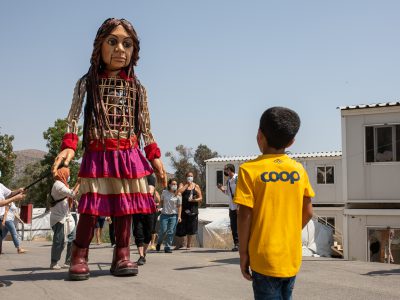
Amal’s welcome across Turkey, Greece, and Italy varied from country to country and village to village. Like the refugees whose experiences she’s enacting, Amal’s journey has only begun. Her last stop is the U.K., where the government is currently pushing through legislation called the borders and nationalities bill, which would deny asylum or aid to any refugee who enters the country through an unofficial port of entry—for example, by crossing the channel in a small boat. Under the provisions of the bill, Afghan refugees forced to escape from the Taliban could be jailed in the U.K. because they reached the country by routes that the U.K. government has decided are “illegal”—although, according to international law, there is no such thing as an illegal asylum seeker. What kind of welcome can Amal expect when she arrives in October? In spite of the government proposals, many British communities promise a warm welcome to Amal and to refugee children. Camden Town has planned a birthday party for Amal, while several choirs will sing for her in the port town of Folkestone on the day she arrives in the U.K.. Anti-refugee sentiment has become more pronounced since Brexit, but many people have also become more vocal about their support for refugees. In the face of racism, changing government policy, and dehumanizing tabloid headlines, compassionate communities are needed more than ever. [post_title] => This is Little Amal, the puppet refugee girl on a European odyssey [post_excerpt] => Ferried from country to country by volunteer puppeteers, Little Amal has been greeted by choirs and dancers. In Vatican City, she was greeted by Pope Francis. [post_status] => publish [comment_status] => closed [ping_status] => open [post_password] => [post_name] => this-is-little-amal-the-puppet-refugee-girl-walking-8000-kilometers-across-europe [to_ping] => [pinged] => [post_modified] => 2024-08-28 21:15:12 [post_modified_gmt] => 2024-08-28 21:15:12 [post_content_filtered] => [post_parent] => 0 [guid] => https://conversationalist.org/?p=3193 [menu_order] => 177 [post_type] => post [post_mime_type] => [comment_count] => 0 [filter] => raw )

This is Little Amal, the puppet refugee girl on a European odyssey

WP_Post Object
(
    [ID] => 3053
    [post_author] => 2
    [post_date] => 2021-07-29 15:39:53
    [post_date_gmt] => 2021-07-29 15:39:53
    [post_content] =>                     

 
    [post_title] => How the Soviet Jews changed the world: a graphic tale of tragedy and triumph
    [post_excerpt] => Soviet Jews played a critical role in the history of the USSR and, by extension, the trajectory of the Cold War and the history of the twentieth century. 
    [post_status] => publish
    [comment_status] => closed
    [ping_status] => open
    [post_password] => 
    [post_name] => how-the-soviet-jews-changed-the-world-a-graphic-tale-of-tragedy-and-triumph
    [to_ping] => 
    [pinged] => 
    [post_modified] => 2024-08-28 21:15:13
    [post_modified_gmt] => 2024-08-28 21:15:13
    [post_content_filtered] => 
    [post_parent] => 0
    [guid] => https://conversationalist.org/?p=3053
    [menu_order] => 186
    [post_type] => post
    [post_mime_type] => 
    [comment_count] => 0
    [filter] => raw
)
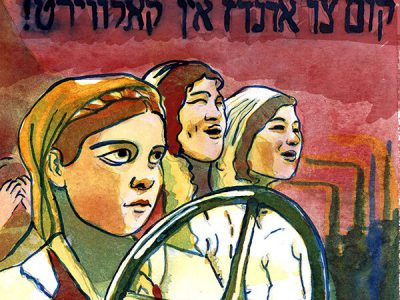
How the Soviet Jews changed the world: a graphic tale of tragedy and triumph