WP_Post Object
(
[ID] => 11308
[post_author] => 15
[post_date] => 2026-11-13 00:08:04
[post_date_gmt] => 2026-11-13 00:08:04
[post_content] =>
Could a USB-sized vagina model unlock women's healthcare?
There is a big problem in the world of women’s healthcare: It is under-researched and underfunded, receiving around only 5% of global funding. As a result, the male body has become the default, often at the expense of women, who experience conditions differently from men and have a whole range of specific healthcare needs.
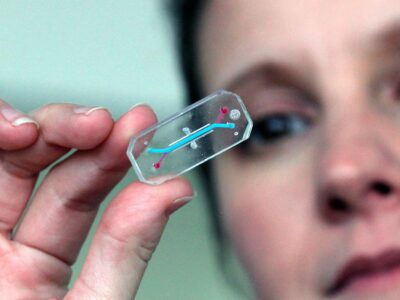
At Harvard University’s Wyss Institute, with Gates Foundation help, a team of scientists have been looking to fix this disparity, and to create a better model for women’s health research—using small, clear USB drive-sized devices, each “containing” a vagina and a cervix.
Organs-on-a-chip might sound like something dreamed up in a sci-fi movie, but it’s a development already having a real impact in the here and now. A fairly new technology, the first, a lung-on-a-chip, was created in 2010, also at the Wyss Institute. The chips are made of clear polymer with hollow channels, which are lined with living human cells, each replicating a human organ. They can be used for things like drug and toxicity testing, or disease modelling, and are now finally being used to tackle a range of women’s health conditions.
There is growing confidence in new models like these, including hope in some parts of the scientific community that organ-on-a-chip technology could replace animal testing models, which aren’t just unethical, but often irrelevant for human biology. (Earlier this year, the team at Wyss also won the science category of the Lush Prize, which aims to support efforts to replace animal testing.) There’s also hope that one day scientists will be able to create a full body-on-a-chip, where the various organ chips are connected together to model the whole system.
Dr. Anna Stejskalová, a postdoctoral researcher on the Wyss project who has now moved to Imperial College London, believes the technology could lead to huge advances in women’s healthcare.
“Many women suffer from this condition called bacterial vaginosis,” Stejskalová cites as one example, an overgrowth of a non-optimal microbiome (a community of microorganisms), which around 30% of women develop each year. This imbalance of bacteria can cause unusual discharge and an increased risk of infertility or pregnancy complications.
There’s a big effort, she explains, to create probiotics which could flip the microbiome into a healthy state, something the vagina-on-a-chip and cervix-on-a-chip might help scientists figure out before doing any human clinical trials. The chips have also been used to study how effective and safe it is for women to use a new type of non-hormonal contraceptive that targets sperm.
In her research group at Imperial College London, Stejskalová will be using various organ chips to address other health conditions, including pregnancy complications and endometriosis. Previously, while at the Wyss Institute, she and her team also developed the endocervix chip for evaluating preterm labor, one of the leading causes of death in children under five years old.
“Currently we have no way to stop preterm labor from happening, or even of guessing who will deliver preterm,” she says, explaining that the only routine indicator is a premature shortening of the cervix visible on an ultrasound during the second trimester.
The Wyss team was able to reproduce parts of this scenario on the chip, mimicking the shortening, and screening potential treatments. This is something which could never be tested on a pregnant woman, as the risk to the pregnancy would be much too high. Though they only have preliminary results, Wyss researchers are already starting to develop methods that can lead towards new therapeutic strategies.
Stejskalová also helped develop the fallopian tube chip—currently being used in contraceptive testing—and other organs-on-chips alongside key members of the Wyss team, including Dr. Zohreh Izadifar. Collectively, these chips are the closest living laboratory models to human vaginal and cervical tissues available today.
“The vagina and cervix chips have the potential to make a major impact on women’s health because they address a long-standing gap in biomedical research,” Izadifar says. “For decades, many conditions that disproportionately affect women have been understudied, and that has limited our understanding of disease mechanisms and slowed the development of better treatments.”
In the long term, the use of this technology could help shift women’s healthcare from symptom management alone towards more precise, effective, and preventive treatments for millions of patients worldwide, Izadifar adds.
The chips created at the Wyss Institute are commercially available to other researchers, and organ chips are already being used by the pharmaceutical industry to evaluate different drugs. Some chips are healthy generic models, which could be used to test for things like the toxicity of products. Other chips are disease-specific, like for bacterial vaginosis. (There is a push to standardize organ chips which have a specific use that “really mimic this specific condition,” Stejskalová explains.)
All this work is vital, given women’s health research has been so severely underfunded for so long—a trend that continues today. In one recent example, analysis from The Times showed that the UK government has committed 60% more funding for new men’s health research (for things like prostate cancer, men's suicide prevention, and substance abuse interventions for older men) than for women’s health research.
Dr. Nicola Tempest is a consultant gynecologist and works as a researcher with Wellbeing of Women, a UK-based women’s health charity which campaigns, provides education, and funds research. She uses endometrium-on-a-chip as well as human tissue in her research, and has a theory as to why women’s healthcare research has historically been so undervalued.
“I think at the beginning, it was because people thought that we didn't need women's health research, and they thought if we're doing research on men, then women are just little men,” she says, adding that, obviously, women’s bodies are entirely different.
Up until the 1990s, women were excluded from clinical trials, in part following the fallout from the thalidomide tragedy, where the drug used for morning sickness caused severe birth defects after it was taken by pregnant women. There was also a belief that fluctuating hormones and menstrual patterns would be too difficult to manage in trials, and future fertility could be impacted—all contributing to why the male body was treated as the norm.
Because of this exclusion, there are many areas where women-specific research is still needed, including how and why they experience heart attacks differently than men do, as opposed to extrapolating from research into heart attacks more generally.
“I do think that there has been a lot more hype around women's health, but that hasn't translated into funding yet,” Tempest says. “I still think that there are a lot of people in these high-up positions that choose who gets grants and who gets funding, that maybe don't see women's health at the forefront of what they think should be funded.”
With more vocal advocates around menopause in recent years, Tempest hopes there will now be deeper research into areas like Hormone Replacement Therapy (HRT). But even when there is more awareness, the research doesn’t always follow. She describes securing funding as an uphill battle, and often still finds herself having to sell the idea of women’s health.
The dearth of women’s research is not only due to a lack of funding, adds Dr. Stejskalová, but a lack female researchers—which means there’s no one in the room asking the right questions. A growing number of women in academia and the medical industry has been important for reshaping this ecosystem, she says, and so too have advocates championing the importance of this work.
Organ chips are revolutionizing healthcare, and the invention of chips specific to female anatomy offers a vital step for expanding that revolution across the gender spectrum. Now, we’re one step closer to having female bodies become the default for studying women’s health.
[post_title] => Female Futures on a Chip
[post_excerpt] => Could a USB-sized vagina model unlock women's healthcare?
[post_status] => publish
[comment_status] => closed
[ping_status] => closed
[post_password] =>
[post_name] => womens-healthcare-research-wyss-institute-vagina-cervix-organ-on-a-chip-models
[to_ping] =>
[pinged] =>
[post_modified] => 2026-11-13 00:08:06
[post_modified_gmt] => 2026-11-13 00:08:06
[post_content_filtered] =>
[post_parent] => 0
[guid] => https://conversationalist.org/?p=11308
[menu_order] => 0
[post_type] => post
[post_mime_type] =>
[comment_count] => 0
[filter] => raw
)
Healthcare
WP_Post Object
(
[ID] => 11119
[post_author] => 15
[post_date] => 2026-10-07 22:16:20
[post_date_gmt] => 2026-10-07 22:16:20
[post_content] =>
Why you should pay attention to Virginia's Question 1 this election.
This article is a part of Down-Ballot, a weeklong series highlighting state measures worth watching in the 2026 United States election.
Sara Sanatkar learned firsthand how important it is to have the freedom to make decisions over her own body when she faced an unexpected pregnancy at 19 years old.
This was in 2019. Sanatkar was in an unhealthy relationship, and knew she wasn’t ready to be a mother. But, unfamiliar with the laws regarding reproductive care in her home state of Virginia, Sanatkar wasn’t sure if she could have an abortion, so she Googled it and learned about Roe v. Wade. Back then, she felt immense relief. “I can have access to care. I can have access to legal care. I can have access to safe care,” she remembers her 19-year-old self saying.
Sanatkar says she was “geographically lucky” to have gotten pregnant in Virginia. Born and raised in Tehran, Iran, Sanatkar grew up in a country where, even though her family and the general population supported the right to abortion, the government did not. Leaving Tehran at age 15 wasn’t easy; despite some of the drawbacks women face, such as the threat of death penalty for illegal abortions, it was the only home she’d known. The year before she moved, she remembers sitting in the back of a taxi with her mother, whose words altered her perspective of home and family. While holding her hand, Sanatkar’s mother told her, “I'm so happy that you get to live in a country where you get to make decisions about your own body.”
In 2022, the Supreme Court overturned Roe v. Wade—the ruling that had provided Sanatkar relief just three years before—ending the federal constitutional right to abortion, once again leaving the authority with individual states. Since then, 20 states have either severely restricted abortions or established total bans, including West Virginia, Kentucky, and Tennessee.
As the Field & Canvass Manager at REPRO Rising, a grassroots political organization working to guarantee comprehensive reproductive healthcare information and services to all Virginians, Sanatkar now works alongside the Virginians for Reproductive Freedom coalition, which includes ACLU of Virginia, Virginia League for Planned Parenthood, and the National Women's Political Caucus of Virginia, to protect the right to reproductive freedom within their state constitution. Since August 2024, REPRO Rising has been organizing awareness around Virginia Question 1—one of three proposed amendments to the state constitution on the ballot this November.
In her organizing work so far, she has seen an overwhelmingly positive attitude towards the amendment. According to Sanatkar, many people view it as “very reasonable,” which has resulted in “a sense of pride for me as a Virginia voter,” she says.
“Across Virginia, we’ve heard a consistent message from voters,” she adds. “Regardless of their personal beliefs or experiences with reproductive healthcare, Virginians believe these deeply personal decisions should remain between a patient, their family, and their doctor, not politicians.”
For Virginians, the outcome of Question 1 will determine whether the state establishes a fundamental right to reproductive freedom, following a complicated, multi-year process to add the amendment to the state constitution.
The constitutional amendment was first introduced in January 2023. The General Assembly subsequently passed the amendment in January 2025. The state process requires an intervening election, and a House of Delegates election was held in November 2025. Then, the General Assembly passed the amendment for the second time in January 2026.
Now it is up to voters to vote yes or no. A “yes” vote means Virginians will have a constitutional right to make their own decisions on reproductive care, including abortion. (However, not without some potential restrictions: The proposed amendment would still allow the Virginian government to pass laws regulating abortion care in the third trimester though with decreased barriers.) A “no” vote will mean the status quo is maintained, including the same restrictions to abortion care in the third semester that require approval from three physicians. What’s more, abortion rights in the future could eventually be restricted with a change in office.
The issue has been a key part of Virginia Governor Abigail Spanberger’s platform since her electoral victory over Glenn Youngkin last November. In June, half a year after taking office, Gov. Spanberger joined the Reproductive Freedom Alliance (RFA), a nonpartisan coalition of governors dedicated to protecting reproductive freedom across the nation.
“Virginia is the only state in the South where a woman has the same freedom to make her own healthcare decisions as she did before the fall of Roe v. Wade. Today, we are taking a step to reaffirm those freedoms,” Gov. Spanberger said in an RFA press release last June.
In effect, a “yes” vote means Virginia law won’t change, says Executive Director of Virginia ACLU Mary Bauer. “Our goal is not to change Virginia law. Our goal is to enshrine reproductive freedom into our constitution because we know that these rights can be taken away with a flick of a politician’s pen,” she says. “We want to make sure that our rights don’t depend on who happens to be in office at any given moment.”
Prior to the 2022 Dobbs v. Jackson Women’s Health Organization decision, which eliminated the federal constitutional right to abortion, roughly 3% of patients accessing abortion care in Virginia came from out of state. After the Supreme Court overturned Roe v. Wade, and more Southern states limited access to abortions, the percentage of out-of-state patients jumped to 30%, according to the Virginia Independent. This means the results of Amendment 1 will affect more than just Virginians. Arguably, the state is the last stronghold for abortion care in the South.
“To see Virginia as a leader in this space is really a beautiful thing,” Bauer says.
If the amendment fails to pass, there is a risk that Virginia will transform into a state banning abortion, says Dr. Kimberly Chernoby, a physician and reproductive rights lawyer. “Virginia is a state that is not very clearly Democratic or Republican,” she says. “Our legislature has gone both ways, and so there is a real risk that in the future, and it could be near future, that we could lose access to reproductive healthcare.”
Amendment 1 also holds implications for practicing physicians. “It means that when my patient is miscarrying and I have to offer them an abortion to treat their miscarriage, that I'm not worried. ‘Am I going to go to jail? Am I going to lose my medical license? Am I going to be fined $10,000?’ The idea that any physician is asked to weigh those things at the bedside is really incredible,” Dr. Chernoby says. “Abortion is routine healthcare, and you cannot affect all other aspects of reproductive healthcare. When you limit abortion care, you are by definition going to limit all other aspects of reproductive healthcare, and you can't have one without the other.”
It’s exactly this full span of reproductive healthcare that Sanatkar is advocating for, and that she’s encountered broad support for through her organizing. “It's a very simple question: Do you want to have access to bodily autonomy, and do you want to be able to make decisions independently with your doctor without being scared that the state is going to punish you or your provider? And I think [the] majority of Virginians are going to say ‘yes’ to that,” she says.
[post_title] => When the Future of Bodily Autonomy Is in Question
[post_excerpt] => Why you should pay attention to Virginia's Question 1 this election.
[post_status] => publish
[comment_status] => closed
[ping_status] => closed
[post_password] =>
[post_name] => 2026-election-down-ballot-virginia-question-1-abortion-bodily-autonomy-healthcare-womens-rights-voting
[to_ping] =>
[pinged] =>
[post_modified] => 2026-10-07 22:16:23
[post_modified_gmt] => 2026-10-07 22:16:23
[post_content_filtered] =>
[post_parent] => 0
[guid] => https://conversationalist.org/?p=11119
[menu_order] => 0
[post_type] => post
[post_mime_type] =>
[comment_count] => 0
[filter] => raw
)
WP_Post Object
(
[ID] => 5461
[post_author] => 15
[post_date] => 2023-01-17 08:00:00
[post_date_gmt] => 2023-01-17 08:00:00
[post_content] =>
Nearly seven months later, a case for why some healthcare providers in Nigeria are getting nervous.
Rose sits in the waiting room of a Planned Parenthood clinic in Isolo, Lagos, waiting to receive her prescription for oral contraceptives. While her husband supports her decision, her family does not, and she is here despite their insistence on her having more children before trying them, believing that they can take away her fertility. That she’s even able to get these contraceptives would have been unthinkable just a few years ago: Rose has never heard about Roe v. Wade, but she remembers when it was impossible to consider family planning at all, let alone have access to it, and fears returning to those times.
Before organizations like Planned Parenthood Federation Nigeria (PPFN), sexual and reproductive agency were impossible for most women in the country. “Many women who visit Planned Parenthood defy their husbands to get contraceptives, secretly making choices that save their lives despite facing consequences if they are ever found out,” says Zainab Mukhtar, Communications Officer for PPFN. "We advocate method by choice and exercising free will, not only for married women but sexual and reproductive health choices for young people."
In Nigeria, many women cannot access reproductive health services without spousal permission, and if unmarried, they are shunned for considering it. Even health workers cite God's omniscience when refusing care: While trying to obtain birth control, one unmarried woman recalls her male doctor condescendingly telling her, "Ah, madam, do you want to test God? Where is your husband? Go and bring [him]." This provider bias, where health workers lead with disapproval when consulted for reproductive and sexual health care, has only made it harder for many women in Nigeria to access the care they need—a bias that becomes far more severe when it comes to abortion.
This bias is likely to only get worse: Sani Mohammed, a sociologist, activist, and the executive director of the Bridge Connect Africa Initiative, says the repeal of Roe v. Wade last summer has had ripple effects beyond the U.S., and creates justification for more limits on women's rights worldwide, often detering advocacy efforts and slowing momentum behind progressive bills. “It sends a signal to anti-abortion advocates in Nigeria that if the U.S. can do it, why not us?” Mohammed says. “It will take longer for Nigeria to make abortion services open and legal because it sets a precedent and justification, rescinding all the work done today and making it harder to make a case in favor of sexual and reproductive rights.”
Sani was careful in choosing his words, so as not to risk the little progress made, adding that it took a long time to even get this far. Bridge Connect Africa Initiative focuses on women’s rights and reproductive health rights, pushing for policies and campaigns around gender-based violence, and access to education for young girls to help inspire more informed social and reproductive health choices, especially in northern Nigeria. But it’s been an uphill battle.
Except in situations where having the child puts the mother's life at risk, Nigeria is governed by two laws that criminalize abortion: the penal code in the north and the criminal code in the south. When discussing restrictive sexual and reproductive laws in Nigeria, people often think of the north, associating it with Sharia law and terrorism, but southern Nigeria is predominantly Christian, comprising of Catholics and evangelical Christians, and their stance toward abortion and sexual reproductive rights is similar to hardliners in America. In Enugu State, in southeastern Nigeria, for example, a coalition of civil society organizations claimed that the comprehensive sexuality education (CSE) in the public school curriculum equates to pornography and demanded to stop sex education in schools.
While abortion is a crime in Nigeria, it is also a cause of shame to be pregnant out of wedlock, regardless of the circumstances of the pregnancy. In northern Nigerian culture, a girl is considered old enough to be married and have children at 11 years old, but an 11-year-old girl is not allowed to seek out family planning methods. Young girls who get pregnant from rape still have to carry it to term, and to avoid scorn and ostracism, often find unsafe means to hide their shame. Without legal recourse, these girls either neglect the children after they are born or resort to unsafe abortions, regardless of the risks. Sani recalls witnessing two cases of hysterectomies performed on 14-year-old girls. "It is already difficult to have access to safe abortion, and other reproductive health devices that help girls as young as 12 to 14 stay safe and live healthy lives."
According to a report by the Population Reference Bureau (PRB), about two million women and girls aged 15 to 45 have abortions in Nigeria every year—a staggeringly high number over three times the estimated number of abortions in the U.S. Of these women and girls, 6,000 die, and 500,000 live with complications from unsafe abortions, despite some doctors risking their licenses to provide off-record/off-book abortion care. It is also the fourth leading cause of death for lower and middle income women, according to the Academy for Health Development (AHEAD), a not-for-profit health research agency in Nigeria.
Organizations like PPFN—which is a member of the International Planned Parenthood Federation (IPPF)—are doing their best to combat this, but similar to America, misconceptions about their services abound. Like in the U.S., the majority of Planned Parenthood Nigeria’s services are preventive, especially against HIV/AIDS, cervical cancer, and malaria. They provide maternal and child care through malaria prevention and treatments, especially intermittent preventive treatment (IPT) for pregnancy malaria, which is a critical public health problem in Nigeria. Also like in the U.S., PPFN provides post-abortion care for women and girls having spontaneous abortions or miscarriages, and those who attempt incomplete abortions using crude objects to remove an unwanted pregnancy “by any means necessary.” Sometimes these objects are found still inside the women.
Would PPFN provide abortions in uncomplicated cases? Zainab, with a careful laugh, says they would, but that it’s “tricky.” They are damned if they do and damned if they don’t. If they don’t help, the patient could seek an unsafe abortion elsewhere that could lead to death; if they do, it could mean breaking the law. Nevertheless, PPFN will not turn away a patient in need, and will perform abortion services within legal exceptions—that is, when the birth of the child directly puts the life of the mother in mortal danger.
Perhaps if Nigerians were more open about abortion, it could inspire a legislative debate similar to the one in Ireland, and allow a platform to discuss the benefits of legalizing abortion, providing safer choices for women and girls through government funding and training for health care providers. But with the Nigerian health sector being one of the most underfunded in the world, it does not leave much hope.
While Zainab believes it is too early to say what the real effects of the overturning of Roe v. Wade will be on Africa, she predicts the heightening of fear and possibilities of regression. “It is difficult to work in this field in Nigeria; these things happening here have existed a long time but signaling from the U.S. can make things worse.” Shortly after the repeal of Roe v. Wade, the Lagos Government proposed new abortion guidelines on the safe termination of pregnancy. They were quickly rejected after the governor, Babajide Sanwo Olu, who is running for re-election, received backlash from Christian and Muslim religious organizations in the state.
But even before the overturning of Roe v. Wade, it’s been an especially difficult time. For more than 50 years, the United States has supported global family planning and reproductive health rights in Nigeria, but when countries like America, which have historically provided aid, start taking them away in their own countries, the idea of choice for women in oppressive societies is erased forever. Most notably, the global gag rule on abortion during the Trump years reduced reproductive health funding and setback the work being done independently on sexual health rights both locally and abroad.
There is progress, however, no matter how slow. Planned Parenthood Nigeria has a more comprehensive curriculum for sexual and reproductive health rights (SRHR) education currently being piloted in private schools, where there is less national control of the curriculum. They also train health workers on sexual and reproductive health rights and how to identify provider bias. Bridge Connect Initiative has been able to get three northern states (Kano, Jigawa, and Bauchi) to recognize the Violence Against Person Prohibition Act (VAPP) and the child protection bill. They also provide psychosocial support to child brides and survivors of gender-based violence while helping many girls complete their education.
The durability of these successes lies in the allyship of progressive nations towards women’s health abroad. This is why the rescinding of Roe v. Wade is so dangerous on a global scale. Women are dying now. Nigerian women are deprived of contraception when they want it or forced by their husbands to take it when they don’t, and even that is considered progressive. What becomes the fate of a woman living in Nigeria when the government takes a more hardline stance on her agency without a powerful ally to help? With the right support from local organizations and international health rights networks, and a renewed interest in Africa from the U.S., hopefully, we never have to find out.
[post_title] => The Overturning of Roe v. Wade Didn't Just Affect America
[post_excerpt] => Nearly seven months later, a case for why some healthcare providers in Nigeria are getting nervous.
[post_status] => publish
[comment_status] => closed
[ping_status] => closed
[post_password] =>
[post_name] => roe-v-wade-abortion-reproductive-access-planned-parenthood-nigeria
[to_ping] =>
[pinged] =>
[post_modified] => 2026-08-04 20:03:10
[post_modified_gmt] => 2026-08-04 20:03:10
[post_content_filtered] =>
[post_parent] => 0
[guid] => https://conversationalist.org/?p=5461
[menu_order] => 99
[post_type] => post
[post_mime_type] =>
[comment_count] => 0
[filter] => raw
)