Unlearned historical lessons from Jacques-Louis David’s retrospective at the Louvre.
Cultural Currency is a bi-monthly romp through the intersections of art, capital, and politics with writer Cara Marsh Sheffler.
Many of us have had enough of living through Interesting Times. As an American raised in the misguided, batshit optimism between the fall of the Berlin Wall and 9/11, I often feel as if my adult life has been lit by the glow of a global garbage fire no one conditioned me to anticipate—a garbage fire lit by the US government, and tended to with as much care as it lavishes on the Eternal Flame. For this reason, I was eager to see the monumental Jacques-Louis David retrospective at the Louvre earlier this year: David is, in many ways, the official court painter of Interesting Times. He lived through some of the most shocking regime changes in European history and both painted and propagandized them.
Born in 1748 during the ancien régime, David rose through the traditional, royally patronized ranks to become a painter known for his austere style and his focus on Neoclassical themes. Though socially connected, during the heyday of the salon, he was tormented by a benign facial tumor that impeded his speech, somewhat setting him apart from polite society. When the French Revolution kicked off, he dove into radical politics and befriended Maximilien Robespierre, the architect of the Reign of Terror, which saw some 17,000 public executions by guillotine. David served in government designing festivals, monuments, and uniforms; he also sat on the Orwellian Committee For Public Safety and voted for the death of Louis XVI. When Robespierre fell, David went to prison for the better part of a year, but kept his own head. A few short years later, he rose to prominence once more as the official court painter of Napoleon, outliving the empire, only to die in 1825 in exile in Brussels. Remarkably, this was a voluntary exile: the restored Bourbon King had invited him to serve as court painter, despite knowing David voted to guillotine his brother.
If this Louvre show was any indicator, the French curatorial class is still vaguely terrified of one of its most emblematic painters and unsure of what to make of him, the same way French elected officials are still afraid of an electorate that once managed to chop up its ruling class. The Internet likes to joke the White House would be covered in shitand on fire if Trump were governing France and, there is, perhaps, some truth to this. The French are known as feisty, indignant, and quick to strike or riot in a way that we Americans deem “bad for business.” Each time I’m in the country for any kind of civil unrest, it is not hard to imagine how they conceived of the guillotine, a sublime machine of both political horror and political theater concocted under the cynical pretense of science, democracy, and progress (cf., Liberté, Égalité, Fraternité).
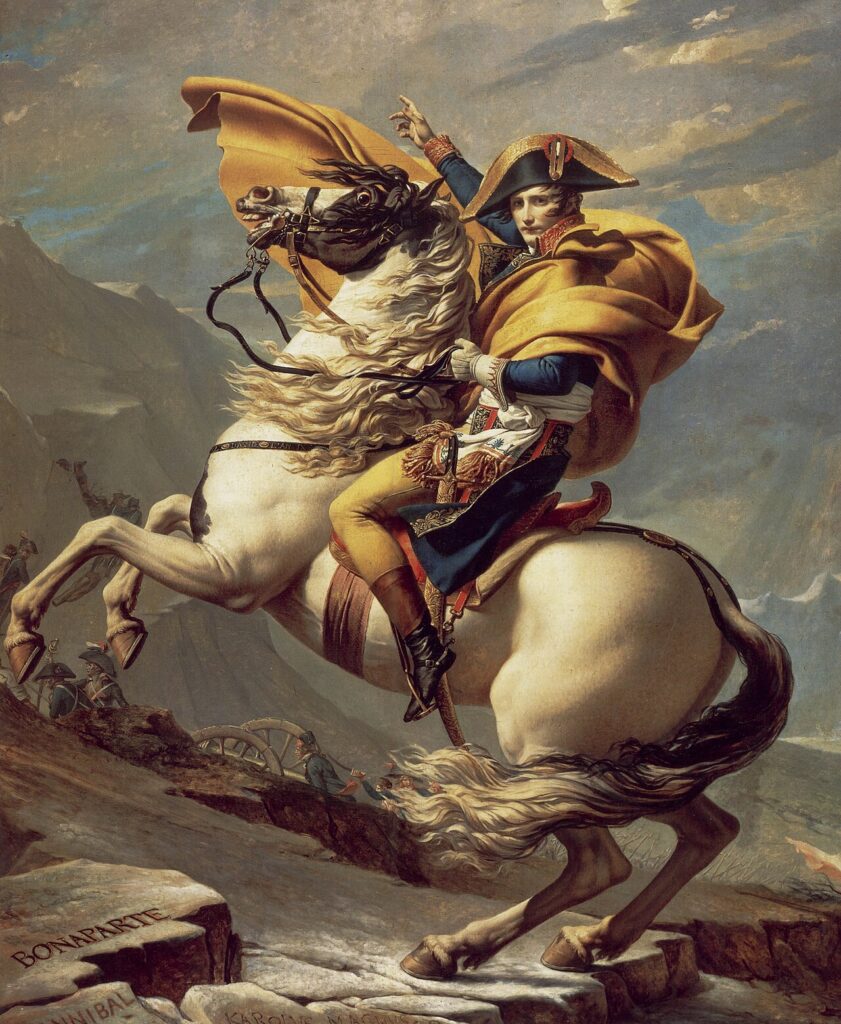
"Napoleon Crossing the Alps" by Jacques-Louis David
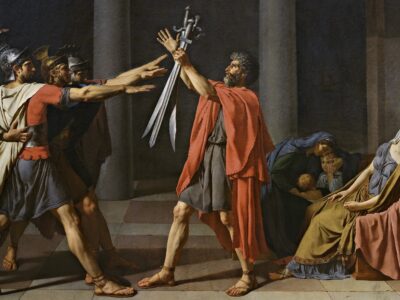
A Neoclassical master, David’s most famous paintings include “The Oath of the Horatii” (1785), “The Death of Marat” (1793), “Madame Récamier” (1800), “Napoleon Crossing the Alps” (1801), and “The Coronation of Napoleon” (1807). The show was organized chronologically to chart the violent, winding historical path between these paintings, and David’s relationship to each regime he served. His evolution marks him at best as a cipher, and at worst, the most corrupt hypocrite. But David was hardly alone in changing alliances to survive: Talleyrand, the French statesman and contemporary political chameleon survived five regimes in succession, brazenly switching sides to do so. When he died, Metternich, his Austrian nemesis, sarcastically remarked, “I wonder what he meant by that?” In many ways, that question felt like the animating force of the David exhibition. One could easily assert he was an artist without scruples who went where the moment and money took him. But, that’s too simplistic. David painted the long, strange journey through the phases of one’s life, one’s country, and one’s era. He painted the life and death of ideas and the flesh-and-blood people who lived them; his works testify to the gap between espoused ideals and lived reality—between pulling the trigger and watching the body fall.
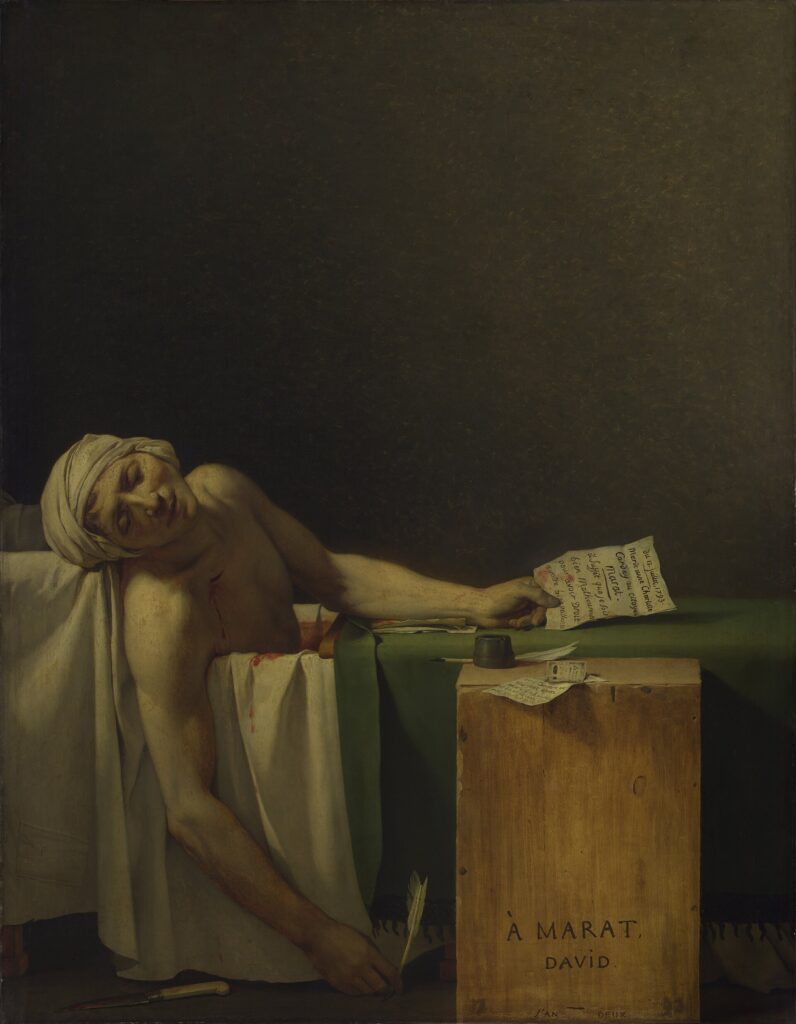
Hot-headed and famously difficult from the jump, David attempted suicide the second time he failed to win the Prix de Rome in 1772. His third time was the charm, however, and he proved to be a prescient artist: His themes of stoicism and self-sacrifice conveyed through Neoclassical renderings of Athens and the Roman Republic foretold a great deal of politics and fashion, from the empire waistlines to the rise of democracy in modern Europe. His earliest successful paintings, such as “The Oath of the Horatii”, are impressive, even as they are also re-imagined scenes from a mind untested by political reality. The 1784 painting is literally bloodless: men swear to die for a cause while their wives cry in a corner. Nine years later came “The Death of Marat”, a visceral masterwork of propaganda. Oddly, when I first came upon it in the exhibit, I said to myself, “Welp, there it is,” and meandered into the next room. It wasn’t until I re-entered the gallery, painted green to match the solemn background of the composition, that I realized I had seen a copy: The entire room was filled with painted copies that had been disseminated across France. I turned around to face the utterly electrifying Real One. You didn’t need to know a thing about art to figure out which one it was: a painting of the cold, calculated stabbing of a vulnerable man in his bathtub, the artist’s own murdered best friend, dead for the Republic.
"The Death of Marat" by Jacques-Louis David
David’s political journey is also evident in the gap between his stiff, slightly asexual representation of so many female figures in his earlier allegorical paintings, versus the real and vibrant women he painted with loose brushstrokes and incredible intelligence in his portraits, such as that of Marie-Louise Trudaine.David’s own wife, Marguerite-Charlotte, divorced him in 1789 for being a regicide, but they remarried after he was released from prison, raising four children together who sat for him often. For a painter often criticized as unfeeling, his portraits of married couples are a delight: “father of chemistry” Antoine Lavoisier and his wife (and underappreciated fellow chemist) Marie-Anne Paulze dominates his depiction of them together in the lab; he also painted a tender double portrait of Antoine and Angelique Mongez, simply because they were great friends of his, as an inscription attests.
That he eagerly chased an ideal (or three) is nothing novel or noteworthy, but his art became more compelling the more tested he was by events. The more shit spiraled out of control, the more David understood the power of the narrative—as well as when to turn it off completely. His self-portrait in prison is a high watermark of decontextualizing. It’s a testament to that ever-present gap between our personal political thoughts and our complicated, shared realities. Finding an authentic perspective on that gap is impossible: If the Renaissance painters taught us about visual perspective, David demonstrated that perspective on current events is a lie. In fact, his best use of literal perspective is a metaphorical one. In his great portrait of Comte Antoine-Français de Nantes he shows us the cost of living through Interesting Times: The count, once a fiery, young revolutionary, became a Napoleonic crony. David painted him from below, so he literally looks down his nose at viewers. His contemptuous face and saggy jowls are articulated with unsparing detail, a countenance juxtaposed with and choked out by finery—the lace, the velvet cape, and a medal for the ideals he betrayed along the way. Survival is an exercise in brutality. This sellout—the sellout—David says, is what winning actually looks like. This is the political happily ever after.
I came to this show as a citizen of a different empire presently running amok. France forged the United States’ first alliance and, like so many American allies to come, was left holding the bag. (This should have been a caveat emptor for future allies: Leopards do not change their spots, and Americans do not change their stars and stripes—but we Yanks are, if nothing else, fantastic at sales.) Funds sent to aid the American Revolution helped bankrupt the French crown and sparked a chain of events that cost the French king his head. All the while Thomas Jefferson meddled in The Declaration of the Rights of Man from his Parisian salon, Sally Hemings was enslaved in the next room. From this eventful early alliance, France and the US allegedly share ideals (cf., the Enlightenment), but we don’t exactly share historical roots. One major difference was reflected in a telling piece of wall text in the show: the role of the Catholic church. Next to the OG “Death of Marat”, the curator alluded to how revolutionary France needed martyrs to fill the void left by the abrupt banishment of the Catholic Church and the monarchy. Hours after Marie Antoinette was beheaded, “The Death of Marat” was unveiled at the Louvre, recently changed from palace to museum. That is to say, a cult of the state was invoked to fill the void of state religion.
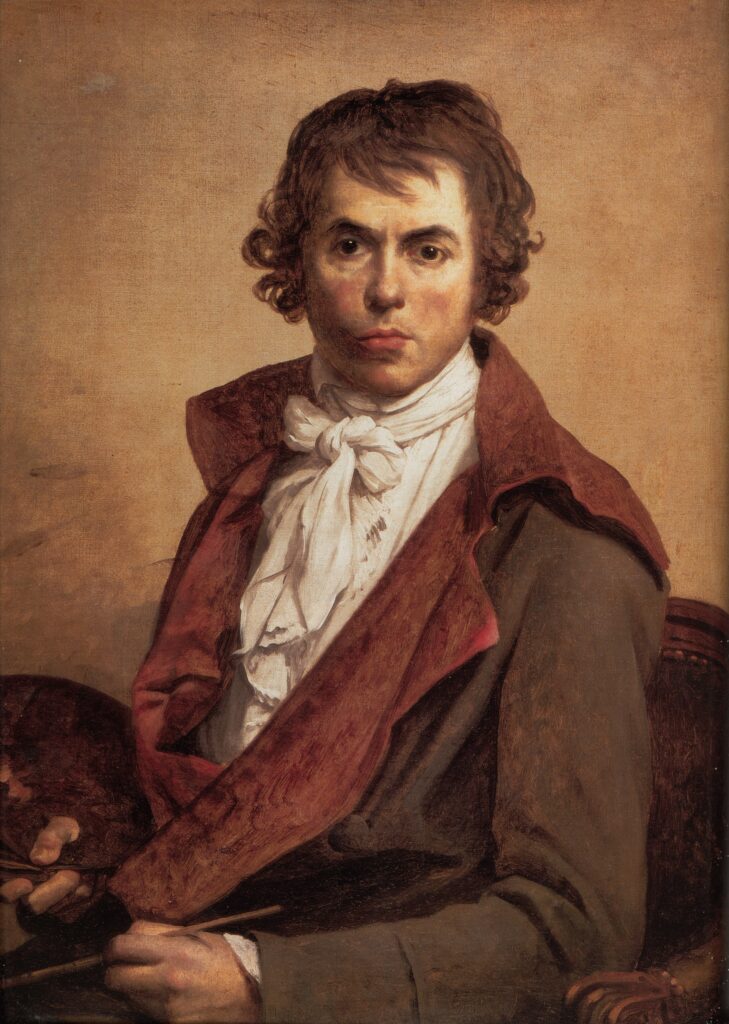
Self-portrait by Jacques-Louis David
To this New Yorker, it often feels laïcité—the French principle of secularity—demands its own sort of worship. Religious freedom in France looks to me more like a hole in the ground where a Catholic church once was. Rather than a new structure where all are welcome and inclusion is additive, it’s one that demands the sacrifice or sublimation of all other cultural tenets for those wishing to be included. This creates toxic conditions as France wrestles with a number of postcolonial realities, including a large Muslim minority. Those limitations on the public imagination for an honest plurality were, to me, somehow reflected in this state-funded exhibit’s unwillingness or inability to reach final conclusions about David—and his attempts to fill that civic-religious void with new meaning. If America’s fundamental struggle is with equality, France’s is with diversity. Today, the French do not understand their secularity is exclusionary, much the same way we Americans don’t understand our democracy is a fiction.
Unlike France, we never have had a class revolution in the United States. In 1776, a bunch of rich lawyers told a king far away to fuck off, then immediately turned around and did business with him without changing all that much on the ground. That’s why the 13th Amendment is still, somehow, just sinking in. Ironically, white Americans scored many of their freedoms from Britain when the country was still a colony: Even the pope of the Enlightenment himself, Voltaire, envied the British their Parliament and the rights it accorded in the mid-18th century. From France, we may have learned exceptionalism, but we never learned real revolution. In America, the “revolution” was just another nice thing that only rich white people could have; in France, the revolution cost the upper class their heads.
If the French figured out how to stop deifying the king, maybe someday we can figure out how to stop deifying billionaires. And if we do, maybe someone will stay alive long enough to paint the whole drama as it unfolds. Doing so requires vanity, opportunism, gall, cruelty, and a profound degree of hypocrisy. However, it also requires bravery, and for that bravery, David was rewarded with awareness of some very modern dilemmas that keep his work relevant: of knowing it is impossible to portray a scene without altering it; of knowing all art is inherently political; of knowing the stories we tell control our realities; and of knowing that you will be judged as harshly as you judged others—and going through with it anyway, charging into The Void, no matter the cost.
[post_title] => Painting as It Burns
[post_excerpt] => Unlearned historical lessons from Jacques-Louis David’s retrospective at the Louvre.
[post_status] => publish
[comment_status] => closed
[ping_status] => closed
[post_password] =>
[post_name] => jacques-louis-david-retrospective-louvre-art-cultural-curreny-history-museum-france-united-states
[to_ping] =>
[pinged] =>
[post_modified] => 2026-05-07 23:02:27
[post_modified_gmt] => 2026-05-07 23:02:27
[post_content_filtered] =>
[post_parent] => 0
[guid] => https://conversationalist.org/?p=10407
[menu_order] => 0
[post_type] => post
[post_mime_type] =>
[comment_count] => 0
[filter] => raw
)
WP_Post Object
(
    [ID] => 3767
    [post_author] => 2
    [post_date] => 2022-02-03 01:15:03
    [post_date_gmt] => 2022-02-03 01:15:03
    [post_content] => Zemmour's racism and anti-immigrant positions are not new, but his misogyny reveals where the ideological fault line lies between the new and the old far right.

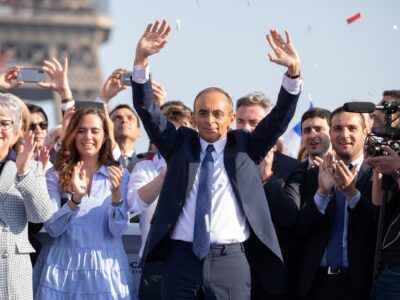
Éric Zemmour, a prominent French journalist and television personality who espouses extreme-right views, announced in November that he would be a candidate for president of the Republic. He doesn’t yet have enough signatures to run in the April election, but his potential candidacy has captured enormous media attention, revealing significant support from the far right and even from some subcultures of the moderately conservative right.

Zemmour has almost no chance of being elected president, though he might poach some votes from Marine Le Pen, the leader of the Rassemblement National (RN, or National Rally; formerly the FN, or National Front). Nevertheless, a trickle of ministers and smaller political parties continue to join his newly established Reconquête (Reconquer) party, even as he is involved in a series of high profile scandals involving several accusations of sexual assault, an extramarital relationship with a much younger woman, and three court cases on accusations of inciting racist hatred.

While he has won supporters for his extreme positions on Muslims and immigration, Zemmour polls low with women. Marine Le Pen has reorganized her campaign accordingly, and Zemmour —with seven accusations of sexual assault currently pending and more than a few misogynist tracts under his belt—was obliged, for reasons of realpolitik, to declare himself a “feminist, like the next man.”
A darling of the culture wars
Zemmour, 63, rose to prominence in the 1990s as a columnist and commentator. Back then he espoused a “union of the right”—i.e., a coalition of the moderate right Républicains and the far-right Front National (FN). He became a darling of the culture wars with his essay Le Premier Sexe (2006), a gender panic polemic on the purported “feminization” of men in France. The book—yes, its title is a riposte of Simone de Beauvoir’s feminist book The Second Sex—sold over 100,000 copies.  He followed this with a novel, Petit Frère (2008), in which he attacked “anti-racist angelism," and then a trilogy that sold even better than Le Premier Sexe—Mélancolie française (2010), in which he recounts the history of France; Le Suicide français (2014), where he argues that the French nation has become degenerate since the student-led uprisings of 1968; and Destin français (2018), a sort of autobiography in which he describes various historical events that have influenced his worldview. He ends the final essay with a polemic against the growing influence of Islam on French society.

Zemmour’s most recent book, La France n’a pas dit son dernier mot (France Hasn’t Had Its Last Word), published in 2021, sold 165,000 copies within three weeks. Cherished by his followers as “an intellectual” and tolerated by others as a kind of maverick TV personality—a buffoon, perhaps, like the former journalist Boris Johnson, or like Donald Trump—Zemmour is, thanks to his many books, a frequent guest on television news and culture programs. He uses these prime-time opportunities to air his views on the decline of French society, the clash of civilizations, immigration and assimilation, national preference, and national identity. He is one of the figures responsible for bringing the “great replacement theory,” the fear that France’s “native” (white) population will be replaced by (brown) non-European people, into the mainstream discourse.

Whilst lamenting the passage of France’s heroic age—Napoleon, etc.—Zemmour manages to align himself with both President Charles de Gaulle, who led the French resistance during the Nazi occupation of France, and the Nazi collaborator Marshall Philippe Pétain, Vichy France’s chief of state. This pairing is an ingenious move, presenting two historical figures who represented opposing political views as representatives of France’s lost past, when strong men took charge. Jean Marie Le Pen, the former leader of the far-right FN, made the mistake of expressing his support for Pétain while denouncing de Gaulle—at a time when de Gaulle was still an extremely popular figure in France. Zemmour expresses support for both men, which is novel.
A racist's racist
Zemmour is the son of Jewish immigrants from Algeria and is himself a practicing Jew who attends an Orthodox synagogue. That has not stopped him from aligning himself with the antisemitic far right, or from saying that Pétain was right to deport non-French Jews to concentration camps—because in doing so he saved some French-French Jews (of the 75,000 Jews deported from France, 72,500 were murdered) .

Zemmour has transitioned smoothly from being an “outspoken” voice in the discourse around political correctness as it morphed into what we now call a “debate” on “cancel culture.” Today he is a comfortable anti-feminist, traditionalist, misogynist, homophobe, anti-abortionist, and a “critic” of the legacy of the social movements of the 1960s. He also deplores gender studies and writes in Le Premier Sexe that rape trials qualify as the “judiciary surveillance of desire.”

In the months before he announced his candidacy, Zemmour reveled in several personal and legal scandals that further raised his public profile. In September Paris Match’s cover showed him frolicking in the sea with Sarah Knafo, his 28 year-old assistant and campaign manager, whom he has known since she was 13 years old (she is the daughter of family friends). Zemmour recently confirmed that Knafo is his “companion” and is pregnant with his baby, to the delight of the press, which speculates endlessly about Mylène Chichportich, his wife of 40 years: Is she suffering or indifferent as she stands silently at his side?

While Knafo is something of a protégée to Zemmour, she is in her own right a perfectly terrifying and precocious extreme right militant. As a university student she was active in the FN and in a student association called Critique of European Reason, through which she got down with the sovereigntists and Euroskeptics, and met prominent right wing thinkers like Alain Finkielkraut. At 25 she did an internship at the French embassy in Tunis. She then authored a “handbook,” based on what she’d learned in North Africa about migration routes, on how to facilitate the deportation of undocumented migrants from France.

His frequent trips in and out of court keep the press talking about Zemmour, too. His January 17 conviction for inciting racial hatred was his third. A judge fined him 10,000 euros ($11,400) for having said, on live television, that unaccompanied migrant minors “have nothing to do [in France], they’re rapists, assassins, that’s all they are, you have to send them back to where they came from.” Meanwhile, at one of his November rallies, Zemmour’s militia-style bodyguards beat up an anti-racist activist in a brawl reminiscent of Trump rally scenes.
A radical ideologue
French commentators have pointed out that the country’s media is falling into the trap of giving free publicity to Zemmour, just as the U.S. media made the mistake of broadcasting Trump’s rallies live without commentary and of reporting incessantly on his tweets, giving him massive free publicity on mainstream evening and cable news programs. Like Trump, Zemmour overwhelms the media with provocative soundbites, which are often in the form of attacks on journalists. As a result, media outlets are drowning in a sea of far-right madness—reporting and broadcasting Zemmour’s racist, sexist, and fascist comments repeatedly, without analysis or critique.

The fact that Zemmour’s ideas are splayed bittily across television and internet platforms, and that only certain people read his books from beginning to end, works to obscure their character as a complete ideology. His misogyny, abhorrence for the student-led uprisings of 1968, dislike of modernity, and hatred of Muslims are connected and inform each other. A quick online search brings up a list of citations to go with each of Zemmour’s ideas, presented like an inventory of the contents of a bag belonging to the fasciste du jour.

Zemmour deliberately muddies the extremism of his complete ideology by presenting his ideas in a willfully confusing, often “third positionist” manner— i.e., expressing right wing ideas in the language of left-wing ones. For example, in his books he offers a critique of the monogamous couple and, ostensibly, praise for polyamory. But this is not advocacy for free love. Rather, it is an expression of approval for a premodern society in which married men had multiple mistresses and in which women had no means of leaving an unhappy marriage. In French third positionism is roughly translated as confusionniste — which is a better term, perhaps, because the deliberate effort to create confusion is a salient and defining characteristic of contemporary fascism. Writing about Zemmour is challenging because it’s almost impossible to avoid the trap of either reproducing his ideas without comment, or presenting them with expressions of shock and outrage. In either case, the writer is amplifying Zemmour’s ideology, thus giving him yet more free publicity.

Zemmour and his fellow far right television personalities have succeeded in shifting the Overton window of the French discourse. Fueled by the country’s growing and fertile climate of Islamophobia, which is partly a reaction to a series of high profile, violent terrorist attacks over the last six years, the center and center-right are now taking positions that were once considered far right. In a recent illustration of this shift, Macron’s government drafted and passed the Loi de Séparatisme, a law to “strengthen republican values.” The law targets and seeks to repress the Muslim community and its cultural expression, which conflicts with France’s aggressive secularism. As such, it is a populist attempt to exploit, or give lip service to, the idea that a cultural “great replacement” has happened, or is happening, in France.

It is perhaps surprising that the extreme right—identitarian and antisemitic as it is—might choose Éric Zemmour over Marine Le Pen. Zemmour, though born in France, is the offspring of an Algerian-Berber Jewish immigrant family, while Le Pen is white and descended from France’s best-known fascist dynasty. Zemmour’s background has been a subject of conversation on fan forums for Papacito (a far-right influencer with a popular YouTube channel who supports Zemmour) and on gaming websites, where eager 20-year-old neo-Nazis agree that while his Jewishness is a bit of a problem, he’s kind of an Ubermensch.
The fault line in the far right
Physically, Zemmour cuts a slight figure, with, as Harrison Stetler put it, “massive ears folding out around [a] receding jaw.” He bears no physical resemblance to the towering Aryan figures of Donald Trump or Boris Johnson, or to the topless horse rider Vladimir Putin. His possible success amongst extreme right voters — a smattering of ultra-conservative Christians, neo-Nazi groups, far right influencers, lapsed FN or Républicains voters—seems to be derived from his capacity to embody discursively a kind of straight talking, Trumpian masculinity (and whiteness), not seen in French politics since Jean-Marie Le Pen led the FN. He espoused a more overt brand of racism than that of his daughter Marine, the heir to the party’s leadership.

Marine Le Pen, meanwhile, has in recent years made a dive for the center, trying to clean up her party and kicking out embarrassing family members such as her niece (who now wants to run with Zemmour) and her father, who infamously described the Holocaust as “a detail of history” and, as a French military officer, tortured people during the Algerian war. The effect of Marine’s efforts to take the party mainstream was to alienate her most right-wing voters, who have become disillusioned with her perceived political correctness. While Le Pen herself has said she is “against gay marriage,” she has also pink-washed her party in an effort to appeal to LGBT groups and even has several gay deputies. Recently Le Pen revealed that for the last five years she has been living in secret with a woman, her “childhood friend” Ingrid. “There are no men in my house, even the cats are female,” Marine said in a widely watched TV interview broadcast in early November.

The critical fault line between Zemmour and Le Pen is, clearly, misogyny. Zemmour positions himself against a “cosmopolitan” political correctness that purportedly welcomes homosexuality and feminizes extreme right politics. Those who oppose Marine Le Pen’s leadership of the FN perceive her as having emasculated her daddy’s once-great party.

One might wonder what is more prominent in Zemmour’s ideology—a hatred of women, or a hatred of Muslims and immigrants?

But this would be the wrong question. Zemmour’s essay Le Premier Sexe shows his misogyny and his racism to be, if not interchangeable, on a continuum with one another. It shows the strong link between “theories” of feminization and the great replacement, which usually advances the racist theory that Muslims, Jews, and other non-white people will soon replace white people. It starts out as a great replacement theory about gender, advancing the idea that French men have become feminized through a culture that elevates “feminine values.” Men, he writes, are allowing themselves to be replaced by women and become total pussies, whereas a real man is a “sexual predator, a conqueror.”

It is of course a polemic: his histrionic dismay at the purported fragility of contemporary French men is motivated by his belief in a naturalized masculine power (and violence), ready and waiting to be resuscitated. His essay is a spurious patchwork of loosely connected observations on advertising, football, cinema, sport, dubious “facts” and statistics, and hardcore conspiracy theories. He advances the theory that the purported feminization of men is due to the influence of “single mothers, sixty-eighters and feminists,” plus a homosexual conspiracy that wants to denaturalize sex and create a society segregated along the lines of gender. According to Zemmour, the plot is to eradicate male body hair because it would remind men of their natural “bestiality, virility,” and to set up conspiratorial alliances in cities between immigrants, single women, and gays. The speed with which he moves from roots to rootless cosmopolitans is, frankly, startling.

By the end of Le Premier Sexe all this scattered madness joins up with his other great preoccupation—Muslims and immigrants. The great replacement of gender becomes just the great replacement, tout court. Hurtling through an account of the liberalization of divorce and abortion, he claims that French men have “laid their phalluses down,” thus declaring France “an open land, waiting to be impregnated by a virility from outside.” This has happened, he writes, because Christianity is a pussy religion. Outside of the Western world, he writes, men defend their dominant position “like a treasure” and refuse to align the “status” of their women with that of the Europeans.

The argument is not simply that white French men are becoming more like women, but that they will be replaced by a masculine revolution of foreign (Muslim) men who are concentrated in France’s suburbs. Despite the book’s highly misogynistic character, which shows Zemmour’s hatred for women and especially feminists, part of his argument is that Black and Arab men, with their machismo and their desire to dominate, present a danger to…Western white women and feminists.

Zemmour can claim as much as he likes that he is now a feminist. His entourage of female influencers, FemmesAvecZemmour (WomenWithZemmour), are flocking to make the same racist argument about women’s safety in an effort to make a feminist of old Zemmour. But Zemmour is quite different from other leaders. He manages to present himself as a real man, a man’s man, a man who speaks his mind, while remaining, a wily, self-satisfied intellectual who espouses a hardcore and explicit ideology. Whether he becomes a candidate in the presidential election or not, it’s quite clear that his prominence is symptomatic of a rightward shift in France, and in any case such extreme right mobilizing has already made its impact on the policies of the center.
    [post_title] => Softbois in France: a feminist perspective on the rise of Éric Zemmour
    [post_excerpt] => Zemmour's racism and anti-immigrant positions are not new, but his misogyny reveals where the ideological fault line lies between the new and the old far right.
    [post_status] => publish
    [comment_status] => closed
    [ping_status] => open
    [post_password] =>
    [post_name] => softbois-in-france-the-rise-of-eric-zemmour-from-a-feminist-perspective
    [to_ping] =>
    [pinged] =>
    [post_modified] => 2026-08-05 18:03:34
    [post_modified_gmt] => 2026-08-05 18:03:34
    [post_content_filtered] =>
    [post_parent] => 0
    [guid] => https://conversationalist.org/?p=3767
    [menu_order] => 144
    [post_type] => post
    [post_mime_type] =>
    [comment_count] => 0
    [filter] => raw
)
WP_Post Object
(
    [ID] => 2365
    [post_author] => 2
    [post_date] => 2021-03-12 03:41:06
    [post_date_gmt] => 2021-03-12 03:41:06
    [post_content] => The Minister of Higher Education branded academics "Islamo-leftists," claiming they bear responsibility for terror attacks.

When France’s Minister of Higher Education and Research, Frederique Vidal, announced last month that free, environmentally friendly period products would be made available on French campuses, the news generated ample national and international media coverage. This measure must be recognized as a victory for French student unions, which have long campaigned against  period poverty. Yet, a good news story about the country’s campuses is also what the center-right ruling party, La République en Marche, needs right now to distract us from the reality of what the government is doing to French universities—which is far more sinister.

In recent years, Paris has engaged in frontal attacks on academic freedom. Austerity measures have eroded universities, with students and staff struggling with deteriorating working and learning conditions. A controversial new higher education law is set to damage academic autonomy and quality by consolidating short-term employment and funding, and the role of private companies.

Most recently, the French government has decided to turn public universities into a battleground on which to wage a culture war ahead of the April 2022 presidential elections—where they will likely try and appeal to the far right. Feeding into public antagonism toward Muslims, Vidal has attacked so-called “Islamo-leftists” in universities, claiming that academics engaged in race, postcolonial, and gender studies, bear responsibility for terrorist attacks against France. Last month, Vidal called for an investigation into academic research that feeds “Islamo-leftist’’ tendencies that “corrupt society.’’ This caused a general outcry in academia and it remains unclear whether this ludicrous exercise will happen.

But in a context of socio-economic distress and social anxiety due to the pandemic, the government’s inflationary use of the term  helps build an imagined “enemy of the interior,” a treacherous intellectual elite responsible of the country’s ills. The scholars under attack are actually doing critical work in helping us understand the complex mechanisms that perpetuate sexism, racism and class and how they intersect. The official call for a purge of French academia can only raise deep concerns among those who consider academic freedom and intellectual inquiry to be core pillars of a democratic society.

At the same time, the impoverishment of French public universities has continued, carrying with it a deleterious impact on academic autonomy and students’ life. The free period products campaign will cost €15 million ($18 million) a year—a cheap price to buy a progressive reputation and social peace on campus. By comparison, the Union des Etudiants de France (UNEF), one of France’s student unions, has been calling for a €1.5 billion emergency plan to address student poverty.

Compared to the astronomical cost of higher education in the United States, French universities are inexpensive; annual tuition ranges between between €170 to €600 ( $204-$720), depending on the degree. But the principle of free education has been enshrined in the French constitution since 1946, recognized by the state as a duty to its citizens and an integral aspect of the post-WWII social contract. Anyone who completes a Baccalaureate (high school matriculation) is entitled to attend university. While the most prestigious universities remain selective and elite, low tuition fees have had the effect of narrowing socio-economic gaps. This is why French society remains strongly attached to the “free university” principle and has resisted the government’s decades-long ambition to shift to a high tuition system like the one in the United States. And yet, even with low or free tuition, student poverty is today a stark reality in France: about 20 percent of students live below the poverty line, while 46 percent are seeing their academic work suffer because they have been forced to take jobs to compensate for the severe cuts to once-adequate state financial aid.

In face of the deterioration of their learning and living conditions, student anger is brewing. Last year, a student in Lyon set himself on fire in Lyon to protest academic poverty. Over the past two decades of budget austerity, academics’ working conditions have also steadily worsened. The recruitment of permanent academic staff has been minimal while student numbers have increased very fast. Rather than ramp up university support, though, some €6 billion of public funding are annually paid to private companies to support their R&D efforts through the Research Tax Credit, with very limited impact on France’s research achievements.

Vidal’s new Higher Education and Research Law, adopted in December despite the academic community’s quasi-unanimous rejection, will deepen the inequalities between a few well-resourced institutions and the majority of cash-strapped universities.

The law increases the number of early-career academic staff who are forced to work as adjuncts rather than staff with benefits; it also reinforces the funding of public research through short-term projects and commercial companies. This will have a damaging impact on academic autonomy and quality.

All of this, meanwhile, is playing out while France grapples with a series of sexual harassment and rape cases that have damaged the reputation of prestigious higher education institutions.,

Academics and students have been calling on the government and university leadership to challenge the power structures that allow for the systemic entrenchment of sexism within French universities. So far, their demands have been met with little response.

Anti-intellectualism, scapegoating of the academic community, and chipping away at university freedom are hardly new or unique to France. These are, indeed, a cornerstone of authoritarian governments, who deploy discursive and legal tactics in order to stifle dissent and free inquiry on campus. Now, as these wars increasingly reach democratic fronts, we must oppose them.

Of course, I am in favor of free period products in universities and schools, but why did France’s universities have to wait for 2021 to receive this benefit? French public universities are an essential public service dedicated to fostering human understanding through open-ended enquiry. They are an instrument of social mobility for many working class youth. They also add to France’s influence on the world stage. As the government dismantles these crucial institutions, we should not allow opportunist politicians to use free tampons as a fig leaf for their actions.
    [post_title] => French gov't diverts attention from its war on academic freedom with free period products
    [post_excerpt] => Over the past two decades of budget austerity, academics’ working conditions have also steadily worsened. Last year, a student set himself on fire to protest academic poverty.
    [post_status] => publish
    [comment_status] => closed
    [ping_status] => open
    [post_password] =>
    [post_name] => free-menstrual-products-distract-from-the-french-govts-war-on-academia
    [to_ping] =>
    [pinged] =>
    [post_modified] => 2026-08-06 22:48:11
    [post_modified_gmt] => 2026-08-06 22:48:11
    [post_content_filtered] =>
    [post_parent] => 0
    [guid] => https://conversationalist.org/?p=2365
    [menu_order] => 222
    [post_type] => post
    [post_mime_type] =>
    [comment_count] => 0
    [filter] => raw
)

 In the months before he announced his candidacy, Zemmour reveled in several personal and legal scandals that further raised his public profile. In September Paris Match’s cover showed him