How women crab farmers along India's coast have linked their livelihoods to environmental conservation.
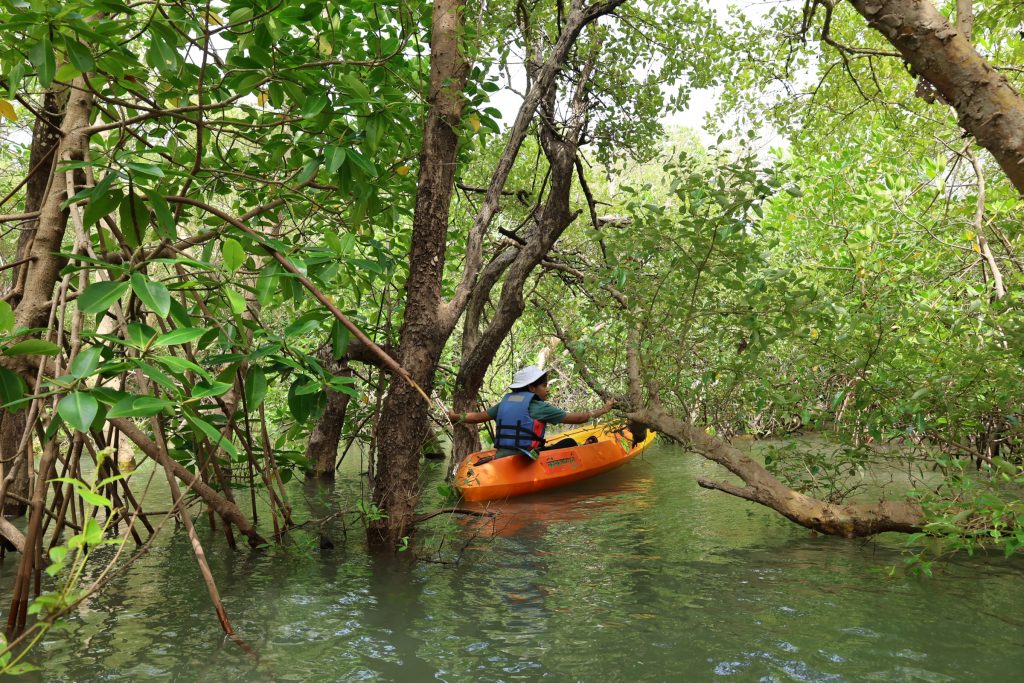
A soft current ripples near Jamdulwadi Island as 15-year-old Prachi Santosh Acharekar guides her canoe through the gnarled trunks of a mangrove forest.
The afternoon sun warms the surface of the water, revealing a familiar scene to local communities around India’s Konkan coast: clusters of mud-covered crabs, basking on branches.
As she approaches them, she slows her boat. Prachi, a 10th-standard student, doesn’t just see mud crabs: She sees her future. Her focused gaze and deft handling of the boat are part of her autodidactic training, a testament to a burgeoning passion that runs deep within the Acharekar family.
Prachi Santosh Acharekar navigating her canoe through the mangroves, a part of her crab farming training.
Champions of the Mangroves
In Achara village, where she lives, crab farming season typically runs from October to May. When Prachi is fully inducted into her family’s business in about three years, during this time, she’ll be busy with preparations, stocking seed, feeding the crabs, and folding boxes to safely transport them once they’ve been harvested.
All of it will also formalize her role in a grassroots movement, led by women from India’s coastal belt: In Sindhudurg, women fisherfolk have become champions in linking their livelihoods with environmental conservation. Through crab farming, they’ve created a strong incentive to protect local mangroves, which serve as critical nursery habitats for mangrove crabs. The benefits of this are both economical and ecological: Alongside generating sustainable income for the women, the mangroves’ preservation stabilizes shorelines and mitigates erosion, enhancing coastal resilience against the impacts of climate change.
At the heart of this enterprise is Prachi’s aunt, 55-year-old Sonali Sunil Acharekar, a proud entrepreneur and leading member of Konkansparsh, one of Maharashtra’s pioneering women-led self-help groups (SHGs). Like all women of this SHG, for her, the mangrove is not just an ecosystem, but a dynamic marketplace.
“Be it dolphin safari, trekking, birdwatching, or traditional fishing, we do it all at Konkansparsh,” says Sonali, sitting in a charpoy at her home, surrounded by a vast area of mangroves. “But crab farming is our speciality. It is something we feel deeply attached to.”
Sonali and other leaders manage the entire crab farming supply chain, from feeding and harvesting the crabs to selling them. The process is meticulous but straightforward. Crab seeds are carefully placed one-by-one into fiber boxes. Each box is then deployed within the protected mangrove territories of Sindhudurg district, which boasts 6,940 hectares of mangroves perfectly suited for farming. Sonali also feeds the small raw fish stock twice daily, in the morning and evening. Then, once the crabs are ready, they’re harvested, boxed, and sold.
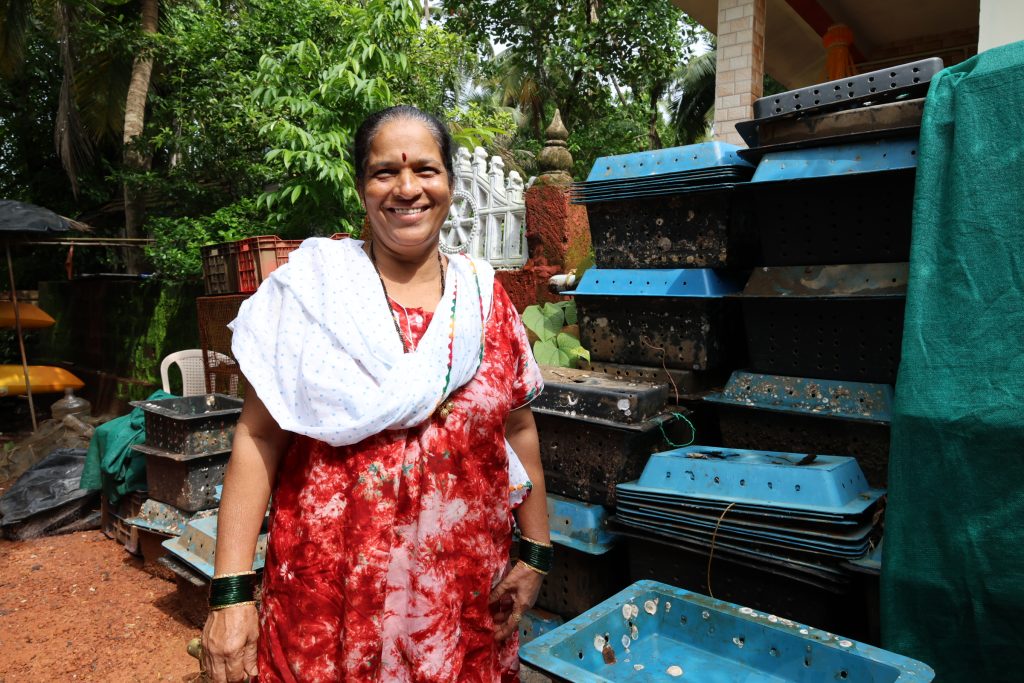
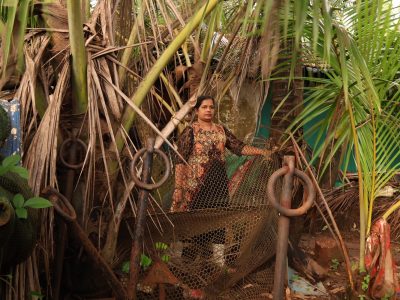
Sonali Sunil Acharekar in the backyard of her home in Achara village.
Overseeing the entire operation in this way has significantly enhanced the women’s access to resources, as well as to the market. The payoff is also demonstrable, including as a sustainable model: Last year, the Acharekar family, a seven-member unit that works in tandem, generated an impressive 150,000 INR ($1,706 USD) from the sale of 180 crabs. They also earned an additional 130,000 INR ($1,466 USD) from running mangrove safaris.
“It feels so good to partake in the process,” says Sonali. “This year, we intend to maintain 200 boxes fully. More boxes mean more business and more business means more prosperity.”
Their success also reinforces a crucial ecological benefit: According to research published in the Marine Biological Association of India, mud crab farming is not only a sustainable—and profitable—livelihood, but an essential strategy for mangrove conservation, supporting the region’s climate resilience through ecosystem protection. The mangroves provide a conducive natural habitat for raising mud crabs, or green crabs, commonly from the species Scylla serrata, which are indigenous to the region. By breeding and harvesting crabs, and building and tending to crabs pens in mangrove creeks, the women have both created a financial incentive for the mangroves' protection and helped to increase the local crab population.
In coastal areas, crabs are considered an economically significant species due to their huge demand. The crabs themselves can also tolerate a wide range of temperatures and salinities without destroying local ecosystems. But over the years, sand mining, saltwater intrusion, and rising water temperatures have contributed to a declining mud crab population, and are just a few of the ongoing stresses and trends that fisher communities have dealt with, and that local SHGs hope to tackle.
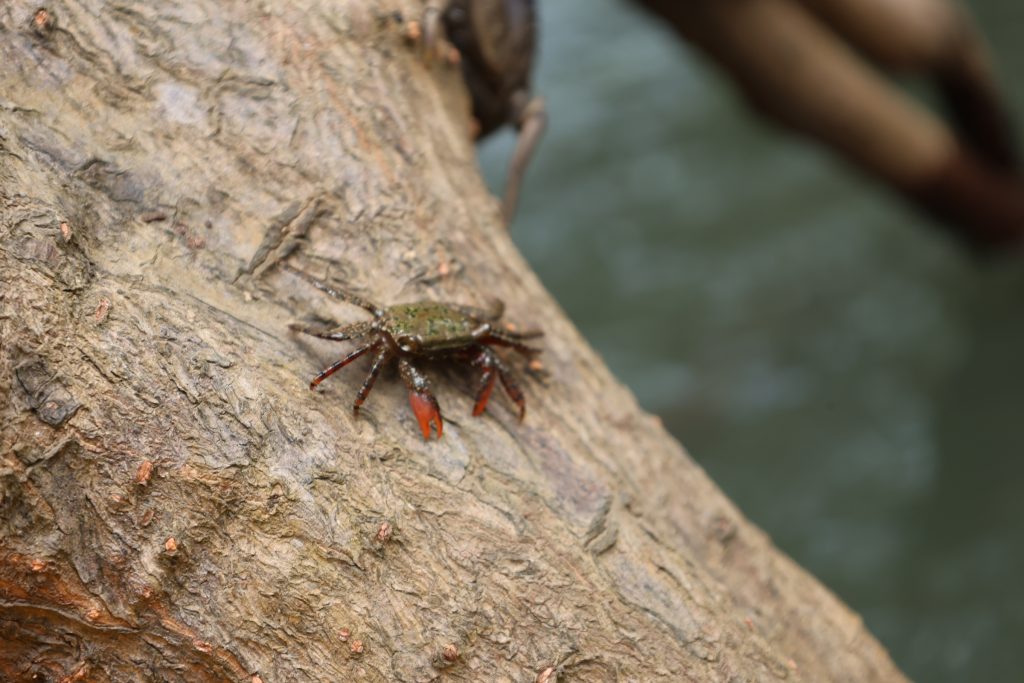
A wild baby crab crawls on the trunk of a mangrove tree.
In other coastal communities like Kerala, Maharashtra’s neighboring state, crab farmers who once caught wild juvenile crabs and had plentiful stock are grappling with rising costs and dwindling returns, as crabs have become scarce and stressed. Their annual incomes have dropped by 50,000 INR to 100,000 INR (around $600 USD to $1,200 USD) due to poor water quality, causing frequent disease outbreaks, pushing many farmers to downsize or cease operations altogether, largely due to reduced harvests linked to environmental degradation.
Sustainable crab models in coastal communities in Maharashtra aim to address the pressing problems of overfishing, habitat loss, and food insecurity through long-term economic stability. But without such practices, crab harvesting may yield fleeting profits, triggering ecological collapse and harm to a region’s inhabitants.
In addition to boosting the economy, this is part of why the SHG’s endeavors have been such a great boon to the area.
According to Kedar Palav, Livelihood Specialist at Sindhudurg’s Mangrove Foundation, women-led groups comprising 40 women have been active in Sindhudurg district during the 2024-25 crab farming season. “Our aim,” he notes, “is to facilitate strong livelihood opportunities for the women.”
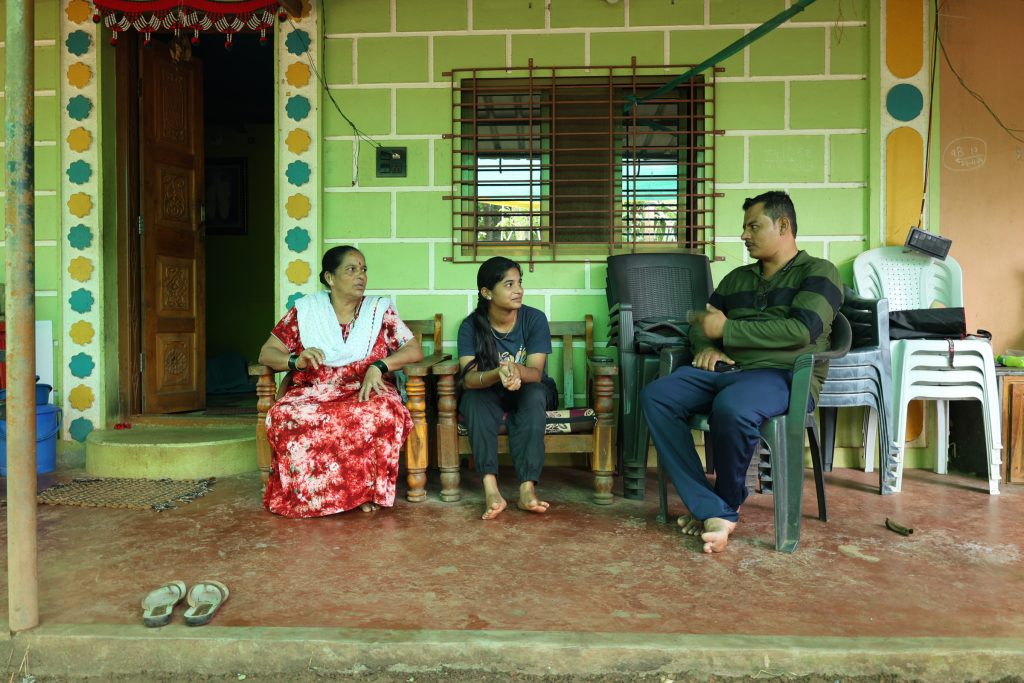
Sonali Sunil Acharekar (left) and her niece Prachi Santosh Acharekar (center) in conversation with Mayur Pansare (right), a Project Assistant for the Mangrove Foundation.
But even those with formal careers are drawn to the potential. Sonali’s 32-year-old son, Omprakash Sunil Achrekar, an engineering graduate, has embraced crab farming full-time; and Manish Tari, 22, an undergraduate in fisheries science, launched Manish Agro & Seafood with his father during the Covid-19 pandemic, specializing in vertical crab farming.
“We deal in red and green crabs,” says Tari. “A single piece per kilo can go up to 2,400 INR. It’s very lucrative.”
Navigating the Tides
Despite the economic potential, the journey is not without profound risks and hurdles. The most immediate occupational hazard, however, is theft.
“Theft of crabs is a big problem here,” says Sonali. “Sometimes diseases can spread in the backwaters, as well…A mortality rate of 20 percent is considered normal.”
It’s a challenge that has historically forced some farmers out of business. Samiksha Gaonkar, 50, from Pirawadi village, recalls being part of Sindhudurg’s very first crab culture group, which operated between 2014 to 2019. Despite each group member earning around 5000 INR per month, they were forced to shut down.
“Our crabs got suddenly stolen,” says Samiksha. “We could not keep a check on the thefts and then we had to pull out.”
Anagarajan Joshi, 58, a former crab farmer, at her friend’s home in Pirawadi village.
Another hurdle is the scarcity of crab seed. According to Palav, there is only one hatchery in India: the Rajiv Gandhi Centre for Aquaculture (RGCA) in the southernmost state of Tamil Nadu.
Sanjeevni Santosh Mithbavker,43, a member of the Vedoleshwar SHG, says crab farming has become more difficult as a result. “We lack seed,” she says. “If the supply of seed becomes easy, we can take this business forward.”
Despite the scarcity, Sanjeevni sold crabs worth 60,000 INR last season. But while business is “great,” seed still costs 25 to 30 INR for a single piece—makings it an expensive venture for the average crab farmer.
A Wave of Resilience
To counter these challenges, government and non-governmental efforts have actively focused their support on the most vulnerable communities, placing women at the forefront.
Government initiatives such as the Mangrove Conservation and Livelihood Generation Scheme, alongside international projects like Enhancing Climate Resilience of India’s Coastal Communities (ECRICC), have been instrumental in fostering local interest in Sindhudurg’s coastal villages, including Achara and Hadi. As part of the Mangrove Foundation’s intervention, women’s groups also receive substantial training and support, including expert talks, presentations, and hands-on workshops that offer extensive practical training.
On the ground, additional support comes from 34 Sagar Mitras—fisheries graduates who act as vital resources for the women. Mayur Vinayak Pansare, Project Assistant with the Mangrove Foundation, sees themselves in a family-like role. While they occasionally help fix issues, like crabs breaking through fiber boxes, he says, “It’s heartwarming to see these women coming forward and taking steps towards self-reliance.”
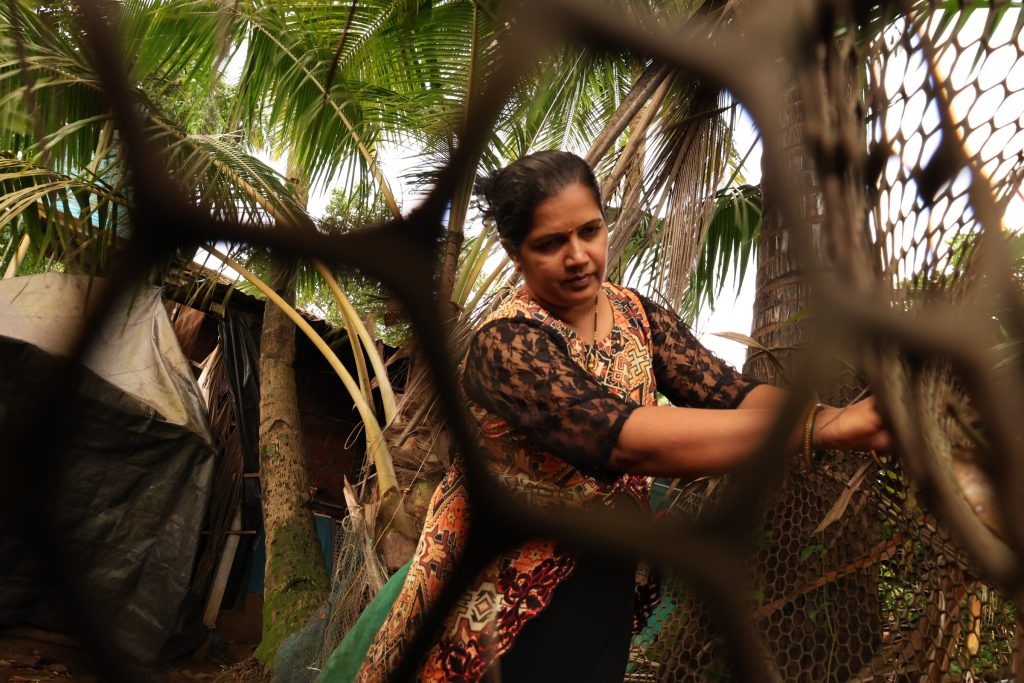
Sanjeevni Santosh Mithbavker, 43, mends nets at her home in Hadi village.
The financial assistance is also significant: The Achrekar family, for instance, received a substantial 90 percent subsidy from the Department of Fisheries and the Mangrove Foundation. Between 2021 and 2025, larger initiatives like the Pradhan Mantri Machi Sampada have backed an additional 124 fisheries projects, with women as a remarkable 60 percent of beneficiaries between 2021 and 2025, says Bahar Vithala Mahakal, Sindhudurg District Program Manager at the Fisheries Department.
This focus is clear across other programs, too: The Sindu Ratna Samrudhi Scheme saw a 70 percent rise in female beneficiaries in a single year, between 2022 and 2023.
Planting the Future
Women’s presence as crab sellers in Sindhudurg’s main fish market signals a generational shift in the industry: They’re taking center stage in an otherwise male-dominated marketplace. For Dakshita (who asked we only use her first name), her presence here is about more than selling her own yield—she’s also reclaiming a little more of herself.
“What is the need for middlemen when I can run my own business?” she says, waiting for customers.
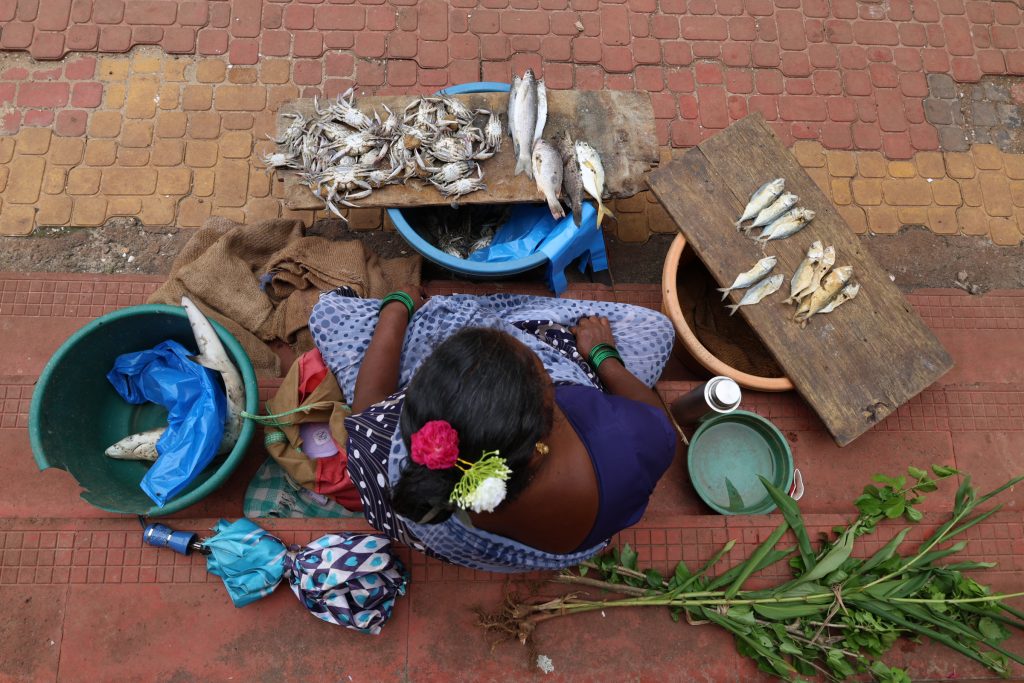
Dakshita, 50, sells green crabs at the Malvan fish market in Sindhudurg.
In Prachi’s case, the journey towards self-reliance began slowly. She initially “harbored no interest in crab farming.” But witnessing her family’s dedication and serving as a guide for tourists through the vibrant backwaters transformed her perspective, converting her initial disinterest into a passion.
In the shifting tides of the Maharashtra coast, Prachi represents the strong voice of a younger generation, seamlessly blending tradition with science to carve a new path forward. For them, crabs are the ‘green gold,’ promising economic returns.
While elder members strengthen their place in the market, Prachi is now articulating a dream that links her environment to her education, which she plans to pursue further by studying Marine Science.
“By protecting the mangroves, my crabs thrive,” she says. “The mangroves in return protect my family from storms, erosion, and the rising sea.”
A view of a mountain village in Sindhudurg.
In the nearby pond, Prachi and Sonali have also started to plant new mangrove saplings. Other efforts at sustainability have only grown. In 2017, scientists visited the area and told local crab farmers that in order to have a better catch, they needed to maintain cleaner water. To boost women’s participation in local water and pond management, women farmers are now being trained to regularly flush water through the crab ponds for freshness, monitor water quality, and prevent overcrowding. Since then, they’ve seen the return of many new birds in the area, from cattle egret to common sandpiper and Indian pond heron.
The tides speak louder than people in Sindhudurg’s coastal communities, and for these powerful women, mangroves stand like guardians along the coast. The more they nurture the mangroves, the more the mangroves give back to them, too. It’s a quiet partnership in nature, this connection between crab farmers and the mangrove forests, and a small step in healing the Earth.
[post_title] => Guardians of the Mangroves
[post_excerpt] => How women crab farmers along India's coast have linked their livelihoods to environmental conservation.
[post_status] => publish
[comment_status] => closed
[ping_status] => closed
[post_password] =>
[post_name] => crab-farmers-farming-aquaculture-india-mangroves-conservation-climate-change-ecosystem
[to_ping] =>
[pinged] =>
[post_modified] => 2026-08-03 21:03:35
[post_modified_gmt] => 2026-08-03 21:03:35
[post_content_filtered] =>
[post_parent] => 0
[guid] => https://conversationalist.org/?p=9839
[menu_order] => 0
[post_type] => post
[post_mime_type] =>
[comment_count] => 0
[filter] => raw
)
A survey of 12-year-olds to early 20-somethings in the US.
This article is a companion piece. If you’re curious to learn how older people feel about the state of the world, click here.
We’re more than two years deep into a pandemic, and if it feels like we’re moving backwards, it’s because in many ways, we are.
In 2022 alone, there have been over 300 mass shootings in the US. Earlier this summer, in a historic decision, the Supreme Court overturned Roe v. Wade, immediately impacting the reproductive rights of millions. Meanwhile, global temperatures have reached dangerous, record-breaking highs, and if we squint into the horizon, all signs point to an imminent recession, where young people seeking employment will undoubtedly be among those hit the hardest.
Oh, and did we mention we’re still living amid a deadly virus that continues to take lives each day?
The Conversationalist asked young people from various parts of the country their thoughts on the state of the world right now. Which issues are overwhelming them the most? What kinds of discussions are they having with their friends? How do they feel about the future? Is it all doom and gloom?
Here’s what they had to say, in their own words.
~
“Turning on the news and seeing the violence in this world is not a surprise anymore. It's not even sad because I expect it. What scares me now is going to places where I can't find the nearest exit if I need to flee quickly. My home city of Chicago is now looked down upon by America as crime central. When I tell people I live in the suburbs of Chicago they gasp as if I'm in danger.
I remember flinching at school when I heard a student squeeze open their chip bag, resulting in a loud popping noise. My heart skipped a beat and my mind immediately thought of the worst. Within seconds I was asking myself, Where is the noise coming from? Is it safe to stay where I am? How did the intruder get into the school? All from a kid’s chip bag making a loud popping noise. I shouldn't be thinking that way. It shouldn't be a habit for me, a 17-year-old, to look for the nearest exit in every public place I go to.
I just want to be shocked when I turn on the news channels again.”
—Amanda, 17, suburbs of Chicago
“Not only is there more fear in the world with monkeypox currently, specifically in New York, climate change is also only giving us about eight more years before there is no turning back. This is extremely worrisome because Americans aren’t doing anything about this and we only have so much time before our ecosystems become more fragile than ever.
Overall, as someone within the generation that has to suffer most from these current issues, this is very concerning for not only our well-being but our physical health. We need to take the appropriate measures to prevent further conflict.”
—Juliette, 15, New York, NY
“I’m finishing up my senior year in the fall at Penn State University. From my vantage point, the recent Dobbs decision has stirred up an immense amount of emotion from all sides of the spectrum and both sides of the coin, so to speak. College-aged women and female students that I interact with are overwhelmingly disturbed and frightened—they are fired up and want to help right the ship to protect abortion access for themselves and, in the case of the few pro-life women, for others. I work in local political organizing and one way to communicate with pro-life women in particular is to remind them that while they may not choose to have an abortion, their friends may face situations where they need one—and bringing the hot-button issue to a hyper-personal level really helps some people understand that they should not be so anti-choice.
For men, a general sense of confusion and passive worrisome behavior is the vibe that I’m getting. My guy friends in particular tend NOT to be split among party lines with abortion—a lot of them think it’s stupid to tell women they can’t do something, while others are afraid that their female partners may not have the birth control/contraceptives they need to continue a sexual relationship.
My fear is that despite the level of concern and anger at this decision, people my age will not care enough to vote in the large numbers that we need to actually change things. [We] can’t change SCOTUS, but can sure as hell change our state legislatures and Congress. That’s why I’m getting as involved as I can to spread the word to students and folks my age that this election is undeniably the most important of our lifetimes, and that at the very least you need to vote.”
—Josh, 21, State College, PA
“With everything happening in our political climate, the one word that can't escape my mind is 'division.’ With all of the constant discord going about through the media, it's hard to ignore.
I've noticed that the in-person conversations I've shared with people of differing views from me have been much more productive than online ones, whether it be in my classes or at group hangouts. I believe a considerable problem our generation is facing is a lack of personal connection stemming from social media playing a much more significant role in our day-to-day lives. The more that I've realized the adverse side effects of social media, the more attempts I've made to stray away from it. I've deleted Twitter, TikTok, and Facebook with the goal of doing away with it entirely. It's too stressful and time-consuming, and I've also found my mental health to be better in my time away from it.
I can't help but have my worries about our society's collapse. It's very taxing on me to see so much nonstop negative news.”
—Tommy, 18, Worthington, OH
“I’m feeling a bit agitated with how we talk about mental health on the internet and social media lately. I’m not saying that mental health awareness is bad. I just think that with anything that becomes mainstream, it loses any much-needed nuance and seriousness. And that’s what has happened with mental health awareness. You can see it happening in so many forms, whether it’s brands trying to capitalize off of it, down to those stupid ‘Little Miss Whatever’ memes, or any other insert-yourself-here gimmick. All of it totally downplays how serious mental health is and buries any useful resources, turning mental health awareness into another throwaway talking point.”
—Margot, 19, Boston, MA
“I live in Jacksonville, Florida but attend school in Ohio. I’m pursuing a degree in fashion and am thankful that most opportunities in fashion do take place in more blue states like New York and California. However, that doesn’t take away my fear of what the future holds.
While New York, specifically NYC, and California are states that I believe do well in protecting the rights of their citizens, they are also some of the most expensive places to live. Fashion is not one of the best industries in terms of high salaries and affordable wages––at least compared to the cost of living in the places where the industry is best established.
But even more than that, reproductive rights are a major concern for me. The mere thought of me unintentionally getting pregnant and not even having the option to decide how I want to go about my health has me petrified and runs through my mind constantly. I’m truly at the point where I don’t think I’m even going to consider looking into jobs and companies that are located in red states. To make matters worse, we’re living in a system ruled by a Supreme Court that just took a major blow to combating the climate crisis and agreed to hear a case that heavily impacts voting rights, which would just be another major step in the seemingly decline of democracy.
I’m very worried about the future, which really sucks because I feel like this is the time that I should be looking forward to it the most.”
—Janelle, 21, Jacksonville, FL
“Over the past few years, the world has felt pretty bad and it’s not getting much better. The government is corrupt; politicians are bad. I’m just resigned to it. I don’t really know how I could change anything. All politicians suck (sorry). It feels like things have been bad forever.”
—Charlotte, 12, Los Angeles, CA
“Everything and everyone right now is so polarized. Most people are arguing for or against things that they don’t know the half about. We are being served all of our information through the media and most of it is altered and incorrect. People form opinions on misinformation and stick to them while being blind to any opposing information. We have to be more open to hearing others' ideas in order to function as a united front.”
—Kate, 18, East Lyme, CT
“It's pretty easy to feel despair about the big national issues as it really seems like there is nothing we can do to stem the flow of environmental and human rights catastrophes coming down from a federal and corporate level. That said, I feel hopeful about local politics.
I hear a lot of talk about urban issues in my peer groups, mainly how to deal with cars-as-default politics in urban planning and policy while promoting alternatives for local transport. While this also feels futile sometimes, there are always silver linings and improvements being made to help bring American cities up to snuff, which in turn seems like a way to help the battle against climate change AND improve quality of life across the board.”
—Nicholas, 21, Memphis, TN
“After the events of the last few months I have really felt a crushing fear settle under my skin, wherever I am––at a parade, my school, or the grocery store. It has become harder and harder to listen to the news, to force myself to feel the reality of the crushing headlines, both afraid of the state of the country and afraid of becoming numb to it.
Being a teen right now is a minefield of double edged swords; between finding comfort in social media and absorbing yourself in saddening discussions, and learning how to become an adult while having massive gaps in the teen experience from the pandemic. I feel young and afraid to grow up in a world where my rights are in question and where there is not a path in sight leading to true freedom. I am as helpless as our elected president, sadly tweeting about what I wish I could fix about our country.”
—Carley, 17, Romeoville, IL
“I feel like the world is moving forwards and backwards in different ways. Some things are being improved such as tech and medicine, and some things may be struggling to improve such as plastic in the ocean or people littering. [But] I believe that people should still take precautions with COVID.”
—Spencer, 13, New York, NY
“I think it’s impossible not to feel somewhat hopeless at the moment, especially if you’re an activist or politically ‘in-the-know’ circle. I work in education consultancy and research and have done so since I was 15, so I am no stranger to a challenge. Kentucky was not exactly the most conducive environment to the work I was attempting to do. So I guess today's current state of affairs does not strike me as too abnormal.
I understand this is not the prevailing view amongst my peers, especially in California. But I honed my chops in this work when Kentucky had a governor who openly wondered about drowning teachers, who loosened gun restrictions, and who attempted to gut our teacher pension system. Today's battles are not any different from yesterday’s; they are just as severe and not any more severe. But that assumes you were fighting yesterday’s battles and a lot of my peers weren’t. A lot of them gained political and social consciousness relatively recently and have nothing to compare today's climate to. I would never blame them for that, and I do not think that lessens the importance of their voices. But it does mean these activists need to take a step back from their work to frame it in historical context.
The Civil Rights Movement, the LGBTQ movement, the fight for Roe; these movements led to large scale social changes in the face of unprecedented challenges. We should be taking strategic guidance from these movements to provide us with that roadmap to social change. It’s like if we were playing chess and constantly losing to the same guy, yet when we stopped and looked at the table next to us, we see the same guy losing to someone else. By taking that step back, we are able to observe a successful strategy to counter that would not have come out of our frustration. If we just keep attempting the same strategies over and over to create social change, without drawing from successful historical examples, we are destined to lose.
This is why I have hope in the midst of such despair. Because I understand much of our despair has to do not with the particular situation we find ourselves in and more with our outlook on this situation.”
—Will, 21, Somerset, KY
[post_title] => How Do Younger People Feel About the State of the World?
[post_excerpt] =>
[post_status] => publish
[comment_status] => open
[ping_status] => open
[post_password] =>
[post_name] => how-do-younger-people-feel-about-the-state-of-the-world
[to_ping] =>
[pinged] =>
https://conversationalist.org/2022/08/31/how-do-older-people-feel-about-the-state-of-the-world/
[post_modified] => 2026-08-04 20:42:06
[post_modified_gmt] => 2026-08-04 20:42:06
[post_content_filtered] =>
[post_parent] => 0
[guid] => https://conversationalist.org/?p=4811
[menu_order] => 124
[post_type] => post
[post_mime_type] =>
[comment_count] => 0
[filter] => raw
)