How women crab farmers along India's coast have linked their livelihoods to environmental conservation.
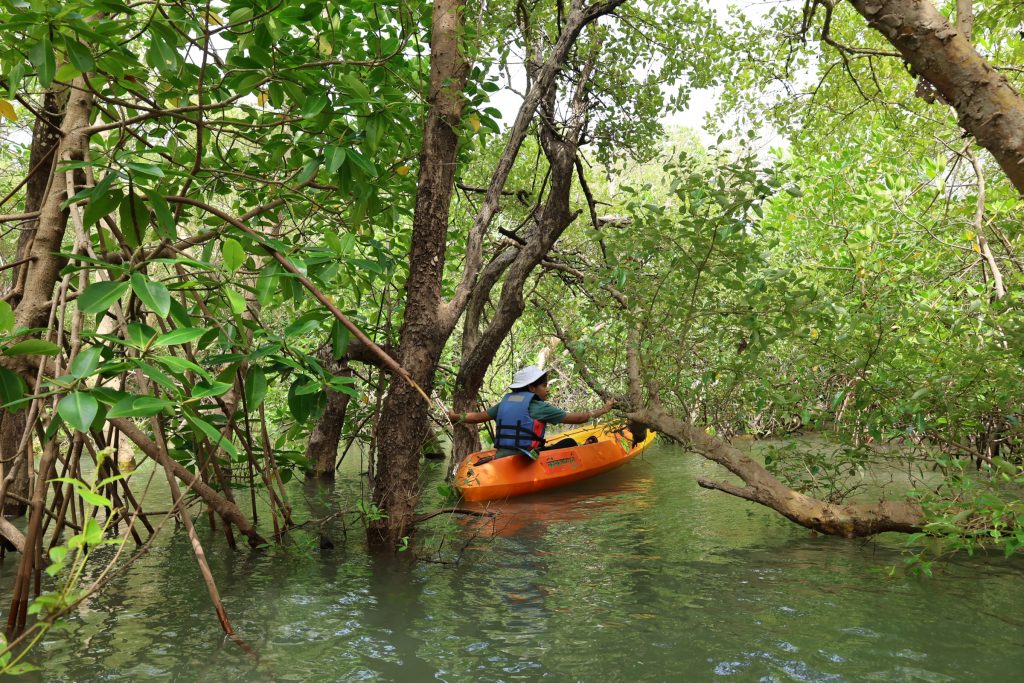
A soft current ripples near Jamdulwadi Island as 15-year-old Prachi Santosh Acharekar guides her canoe through the gnarled trunks of a mangrove forest.
The afternoon sun warms the surface of the water, revealing a familiar scene to local communities around India’s Konkan coast: clusters of mud-covered crabs, basking on branches.
As she approaches them, she slows her boat. Prachi, a 10th-standard student, doesn’t just see mud crabs: She sees her future. Her focused gaze and deft handling of the boat are part of her autodidactic training, a testament to a burgeoning passion that runs deep within the Acharekar family.
Prachi Santosh Acharekar navigating her canoe through the mangroves, a part of her crab farming training.
Champions of the Mangroves
In Achara village, where she lives, crab farming season typically runs from October to May. When Prachi is fully inducted into her family’s business in about three years, during this time, she’ll be busy with preparations, stocking seed, feeding the crabs, and folding boxes to safely transport them once they’ve been harvested.
All of it will also formalize her role in a grassroots movement, led by women from India’s coastal belt: In Sindhudurg, women fisherfolk have become champions in linking their livelihoods with environmental conservation. Through crab farming, they’ve created a strong incentive to protect local mangroves, which serve as critical nursery habitats for mangrove crabs. The benefits of this are both economical and ecological: Alongside generating sustainable income for the women, the mangroves’ preservation stabilizes shorelines and mitigates erosion, enhancing coastal resilience against the impacts of climate change.
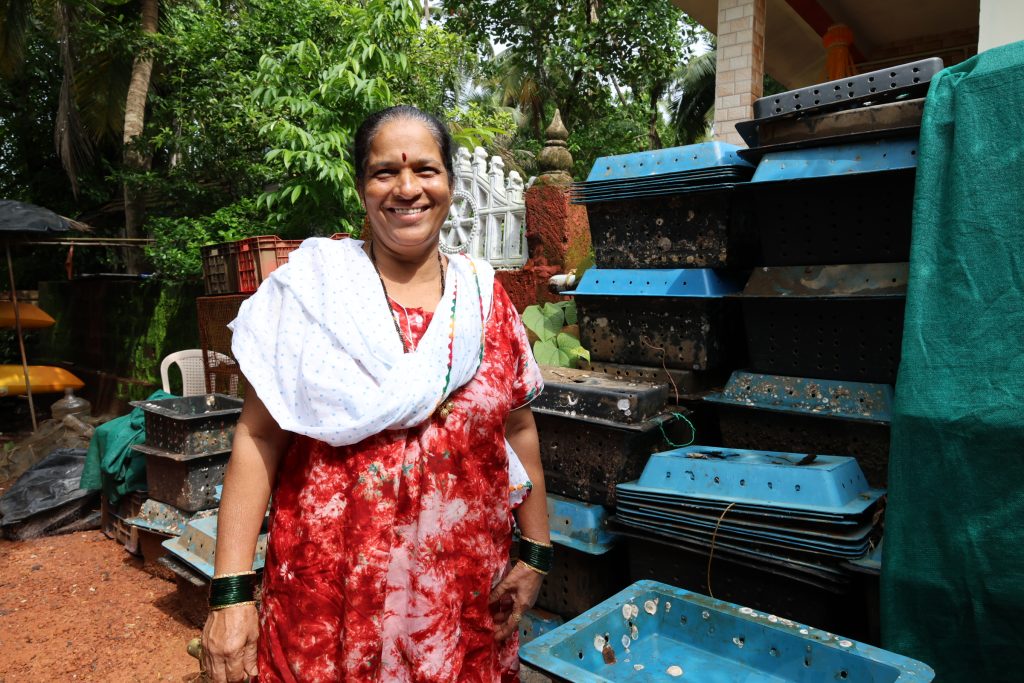
At the heart of this enterprise is Prachi’s aunt, 55-year-old Sonali Sunil Acharekar, a proud entrepreneur and leading member of Konkansparsh, one of Maharashtra’s pioneering women-led self-help groups (SHGs). Like all women of this SHG, for her, the mangrove is not just an ecosystem, but a dynamic marketplace.
“Be it dolphin safari, trekking, birdwatching, or traditional fishing, we do it all at Konkansparsh,” says Sonali, sitting in a charpoy at her home, surrounded by a vast area of mangroves. “But crab farming is our speciality. It is something we feel deeply attached to.”
Sonali and other leaders manage the entire crab farming supply chain, from feeding and harvesting the crabs to selling them. The process is meticulous but straightforward. Crab seeds are carefully placed one-by-one into fiber boxes. Each box is then deployed within the protected mangrove territories of Sindhudurg district, which boasts 6,940 hectares of mangroves perfectly suited for farming. Sonali also feeds the small raw fish stock twice daily, in the morning and evening. Then, once the crabs are ready, they’re harvested, boxed, and sold.
Sonali Sunil Acharekar in the backyard of her home in Achara village.
Overseeing the entire operation in this way has significantly enhanced the women’s access to resources, as well as to the market. The payoff is also demonstrable, including as a sustainable model: Last year, the Acharekar family, a seven-member unit that works in tandem, generated an impressive 150,000 INR ($1,706 USD) from the sale of 180 crabs. They also earned an additional 130,000 INR ($1,466 USD) from running mangrove safaris.
“It feels so good to partake in the process,” says Sonali. “This year, we intend to maintain 200 boxes fully. More boxes mean more business and more business means more prosperity.”
Their success also reinforces a crucial ecological benefit: According to research published in the Marine Biological Association of India, mud crab farming is not only a sustainable—and profitable—livelihood, but an essential strategy for mangrove conservation, supporting the region’s climate resilience through ecosystem protection. The mangroves provide a conducive natural habitat for raising mud crabs, or green crabs, commonly from the species Scylla serrata, which are indigenous to the region. By breeding and harvesting crabs, and building and tending to crabs pens in mangrove creeks, the women have both created a financial incentive for the mangroves' protection and helped to increase the local crab population.
In coastal areas, crabs are considered an economically significant species due to their huge demand. The crabs themselves can also tolerate a wide range of temperatures and salinities without destroying local ecosystems. But over the years, sand mining, saltwater intrusion, and rising water temperatures have contributed to a declining mud crab population, and are just a few of the ongoing stresses and trends that fisher communities have dealt with, and that local SHGs hope to tackle.
A wild baby crab crawls on the trunk of a mangrove tree.
In other coastal communities like Kerala, Maharashtra’s neighboring state, crab farmers who once caught wild juvenile crabs and had plentiful stock are grappling with rising costs and dwindling returns, as crabs have become scarce and stressed. Their annual incomes have dropped by 50,000 INR to 100,000 INR (around $600 USD to $1,200 USD) due to poor water quality, causing frequent disease outbreaks, pushing many farmers to downsize or cease operations altogether, largely due to reduced harvests linked to environmental degradation.
Sustainable crab models in coastal communities in Maharashtra aim to address the pressing problems of overfishing, habitat loss, and food insecurity through long-term economic stability. But without such practices, crab harvesting may yield fleeting profits, triggering ecological collapse and harm to a region’s inhabitants.
In addition to boosting the economy, this is part of why the SHG’s endeavors have been such a great boon to the area.
According to Kedar Palav, Livelihood Specialist at Sindhudurg’s Mangrove Foundation, women-led groups comprising 40 women have been active in Sindhudurg district during the 2024-25 crab farming season. “Our aim,” he notes, “is to facilitate strong livelihood opportunities for the women.”
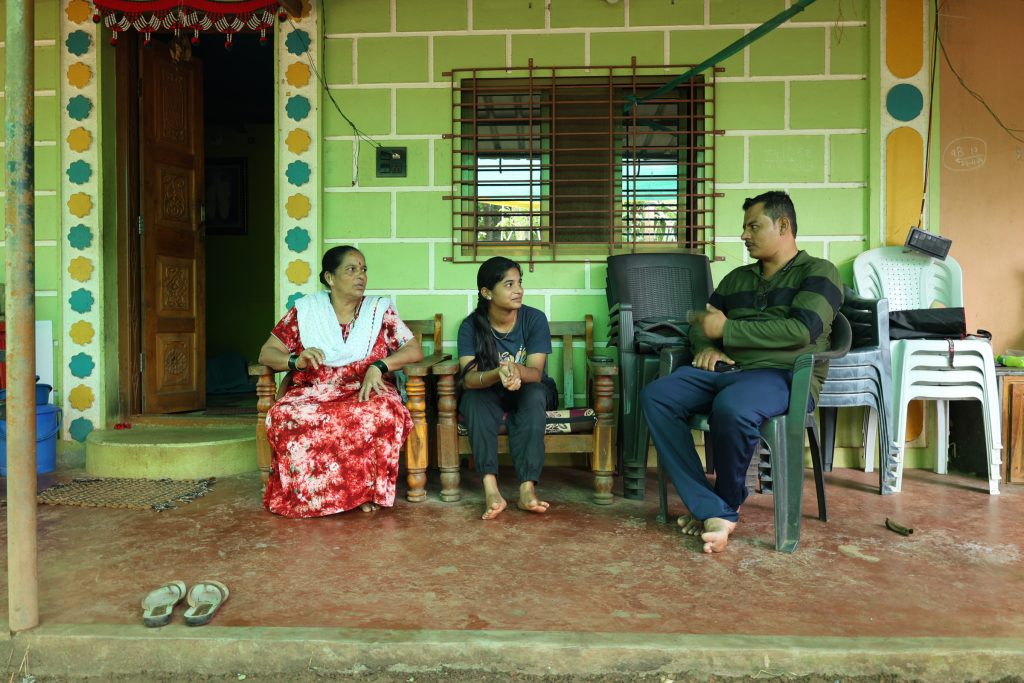
Sonali Sunil Acharekar (left) and her niece Prachi Santosh Acharekar (center) in conversation with Mayur Pansare (right), a Project Assistant for the Mangrove Foundation.
But even those with formal careers are drawn to the potential. Sonali’s 32-year-old son, Omprakash Sunil Achrekar, an engineering graduate, has embraced crab farming full-time; and Manish Tari, 22, an undergraduate in fisheries science, launched Manish Agro & Seafood with his father during the Covid-19 pandemic, specializing in vertical crab farming.
“We deal in red and green crabs,” says Tari. “A single piece per kilo can go up to 2,400 INR. It’s very lucrative.”
Navigating the Tides
Despite the economic potential, the journey is not without profound risks and hurdles. The most immediate occupational hazard, however, is theft.
“Theft of crabs is a big problem here,” says Sonali. “Sometimes diseases can spread in the backwaters, as well…A mortality rate of 20 percent is considered normal.”
It’s a challenge that has historically forced some farmers out of business. Samiksha Gaonkar, 50, from Pirawadi village, recalls being part of Sindhudurg’s very first crab culture group, which operated between 2014 to 2019. Despite each group member earning around 5000 INR per month, they were forced to shut down.
“Our crabs got suddenly stolen,” says Samiksha. “We could not keep a check on the thefts and then we had to pull out.”
Anagarajan Joshi, 58, a former crab farmer, at her friend’s home in Pirawadi village.
Another hurdle is the scarcity of crab seed. According to Palav, there is only one hatchery in India: the Rajiv Gandhi Centre for Aquaculture (RGCA) in the southernmost state of Tamil Nadu.
Sanjeevni Santosh Mithbavker,43, a member of the Vedoleshwar SHG, says crab farming has become more difficult as a result. “We lack seed,” she says. “If the supply of seed becomes easy, we can take this business forward.”
Despite the scarcity, Sanjeevni sold crabs worth 60,000 INR last season. But while business is “great,” seed still costs 25 to 30 INR for a single piece—makings it an expensive venture for the average crab farmer.
A Wave of Resilience
To counter these challenges, government and non-governmental efforts have actively focused their support on the most vulnerable communities, placing women at the forefront.
Government initiatives such as the Mangrove Conservation and Livelihood Generation Scheme, alongside international projects like Enhancing Climate Resilience of India’s Coastal Communities (ECRICC), have been instrumental in fostering local interest in Sindhudurg’s coastal villages, including Achara and Hadi. As part of the Mangrove Foundation’s intervention, women’s groups also receive substantial training and support, including expert talks, presentations, and hands-on workshops that offer extensive practical training.
On the ground, additional support comes from 34 Sagar Mitras—fisheries graduates who act as vital resources for the women. Mayur Vinayak Pansare, Project Assistant with the Mangrove Foundation, sees themselves in a family-like role. While they occasionally help fix issues, like crabs breaking through fiber boxes, he says, “It’s heartwarming to see these women coming forward and taking steps towards self-reliance.”
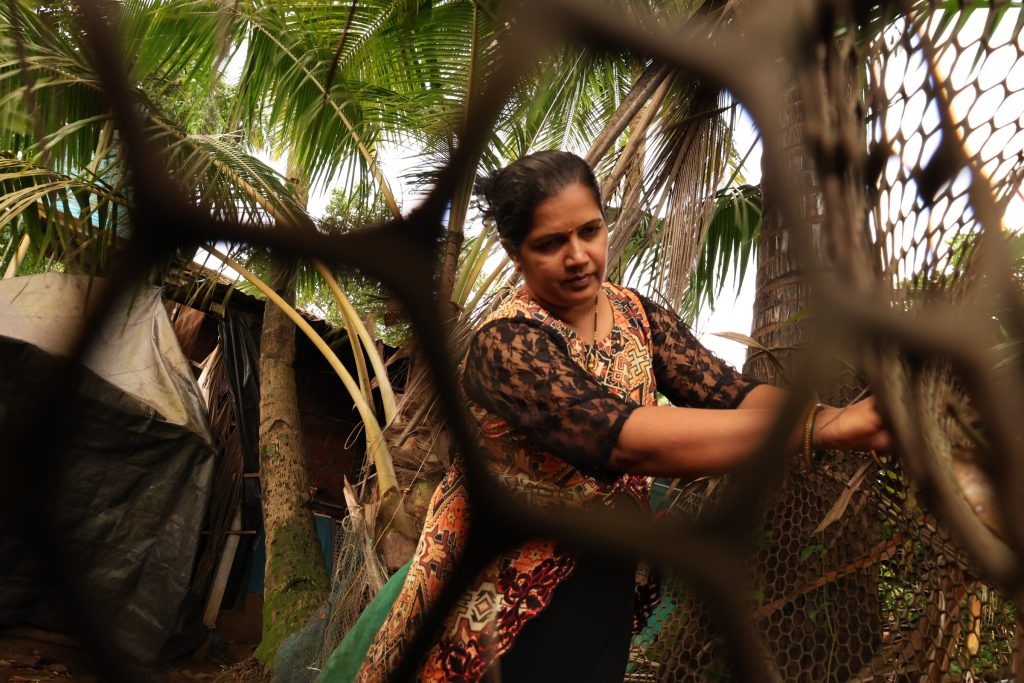
Sanjeevni Santosh Mithbavker, 43, mends nets at her home in Hadi village.
The financial assistance is also significant: The Achrekar family, for instance, received a substantial 90 percent subsidy from the Department of Fisheries and the Mangrove Foundation. Between 2021 and 2025, larger initiatives like the Pradhan Mantri Machi Sampada have backed an additional 124 fisheries projects, with women as a remarkable 60 percent of beneficiaries between 2021 and 2025, says Bahar Vithala Mahakal, Sindhudurg District Program Manager at the Fisheries Department.
This focus is clear across other programs, too: The Sindu Ratna Samrudhi Scheme saw a 70 percent rise in female beneficiaries in a single year, between 2022 and 2023.
Planting the Future
Women’s presence as crab sellers in Sindhudurg’s main fish market signals a generational shift in the industry: They’re taking center stage in an otherwise male-dominated marketplace. For Dakshita (who asked we only use her first name), her presence here is about more than selling her own yield—she’s also reclaiming a little more of herself.
“What is the need for middlemen when I can run my own business?” she says, waiting for customers.
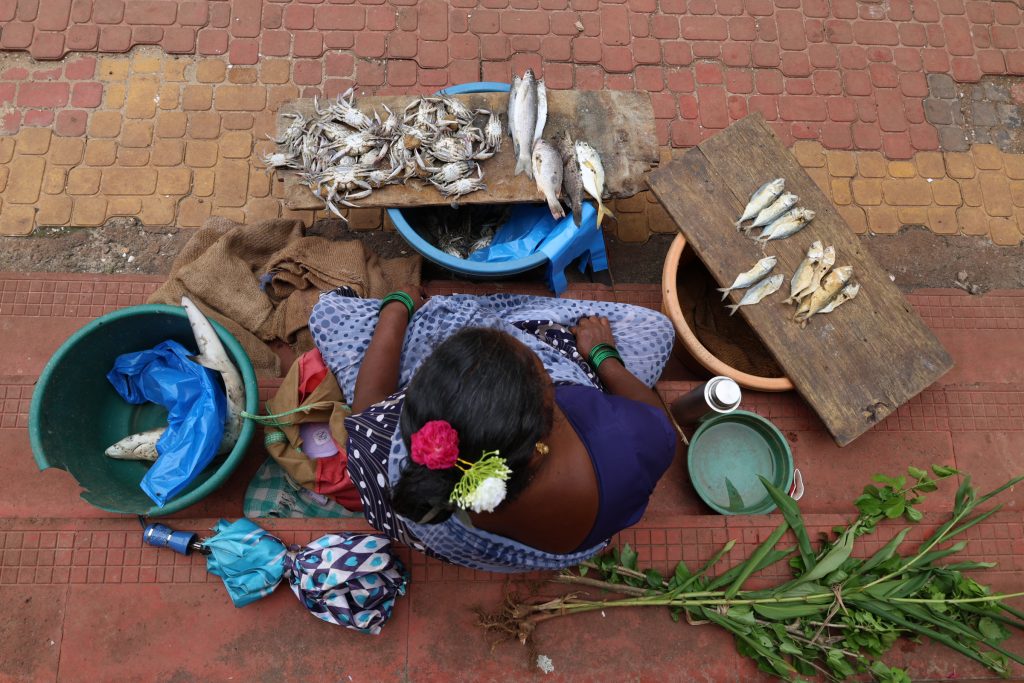
Dakshita, 50, sells green crabs at the Malvan fish market in Sindhudurg.
In Prachi’s case, the journey towards self-reliance began slowly. She initially “harbored no interest in crab farming.” But witnessing her family’s dedication and serving as a guide for tourists through the vibrant backwaters transformed her perspective, converting her initial disinterest into a passion.
In the shifting tides of the Maharashtra coast, Prachi represents the strong voice of a younger generation, seamlessly blending tradition with science to carve a new path forward. For them, crabs are the ‘green gold,’ promising economic returns.
While elder members strengthen their place in the market, Prachi is now articulating a dream that links her environment to her education, which she plans to pursue further by studying Marine Science.
“By protecting the mangroves, my crabs thrive,” she says. “The mangroves in return protect my family from storms, erosion, and the rising sea.”
A view of a mountain village in Sindhudurg.
In the nearby pond, Prachi and Sonali have also started to plant new mangrove saplings. Other efforts at sustainability have only grown. In 2017, scientists visited the area and told local crab farmers that in order to have a better catch, they needed to maintain cleaner water. To boost women’s participation in local water and pond management, women farmers are now being trained to regularly flush water through the crab ponds for freshness, monitor water quality, and prevent overcrowding. Since then, they’ve seen the return of many new birds in the area, from cattle egret to common sandpiper and Indian pond heron.
The tides speak louder than people in Sindhudurg’s coastal communities, and for these powerful women, mangroves stand like guardians along the coast. The more they nurture the mangroves, the more the mangroves give back to them, too. It’s a quiet partnership in nature, this connection between crab farmers and the mangrove forests, and a small step in healing the Earth.
[post_title] => Guardians of the Mangroves
[post_excerpt] => How women crab farmers along India's coast have linked their livelihoods to environmental conservation.
[post_status] => publish
[comment_status] => closed
[ping_status] => closed
[post_password] =>
[post_name] => crab-farmers-farming-aquaculture-india-mangroves-conservation-climate-change-ecosystem
[to_ping] =>
[pinged] =>
[post_modified] => 2026-08-03 21:03:35
[post_modified_gmt] => 2026-08-03 21:03:35
[post_content_filtered] =>
[post_parent] => 0
[guid] => https://conversationalist.org/?p=9839
[menu_order] => 0
[post_type] => post
[post_mime_type] =>
[comment_count] => 0
[filter] => raw
)
WP_Post Object
(
    [ID] => 3531
    [post_author] => 2
    [post_date] => 2021-12-02 22:17:42
    [post_date_gmt] => 2021-12-02 22:17:42
    [post_content] => Future COPs will bring about successful results only if organizers make the conferences more democratic, fair, and equal.

There were high hopes for COP26.  After years of disappointing climate conferences, many observers hoped that this one, held in Glasgow from October 31-November 13, would end with ambitious pledges and meaningful actions—particularly after both China and the US raised hopes with significant announcements going into the global event. China pledged to become carbon neutral by 2060, while the US pledged to double its financing to poorer countries for combating climate change. However, in the end COP26 fell short. Once again, the decisions taken at the UN Climate Change Conference brought a few advances, but mainly perpetuated the dangerous stagnation that we cannot afford at this critical time of rapid global warming.

I was an observer at COP26 under the auspices of the University of Edinburgh and Nuestra América Verde, a Latin American NGO. Although I studied climate law for both my LLM and now my doctorate, this was my first COP—and a totally novel experience, as can be seen in my description and analysis of events in this article.
Deeply unequal
Equity constitutes an essential element, in both procedural and substantive ambits, for achieving a successful UN climate change conference. Unfortunately, neither the conference organizers nor the state actors who attended COP26 took equity into account. Civil society organizations that came to observe were met with restricted  access to negotiations due to a combination of circumstances that included  the UK’s onerous and restrictive visa requirements; the high cost of accommodation in Glasgow; and vaccine apartheid. The absence of thousands of observers and climate activists from poorer countries in the global south, which are disproportionately affected by climate change made this extremely important global event that deeply unequal. State representatives engaged in important negotiations on critical climate issues with insufficient transparency, and in the absence of observers from civil society groups. The lack of equity and fairness had a strong impact on the substantive outcomes of the COP26, particularly on climate finance.

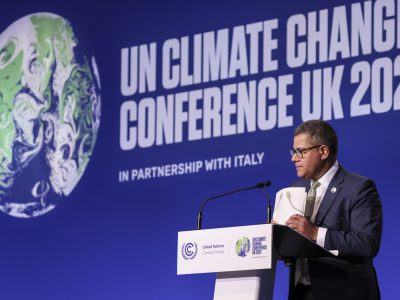
[caption id="attachment_3535" align="aligncenter" width="640"] COP26 Climate Change Conference on November 4, 2021.[/caption]

COP (Conference of the Parties) is the decision-making body for the United Nations Framework Convention on Climate Change (UNFCCC). Signed in 1992, the Convention tasks COP with realizing the UNFCCC’s agenda as it responds to the evolving challenges of climate change. COP1 took place in Berlin in 1995. Since then, the climate conferences have been held every one or two years; their purpose is to define the global path toward confronting the climate crisis.

Some of the best-known COPs include:
COP3 (1997), where the Kyoto Protocol on greenhouse emissions was adopted;
COP21 (2015), which resulted in the Paris Agreement to limit global warming.
The success of each meeting is measured by the ambition and equity of its goals and their implementation. In this sense, many experts have pointed to the Paris Agreement as the perfect balance between ambition and equity, illustrated by its broad support among states. Lavanya Rajamani, a professor of environmental law at the University of Oxford Law School, said that the Paris Agreement “contains ambitious goals” and “is firmly anchored in the common but differentiated responsibilities principle” that are an expression of equity between states.
The importance of civil society groups
In August, the Intergovernmental Panel on Climate Change (IPCC) published the Sixth Assessment Report, with climate scientists issuing dire warnings about imminent climate collapse resulting from faster-than-predicted global warming. UN Secretary General Antonio Guterres called the report “a code red for humanity.” In September, the NDCs Report of the United Nations further warned that the signatories of the Paris Accords were not meeting emissions control goals fast enough to stave off catastrophic global warming. Both reports stipulated that there was a narrow window of opportunity for strong, efficient actions to reduce emissions and implement adaptation. As if to illustrate the warnings from scientists, 2021 saw several climate-related disasters—devastating floods, forest fires, unprecedented high summer temperatures—in Europe, India, China, and the US. Climate activists and civil society groups came to COP 26 hoping that the dire events of 2021 would inspire constructive and ambitious agreements to slow global warming and stave off climate catastrophe.
Civil society groups play a decisive role in creating truly cohesive and ambitious agreements at the COPs. The Paris Agreement, for example, is based on the preliminary work of civil society organizations that raised issues such as transparency, adaptation, mitigation and finance. The Climate Action Network was a key actor in achieving an agreement on global stocktake and transparency. NGOs and grassroots movements can play a crucial role in pressuring their governments to improve climate commitments and actions domestically whereby reaching agreements that are more powerful. Every COP receives official delegations, observers, and what are known as “overflow parties”; these last two are usually representatives of NGOs or organizations that fight climate change.
The reality of advocacy within COP is more complex. The limited time and restricted opportunities for civil society to engage with officials makes it difficult to exert real influence. In addition, observers and civil society have a very limited voice at the negotiating table, where only those presiding at the discussion can invite NGOs to talk which is extremely rare. In sum, civil society and NGOs must act as spectators at talks defined almost entirely by governments.
COP26 was heavily criticized for unfair access to negotiations. It was the most attended COP in history, but non-state observers were not given proper access to negotiations. The Climate Action Network represents more than 1,500 organisations, but were given only two tickets to enter the negotiating area for the first two days of COP26, which was considerably fewer than the number they had received for previous COPs. Organizers blamed pandemic restrictions, which limited the number of people who could gather in a single room. I saw dozens of observers barred from entering negotiation rooms, purportedly to comply with COVID-19 restrictions. But the COP presidency could have pre-empted this situation by providing larger conference rooms with proper ventilation so that civil society members could participate fully. Limiting access to negotiations is particularly unfair in the case of the vulnerable communities that assisted in organizing and consulting to COP26, only to find themselves barred from observing the negotiations. Restricted access to negotiations aggravates the structural exclusion that is already an issue for vulnerable communities and indigenous people.
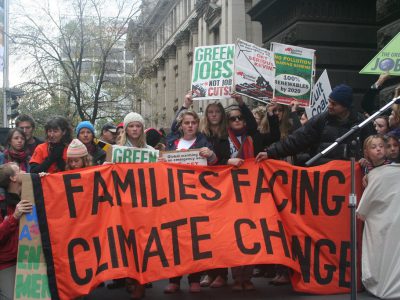
But these limitations did not stop civil society from exerting much-needed pressure on the negotiations. On Friday, November 12, hundreds gathered inside the COP26 venue to express their dissatisfaction with the draft decisions that had been published. The weak and unclear wording regarding support for developing countries was at the core of climate justice claims inside and outside the COP venue. Access restrictions were somewhat lifted toward the end of the conference due to pressure from civil society. The next COP presidency must do more to ensure broader access to the negotiations. The UNFCCC must work on new guidelines to ensure an effective method for including the participation of civil society organizations at global climate negotiations.
Poor countries gonna get what's theirs
Unequal climate burdens provide the context for every COP gathering and Glasgow was no exception. Since the Paris Agreement, COPs have tried to make further progress on the implementation of past agreements, but so far have failed. Issues like “climate finance,” article 6 of the Paris Agreement, and “loss and damage” are among the most complicated ambits the COP must grapple with; equity is an important element of those debates.
Wealthy industrialized nations arrived at COP this year having failed to comply with a commitment they made in 2009 at COP15 in Copenhagen, to transfer $100 billion annually to poorer nations for finance mitigation and adaptation actions. Through funds such as the “Adaptation Fund,” the “Global Environment Facility,” or the “Green Climate Fund,” climate finance can support projects to increase the resilience of vulnerable coastal lands, or for coping with severe droughts in sub-Saharan Africa. Enhancing the adaptive capacity of the poorest communities across the globe is essential for climate justice; that is why developing nations at COP26 pushed for an acknowledgement in the final statement that wealthy nations had reneged on their financial commitment. Climate mitigation and adaptation actions are costly and developing countries simply do not have enough money. This scarcity of resources creates a vicious circle, whereby poorer nations cannot afford to make more ambitious commitments until the wealthier nations accept their historical responsibility by sharing the necessary financing with those who need it.
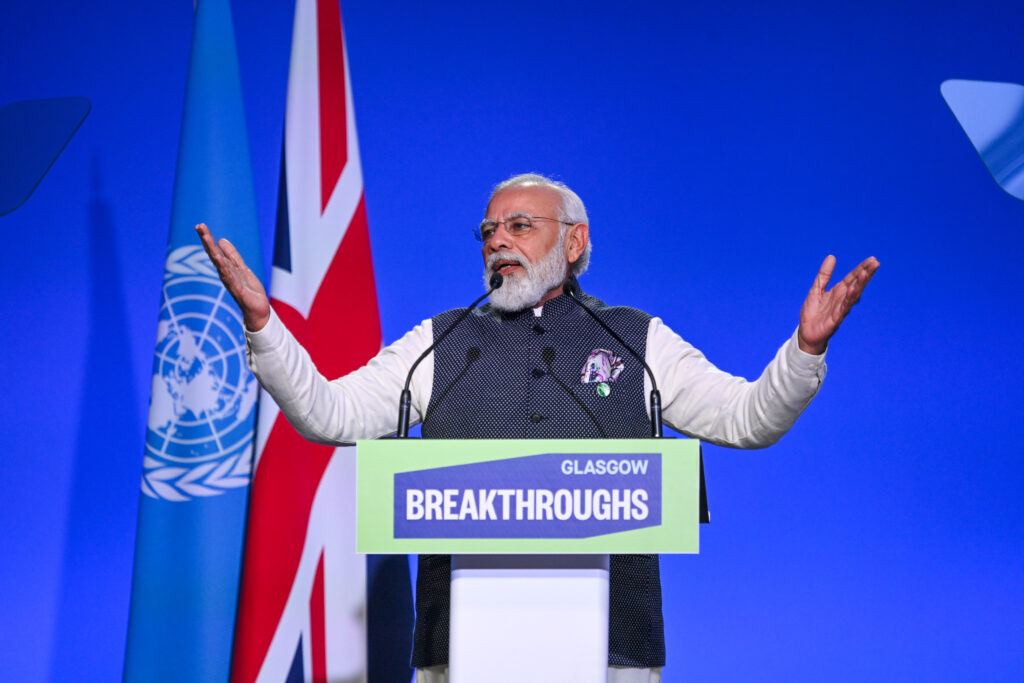
[caption id="attachment_3534" align="alignleft" width="640"] Indian Prime Minister Narendra Modi at at COP26 on November 2, 2021.[/caption]
India’s last-minute demand for a change to the wording of the conference resolution caused an enormous uproar. The original wording called upon signatories to “accelerate (…) efforts towards the phase-out of unabated coal power”; India said it wanted it changed to “phasedown of unabated coal power.” COP decisions require consensus, so the president was forced to capitulate. But while wealthy countries were vociferous in their criticism of this move and the media blamed India for playing an obstructive role, there is more to India’s position than simple obstruction or lack of purpose. The country’s negotiators were responding to a lack of commitment from rich countries to supporting the needs of poorer ones. From India’s perspective, the richer nations were historically for climate change and were therefore ethically obligated to cooperate with those who were poorer, carried far less responsibility for climate change, and were more vulnerable to its impact. Ambition and equity mark a delicate balance in every climate negotiation, a fact that Glasgow demonstrated once again.
Future COPs must better consider how to navigate this precarious balancing act. The urgency of the situation precludes further setbacks.
It will be very difficult for anyone who attended COP26 to forget the sight of Alok Sharma, the president of COP, struggling to hold back tears at the final plenary as he acknowledged that the conference had failed to produce the climate commitments needed to avert global climate collapse.
COP26 fell short because it failed to integrate the principle of equity into its decisions. To bring about the ambitious change we desperately need, civil society must play an equal role to state actors in negotiations. Future climate agreements need to push harder for more significant cooperation and concessions from wealthier nations. This is not about charity; it is a matter of justice and responsibility that should be shouldered by those who created this climate emergency. If future COP climate agreements follow these steps and ensure true global equity, it may still be possible to attain the goal of keeping global warming at 1.5 degrees.
[post_title] => COP26 fell short, but ended with a ray of hope
[post_excerpt] => Conference organizers failed to include the civil society activists who do the hard work on the ground, but they still managed to have an impact.
[post_status] => publish
[comment_status] => closed
[ping_status] => open
[post_password] =>
[post_name] => cop26-fell-short-but-ended-with-a-fragile-ray-of-hope
[to_ping] =>
[pinged] =>
[post_modified] => 2026-08-05 18:23:22
[post_modified_gmt] => 2026-08-05 18:23:22
[post_content_filtered] =>
[post_parent] => 0
[guid] => https://conversationalist.org/?p=3531
[menu_order] => 159
[post_type] => post
[post_mime_type] =>
[comment_count] => 0
[filter] => raw
)
WP_Post Object
(
    [ID] => 720
    [post_author] => 5
    [post_date] => 2019-03-13 14:45:52
    [post_date_gmt] => 2019-03-13 14:45:52
    [post_content] => The power of the individual to halt global warming is the major theme of this week’s curated articles. Alexandria Ocasio-Cortez has said that she wants to “rediscover the power of public imagination" as we begin to address our changing climate.
“It’s 2050 — how did we stop climate change?” This is the question posed at the opening of a recent NPR report. Instead of focusing on the monumental challenge facing the world, the reporter asks what actions we as individuals can take right now. The result is an optimistic road map for a more climate-friendly future, relying almost entirely on technology and capabilities that we already have. Listen to the story here.
A grassroots campaign in Britain convinced Walkers, the manufacturer of the country’s most popular brand of potato chips, to create a recycling scheme for its excessive packaging. The company’s response to the popular campaign shows that consumers have the power to influence corporate policies. Read The Independent op-ed.
Case in point: Greta Thunberg, the adolescent activist who skipped school to protest climate inaction outside of the Swedish parliament building. What began as her lone crusade has become a global movement with Thunberg at the helm, inspiring her teenage peers and adult activists alike. Read The Guardian’s profile of this remarkable girl.
In finding a way to get the Green New Deal passed by the Senate, there’s a case to be made that the left wing of the Democratic Party has embraced tactics more effective than those of the moderates. While the moderates are searching for a sensible compromise, progressives want to eliminate structural impediments to real action. “This might seem like fantastical thinking, but it actually carries a greater dose of realism about both the current political situation and about the opposition in the Republican Party,” writes David Atkins. Read his op-ed in The American Prospect.
A vegan reporter faced an online backlash from dairy farmers after appearing on a national Canadian radio show to talk about veganism. But instead of throwing up her hands in frustration at the incivility of social media, she took the opportunity to learn from her so-called opponents, and modelled the ideal social media conversationalist for people on either side of the issue. Read her account for Vice.
[post_title] => Harnessing the imagination to address climate change
[post_excerpt] => The power of the individual to halt global warming is the major theme of this week’s curated articles.
[post_status] => publish
[comment_status] => open
[ping_status] => open
[post_password] =>
[post_name] => harnessing-the-imagination-to-address-climate-change
[to_ping] =>
[pinged] =>
[post_modified] => 2026-09-15 21:04:06
[post_modified_gmt] => 2026-09-15 21:04:06
[post_content_filtered] =>
[post_parent] => 0
[guid] => https://conversationalist.org/?p=720
[menu_order] => 349
[post_type] => post
[post_mime_type] =>
[comment_count] => 0
[filter] => raw
)




 COP26 Climate Change Conference on November 4, 2021.[/caption]
COP (Conference of the Parties) is the decision-making body for the United Nations Framework Convention on Climate Change (UNFCCC). Signed in 1992, the Convention tasks COP with realizing the UNFCCC’s agenda as it responds to the evolving challenges of climate change. COP1 took place in Berlin in 1995. Since then, the climate conferences have been held every one or two years; their purpose is to define the global path toward confronting the climate crisis.
Some of the best-known COPs include:
COP26 Climate Change Conference on November 4, 2021.[/caption]
COP (Conference of the Parties) is the decision-making body for the United Nations Framework Convention on Climate Change (UNFCCC). Signed in 1992, the Convention tasks COP with realizing the UNFCCC’s agenda as it responds to the evolving challenges of climate change. COP1 took place in Berlin in 1995. Since then, the climate conferences have been held every one or two years; their purpose is to define the global path toward confronting the climate crisis.
Some of the best-known COPs include:
 Indian Prime Minister Narendra Modi at at COP26 on November 2, 2021.[/caption]
India’s last-minute demand for a change to the wording of the conference resolution caused an enormous uproar. The original wording called upon signatories to “accelerate (…) efforts towards the phase-out of unabated coal power”; India said it wanted it changed to “phasedown of unabated coal power.” COP decisions require consensus, so the president was forced to capitulate. But while wealthy countries were vociferous in their criticism of this move and the media blamed India for playing an obstructive role, there is more to India’s position than simple obstruction or lack of purpose. The country’s negotiators were responding to a lack of commitment from rich countries to supporting the needs of poorer ones. From India’s perspective, the richer nations were historically for climate change and were therefore ethically obligated to cooperate with those who were poorer, carried far less responsibility for climate change, and were more vulnerable to its impact. Ambition and equity mark a delicate balance in every climate negotiation, a fact that Glasgow demonstrated once again.
Future COPs must better consider how to navigate this precarious balancing act. The urgency of the situation precludes further setbacks.
It will be very difficult for anyone who attended COP26 to forget the sight of Alok Sharma, the president of COP,
Indian Prime Minister Narendra Modi at at COP26 on November 2, 2021.[/caption]
India’s last-minute demand for a change to the wording of the conference resolution caused an enormous uproar. The original wording called upon signatories to “accelerate (…) efforts towards the phase-out of unabated coal power”; India said it wanted it changed to “phasedown of unabated coal power.” COP decisions require consensus, so the president was forced to capitulate. But while wealthy countries were vociferous in their criticism of this move and the media blamed India for playing an obstructive role, there is more to India’s position than simple obstruction or lack of purpose. The country’s negotiators were responding to a lack of commitment from rich countries to supporting the needs of poorer ones. From India’s perspective, the richer nations were historically for climate change and were therefore ethically obligated to cooperate with those who were poorer, carried far less responsibility for climate change, and were more vulnerable to its impact. Ambition and equity mark a delicate balance in every climate negotiation, a fact that Glasgow demonstrated once again.
Future COPs must better consider how to navigate this precarious balancing act. The urgency of the situation precludes further setbacks.
It will be very difficult for anyone who attended COP26 to forget the sight of Alok Sharma, the president of COP,