Nadja Pass on how curiosity, connection, and collective imagination can help renew the foundations of a peaceful society.
There is a whale somewhere in the deep ocean that has become a world.
Credit: Concopia Cards
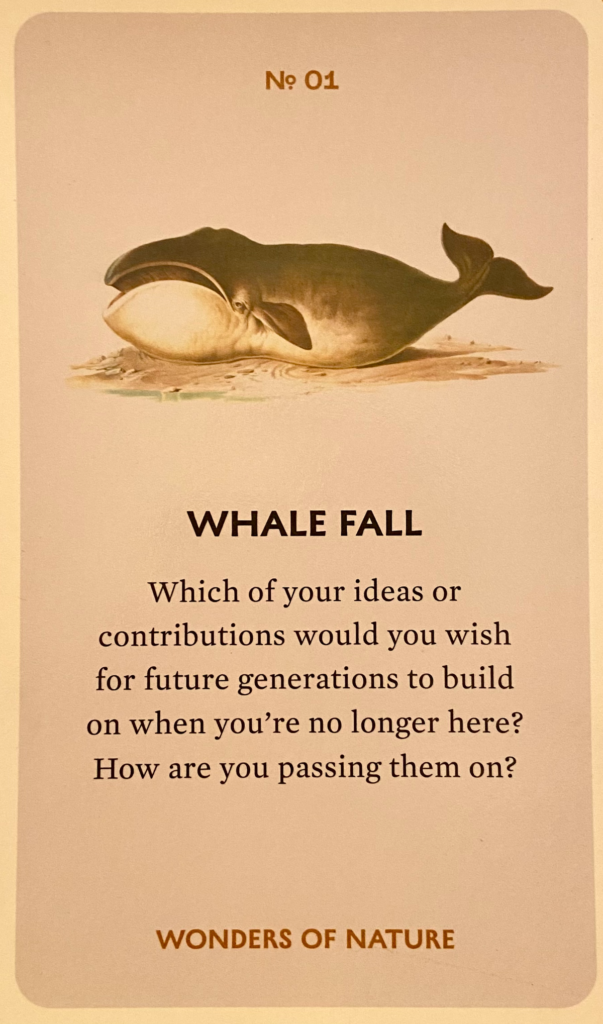
When a whale dies, its body sinks to the ocean floor and becomes an ecosystem. Creatures arrive to feed, new organisms take hold, and life flourishes in a place that might otherwise have been empty. Scientists call this a whale fall.
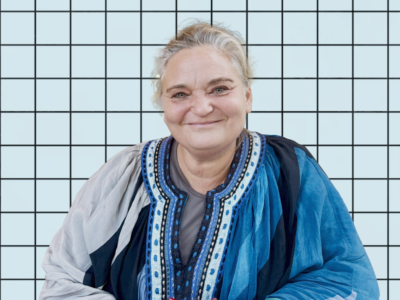
For Nadja Pass, a Danish civic designer and the creator of Concopia Cards, it is also a metaphor for what we owe one another—and what we might leave behind.
Credit: Concopia Cards
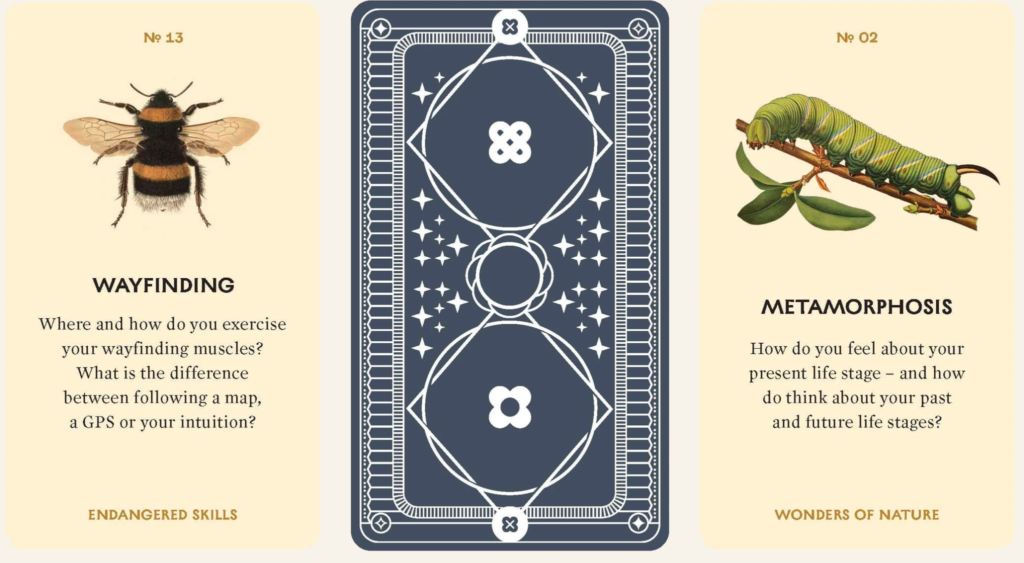
“Whale Fall” is one of her favorite cards in the Concopia deck, a set of cards Pass designed to help spark conversations. It asks us to consider what we want to pass on: What have we learned that future generations might build upon? What can we contribute that will continue to nourish life after we are gone?
These questions invite us to think beyond individual achievement, and toward something more enduring: the conditions that allow other people, communities, and future generations to flourish. It is also a useful place to begin thinking about regenerative civics.
Democracy must do more than reproduce its existing institutions. It must continually renew the relationships, shared knowledge, imagination, and capacity for collective action that make self-government possible.
For Pass, this work began with a moment of disappointment.
When voting isn't enough
In 2009, Pass was standing in line to vote in Denmark, frustrated by the choices on the ballot. She wanted to participate in democracy, but didn't feel that any of the available options represented what she wanted for society.
Then, a question occurred to her: Why wasn't she a better citizen herself?
She believed citizenship mattered. She wanted to contribute more. Yet when she looked at her own life, she realized that the conventional pathways for civic participation did not fit her personality. She felt embarrassed and alone, as though she had somehow fallen through the civic system. Rather than finding another way in, she had drifted away from participation altogether.
After the election, she began talking openly about her experience, and discovered that other people felt the same. What had felt like a private failure turned out to be a shared problem: People wanted to contribute to society, but couldn't find forms of participation that felt meaningful to them.
That realization became the beginning of Civic Desire, a civic laboratory she developed with collaborator Andreas Lloyd. Using their own experiences as a starting point, they began experimenting with different ways of participating, then documenting and sharing what worked, what didn't, and why.
Pass has observed a similar pattern in other civic initiatives. Someone begins with a question. They investigate it, give it a shape, and share it with others. Eventually, what began as personal curiosity becomes a collective endeavor.
She describes this transformation with a playful phrase that she learned from Lars AP, another Danish civic designer: when individual star gazing becomes collective star gazing.
The task is not simply to persuade people to enter existing democratic institutions. It is to make room for more ways of contributing.
Re-enchanting the civic imagination
Concopia grew out of that impulse. Pass describes it as “a collection of curiosities and questions that encourage us to reimagine and re-enchant the world.” Its questions invite people to look at familiar things from unfamiliar angles, examine their assumptions, and explore what they might otherwise leave unspoken.
The cards are not a conventional civics curriculum. They don't begin with the structure of government or ask participants to debate a prescribed set of policies. Instead, they create openings for discovery: about how we live, what we value, what we are losing, and what we might build together.
Pass developed the first iteration of the cards during the COVID-19 pandemic. While public conversation often centered on immediate disagreements about masks and vaccines, she wondered whether the crisis might offer a larger opportunity. Democracy works better when people are willing to listen openly and respect the opinions of others, even when those opinions are difficult to hear. When everyday routines are disrupted, why not use the moment to rethink how we live and what we want to change?
It was a chance for a civic renaissance.
She wanted people to have the conversations that might otherwise never happen. Even more, to prompt a starting point for individuals to find and connect with kindred spirits and create projects together.
That ambition is especially relevant to democracy today. Institutions can provide formal opportunities to participate, but they cannot manufacture the curiosity, mutual recognition, or willingness to listen that meaningful participation requires. Those capacities must be cultivated, and Concopia creates room for people to practice.
When an ally becomes a source of fear
For Denmark, the American threats to take control of Greenland have brought an unsettling realization: Even a longstanding democratic friend can become a source of profound insecurity.
Greenland is a self-governing territory within the Kingdom of Denmark, and the American president's threats to acquire it shocked a country accustomed to decades of peaceful relations with the United States. It also raised questions that many Danes had scarcely imagined confronting. What happens when a powerful ally threatens the sovereignty of a smaller country? What does solidarity look like when the threat comes from within an alliance built on mutual security? And how do people respond when the rules they have trusted suddenly seem less certain?
While allies, the much bigger United States was acting like a bully. Pass describes feeling a deep sense of vulnerability in light of this shocking encounter with power, which seemed to leave little room for resistance. The experience was both geopolitical and personal.
Yet Pass also saw something hopeful in her country’s response. The crisis brought people together around a shared sense of what was at stake. It became a wake-up call: a reminder that peace cannot be taken for granted and that societies accustomed to stability must better prepare for a future marked by greater volatility.
For Pass, this has meant creating spaces where people can find and listen to each other, ask better questions, and imagine ways of living together that do not depend on domination.
This may sound gentle, but it is far from a passive response in the face of coercive power.
Authoritarian behavior often works by making people feel isolated, powerless, or unable to imagine alternatives. Pass's work helps cultivate some of the capacities that democratic resilience requires: independent thought, mutual recognition, curiosity about difference, and the confidence to question whether the existing order is the only possible one.
A card deck cannot replace political action, institutional safeguards, or collective organizing. But those efforts become more possible when people retain the ability to think for themselves. The democratic imagination itself is also something worth defending.
The banality of virtue
During our conversation, Pass and I discuss Denmark's collective memory of Nazi occupation. In 1943, thousands of Danish Jews escaped to neutral Sweden with help of organized rescue efforts, often at considerable personal risk to the people behind the organizing. Pass says these stories remain an important source of inspiration for thinking about how communities should respond when members are threatened.
I share a phrase from my graduate school mentor, the social psychologist Lee Ross: the banality of virtue. While Hannah Arendt has made the banality of evil a familiar framework for thinking about how ordinary people can become complicit in extraordinary wrongdoing, Ross was interested in the opposite: that people might also do the right thing without necessarily seeing themselves as heroes.
Pass immediately connects with the idea. During a recent conversation with students about weighing risks, she shares that a participant reflected on the times he had made the wrong decision when faced with a difficult choice. This led to a question he had not previously considered: What would it mean to accept risk because doing the right thing matters?
The lesson is not that courage comes easily or that everyone can take the same risks. People have different responsibilities, resources, and vulnerabilities. It is that a society's capacity to respond to danger depends, in part, on whether ordinary people have opportunities to think together about responsibility—before a crisis arrives.
It is here that peacebuilding and democracy meet.
A library becomes a chamber of wonders
For Pass, the journey from a Danish civic laboratory to Washington, DC, was an exercise in the kind of serendipity her Concopia cards hope to encourage.
In 2023, Pass attended the Next Library biennale, an international gathering of library professionals and public engagement practitioners held in Aarhus, Denmark. While there, she struck up a conversation with an American participant. The next morning, the two ran into each other at a coffee shop, and continued talking, discovering a shared enthusiasm for the possibilities of libraries as places of public connection.
Her new acquaintance was Meaghan O’Connor, Director of Service Design & Engagement at Washington's Martin Luther King Jr. Memorial Library. While neither knew it yet, O’Connor would eventually help Pass bring her project to the United States. One of the conference's keynote speakers had received a Concopia deck and shown it to the library director, who ordered one for herself.
A few messages later, the invitation came: What dates could Pass come to Washington?
The result was the Concopian Chamber of Wonders, an exhibition at the MLK Library that transforms the cards from a tabletop conversation into an experience visitors can move through physically. The project has since also opened doors to other libraries and communities, including a Concopia salon at New York’s The Library Field, a developing project by the Metropolitan New York Library Council that imagines nature itself as a library.
Libraries, Pass believes, are becoming important strongholds of democracy. Their networks are collaborative rather than competitive; one institution can help another experiment, learn, and bring new ideas to its community. More than just a venue, the library is also an important example of civic infrastructure—a place where people can encounter new ideas and people, and practice being part of a shared world.
At a time when public life can be shaped by fear, polarization, and the threat of force, this kind of infrastructure matters. It creates spaces where people can meet outside the immediate demands of political conflict, exercise their curiosity, and discover that they have more possibilities than they may have imagined—making it the perfect home for Pass’s work.
Regeneration means passing something on
Pass is independent by choice. She values the ability to work without compromising her ideas, and she has organized her life around purpose rather than maximizing income. That freedom has allowed her to experiment, take risks, and devote time to the common good.
She believes her generation has a particular responsibility: People who grew up in an analog world and then helped shape the internet should serve as bridges between different generations and experiences of that world.
Pass has explored these questions in short books, and in conversations with young relatives. One book contrasts the way things used to be with the way they are now, using simple images to prompt discussion. It is not meant to be an argument against change, but rather, an invitation to notice it, contextualize it, and decide what’s worth preserving.
That is another form of regeneration: not a return to the past, but a conscious carrying forward of what remains valuable while making room for what comes next.
The "Whale Fall" card brings these threads together. Its question is not simply what legacy we want to leave, but how we can leave something that others can use, transform, and build upon.
For democracy, that might mean passing on more than institutions and laws. It might mean preserving community knowledge, creating public spaces for difficult conversations, and teaching people how to listen across differences. It might mean building civic practices that can survive beyond their founders, so that each generation does not have to begin again from scratch.
This is where peacebuilding and democracy become inseparable. Peace is not only the absence of violence, and democracy is more than the act of voting. Both depend on a society's ability to renew the conditions for living together: the relationships, knowledge, habits, and institutions that help people face uncertainty without surrendering their capacity to act collectively.
Nadja Pass did not set out to become a civic leader. She began as a voter who felt that something was missing. Rather than conclude that the problem was hers alone, she chose to share it. From there, a civic laboratory emerged, then a deck of cards, then an exhibition, then a growing network of libraries and communities.
Because she is not a political analyst or strategist, her story offers a different picture of civic courage. It is not always loud, confrontational, or immediately legible as political action. Sometimes it looks like making room for a conversation that would not otherwise happen. It is affirming people with a desire for change that they are not alone. Sometimes it means creating something beautiful that helps people recover their sense of agency. Sometimes it is insisting that even in a frightening moment, we have the capacity to think, choose, and build together.
The answer to authoritarian behavior cannot be optimism alone. It requires institutions, organization, accountability, and people willing to stand with one another. But those efforts become more possible when people can imagine a future beyond the immediate exercise of power—and when they have practiced the habits of solidarity that make collective action possible.
The whale falls to the ocean floor, and a new world takes shape around it.
What if our civic lives could work that way, too? What if we built institutions and relationships that nourish people we may never meet, preserve what we have learned, and make it easier for future generations to resist coercion and care for one another?
In an unsettled world, that is not an escape from politics. It is part of the work of democracy—and of peace.
[post_title] => The Art of Regenerative Civics
[post_excerpt] => Nadja Pass on how curiosity, connection, and collective imagination can help renew the foundations of a peaceful society.
[post_status] => publish
[comment_status] => closed
[ping_status] => closed
[post_password] =>
[post_name] => nadja-pass-global-peacebuilders-denmark-regenerative-civics-concopia-cards-democracy
[to_ping] =>
[pinged] =>
[post_modified] => 2026-11-13 17:50:59
[post_modified_gmt] => 2026-11-13 17:50:59
[post_content_filtered] =>
[post_parent] => 0
[guid] => https://conversationalist.org/?p=11304
[menu_order] => 0
[post_type] => post
[post_mime_type] =>
[comment_count] => 0
[filter] => raw
)