WP_Post Object
(
    [ID] => 10985
    [post_author] => 15
    [post_date] => 2026-09-04 01:15:56
    [post_date_gmt] => 2026-09-04 01:15:56
    [post_content] =>
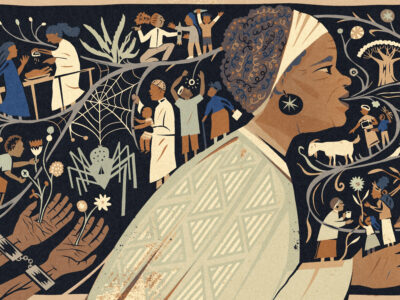
For many in the African and Caribbean diaspora, oral tradition is a survival tool passed down through generations. It is also largely sustained by women like my great-aunt Nerissa.


I credit much of how I live my life to the wisdom of the women in my family. From my grandmother’s tip to drink chamomile tea after dinner ahead of an early morning, to my mother’s insistence on cleaning chicken with vinegar and lemon juice; from learning to grow aloe vera at home to heal wounds in an emergency, to knowing that blowing air into an infant’s face will stop them from choking. All this is part of my inheritance.


While the benefits of chamomile are easily found on the internet, in my family, such knowledge was passed by word of mouth. In some ways, that’s still common today: For many in the African and Caribbean diaspora, oral tradition is a survival tool that is sharpened, exercised, and passed down through generations. Encompassing stories, songs, beliefs, and customs that preserve history, memory, and cultural practices, this tradition influences the choices we make and how we navigate the world.


In Jamaica, where my family comes from, oral tradition was as much an old practice taken from enslaved Africans as it was an act of survival, because they were forbidden from reading and writing. “During slavery, enslaved people were denied literacy and formal education, so oral tradition became the most crucial tool,” says Mickayla Whyte, a library assistant at the African Caribbean Institute of Jamaica in Kingston. “Oral tradition is the oldest form of traditional preservation, and it allows communities to remember who they are, where they come from, and even where they're going."


These traditions from West and Central African nations blended over time with Indigenous Arawak practices on the island. The survival of folklore like Anansi the Spider—about a mischievous spider who creates and escapes trouble with his wit—alongside the use of herbal remedies, like cerasee tea to lower blood pressure, exemplify the intergenerational strength of oral tradition and the syncretism found across diasporas. Across the diaspora, as in my own family, this tradition is largely sustained by matrifocality.


“In its most simplistic form, matrifocality means mother-focused,” Dr. Leighan Renaud, University of Bristol lecturer and author of Mothering and Matrifocality in Contemporary Caribbean Literature, tells me. “What that means is that women in their roles as mothers—not necessarily biological mothers—are central to the organization of families and therefore the organization of communities.”


Unlike patriarchy, matrifocality subverts modern ideas of familial and cultural hierarchy. Dr. Renaud notes that women are not so much at the top of a structure, but are instead the nucleus around which society operates.


In my family, this tradition was led by my late great-aunt Nerissa. She was witty, generous, and supportive, with a deep passion for sharing her faith with friends, family, and strangers. Born the fourth of 14 children and a mother to six of her own, Great-Aunt Nerissa was as beloved for her caretaking as she was for passing on family and cultural lore, like knowing not to whistle after dark for fear of attracting ghosts. Before she passed away this spring at 76, she took pride in knowing and sharing our history, and would always wrangle our large family together to tell us stories during holidays. She did this with little complaint, but now, in her absence, I recognize the enormous responsibility she held in carrying our family’s legacy for as long as she did.


Because of her, I learned how much my family sacrificed when they journeyed to the United States. I attended her naturalization ceremony when I was in middle school and remember hearing about all the preparation and studying she did in order to pass the interview and test. She was asked questions about American presidents, laws, and wars that I admittedly still don't know the answers to. As a first-generation American citizen, it left me with a profound understanding of the legal and cultural challenges so many immigrant families face as they attempt to embrace a country that doesn't always return the sentiment.


In the aftermath of grieving her, I also realize the important task of preserving tradition and passing on memory has now fallen to my mother, myself, and the rest of the younger women in my family. This is not a role that I take lightly: In the Caribbean, women like my great-aunt Nerissa are simultaneously regarded as family, community, and cultural pillars.


While they are revered as leaders inside the home, however, women and girls across the Caribbean still experience objectification in both pop culture and daily life, as well as violence, fewer leadership roles, and unequal power relations. Still, misogynistic and sexist ideals often clash with the values taught in many Caribbean homes, where maternal figures are respected for nurturing families. Through her research on child socialization in the region, Dr. Renaud found this paradox exists because “girls are socialized to become mothers, and boys are socialized to stay boys.”


“Even though there is this patriarchal ideology that's kind of pervasive everywhere, girls are being raised to parent,” Dr. Renaud says. “Not just to parent children, but also to parent everybody.”


This caretaking role has been thrust upon Caribbean women for centuries, persisting during slavery and beyond. As Dr. Renaud points out, for enslaved Africans, nuclear families couldn’t exist due to labor divisions that frequently separated men from their wives and children in the home. But the expectation that women should take on a more significant role in preserving and implementing cultural values and practices likely predates transatlantic enslavement altogether.


According to Dr. Renaud, some theories suggest that these truncated traditions derive from West Africa. “So much of who we were as Africans culturally was outlawed in slave plantations,” she says. “What that meant was that so much of the culture happened in the house, and if for whatever reason it's women who are in the house with the children, then it's the women who become responsible for making sure that the culture passes on.”


Whyte agrees, adding that historically, women’s sharing of a family’s oral traditions built community and combated oppression. Our ancestors persevered through stories, songs, and proverbs, using them to transmit lessons on survival, intelligence, and resistance. These practices have continued long after emancipation: When slavery was outlawed across the Caribbean by 1873, we still retained our oral traditions. Like other women across the region, my own foremothers bore the responsibility of remembering health needs, birthdates, and anniversaries, along with preserving skills like foraging, gardening, and cooking. All things necessary for remembrance and survival.


Take my mother’s mother, Grandma Carmen, Great-Aunt Nerissa’s immediate younger sister. Born in the south-central Manchester parish, she was raised in Kingston before emigrating to New York in the 80s at 30 years old. Like my great-aunt, Grandma Carmen has passed on adages like, “Make a friend before you need a friend,” instilling in me the importance of sustaining relationships. She also has shared stories about her childhood pet goat, inspiring me to imagine a slower, “country” life, which eventually led me to buy a pig that was raised on my grandfather's farm in Jamaica. Simultaneously, I’ve often noted her discomfort when telling stories about her childhood. Her life wasn’t an easy one: Grandma Carmen was raised apart from some of her siblings, and in addition to the oral traditions they inherited, they had to create their own form of play, teaching themselves most of the skills they needed to thrive despite limited resources and an unconventional upbringing.


After Great-Aunt Nerissa’s funeral earlier this year, I spent time with my grandmother and her sisters as they pieced together family stories I’d never heard of before, relying only on their memories to corroborate events. I was surprised to learn that some of my family members’ legal names were apparently misspelled on their registration documents when they were newborns. In a couple cases, the names I know them by turned out to be nicknames—my Great-Grandaunt Madgie is actually “Margarita” and my great-aunt Nerissa was legally “Norissia.” I also learned that my great-grandmother died of kidney failure and high-blood pressure around the age of 44 (though nobody seems to know how old she was for certain). It struck me how vital this information is to our family’s medical history, especially considering the ways we’ve combated illnesses since, often following tradition and our ancestors’ wisdom.


“When you live in the Caribbean, usually instead of going to the doctor most of the time, they just practice what they learn from their foreparents,” my grandmother Carmen says. She is 74 years old and lives in New York. “Each generation, they look at life from a different point of view. But then, because you, as a parent, know what works for you, you try to pass it on to your children.”


Oral tradition is a living tradition. As culture evolves alongside technology and other discoveries, so can the ways we document our memories, giving each new generation space to adjust according to our own experiences. I realize now that some advice passed onto me was not always given in the name of custom. In some cases, they were suggestions based on lived experiences that were not mine, leaving me with the choice to take what I needed for my own life and leave the rest to our family’s collective memory.


Still, new technology and methods of documentation could disrupt oral tradition and storytelling as we’ve known it for centuries, potentially causing it to become obsolete. Women’s roles in communities have also changed, as has women’s labor, altering traditional storytelling avenues and frameworks that were once central to family and community life. But Whyte argues we’re still engaging in oral tradition when we use technology, we’re just doing it differently.


“I think we're still sharing stories, because I think social media is still a form of preserving stories,” Whyte says. “If you're to create a video and put it out there, the internet is forever, it's everlasting. That video is going to always be out there, the story is still being preserved, so regardless of women having to work more, we're still connecting.”


Growing up, my great-aunt Nerissa and Grandma Carmen did not foresee a reason to document their experiences beyond word-of-mouth in their small, tight-knit community in Manchester, where traditions were passed vertically. As the family grew and dispersed, my mother’s generation embraced analog recording methods, exchanging Polaroids with those who lived far away and making home videos on VHS tapes that were stored away for years at a time. My generation obsesses over documenting big and small moments with our smartphones and sharing them online instantaneously, with the hopes that others might relate or take interest. We may have a tendency to overshare, but I believe it is fueled by a desire to build community beyond physical limitations, giving more opportunity to spread oral traditions horizontally.


I may be living a vastly different life from the women who came before me, yet we are mirrors of each other. And as long as we keep finding ways to pass on tradition from one generation to the next, our memories and principles, and those of the many ancestors who came before us, will live on.

    [post_title] => My Family's Wisdom Is My Inheritance
    [post_excerpt] => For many in the African and Caribbean diaspora, oral tradition is a survival tool passed down through generations. It is also largely sustained by women like my great-aunt Nerissa.
    [post_status] => publish
    [comment_status] => closed
    [ping_status] => closed
    [post_password] =>
    [post_name] => oral-tradition-family-wisdom-matrifocality-african-caribbean-diaspora-storytelling-survival-tool-motherhood-personal-essay
    [to_ping] =>
    [pinged] =>
    [post_modified] => 2026-09-04 01:30:50
    [post_modified_gmt] => 2026-09-04 01:30:50
    [post_content_filtered] =>
    [post_parent] => 0
    [guid] => https://conversationalist.org/?p=10985
    [menu_order] => 0
    [post_type] => post
    [post_mime_type] =>
    [comment_count] => 0
    [filter] => raw
)