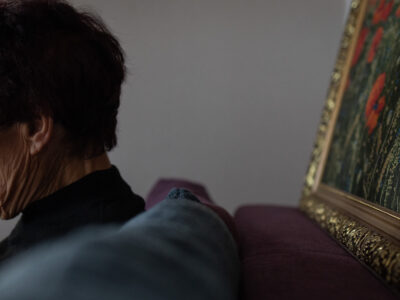
Since the start of the war, Russian soldiers have targeted vulnerable Ukrainian women for sexual abuse.
These are just a few of their stories.
Olena Zaitseva was in the early stages of pregnancy when she was unlawfully detained by Russian forces in February 2019.
“They took me into a prison-like facility, where they handcuffed me and attached me to a pipe,” she recalls. But soon after, they moved her to another room, “where the violence—and all the horrors imaginable—took place.”
Living close to what was then the front lines of eastern Ukraine, where the ongoing war with Russia first broke out in 2014, Olena and her 18-year old son Vladyslav had been accused by Russian forces of plotting to destroy railway infrastructure. Without legal defense or recourse, the mother, then 48, would spend the next four years as a civilian captive, while her son would be sentenced to 22 years in prison.
Olena was first held captive in Makiyivka, a former prison colony, and later in Izolyatsia, a former pre-trial detention center. Both had been converted into torture chambers by the Russian army, and were widely known for the atrocities committed by Russian servicemen against Ukrainian prisoners—atrocities that continue to this day.
When she first arrived at Makiyivka, Olena tells me she was imprisoned in a one-person cell, where around six men in balaclavas beat her and raped her with rubber batons for several days. (The soldiers put a bag on her head, so she could not count the total number of perpetrators.) The rapes triggered grave gynecological difficulties, causing Olena to bleed heavily. For nearly two years, these symptoms persisted. “I was alone in a cell with only a mattress, a bottle of water, and one bucket,” she says. “I’d sit on the bucket so that the blood could flow because I had no pads, no cloth, nothing.”
Olena with a photo of her son, Vladyslav. (Photo: Sara Cincurova)
Subjected to other forms of torture, Olena did not receive medical aid in her four years in Russian captivity, except for a single hospital visit in occupied Donetsk to consult with a gynecologist. “I cannot translate that feeling into words,” she recalls. “It was like in American movies: my hands in chains, my legs in irons, I was forced to bend forward and look down, and they dragged me like a dog. I was so ashamed.”
“People were walking in the street, and I had a bag on my head, like the worst of the criminals,” she says.
The doctors did not give her a diagnosis that day. It would have been impossible, Olena says, because the same Russian servicemen and prison guards who had abused her were watching and listening. But she already knew she had lost her pregnancy as a result of the violence she’d experienced during her imprisonment. (The father of her child would die on the front lines before they could be reunited.)
After four years in captivity, Olena was freed in a prisoner exchange in 2022. I meet her outside of Kyiv, where she now lives alone in a small room in a shared apartment. She has recently applied to receive disability status as a result of permanent injuries sustained during her imprisonment, while her son Vladyslav remains in Russian captivity, now for the eighth consecutive year. Olena continues to advocate for his release every day, and says she only relives the abuse she experienced and gives interviews to the press in order to help draw attention to his case. But she admits there is little hope.
“For my son to be exchanged, a miracle would have to happen,” she tells me. “Looking at what is happening, those who had been imprisoned before 2022 have been forgotten.”
Searching Houses for Vulnerable Victims
Olena’s story is just one of nearly 30 testimonies I have collected over the past two years of conflict-related sexual violence perpetrated against Ukrainian women, and is consistent with the testimonies of other women I have interviewed who were held at Makiyivka and Izolyatsia.
All of the women’s accounts were independently verified by Ukrainian NGOs collecting evidence of Russia’s war crimes, and together, paint a grim picture of systematic abuse—one that is not just a crime of opportunity, but suggests an intentional scouting effort by Russian soldiers to find potential victims who are especially vulnerable.
Although the Geneva Conventions, as well as international humanitarian law, stipulate that all civilians in conflict who are wounded or sick “shall be respected and protected in all circumstances,” UN reporting suggests that Russian forces have not respected these protections, routinely abusing even the most defenseless of Ukrainian civilians. Children, disabled persons, and the elderly are also protected civilians under international law; as are pregnant women like Olena, as well as mothers and other caregivers. But since the war broke out in 2014, rape and other war crimes have been routinely documented against each of these protected groups, as confirmed by both a 2023 and 2024 UN Independent International Commission of Inquiry on Ukraine. Explicitly defining rape as a form of torture under international law, the investigators found that soldiers routinely "identified women in a vulnerable situation" and "committed acts of rape and sexual violence when they broke into the victims’ houses," sometimes "at gunpoint with extreme brutality and with acts of torture, such as beatings and strangling."
(Photo: Diana Deliurman)
While sexual violence has become a defining weapon in the Russian war in Ukraine, it has also been on the rise in conflicts around the world. A 2025 UN report documented thousands more cases of conflict-related sexual violence in 2024 compared with the year before—a 25 percent increase, widely considered a conservative estimate. A 2026 report of the UN Secretary-General on conflict-related sexual violence estimated that for each rape reported in connection with a global conflict, 10 to 20 cases went undocumented.
Rape and other forms of sexual violence have long been a violation of international humanitarian law, yet committed with impunity in conflicts around the world, Jessica Neuwirth, founder of the Frontline Women's Fund, tells The Conversationalist. Her organization works to combat this by offering support to women's organizations working in conflict zones, helping survivors of sexual violence. “The Geneva Conventions prohibit ‘outrages upon personal dignity’ and specifically mention ‘rape and any form of indecent assault,’" she says. “The statute of the International Criminal Court explicitly includes rape as both a war crime and a crime against humanity.”
The problem, Neuwirth says, has not been the legal prohibition of rape, but the failure to hold perpetrators accountable under the law.
There have, however, been some efforts to bring perpetrators to account. In 2025, the UN Special Rapporteur on Torture, Alice Jill Edwards, joined by several other experts, sent a dossier of sexual torture allegations to the Russian Federation, involving the cases of 10 Ukrainian civilians. “These were all highly sexualized assaults which included rapes, threats of rape, and other depraved conduct,” the dossier read. “It is becoming clearer that the Russian Federation’s deliberate and systematic policy of torture in Ukraine involves sexualized torture and other sexualized cruelty, including against the civilian population.” (While Russia did not formally address a reply to the UN, the Kremlin has publicly stated its belief that many reports by Ukrainian women of sexual violence were groundless.)
The Strongest of All
“No one is as strong as Ukrainian women,” Liudmyla, a retired teacher who will celebrate her 79th birthday this summer, tells me. In the summer of 2022, she was beaten and raped by a young Russian serviceman in her house in a small village of the Kherson region, then under Russian occupation. The soldier left her with four broken ribs, among other injuries.
I interviewed Liudmyla for the first time in February 2025. Despite temperatures in the negatives that day, we set out to meet in the ruins of a bombarded elementary school in her village, which Liudmyla wanted to show me. In the end, we had no choice but to record the interview in a car because of the unbearable cold.
Despite the risks of coming forward with her story, Liudmyla has refused to be silenced, and has inspired other survivors in the country to speak out—including elderly or deeply religious women who at times blamed themselves for their assault. For her bravery, she is now seen as a local leader.
Liudmyla. (Photo: Diana Deliurman)
A year and a half after our first interview, I meet Liudmyla again. Her mobility has worsened; she struggles to walk up and down the stairs. But her resolve remains unchanged, speaking with the same determination she had the first time we met.
The day she was raped, Liudmyla recalls, she was convinced she would die. When the soldier started violating her, she said “farewell to my children, grandchildren, and great grandchildren in my mind.” But she survived. “I speak in order to denounce the war crimes committed by Russia against Ukrainian women,” she tells me.
Liudmyla says the Russian soldier who raped her stormed into her house around 10 p.m. She was terrified: At the time, she lived alone. He shouted and interrogated her, asking questions such as “who lives in your house?” and “why are the lights turned on?” Then, he beat her up and tore her clothes apart. He raped her, she says, then immediately fell asleep beside her. Liudmyla said those hours were among the most harrowing. “I lay right next to him, petrified,” she said, “while he was asleep and snoring.”
At 4 a.m., the soldier woke up and told Liudmyla he would come back in two days. “He told me that if I told anyone, he would kill me,” she says. Liudmyla was too scared to go to the hospital—then occupied by Russian troops—and immediately decided to flee her village rather than wait for the soldier’s return. She was only able to move back to her house, which had been almost completely destroyed, after her village was liberated in late 2022.
Recalling the days of occupation, Liudmyla says she saw wounded and desperate civilians being tortured by Russian soldiers. Some were hanged; others were forced to drink motor oil, she recalls. Other survivors as well as Ukrainian soldiers from the area I have interviewed recall seeing and hearing school children being raped.
Today, Liudmyla’s village is located near the so-called “kill zone,” about 30 kilometers from the frontlines, where Russian servicemen use first-person view (FPV) drones to kill civilians with precision. The practice is called “human safari”—an act of brutality consisting of dropping bombs on people, cars, and even children at play, as if it is a video game. Making matters more dire for the village, there is almost no access to food or medications. “If it wasn’t for humanitarian organizations, I would die of hunger today,” Liudmyla tells me. She hopes the situation will not get worse.
Liudmyla’s testimony is not an isolated incident. Rape and forced abductions of elderly Ukrainian civilians by the Russian army have been widely documented in recent years. The elderly also represent a large majority of people who remain living close to the frontlines, unable or unwilling to move out of the houses where they have spent their entire lives.
Pain That Cannot Be Expressed in Words
While international humanitarian law protects all civilians living in conflict without discrimination, certain groups are singled out for additional protections. The Convention on the Rights of Persons with Disabilities, for example, contains specific protections for people with disabilities, who are at greater risk of violence, including of a sexual nature.
While reports across various countries have shown that violence against people with disabilities tends to receive relatively little media coverage, the UN has been “gravely concerned” about the fate of disabled Ukrainians since the outset of the war. “People with disabilities trapped in the Russian control zones in Ukraine are reportedly being used as ‘human shields’ by the Russian Federation armed forces,” the UN Committee on the Rights of Persons with Disabilities (CRPD) warned in September 2022. Other human rights organizations such as ZMINA have also published reports documenting the experiences of women with disabilities living in Ukraine.
Lidia Tarash, the acting head of the Department of Documenting War Crimes at the Ukrainian NGO Media Initiative for Human Rights, tells me that according to their organization’s data, at least 27 civilians with disabilities are currently held in Russian captivity. “We also have testimonies regarding at least five seriously ill civilians unlawfully detained by Russia,” she says. “These include people with spinal conditions, epilepsy, diabetes, asthma, cancer, amputations, and paralysis.” Some of these civilians are also being held “incommunicado,” in complete isolation from the outside world—their whereabouts and conditions completely unknown.
“These cases demonstrate that even particularly vulnerable groups of civilians receive no protection from Russia’s system of persecution,” she explains. “They point to the systematic nature of the unlawful detention of Ukrainian civilians and Russia’s blatant disregard for international humanitarian law."
Documenting disabled people’s stories in conflict also presents particular challenges. Many disabled people live close to the frontlines, where media access is limited and particularly dangerous. Disabled people are also a largely underrepresented group across traditional media, and anecdotally, this has made it especially difficult for journalists to find a home for their stories. On his last day in the role, Giles Duley, the United Nations Global Advocate for Persons with Disabilities in Conflict and Peacebuilding Situations, said, “When I photograph somebody in a war zone… they always say to me: share this story with the leaders. But the opportunities to do so were never fully realized.”
(Photo: Diana Deliurman)
In the spring of 2025, I spoke with the mother of a disabled woman, living with her family only about 13 kilometers from the frontlines of the Kherson region. Their village, which was occupied in 2022, has been routinely hit and targeted by FPV drones.
Her daughter Olha, she explains, sustained a severe head injury as a toddler that blocked the flow of oxygen to her brain, leaving her non-verbal and bed-bound. Although now a young woman of 33, she still looks like a child, no older than 9 or 10.
In late February 2022, as Russians stormed into their region, Olha’s parents were taken to the local police station for questioning. Her mother says they were forced to kneel for hours as they were beaten and interrogated by Russian soldiers. But all the while, she feared most for her daughter, who had been left at home alone.
Hours later, Olha’s mother was released. When she returned home, she found Olha lying on the bed, naked and motionless, with sweets placed on her pillow.
“Olha cannot undress herself alone,” her mother tells me. Devastated, she immediately knew: It must have been the Russian soldiers.
With Olha unable to speak, it was impossible to fully determine what had happened. But Olha’s body spoke for her. In the months that followed, she lost around 10 kilograms, and nearly all her teeth fell out. She became terrified of men, her mother says.
While the family will never know the details of the abuse, organizations such as Human Rights Watch have documented similar war crimes perpetrated against people with disabilities in Ukraine. In 2024, the country’s United Nations Population Fund (UNFPA) stated that the prolonged and combined nature of insecurity, displacement, and economic deterioration had reduced “the coping capacities of women and girls and other at-risk groups in Ukraine ... further exposing them to risks of gender-based violence.” The organization also warned that older women and women with disabilities represent a significant majority of vulnerable civilians in frontline areas, and that both are more likely to be left alone, which often makes them especially vulnerable. As a result, the UNFPA concluded that different forms of gender-based violence have been significantly increasing.
A Fear of Sexual Violence
Children are legally protected in armed conflicts under international humanitarian law, with a series of rules granting them special protections. Ukraine’s General Prosecutor’s Office is currently investigating 23 cases of child victims of conflict-related sexual abuse, out of a total 396 reported cases of sexual violence by Russian troops. These numbers, however, are likely just the tip of the iceberg, and do not reflect the full reality of the sexual abuse that has been committed against children.
Alla Sobchuk, a 42-year old woman from Kherson, tells me she was unlawfully detained with her then 11-year old daughter, Viktoriia, when the city was occupied in 2022. She says they were driving through a checkpoint set up by the Russian military, who tried to force her to remove her window tint.
“I said no and they threatened to shoot me,” she says. “They handcuffed me, beat me, put zip ties on my wrists, and sprayed me with tear gas.” All of this, she adds, happened in front of her daughter.
Alla next to a sign that reads, "Ukraine will win." (Photo courtesy of Alla Sobchuk.)
The pair was then taken to a former police station, occupied by what seemed to be Russian police, she says. Viktoriia watched as Russian officers hit her mother and tore her dress apart.
“We are both very afraid of sexual violence,” Alla says, “and very afraid they would assault us.” (She adds that “luckily,” the Russian forces “only” used physical violence.)
Viktoriia was taken to a separate office, where the soldiers interrogated her. One of them threatened to send her to a boarding school and Alla to prison, before threatening Alla directly, as well. “He hit me in the face because I demanded my child be returned,” Alla says. They were both held at the police station in separate offices for nearly 24 hours. The next day, they were freed.
After they were released, Alla says, Viktoriia was very frightened—but relieved to see her mother again. “I supported her by telling her she was a hero, and even adults could not endure the [abuse] by occupation forces the way she did.”
Viktoriia next to a sign that reads "Kherson is Ukraine!!!" (Photo courtesy of Alla Sobchuk.)
This kind of exposure to violence—sexual and otherwise—is prevalent in captivity, especially in cases where children and teenagers are held for longer periods of time. But as more cases emerge involving Ukrainian children, particularly those detained in Russia, humanitarian organizations—and victims’ families—are warning of another deeply disturbing reality: evidence of severe physical and sexual violence inflicted on children themselves. Mariam Lambert, the co-founder of Emile Foundation, an organization that helps bring Ukrainian children abducted to Russia back to Ukraine, shared one recent case involving a family reunited after years of separation. “One of the children, a six-year-old girl, had previously been identified on a Russian adoption database,” Lambert says. “After her return home, evidence emerged indicating that she had been exposed to violent sexual abuse while in Russian-controlled custody.”
Lambert also confirms that similar incidents point to a broader pattern of abuse, disappearance, forced separation, and exploitation of vulnerable children caught inside a system operating without transparency or accountability. “The world still does not fully understand what some of these children have endured,” she concludes.
Hundreds of Methods of Torture
The sexual abuse committed as a weapon of war by the Russian forces remains just one method of brutal torture used against imprisoned civilians and other prisoners of war. Lyubov Smachylo, the Head of the Analytical Department at Media Initiative for Human Rights Ukraine, an NGO that has carried out comprehensive investigations and in-depth interviews with detained civilians, says she and her colleagues have been able to document patterns and connections between violations of civilians’ rights in different locations and at different times, which indicates that such violations “are not isolated incidents and may qualify as war crimes, as well as crimes against humanity.” Today, the organization is aware of at least 2,495 civilians held in unlawful captivity across 240 locations.
Based on in-depth interviews conducted as part of the organization’s research, in 87% cases of torture, Russian forces subjected victims to severe beatings, using their hands, feet, sticks, clubs, belts, hammers, or other improvised equipment. Of the 54 torture victims identified, 34 were also subjected to electric shocks. The evidence also suggests that Russian forces have used sexual and gender-based violence against both male and female detainees.
On May 22, 2026, the Ukrainian Parliament Commissioner for Human Rights, Dmytro Lubinets, reported that Russia has used 695 different forms of torture, including physical and psychological abuse, as well as sexual violence, in the war so far." Prisoners of war are strangled, beaten, subjected to electric shocks, set upon by dogs and sometimes forced to stand in one place for up to 18 hours; as soon as you start to squat, you are immediately physically beaten,” he said. He said that Russia has already tortured 406 Ukrainian captives to death.
This torture and abuse is perpetrated unlawfully and indiscriminately. The stories described above are a reminder that such horrors have not spared anyone—not even the elderly, not even the children. But reporting for months on sexual abuse across Ukraine, it has become clear to me that numerous survivors do not want their accounts to remain buried in shame. Nearly all of the women I spoke to longed to have their stories told and shared with the world—showing global readers that such unbearable, widespread abuse continues, and none of its perpetrators have been brought to justice for their crimes.
[post_title] => "All the Horrors Imaginable"
[post_excerpt] => Since the start of the war, Russian soldiers have targeted vulnerable Ukrainian women for sexual abuse. These are just a few of their stories.
[post_status] => publish
[comment_status] => closed
[ping_status] => closed
[post_password] =>
[post_name] => war-crimes-rape-sexual-assault-ukraine-civilians-russia
[to_ping] =>
[pinged] =>
[post_modified] => 2026-08-03 20:47:20
[post_modified_gmt] => 2026-08-03 20:47:20
[post_content_filtered] =>
[post_parent] => 0
[guid] => https://conversationalist.org/?p=10622
[menu_order] => 0
[post_type] => post
[post_mime_type] =>
[comment_count] => 0
[filter] => raw
)
WP_Post Object
(
[ID] => 2892
[post_author] => 2
[post_date] => 2021-07-07 21:08:49
[post_date_gmt] => 2021-07-07 21:08:49
[post_content] => The former comedian is out of jail, but his own sworn deposition confirms that he is a rapist.When I was 21 years old, I was drugged and raped by a man I met in college. I didn’t tell this story to anybody, including myself, until December 2014, when a series of women–some famous, some not–came forward to describe in unsparing detail what it was like to be sexually violated by “America’s Dad,” Bill Cosby. After reading Beverly Johnson’s story in Vanity Fair, in which she recounted how Cosby lured her into his home under false pretenses and gave her a coffee—“My head became woozy, my speech became slurred, and the room began to spin nonstop”—I could no longer deny that a similar thing had once happened to me. I read each new account, seeing myself over and over again in these women’s horror stories, and decided, finally, to tell my own.It was with disappointment—though, honestly, not much surprise—that I saw Cosby trending on Twitter on June 30; the Supreme Court of Pennsylvania had overturned his 2018 conviction on three felony counts for drugging and raping Andrea Constand, a former employee of Temple University. By then, Cosby, who is Temple’s most famous alumnus, had already served almost three years of his three-to-10 year sentence in a maximum security prison. When he walked out of there he flashed the “V” for victory sign at his supporters, as though his release from jail represented some kind of exoneration. Victims and their advocates were understandably devastated, expressing concern that the decision would discourage women from reporting sexual assault in the future. “The semblance of justice these women had in knowing Cosby was convicted has been completely erased with his release today,” wrote Time’s Up chief executive Tina Tchen in a statement. “Bill Cosby is free on a technicality, but the women he assaulted, who bravely came forward to bring him to justice, are suffering anew,” said the National Organization for Women in a press release. “I fear that this is going to really hinder other survivors from coming forward,” Angela Rose, founder and president of Promoting Awareness Victim Empowerment told NPR.Attorney Gloria Allred, who has represented almost half of the Cosby victims, was asked in an interview if she thought that the decision was a blow to the #MeToo movement; she paused before delivering her assessment: “It’s not a win.” I do not believe the decision to set Cosby free is a blow to the #MeToo movement, or that it will discourage women from speaking out in the future. Nor do I think that justice has been completely erased. Cosby can make a “V” sign with his hands as often as he likes, but he has not scored a victory; he was not exonerated, but rather freed on a technicality. His premature release from prison is just another example of the Patriarchy Industrial Complex on full display, with rich men paying their expensive lawyers to identify procedural loopholes so they can wiggle their way out of consequences for their behavior.In a 79-page opinion that led to Cosby’s release from prison, the Pennsylvania Supreme Court wrote that Cosby should not have been tried in criminal court, owing to a non-prosecution deal that his lawyers cut years earlier with former Montgomery County District Attorney Bruce Castor. If that name rings a bell, it’s because Castor went on to become Donald Trump’s lawyer in his second impeachment trial. (Remember the guy in a boxy pinstripe suit that was two sizes too big, delivering non sequiturs about how “Nebraska is quite a judicial thinking place”? Yeah, that’s him.) Cosby’s agreement with Castor was similar to the sweetheart deal that pedophile Jeffrey Epstein obtained in 2008 from another Trumpworld lackey: Alex Acosta, the former U.S. Attorney for the Southern District of Florida. Acosta rose to become Trump’s Secretary of Labor—a position from which he was forced to resign in 2019 after Epstein’s second arrest. As the former President likes to say: only the best people. In 2015, upon learning that Risa Ferman, then District Attorney of Montgomery County, was reopening the criminal case against Cosby after several more of his victims came forward, Bruce Castor informed her by email of the 2005 non-prosecution agreement. This was the first she had heard of it. In response to Ferman’s request that Castor send her a copy of the binding legal agreement, he instead sent her a press release–a press release!–claiming it was actually a “written declaration” that had been approved by Constand’s lawyers. One need not be trained in the law to know that a press release does not constitute a legally enforceable document. I am thus extremely curious as to why the justices on the Pennsylvania Supreme Court ruled, in a split decision, that Castor’s oral promise to Cosby’s attorneys was binding. In a statement released June 30, Constand’s lawyers asserted that they “were not signatories to any agreement of any kind” and that Castor’s press release “had no meaning or significance to us in 2005 other than being a press release circulated by the then-District Attorney.” Was there a non-prosecution agreement or was there not a non-prosecution agreement? Once again, we find ourselves in familiar territory—her word against his. The bigger, more consequential question is why Castor gave Cosby any type of assurance, whether verbal or written, that he wouldn’t face future criminal prosecution. His stated reasons speak volumes about the discrimination against sexual assault survivors that is embedded in our judicial system. Without even interviewing Andrea Constand, Castor determined in 2005 that there was not enough evidence to successfully prosecute a criminal case against Cosby. His reasons: The victim waited a year to come forward with her allegations; and she stayed in contact with her attacker after the assault. Anyone who has been sexually assaulted can explain how and why fear and shame prevent them from going to the police, as can the many psychologistswhowereinterviewed by major media outlets in recent years about this common behavior pattern. Victims stay in touch with their rapists—I know I did—because their brains are paralyzed, trapped in survival mode, trying to deny the enormity of what has taken place, particularly when the crime is committed by someone they know and trust. Such cognitive dissonance, as Cosby’s victims can attest, can take a very long time to overcome. In my own case, it took 16 years.Constand prevailed in her civil lawsuit against Cosby, winning a $3.4 million settlement in 2006. Cosby testified in a sworn deposition that he had obtained prescription Quaaludes, which render a person physically immobile, with the intent of giving them to women with whom he wanted to have sex. Nine years later, after new accusers came forward, the Associated Press successfully petitioned the court to unseal the records of the civil trial. This is what led to Cosby’s re-arrest and trial for aggravated sexual assault against Constand: He incriminated himself with his own words, spoken in a sworn deposition more than a decade earlier. The timeline that led to Cosby’s re-arrest and trial was miraculous: In July 2015 a judge agreed to unseal the documents; on November 3, voters elected a new district attorney, Kevin R. Steele, who then helped bring charges against Cosby; and on December 30 the former actor was arrested, just days before the 12-year statute of limitations on Constand’s criminal complaint was set to expire. Cosby’s attorneys argued unsuccessfully that the deposition he had given in Constand’s civil suit should be inadmissible, because their client had made his incriminating statements only because he believed he had immunity from criminal prosecution. By then more than 50 women had come forward, all with disturbingly similar stories about Cosby drugging and raping them. In July 2015, New York Magazine published a striking black-and-white cover photo showing 35 of those women, seated and looking directly into the camera, under the headline: “I’m No Longer Afraid.” Five of those women testified at the 2018 trial that resulted in Cosby’s conviction.
The outcome of that trial was shocking. Given his wealth, power, and all the systemic barriers rape victims face in our society, there was every reason to expect that Cosby would once again avoid prison. But the #MeToo movement laid the groundwork for victims to come forward, finding strength and solidarity with one another as they told the truth about Bill Cosby, Harvey Weinstein, and so manyothermen.All things considered, when I think about Andrea Constand’s 14-year journey to see her rapist behind bars, I am reminded of the aphorism, “Don’t cry because it’s over. Smile because it happened.” This is not to say we shouldn’t be furious about the incompetence and malice of Bruce Castor, or about the Pennsylvania Supreme Court’s decision to believe his story about the non-prosecution agreement that might or might not actually exist. But we should stop and marvel that Cosby was convicted at all. His was the first big trial of a famous man in the wake of the #MeToo movement, and it resulted in an undeniable moment of reckoning. These women were telling the truth. There would be more to come. We shouldn’t be surprised that Cosby obtained early release from prison. He’s an old, rich, entitled narcissist with nothing to lose by appealing the verdict. Constand, by contrast, had nothing to gain by revisiting her trauma. She had won her multi-million-dollar settlement in 2006, and was finally getting her life back, working as a massage therapist in Toronto. Still, she agreed to testify against Cosby at his 2017 trial, which resulted in a mistrial, and then again in 2018. She did this because she felt it was the right thing to do. The statute of limitations for all the other victims had run out. She was their only hope. An accomplished college athlete who later oversaw operations for Temple University’s women’s basketball team, Constand knows how to play the long game. Her fight inspired sexual assault victims all over the world, including me, and led to the elimination of statutes of limitations in rape cases in several states. This is her legacy. At 83 years old, Bill Cosby is technically a free man, in that he no longer lives behind bars. But he’s also a pariah in the entertainment industry, his reputation destroyed thanks to the #MeToo movement and its allies. Remember that it was Hannibal Burress, a Black male comedian, who ignited the media firestorm against Cosby by courageously calling him out as a rapist at Philadelphia’s Trocadero comedy club back in October 2014. Seven years later, as he faces another civil lawsuit for sexual battery in Los Angeles, Bill Cosby’s legacy will never amount to anything more than a sick joke.
[post_title] => Bill Cosby's release from prison has nothing to do with #metoo
[post_excerpt] => The former comedian is out of jail, but his own sworn deposition confirms that he is a rapist.
[post_status] => publish
[comment_status] => closed
[ping_status] => open
[post_password] =>
[post_name] => bill-cosbys-release-from-prison-has-nothing-to-do-with-metoo
[to_ping] =>
[pinged] =>
[post_modified] => 2026-08-06 20:39:50
[post_modified_gmt] => 2026-08-06 20:39:50
[post_content_filtered] =>
[post_parent] => 0
[guid] => https://conversationalist.org/?p=2892
[menu_order] => 190
[post_type] => post
[post_mime_type] =>
[comment_count] => 0
[filter] => raw
)