
WP_Post Object
(
    [ID] => 2696
    [post_author] => 2
    [post_date] => 2021-06-04 03:39:59
    [post_date_gmt] => 2021-06-04 03:39:59
    [post_content] => Changing attitudes and mentorship programs are nurturing an emerging generation of young women. 

Numana Bhat, 34, is a postdoctoral researcher at the La Jolla Institute for Immunology in San Diego, where she focuses on understanding the biology that underlies the immune response to vaccines. Her husband, Raiees Andrabi, is Institute Investigator at the Department of Immunology and Microbiology at Scripps Research, a prestigious non-profit medical research center. Both are from Kashmir, the India-administered Muslim majority territory that has been convulsed by political violence for decades.

India and Pakistan have fought three wars over Kashmir, which is claimed by both countries. Meanwhile, the Indian military has put down popular insurgencies, which began in the late 1980s, with tactics that Amnesty International and Human Rights Watch have described as human rights abuses. Since 1989, more than 70,000 Kashmiris have been killed during these government crackdowns, while more than 8,000 have disappeared. Thousands of people have been detained without charge under the draconian Public Safety Act.

On August 5, 2019, Prime Minister Narendra Modi’s BJP government unilaterally revoked the constitutionally guaranteed autonomous status of the region, further dividing it into two federally governed union territories. The military imposed an unprecedented lockdown, blocking internet access and phone lines and intimidating journalists. As a result, seven million people were cut off from the outside world for several months.

Given the obstacles created by the political turmoil and violence in Kashmir, Dr. Bhat’s academic success is remarkable. And she is not alone; a notable number of Kashmiri women have become prominent scientists, despite periodic and unpredictable outbreaks of militarized violence, a lack of resources, and the pressure of traditional expectations.

After completing her B.A. and Master’s degrees in Kashmir, Dr. Bhat earned a PhD in biomedical sciences from Sanford Burnham Prebys Medical Discovery Institute, a non-profit medical research center in La Jolla, California. There she discovered that “a fascinating molecule called Regnase-1 acts as molecular brakes in antibody producing cells and prevents autoimmunity.”

[caption id="attachment_2698" align="alignnone" width="300"] Numana Bhat in her laboratory.[/caption]
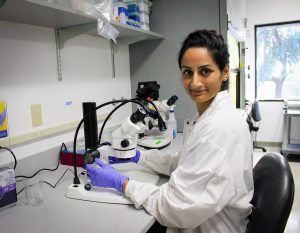
She credits her mother and a dedicated high school biology teacher for endowing her with the tools and curiosity to pursue a career in biomedical science. But other gifted young women are not as fortunate: opportunities and resources for higher education in scientific research are scarce in Kashmir, “although the people themselves, both students and mentors at the university level, are capable of doing great things,” she said.

She added that she had heard about “people in mentoring positions” who made “discouraging remarks” to female students— including explicit pressure to channel their energy into getting married and having children rather than into post-graduate studies.

Nevertheless, Dr. Bhat said, she has noticed an increasing number of young Kashmiri women pursuing graduate studies and careers in scientific research both in India and abroad. She added that younger people were going outside the sciences to choose careers in humanities, journalism and the arts, “which is also quite refreshing to see.”

More challenges for women

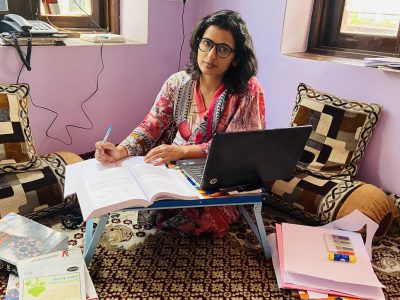
Masrat Maswal, 33, is an assistant professor in chemistry at a government college in central Kashmir’s Budgam district. She grew up middle class in an extended family where attention and money were scarce. Her parents paid more attention to her in high school, where she excelled academically and won praise from her teachers. But she said that Kashmiri society does not make it easy for young women who want to pursue post graduate work and demanding research positions in the sciences. “From the day you are born as a girl in a family in Kashmir, they start to prepare for your marriage; so choosing a career—particularly in science, which needs patience, persistence, hard work, sacrifices and an ample amount of time—is really hard,” she said. [caption id="attachment_2704" align="alignnone" width="300"] Masrat Maswal at home in Kashmir.[/caption] Her female students are often deterred from pursuing graduate work in the sciences by social pressures to marry and settle down when they are in their twenties. “We are losing a lot of talent,” she said, “Due to the prevailing socio-cultural norms of our society.” The lack of proper infrastructure and lab facilities in Kashmir’s colleges also undermines the enthusiasm of both students and teachers, she added.

Family support matters

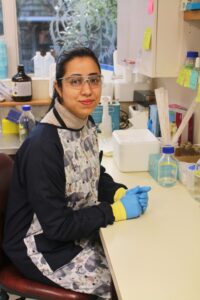
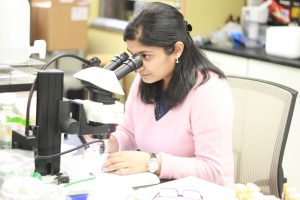
Amreen Naqash, 31, moved to New Zealand in 2019 to study for a doctorate in pharmacology and toxicology at the University of Otago. In her spare times she mentors students in her native Kashmir who want to pursue graduate studies either in India or abroad. Women, she observed, are showing more interest in looking for fellowships and pursuing graduate work in the sciences at universities outside India. [caption id="attachment_2702" align="alignnone" width="200"] Amreen Naqash in her lab.[/caption] “I’m in touch with some promising female undergrads from Kashmir, which makes me so glad,” she said. “It is such a wonderful feeling to guide them as they are in their prime career stage.” Omera Matoo, 38, has a PhD in marine biology. She is an assistant professor in evolutionary genetics and physiology at the University of Nebraska in Lincoln, where her research is funded by the National Science Foundation (NSF). Born and raised in Kashmir, Dr. Matoo earned her B.A. and Master’s degrees at Bangalore University, where she became friends with two classmates from different parts of India, both of whom came from families of scientists. [caption id="attachment_2703" align="alignnone" width="300"] Omera Matoo in her lab.[/caption] “Looking back, I realize that played a very big role in my career,” she said. All three of them decided to pursue doctorates in the sciences.
Limited opportunities

When Dr. Matoo applied in 2007 for a doctoral program at a university in the United States, she had to travel to New Delhi and Bangalore to take her GRE and TOEFL exams; at the time, there wasn’t a single coaching or test center in Kashmir. The situation for prospective graduate students has since improved. Thanks to the internet, they can take standardized tests online. Mentoring initiatives like JKScientists have been established, with volunteers offering would-be graduate students help and advice. “And then there are other Kashmiri scientists across the world who struggled along similar paths before making a mark in their chosen fields; and now they are giving back to their society by mentoring and guiding young students and aspiring researchers.” Role models and social support structures, said Dr. Matoo, provide positive feedback for young people; this is especially true for female university students in Kashmir, who benefit from having their academic interests nurtured. Dr Seemin Rubab, a professor of physics at the National Institute of Technology in Srinagar, is regularly approached by young girls from Kashmir for career guidance and counseling. “Many times I’ve had to counsel their fathers and brothers to let them pursue their academic careers and avail themselves of opportunities outside Kashmir and India,” said Dr. Rubab. Professor Nilofer Khan, acting Vice Chancellor at the University of Kashmir who has also served as Dean of Student Welfare and founder coordinator of Women’s Studies Centre, confirmed that for years a lack of family support has been a serious obstacle for women who wished to pursue doctoral studies, particularly when they were married with children. “Very few females used to go for research studies in science subjects,” she said, adding that times were changing and female students were “proving their mettle” in the sciences. The frequent government-imposed internet shutdowns are a serious problem for students facing application deadlines, said Dr. Matoo. Delayed exams and the lack of access to resources—“all these limiting things have a scale up effect, not to mention the consequences for mental health,” she said. But somehow these obstacles have not undermined the enthusiasm and academic focus of the young women from Kashmir who regularly reach out to her for guidance on making a career in science. “I am constantly impressed and humbled by their resolve to make a bright future for themselves against all odds,” said Omera. “That gives me a lot of hope and in a way keeps me grounded.” [post_title] => Kashmiri women defy patriarchy & politics to pursue careers in the sciences [post_excerpt] => A notable number of Kashmiri women have become prominent scientists, despite periodic and unpredictable outbreaks of militarized violence, a lack of resources, and the pressure of traditional expectations. [post_status] => publish [comment_status] => closed [ping_status] => open [post_password] => [post_name] => kashmiri-women-defy-patriarchy-politics-to-pursue-careers-in-the-sciences [to_ping] => [pinged] => [post_modified] => 2026-08-06 21:00:05 [post_modified_gmt] => 2026-08-06 21:00:05 [post_content_filtered] => [post_parent] => 0 [guid] => https://conversationalist.org/?p=2696 [menu_order] => 199 [post_type] => post [post_mime_type] => [comment_count] => 0 [filter] => raw )
Kashmiri women defy patriarchy & politics to pursue careers in the sciences

WP_Post Object
(
    [ID] => 56
    [post_author] => 3
    [post_date] => 2020-09-03 16:41:12
    [post_date_gmt] => 2020-09-03 16:41:12
    [post_content] => Published on December 15, 2016, this analysis of the Trump presidency is remarkably prescient.

As a writer and journalist, I’ve been lucky enough to have a long, varied and exciting (and sometimes too exciting) career. A few years ago, I worked with a genuine, bona fide narcissist. The kind of man who once bragged about his diagnosis while dismissing the “asshole shrink” who made it.

Without going into too much detail, here are a few things you can expect from a narcissist in a position of power:

He won’t take responsibility for mistakes.

At most, he will force himself to pretend to take responsibility, while scheming to shirk it in the end anyway. He will, however, hog credit for successes, whether they are his or not. This is why you absolutely have to stop being shocked when Trump says a nasty lie about the CIA and then doesn’t care about the consequences. He will never care. Consequences are for losers.

Everything is always someone else’s fault, and he’ll mess with your head to keep it that way. Here’s a classic exchange between me and my old colleague:

Him: … And let’s focus on that topic tomorrow. Me: OK. ***day goes by*** Me: …So I was writing about this topic and I think… Him: [Screaming, interrupting] WHY AREN’T YOU FOCUSED ON THIS OTHER TOPIC INSTEAD? THIS IS A NIGHTMARE. YOU’RE A NIGHTMARE. WHAT’S WRONG WITH YOU? WHAT KIND OF A JOURNALIST ARE YOU? Me: But you said… Him: [More screaming, more interrupting] I NEVER SAID THAT.

Basically, you couldn’t have a normal conversation with my colleague, because every conversation was a battle he had to win. If he found himself in a corner, he just lied.

You can’t appeal to a narcissist’s morals and ethics.

For them, morals are a weakness and you’ll lose their respect for trying. You’ll never persuade them with ethical arguments, but don’t let that corrupt your own moral compass in the process. When I was being verbally abused by my narcissist colleague, I worked hard to keep the moral high ground. When he insisted that the world was upside-down, it was necessary to keep right and wrong clear in my own head. Why should someone sick like that set the standard for my behavior, let alone explain my reality?

Don’t waste your time expecting a narcissist to change.

Before Trump won, there was all this talk about how he’ll become more “presidential” should he win, because he will realize the gravity of his responsibility. Hahaha — what a joke!

Now people are telling you that it’s OK, Trump will be “presidential” when he’s sworn in. Those people are wrong. You know, sometimes it’s necessary to admit that things are exactly as bad as they seem. I did it. You can too. This doesn’t mean you get to sink into a deep, apathetic depression about the state of things, it just means facing what is happening to our country and society head on. The emperor is naked, but you won’t go blind looking at him.

Disengagement is always the best policy, but when you can’t disengage, remember to not let the narcissist play you off other people.

Narcissists can’t form healthy bonds with others, and therefore do their best to destroy others’ healthy bonds through divide and conquer tactics.

My narcissist colleague would badmouth others around me, trying to make me feel like his special confidante. I realized he was badmouthing me to others simultaneously. I wasn’t important to him, I was just being isolated and used. Look at how Trump humiliated Mitt Romney. Trump didn’t do it because he’s some brilliant tactician, he did it because he pathologically dominates others.

Speaking of “brilliant tacticians” — don’t buy in to the image of grandiosity these people like to project.

Narcissists fake it ‘till they make it. They bluster, and people give in to the bluster. This doesn’t mean that they are smarter than you, it just means that they’re better at the game of “chicken.”

I noticed that my colleague liked to surround himself with people who were conscientious and, in many ways, vulnerable to him precisely because they were conscientious. He enjoyed making people feel guilty and insecure. This kind of abuse is so rampant because it’s everyone’s best kept secret — those of us who have been abused elsewhere are perfect targets for further abuse.

A narcissistic leader won’t inspire genuine loyalty in his inner circle, which is why he forces compliance. 

People have mercenary approaches to narcissists in power: “Oh, I just need the money,” or “Oh, let’s see what he can do for me,” that kind of stuff. Sadly, those who stick around too long get “Stockholm syndrome-ed” to the point of no return. Just look at Trump’s marriage. Melania acts like his well-coached prisoner, not his wife.

Meanwhile, does someone like Kellyanne Conway look like a true believer to you? Please. This lack of loyalty is precisely why narcissists are always working with incomplete information. It is their primary weakness and must be exploited.

These people have big plans they often can’t deliver on.

They’re too bored, enraged or hysterical, which are not particularly efficient emotions. Or it’s because hard work is rarely glamorous and seemingly unrewarding at first. Or maybe it’s because they spend all their time hiring and firing their latest favorites.

You’re going to argue, “But Trump made billions.” Says Trump. We can’t check that fact because he’s shady and avoids all accountability. He won’t even make his tax returns public.

We do know he had his father’s support, and a narcissist’s knack for abusing others’ vulnerability. It’s why he’s such an effective sexist and racist, though maybe not such a brilliant businessman. In short, Trump succeeded because money makes more money, not due to his great ideas. Don’t let the lifestyle and the babes surrounding him fool you.

I remember how my colleague would say literally anything just to maintain the appearance of power and control. People who didn’t know him took him at his word. But observing him closely, I became disillusioned. Seeing his lies for what they were helped protect my sense of self from his verbal assaults.

Narcissistic leaders need adulation and refuse to listen to things they don’t want to hear (i.e., the truth).

Besides vulnerable folks, my old colleague had to surround himself with incompetent people who made him the center of their universe (sometimes the vulnerability and the incompetence overlapped). He mistook empty praise for loyalty.

This is why members of the press should be wary about falling into Trump’s trap. He will seek to punish anyone who in any way deviates from him, because the truth is a betrayal of his worldview. And his worldview is the only one that matters.

If you’re a journalist who depends on access — you’re going to have an especially hard time. Use your access for good. Stockpile what you know. Stay organized.

Narcissists in power do everything they can to drain you of your energy.

They are relentless. They argue, cajole, whip up hysteria, insult, demand that you please them, etc. It’s important to keep quiet about what you value, because they will go nuclear just to take it from you and force you into submission.

The bottom line with a narcissist is that they demand that all attention be focused on them, at all times. If you can’t disengage, don’t try and reason with them. You must learn to conserve your energy, pick your battles, and just. remember. to. breathe.

. . .

In summation, I’d like to be completely honest : You are not going to win with powerful narcissists when you play their games. The minute you’ve started playing, you’ve already lost.

But being realistic about the person you’re dealing with will save your mental health. Don’t let them into your head to prey on your insecurities.

These people do real psychological damage. This is why The Conversationalist places so much emphasis on the roots of and consequences of authoritarianism.

[post_title] => I used to work with a narcissist. Here is my advice on dealing with Donald Trump [post_excerpt] => You’ll never persuade them with ethical arguments, but don’t let that corrupt your own moral compass in the process. [post_status] => publish [comment_status] => open [ping_status] => open [post_password] => [post_name] => i-used-to-work-with-a-narcissist-here-is-my-advice-on-dealing-with-donald-trump [to_ping] => [pinged] => [post_modified] => 2024-08-28 21:08:26 [post_modified_gmt] => 2024-08-28 21:08:26 [post_content_filtered] => [post_parent] => 0 [guid] => https://conversationalist.org/?p=56 [menu_order] => 249 [post_type] => post [post_mime_type] => [comment_count] => 0 [filter] => raw )

I used to work with a narcissist. Here is my advice on dealing with Donald Trump

WP_Post Object
(
    [ID] => 1767
    [post_author] => 2
    [post_date] => 2020-05-14 22:00:58
    [post_date_gmt] => 2020-05-14 22:00:58
    [post_content] => A scientist-turned-businessman believes he can make a profit by harvesting carbon dioxide from the atmosphere and turning it into synthetic limestone.

In 2006 Brent Constanz, a marine biologist who had studied corals for over 20 years, founded a company called Calera to produce cement with carbon dioxide. Constanz believed he could make a profit from harvesting toxic emissions to make the world’s most in-demand product with a method that was not only environmentally sound – but which actually helped reduce carbon emissions. He later thought using carbon dioxide to create concrete was the way to go and in 2012 launched Blue Planet, with the aspiration to pull 25 billion tons of carbon dioxide annually out of the air’s foul breath and turn it into synthetic limestone. Blue Planet manufactures synthetic limestone out of carbon dioxide – the toxic gas that is an industrial byproduct.  Synthetic limestone, when broken down into small pebbles and added to water and cement, becomes concrete, the second largest commodity in the world after water.

Today, carbon in the atmosphere has hit 415 parts per million—the highest level in the 800,000 years for which we have reliable data. In the pre-industrial era, it was below 300 parts per million. The excess carbon in the atmosphere traps heat on Earth, turning up the global thermostat.

Sanjeev Khagram, dean of the Thunderbird School of Global Management at Arizona State University, said that Blue Planet’s method of turning carbon into synthetic limestone was an effective means of reducing carbon dioxide emissions in the atmosphere. While presenting a paper on the subject at the Davos World Economic Forum this year, Khagram said that “carbon farming” was an opportunity for entrepreneurs to “turn a profit of $1 to $10 trillion” per year.

“Blue Planet’s is indeed a market-based approach to tackling climate change,” said Rick Parnell, CEO of the Foundation for Climate Restoration,  an organization that aspires to restore atmospheric CO2 levels to pre-industrial levels by 2050. Parnell also advocates private sector initiatives like that of Constantz’s. “You can't wait for the governments to act, we need to act now,” he said. His partner, MIT graduate Peter Fiekowsky, said that until now Bill Gates was the only person funding carbon removal. He added that recent government initiatives were “at one tenth the scale we need.”

Carbon farming on a large scale would indeed solve a major environmental issue while creating a whole new industry, said Casper Ohm, a data scientist in the field of environmental sustainability. Ohm is editor-in-chief of Water Pollution, an online resource about water and the environment. “The investment to pull 25 billion tons of C02 per year would require a huge amount of capital,” he said.  “It all depends on money.”

For other experts, carbon trading is controversial for ethical and environmental reasons.

“It is kind of like enabling other companies to release more carbon carbon dioxide [so that] another company can take it out of the atmosphere, [which allows] the first company to keep creating more carbon dioxide,” said Lisa Schaefer, a systems engineer who founded Thinq.tv, a video streaming platform developed at Arizona State University that hosts live grassroots conversations about current events.

The first company, explained Schaefer, could be investing in making its infrastructure and processes greener, but instead will now pay a contractor to clean up what they are putting out into the atmosphere.  Schaefer also believes the amount of carbon Blue Planet promises to pull out of the atmosphere might have the counter-productive effect of encouraging the production of more concrete.

“Only 10 billion tons of concrete are produced every year, not including the recycling of old concrete and other cheaper materials for making concrete,” she said. There appears to be no demand for 25 billion tons. She added: “We certainly don't want to encourage companies to manufacture more concrete even if it is a ‘green one.’”

Constantz was, until January 2020, in discussions with a wide range of industrial emitters, including cement and steel plants about initiatives to establish manufacturing plants around the world. The Covid-19 pandemic has brought those discussion to a temporary halt, but Constanz expects them to resume once the crisis has passed.

But even in these times of insecurity, global stasis, and introspection, Fiekowsky, who invested in Blue Planet years ago (Leonardo DiCaprio and  Don Kennedy, the former president of Stanford University, are also investors), says there are parallels to be drawn between how different countries are addressing climate change and Covid-19.

“Singapore and South Korea decided they wanted to control the virus. The US and the UK said, well, let's just minimize the impact of the virus,” Fiekowsky said. As of this writing, the US has reported 1,259,108 cases and 75,781 deaths and the UK 207,977 cases and 30,689 deaths, while South Korea reports 10,822 cases and 256 deaths and Singapore 21,707 cases and 20 deaths. “Obviously, it's horrible. To just minimize what you really want to get rid of,” said Fiekowsky.

Governments were giving short shrift to the urgent need for policy to deal with climate change before the pandemic, which has since drowned out the conversation about the issue.  Constanz pointed out that while the United States government has allocated $2 trillion to address the Covid-19 emergency, far more will die from climate change.

Ismail Serageldin, the former  Vice-President for Environmentally and Socially Sustainable Development at the World Bank, famously said in 1995 that "if the wars of [the twentieth century] century were fought over oil, the wars of the [twenty-first] century will be fought over water — unless we change our approach to managing this precious and vital resource."

Climate change will continue to ravage the Earth even after a vaccination for the Covid-19 virus becomes available. It is thus a crisis that we cannot afford to sideline, even during a global health crisis. To that point, climate expert Professor Robert Devoy of Ireland’s Coastal Marine Research Center issued a stark warning in a 2015 interview. “The last time the planet warmed this much,” he said, “88 percent of life disappeared.”

 
    [post_title] => Can private industry save the environment with for-profit green initiatives?
    [post_excerpt] => Harvest carbon and turning it into synthetic limestone could be an effective means of reducing carbon dioxide emissions in the atmosphere.
    [post_status] => publish
    [comment_status] => closed
    [ping_status] => open
    [post_password] => 
    [post_name] => can-private-industry-save-the-environment-with-for-profit-green-initiatives
    [to_ping] => 
    [pinged] => 
    [post_modified] => 2024-08-28 21:08:26
    [post_modified_gmt] => 2024-08-28 21:08:26
    [post_content_filtered] => 
    [post_parent] => 0
    [guid] => http://conversationalist.org/?p=1767
    [menu_order] => 267
    [post_type] => post
    [post_mime_type] => 
    [comment_count] => 0
    [filter] => raw
)

Can private industry save the environment with for-profit green initiatives?