WP_Post Object
(
    [ID] => 9937
    [post_author] => 15
    [post_date] => 2026-01-07 07:35:47
    [post_date_gmt] => 2026-01-07 07:35:47
    [post_content] => 

Why Ireland's Basic Income for the Arts program is just the first step in better supporting the country's artists.

In 2022, visual artist Elinor O’Donovan was working as a receptionist in Cork, Ireland, when she began to receive the Basic Income for the Arts (BIA) stipend. The Irish government had launched the program that year as a way to address the country’s unstable arts sector, which had left many artists without job security and consistent financial earnings—O’Donovan included. At the time she applied, she'd just graduated from university and was living with her parents as she tried to figure out the next steps for her career. When she found out she’d been selected from a pool of over 9,000 other applicants for the BIA, it was life-changing. As one of 2,000 artists receiving a weekly income of €325 over a three-year period, O’Donovan was able to quit her job and move to Dublin to make art full-time. 

“The BIA has allowed me to be a bit more brave with the stuff that I make,” she tells The Conversationalist. “It allowed me to make whatever I want, and not feel as if I have to justify why it's important to a funding body.” 

According to a cost-benefit analysis published by the Department of Culture, Communications and Sport last September, the BIA has been a resounding success for beneficiaries, and Irish society at large. The report revealed that recipients were able to dedicate an additional four hours per week to art-making, and that the program “strengthened artists’ professional autonomy, capacity for creative work, and attachment to the arts sector.” Moreover, for every €1 of public money invested in the pilot, the country received €1.39 in return—a value that accounts for an increase in earnings generated from art-making as well as an increase in public engagement with the arts. In short: Giving money to artists, with no strings attached, was demonstrably profitable.  

For O’Donovan, income from the BIA not only gave her more time to make art, but provided her with newfound financial stability, something that affected every part of her life. She had more time to cook for herself, joined a gym, and for the first time, was able to afford to go to therapy. She was also finally able to plan for the future. 

“I was 26 when I started receiving [the BIA], and I was able to start a pension fund,” she says. “Just having that fallback [was a relief], knowing that I would receive an income no matter what happened; if I got sick, I would still be able to pay my bills, pay my rent. It has really been transformative for my well-being.”

Importantly, the BIA has also allowed her to create opportunities for other artists: O’Donovan’s ability to explore filmmaking, something she was afforded because of the stipend, meant she could create new jobs in the field. “Having financial stability from the basic income means that I've been able to hire other people to work with me,” O’Donovan says. “So there's even been a kind of trickle down of the basic income to other artists and other creatives in Ireland.” 

For artists around the world, the program has also offered one hopeful potential solution for a global arts sector severely hit with funding cuts and political uncertainties over the last few years. But while things have taken a recent downturn, the financial instability of the arts has been a major problem for decades, if not centuries, something that likely explains the growing admiration for the BIA around the world.

In a capitalist society, creative work is not valued as a productive or profitable field, which often means that artists are being underpaid for their work, if they’re paid at all. Creativity and art-making require passion and time, two resources that are generally scarce in an economic system more concerned with profit than beauty. Often, this forces workers to abandon or sideline their creative work in favor of taking a non-creative job that will provide financial stability. But a program like the BIA provides an alternative model, giving artists the financial foundation to create without the stress of figuring out how they will pay their rent or bills. 

Joining other basic income pilot programs around the world, the BIA demonstrates that providing workers with financial stability first allows them to thrive, increasing a country’s worker satisfaction, contributing to better mental health, and resulting in higher housing stability, by supporting people pursuing their preferred fields of work

Even the program’s most ardent supporters, however, argue that the BIA is only the start of a more stable arts field. In Ireland, the arts generate €1.5 billion in income each year, but according to Praxis, the artists’ union of Ireland, artists still face “extremely challenging economic conditions.” In an open letter published in September, the group cited that 50.7% of artists in Ireland still live in Enforced Deprivation, compared to 15.7% of the general population. (The Irish Central Statistics Office defines Enforced Deprivation as when a household experiences two or more of 11 national deprivation items, such as being unable to replace worn out furniture, or being unable to afford a drink or a meal with friends once a month.) The BIA, then, should be seen as just the first step in a bigger effort to make the industry more sustainable. 

“It has always been precarious,” writer, editor, and Praxis policy director Michaele Cutaya tells The Conversationalist. “I've never managed to make a living off just my art income, [and] my situation, my difficulties, are not isolated instances.” As a union representative, Cutaya helped advise the government on the BIA’s design; but despite its success, she emphasizes that the country still has a long way to go. 

“Quite a large part of the economy relies on the work of artists,” she says, citing the profit the arts brings to the hospitality sector in Dublin as one example. But very little money generated by the arts sector actually goes to artists, a discrepancy that continues to grow despite the BIA. In the last three years, work opportunities have diminished throughout the sector, a trend worrying to union leadership and artists alike. “Access to public funding remains the main source of income for artists, mainly through the Arts Council,” Cutaya continues. “[But] I find that the number of chances of getting your work selected has gone down because essentially there seems to be a lot more people applying [to public funding].”

This may explain why some are concerned that the BIA will become “the shiny object” of policies, while other issues in the sector go ignored, like unregulated pay, the use of AI, and the still-growing lack of opportunities.

“There's a lot of issues and they’re not doing much about it,” says actor Christophe Lombardi, who was in the control group of the BIA pilot program, where he received one yearly payment of €650 as compensation for participating, rather than the weekly stipend of €325. (The results of Lombardi’s control group were used so researchers could better understand how the BIA helps artists over a longer period of time, in comparison with those not receiving it.)  

Emphasizing other issues he would like to see addressed, Lombardi points to Gayanne Potter, a voice actor whose voice was used without permission by ScotRail to create AI-generated platform announcements in Scotland. “We are facing all the [same] problems [in Ireland]. So I don't want [the government] to use the BIA as an excuse to pretend to help the artists, but behind the scenes, not [do] anything about the rest of the issues.” 

Last April, the Irish Creative Industries Forum (ICIF) wrote to the Irish government requesting measures for the protection of artists from AI, and the enforcement of copyright infringement laws against the misuse of the technology. As of yet, however, the government has yet to implement any AI regulation policies in response. 

Still, there is a widespread recognition that the BIA is a net positive, and can and should be used to help address many of the existing issues in the industry. In its letter, the ICIF requested that the BIA be extended to artists affected by job loss caused by AI. Across Ireland, unionized artists are currently campaigning for the BIA’s permanent expansion. “It does make a difference, obviously,” Lombardi says. “Because it's hard to stay creative, to keep things going, while you can't keep a roof over your head. There was [an] upswing in mental health—everything's better.”

In Praxis’ open letter, the union demanded for the program’s extension for an indefinite period of time, and for the income to be indexed to inflation. Additionally, the union urged the government to expand eligibility to include previously omitted art forms, like performance artists, socially-engaged artists, craftspeople, and designers. 

Arguing that the BIA pays for itself in economic returns, Praxis warns this expansion should not come at the expense of other arts agencies, which also deserve resources, attention, and support. “The arts sector needs more funding, not less,” the letter reads. 

O’Donovan agrees. Given her experience, she says the BIA should be one part of a “bigger ecosystem” that helps the arts sector thrive, and allows artists to be fairly compensated for their work. “I think what people don't understand about being an artist is how much work you do that goes unpaid,” she says. “Having the basic income means that I'm still able to live and I'm still able to work.” 

The pilot program was originally set to end in December 2025, but has now been extended to February 2026. From September 2026, it will be a permanent program in the country, although the government has not defined eligibility criteria or the number of recipients moving forward. In an email to The Conversationalist, a spokesperson for the Department of Culture, Communications and Sport writes that “details such as the duration, eligibility and selection method… have not yet been decided.” 

Cutaya says, so far, they’ve also been left in the dark about the expanded program’s specifics, something especially concerning because, while the program was initially launched under a progressive coalition government, the current government is conservative. “We know very little at this stage,” Cutaya says, but adds that Praxis is holding out hope their input will be taken into consideration as the program evolves. 

This lack of transparency has also left current BIA recipients in the dark, unsure of how they will support themselves in the gap between February and September. “Realistically I'll just have to start working again,” O’Donovan says. “It feels like a shame. I'm really grateful to have had these three years where I've been able to work full-time as an artist because very few people who aren't on the basic income can afford that.” 

Reflecting on how public arts funding is the first to be cut during economic hardship, Lombardi wishes that society at large would recognize the inherent value of artists’ labor for the mental health and wellbeing of the general population. “Imagine life without art,” Lombardi says, pointing to how artists played a key role in keeping people sane during the pandemic. “Imagine for six months, there is no art. You can't watch stuff, you can't read stuff, you can't go out and see stuff. You can't sing, there's no music, there's nothing. The only thing is work and sports. That's it. The decrease in mental health would be astounding, people would go around the bend.” 

Having access to the most basic resources to be able to live while working in your preferred profession shouldn’t be a privilege for the few: Everyone deserves what the BIA has provided to artists for the last three years. But as too many places proverbially edge closer to the dystopia Lombardi describes, the BIA might be seen as a place to begin to reimagine how we value and fund the arts moving forward. Whether it’s an album, a painting, a play, a movie, a live band—whatever your preferred mode of expression—the arts remind us of the wonders of life, forcing us to see the beauty in between work shifts and growth indicators. Fair pay to the workers who deliver those reminders to the general population, then, is urgent; otherwise, we risk a world without fascination. The findings of the BIA pilot reveal the systemic flaws of how society treats its artists, and beyond the stipend, point to more hopeful solutions on the path to a world where art and artists are truly valued.
[post_title] => Painting a More Hopeful Future [post_excerpt] => Why Ireland's Basic Income for the Arts program is just the first step in better supporting the country's artists. [post_status] => publish [comment_status] => closed [ping_status] => closed [post_password] => [post_name] => hope-week-universal-basic-income-for-the-arts-artists-ireland [to_ping] => [pinged] => [post_modified] => 2026-01-07 07:35:53 [post_modified_gmt] => 2026-01-07 07:35:53 [post_content_filtered] => [post_parent] => 0 [guid] => https://conversationalist.org/?p=9937 [menu_order] => 0 [post_type] => post [post_mime_type] => [comment_count] => 0 [filter] => raw )
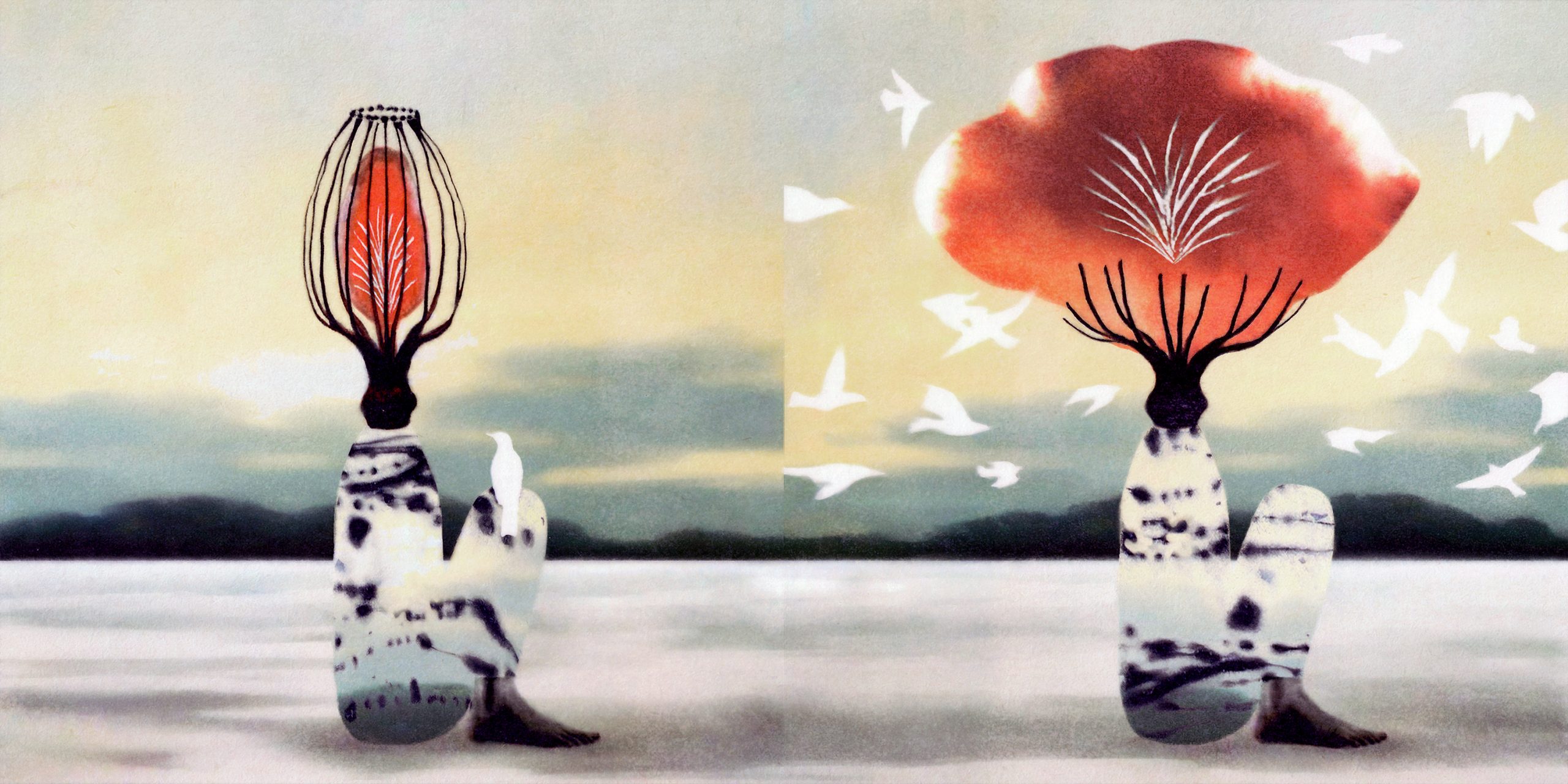
A two-panel illustration of a person with a flower head; in the first, the bud is closed, and in the second, the flower is in bloom.
Aldo Jarillo

Painting a More Hopeful Future

Why Ireland’s Basic Income for the Arts program is just the first step in better supporting the country’s artists.

In 2022, visual artist Elinor O’Donovan was working as a receptionist in Cork, Ireland, when she began to receive the Basic Income for the Arts (BIA) stipend. The Irish government had launched the program that year as a way to address the country’s unstable arts sector, which had left many artists without job security and consistent financial earnings—O’Donovan included. At the time she applied, she’d just graduated from university and was living with her parents as she tried to figure out the next steps for her career. When she found out she’d been selected from a pool of over 9,000 other applicants for the BIA, it was life-changing. As one of 2,000 artists receiving a weekly income of €325 over a three-year period, O’Donovan was able to quit her job and move to Dublin to make art full-time. 

“The BIA has allowed me to be a bit more brave with the stuff that I make,” she tells The Conversationalist. “It allowed me to make whatever I want, and not feel as if I have to justify why it’s important to a funding body.” 

According to a cost-benefit analysis published by the Department of Culture, Communications and Sport last September, the BIA has been a resounding success for beneficiaries, and Irish society at large. The report revealed that recipients were able to dedicate an additional four hours per week to art-making, and that the program “strengthened artists’ professional autonomy, capacity for creative work, and attachment to the arts sector.” Moreover, for every €1 of public money invested in the pilot, the country received €1.39 in return—a value that accounts for an increase in earnings generated from art-making as well as an increase in public engagement with the arts. In short: Giving money to artists, with no strings attached, was demonstrably profitable.  

For O’Donovan, income from the BIA not only gave her more time to make art, but provided her with newfound financial stability, something that affected every part of her life. She had more time to cook for herself, joined a gym, and for the first time, was able to afford to go to therapy. She was also finally able to plan for the future. 

“I was 26 when I started receiving [the BIA], and I was able to start a pension fund,” she says. “Just having that fallback [was a relief], knowing that I would receive an income no matter what happened; if I got sick, I would still be able to pay my bills, pay my rent. It has really been transformative for my well-being.”

Importantly, the BIA has also allowed her to create opportunities for other artists: O’Donovan’s ability to explore filmmaking, something she was afforded because of the stipend, meant she could create new jobs in the field. “Having financial stability from the basic income means that I’ve been able to hire other people to work with me,” O’Donovan says. “So there’s even been a kind of trickle down of the basic income to other artists and other creatives in Ireland.” 

For artists around the world, the program has also offered one hopeful potential solution for a global arts sector severely hit with funding cuts and political uncertainties over the last few years. But while things have taken a recent downturn, the financial instability of the arts has been a major problem for decades, if not centuries, something that likely explains the growing admiration for the BIA around the world.

In a capitalist society, creative work is not valued as a productive or profitable field, which often means that artists are being underpaid for their work, if they’re paid at all. Creativity and art-making require passion and time, two resources that are generally scarce in an economic system more concerned with profit than beauty. Often, this forces workers to abandon or sideline their creative work in favor of taking a non-creative job that will provide financial stability. But a program like the BIA provides an alternative model, giving artists the financial foundation to create without the stress of figuring out how they will pay their rent or bills. 

Joining other basic income pilot programs around the world, the BIA demonstrates that providing workers with financial stability first allows them to thrive, increasing a country’s worker satisfaction, contributing to better mental health, and resulting in higher housing stability, by supporting people pursuing their preferred fields of work

Even the program’s most ardent supporters, however, argue that the BIA is only the start of a more stable arts field. In Ireland, the arts generate €1.5 billion in income each year, but according to Praxis, the artists’ union of Ireland, artists still face “extremely challenging economic conditions.” In an open letter published in September, the group cited that 50.7% of artists in Ireland still live in Enforced Deprivation, compared to 15.7% of the general population. (The Irish Central Statistics Office defines Enforced Deprivation as when a household experiences two or more of 11 national deprivation items, such as being unable to replace worn out furniture, or being unable to afford a drink or a meal with friends once a month.) The BIA, then, should be seen as just the first step in a bigger effort to make the industry more sustainable. 

“It has always been precarious,” writer, editor, and Praxis policy director Michaele Cutaya tells The Conversationalist. “I’ve never managed to make a living off just my art income, [and] my situation, my difficulties, are not isolated instances.” As a union representative, Cutaya helped advise the government on the BIA’s design; but despite its success, she emphasizes that the country still has a long way to go. 

“Quite a large part of the economy relies on the work of artists,” she says, citing the profit the arts brings to the hospitality sector in Dublin as one example. But very little money generated by the arts sector actually goes to artists, a discrepancy that continues to grow despite the BIA. In the last three years, work opportunities have diminished throughout the sector, a trend worrying to union leadership and artists alike. “Access to public funding remains the main source of income for artists, mainly through the Arts Council,” Cutaya continues. “[But] I find that the number of chances of getting your work selected has gone down because essentially there seems to be a lot more people applying [to public funding].”

This may explain why some are concerned that the BIA will become “the shiny object” of policies, while other issues in the sector go ignored, like unregulated pay, the use of AI, and the still-growing lack of opportunities.

“There’s a lot of issues and they’re not doing much about it,” says actor Christophe Lombardi, who was in the control group of the BIA pilot program, where he received one yearly payment of €650 as compensation for participating, rather than the weekly stipend of €325. (The results of Lombardi’s control group were used so researchers could better understand how the BIA helps artists over a longer period of time, in comparison with those not receiving it.)  

Emphasizing other issues he would like to see addressed, Lombardi points to Gayanne Potter, a voice actor whose voice was used without permission by ScotRail to create AI-generated platform announcements in Scotland. “We are facing all the [same] problems [in Ireland]. So I don’t want [the government] to use the BIA as an excuse to pretend to help the artists, but behind the scenes, not [do] anything about the rest of the issues.” 

Last April, the Irish Creative Industries Forum (ICIF) wrote to the Irish government requesting measures for the protection of artists from AI, and the enforcement of copyright infringement laws against the misuse of the technology. As of yet, however, the government has yet to implement any AI regulation policies in response. 

Still, there is a widespread recognition that the BIA is a net positive, and can and should be used to help address many of the existing issues in the industry. In its letter, the ICIF requested that the BIA be extended to artists affected by job loss caused by AI. Across Ireland, unionized artists are currently campaigning for the BIA’s permanent expansion. “It does make a difference, obviously,” Lombardi says. “Because it’s hard to stay creative, to keep things going, while you can’t keep a roof over your head. There was [an] upswing in mental health—everything’s better.”

In Praxis’ open letter, the union demanded for the program’s extension for an indefinite period of time, and for the income to be indexed to inflation. Additionally, the union urged the government to expand eligibility to include previously omitted art forms, like performance artists, socially-engaged artists, craftspeople, and designers. 

Arguing that the BIA pays for itself in economic returns, Praxis warns this expansion should not come at the expense of other arts agencies, which also deserve resources, attention, and support. “The arts sector needs more funding, not less,” the letter reads. 

O’Donovan agrees. Given her experience, she says the BIA should be one part of a “bigger ecosystem” that helps the arts sector thrive, and allows artists to be fairly compensated for their work. “I think what people don’t understand about being an artist is how much work you do that goes unpaid,” she says. “Having the basic income means that I’m still able to live and I’m still able to work.” 

The pilot program was originally set to end in December 2025, but has now been extended to February 2026. From September 2026, it will be a permanent program in the country, although the government has not defined eligibility criteria or the number of recipients moving forward. In an email to The Conversationalist, a spokesperson for the Department of Culture, Communications and Sport writes that “details such as the duration, eligibility and selection method… have not yet been decided.” 

Cutaya says, so far, they’ve also been left in the dark about the expanded program’s specifics, something especially concerning because, while the program was initially launched under a progressive coalition government, the current government is conservative. “We know very little at this stage,” Cutaya says, but adds that Praxis is holding out hope their input will be taken into consideration as the program evolves. 

This lack of transparency has also left current BIA recipients in the dark, unsure of how they will support themselves in the gap between February and September. “Realistically I’ll just have to start working again,” O’Donovan says. “It feels like a shame. I’m really grateful to have had these three years where I’ve been able to work full-time as an artist because very few people who aren’t on the basic income can afford that.” 

Reflecting on how public arts funding is the first to be cut during economic hardship, Lombardi wishes that society at large would recognize the inherent value of artists’ labor for the mental health and wellbeing of the general population. “Imagine life without art,” Lombardi says, pointing to how artists played a key role in keeping people sane during the pandemic. “Imagine for six months, there is no art. You can’t watch stuff, you can’t read stuff, you can’t go out and see stuff. You can’t sing, there’s no music, there’s nothing. The only thing is work and sports. That’s it. The decrease in mental health would be astounding, people would go around the bend.” 

Having access to the most basic resources to be able to live while working in your preferred profession shouldn’t be a privilege for the few: Everyone deserves what the BIA has provided to artists for the last three years. But as too many places proverbially edge closer to the dystopia Lombardi describes, the BIA might be seen as a place to begin to reimagine how we value and fund the arts moving forward. Whether it’s an album, a painting, a play, a movie, a live band—whatever your preferred mode of expression—the arts remind us of the wonders of life, forcing us to see the beauty in between work shifts and growth indicators. Fair pay to the workers who deliver those reminders to the general population, then, is urgent; otherwise, we risk a world without fascination. The findings of the BIA pilot reveal the systemic flaws of how society treats its artists, and beyond the stipend, point to more hopeful solutions on the path to a world where art and artists are truly valued.