Since the start of the war, Russian soldiers have targeted vulnerable Ukrainian women for sexual abuse.
These are just a few of their stories.
Olena Zaitseva was in the early stages of pregnancy when she was unlawfully detained by Russian forces in February 2019.
“They took me into a prison-like facility, where they handcuffed me and attached me to a pipe,” she recalls. But soon after, they moved her to another room, “where the violence—and all the horrors imaginable—took place.”
Living close to what was then the front lines of eastern Ukraine, where the ongoing war with Russia first broke out in 2014, Olena and her 18-year old son Vladyslav had been accused by Russian forces of plotting to destroy railway infrastructure. Without legal defense or recourse, the mother, then 48, would spend the next four years as a civilian captive, while her son would be sentenced to 22 years in prison.
Olena was first held captive in Makiyivka, a former prison colony, and later in Izolyatsia, a former pre-trial detention center. Both had been converted into torture chambers by the Russian army, and were widely known for the atrocities committed by Russian servicemen against Ukrainian prisoners—atrocities that continue to this day.
When she first arrived at Makiyivka, Olena tells me she was imprisoned in a one-person cell, where around six men in balaclavas beat her and raped her with rubber batons for several days. (The soldiers put a bag on her head, so she could not count the total number of perpetrators.) The rapes triggered grave gynecological difficulties, causing Olena to bleed heavily. For nearly two years, these symptoms persisted. “I was alone in a cell with only a mattress, a bottle of water, and one bucket,” she says. “I’d sit on the bucket so that the blood could flow because I had no pads, no cloth, nothing.”
Olena with a photo of her son, Vladyslav. (Photo: Sara Cincurova)
Subjected to other forms of torture, Olena did not receive medical aid in her four years in Russian captivity, except for a single hospital visit in occupied Donetsk to consult with a gynecologist. “I cannot translate that feeling into words,” she recalls. “It was like in American movies: my hands in chains, my legs in irons, I was forced to bend forward and look down, and they dragged me like a dog. I was so ashamed.”
“People were walking in the street, and I had a bag on my head, like the worst of the criminals,” she says.
The doctors did not give her a diagnosis that day. It would have been impossible, Olena says, because the same Russian servicemen and prison guards who had abused her were watching and listening. But she already knew she had lost her pregnancy as a result of the violence she’d experienced during her imprisonment. (The father of her child would die on the front lines before they could be reunited.)
After four years in captivity, Olena was freed in a prisoner exchange in 2022. I meet her outside of Kyiv, where she now lives alone in a small room in a shared apartment. She has recently applied to receive disability status as a result of permanent injuries sustained during her imprisonment, while her son Vladyslav remains in Russian captivity, now for the eighth consecutive year. Olena continues to advocate for his release every day, and says she only relives the abuse she experienced and gives interviews to the press in order to help draw attention to his case. But she admits there is little hope.
“For my son to be exchanged, a miracle would have to happen,” she tells me. “Looking at what is happening, those who had been imprisoned before 2022 have been forgotten.”
Searching Houses for Vulnerable Victims
Olena’s story is just one of nearly 30 testimonies I have collected over the past two years of conflict-related sexual violence perpetrated against Ukrainian women, and is consistent with the testimonies of other women I have interviewed who were held at Makiyivka and Izolyatsia.
All of the women’s accounts were independently verified by Ukrainian NGOs collecting evidence of Russia’s war crimes, and together, paint a grim picture of systematic abuse—one that is not just a crime of opportunity, but suggests an intentional scouting effort by Russian soldiers to find potential victims who are especially vulnerable.
Although the Geneva Conventions, as well as international humanitarian law, stipulate that all civilians in conflict who are wounded or sick “shall be respected and protected in all circumstances,” UN reporting suggests that Russian forces have not respected these protections, routinely abusing even the most defenseless of Ukrainian civilians. Children, disabled persons, and the elderly are also protected civilians under international law; as are pregnant women like Olena, as well as mothers and other caregivers. But since the war broke out in 2014, rape and other war crimes have been routinely documented against each of these protected groups, as confirmed by both a 2023 and 2024 UN Independent International Commission of Inquiry on Ukraine. Explicitly defining rape as a form of torture under international law, the investigators found that soldiers routinely "identified women in a vulnerable situation" and "committed acts of rape and sexual violence when they broke into the victims’ houses," sometimes "at gunpoint with extreme brutality and with acts of torture, such as beatings and strangling."
(Photo: Diana Deliurman)
While sexual violence has become a defining weapon in the Russian war in Ukraine, it has also been on the rise in conflicts around the world. A 2025 UN report documented thousands more cases of conflict-related sexual violence in 2024 compared with the year before—a 25 percent increase, widely considered a conservative estimate. A 2026 report of the UN Secretary-General on conflict-related sexual violence estimated that for each rape reported in connection with a global conflict, 10 to 20 cases went undocumented.
Rape and other forms of sexual violence have long been a violation of international humanitarian law, yet committed with impunity in conflicts around the world, Jessica Neuwirth, founder of the Frontline Women's Fund, tells The Conversationalist. Her organization works to combat this by offering support to women's organizations working in conflict zones, helping survivors of sexual violence. “The Geneva Conventions prohibit ‘outrages upon personal dignity’ and specifically mention ‘rape and any form of indecent assault,’" she says. “The statute of the International Criminal Court explicitly includes rape as both a war crime and a crime against humanity.”
The problem, Neuwirth says, has not been the legal prohibition of rape, but the failure to hold perpetrators accountable under the law.
There have, however, been some efforts to bring perpetrators to account. In 2025, the UN Special Rapporteur on Torture, Alice Jill Edwards, joined by several other experts, sent a dossier of sexual torture allegations to the Russian Federation, involving the cases of 10 Ukrainian civilians. “These were all highly sexualized assaults which included rapes, threats of rape, and other depraved conduct,” the dossier read. “It is becoming clearer that the Russian Federation’s deliberate and systematic policy of torture in Ukraine involves sexualized torture and other sexualized cruelty, including against the civilian population.” (While Russia did not formally address a reply to the UN, the Kremlin has publicly stated its belief that many reports by Ukrainian women of sexual violence were groundless.)
The Strongest of All
“No one is as strong as Ukrainian women,” Liudmyla, a retired teacher who will celebrate her 79th birthday this summer, tells me. In the summer of 2022, she was beaten and raped by a young Russian serviceman in her house in a small village of the Kherson region, then under Russian occupation. The soldier left her with four broken ribs, among other injuries.
I interviewed Liudmyla for the first time in February 2025. Despite temperatures in the negatives that day, we set out to meet in the ruins of a bombarded elementary school in her village, which Liudmyla wanted to show me. In the end, we had no choice but to record the interview in a car because of the unbearable cold.
Despite the risks of coming forward with her story, Liudmyla has refused to be silenced, and has inspired other survivors in the country to speak out—including elderly or deeply religious women who at times blamed themselves for their assault. For her bravery, she is now seen as a local leader.
Liudmyla. (Photo: Diana Deliurman)
A year and a half after our first interview, I meet Liudmyla again. Her mobility has worsened; she struggles to walk up and down the stairs. But her resolve remains unchanged, speaking with the same determination she had the first time we met.
The day she was raped, Liudmyla recalls, she was convinced she would die. When the soldier started violating her, she said “farewell to my children, grandchildren, and great grandchildren in my mind.” But she survived. “I speak in order to denounce the war crimes committed by Russia against Ukrainian women,” she tells me.
Liudmyla says the Russian soldier who raped her stormed into her house around 10 p.m. She was terrified: At the time, she lived alone. He shouted and interrogated her, asking questions such as “who lives in your house?” and “why are the lights turned on?” Then, he beat her up and tore her clothes apart. He raped her, she says, then immediately fell asleep beside her. Liudmyla said those hours were among the most harrowing. “I lay right next to him, petrified,” she said, “while he was asleep and snoring.”
At 4 a.m., the soldier woke up and told Liudmyla he would come back in two days. “He told me that if I told anyone, he would kill me,” she says. Liudmyla was too scared to go to the hospital—then occupied by Russian troops—and immediately decided to flee her village rather than wait for the soldier’s return. She was only able to move back to her house, which had been almost completely destroyed, after her village was liberated in late 2022.
Recalling the days of occupation, Liudmyla says she saw wounded and desperate civilians being tortured by Russian soldiers. Some were hanged; others were forced to drink motor oil, she recalls. Other survivors as well as Ukrainian soldiers from the area I have interviewed recall seeing and hearing school children being raped.
Today, Liudmyla’s village is located near the so-called “kill zone,” about 30 kilometers from the frontlines, where Russian servicemen use first-person view (FPV) drones to kill civilians with precision. The practice is called “human safari”—an act of brutality consisting of dropping bombs on people, cars, and even children at play, as if it is a video game. Making matters more dire for the village, there is almost no access to food or medications. “If it wasn’t for humanitarian organizations, I would die of hunger today,” Liudmyla tells me. She hopes the situation will not get worse.
Liudmyla’s testimony is not an isolated incident. Rape and forced abductions of elderly Ukrainian civilians by the Russian army have been widely documented in recent years. The elderly also represent a large majority of people who remain living close to the frontlines, unable or unwilling to move out of the houses where they have spent their entire lives.
Pain That Cannot Be Expressed in Words
While international humanitarian law protects all civilians living in conflict without discrimination, certain groups are singled out for additional protections. The Convention on the Rights of Persons with Disabilities, for example, contains specific protections for people with disabilities, who are at greater risk of violence, including of a sexual nature.
While reports across various countries have shown that violence against people with disabilities tends to receive relatively little media coverage, the UN has been “gravely concerned” about the fate of disabled Ukrainians since the outset of the war. “People with disabilities trapped in the Russian control zones in Ukraine are reportedly being used as ‘human shields’ by the Russian Federation armed forces,” the UN Committee on the Rights of Persons with Disabilities (CRPD) warned in September 2022. Other human rights organizations such as ZMINA have also published reports documenting the experiences of women with disabilities living in Ukraine.
Lidia Tarash, the acting head of the Department of Documenting War Crimes at the Ukrainian NGO Media Initiative for Human Rights, tells me that according to their organization’s data, at least 27 civilians with disabilities are currently held in Russian captivity. “We also have testimonies regarding at least five seriously ill civilians unlawfully detained by Russia,” she says. “These include people with spinal conditions, epilepsy, diabetes, asthma, cancer, amputations, and paralysis.” Some of these civilians are also being held “incommunicado,” in complete isolation from the outside world—their whereabouts and conditions completely unknown.
“These cases demonstrate that even particularly vulnerable groups of civilians receive no protection from Russia’s system of persecution,” she explains. “They point to the systematic nature of the unlawful detention of Ukrainian civilians and Russia’s blatant disregard for international humanitarian law."
Documenting disabled people’s stories in conflict also presents particular challenges. Many disabled people live close to the frontlines, where media access is limited and particularly dangerous. Disabled people are also a largely underrepresented group across traditional media, and anecdotally, this has made it especially difficult for journalists to find a home for their stories. On his last day in the role, Giles Duley, the United Nations Global Advocate for Persons with Disabilities in Conflict and Peacebuilding Situations, said, “When I photograph somebody in a war zone… they always say to me: share this story with the leaders. But the opportunities to do so were never fully realized.”
(Photo: Diana Deliurman)
In the spring of 2025, I spoke with the mother of a disabled woman, living with her family only about 13 kilometers from the frontlines of the Kherson region. Their village, which was occupied in 2022, has been routinely hit and targeted by FPV drones.
Her daughter Olha, she explains, sustained a severe head injury as a toddler that blocked the flow of oxygen to her brain, leaving her non-verbal and bed-bound. Although now a young woman of 33, she still looks like a child, no older than 9 or 10.
In late February 2022, as Russians stormed into their region, Olha’s parents were taken to the local police station for questioning. Her mother says they were forced to kneel for hours as they were beaten and interrogated by Russian soldiers. But all the while, she feared most for her daughter, who had been left at home alone.
Hours later, Olha’s mother was released. When she returned home, she found Olha lying on the bed, naked and motionless, with sweets placed on her pillow.
“Olha cannot undress herself alone,” her mother tells me. Devastated, she immediately knew: It must have been the Russian soldiers.
With Olha unable to speak, it was impossible to fully determine what had happened. But Olha’s body spoke for her. In the months that followed, she lost around 10 kilograms, and nearly all her teeth fell out. She became terrified of men, her mother says.
While the family will never know the details of the abuse, organizations such as Human Rights Watch have documented similar war crimes perpetrated against people with disabilities in Ukraine. In 2024, the country’s United Nations Population Fund (UNFPA) stated that the prolonged and combined nature of insecurity, displacement, and economic deterioration had reduced “the coping capacities of women and girls and other at-risk groups in Ukraine ... further exposing them to risks of gender-based violence.” The organization also warned that older women and women with disabilities represent a significant majority of vulnerable civilians in frontline areas, and that both are more likely to be left alone, which often makes them especially vulnerable. As a result, the UNFPA concluded that different forms of gender-based violence have been significantly increasing.
A Fear of Sexual Violence
Children are legally protected in armed conflicts under international humanitarian law, with a series of rules granting them special protections. Ukraine’s General Prosecutor’s Office is currently investigating 23 cases of child victims of conflict-related sexual abuse, out of a total 396 reported cases of sexual violence by Russian troops. These numbers, however, are likely just the tip of the iceberg, and do not reflect the full reality of the sexual abuse that has been committed against children.
Alla Sobchuk, a 42-year old woman from Kherson, tells me she was unlawfully detained with her then 11-year old daughter, Viktoriia, when the city was occupied in 2022. She says they were driving through a checkpoint set up by the Russian military, who tried to force her to remove her window tint.
“I said no and they threatened to shoot me,” she says. “They handcuffed me, beat me, put zip ties on my wrists, and sprayed me with tear gas.” All of this, she adds, happened in front of her daughter.
Alla next to a sign that reads, "Ukraine will win." (Photo courtesy of Alla Sobchuk.)
The pair was then taken to a former police station, occupied by what seemed to be Russian police, she says. Viktoriia watched as Russian officers hit her mother and tore her dress apart.
“We are both very afraid of sexual violence,” Alla says, “and very afraid they would assault us.” (She adds that “luckily,” the Russian forces “only” used physical violence.)
Viktoriia was taken to a separate office, where the soldiers interrogated her. One of them threatened to send her to a boarding school and Alla to prison, before threatening Alla directly, as well. “He hit me in the face because I demanded my child be returned,” Alla says. They were both held at the police station in separate offices for nearly 24 hours. The next day, they were freed.
After they were released, Alla says, Viktoriia was very frightened—but relieved to see her mother again. “I supported her by telling her she was a hero, and even adults could not endure the [abuse] by occupation forces the way she did.”
Viktoriia next to a sign that reads "Kherson is Ukraine!!!" (Photo courtesy of Alla Sobchuk.)
This kind of exposure to violence—sexual and otherwise—is prevalent in captivity, especially in cases where children and teenagers are held for longer periods of time. But as more cases emerge involving Ukrainian children, particularly those detained in Russia, humanitarian organizations—and victims’ families—are warning of another deeply disturbing reality: evidence of severe physical and sexual violence inflicted on children themselves. Mariam Lambert, the co-founder of Emile Foundation, an organization that helps bring Ukrainian children abducted to Russia back to Ukraine, shared one recent case involving a family reunited after years of separation. “One of the children, a six-year-old girl, had previously been identified on a Russian adoption database,” Lambert says. “After her return home, evidence emerged indicating that she had been exposed to violent sexual abuse while in Russian-controlled custody.”
Lambert also confirms that similar incidents point to a broader pattern of abuse, disappearance, forced separation, and exploitation of vulnerable children caught inside a system operating without transparency or accountability. “The world still does not fully understand what some of these children have endured,” she concludes.
Hundreds of Methods of Torture
The sexual abuse committed as a weapon of war by the Russian forces remains just one method of brutal torture used against imprisoned civilians and other prisoners of war. Lyubov Smachylo, the Head of the Analytical Department at Media Initiative for Human Rights Ukraine, an NGO that has carried out comprehensive investigations and in-depth interviews with detained civilians, says she and her colleagues have been able to document patterns and connections between violations of civilians’ rights in different locations and at different times, which indicates that such violations “are not isolated incidents and may qualify as war crimes, as well as crimes against humanity.” Today, the organization is aware of at least 2,495 civilians held in unlawful captivity across 240 locations.
Based on in-depth interviews conducted as part of the organization’s research, in 87% cases of torture, Russian forces subjected victims to severe beatings, using their hands, feet, sticks, clubs, belts, hammers, or other improvised equipment. Of the 54 torture victims identified, 34 were also subjected to electric shocks. The evidence also suggests that Russian forces have used sexual and gender-based violence against both male and female detainees.
On May 22, 2026, the Ukrainian Parliament Commissioner for Human Rights, Dmytro Lubinets, reported that Russia has used 695 different forms of torture, including physical and psychological abuse, as well as sexual violence, in the war so far." Prisoners of war are strangled, beaten, subjected to electric shocks, set upon by dogs and sometimes forced to stand in one place for up to 18 hours; as soon as you start to squat, you are immediately physically beaten,” he said. He said that Russia has already tortured 406 Ukrainian captives to death.
This torture and abuse is perpetrated unlawfully and indiscriminately. The stories described above are a reminder that such horrors have not spared anyone—not even the elderly, not even the children. But reporting for months on sexual abuse across Ukraine, it has become clear to me that numerous survivors do not want their accounts to remain buried in shame. Nearly all of the women I spoke to longed to have their stories told and shared with the world—showing global readers that such unbearable, widespread abuse continues, and none of its perpetrators have been brought to justice for their crimes.
[post_title] => "All the Horrors Imaginable"
[post_excerpt] => Since the start of the war, Russian soldiers have targeted vulnerable Ukrainian women for sexual abuse. These are just a few of their stories.
[post_status] => publish
[comment_status] => closed
[ping_status] => closed
[post_password] =>
[post_name] => war-crimes-rape-sexual-assault-ukraine-civilians-russia
[to_ping] =>
[pinged] =>
[post_modified] => 2026-08-03 20:47:20
[post_modified_gmt] => 2026-08-03 20:47:20
[post_content_filtered] =>
[post_parent] => 0
[guid] => https://conversationalist.org/?p=10622
[menu_order] => 0
[post_type] => post
[post_mime_type] =>
[comment_count] => 0
[filter] => raw
)
On January 4, in Enoch, Utah, 42-year-old Michael Haight shot and killed his wife, five children, and mother-in-law, before turning the gun on himself, a form of murder-suicide known as "family annihilation." Tausha Haight, his wife of twenty years, had filed for divorce a couple weeks prior. Abusers always lose it when you leave.
It's since been reported, first by the Associated Press, that Haight was investigated in 2020 for potential child abuse after someone outside the family reported it to the police. Utah's child protective services got involved. At the time, Haight’s eldest daughter Macie said the abuse had begun years earlier, in 2017. She described a time her father grabbed her by the shoulders and threw her into furniture, along with another incident in which he had strangled her. She said she’d been afraid that he would kill her. Michael blamed the then-14-year-old for his violence, saying she was "mouthy." During the same police investigation, Macie also said that her father regularly belittled her mother, and Michael admitted to surveilling his wife’s communications. No charges were filed.
Nearly three years later, Michael’s obituary in the local paper would read that he "made it a point to spend quality time with each and every one of his children," and that they were a "cherished miracle." One commenter spoke of his “Christlike love and service.” Neither the obituary nor the commenters mentioned the murders, and it was only taken down after Shannon Watts, gun reform advocate and founder of Moms Demand, tweeted it out.
Haight’s story isn’t so uncommon. In the United States alone, a man has annihilated his family every 3.5 weeks for the last two decades, a likely miniscule portion of the estimated family annihilations worldwide. Men who strangle their partners are ten times more likely to become men who kill them. And having a gun in the home increases the risk of murder in a domestic violence incident by 500%.
So why do we continue to treat what happened to the Haight family like an isolated tragedy—a “personal” matter—as opposed to exactly what it was: a domestic tyrant who felt entitled, by virtue of being a man, to enforce his will, crush dissent, and destroy his family as soon as they tried to flee?
When a head of state insists on their natural or divine right to monitor your private communications, stalk your movements, imprison you at home, and beat or kill you for wearing certain clothes, meeting friends, or maintaining a separate bank account, we rightly call them authoritarian. We are loud in our disapproval: When Iranian women took to the streets in protest over the arrest and murder of Mahsa Amini by morality police for not properly wearing hijab, the support abroad was strong, the brutality obvious. But when it's the head of a household terrorizing you, the euphemisms (and excuses) surface: family difficulties over a private matter, better dealt with behind closed doors; it’s best not to get involved, it’s none of our business. All support evaporates, because father still knows best — and if father wants to blow everything up just because he can, who's going to stop him?
Studies on familicide say in almost every case, the man claims his family as property, with the right to end their lives. Murder, after all, is the ultimate form of control. But the impulse to control or destroy isn't limited to physical violence: The easiest way to break people is to break what's precious to them. Look at Elon Musk, who had to lose 200 billion dollars before people finally stopped calling him a genius. Within months of his taking over Twitter, 80% of the company’s workforce had quit or been fired, especially anyone found criticizing him. In a recent New York Magazine piece about Musk's takeover, they describe how Twitter employees flocked to the company Slack during these mass layoffs, all anxiously waiting for the ax: "One person posted a meme of Thanos from Avengers: Infinity War, the supervillain who exterminates half the living beings in the universe with a snap.”
Advertisers fled Musk’s "extremely hardcore" site as he rolled out a disastrous verification process, threatened people who linked out to other social networks, reinstated Nazis, and ranted about eugenics, all while overseeing a radical uptick in harassment and slurs. With no clear plan to make Twitter profitable, and engineers rolling their eyes at his technical expertise, it's no wonder Twitter and Tesla's value has since plummeted. Not that he's taken any accountability for the losses or the lives he's upended. He's been too busy impregnating his employee, lashing out at mouthy critics, and, most recently, firing a Twitter engineer for informing him the reason his engagement was down wasn’t due to a bug—but because people weren’t as interested in him as they used to be.
Whether they're the head of a family, company, or state, everyone suffers so long as masculinity is wrapped up in an ability to dominate. Impunity and entitlement breed ignorance and nihilism. Patriarchy is ancient, authoritarian, incompatible with equality and democracy, and bad for everyone involved. And it’s as relevant to how Musk acquired and destroyed Twitter as it is to the protests in Iran as it is to what happened to the Haight family.
Human rights also don't disappear at your doorstep. According to the UN, 47,000 women and girls were killed by their partners or other family in 2020. On average, that means one murder every 11 minutes. But freeing women and children from violence won't happen so long as it's still taboo to speak about it. We’d rightfully consider it outrageous if someone called reports of mass rapes and murders in Ukraine by Russian soldiers "airing dirty laundry.” Yet we don’t extend the same support to women abused and murdered by partners or relatives, which happens in every community, and is far more likely than “stranger danger.” (And on the rare occasion victims do get attention, they’re usually blonde, white, and already dead.)
Meanwhile, it's the same self-destructive, patriarchal entitlement that motivates domestic violence that motivates atrocities like the Russian invasion of Ukraine – if I can't have you, nobody can – with the same results. Putin first became aggressive in 2014 after Ukraine turned down a trade agreement with Russia in favor of one with the European Union. (Again, it's most dangerous when you try to leave.) Absent consequences, including for past wars in Syria, Georgia, and Chechnya, Putin has continuously escalated the bloodshed, and will do anything short of giving up power to punish Ukrainians for daring to be free, including letting Russia crumble. In that sense, he's just like Michael Haight: Insult the sovereign, or threaten his control, and watch him burn the building down with everyone trapped inside. Whatever it takes to teach them a lesson.
Our bodies don't differentiate between state-sponsored or home-bound torture. What does your killer's institutional affiliation matter when you're dead? The lines are blurred in any case, considering the number of men who abuse in private who also abuse the public. It's not a coincidence that police abuse their families at high rates, or that two-thirds of mass shootings are either an incident of domestic violence or are perpetrated by someone with a record of it. Yet time and time again, on both a personal and policy level, we treat domestic violence as a completely separate matter – anything to avoid the reality that some homes are conflict zones, too.
Even the preeminent global treaty on women’s rights, the Convention on the Elimination of Discrimination Against Women (CEDAW), does not contain the word "violence" once. In 1980, when CEDAW was passed, gender-based violence was considered outside its scope, a private matter that this public treaty wouldn't touch with a ten-foot pole. Men's rights, especially in war, were already covered as human rights, a courtesy not extended to everyone else. It wasn't until 1992 that the CEDAW Committee issued General Recommendation 19, which interpreted the treaty to include gender violence. (Full disclosure, I'm on the board of an organization, Every Woman, calling for a new global treaty to close this atrocious gap in international law.) Like the Refugee Treaty, which advocates fought tooth and nail to have courts interpret to include gender persecution as a "particular social group," half the world's population suffering the most pervasive human rights violation was considered niche.
When feminism states that the personal is political, it speaks to the ways the private sphere continues to oppress women. There can be no equality in public so long as violence at home is ignored. To be part of the public, you first need to make it outside. Patriarchy cuts across every divide, but its effects are worsened by poverty, racism, and other forms of oppression. When 72-year-old Huu Can Tran shot and killed 11 people at the Star Ballroom Dance Studio in Monterey Park, California during a Lunar New Year celebration, people speculated whether this was yet another anti-Asian hate crime, a misogynist escalation, or possibly both. No motive has been found so far, or connection to any of the victims, but the shooting sparked a discussion online about domestic violence in the Asian American community. The Asian Pacific Institute on Gender Based Violence released a statement of mourning, and a plea to make the connection between femicide and mass shootings. They estimate that between 21-55% of API women in the US have experienced intimate physical or sexual violence.
In the United States, women of color are disproportionately affected by gender violence. The CDC reports that Black women are three times more likely than white women to be killed in a domestic dispute. More than half of Indigenous women in the US have experienced sexual or intimate partner violence. On a global scale, 1 in 3 women have experienced sexual assault or domestic violence.
Authoritarians know that subordinating women helps them stay in power, and systematically encourage and enact patriarchal violence to keep people in line. They claim that masculinity is under threat, and loosen laws that protect women and gender nonconforming people. Reactionary autocrats worldwide are attacking women's rights as a means of entrenching their control and weakening political participation in democratic mass movements. In Russia, Putin rolled back criminal consequences for domestic violence. President Recep Tayyip Erdoğan withdrew Turkey from the Istanbul Convention, the European treaty on domestic violence. Poland keeps threatening to do the same, while Hungary never signed it in the first place. (In a move to distance itself from its neighbors, Ukraine finally ratified the Istanbul Convention last year.) Before he was voted out and supporters staged a failed coup on his behalf, Jair Bolsonaro cut 90% of funding for domestic violence prevention in Brazil. The Taliban once again won’t even let women go to school.
So long as authoritarian violence is acceptable, even encouraged, on the micro level within families, it will be impossible to defeat on a macro level. There is no democracy, no value for human rights, without the participation and inclusion of women and children. And that participation depends on feeling safe at home first. All life, and livelihoods, are devalued when we devalue vulnerable people. And for what? An ancient status quo built on brute strength. Marriage and the nuclear family still provide the basic unit for our tax code. We're incentivized by the government to create a private jurisdiction where men overarchingly rule. The patriarchs are not okay, and it's doubtful they ever have been. Their benevolent dictatorship kills, and it’s time to let the toxic institution go.
[post_title] => Why Do So Many Men Destroy What They Can't Control?
[post_excerpt] => And why do so many people support them?
[post_status] => publish
[comment_status] => closed
[ping_status] => closed
[post_password] =>
[post_name] => domestic-abuse-family-annihilation-gender-violence-why-men-destroy
[to_ping] =>
[pinged] =>
[post_modified] => 2026-08-04 19:33:38
[post_modified_gmt] => 2026-08-04 19:33:38
[post_content_filtered] =>
[post_parent] => 0
[guid] => https://conversationalist.org/?p=5576
[menu_order] => 94
[post_type] => post
[post_mime_type] =>
[comment_count] => 0
[filter] => raw
)
WP_Post Object
(
    [ID] => 3689
    [post_author] => 2
    [post_date] => 2022-01-06 13:39:17
    [post_date_gmt] => 2022-01-06 13:39:17
    [post_content] => If Maxwell ends up being the only person involved in this vast criminal enterprise to do hard time, when so many prominent men have been named as 'guests' and associates of Epstein's, the reckoning will be very incomplete.

On December 29, following five days of deliberations, a New York jury found the disgraced British socialite Ghislaine Maxwell guilty of recruiting and grooming underage girls for pedophile Jeffrey Epstein to abuse. The most serious of the charges—sex trafficking—carries a maximum sentence of 40 years. As 2021 drew to a close, the verdict felt like a giant exhale. But it was not powerful enough to bend the moral arc of the universe toward justice.

Maxwell turned 60 on Christmas and will likely be spending the rest of her life behind bars. This is good. For the victims, it is necessary—though, considering the scale and scope of Epstein’s criminal enterprise, it is not sufficient.

Once the social media high-fiving subsided, there was something about the whole trial that left me feeling empty and bamboozled. It felt as if the incarceration of this one individual was supposed to satisfy the victims’ long quest for justice, and we observers should now move on, leave it alone. No further questions. It reminded me of what Maxwell’s lead attorney Bobbi Sternheim had said in her opening arguments, that “[e]ver since Eve was accused of tempting Adam with the apple, women have been blamed for the bad behavior of men.” While I disagree with the contention that Maxwell was just a scapegoat for Epstein, who died in 2019, it would be an incomplete reckoning—for the victims, and for the rule of law—if this woman were to end up being the only person involved in this vast criminal enterprise to do hard time.

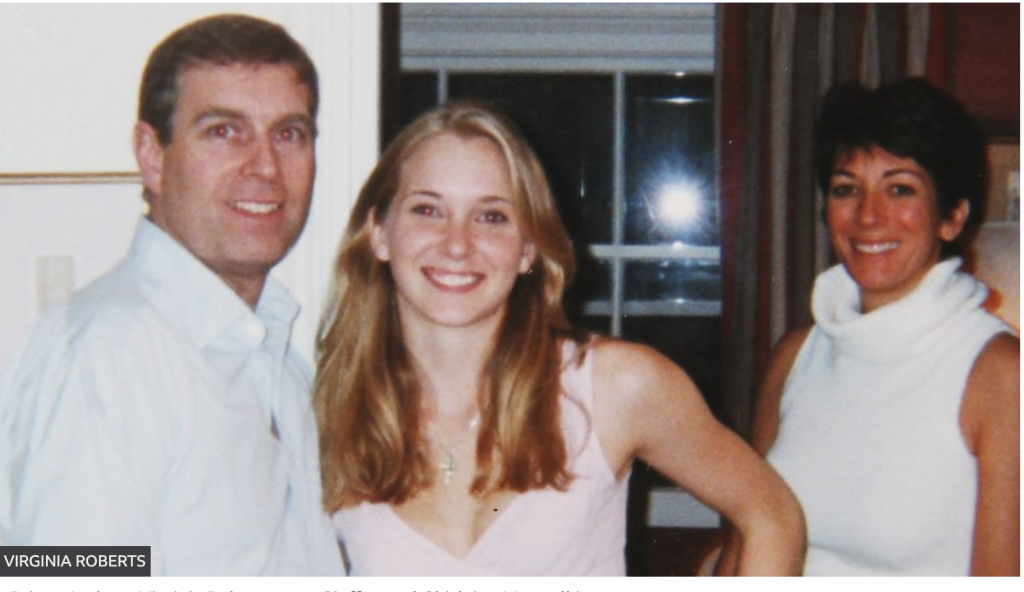
For more than two decades Jeffrey Epstein operated a child sex-trafficking ring allegedly patronized by some of the most powerful men in the world. Heads of state, billionaire businessmen, thought leaders, prominent academics, members of royal families, and philanthropists are accused of having partaken in, or having had knowledge of, what Epstein had on offer. One of those people is Prince Andrew, second son of Queen Elizabeth; he currently faces a civil suit brought by Virginia Giuffre, who has accused Andrew of assaulting her at the London home of Ghislaine Maxwell when she was 17. Another is Epstein’s former attorney Alan Dershowitz, who is also being sued by Guiffre; she alleges that he, too, raped her. (Dershowitz has countersued her for defamation.)

[caption id="attachment_3693" align="alignleft" width="640"] Virginia Roberts Giuffre was 17 in this 2001 photo with Prince Andrew and Ghislaine Maxwell.[/caption]

There remain many questions left unanswered by the Maxwell trial, which focused narrowly on the testimony of four victims, none of which was Guiffre. The most critical question centers on the origins of Epstein’s obscene wealth. Was he really a financier, a math whiz with a rare ability to discover patterns in stock movements (as he was often described in the press), or just a very talented blackmailer? If the latter, then who was he blackmailing and with what?

Here’s what we do know: In 1974, a 21-year-old college dropout from Coney Island named Jeffrey Epstein managed to get a job teaching math at Dalton, one of the most prestigious private schools in New York City. The outgoing headmaster at the time was one Donald Barr, father of former Attorney General Bill Barr; in what might just be a creepy coincidence, Donald Barr was also the author of a 1973 novel called Space Relations, which features the rape of teenage girls. Whether Barr was the person directly responsible for hiring Epstein is unknown, according to the New York Times. What is known is that being inside the Dalton orbit afforded Epstein the opportunity to schmooze with bigwigs like Bear Stearns chairman Ace Greenberg, whose daughter attended the school. So, when Epstein was eventually fired from his teaching job, those connections enabled him to do what he did best: fail upward. He scored a job working for Greenberg at Bear Stearns, where he was made a limited partner before departing in the early 1980s after allegedly violating securities laws, although the specifics are murky. Investigative journalist Vicky Ward has noted that the death last week of former Bear Stearns CEO Jimmy Cayne—whom Epstein once reported to—might help clarify the circumstances of his departure; she speculates that, amid an SEC investigation, Epstein might have taken the fall for the bank’s higher-ups in exchange for their loyalty.

Several years after leaving Bear Stearns, once he glommed onto his first big client, Epstein reinvented himself as a globe-trotting philanthropist, rubbing shoulders with powerful people and building up an aura of mystery. That client was legendary retailer Leslie Wexner, the founder and Chief Executive of Limited Brands—later renamed L Brands—who boasted a net worth of $1.4 billion in 1986. For such a savvy businessman, Wexner made some strange financial moves in the 1990s, such as firing his longtime financial adviser and giving Epstein—a man with a revoked broker’s license and no experience—power of attorney over all his money. From Wexner, Epstein acquired his 51,000-square-foot New York City townhouse, in which he entertained rich men and abused young girls; he also obtained a private jet that was formerly owned by his client’s company. Epstein exploited his connections to the company, which owns now-embattled lingerie brand Victoria’s Secret, as a way to lure young girls with promises of modeling contracts.

Wexner, now 84, has some explaining to do. It wasn’t until September 2019, after Epstein was arrested, that he spoke about Epstein, without naming him. “Being taken advantage of by someone who was so sick, so cunning, so depraved,” he said at an analysts’ meeting, “is something that I’m embarrassed that I was even close to, but that is in the past.” Is it really? Maria Farmer, a visual artist, was in her mid-20s when Ghislaine Maxwell invited her under false pretenses to Wexner’s sprawling Ohio compound, where she was held hostage and sexually assaulted by Epstein; she would probably disagree that this trauma, which she has said is the reason she chose not to have children, is all in the past. Farmer went to the FBI in 1996 to report Epstein, and nothing was done. It wasn’t until a shareholder lawsuit was filed last year that allegations emerged that Wexner and his wife, Abigail, were not only aware of Epstein’s conduct but allowed him to “use their home for liaisons with victims.” (Following internal investigations, the results of which have not been made public, Wexner has since resigned from his company and its board.)

Only once we follow the money can we begin to understand why people like former Israeli prime minister Ehud Barak was so tight with Epstein, why Bill Gates said Epstein’s “lifestyle is very different and kind of intriguing,” why ex-presidents Bill Clinton and Donald Trump frequently rode on his plane, nicknamed the Lolita Express, and attended his parties. At one point, there was a lawsuit filed in New York by a victim who alleged that when she was just 13, Trump violently raped her at one of Epstein’s soirees. But just days before the 2016 election, right as the victim was expected to hold a press conference at the office of her attorney, Lisa Bloom, the case was abruptly dropped. What happened there? Did it have anything to do with the reason why Trump said, following the arrest of Maxwell, “I wish her well”? Did it have anything to do with why,  according to a new book by journalist Michael Wolff, Trump advisor Steve Bannon told Epstein that he was “the only person we were afraid of during the [2016] campaign”? And where did all the videos of Epstein’s high level friends engaged in illegal sexual activity with minors go? Why was CCTV footage from the prison cell where Epstein killed himself mysteriously deleted? (In a supreme irony, the investigation into Epstein’s death was led by the former attorney general Bill Barr, who concluded, in the understatement of the century, that it stemmed from “a perfect storm of screw ups.”)

Until the public can understand who was involved in Epstein’s crime ring, and see them held accountable for their involvement, the conviction of Ghislaine Maxwell will feel like a sad consolation prize, a cover up for the predations of extremely powerful men. Some legal experts have said that there’s a remote possibility that Maxwell could now negotiate a deal with prosecutors and name names in exchange for a more lenient prison sentence. But the fact that she’s the only person who has been prosecuted by the government for her role in this sprawling decades-long criminal conspiracy is just further evidence that a corrupt elite has captured our institutions and perverted the justice system to serve their own ends.

Under such conditions, as it stands right now, Maxwell’s best bet is to keep her mouth shut and pray that Trump can win in 2024, at which time he can pardon her and wish her well in person.
    [post_title] => Ghislaine Maxwell's conviction is just one step toward still-elusive justice for her victims
    [post_excerpt] => Maxwell will likely spend the rest of her life behind bars. This is good. For the victims, it is necessary—but insufficient.
    [post_status] => publish
    [comment_status] => closed
    [ping_status] => open
    [post_password] =>
    [post_name] => ghislaine-maxwells-conviction-is-just-one-step-toward-still-elusive-justice-for-her-victims
    [to_ping] =>
    [pinged] =>
    [post_modified] => 2026-08-05 18:12:59
    [post_modified_gmt] => 2026-08-05 18:12:59
    [post_content_filtered] =>
    [post_parent] => 0
    [guid] => https://conversationalist.org/?p=3689
    [menu_order] => 150
    [post_type] => post
    [post_mime_type] =>
    [comment_count] => 0
    [filter] => raw
)
WP_Post Object
(
[ID] => 3247
[post_author] => 2
[post_date] => 2021-10-07 22:29:15
[post_date_gmt] => 2021-10-07 22:29:15
[post_content] => Abuse turns your world into a kind of sadistic haunted house setting—frightening but also extremely disorientingA police officer’s body cam captured a young woman standing on the side of the road, sad and sheepish, the sun in her eyes. Her relationship was on the rocks, but she was earnestly telling the officer that she wanted things to work out, she wanted them to be OK. It looked like an unfortunate incident, a stumble on the way to a great adventure, that would soon be behind her. A few weeks later, however, the pretty woman in the footage would be dead.The tragedy of 22-year-old Gabby Petito seemed, at first glance, to be entirely preventable. Before she disappeared while on a cross country trip with her fiancé, Brian Laundrie, witnesses saw him slap Petito. This is how the police became involved. Petito was an ambitious young woman, originally from New York State, who dreamed about being a travel influencer. To that end, she set out on a cross-country trip alongside her fiancé, documenting their journey along the way. Not all seemed well in their relationship, however, and her family grew suspicious when Petito stopped communicating with them. When Laundrie returned to his home in Florida without Petito, but still in possession of her travel van, it became clear that something horrible had happened.Petito’s body was found in Wyoming a few weeks after Laundrie returned. Police have ruled her death a homicide; as of this writing, her fiancé remains missing. It is unclear whether he has harmed himself or is simply on the run from the authorities. The footage of the police encounter that took place in Moab, Utah, weeks before Petito went missing, gives us plenty of clues as to what may have transpired between the young woman and her fiancé. It is a tragically familiar sight to anyone with experience in domestic violence, but it is even more heartbreaking in hindsight:
Laundrie is calm and pleasant when speaking with the officers. Petito looks like she is emotionally unstable, but she is clearly heartbroken and dying of shame—the typical response of a woman who is used to being belittled and told that everything that happens to her is her fault.
The police are courteous, polite, and clearly sympathetic, but they don’t see the need to put anyone in handcuffs. No one is giving them an explicit reason to do so. The police are focusing on de-escalating the situation, and appear to be succeeding. They believe that what is happening before them is a mental health crisis first and foremost—especially because Petito, at one point, admits to slapping Laundrie—and their actions are consistent with that.
In light of what ultimately happened to Petito, the internet cried foul over the police encounter. If only the cops had taken the situation more seriously, the wisdom went, Petito would still be alive. It’s a noble and understandable sentiment, but as someone who surveyed her own hellish, seven-year-long abusive relationship, I am not sure if it is the correct one. Human beings have always loved our stories of good and evil to be uncomplicated, and by increasing both the speed and frequency of communication, social media has in particular amplified demand for the simplest of narratives. In the case of tragic stories like Petito’s, it feels only natural to say that what happened to her could have easily been prevented. This narrative is bolstered by the fact that Petito was young, attractive, and white — which is why her case immediately received national attention. “Missing white woman syndrome” is very much a real phenomenon, particularly when the white woman happens to be young, attractive, and from the sort of background that, while not necessarily wealthy, can be described as “good” or “upstanding.” Some have wondered whether the incident with the police would have gone down differently if Petito and/or her fiancé had been, for example, Black. Would both of them have been criminalized? Would there have been a chance of the officers being more harsh on the fiancé, hence preventing a murder? The history of policing with regard to domestic violence tells us that a tougher response by officers would not have necessarily saved anyone.In general, policing alone does not appear to be sufficient to solve the problem of domestic violence, and frequently, much depends on luck. The idea that domestic violence outcomes can sometimes depend on blind luck alone is, of course, completely detestable to us. Why should Petito — or any woman, or any abuse victim — have to depend on luck? Why couldn’t her horrifying trajectory have just been stopped?When reviewing the body cam footage, I was struck by the fact that at one point, Petito told a police officer that her boyfriend didn’t really believe she could pull off her dream of building a website and becoming a well-known travel influencer. “He doesn’t really believe I can do any of it,” she says at one point, looking both desperate and desperate to please, an expression I have caught on my own face in videos and pictures that documented my highly volatile past.Two things stuck out: Petito was far away from home, and essentially under Laundrie’s full control. Yet she was also embarking on an ambitious project, which must have made Laundrie feel as though his control was slipping. The night my husband almost killed me, I too was far away from home, on vacation on the island of Crete, one of my favorite places on earth. That day, I had submitted a new play to a festival, a piece of work my director husband had praised highly. Yet the mere fact that I had written and submitted it resulted in dark feelings of jealousy and resentment in my husband, who felt that I was growing too successful, too fast. A few drinks into a moonlit summer night, he grew more and more furious with me, until he could no longer contain his anger and he attacked me physically. The hotel owner called the police, an act that almost certainly saved my life that night.When the police interviewed me, they could see the bruises already blooming on my body and had eyewitness accounts to go on. But, much like Petito, I was too mortified to press charges. The fact that my then husband had bruises himself — from when I had, very unsuccessfully, tried to defend myself, much as Petito had apparently done — made the situation murkier. In the light of day, my guilt overwhelmed me, and I was ready to believe that I had provoked the entire incident, in spite of people who were ready to testify on my behalf.That’s the funny thing about abuse—it turns your world into a kind of sadistic haunted house setting, frightening but also extremely disorienting. Up is down and down is up. You are so demoralized and humiliated, that you stop seeing yourself as a full person deserving of the most basic of rights. The Greek police urged me to press charges, but they couldn’t force me to. In the Petito case, the Utah police had even less to go on. My friend Joy Ziegeweid has spent nearly a decade working with domestic violence victims and is currently the supervising immigration attorney at the Urban Justice Center’s Domestic Violence Project. Haunted by the body cam footage of Petito, I called her for an opinion on the case. Joy reminded me that police involvement “does not always guarantee a good outcome” in a domestic violence situation. Again, we often like to think that it does, but even the most fair-minded officer can only respond in cases when the abuser takes specific actions. If a chillingly manipulative man like Laundrie is not physically attacking a woman in front of the police, and the woman herself does not say that she is in danger, there isn’t much law enforcement officers can do. Of course, as Joy reminded me, there are some jurisdictions in which a victim does not need to press charges in order for the cops to move to make an arrest. “But that can have its own downsides,” Joy explained. A victim residing in such a jurisdiction may be less likely to seek help in the first place — because victims are gradually taught to place the abuser’s needs ahead of their own, they may not want to see them arrested at all. According to available data, one in four women and one in nine men experience what is termed to be severe abuse—including physical violence, sexual violence, and/or stalking—in the United States. There has been widespread evidence that the Covid-19 pandemic has greatly exacerbated the problem. For most of us, domestic violence is a problem hidden from view, only spilling out into the public sphere when it is already too late, which is what appears to have happened in the Petito case. Because of the nuanced and complex nature of domestic violence, solutions not involving law enforcement can be helpful, especially when the victim is not yet able to fully articulate or even realize the problem, which is a phenomenon I have experienced myself. Again, much depends on jurisdiction. As Joy reminded me, in New York State one can obtain a protective order through family court without involving the police. “But the police can then be called to enforce it,” she said. Availability of beds in women’s shelters and other resources for victims struggling to break free is another important part of the equation, according to Joy. Simply put, in many cases, a battered spouse or partner has nowhere to go. A battered spouse or partner is also under intense psychological stress. Both economic and psychological factors are cited as very important in determining good outcomes for domestic abuse situations. Without financial support and very specific, targeted counseling, victims frequently cannot be saved by cops alone, no matter how heroic or well-trained. Hybrid solutions are required to tackle the problem of domestic violence because the problem itself is hybrid, with a victim’s reality constantly shifting. In the first months after I was able to leave my husband—only with the help of friends and family, I could never have done it on my own—I struggled with feelings of guilt, wanting to go back, and wondering if I had made a terrible mistake. Only by slowly learning how to experience life without constant control—the same control plainly visible to me as I watched the Petito footage years later—did I begin to understand what I had been missing for all of those years: a full life as an adult woman, with her boundaries intact, and her physical safety no longer dependent on someone else’s moods. The fact that I escaped is extremely lucky. Many things could have gone wrong for me, and simply didn’t. Sometimes, there are no clear cut answers to the question as to why one victim makes it and another one doesn’t, and decisions that seem right in the moment don’t necessarily withstand the test of time. When I refused to press charges against my husband, all of those years ago, I thought I was doing the right thing. Sometimes, the true nature of a crime emerges only in hindsight. At the same time, I don’t know how criminal charges would have affected my situation. What if my husband had been released pending trial and been sufficiently enraged to kill me? What if financial and psychological resources hadn’t been available to me at the time, forcing me into an even worse situation with a man who had one more reason to hate and to dispose of me?While I believe that it is only natural to say that a murder was preventable, the truth is, what happened to Petito, and what is happening to countless other victims, many of them ignored by the press, requires the build up of a decent preventative infrastructure. Otherwise, we are only offering platitudes.
[post_title] => As a survivor of domestic abuse, I recognized my own face in Gabby Petito's
[post_excerpt] => The history of policing with regard to domestic violence tells us that a tougher response by law enforcement officers would not necessarily have saved her.
[post_status] => publish
[comment_status] => closed
[ping_status] => open
[post_password] =>
[post_name] => as-a-survivor-of-domestic-abuse-i-recognized-my-own-face-in-gabby-petitos
[to_ping] =>
[pinged] =>
[post_modified] => 2026-08-06 17:24:02
[post_modified_gmt] => 2026-08-06 17:24:02
[post_content_filtered] =>
[post_parent] => 0
[guid] => https://conversationalist.org/?p=3247
[menu_order] => 172
[post_type] => post
[post_mime_type] =>
[comment_count] => 0
[filter] => raw
)




 Virginia Roberts Giuffre was 17 in this 2001 photo with Prince Andrew and Ghislaine Maxwell.[/caption]