How women play a crucial role in the country's struggle against dictatorship.
Andreina Baduel, a 39-year-old activist from Caracas, Venezuela, had a happy childhood. Growing up with 11 brothers and sisters, she fondly remembers the love and support she received from her parents—how her father frequently took all his children to the beach, or out to dinner at their favorite restaurant. From an early age, she says, her father also instilled in them an appreciation for education, allowing her, in her own words, to "cultivate an intellect and become a better human being.” But at 23, life as Baduel knew it came to an abrupt end when her father was sent to prison.
“My life came to a standstill,” she recalls. “It was a turning point in our lives that affected so many things.”
Baduel is the daughter of Raúl Isaías Baduel, a retired general of the Venezuelan armed forces and former defense minister under former President Hugo Chávez’s regime. In 2009, he publicly broke with Chávez over constitutional disagreements, and accused the then-president of becoming “increasingly authoritarian.” For his dissent, he was sent to prison for the majority of his remaining life, until his death in 2021.
After her father’s imprisonment, Baduel became her family’s main source of moral support. The Baduel family has now been considered dissidents for nearly 17 years, and she also acts as their public mouthpiece—speaking out on their behalf, and ensuring their stories continue to be heard, both in their country and beyond. This has included aiding two of her brothers over the years, who were respectively detained, arrested, and subjected to torture and ill-treatment in prison, under both Chávez’s and current President Nicolás Maduro’s regimes.
“We have been persecuted, harassed, silenced,” Baduel says. “[But] the truth cannot be killed, [and] faith cannot be extinguished. My father’s voice lives in every word we speak.”
Baduel’s story is not uncommon. Like many women in Venezuela, she is known both as the relative of a high profile political prisoner, and as an outspoken activist. Her advocacy on her family’s behalf also exemplifies how Venezuelan women play a crucial role in fighting against the country’s dictatorship, amid Maduro’s human rights violations and in the face of his “reelection” last year. (The win was deemed fraudulent by election watchdogs such as Transparencia Electoral, as well as the international community, including the U.S. and some of the country’s Latin American neighbors, like Brazil and Colombia.)
“Women have a very important role in the opposition movement; but also in sounding the alarm after last year’s election,” says a leader of a Venezuelan women’s rights organization, who asked to remain anonymous for safety reasons. Referencing María Corina Machado—one of the country’s main opposition leaders, who recently won a Nobel Peace Prize for her democratic struggle against the country’s dictatorship—the organizer says Venezuelan women have long “been a leading force and a leading voice” in speaking out about the government’s infractions, both at home and abroad. “[Many] women in exile and in the diaspora are also playing a key role,” she says.
This includes women like Violeta Santiago, a Venezuelan human rights activist and journalist who was forced to flee the country after receiving death threats by government-led armed groups. She now continues to write about injustice and the state of human rights in Venezuela from Chile.
But at home, the risks are higher, both for those who speak out and those who don’t. Because of this, everyday women like Baduel have been forced to partake in this fight for their entire adult lives, defining the parameters of their existence from within the nation they call home.
First Arrest
On the day Baduel’s father was arrested by the Venezuelan military, he was shopping with his family. None of them could have known that, except for a brief period of house arrest in 2017, he’d languish in prisons for the rest of his life. This included spending time in La Tumba, or The Tomb, a prison infamous for inflicting white torture on its prisoners. This torture is comprised of, but not limited to, isolation, a lack of access to natural light, constant freezing temperatures, no access to water, and nearly no food.
In 2021, while detained in El Helicoide, one of Caracas’ most notorious penitentiary facilities, Baduel’s father died at 66, over a decade after his initial arrest. According to the official report, he died from “cardiac-respiratory failure” after contracting COVID-19. But his family believes his death was actually caused by neglect, torture, and ongoing health conditions sustained after years of imprisonment without medical care. Juan Guaidó, the main opposition leader at the time, publicly supported this claim on social media, and the United Nations called for an independent investigation. A separate UN fact-finding mission has since concluded that crimes against humanity have been perpetrated in the country, particularly in relation to political persecution and prison conditions.
Through all of it, the Baduel family has remained steadfast.
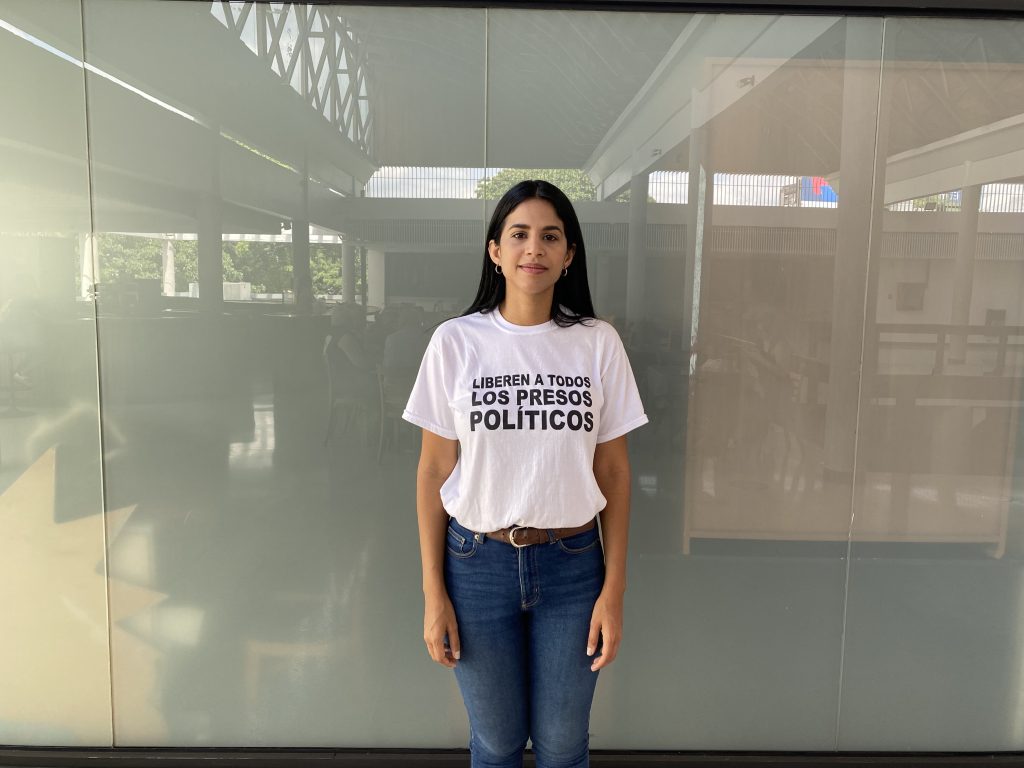
“We knew our father’s imprisonment and death would change us from within,” Baduel says, wearing a t-shirt that reads “Ser Baduel No Es un Delito” (“Being a Baduel Is Not a Crime”). “We understood it would either bring up the best of us, or the worst of us. And we decided to confront it with faith and hope.”
Brutal Torture
Years before Baduel’s death, two of his sons—Raúl Emilio Baduel and Josnars Adolfo Baduel—were also imprisoned over conspiracy charges. Raúl Emilio, now 45, was detained while attending a peaceful protest in 2014, and released four years later. Josnars Adolfo, now 37, was detained in 2020 and sentenced to 30 years in prison, which he’s currently serving at Rodeo Uno, also known for its brutal torture of prisoners.
“He is imprisoned in a cell of two square meters, where he only has a cement bed and a latrine,” Baduel says. “They physically torture [him]—they beat him, suffocate him, and use electric [torture] on him.” She also says she’s only able to speak to Josnars for 15 minutes each week, from behind a glass wall. “They want to annihilate him, and make other prisoners scared of what awaits them,” she says.
Despite facing an onslaught of harassment, death threats, and government surveillance, Baduel plans to keep fighting. Recently, she received support from The Inter-American Commission on Human Rights, who granted her precautionary measures “in the belief that she faces a serious, urgent risk of suffering irreparable harm to her rights to life and personal integrity.” But while there is still no guarantee that her rights will be respected under the current regime, Baduel believes that she and the many other women stuck in the same fight as her are “a fundamental pillar” in defending human rights in Venezuela. “I am the voice of my family,” she reiterates, ”and of all the victims of this regime who are in prison, and who cannot speak for themselves.”
Constant Fear
Sairam Rivas, 32, is another Venezuelan activist fighting for a loved one who she says was unjustly imprisoned by the regime: Her partner, Jesús Armas, 38, has been imprisoned since December 2024.
Rivas is also a former political prisoner herself. In May 2014, while attending Caracas’ Central University of Venezuela for social work, Rivas, then a leading student organizer, was a part of a public camping protest in the capital’s streets. They were speaking out against the militarization of public space, and protesting the recent deaths of multiple young protestors at previous demonstrations. Along with 200 other young people, Rivas was arrested and later incarcerated at El Helicoide, the same prison as Raúl Baduel. With support from her university and international NGOs like PROVEA, Amnesty International, and Foro Penal, she was released after five months, unlike other young people detained that day, some of whom she says were imprisoned for up to three years.
“But the [political] situation then was different to what it is now,” Rivas says. “Back then, we could hire private lawyers, and there were no forced disappearances of dissidents.”
Sairam Rivas. (Photo courtesy of Sara Cincurova.)
She also says she believes the only reason she was not subjected to sexual violence and torture is because her imprisonment was “very famous.” “As a student leader, my case had a lot of visibility on social media among young people,” she explained. The notoriety of her case did not avert all ill-treatment, however. “We had to sleep handcuffed on the floor,” she says. “We were threatened to be transferred to harsher prisons and face torture if we continued to protest in the future.”
A decade later, on June 10, 2024, Rivas would experience a new horror: Her partner, Jesús Armas, was nowhere to be found. Neither she nor his family had received any information about him for seven days, only to discover he’d been “kidnapped” by the government.
Armas had been a part of María Corina Machado’s campaign team, and as punishment following the 2024 election, he was detained, interrogated, imprisoned, and then tortured by Maduro’s regime.
“At this moment, Jesús is still isolated in El Helicoide, and doesn’t have any contact with me or his family,” she says. “The feeling of fear is [constant] in Venezuela, but you cannot think about it because then you become paralyzed.”
Rivas is acutely aware of the pain many Venezuelan women experience, not only as prisoners, but often, as the caretakers and public resistors on their family’s behalf. But she also notes that many Venezuelan women are transforming this pain into action. As she sees it, beyond activism, women must also take on key roles in the opposition, as Machado has, and lead movements that will restructure the civil and political order destroyed by the dictatorship. “Women have a crucial role to play in the construction of a movement of families of political prisoners—a movement that not only fights for their freedom, but also for the creation of historical memory, so that justice can be done and [similar] crimes are never repeated,” she says.
A Venezuelan university professor of social sciences, who also requested anonymity for fear of retaliation, echoes Rivas’ assessment that it is a particularly scary time. She tells The Conversationalist that “every [new] day has become a possibility of chaos.” But despite the enormous risks, women across the country continue to fight however they can.
“After having spent my entire active life as a professor at the Central University of Venezuela, it is very difficult to keep my mouth shut when I see how [our] country is being destroyed,” she says. “But when you open your mouth, [the government] can come and look for you—regardless of whether you are young or old, or whether you live in a middle class or lower class area.”
According to the professor, women’s rights violations have a long, multifaceted history in Venezuela. “More covert at one time, more open at another, more hidden in some places, more open in others—it is permanent and constant,” she says, adding that political prisoners are always treated worse than other prisoners, especially those detained for democratic activism.
Still, fear of imprisonment has not silenced opposition to the government for some, despite the potential cost. As Machado recently wrote on X—while still living in hiding within the country's borders––in the face of a brutal dictatorship and the suffering, torture, and extrajudicial killings it has caused, Venezuelans have continued bravely forging a “formidable civic movement,” overcoming the barriers “the regime built to divide us.”
For Baduel, the years of persecution, and witnessing her family members being tortured, also forced her to confront a personal choice: “to become the best version of myself, or the worst.”
Despite her suffering, she says she deliberately chose to cultivate her humanity, something necessary in the continued fight. “I decided to transform my life for the better, not for the worse,” she says. “To fight for justice in Venezuela; to demand accountability, and to build a historical memory for my family and all those who were tortured.”
[post_title] => The Fight to Free Venezuela's Political Prisoners
[post_excerpt] => How women play a crucial role in the country's struggle against dictatorship.
[post_status] => publish
[comment_status] => closed
[ping_status] => closed
[post_password] =>
[post_name] => venezuela-dictatorship-activist-adreina-baduel-raul-isaias-caracas-prison-political-persecution-sairam-rivas-jesus-armas
[to_ping] =>
[pinged] =>
[post_modified] => 2025-12-16 08:26:28
[post_modified_gmt] => 2025-12-16 08:26:28
[post_content_filtered] =>
[post_parent] => 0
[guid] => https://conversationalist.org/?p=9814
[menu_order] => 0
[post_type] => post
[post_mime_type] =>
[comment_count] => 0
[filter] => raw
)