WP_Post Object
(
    [ID] => 10700
    [post_author] => 15
    [post_date] => 2026-07-08 22:54:49
    [post_date_gmt] => 2026-07-08 22:54:49
    [post_content] =>
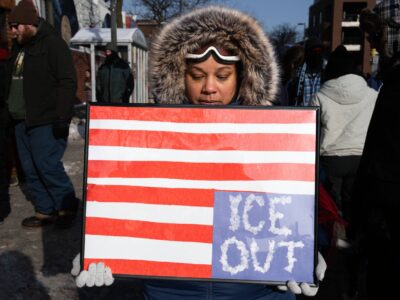
In their own words, how people in Minneapolis, New Orleans, and Los Angeles are still showing up for their neighbors in the fight against ICE.


Minneapolis, MN — Molly M.


In early December, kids stop coming to school. My daughter’s third grade class shrinks from 22 to 15, then eight. Over the next two weeks, a handful of parents and teachers raise funds for Christmas gifts and toiletries; organize rides; deliver big hunks of meat, tortillas, eggs, and beans. Families begin planning to send their kids back to school after the holidays. After my final food and supply delivery, I pat myself on the back. Wow, look at us. We did it!


Then, three days after winter break, Renee Good is shot in the face a mile from our house. ICE agents indiscriminately teargas a nearby high school. The city of Minneapolis cancels class for the week. The district announces distance learning for children terrified to leave home. I arrive at school to help organize tablets, Chromebooks, hotspots, and food. Hundreds of brown paper bags fill the room adjacent to the cafeteria; 175 students at my child’s school have opted into distance learning, and every single one needs something in this room. Our principal hovers over a spreadsheet. This is the craziest shit ever, she mumbles under her breath. I see a teacher crying, then another.


I deliver supplies to four families. At the first stop, an apartment building above a Somali shopping center, a masked ICE agent marches past me. I’m a blonde, white, middle-aged woman carrying three grocery bags; I’m his sister, his cousin. I’m someone he knows from high school. I take the elevator to the seventh floor and hand everything to a terrified mother who hasn’t left her apartment, or her children, in weeks.


"The news cycle has moved on. We have not."


The version of me that existed way back in 2025 could not fathom what we’ve pulled off in the months since. A small team of parents and educators raising over a quarter of a million dollars for rent, utilities, legal fees, groceries, hygiene products. We’ve organized food and supply deliveries for 75 families. We’ve patrolled the streets around school, scanning for ICE vehicles while simultaneously smiling at children—letting them know Everything will be fine! As if we know.


Operation Metro Surge ended in February, but did it? The week Tom Homan announced the departure of 700 ICE agents from Minneapolis, three parents at my kids’ school disappeared. ICE has merely changed tactics—they’re quieter, less overtly violent, but they’re still here. The news cycle has moved on. We have not.


Our mutual aid group is exhausted, as is every other one just like ours. We’re just regular people, primarily moms, with regular jobs and responsibilities—cooking and cleaning for our own families, caring for aging parents, driving our kids to swimming lessons. Teachers should be focused on instruction, not learning the habeas petition process or figuring out a 1:1 tutor to help homebound kids desperately behind. They should not be scrambling to find emergency mental health services for children.


For the families we’re supporting—our kids’ friends and classmates, their parents, their siblings—things aren’t even close to normal. They’ve depleted their savings. Parents have lost jobs, and even if a position is being held for them, many businesses teeter on the brink of closure, unable to offer the hours required to support a family.


Yes, Minnesotans deserve accolades for showing up 50,000 strong to protest on the coldest day of the year. And frankly, I think we deserve that Nobel Peace Prize, too. But the fight is not over. Springsteen has left, and what remains is the basic, boring, unsexy work of feeding people and keeping them in their homes. And because no one else is coming to save us, we will continue to fight ICE ourselves, one $20 donation, one box of diapers, and one carpool at a time.


New Orleans, LA — Rachel T. (Unión Migrante)


Last December was a hurricane of emotion. Agony. Terror. Heartbreak. You can't unhear girls sobbing as their dad is taken away by masked agents.


But New Orleans weathers every storm of government abandonment. People are used to helping their neighbors survive, and that includes helping immigrants remain in our city.


Our system is called Ojos (Eyes). It works in limitless chats and social media posts on Facebook, TikTok, WhatsApp, wherever. Neighbors share information about ICE and police activity: the exact location, a time stamp, a description. We communicate verifiable, protective facts, not fear. Community “dispatchers” comb through group messages, call eye witnesses, and signal boost confirmed alerts in Unión Migrante forums. Allies head to the scene to film, sometimes exposing ICE live, often just arriving to post “DESPEJADO” once ICE leaves, so folks can transit there again.


Ojos is operated by everyone at once, in real time. Thousands of people participate. Some are confined to their homes for their safety. Some are citizens who parked up in churches, bars, and Mardi Gras krewe warehouses every day and night but Thanksgiving during the height of the Border Patrol occupation.


In a state where the Attorney General threatens prosecution of anyone who “interferes” with ICE arrests, we remind our participants that we're not impeding ICE’s operatives—the Constitution is; we just witness. We’ve learned to peacefully, legally, safely and effectively film and expose ICE and police, without getting Obstruction of Justice charges.


Limiting ICE’s ability to make arrests is paramount—we can't pay rent for everyone in the city for as long as these attacks may continue. People have to go to work. Rather than falling short with a finite band-aid of charity on these deep wounds, peaceful confrontation slows harm at its root.


"You can't unhear girls sobbing as their dad is taken away by masked agents."


We can't stop every arrest. But we can do a lot. Beyond alerts, Ojos educates followers on our rights to demand a warrant, to remain inside, to maintain silence, to film. Peaceful filming in the streets becomes a daily protest broadcast live as soccer moms, bartenders, and tech workers film ICE and Kenner cops, and then share their own families’ immigration stories on Facebook Live—Sicilians who fled gang violence not unlike in Honduras’; Jews who were kidnapped off the streets in broad daylight. It changes the public narrative.


Footage has aided civil lawsuits and deportation defense. Ojos led a 14-hour stand off between neighbors and ICE agents and cops at a trailer park in red voter Hammond, a suburb north of New Orleans. There were solidarity pizzas, politicians, journalists, thousands of viral views, and substantially fewer arrests than might have happened without so many ojos watching. Hammond’s City Hall exploded with vitriol against the agreement of local police collaborating with ICE in the aftermath.


Putting our bodies publicly and peacefully on the line isn't just about keeping our neighbors here. It's about keeping our democracy. I know this personally: Federal agents have come to my home to intimidate me. An eerie echo of the state violence I hear in the asylum interviews I interpret for. It’s the same violence my child’s father endured when he was beaten and wrongfully arrested while filming ICE, profiled as an undocumented Hispanic construction worker, though he's a citizen.


But We The People create our government and our reality. We the People of New Orleans choose love and peaceful, public, unified resistance, rather than cowering in fear and doom-scrolling in isolation. This choice is the future of our democracy. We hope others choose it, too.


Los Angeles, CA — Bitta S. (Mar Vista Voice)


When immigration raids intensified across Los Angeles last summer, almost every day seemed to bring another report of a neighbor’s disappearance. On the Westside, where I live, a beloved paletero was detained while selling ice cream on the street corner. Immigration agents kidnapped workers from a local car wash and day laborers outside a Home Depot. Neighbors reported seeing ICE vehicles staging at familiar shopping centers and church parking lots, turning ordinary places into sites of fear and uncertainty.


Suddenly, families across the city were faced with impossible choices, and many stopped working because they feared they would be next. Others returned to work because they felt they had no choice: The alternative meant falling behind on rent and risking their ability to support their families.


Like many, my neighbors and I wanted to do something concrete to help. Around that time, we saw that Ktown For All, a mutual aid organization in Koreatown, had begun buying out street vendors, and had published a guide explaining how other communities could do the same. That was the moment it clicked. Mutual aid is strongest at the hyperlocal level, where trust already exists and people can stay connected long after the immediate crisis has passed. We didn't need to invent something new to support and protect our neighbors. We could learn from organizers who had already done the work, and adapt it to our own neighborhoods.


As ICE raids have continued into another summer, street vendors remain among the workers most exposed to immigration enforcement. Their livelihoods depend on being visible in public spaces, often in the same locations every day. Many are women balancing the work of running a small business while caring for children and supporting their families. When those spaces become unsafe, they lose the ability to earn a living at all.


"Mutual aid is strongest at the hyperlocal level, where trust already exists and people can stay connected long after the immediate crisis has passed."


Our idea was simple. If the community could temporarily replace a vendor's lost income, that vendor would have one less reason to choose between personal safety and paying the bills. We started by visiting vendors we already knew. As the project grew, we partnered with local rapid response networks whose trusted community relationships helped us reach many more vendors than we ever could have on our own.


We expected to help a handful of people here in Mar Vista. Instead, our work has expanded to the entire Westside.


When we first started Westside Vendor Buyout, we realized almost immediately that the challenge wasn’t convincing people to care. It was giving people a tangible way to turn their concern into action. Hundreds of neighbors donated, and volunteers stepped up to contribute however they could. Some helped with translation or behind-the-scenes support, while others connected us with families we never would have met otherwise.


As we spent more time with vendors, we began to understand that the raids were doing far more than sowing fear. They were destabilizing entire households and livelihoods. Vendors described living day to day as plummeting sales turned to mounting debt and missed rent payments. One mother told us her son had considered leaving college because weeks of lost income made it impossible to keep up with household expenses. Another vendor received an eviction notice after staying home because she was too afraid to return to the corner where she had built her business. As customers disappeared, neighborhood businesses struggled.


We had originally imagined the Vendor Buyout as an emergency fund, but every conversation revealed another way the community could help. We created a Hire a Vendor program so neighbors could continue supporting local vendors whenever they needed food for an event. When families faced eviction, we organized emergency fundraisers to help keep them housed. We also partnered with community organizations to host tenant rights clinics and organized a Thanksgiving gathering where we broke bread with vendors and their families, shared groceries and holiday gifts, and spent time together outside the pressures of work and immigration enforcement. The gathering met immediate needs, but it also gave people a chance to get to know one another and build relationships that couldn't be forged through a cash transfer alone.


"We weren’t starting from scratch, but instead joining a much larger tradition of community care."


One of the most important lessons has been recognizing that our efforts did not emerge in isolation. Long before the current wave of raids, immigrant communities across LA were already building rapid response networks to combat years of immigration enforcement, creating trusted systems for sharing information and supporting families in moments of crisis. At the same time, mutual aid networks have expanded across the city, especially in response to the COVID-19 pandemic and the 2025 fires, creating new ways for neighbors to care for one another. We weren't starting from scratch, but instead joining a much larger tradition of community care, and have continued learning from those who have been doing this work for years.


Today, whenever possible, we also use Buyout funds to purchase food from participating vendors for mutual aid efforts already happening across the city. A contribution meant to support immigrant vendors can also help feed unhoused neighbors at a local distro or help sustain another community organization. It’s the main lesson I think we'll all carry forward, even long after ICE has left. The strongest mutual aid isn't a collection of disconnected projects. This work is about building a network of relationships where each act of solidarity makes the next one possible.


    [post_title] => Helpers On the Ground
    [post_excerpt] => In their own words, how people in Minneapolis, New Orleans, and Los Angeles are still showing up for their neighbors in the fight against ICE.
    [post_status] => publish
    [comment_status] => closed
    [ping_status] => closed
    [post_password] =>
    [post_name] => helpers-on-the-ground-protest-mutual-aid-community-organizing-ice-raids-immigration-border-patrol-arrests
    [to_ping] =>
    [pinged] =>
    [post_modified] => 2026-07-09 00:26:22
    [post_modified_gmt] => 2026-07-09 00:26:22
    [post_content_filtered] =>
    [post_parent] => 0
    [guid] => https://conversationalist.org/?p=10700
    [menu_order] => 0
    [post_type] => post
    [post_mime_type] =>
    [comment_count] => 0
    [filter] => raw
)