Communities directly affected by a mass shooting don't just get to move on when there's another one.
I was a junior in high school when I first imagined dying in a mass shooting. It was 1999 and two young men had murdered 12 of their fellow students and one teacher at Columbine High School in Littleton, Colorado, 1,500 miles from my hometown of Buffalo, New York. A few weeks after the slaughter, a schoolmate burst onstage at an assembly. He was wielding a Super Soaker and wearing a trench coat, the Columbine killers’ signature clothing item. He thought it was funny. Those of us who’d spent that spring mapping out escape routes in our heads were less amused.
On the eve of my 40th birthday, I’ve been thinking about that episode a lot. Columbine stood out in 1999 because it was then the deadliest school shooting in U.S. history, the killers ending more than ten lives at once. Once a grim milestone, it now seems relatively small in scale. While roughly as common as they were in the 1990s, mass shootings have become deadlier and more prominent in the age of social media: Gunmen killed 60 people in Las Vegas in 2017; 49 at Orlando’s Pulse nightclub in 2016; 32 at Virginia Tech in 2007; and 26, including 20 first graders, at Sandy Hook Elementary School in Newtown, Connecticut in 2012. Back when I was in high school, these shootings didn’t seem so sickeningly normal.
I was sheltered enough then that I didn’t think about dying every day. Like lots of other kids, my anxiety spiked when I read about Columbine or heard about it on TV, but I didn’t really believe that something like that could happen where I lived or went to school. People frequently die of gun violence in Buffalo—a fact I was only dimly aware of as a teenager—but I invented all kinds of reasons why my classmates and I were exempt from the kind of random mass killing that had taken place at Columbine: New York has tougher gun laws than the rest of the country; my high school was small and close-knit; and, like most sheltered adolescents, I simply didn’t believe that people my age could die. As one high school friend put it, “I definitely didn’t internalize Columbine as a real risk for us. That was something crazy people in other places did.”
For a long time, it felt as if my friend was right. Our city was scarred by everyday violence, but for decades it escaped large mass shootings of the kind that happened at Columbine. Earlier this month, I was grabbing lunch at a diner in Providence, Rhode Island, when I overheard some customers chatting about a local shooting. “Not too many people get shot who haven’t put themselves in harm’s way,” one guy tut-tutted, expressing a belief many Americans still hold. It’s comforting to believe you can avoid violence by being smart and doing right, even when there’s plenty of evidence to the contrary.
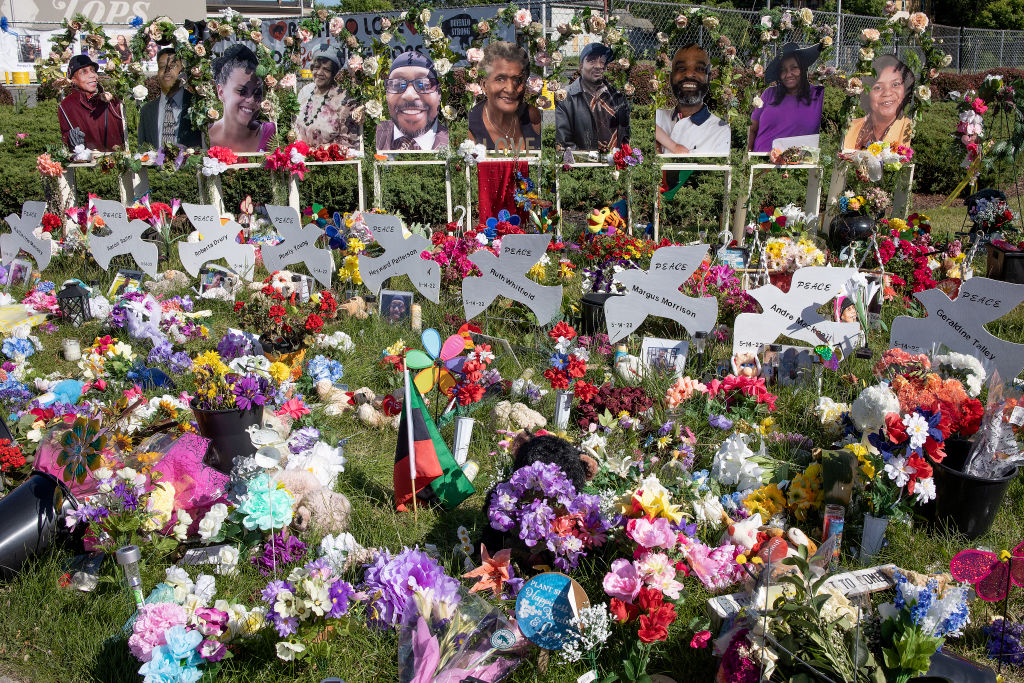
Buffalo’s luck ran out in May, when it became the latest American city to experience a deadly mass shooting, this time at a Tops grocery store in a predominantly Black neighborhood. Ten people were killed, victims of a targeted, anti-Black hate crime. No decent person would suggest that the victims had “put themselves in harm’s way” by shopping for groceries in the middle of the afternoon. But whether an act of violence feels random and haphazardly cruel or personal and targeted only really matters to those left behind. It makes no difference to the dead.
One of the cruelest aspects of the way we live now—always bracing for the next horrific headline, believing this kind of violence is inevitable because we are told over and over again that it is—is the way all of these massacres, no matter how shocking or deadly or racist or cruel, soon become old news to everyone but those most directly affected. Occasionally they reappear in headlines on anniversaries, or as benchmarks to help contextualize the latest mass shooting. Even the phrase “mass shooting” has acquired a leaden deadness; it’s become so common that it has lost the power to shock and horrify. Before those who lost children and parents and spouses and friends can even keep food down again, the rest of us have already moved on.
Andrew Lichtenstein/Corbis via Getty Images
“5/14,” the date of the Tops massacre, has become the equivalent of “9/11” for Buffalonians—a grim shorthand for a community-altering event that few outside of Buffalo would immediately comprehend. When I first heard about the shooting, I cried for two days. My sister-in-law used to shop at that Tops; it’s a mile and a half from my parents’ place. There were vigils and rallies and fundraisers. President Biden showed up to denounce the “poison” of white supremacy. Then we tried to move on. We have come to believe that those not directly affected by a particular mass shooting have to move on; it’s the only way to grasp a few moments of peace before the next one.
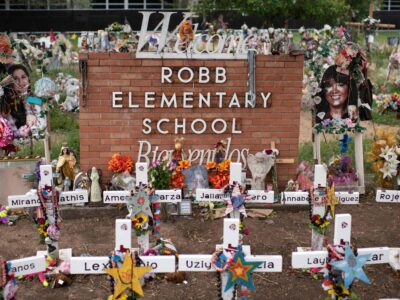
The respite was short-lived. Ten days after the murders in Buffalo, an 18-year-old man killed 19 children and two adults at Robb Elementary School in Uvalde, Texas. In both cases, the shooter was an 18-year-old man, the weapon of choice was a legally purchased AR-15-style rifle, and communities of color were the target. The killer in Buffalo was a young white man who targeted Black people; the killer in Uvalde was a young Latino man who targeted Latinos and was likely inspired by the massacre in Buffalo.
It’s impossible to stop thinking about something that never stops happening.
Six months on, residents of Buffalo and Uvalde are feuding over how much of the money raised by various victims' funds is going to which victims. Some Uvalde families believe that only those who lost children should be entitled to compensation. At a recent meeting in Buffalo, survivors of the Tops massacre made the opposite argument. Several argued that the people who died were at peace now, while they still had bills to pay and trauma-related symptoms that make it difficult or impossible to go back to work. Some former Tops employees shared stories of forcing themselves to return to their workplace, which now doubled as the scene of a shattering crime. Most couldn’t make it through an hour. Many of the children who watched their friends die in Uvalde have found it difficult or impossible to return to school. They suffer panic attacks, scare easily, and have trouble sleeping. Hundreds of U.S. parents have lost the power to give their children safe and normal childhoods.
In Buffalo, survivors have complained of being promised substantial financial assistance from a $2.9 million victims’ fund, then fobbed off with gift cards and meal vouchers. Worse than the inadequate disbursement policies of a particular fund is the abandonment of a community by the institutions meant to serve and protect it. In Uvalde, where the cowardice and incompetence of local police and other law enforcement officers may have cost children their lives, Governor Greg Abbott announced the opening of a center meant to provide the community with long-term mental health services. The mother of a little girl who survived the massacre toldThe Washington Post that no staffers were there when she stopped by the center to request gas vouchers. “It’s so frustrating,” she said. “Like, I know how this system works. And as an educated person, I see how they’re trying to take advantage of all these families…I knew it was gonna happen. Resources here are so limited. They were limited prior to this. And it was obvious to me this morning that there was no one that could help when we needed it.”
Adding to their trauma is the fact that survivors are now pitted against one another in a Hunger Games-style competition for artificially meager resources. A state government that cares for its people would fully fund its schools and mental health services, ensure families have a basic income, and provide free therapy to traumatized children that parents don’t have to drive for miles to access. A responsibly run charity would seek guidance from the community it is ostensibly serving and be open and transparent about its resources and who can expect what.
Instead, the thousands of people in this country who have been traumatized by a mass shooting—who were there when it happened, who were shot but survived, who lost children and parents and spouses and friends—get thoughts and prayers. They get to talk to high-profile reporters for a few days or a week. Their kids get therapy every other week, sometimes for as little as 15 minutes per session. Maybe they get a couple of gift cards or a meal voucher. After every mass shooting, we vow to support the victims, yet more often than not, what they end up getting is staggeringly inadequate. Meanwhile, the rest of the country moves on. And all these communities are left with is the pain of being associated with the worst thing that ever happened there: “Buffalo” now evokes a brutal hate crime more than football or chicken wings or snow.
On December 14, the Sandy Hook parents, with the exception of those who couldn’t bear to go on living, will have survived a decade without their babies. November 14 marked six months since the Buffalo massacre. The six-month anniversary of the Uvalde shooting falls on Thanksgiving. This year, I am thankful for my friends and family, and the fact that we survived another year in a violent, fraying, heartless country ruled by people who would rather let children smear blood on themselves and play dead than ban assault rifles.
The day this essay was commissioned, there was a mass shooting at the University of Virginia that left three young men dead. Two other students were injured, one by a bullet that went through his back and lodged in his stomach. He is expected to survive, which in this country counts as luck. Two days after I submitted a draft, a 22-year-old man shot up an LGBTQ club in Colorado, killing at least five people and injuring 25 others. The morning after I submitted a final draft, a gunman killed six people and himself at a Walmart in Chesapeake, Virginia.
What is a life worth? What about the lives of three people, or ten, or 12, or 60? We have reached a point where we can’t process the unique horror of any single massacre, let alone deal with the social fallout, before the next one comes along. And until we meaningfully restrict access to guns in the United States, there will always be a next one. That sense of inevitability has led to a pervasive hopelessness that compounds this uniquely American trauma. It is daunting to mourn each life lost, each family broken, each childhood marred, each marriage strained and severed. But that’s what we need to do, and we need to do it while fighting to dismantle the anti-democratic institutions preventing us from ending this carnage. We have to stop moving on from what those who lost loved ones, the use of limbs, or the will to live can never move on from. We have to confront the true cost of these killings: to victims, survivors, society, and every human being with a soul.
[post_title] => Buffalo and Uvalde, Six Months Later
[post_excerpt] => Communities directly affected by a mass shooting don't just get to move on when there's another one.
[post_status] => publish
[comment_status] => closed
[ping_status] => closed
[post_password] =>
[post_name] => buffalo-uvalde-shooting-six-month-anniversary
[to_ping] =>
[pinged] =>
[post_modified] => 2026-08-04 20:08:10
[post_modified_gmt] => 2026-08-04 20:08:10
[post_content_filtered] =>
[post_parent] => 0
[guid] => https://conversationalist.org/?p=5337
[menu_order] => 102
[post_type] => post
[post_mime_type] =>
[comment_count] => 0
[filter] => raw
)
A survey of 12-year-olds to early 20-somethings in the US.
This article is a companion piece. If you’re curious to learn how older people feel about the state of the world, click here.
We’re more than two years deep into a pandemic, and if it feels like we’re moving backwards, it’s because in many ways, we are.
In 2022 alone, there have been over 300 mass shootings in the US. Earlier this summer, in a historic decision, the Supreme Court overturned Roe v. Wade, immediately impacting the reproductive rights of millions. Meanwhile, global temperatures have reached dangerous, record-breaking highs, and if we squint into the horizon, all signs point to an imminent recession, where young people seeking employment will undoubtedly be among those hit the hardest.
Oh, and did we mention we’re still living amid a deadly virus that continues to take lives each day?
The Conversationalist asked young people from various parts of the country their thoughts on the state of the world right now. Which issues are overwhelming them the most? What kinds of discussions are they having with their friends? How do they feel about the future? Is it all doom and gloom?
Here’s what they had to say, in their own words.
~
“Turning on the news and seeing the violence in this world is not a surprise anymore. It's not even sad because I expect it. What scares me now is going to places where I can't find the nearest exit if I need to flee quickly. My home city of Chicago is now looked down upon by America as crime central. When I tell people I live in the suburbs of Chicago they gasp as if I'm in danger.
I remember flinching at school when I heard a student squeeze open their chip bag, resulting in a loud popping noise. My heart skipped a beat and my mind immediately thought of the worst. Within seconds I was asking myself, Where is the noise coming from? Is it safe to stay where I am? How did the intruder get into the school? All from a kid’s chip bag making a loud popping noise. I shouldn't be thinking that way. It shouldn't be a habit for me, a 17-year-old, to look for the nearest exit in every public place I go to.
I just want to be shocked when I turn on the news channels again.”
—Amanda, 17, suburbs of Chicago
“Not only is there more fear in the world with monkeypox currently, specifically in New York, climate change is also only giving us about eight more years before there is no turning back. This is extremely worrisome because Americans aren’t doing anything about this and we only have so much time before our ecosystems become more fragile than ever.
Overall, as someone within the generation that has to suffer most from these current issues, this is very concerning for not only our well-being but our physical health. We need to take the appropriate measures to prevent further conflict.”
—Juliette, 15, New York, NY
“I’m finishing up my senior year in the fall at Penn State University. From my vantage point, the recent Dobbs decision has stirred up an immense amount of emotion from all sides of the spectrum and both sides of the coin, so to speak. College-aged women and female students that I interact with are overwhelmingly disturbed and frightened—they are fired up and want to help right the ship to protect abortion access for themselves and, in the case of the few pro-life women, for others. I work in local political organizing and one way to communicate with pro-life women in particular is to remind them that while they may not choose to have an abortion, their friends may face situations where they need one—and bringing the hot-button issue to a hyper-personal level really helps some people understand that they should not be so anti-choice.
For men, a general sense of confusion and passive worrisome behavior is the vibe that I’m getting. My guy friends in particular tend NOT to be split among party lines with abortion—a lot of them think it’s stupid to tell women they can’t do something, while others are afraid that their female partners may not have the birth control/contraceptives they need to continue a sexual relationship.
My fear is that despite the level of concern and anger at this decision, people my age will not care enough to vote in the large numbers that we need to actually change things. [We] can’t change SCOTUS, but can sure as hell change our state legislatures and Congress. That’s why I’m getting as involved as I can to spread the word to students and folks my age that this election is undeniably the most important of our lifetimes, and that at the very least you need to vote.”
—Josh, 21, State College, PA
“With everything happening in our political climate, the one word that can't escape my mind is 'division.’ With all of the constant discord going about through the media, it's hard to ignore.
I've noticed that the in-person conversations I've shared with people of differing views from me have been much more productive than online ones, whether it be in my classes or at group hangouts. I believe a considerable problem our generation is facing is a lack of personal connection stemming from social media playing a much more significant role in our day-to-day lives. The more that I've realized the adverse side effects of social media, the more attempts I've made to stray away from it. I've deleted Twitter, TikTok, and Facebook with the goal of doing away with it entirely. It's too stressful and time-consuming, and I've also found my mental health to be better in my time away from it.
I can't help but have my worries about our society's collapse. It's very taxing on me to see so much nonstop negative news.”
—Tommy, 18, Worthington, OH
“I’m feeling a bit agitated with how we talk about mental health on the internet and social media lately. I’m not saying that mental health awareness is bad. I just think that with anything that becomes mainstream, it loses any much-needed nuance and seriousness. And that’s what has happened with mental health awareness. You can see it happening in so many forms, whether it’s brands trying to capitalize off of it, down to those stupid ‘Little Miss Whatever’ memes, or any other insert-yourself-here gimmick. All of it totally downplays how serious mental health is and buries any useful resources, turning mental health awareness into another throwaway talking point.”
—Margot, 19, Boston, MA
“I live in Jacksonville, Florida but attend school in Ohio. I’m pursuing a degree in fashion and am thankful that most opportunities in fashion do take place in more blue states like New York and California. However, that doesn’t take away my fear of what the future holds.
While New York, specifically NYC, and California are states that I believe do well in protecting the rights of their citizens, they are also some of the most expensive places to live. Fashion is not one of the best industries in terms of high salaries and affordable wages––at least compared to the cost of living in the places where the industry is best established.
But even more than that, reproductive rights are a major concern for me. The mere thought of me unintentionally getting pregnant and not even having the option to decide how I want to go about my health has me petrified and runs through my mind constantly. I’m truly at the point where I don’t think I’m even going to consider looking into jobs and companies that are located in red states. To make matters worse, we’re living in a system ruled by a Supreme Court that just took a major blow to combating the climate crisis and agreed to hear a case that heavily impacts voting rights, which would just be another major step in the seemingly decline of democracy.
I’m very worried about the future, which really sucks because I feel like this is the time that I should be looking forward to it the most.”
—Janelle, 21, Jacksonville, FL
“Over the past few years, the world has felt pretty bad and it’s not getting much better. The government is corrupt; politicians are bad. I’m just resigned to it. I don’t really know how I could change anything. All politicians suck (sorry). It feels like things have been bad forever.”
—Charlotte, 12, Los Angeles, CA
“Everything and everyone right now is so polarized. Most people are arguing for or against things that they don’t know the half about. We are being served all of our information through the media and most of it is altered and incorrect. People form opinions on misinformation and stick to them while being blind to any opposing information. We have to be more open to hearing others' ideas in order to function as a united front.”
—Kate, 18, East Lyme, CT
“It's pretty easy to feel despair about the big national issues as it really seems like there is nothing we can do to stem the flow of environmental and human rights catastrophes coming down from a federal and corporate level. That said, I feel hopeful about local politics.
I hear a lot of talk about urban issues in my peer groups, mainly how to deal with cars-as-default politics in urban planning and policy while promoting alternatives for local transport. While this also feels futile sometimes, there are always silver linings and improvements being made to help bring American cities up to snuff, which in turn seems like a way to help the battle against climate change AND improve quality of life across the board.”
—Nicholas, 21, Memphis, TN
“After the events of the last few months I have really felt a crushing fear settle under my skin, wherever I am––at a parade, my school, or the grocery store. It has become harder and harder to listen to the news, to force myself to feel the reality of the crushing headlines, both afraid of the state of the country and afraid of becoming numb to it.
Being a teen right now is a minefield of double edged swords; between finding comfort in social media and absorbing yourself in saddening discussions, and learning how to become an adult while having massive gaps in the teen experience from the pandemic. I feel young and afraid to grow up in a world where my rights are in question and where there is not a path in sight leading to true freedom. I am as helpless as our elected president, sadly tweeting about what I wish I could fix about our country.”
—Carley, 17, Romeoville, IL
“I feel like the world is moving forwards and backwards in different ways. Some things are being improved such as tech and medicine, and some things may be struggling to improve such as plastic in the ocean or people littering. [But] I believe that people should still take precautions with COVID.”
—Spencer, 13, New York, NY
“I think it’s impossible not to feel somewhat hopeless at the moment, especially if you’re an activist or politically ‘in-the-know’ circle. I work in education consultancy and research and have done so since I was 15, so I am no stranger to a challenge. Kentucky was not exactly the most conducive environment to the work I was attempting to do. So I guess today's current state of affairs does not strike me as too abnormal.
I understand this is not the prevailing view amongst my peers, especially in California. But I honed my chops in this work when Kentucky had a governor who openly wondered about drowning teachers, who loosened gun restrictions, and who attempted to gut our teacher pension system. Today's battles are not any different from yesterday’s; they are just as severe and not any more severe. But that assumes you were fighting yesterday’s battles and a lot of my peers weren’t. A lot of them gained political and social consciousness relatively recently and have nothing to compare today's climate to. I would never blame them for that, and I do not think that lessens the importance of their voices. But it does mean these activists need to take a step back from their work to frame it in historical context.
The Civil Rights Movement, the LGBTQ movement, the fight for Roe; these movements led to large scale social changes in the face of unprecedented challenges. We should be taking strategic guidance from these movements to provide us with that roadmap to social change. It’s like if we were playing chess and constantly losing to the same guy, yet when we stopped and looked at the table next to us, we see the same guy losing to someone else. By taking that step back, we are able to observe a successful strategy to counter that would not have come out of our frustration. If we just keep attempting the same strategies over and over to create social change, without drawing from successful historical examples, we are destined to lose.
This is why I have hope in the midst of such despair. Because I understand much of our despair has to do not with the particular situation we find ourselves in and more with our outlook on this situation.”
—Will, 21, Somerset, KY
[post_title] => How Do Younger People Feel About the State of the World?
[post_excerpt] =>
[post_status] => publish
[comment_status] => open
[ping_status] => open
[post_password] =>
[post_name] => how-do-younger-people-feel-about-the-state-of-the-world
[to_ping] =>
[pinged] =>
https://conversationalist.org/2022/08/31/how-do-older-people-feel-about-the-state-of-the-world/
[post_modified] => 2026-08-04 20:42:06
[post_modified_gmt] => 2026-08-04 20:42:06
[post_content_filtered] =>
[post_parent] => 0
[guid] => https://conversationalist.org/?p=4811
[menu_order] => 124
[post_type] => post
[post_mime_type] =>
[comment_count] => 0
[filter] => raw
)