WP_Post Object
(
    [ID] => 10356
    [post_author] => 15
    [post_date] => 2026-03-20 02:24:54
    [post_date_gmt] => 2026-03-20 02:24:54
    [post_content] => 

How samba schools in Brazil are teaching Black history through the parades at Carnival.

The torrential rain couldn’t stop Unidos da Tijuca, one of the oldest samba schools in Rio de Janeiro, Brazil, from rehearsing in the streets. On an evening in early February, dancers flooded the Morro do Borel community, moving their bodies in unison as a crowd cheered them on, shouting their loyalty to the samba school and dancing alongside them. The crowd had been waiting for hours for the rehearsal to begin, drinking beer and barbecuing, the evening already a celebration. Now, the sound of snare drums, quick and sharp, moved each spectator to sing along to the music, as the year's anthem began to play. The performance had officially begun. 

Though the parades in Rio are world-famous, attracting a global audience for Carnival each year, the greatest show in the world still belongs to these communities, where the parades—a pivotal part of the season’s festivities—originated. It is also here that these samba schools work hard year-round to honor the parades’ original purpose: bringing marginalized histories that aren’t taught in Brazilian schools to the national stage.

“Since the 1930s, samba schools have been addressing themes closely related to Brazilian history,” historian Luiz Antonio Simas tells The Conversationalist. “This created a tradition in which Brazilian history, important figures from Brazilian history, and the country's natural beauty became recurring themes [at each parade].” 

During a street rehearsal by the Unidos da Tijuca samba school, and under heavy rain, the opening performance group performs one of its choreographies from the storyline honoring writer Carolina Maria de Jesus near Favela do Borel, in the Tijuca neighborhood of Rio de Janeiro, Brazil.
Leonardo Carrato

Founded in 1931, Unidos da Tijuca is one of 12 samba schools that compete during Carnival, each putting on a parade built from scratch that highlights a different piece of forgotten Brazilian history. For this year’s parade, Unidos da Tijuca chose to tell the story of Carolina Maria de Jesus, a Black Brazilian memoirist, poet, composer, playwright, and best-selling author, most known for her book Child of the Dark: The Diary of Carolina Maria de Jesus, published in 1960 and translated into 14 languages. Last year, the school chose to tell the story of Logun-Edé, an orisha of the Black Brazilian religion Candomblé, and the year before, the influence of Portuguese folk tales on Brazilian samba music. 

Other competing schools chose different figures to celebrate this year: Acadêmicos do Salgueiro paid homage to Carnival designer and professor Rosa Magalhães, a samba school legend who won six Carnival championships in the 1980s. The samba school Paraíso de Tuiuti performed a parade about Afro-Cuban religious practices, with a whole chorus written in the Yorubá language. And the 2026 winner, Unidos do Viradouro, honored Moacyr da Silva Pinto, or Mestre Ciça, the school's legendary percussion conductor. 

In telling these stories, Unidos da Tijuca and other samba schools aim to make marginalized histories—and Black history in particular—more accessible through popular culture, allowing them to keep these histories alive. The construction of the parade is a year-long process that starts again right after Carnival ends, beginning with each school democratically electing a theme, running a song competition, and translating history into a visual performance through choreography that involves hundreds of dancers.

But while the parades are a joyful culmination of the schools’ efforts, for the communities each samba school represents, it’s the lead-up to the final performance that often most solidifies the history being celebrated. 

During the Unidos da Tijuca samba school’s final street rehearsal, the Mestre-Sala and Porta-Bandeira wing leads a large group of members through the streets near Favela do Borel, in the Tijuca neighborhood of Rio de Janeiro, Brazil.
Leonardo Carrato

That rainy Sunday was Unidos da Tijuca’s last street rehearsal before the official parade at the Sambadrone, and party dwellers excitedly gathered to watch an intimate preview of what would later earn the school 7th place in the official competition. At 6 PM, onlookers dressed in the colors of Unidos da Tijuca—blue and yellow—waited outside of the school, a tall building painted in yellow. The energy was high as people gathered, and the song composed for this year’s parade played loudly through speakers at the closest bar, along with songs from previous years: "Logun-Edé - Santo Menino que Velho Respeita" (“Logun-Edé - The Holy Child Old Men Respect”) and "O Conto de Fados" (“The Tale of Fairies”). 

As the time for the performance neared, people began singing along to the story of Maria de Jesus, one that mirrors the stories of many Black women in Brazil today. A single mother of three, Maria de Jesus lived in the favela of Canindé in São Paulo, where she spent her time picking up recyclables to sell, taking care of her children, and writing about her day-to-day life. One of her notebooks from this time would eventually become her first best-selling book, Child of the Dark, which sold 10,000 copies in its first week of publication in 1960—an achievement that was unheard of at the time, and still rarely met in Brazil now. 

But the majority of the community was unfamiliar with these details of Maria de Jesus’s life before Unidos da Tijuca chose to tell her story for the 2026 parade. “It’s essential that we talk about a person who has been made invisible by society and by the Brazilian people,” Mariah Dantas, one of the principal dancers, tells The Conversationalist. “Almost nobody remembers her importance, or how impactful she was at the time, and how important she is today. Because many women still live in poverty like she did… This isn’t just about telling Carolina’s story, but also about highlighting that Black women still live like that, and that this needs to change.”

Many of these same women also live in Morro do Borel, and saw themselves reflected in Maria de Jesus’s story for the first time. “It was the perfect choice,” Carlos Batata, member of Unidos da Tijuca and president of Unidos da Tijuquinha, a version of the samba school for children, tells The Conversationalist. “The story was unknown, [but] with time, people got to know more about Carolina’s work, and now people sing the samba song and relate and cry to it, because there are parts of the lyrics—a phrase, a chorus—that represents each woman’s story here.” 

The children’s wing coordinator walks among the members as they prepare for the Unidos da Tijuca samba school’s final street rehearsal through the streets of Favela do Borel, in the Tijuca neighborhood of Rio de Janeiro, Brazil.
Leonardo Carrato

To accurately tell Maria de Jesus’s story, Unidos da Tijuca worked with an academic consultant on everything from the writing of the samba song’s lyrics, the design of thousands of costumes and five floats, and even some of the choreography. (The practice of hiring a consultant is relatively new across samba schools, a union of institutional education and popular education that only began around 10 years ago.) This year, Unidos da Tijuca collaborated with researcher Fernanda Felisberto, a literature professor at the Federal University of Rio de Janeiro, who is a part of an editorial committee that has salvaged, re-edited, and published Maria de Jesus’s work in recent years. 

“For a long time, we used to say that there are histories that traditional schools don’t tell, but that Carnival will tell those histories, almost as if they’re in opposition to each other,” Felisberto says. “But in reality, we are building a process that goes hand-in-hand, especially because hiring consultants has become more and more common for samba schools. So, samba schools today are learning from these traditional sources of knowledge. The challenge for Carnival is to translate that knowledge in a way that reaches more people.” 

The act of performing in community is a large part of this translation, and in Morro do Borel, it is what has brought Maria de Jesus’s story back to life. “Sou a liberdade, mãe do Canindé / Muda essa história, Tijuca / Tira do meu verso a força pra vencer / Reconhece o seu lugar e luta / Esse é o nosso jeito de escrever,” both members of the samba school and party dwellers alike screamed at the top of their lungs during the street rehearsal. (“I am freedom, mother of Canindé / Change our history, Tijuca / Get the strength to win from my verses / Recognize your place in struggle / This is our way of writing.”)

Under heavy rain, members of one of the wings of the Unidos da Tijuca samba school parade through the neighborhood streets near Favela do Borel during the final rehearsal before Carnival in the city of Rio de Janeiro, Brazil.
Leonardo Carrato

For this year’s parade, Felisberto says the school intentionally focused on lesser known works by Maria de Jesus, like the music she composed and recorded, and the plays she wrote, which remain unreleased to the public. They hoped to show Maria de Jesus was more than her biggest successes, in part so that she is recognized for the breadth of her creative work, which never got as much exposure as her first book. “We want people to understand that Carolina was a multidimensional artist,” Felisberto says. “Child of the Dark constructed an image of Carolina that spotlighted precarity, which is how people see her today. The challenge was to humanize her, show her failures and successes beyond a narrative around her best-selling memoir.” 

Like Felisberto, many view the Carnival parades not just as a celebration marginalized histories, but as a collective experience with a lasting impact. “I consider samba songs by samba schools to be historical documents,” Simas says, adding that in his 30 years working as a history teacher in public schools in Rio, he has used samba songs as pedagogical sources. “It’s a tool to start debates, we can analyze the lyrics, study the trajectory of some historical characters who are less talked about in formal education.” 

For Unidos da Tijuca member Douglas Coutinho, studying samba songs even helped him to pass his university entry exams. “My history teacher used the samba song from 2008, ‘João e Marias’ by Imperatriz Leopoldinense, [in class],” Coutinho says. “The samba song helps teachers teach, and it helps students understand the material that is being taught.”

During a street rehearsal by the Unidos da Tijuca samba school, and under heavy rain, the opening performance group performs one of its choreographies from the storyline honoring writer Carolina Maria de Jesus near Favela do Borel, in the Tijuca neighborhood of Rio de Janeiro, Brazil.
Leonardo Carrato

Perhaps most importantly, in telling and preserving these stories through samba parades, communities are able to reclaim the narrative from the dominant classes, which tend to dismiss or downplay the importance of marginalized histories. Sometimes, it also allows these stories to become the dominant narratives—at least, during Carnival, when the media’s attention turns to the communities these samba schools represent. 

“Samba schools will tell us stories that are important for the people,” says Iara Cassano, a member of Acadêmicos do Salgueiro and a samba teacher. “The dominant narratives will tell histories that are important to the elites… Carnival gives us autonomy to tell our own histories.”

[post_title] => A History Lesson Through Samba [post_excerpt] => How samba schools in Brazil are teaching Black history through the parades at Carnival. [post_status] => publish [comment_status] => closed [ping_status] => closed [post_password] => [post_name] => samba-school-forgotten-marginalized-black-history-rio-de-janeiro-brazil-carnival-parades-unidos-da-tijuca [to_ping] => [pinged] => [post_modified] => 2026-03-20 02:25:49 [post_modified_gmt] => 2026-03-20 02:25:49 [post_content_filtered] => [post_parent] => 0 [guid] => https://conversationalist.org/?p=10356 [menu_order] => 0 [post_type] => post [post_mime_type] => [comment_count] => 0 [filter] => raw )
During a street rehearsal by the Unidos da Tijuca samba school, and under heavy rain, the opening performance group performs one of its choreographies from the storyline honoring writer Carolina Maria de Jesus near Favela do Borel, in the Tijuca neighborhood of Rio de Janeiro, Brazil.
Leonardo Carrato

A History Lesson Through Samba

How samba schools in Brazil are teaching Black history through the parades at Carnival.

The torrential rain couldn’t stop Unidos da Tijuca, one of the oldest samba schools in Rio de Janeiro, Brazil, from rehearsing in the streets. On an evening in early February, dancers flooded the Morro do Borel community, moving their bodies in unison as a crowd cheered them on, shouting their loyalty to the samba school and dancing alongside them. The crowd had been waiting for hours for the rehearsal to begin, drinking beer and barbecuing, the evening already a celebration. Now, the sound of snare drums, quick and sharp, moved each spectator to sing along to the music, as the year’s anthem began to play. The performance had officially begun. 

Though the parades in Rio are world-famous, attracting a global audience for Carnival each year, the greatest show in the world still belongs to these communities, where the parades—a pivotal part of the season’s festivities—originated. It is also here that these samba schools work hard year-round to honor the parades’ original purpose: bringing marginalized histories that aren’t taught in Brazilian schools to the national stage.

“Since the 1930s, samba schools have been addressing themes closely related to Brazilian history,” historian Luiz Antonio Simas tells The Conversationalist. “This created a tradition in which Brazilian history, important figures from Brazilian history, and the country’s natural beauty became recurring themes [at each parade].” 
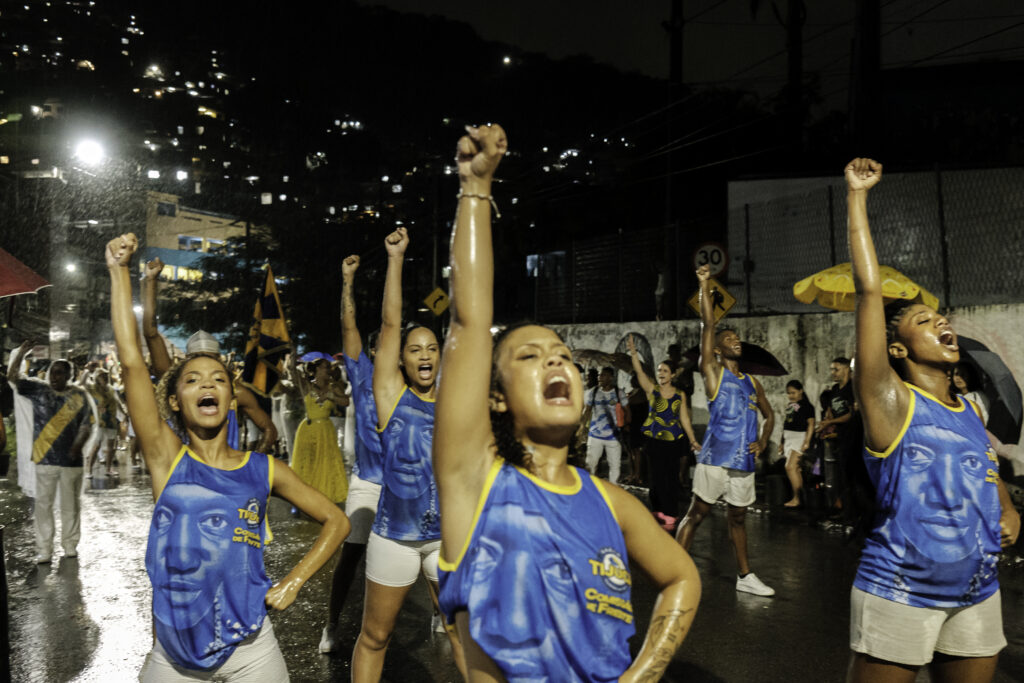
During a street rehearsal by the Unidos da Tijuca samba school, and under heavy rain, the opening performance group performs one of its choreographies from the storyline honoring writer Carolina Maria de Jesus near Favela do Borel, in the Tijuca neighborhood of Rio de Janeiro, Brazil.
Leonardo Carrato

Founded in 1931, Unidos da Tijuca is one of 12 samba schools that compete during Carnival, each putting on a parade built from scratch that highlights a different piece of forgotten Brazilian history. For this year’s parade, Unidos da Tijuca chose to tell the story of Carolina Maria de Jesus, a Black Brazilian memoirist, poet, composer, playwright, and best-selling author, most known for her book Child of the Dark: The Diary of Carolina Maria de Jesus, published in 1960 and translated into 14 languages. Last year, the school chose to tell the story of Logun-Edé, an orisha of the Black Brazilian religion Candomblé, and the year before, the influence of Portuguese folk tales on Brazilian samba music. 

Other competing schools chose different figures to celebrate this year: Acadêmicos do Salgueiro paid homage to Carnival designer and professor Rosa Magalhães, a samba school legend who won six Carnival championships in the 1980s. The samba school Paraíso de Tuiuti performed a parade about Afro-Cuban religious practices, with a whole chorus written in the Yorubá language. And the 2026 winner, Unidos do Viradouro, honored Moacyr da Silva Pinto, or Mestre Ciça, the school’s legendary percussion conductor. 

In telling these stories, Unidos da Tijuca and other samba schools aim to make marginalized histories—and Black history in particular—more accessible through popular culture, allowing them to keep these histories alive. The construction of the parade is a year-long process that starts again right after Carnival ends, beginning with each school democratically electing a theme, running a song competition, and translating history into a visual performance through choreography that involves hundreds of dancers.

But while the parades are a joyful culmination of the schools’ efforts, for the communities each samba school represents, it’s the lead-up to the final performance that often most solidifies the history being celebrated. 
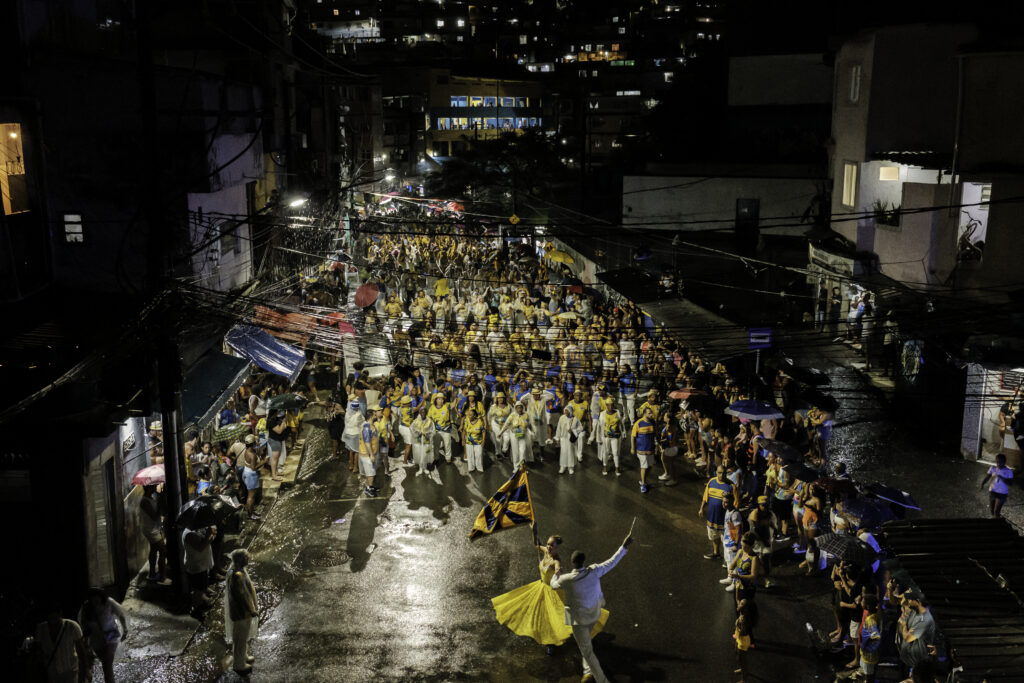
During the Unidos da Tijuca samba school’s final street rehearsal, the Mestre-Sala and Porta-Bandeira wing leads a large group of members through the streets near Favela do Borel, in the Tijuca neighborhood of Rio de Janeiro, Brazil.
Leonardo Carrato

That rainy Sunday was Unidos da Tijuca’s last street rehearsal before the official parade at the Sambadrone, and party dwellers excitedly gathered to watch an intimate preview of what would later earn the school 7th place in the official competition. At 6 PM, onlookers dressed in the colors of Unidos da Tijuca—blue and yellow—waited outside of the school, a tall building painted in yellow. The energy was high as people gathered, and the song composed for this year’s parade played loudly through speakers at the closest bar, along with songs from previous years: “Logun-Edé – Santo Menino que Velho Respeita” (“Logun-Edé – The Holy Child Old Men Respect”) and “O Conto de Fados” (“The Tale of Fairies”). 

As the time for the performance neared, people began singing along to the story of Maria de Jesus, one that mirrors the stories of many Black women in Brazil today. A single mother of three, Maria de Jesus lived in the favela of Canindé in São Paulo, where she spent her time picking up recyclables to sell, taking care of her children, and writing about her day-to-day life. One of her notebooks from this time would eventually become her first best-selling book, Child of the Dark, which sold 10,000 copies in its first week of publication in 1960—an achievement that was unheard of at the time, and still rarely met in Brazil now. 

But the majority of the community was unfamiliar with these details of Maria de Jesus’s life before Unidos da Tijuca chose to tell her story for the 2026 parade. “It’s essential that we talk about a person who has been made invisible by society and by the Brazilian people,” Mariah Dantas, one of the principal dancers, tells The Conversationalist. “Almost nobody remembers her importance, or how impactful she was at the time, and how important she is today. Because many women still live in poverty like she did… This isn’t just about telling Carolina’s story, but also about highlighting that Black women still live like that, and that this needs to change.”

Many of these same women also live in Morro do Borel, and saw themselves reflected in Maria de Jesus’s story for the first time. “It was the perfect choice,” Carlos Batata, member of Unidos da Tijuca and president of Unidos da Tijuquinha, a version of the samba school for children, tells The Conversationalist. “The story was unknown, [but] with time, people got to know more about Carolina’s work, and now people sing the samba song and relate and cry to it, because there are parts of the lyrics—a phrase, a chorus—that represents each woman’s story here.” 
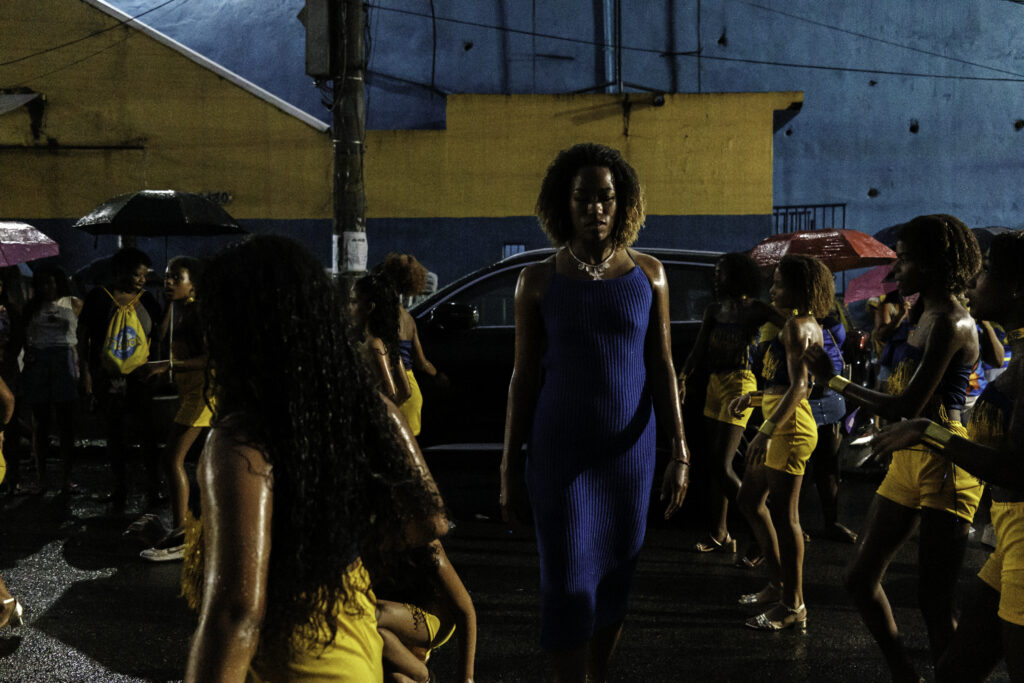
The children’s wing coordinator walks among the members as they prepare for the Unidos da Tijuca samba school’s final street rehearsal through the streets of Favela do Borel, in the Tijuca neighborhood of Rio de Janeiro, Brazil.
Leonardo Carrato

To accurately tell Maria de Jesus’s story, Unidos da Tijuca worked with an academic consultant on everything from the writing of the samba song’s lyrics, the design of thousands of costumes and five floats, and even some of the choreography. (The practice of hiring a consultant is relatively new across samba schools, a union of institutional education and popular education that only began around 10 years ago.) This year, Unidos da Tijuca collaborated with researcher Fernanda Felisberto, a literature professor at the Federal University of Rio de Janeiro, who is a part of an editorial committee that has salvaged, re-edited, and published Maria de Jesus’s work in recent years. 

“For a long time, we used to say that there are histories that traditional schools don’t tell, but that Carnival will tell those histories, almost as if they’re in opposition to each other,” Felisberto says. “But in reality, we are building a process that goes hand-in-hand, especially because hiring consultants has become more and more common for samba schools. So, samba schools today are learning from these traditional sources of knowledge. The challenge for Carnival is to translate that knowledge in a way that reaches more people.” 

The act of performing in community is a large part of this translation, and in Morro do Borel, it is what has brought Maria de Jesus’s story back to life. “Sou a liberdade, mãe do Canindé / Muda essa história, Tijuca / Tira do meu verso a força pra vencer / Reconhece o seu lugar e luta / Esse é o nosso jeito de escrever,” both members of the samba school and party dwellers alike screamed at the top of their lungs during the street rehearsal. (“I am freedom, mother of Canindé / Change our history, Tijuca / Get the strength to win from my verses / Recognize your place in struggle / This is our way of writing.”)
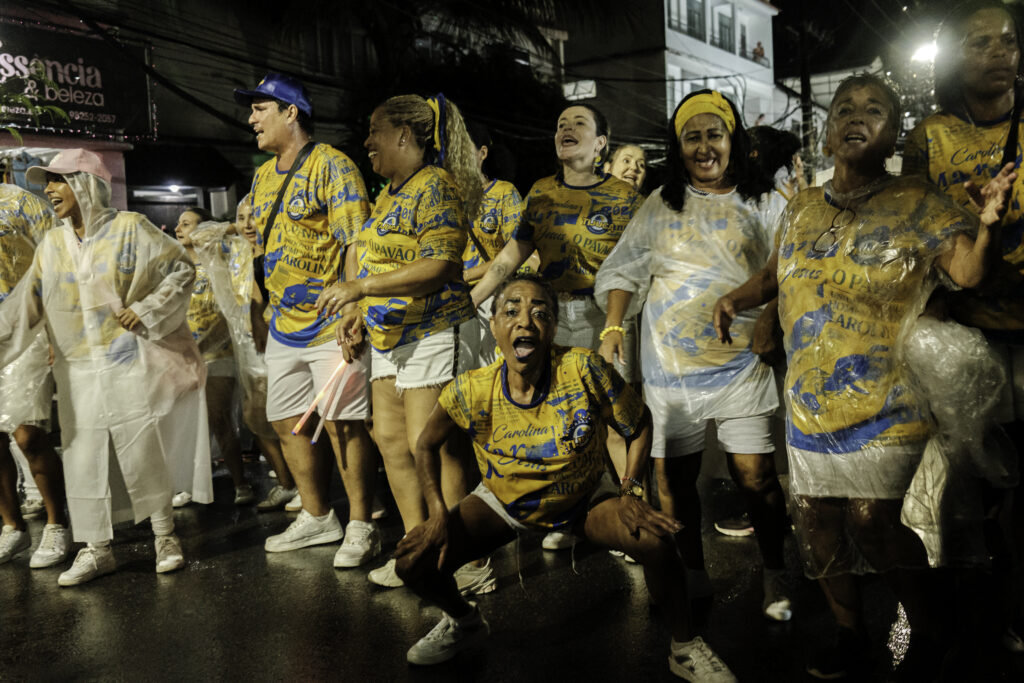
Under heavy rain, members of one of the wings of the Unidos da Tijuca samba school parade through the neighborhood streets near Favela do Borel during the final rehearsal before Carnival in the city of Rio de Janeiro, Brazil.
Leonardo Carrato

For this year’s parade, Felisberto says the school intentionally focused on lesser known works by Maria de Jesus, like the music she composed and recorded, and the plays she wrote, which remain unreleased to the public. They hoped to show Maria de Jesus was more than her biggest successes, in part so that she is recognized for the breadth of her creative work, which never got as much exposure as her first book. “We want people to understand that Carolina was a multidimensional artist,” Felisberto says. “Child of the Dark constructed an image of Carolina that spotlighted precarity, which is how people see her today. The challenge was to humanize her, show her failures and successes beyond a narrative around her best-selling memoir.” 

Like Felisberto, many view the Carnival parades not just as a celebration marginalized histories, but as a collective experience with a lasting impact. “I consider samba songs by samba schools to be historical documents,” Simas says, adding that in his 30 years working as a history teacher in public schools in Rio, he has used samba songs as pedagogical sources. “It’s a tool to start debates, we can analyze the lyrics, study the trajectory of some historical characters who are less talked about in formal education.” 

For Unidos da Tijuca member Douglas Coutinho, studying samba songs even helped him to pass his university entry exams. “My history teacher used the samba song from 2008, ‘João e Marias’ by Imperatriz Leopoldinense, [in class],” Coutinho says. “The samba song helps teachers teach, and it helps students understand the material that is being taught.”
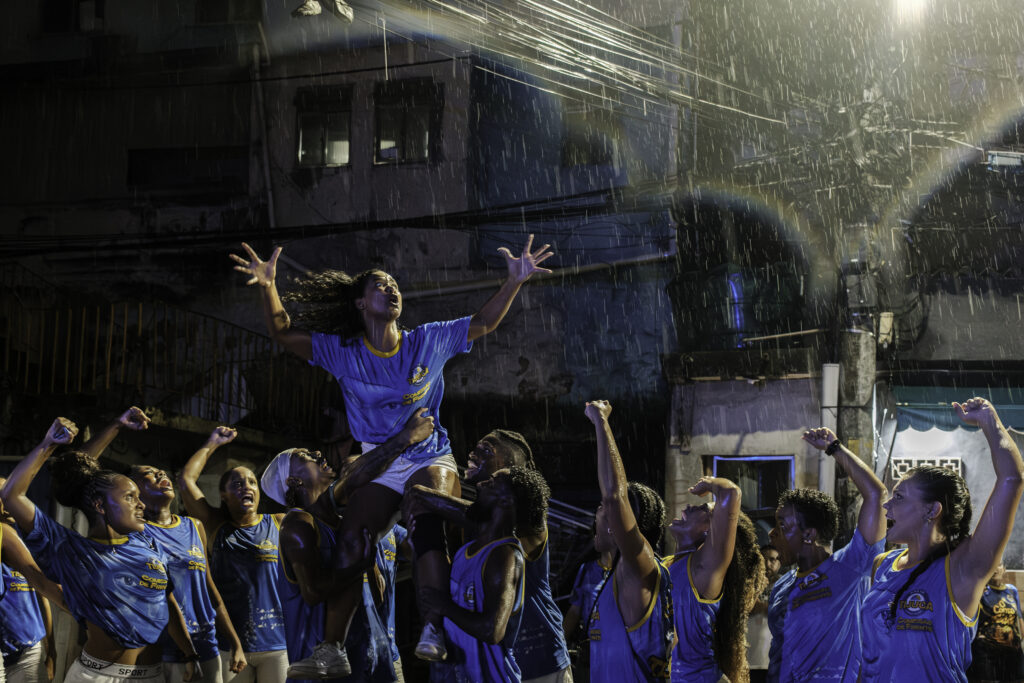
During a street rehearsal by the Unidos da Tijuca samba school, and under heavy rain, the opening performance group performs one of its choreographies from the storyline honoring writer Carolina Maria de Jesus near Favela do Borel, in the Tijuca neighborhood of Rio de Janeiro, Brazil.
Leonardo Carrato

Perhaps most importantly, in telling and preserving these stories through samba parades, communities are able to reclaim the narrative from the dominant classes, which tend to dismiss or downplay the importance of marginalized histories. Sometimes, it also allows these stories to become the dominant narratives—at least, during Carnival, when the media’s attention turns to the communities these samba schools represent. 

“Samba schools will tell us stories that are important for the people,” says Iara Cassano, a member of Acadêmicos do Salgueiro and a samba teacher. “The dominant narratives will tell histories that are important to the elites… Carnival gives us autonomy to tell our own histories.”