How committing to a weekly neighborhood potluck has both fed and strengthened my community.
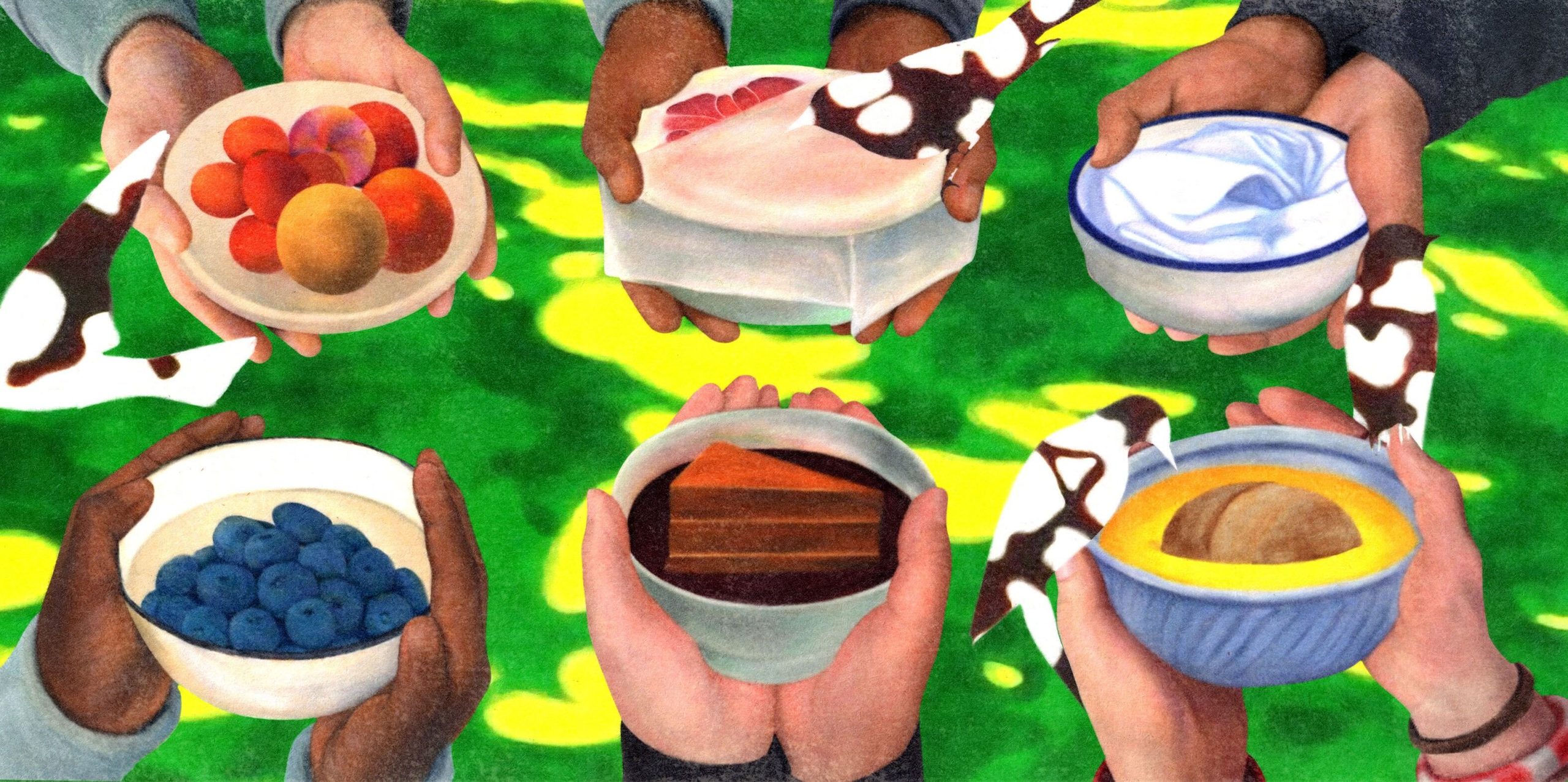
There’s a certain serendipity that happens at a potluck. Foods that have never mingled together find themselves side by side: jambalaya in a crockpot, a cardboard pizza box, a plastic tub of Trader Joe’s hummus, a platter of gluten-free brownies. None of it really makes sense when scooped together onto a plate, but all of the flavors blend like fast friends—and if you’re lucky, oftentimes, the people do, too.
It’s another Monday night, which for me, means another neighborhood potluck. Every week, a group of us meets in the same grassy area by the bay in our neighborhood outside of Providence, Rhode Island. This week, I brought a pesto pasta salad with random veggies I found in our fridge; last week, it was leftover ribs my husband made over the weekend; the week before, a bag of chips and salsa. As we set up shop on a foldout table, I can see the curious faces of people driving and biking by, wondering what the heck is going on. But for us, it’s just another Monday night. People start trickling in around 5:30pm and stay until the sun goes down. We catch up on each other’s lives, and watch the kids run around while helping ourselves to a second plate. Then, we pack up our things and say our goodbyes, knowing we’ll see each other again next week.
While these gatherings now feel like a staple in my life, I first learned the magic of weekly potlucks a few years ago, in my old neighborhood in New Orleans, Louisiana. It was 2022, and we were still feeling a bit socially raw, fresh out of our Covid bubbles. A neighbor friend started a group text, inviting us to gather every Monday at the playground for a whatever-you-have-lying-around potluck dinner and a good hang.
At first, the weekly cadence sounded like… a lot. Weekly? Really? Could my social battery handle it?
Yet after the first few months, it started feeling like an important ritual, and after the first year, it felt like a sacred space. The regular cadence was key. It allowed us to check in on each other and get to know our week-to-week rhythms. I could ask how Jen’s doctor’s appointment went last week, or if Joel had recipe-tested the chicken and dumplings he was planning for his upcoming popup restaurant. When I wanted someone to be my accountability-buddy to do that yoga class I kept swearing I’d do, I could ask if anyone else had been looking for an accountability-buddy, too. And with the standing weekly gatherings, all of this could happen in an intentional way, our commitment to a weekly meal slowly blossoming into something more.
After spending a couple of years social-distancing and mostly avoiding group gatherings, our neighborhood potlucks also felt like a joyful and much-needed form of social fitness, something scientifically proven to be just as important to our well-being as physical exercise. Maybe you’ve heard of Harvard’s 85-year happiness study? It started in 1938 and followed 724 participants from their teens to old age. The participants regularly answered questions about their health and habits, their income and relationships, their joys and disappointments. The study also incorporated insights from their spouses and 1,300 of their descendants.
What did the study find to be the most important factor in determining a long and happy life? Strong, supportive relationships. Not cholesterol levels, or how many kettlebells you’ve lifted (although those things are important, too!)—but genuine human connection. It was a stronger indicator for happiness than even genetic predispositions, social class, or IQ.
This was also precisely what many of us were so starved for back in 2022. As the weeks went by, it felt like we had cracked the code to maintaining a genuine closeness with our neighbors. I also realized it wasn’t just the shared meal that was feeding us and allowing for deeper relationships to grow: It was our commitment to having it in the first place.
In New Orleans, I experienced the fruits of this firsthand. A group of us kept showing up, kept checking in on each other, kept extending the invite to other neighbor friends, and kept feeling the goodness of our Monday merriment spilling into the rest of the week. It was something to look forward to, something that consistently got our weeks started on a hopeful note. The Sunday scaries felt almost cured by the Monday potluck magic.
It was also a weekly reminder that, no matter what else was happening in the world, we were all still here, still showing up, and still feeding each other—with food, with friendship, with community, with care.
This commitment never felt burdensome, but instead, like a newfound necessity. In the age of TikToking your way down the street and scrolling in bed until you fall asleep, people are overconnected but undercommitted. Relationships, however, are built on commitment—and at least according to the Harvard study’s findings, that means our happiness is built on commitment, too. It’s a muscle to exercise like any other, and when we allow it to atrophy, our communities tend to suffer. But when we put the effort into consistently exercising it, our relationships and our communities begin to bloom.
It still impresses me that we managed to meet up every week for over a year, even with small kids and busy jobs and all the rest. I believe a big part of this was probably the fact that we met in a public space (the neighborhood playground), that was walking distance for all of us (no driving required), which also meant that nobody had to host (no need to clean your house).
The not-hosting part felt especially important. Nobody had to stress about people coming over and nobody had to deal with washing the dishes since we BYO’d our own plates and cutlery. We also never felt the pressure to bring anything fancy, a rule we established early on. One week it might be a bag of chips and the next it might be leftover birthday cake and maybe the next it would be homemade enchiladas if you had a little more time to cook. It all evens out in the potluck wash. And when everyone brings something, everyone leaves full.
When I moved to Rhode Island in 2024, I knew I had to keep my potluck muscles active in order to keep this little bit of magic alive, too.
I started a Whatsapp group and kept adding new neighbor friends to join as I met them. I scheduled the first potluck as a test run, just a couple months after we’d moved into our house. Given the big turnout (close to 40 people), I knew it could be a regular thing, so we started it up in earnest in the summer when the weather was more reliably outdoor-friendly. My husband and I began sending out a reminder on Monday mornings. And for the regular crew that started showing up each week, and telling other people to join, the potluck magic alchemized just as it had in New Orleans. I felt especially proud when I started seeing people I didn’t recognize who had heard about it through the neighborhood grapevine.
Every Monday, we’d arrive at the park with our foldout table and gingham tablecloth (adding a tablecloth instantly makes any gathering feel more special). For a quick second, I’d worry that nobody would show up. I’d feel a bit self-conscious, then I’d remember that even if nobody came, I’d still be outside eating with my family, which is a gift on its own.
I wouldn’t take it personally if people couldn’t make it (although a younger version of myself probably would have). But sure enough, people always did, and a mishmash of dishes would start appearing on the table. Hot dogs and mini quiche? Sure, why not! Barbecue ribs and a mountain of edamame? I mean, yeah, let’s do this! The neighborhood kids would run around on the grass and inevitably start piling on top of each other, like a Polaroid snapshot from 1995. No iPads or AI or any other tech-y shenanigans. Just some good ole wholesome potluck fun.
After a full summer of weekly potlucks, however, it became clear that one major difference between New Orleans and New England is, well, winter. In New Orleans, we could keep the weekly cadence humming along for most of the year. The summer heat and storm season did force some cancelations, but in Rhode Island, the days started growing dark by 6 p.m. and it was puffy coat season by Halloween, so we had to “close for the season” in October.
“I really miss our Monday potlucks,” neighbor friends have told me recently. Some have even offered to host in their homes, but this feels like breaking a key tenet. Removing the hosting pressure is a big part of what keeps our potlucks running so smoothly and solidly, so inclusively and so stress-freely.
While I know it’ll come back in full force once the weather warms up and the sunlight stretches back into dinner hours, I can still feel my potluck muscle craving exercise. We’ve been looking into community spaces that might be willing to host us during the winter, such as the library or the masonic center a few blocks away. Or the old-school bowling alley, which has some tables in the back. We’ve also been brainstorming other ways to stay connected during the colder, darker months. Perhaps a weekly walking club around the neighborhood? Or a soup swap (like a cookie swap, but for soup)?
But I also know that rest is important when it comes to exercise, too. And it’s during this wintry off-season that I’m discovering how much the seedlings of our summer potluck friendships have sprouted. People are still texting each other to check in, still asking each other for HVAC repair advice and babysitter recommendations. And thankfully I still have my accountability buddy checking in on how we might move our bodies this winter — she just suggested a 30-day “gentle burn workout” with short daily videos, asking if we could text each other once we’ve finished each as motivation and a healthy bit of peer pressure.
A potluck, of course, isn’t the only way to nurture and maintain our relationships, but it’s one that’s made me feel particularly hopeful. Commitment begets commitment, and makes the muscle stronger, something we can feel even when it’s not in use.
Bringing people together on a regular basis is also a reminder that small rituals can add up to something much bigger. In the months since our last potluck, our Providence community has been deeply hurting following the horrific mass shooting that took place at Brown University in December. We’ve been checking in on our neighbors, and feeling a wide range of emotions: grief, sadness, anger, anxiety, and heartbreak. But as we continue to grieve, our commitment to holding space for each other gives me hope that we’ll live another day, and share another meal, and continue to show up for each other, again and again.